
英飞凌

Search documents
【太平洋科技-每日观点&资讯】(2026-01-19)
远峰电子· 2026-01-18 11:38
Market Overview - The major indices showed mixed performance with the STAR Market 50 index rising by 1.35% and the Shanghai Composite Index declining by 0.26% [1] - The TMT sector led the gains, particularly in semiconductor packaging and testing, which rose by 9.61% [1] Domestic News - The passive components giant Yageo announced a price increase of 15% to 20% on certain resistor products effective from February 1 [2] - Powerchip Semiconductor Manufacturing Corporation confirmed a deal with Micron to sell its P5 factory for $1.8 billion (approximately 12.5 billion RMB), establishing a long-term partnership for advanced DRAM processes [2] - Siwei Technology plans to invest 1 billion RMB in a wafer manufacturing and testing facility, with phase one expected to cost 300 million RMB from 2026 to 2028 [2] - BOE Technology Group signed a strategic cooperation agreement with Huacan and Xinxiangwei to develop Micro LED interconnect technology and production for AR smart glasses and intelligent car lights [2] Overseas News - The U.S. Department of Commerce announced a trade agreement with Taiwan, requiring Taiwanese chip and tech companies to invest at least $250 billion in capacity building [3] - Infineon launched a new product series, AIROC™ ACW741x, integrating Wi-Fi 7 and Bluetooth® LE 6.0 technologies [3] - Micron Technology broke ground on a new super fab in New York, with a total investment of $100 billion aimed at producing advanced memory products [3] AI Insights - Black Forrest Labs introduced the FLUX.2 model, capable of generating high-quality images in under one second [4] - Tsinghua University and others released a 40 billion parameter AI model, Agent CPM Explore, showcasing significant potential in energy efficiency [4] - Nanjing Agricultural University launched the first open-source vertical language model for agriculture, aimed at reducing the application barrier for AI in the sector [4] Industry Tracking - China's first serial high-energy hydrogen ion implanter was successfully developed by the China National Nuclear Corporation [5] - Hydrogen Smart's solar cell production line project passed high-standard acceptance, with some clients achieving over 20% efficiency in per square meter solar cells [5] Earnings Forecast - Lanke Technology expects a net profit of 2.15 to 2.35 billion RMB for 2025, representing a year-on-year growth of 52.29% to 66.46% [6] - Cambridge Technology anticipates a net profit of 252 to 278 million RMB for 2025, with a growth rate of 51.19% to 66.79% [6] - Awei Electronics forecasts a net profit of 300 to 330 million RMB for 2025, reflecting a growth of 17.70% to 29.47% [6] - Shenghong Technology projects a net profit of 4.16 to 4.56 billion RMB for 2025, indicating a significant growth of 260.35% to 295.00% [6]


二十年走出大西北,紫光国芯冲刺IPO
Tai Mei Ti A P P· 2026-01-16 03:54
文 | 产联社CLS,作者 | 初一 继紫光股份(000938.SZ)紫光国微(002049.SZ)后,新紫光集团将迎来又一家半导体上市企业。 近日,陕西证监局披露了西安紫光国芯半导体股份有限公司(下称:紫光国芯)完成上市辅导的备案信 息。这家从一个外资研发部门成长为国内存储芯片领域的重要企业,正式启动IPO进程。 这一路,走过了二十余年。 脱胎于外资技术体系、历经多次资本重组与本土化整合,紫光国芯正凭借DRAM赛道火热的东风以及领 先的国产DRAM芯片设计技术,加速向资本市场迈进。 从外资技术分支到本土产业支柱 紫光国芯的起源要追溯到二十余年前。2004年,德国半导体企业英飞凌在西安设立研发中心的存储事业 部,专注于存储器研发,成为了紫光国芯的技术源头。 2006年,该部门分拆成为独立的奇梦达科技西安有限公司,首次以独立实体身份运营,继续开展存储器 设计与研发业务。 2009年全球半导体产业格局调整浪潮中,奇梦达科技被浪潮集团收购,转制成为国内公司并更名为西安 华芯半导体有限公司,自此从外资企业转变为本土企业,开启了本土化发展进程。 紫光国芯真正融入中国半导体产业体系的关键节点在2015年,紫光集团旗下紫光 ...
这一芯片问题,不容忽视!
半导体行业观察· 2026-01-10 03:37
Core Viewpoint - The article discusses the increasing complexity and challenges of end-to-end security in semiconductor manufacturing, particularly with the rise of multi-chip packaging and edge computing, which complicates supply chain tracking and security measures [1][2][3]. Group 1: Challenges in Multi-Chip Packaging - Multi-chip packaging enhances performance but complicates supply chain tracking, as components may come from different manufacturers [1]. - The aging of chipsets under different workloads can introduce unforeseen vulnerabilities, especially with new components developed using advanced nodes like 3nm [1]. - The fragmentation of chip production among various suppliers increases complexity, making it difficult to ensure compatibility and security across the supply chain [2]. Group 2: Security Measures and Standards - There is a need for comprehensive security measures throughout the supply chain, from chip manufacturing to final product deployment, to mitigate risks associated with malicious chips [3][4]. - The introduction of the EU's Cyber Resilience Act (CRA) mandates companies to assess their security vulnerabilities and supply chain risks, pushing for a more standardized approach to security [5]. - Companies are encouraged to embed unique identifiers in chips to enhance traceability and security [4][5]. Group 3: Long-Term Security Considerations - The longevity of products necessitates ongoing assessments of potential security vulnerabilities that may arise over time [9][10]. - The automotive industry exemplifies the need for long-term security planning, as vehicles may have lifespans of up to 40 years, requiring continuous updates and risk assessments [10]. - Quantum computing poses a future threat to existing encryption methods, necessitating proactive measures during the design phase [9][10]. Group 4: Role of Artificial Intelligence - AI can be utilized to identify security vulnerabilities that are difficult for humans to detect, enhancing the overall security of systems [11]. - However, AI systems themselves require strict controls to prevent independent communication that could compromise security [11][12]. - The development of unified standards for AI in security is still in progress, with organizations working towards establishing comprehensive guidelines [12]. Group 5: Conclusion on Security Landscape - Security has transitioned from a secondary consideration to a primary focus across all stages of electronic system development, with companies facing significant penalties for neglecting security [12]. - Achieving true end-to-end security remains uncertain, but the motivation for companies to pursue it has increased alongside the challenges they face [12].
全球都在抢建芯片工厂
半导体行业观察· 2026-01-08 02:13
Core Insights - The semiconductor industry is experiencing a significant push towards localization, with numerous companies planning to build factories by 2025 to meet the rising demand for advanced technologies such as AI chips and advanced memory [1] - Investment sources include both industry and government, focusing on addressing current technological challenges and expanding capabilities in various sectors [1] Regional Developments Asia - TSMC is constructing six new fabs and advanced packaging plants in Taiwan, while ASE is investing $578.6 million in Kaohsiung for an advanced packaging facility [2] - SK Hynix's total investment in the Yongin industrial cluster may reach 600 trillion KRW (approximately $407 billion) [2] - Micron is building an advanced memory manufacturing plant in Japan with government support, and Rapidus has completed a prototype of a 2nm GAA process [2] - India has approved four new fabs, including SicSem's facility in Odisha [2] Europe - The EU launched five pilot production lines under the Chips Act, targeting 2nm, advanced packaging, and photonics [3] - The Czech semiconductor center received €450 million in funding for ON Semiconductor's SiC power device factory [3] - Germany is providing significant financial support for Infineon's and GlobalFoundries' factory expansions in Dresden [3] - imec has opened an automotive chip center in Heilbronn, Germany, and launched an advanced chip design accelerator project [3] Americas - TSMC has increased its investment in the U.S. to $100 billion, while Apple is investing $500 billion and GlobalFoundries $16 billion [4] - Micron plans to invest an additional $30 billion in U.S. fabs, including new facilities in Idaho and Virginia [4] - Texas Instruments has opened a new advanced 300mm fab in Sherman, Texas, as part of a $60 billion investment plan [4] Challenges and Uncertainties - Several companies, including NXP and Intel, are facing challenges with factory closures and project cancellations due to market volatility [5] - The uncertainty surrounding the U.S. Chips Act and its implications for funding and investment strategies is causing concern among industry leaders [6][7] Material and Energy Concerns - The semiconductor industry is facing strategic challenges related to the supply of rare earth materials, emphasizing the need for diversification and domestic resource development [10] - The energy consumption of AI server clusters is rising, with projections indicating that it could account for 7% of global electricity demand by 2025 [11] Future Outlook - The semiconductor industry is poised for growth driven by advancements in AI, quantum technology, and robotics, with significant potential in healthcare and elder care applications [15] - The industry is expected to see substantial investments in new facilities and fabs, reflecting ongoing adjustments to previously announced plans [16]


天华新能:新能源锂电材料产品包括电池级氢氧化锂、碳酸锂产品
Zheng Quan Ri Bao Wang· 2026-01-07 13:43
Group 1 - The company Tianhua New Energy (300390) produces lithium battery materials, including battery-grade lithium hydroxide and lithium carbonate, primarily used in electric vehicle batteries, communication electronic power devices, and energy storage [1] - The company's anti-static ultra-clean technology products serve various industries, including semiconductor, storage, new display, communication, biomedicine, and precision manufacturing, providing essential cleanroom engineering design and production process static and micro-pollution protection [1] - Major clients of the company include AMD, Micron, Infineon, SMIC, Seagate, Western Digital, SAE, Great Wall Development, Sharp, Samsung, LGD, BOE, Huaxing Optoelectronics, and Tianma Microelectronics [1] Group 2 - The company also offers medical device products such as syringe-type/high-pressure injectors, self-destructing and safety syringes, as well as CT contrast injectors, medical CT tubes, and pulsed therapy devices [1]

今年CES,芯片厂商又开始“神仙打架”
3 6 Ke· 2026-01-07 00:42
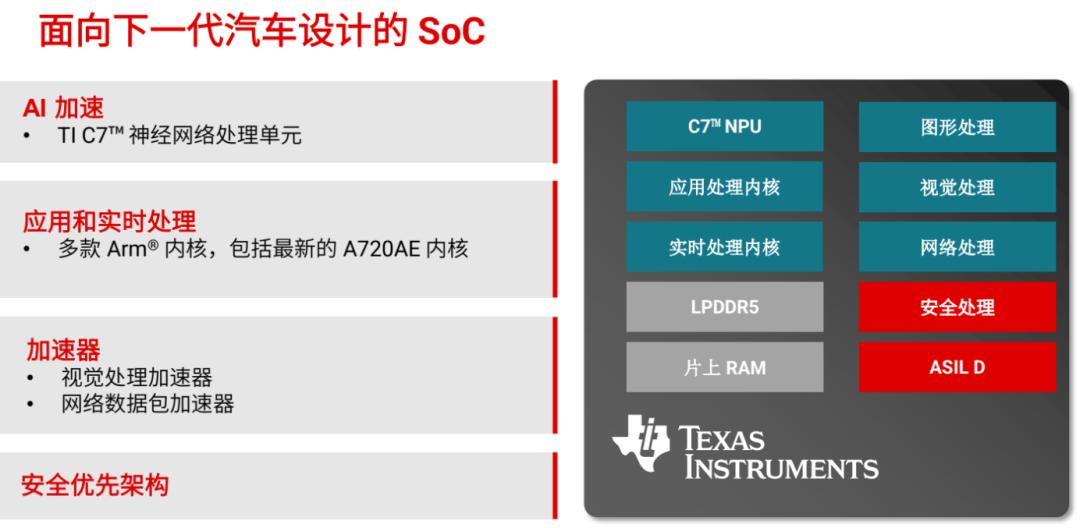
Group 1: TI's Automotive Innovations - TI launched three powerful automotive products at CES: the TDA5 series SoC, AWR2188 radar transmitter, and DP83TD555J-Q1 Ethernet PHY [1][4][7] - The TDA5 SoC features a maximum performance of 1200 TOPS and an energy efficiency of over 24 TOPS/W, with a 12-fold increase in AI computing power compared to previous generations [1] - AWR2188 is the industry's first single-chip 8x8 radar solution, enhancing performance by 30% and achieving high-precision detection for targets over 350m [4] - The DP83TD555J-Q1 Ethernet PHY supports nanosecond-level time synchronization and can transmit power and data over the same line, reducing cable design complexity and costs [7] Group 2: ADI's Diverse Solutions - ADI showcased various solutions in automotive, consumer, and robotics sectors, highlighting the A²B 2.0 solution with four times the bandwidth of its predecessor [10] - The automotive solutions include advanced lighting control and ADAS systems utilizing machine vision inputs [10][11] Group 3: NXP's High-Integration Processor - NXP introduced the S32N7 processor series, which integrates multiple vehicle functions on a single chip, potentially reducing total cost of ownership (TCO) by up to 20% [12][15] Group 4: Microchip's Demonstrations - Microchip presented demos including the ASA Motion Link for Qualcomm's Ride platform and a software-free intelligent headlight system using 10BASE-T1S technology [17][18] Group 5: Silicon Labs' New SDK - Silicon Labs launched a new Simplicity SDK for Zephyr, enhancing support for embedded systems and showcasing advancements in Bluetooth wireless technology [19] Group 6: Infineon's Development Kit - Infineon and Flex unveiled a modular development kit for regional control units, aimed at accelerating the development of software-defined vehicle architectures [20] Group 7: ST's Automotive Gateway - ST displayed the Osdyne Automotive Gateway, which enhances vehicle communication and security while reducing wiring complexity [22] Group 8: Ambarella's AI Vision Chip - Ambarella released the CV7 AI vision SoC, built on a 4nm process, achieving over 20% power reduction and more than 2.5 times the AI performance of its predecessor [25] Group 9: NVIDIA's Revolutionary Products - NVIDIA introduced the Rubin platform with six new chips and launched the Alpamayo series for AI-assisted driving development [26][28] Group 10: AMD's AI Innovations - AMD announced several new products, including the MI455X GPU and Ryzen AI 400 series processors, emphasizing its comprehensive AI capabilities [29][30] Group 11: Arm's Technology Trends - Arm focused on five key technology trends at CES, including advancements in autonomous driving, robotics, and smart home devices [31][32] Group 12: Industry Trends - The CES highlighted three major trends: the penetration of AI across all technology layers, the shift towards centralized and software-defined automotive electronics, and the importance of ecosystem collaboration over isolated technology competition [33]



【太平洋科技-每日观点&资讯】(2026-01-05)
远峰电子· 2026-01-04 13:26
Market Overview - The major indices showed mixed performance with the Shanghai Composite Index up by 0.09%, while the Shenzhen Component, North 50, Sci-Tech 50, and ChiNext Index decreased by 0.58%, 0.70%, 1.15%, and 1.23% respectively [1] - The TMT sector led the gains with SW Marketing Agency up by 7.84%, followed by SW Military Electronics III at 3.09% and SW Horizontal General Software at 2.18% [1] - Conversely, the TMT sector also saw declines, with SW Communication Network Equipment and Devices down by 2.35%, SW Digital Chip Design down by 2.03%, and SW Printed Circuit Board down by 1.80% [1] Domestic News - ASUS issued a price adjustment notice for certain product lines starting January 5, 2026, due to structural fluctuations in the global supply chain and rising costs of key components, particularly DRAM, NAND, and SSD [2] - Ankai Micro announced that its chips and solutions cover mainstream categories such as AI audio glasses, AI photography glasses, and AI display/projector glasses, supporting core functions like video, audio, and wireless connectivity [2] - Xitai Technology's 12-inch silicon-based OLED micro-display industrial park project has topped out, with a designed monthly capacity of 6K wafers, expected to achieve product lighting by the end of 2026 and mass production in Q2 2027 [2] - The Zhuzhou low and medium voltage power device industrialization project has officially commenced, with a total investment of 5.3 billion yuan, expected to add an annual production capacity of 360,000 silicon carbide power devices [2] Overseas News - AMS Osram announced the launch of the AS1181 LED driver chip solution, designed with human eye safety as a core principle, featuring eight independently configurable channels and programmable LED currents up to 66mA [3] - SK Hynix is discussing plans to build a 2.5D manufacturing line at its new packaging factory in Lafayette, Indiana, which will be its first production base in the U.S., aimed at becoming a cutting-edge packaging production base for AI memory by the second half of 2028 [3] - Infineon released the second generation of CoolSiC™ MOSFETs rated at 400V and 440V, targeting applications in AI server power supplies, switch-mode power supplies, motor control, renewable energy, and energy storage systems [3] - Due to limited economic recovery and conservative consumer behavior, the rising prices of memory are continuing to erode the profitability and pricing flexibility of laptop brands, leading to a downward revision of the global laptop shipment forecast for 2026 to a decrease of 5.4%, down to nearly 173 million units [3] AI News - Tencent's Mix Yuan has released an open-source model for 3D human motion generation with one billion parameters, significantly surpassing existing benchmarks in instruction-following capability and motion quality [4] - Fudan University revealed a mechanism aligning neural representations of large language models with human brain functions, predicting model performance in understanding and reasoning tasks [4] - The latest "AA Intelligence Index" ranked China's self-developed GLM-4.7 model first among open-source models with a score of 68, enhancing coding ability and long-range task planning [4] - Tencent's Mix Yuan has also released version 1.5 of its translation model, supporting direct deployment on consumer devices with only 1GB of memory required for smooth operation [4] Industry Tracking - The world's first small-sized humanoid robot with full-body force control, Qiyuan Q1, has been officially launched by Weiqi New Materials, standing at approximately 0.8 meters tall and capable of being stored in a backpack [5] - The Zhongtai Polyester Company has completed the main structure of its 250,000-ton direct-spun polyester filament project, which will significantly enhance its production capacity and market competitiveness [5] - The first domestically produced X-ray photoelectron spectrometer, the Jingwei 100 series, has been delivered, featuring an automated high-efficiency ion source for in-depth analysis [5] - The Anhui Quantum Information Engineering Technology Research Center announced the delivery of China's first superconducting quantum computing measurement and control system designed for a thousand-bit scale [5] High-Frequency Data Updates - The international DRAM spot prices as of December 31 showed various fluctuations, with DDR5 16G (2G×8) averaging $29.329, reflecting a 2.62% increase [6] - Semiconductor material prices from Baichuan Yingfu as of December 31 indicated stable pricing across various categories, with 4N zinc oxide powder priced at 1,445 yuan per kilogram [6]
MCU巨头,全部明牌
半导体行业观察· 2026-01-01 01:26
Core Viewpoint - The embedded computing world is undergoing a transformation where AI is reshaping the architecture of MCUs, moving from traditional designs to those that natively support AI workloads while maintaining reliability and low power consumption [2][5]. Group 1: MCU Evolution - The integration of NPU in MCUs is driven by the need for real-time control and stability in embedded systems, particularly in industrial and automotive applications [3][4]. - NPU allows for "compute isolation," enabling AI inference to run independently from the main control tasks, thus preserving real-time performance [3][5]. - Current edge AI applications typically utilize lightweight neural network models, making hundreds of GOPS sufficient for processing, which contrasts with the high TOPS requirements in mobile and server environments [5]. Group 2: Major MCU Players' Strategies - TI focuses on deep integration of NPU capabilities in real-time control applications, enhancing safety and reliability in industrial and automotive scenarios [7][8]. - Infineon leverages the Arm ecosystem to create a low-power AI MCU platform, aiming to reduce development barriers for edge AI applications across various sectors [9][10]. - NXP emphasizes hardware scalability and a full-stack software approach with its eIQ Neutron NPU, targeting diverse neural network models while ensuring low power and real-time response [11][12]. - ST aims for high-performance edge visual applications with its self-developed NPU, pushing the boundaries of traditional MCU AI capabilities [13][14]. - Renesas combines high-performance cores with dedicated NPU and security features, focusing on reliable edge AIoT applications [15][16]. Group 3: New Storage Technologies - The introduction of NPU in MCUs necessitates a shift from traditional Flash storage to new storage technologies that can handle the demands of AI workloads and frequent updates [17][18]. - New storage solutions like MRAM, RRAM, PCM, and FRAM are emerging to address the limitations of Flash, offering advantages in reliability, speed, and endurance [21][22][25][28][30]. - MRAM is particularly suited for automotive and industrial applications due to its high reliability and endurance, with companies like NXP and Renesas leading in its adoption [22][23][24]. - RRAM offers benefits in speed and flexibility, making it a strong candidate for AI applications, with Infineon actively promoting its integration into next-generation MCUs [25][26][27]. - PCM provides high storage density and efficiency, suitable for complex embedded systems, with ST advocating for its use in advanced MCU designs [28][29]. Group 4: Future Implications - The dominance of Flash storage is being challenged as new storage technologies demonstrate superior performance and reliability for embedded systems [33]. - The integration of NPU and new storage technologies in MCUs represents a shift towards system-level optimization, enhancing overall performance and efficiency [33]. - The transformation in the MCU market presents structural opportunities for domestic manufacturers to innovate and compete against established international players [33].


第2个抢劫中国资产的国家出现,中国企业退出,整个欧洲信誉破产
Sou Hu Cai Jing· 2025-12-31 13:18
Group 1 - The Netherlands and the UK are taking actions against Chinese investments in semiconductor companies, citing "national security" concerns, which undermines the credibility of European nations [2][4] - Nexperia, a subsidiary of Wingtech Technology, was acquired by Chinese capital in 2019, leading to significant improvements in its financial performance, with revenue projected to reach €284 million by 2024 [2] - The Dutch government issued an administrative order on September 30, 2025, to freeze Chinese control over Nexperia, causing disruptions in the global supply chain, particularly in the automotive sector [2][6] Group 2 - In 2021, China Jian Guang Asset acquired 80.2% of UK-based FTDI for $414 million, turning around its financial situation within a year, with net profit rising to $13.03 million and a gross margin exceeding 70% [4][6] - The UK government ordered Jian Guang Asset to divest its shares in FTDI by November 5, 2024, again citing national security as the reason [4][6] - The actions taken by the UK and the Netherlands reflect a broader trend of Western nations reacting to Chinese investments in the semiconductor sector, leading to a decline in Chinese investments in Europe [8][10] Group 3 - The U.S. Department of Commerce added Jian Guang Asset, Wingtech Technology, and Zhilu Capital to its entity list on December 5, 2024, restricting technology exports to these companies [6] - The European economy is already facing challenges, with a projected GDP growth of only 1.1% in spring 2025, which was later adjusted to 1.4% in autumn, indicating ongoing economic uncertainty [8][10] - The tightening of foreign investment rules in Europe, particularly against Chinese companies, is expected to harm local economies and innovation, leading to increased unemployment and a decline in investment activity [10]


北京君正:公司SRAM主要用于车规、工业和医疗等市场
Zheng Quan Ri Bao Wang· 2025-12-30 11:12
Core Viewpoint - Beijing Junzheng (300223) has indicated that its SRAM products are primarily used in automotive, industrial, and medical markets, and these products can replace offerings from Renesas and Infineon [1] Group 1 - The company’s SRAM is targeted at automotive applications [1] - The company’s SRAM is also utilized in industrial markets [1] - The company’s SRAM finds applications in the medical sector [1] Group 2 - The products are positioned as alternatives to those from Renesas [1] - The products are positioned as alternatives to those from Infineon [1]
