蔚来

Search documents
七家车企抢先亮出2026年销量目标,最低同比涨幅为14%
Xin Lang Cai Jing· 2026-01-08 16:45
与上述三家的强势表现不同,奇瑞、长城、蔚来2025年未能完成年度销量目标,其目标设定更趋于理 性。奇瑞2025年实际销量280.64万辆,虽然创下历史新高,但距离326万辆的年度目标仍有差距,完成 率86.1%。基于市场判断,奇瑞将2026年目标微调至320万辆,同比增幅14%,在保持稳健的同时,计划 通过加大新能源和智能化投入缩小差距。 长城汽车2025年实际销量132.37万辆,仅完成原定400万辆目标的33.1%。2026年,长城将目标设定为不 低于180万辆,同比增幅36%。 蔚来汽车2025年交付32.6万辆,未达成44万辆的年度目标。尽管全年亏损额度收窄,但盈利压力仍在。 2026年,蔚来提出45.6万-48.9万辆的区间目标,对应同比增幅40%-50%。迈入"百万俱乐部"后,蔚来将 通过新品迭代与效率提升实现规模与利润的双重突破。 展望2026,乘联会秘书长崔东树称,2025年乘用车行业市场秩序明显改善。2026年将延续2025年的政策 基调,继续实施更加积极的财政政策和适度宽松的货币政策,叠加国家补贴实施得早,效果会很突出。 他预计,车市1月将实现"开门红"。 事实上,在抢先公布2026年销量 ...
凯迪股份20260108
2026-01-08 16:02
Summary of Key Points from the Conference Call of Kaidi Co., Ltd. Company Overview - Kaidi Co., Ltd. focuses on linear drive systems, with product lines covering electric home appliances, height-adjustable desks, medical care equipment, and electric tailgates for vehicles, showcasing strong market competitiveness and deep technological accumulation [2][3][4] Core Industry Insights - The company performed exceptionally well during the pandemic, but has seen a decline in revenue and profit in recent years due to economic slowdowns in Europe and North America [2][5] - Increased market competition has led to a decrease in gross margins, although these margins are stabilizing and expected to recover as overseas production capacity is gradually utilized [2][5][6] Market Potential - The electric tailgate market is projected to experience explosive growth, with an expected global market size of $3 billion by 2030 and a compound annual growth rate (CAGR) of 80% [2][10] - The global new drive market is approximately $10 billion, with a CAGR of about 3%, while China's growth rate is close to 7% to 8% [2][7] - The electric height-adjustable desk market is anticipated to grow from $50 billion to $100 billion between 2024 and 2032, with a CAGR of 13%, and nearly 20% in China [2][8] Product Structure and Revenue - Major products include electric home appliances and height-adjustable desks, with a significant portion of revenue derived from overseas markets [2][6] - The company has established local production in North America to attract high-quality customers [6] Robotics and Technological Development - Kaidi is positioning itself in the robotics sector, driven by the upcoming release of Tesla's next-generation humanoid robot [3][4] - The company has a strong self-manufacturing capability in core components, which are essential for robotic linear joint modules [3][12] - Investments in partners like Huiying Power enhance the company's capabilities in reducer technology and joint module development [4][17][18] Competitive Advantages - Kaidi's complete self-owned industrial chain and 30 years of experience in electromechanical integration provide significant advantages in R&D speed and manufacturing cost [16][20] - The shift from hydraulic to electric drive systems in robotics is a notable trend, with Kaidi's technology supporting this transition [15][20] Future Outlook - The company is expected to maintain high growth potential due to its main business market trends and the emerging robotics sector [20] - Kaidi's strong technological foundation, high self-manufacturing rate, and collaborative partnerships will continue to enhance its competitive edge in the market [20]

多家车企密集降价促销!含多款高热度车型
Mei Ri Jing Ji Xin Wen· 2026-01-08 12:54
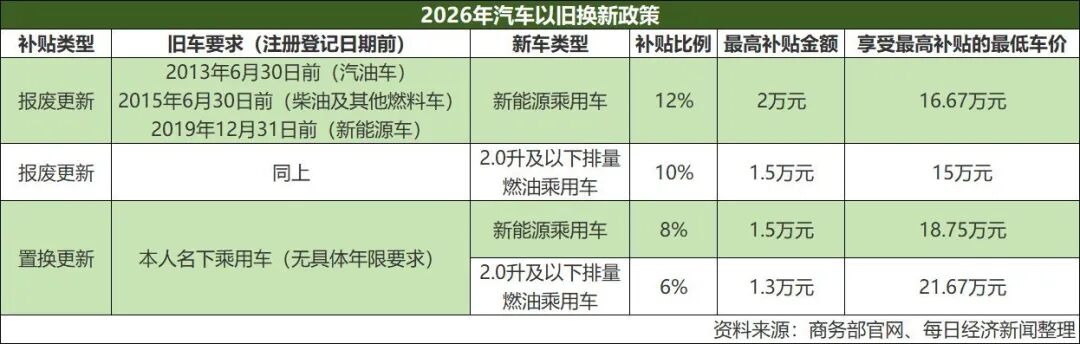
Group 1: Market Response to Tax Changes - Multiple automakers are launching price reduction promotions to counter the impact of the new energy vehicle purchase tax [1][2] - Tesla China introduced a purchase incentive for Model 3/Y/Y L with a "7-year ultra-low interest" financing plan, and a "5-year 0% interest" option for Model Y [1] - GAC Group announced promotional activities for its self-owned brands, including a maximum of 70,000 yuan in government and enterprise subsidies [1] - NIO's Firefly brand is offering various purchase benefits, including a 2,000 yuan tax subsidy and rewards for repeat buyers [1] - Xiaomi Motors is promoting its YU7 and SU7 Ultra models with financing options and limited-time purchase benefits [1] Group 2: Price Adjustments and Subsidy Changes - BMW has initiated a broad official price adjustment for 31 models, with the highest reduction of 24% for the iX1, dropping from 299,900 yuan to 228,000 yuan [2] - Volvo announced a limited-time promotion for the XC70, including a direct tax subsidy of 14,000 yuan [2] - Wuling Motors is providing full purchase tax subsidies for several new energy models, along with additional trade-in and financing incentives [2] Group 3: Future Policy Changes - In 2026, the new energy vehicle market will face two significant policy changes: a reduction in purchase tax incentives from full exemption to a 5% rate, and a shift in subsidy methods from fixed amounts to percentage-based [2][4] - The new subsidy guidelines will be uniformly implemented nationwide, with the maximum subsidy for scrapping vehicles capped at 20,000 yuan and for trade-ins at 13,000 yuan [4] - The new policy aims to mitigate market shocks caused by changes in the new energy vehicle purchase tax [3][4]




资讯日报:美国职位空缺和ADP报告显示就业持续降温-20260108
Guoxin Securities Hongkong· 2026-01-08 12:54
Market Overview - The U.S. job openings fell to the lowest level in over a year, indicating a cooling labor market[11] - The ADP report showed moderate growth in private sector employment for December, with labor demand remaining weak[11] - The S&P 500 index's expected price-to-earnings ratio is currently around 22 times, down from 23 times in November but still above the five-year average of 19 times[12] U.S. Stock Market Performance - On Wednesday, the S&P 500 index closed down, primarily due to weakness in financial stocks like JPMorgan and Blackstone[2] - The Nasdaq index saw a slight increase, driven by gains in Nvidia and Alphabet[2] - Major tech stocks mostly rose, with Google A up 2.43% and Microsoft up 1.04%, while Tesla and Apple saw declines of 0.36% and 0.77%, respectively[11] Hong Kong Stock Market Performance - The Hang Seng Index closed at 26,459, down 0.94% for the day, but up 3.23% year-to-date[3] - Technology stocks faced significant declines, with Alibaba down over 3% and Kuaishou down over 2%[9] - The automotive sector also struggled, with NIO dropping over 3% and several other manufacturers down more than 2% due to tightening subsidies and a forecasted 7% decline in China's auto market sales for 2026[9] Sector-Specific Insights - Oil stocks collectively fell, with Kunlun Energy and CNOOC down over 3% amid concerns over increased supply from Venezuela[9] - Pharmaceutical stocks performed well, particularly CRO and CDMO-related companies, with notable gains for clients like Kelaiying and Tigermed, rising 8.92% and 8.88% respectively[9] - The paper industry saw gains, with Nine Dragons Paper up 8.97% due to supply cuts and price increases announced by major companies[9]
零跑十年:从边缘玩家到价值重构者的蜕变
Zhi Tong Cai Jing· 2026-01-08 12:21
Core Insights - Leap Motor has achieved significant growth, delivering 597,000 vehicles in 2025, a 103% year-on-year increase, securing its position as the top seller among new energy vehicle manufacturers [1] - The launch of the D series, including the D19 SUV and D99 MPV, marks Leap Motor's entry into the high-end market while maintaining its cost-effective strategy [2] - Leap Motor's strategy emphasizes "technological equality," aiming to provide high-end features at competitive prices, thereby reshaping consumer perceptions of "technological luxury" [2] Product Development - The D19 is priced between 250,000 and 300,000 yuan, offering both range-extended and pure electric options, while the D99 targets the 300,000 yuan MPV market with a large battery and flexible seating [1] - Both models are built on a new D platform that integrates range-extended and pure electric architectures, featuring a compact and efficient integrated electric drive system developed in collaboration with NIO [1][2] Strategic Partnerships - Leap Motor has formed a strategic partnership with China FAW, securing a 3.744 billion yuan investment to enhance its resource base and development capabilities [2] - The company has established a dual-driven strategy with domestic and international partnerships, including collaboration with Stellantis, to support its growth and expansion goals [2] Market Positioning - Leap Motor's stock has seen a 50% increase since the beginning of 2025, reflecting positive market sentiment regarding its business fundamentals [3] - Analysts note that Leap Motor has transitioned from a "cost-effective player" to a "technology integrator," leveraging vertical integration to enhance product quality while maintaining margins [3] Competitive Landscape - The upcoming launch of the D19 and D99 in April 2026 will place Leap Motor in direct competition with established players like BYD and Xiaomi, highlighting the need for strong brand positioning [4] - Leap Motor aims to achieve a sales target of 1 million vehicles by 2026, which will require robust production, distribution, and service capabilities [4] Industry Impact - Leap Motor represents a shift in the automotive industry, moving from a follower to a rule-maker, emphasizing the importance of equitable access to advanced technology [5] - The company's focus on electric, intelligent, and localized manufacturing reflects the resilience and innovative spirit of Chinese manufacturing in the face of global challenges [5]

零跑(09863)十年:从边缘玩家到价值重构者的蜕变
智通财经网· 2026-01-08 12:15
Core Insights - Leap Motor has achieved significant growth, delivering 597,000 vehicles in 2025, a 103% year-on-year increase, securing the top position among new energy vehicle manufacturers [1] - The launch of the D series, including the D19 SUV and D99 MPV, marks Leap Motor's entry into the high-end market while maintaining its cost-effective strategy [2] - Leap Motor's strategy includes a partnership with China FAW, enhancing its resource base and aiming for a sales target of one million vehicles by 2026 [2][4] Product Development - The D19 is priced between 250,000 and 300,000 yuan, featuring dual power options and advanced technology, while the D99 targets the 300,000 yuan MPV market with a large battery and flexible seating [1] - Both models are built on a new D platform that integrates range-extending and pure electric architectures, showcasing a collaboration with NIO on an integrated electric drive system [1] Market Positioning - Leap Motor's "technology equality" philosophy aims to redefine consumer perceptions of luxury in the automotive sector, offering high-end features at competitive prices [2] - The company has expanded its global presence, with sales channels in 35 countries and regions, achieving over 60,000 units in exports in 2025, making it a leader in overseas sales among new energy vehicle manufacturers [2] Financial Performance - Leap Motor's stock price has seen a 50% increase since the beginning of 2025, reflecting positive market sentiment towards its business model and growth potential [3] - Analysts highlight Leap Motor's transition from a cost-effective player to a technology integrator, emphasizing its vertical integration capabilities and cost advantages [3] Strategic Vision - Leap Motor aims to create a replicable and scalable technology ecosystem, focusing on in-house development of key components to mitigate supply chain disruptions [4] - The company faces challenges in establishing brand premium and meeting its ambitious sales targets, which will require enhancements in production capacity and service systems [4][5]
雷军抛出55万辆的小目标,流量反噬让小米认清现实?| DA观
Sou Hu Cai Jing· 2026-01-08 12:12
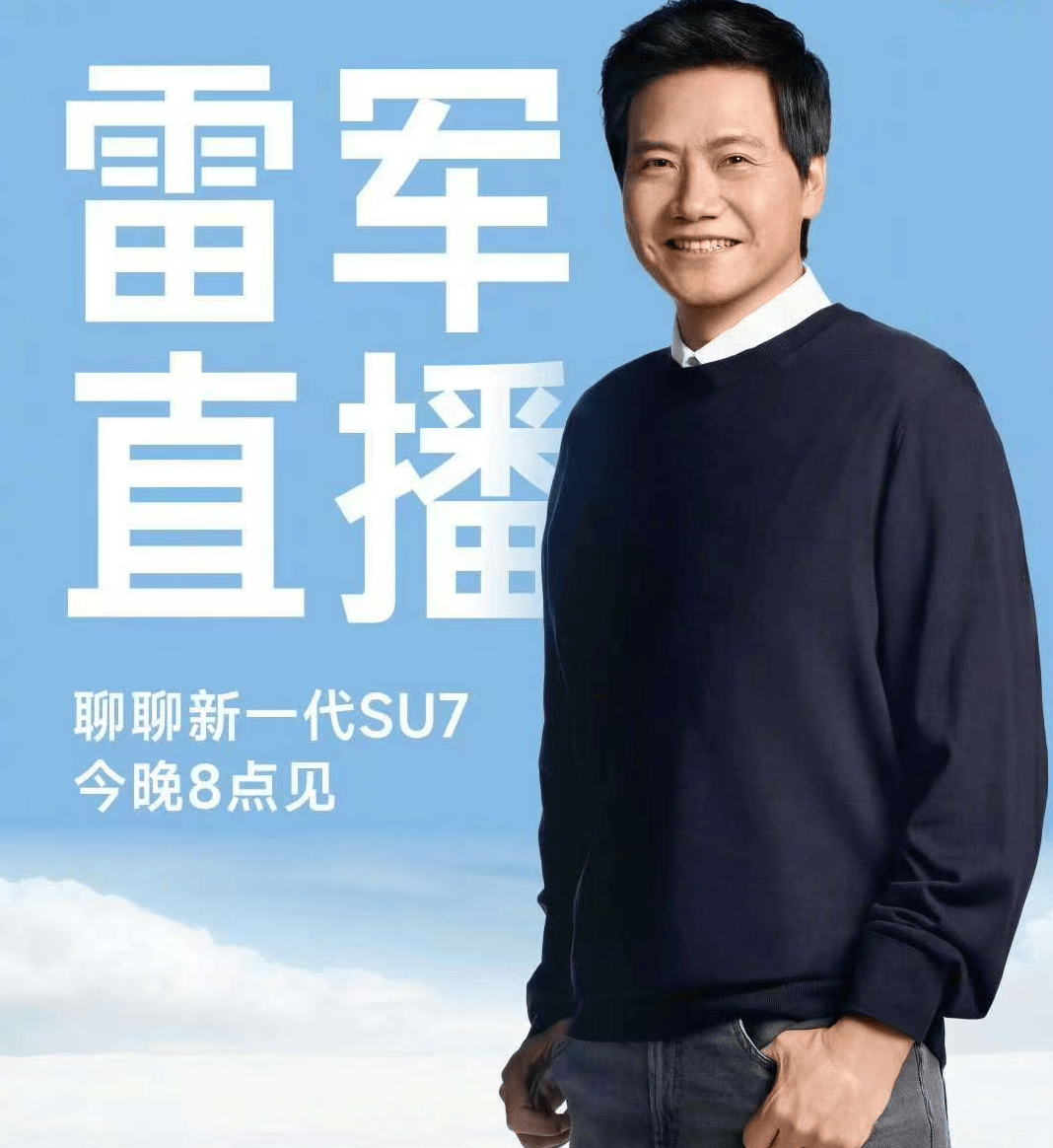
Core Viewpoint - Xiaomi's CEO Lei Jun announced the launch of the new SU7 model expected in April 2026, with a sales target of 550,000 vehicles for the year, which appears conservative compared to previous growth rates [2][3][4]. Sales Targets and Performance - The sales target of 550,000 units for 2026 is only a 34% increase from 410,000 units in 2025, which itself was a significant jump from 135,000 units in 2024 [3][4]. - The internal target may be even lower, around 500,000 units, indicating a cautious approach amidst market uncertainties [4]. - The current main model, YU7, has a monthly sales volume exceeding 30,000 units, suggesting that the target for 2026 may not reflect substantial growth compared to previous years [5]. Market Position and Competition - Xiaomi's sales strategy is being compared to competitors like Leap Motor, which aims for 1 million units in 2026, and Great Wall Motors, targeting 1.8 million units with a 36.4% growth rate [6]. - The company has experienced a significant drop in sales for its Ultra version, which fell from over 3,000 units per month to just 80 units in November 2025 [20]. Marketing and Consumer Sentiment - Xiaomi's marketing strategies have been effective in generating initial interest, with the SU7 achieving 88,898 pre-orders in 24 hours, showcasing the company's ability to leverage its existing consumer base [8][10]. - However, there are signs of consumer backlash, particularly regarding collaborations with KOLs that have not resonated well with Xiaomi's core fanbase, leading to a need for the company to reassess its marketing partnerships [14]. Safety Concerns and Public Perception - The company has faced significant challenges related to safety incidents involving its vehicles, which have raised public concerns about the safety of its products [18][20]. - The negative impact of these incidents has been compounded by a lack of timely responses from the company, leading to increased scrutiny and criticism from consumers [18][22]. Strategic Shifts - Xiaomi may need to adopt a "car sea" strategy, introducing more models to meet sales targets, which contradicts previous statements by Lei Jun about avoiding excessive model proliferation [24].

2025AIEV销量榜出炉!华为、小米等七强围攻10万亿特斯拉
Xin Lang Cai Jing· 2026-01-08 11:43
Core Insights - Tesla remains the top seller in the smart electric vehicle (AIEV) market but faces its largest sales decline in history, with a 8.6% drop in 2025, resulting in total sales of 1.636 million units [2][39] - In 2025, seven leading Chinese smart electric vehicle companies collectively achieved sales that are double that of Tesla, indicating a significant competitive challenge [2][40] - Despite the sales decline, Tesla's market capitalization remains robust at over 1 trillion RMB, significantly higher than the combined market value of its Chinese competitors [4][40] Tesla - In 2025, Tesla delivered approximately 1.636 million electric vehicles globally, with the Shanghai Gigafactory contributing 851,000 units, accounting for over 52% of total deliveries [10][46] - The company faces increasing pressure from rapidly rising Chinese competitors in the electric vehicle market, which is impacting its market share [10][47] - Tesla's innovation pace in key areas like autonomous driving and battery technology has slowed compared to previous years, while local competitors are catching up [10][47] Chinese Competitors - Leap Motor achieved sales of 597,000 units in 2025, surpassing its target of 500,000 units, marking a significant milestone in its growth trajectory [3][50] - Hongmeng Zhixing delivered 589,000 units, establishing a strong presence in both mainstream and high-end markets, with a notable average transaction price of 390,000 RMB [16][52] - Xpeng Motors reported a 126% year-on-year increase, delivering 429,000 units, exceeding its target of 380,000 units, although some new models underperformed [21][57] - Xiaomi Motors delivered over 410,000 units, significantly exceeding its target of 350,000 units, despite facing brand challenges [23][59] - Li Auto's sales fell to 406,000 units, down 18.8% from its target of 640,000 units, reflecting competitive pressures [26][62] - NIO delivered 326,000 units, achieving a 46.9% year-on-year growth, although it did not meet its target of 440,000 units [34][69] Market Dynamics - The combined sales of the seven leading Chinese smart electric vehicle companies indicate a growing competitive landscape that is beginning to challenge Tesla's dominance [2][40] - The market capitalization of Tesla remains a significant barrier for Chinese competitors, who have substantial growth potential but currently lack comparable valuations [4][42] - The ongoing strategic adjustments by Tesla and its competitors highlight the dynamic nature of the electric vehicle market, with companies striving to innovate and capture market share [8][44]


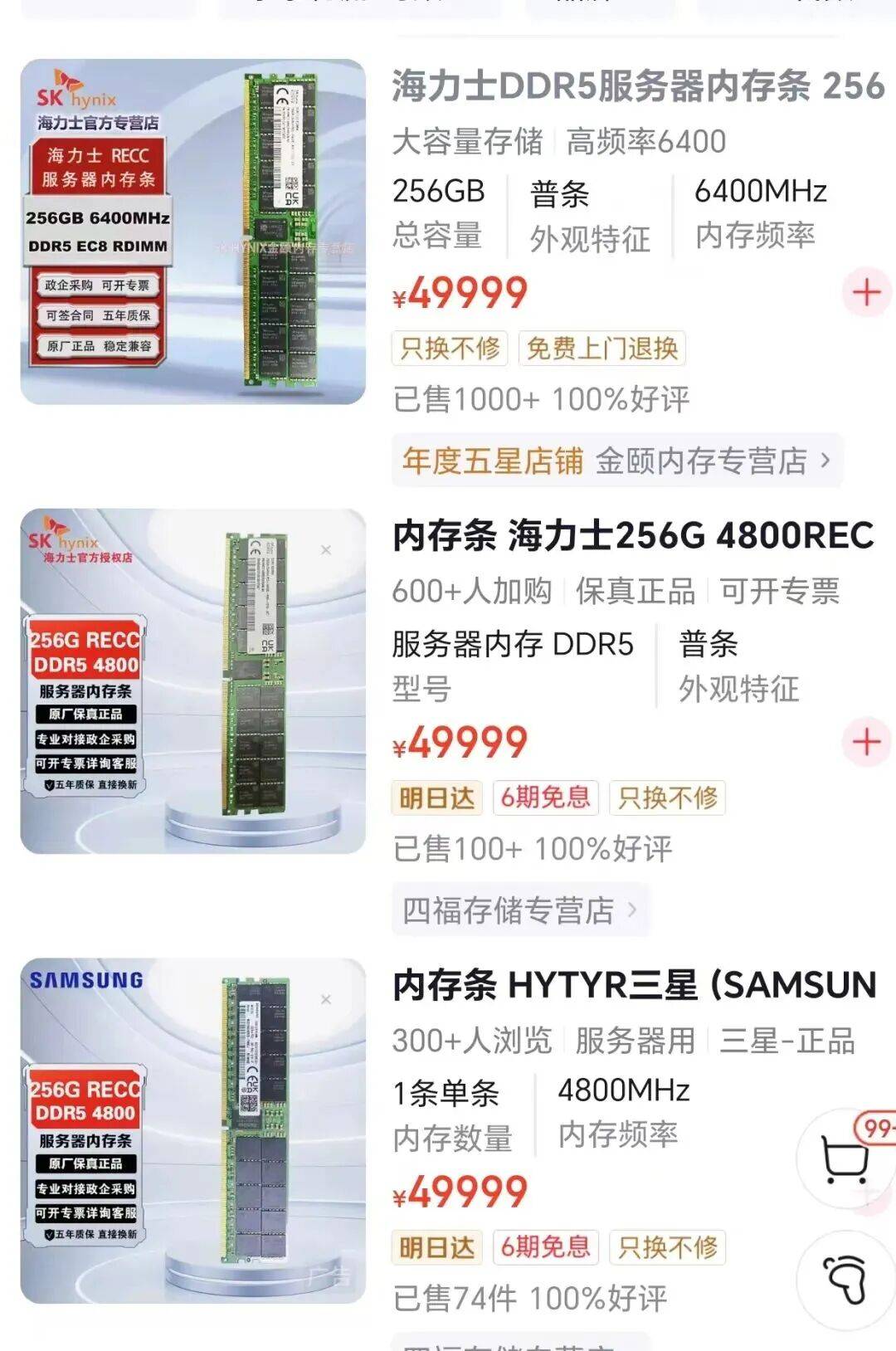
涨得比黄金还猛!“一盒堪比上海一套房”,业内人士:几乎一天一个价,还会涨
Sou Hu Cai Jing· 2026-01-08 11:05
Group 1 - The price of memory modules has surged significantly, with some DDR5 server memory modules exceeding 40,000 yuan each, and prices have increased by 2-3 times within the year for both DDR4 and DDR5 [1][7] - TrendForce reported a dramatic increase in the spot prices of memory chips since September 2025, with DDR5 memory prices rising by 307% and DDR4 by 158% [7] - The demand for DRAM from AI servers is 8-10 times higher than that of regular servers, consuming 53% of global monthly production capacity, leading to a shift in production focus towards server storage [10][11] Group 2 - Major memory manufacturers like Samsung, SK Hynix, and Micron are adjusting their production strategies, focusing on high-margin products like HBM and DDR5, while reducing investments in DDR4 [11] - The price increases are expected to continue throughout 2026, with significant profit growth projected for companies like Samsung and SK Hynix, with expected operating profits increasing by 253% and 224% respectively [11] - The rising memory prices are impacting various sectors, including smartphones and the automotive industry, with companies like NIO highlighting memory price increases as a major cost pressure [12]

造车新势力10年沉浮:既分高下,也决生死
经济观察报· 2026-01-08 10:29
Core Viewpoint - The article discusses the evolution of China's new car-making forces over the past decade, highlighting the contrasting fates of companies like Leap Motor and Neta Auto, and the emergence of new players like Xiaomi and Huawei's Hongmeng Zhixing [2][4]. Group 1: Market Dynamics - By 2025, Leap Motor is projected to achieve nearly 600,000 annual sales, becoming the sales champion among new car-making forces, while Neta Auto faces auctioning due to its decline [2]. - The number of new car-making enterprises has drastically reduced from over 60 in 2015 to only a few that still report sales [2]. - The new rankings for 2025 among new car-making enterprises include Leap Motor, Hongmeng Zhixing, Xiaopeng, Li Auto, Xiaomi, and NIO [2]. Group 2: Rise of New Players - Leap Motor's sales reached 597,000 units in 2025, a 103% increase year-on-year, marking its first time at the top of the sales chart [4]. - Hongmeng Zhixing, although not a traditional new car-making force, has seen rapid growth with its AITO brand, achieving 445,000 units in 2024 and 589,000 units in 2025, a 32% increase [5]. - Xiaomi, entering the market later, achieved 120,000 units in its first year of delivery and 412,000 units in 2025, surpassing NIO, which has been in the market for ten years [5]. Group 3: Challenges for Established Players - NIO, once a leader, saw its sales drop to 326,000 units in 2025, despite launching new brands and models to regain market share [8]. - Xiaopeng Motors sold 429,000 units in 2025, a 126% increase, but faced challenges with product positioning and market competition [9]. - Li Auto's sales fell to 405,900 units in 2025, a 19.6% decline, as it struggled to meet its annual target of 640,000 units [10]. Group 4: Industry Consolidation - Many once-prominent new car-making enterprises have disappeared, categorized into three groups: those that failed before mass production, those that made strategic errors, and those that faced funding issues [12][13][14]. - The industry has undergone a brutal elimination process, with only a few companies remaining competitive as they face increasing pressure from new entrants and established brands [14]. - The next decade is expected to be even more complex, testing the operational efficiency and competitive capabilities of the remaining players [15].