
中国铝业

Search documents
铜、银双双再创新高!紫金矿业涨超1%,有色50ETF(159652)连续4日强势吸金超2亿元,资金盘中再度出手!2026年有色金属怎么看,一文读懂!
Sou Hu Cai Jing· 2025-12-12 03:02
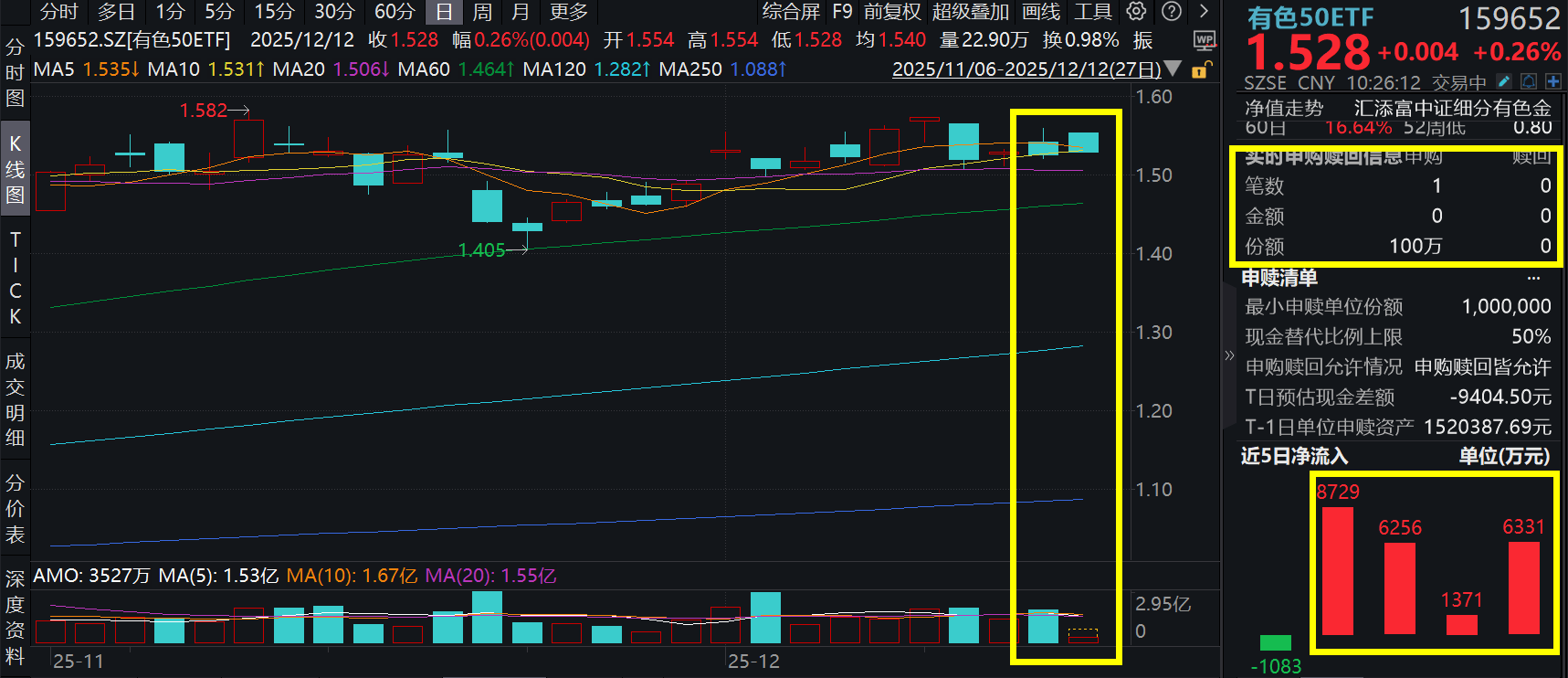
Core Viewpoint - The non-ferrous metal sector is experiencing a significant inflow of capital, with the Non-Ferrous 50 ETF (159652) seeing a net inflow of over 150,000 yuan and a cumulative net subscription exceeding 200 million yuan over the past five days, indicating strong investor interest [1][3]. Group 1: Market Performance - As of December 12, the Non-Ferrous 50 ETF (159652) opened strong, rising by 0.26% and briefly exceeding 1% during the morning session [1]. - The performance of the underlying index components is mixed, with companies like Zhongjin Gold and Shandong Gold rising over 2%, while companies such as Ganfeng Lithium and Tianqi Lithium fell over 3% [2][3]. - The ETF has shown a consistent trend of capital inflow, with a net subscription of 100,000 units during the session, reflecting ongoing investor confidence [1]. Group 2: Price Trends and Influences - The non-ferrous metal sector, particularly silver and copper, has seen significant price increases, with copper prices up 35% year-to-date, potentially marking the largest annual gain since 2009 [5]. - Silver prices have also reached historical highs, with a year-to-date increase exceeding 100% [5]. - The macroeconomic environment, including the Federal Reserve's interest rate cuts, is expected to continue supporting the prices of precious metals [6][7]. Group 3: Future Outlook - Looking ahead to 2026, the non-ferrous metal sector is expected to be driven by macroeconomic factors and fundamental supply-demand dynamics, with a focus on the weakening of the US dollar and ongoing supply constraints [6][7]. - The anticipated increase in demand for industrial metals, driven by new growth areas, is expected to enhance price elasticity [6]. - The copper market is projected to face supply constraints, with a slight increase in global copper production expected but limited by high disturbance rates [8]. Group 4: Investment Opportunities - The Non-Ferrous 50 ETF (159652) is highlighted as a leading investment vehicle, with a high concentration of strategic metals such as copper and gold, and a significant portion of its index comprising these metals [10][12]. - The ETF's index has a copper content of 31% and gold content of 14%, making it attractive for investors looking to capitalize on the non-ferrous metal supercycle [12]. - The ETF has demonstrated superior performance with a cumulative return leading its peers since 2022, driven by earnings rather than valuation expansion [14].





核心指数样本股定期调整落地:动态适配市场趋势,企业价值回归基本面本质
Cai Jing Wang· 2025-12-12 03:01
Group 1 - The Shanghai Stock Exchange, Shenzhen Stock Exchange, and China Securities Index Co., Ltd. announced a periodic adjustment of several core A-share index sample stocks, effective after market close on December 12 for indices like the SSE 50 and after December 15 for others like the Shenzhen Component Index [1] - The SSE 50 index replaced four sample stocks, including SAIC Motor, Northern Rare Earth, Huadian New Energy, and Zhongke Shuguang, while removing Poly Development, China Mobile, China Aluminum, and CRRC, indicating a shift towards high-end manufacturing, strategic resources, new energy, and computing technology [1] - The adjustment reflects a bias towards industries related to new productive forces, as the removed stocks primarily belong to real estate, traditional communication, and cyclical industries [1] Group 2 - The removed companies, such as Poly Development, are industry leaders with strong fundamentals and competitive advantages, evidenced by their financial performance, including a revenue of 173.7 billion yuan and a net profit of 1.928 billion yuan for the first three quarters of 2025 [2] - The adjustments to other indices like the Sci-Tech 50 and CSI 300 also involve sample optimization across various sectors, including information technology and new energy, aligning the index structure with the direction of China's economic transformation [2]
ETF盘中资讯|背后三大推手显现!紫金矿业涨超2%,有色龙头ETF(159876)拉升1.5%,获净申购1200万份!超级周期能有多长?
Sou Hu Cai Jing· 2025-12-12 02:26
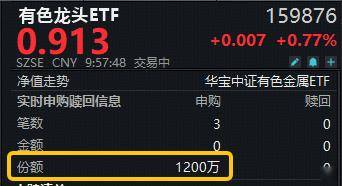
Core Viewpoint - The non-ferrous metal sector is experiencing significant growth, with the Non-Ferrous Metal Leader ETF (159876) seeing a price increase of over 1.5% during trading, reflecting strong investor confidence in the sector's future performance [1] Group 1: ETF Performance - The Non-Ferrous Metal Leader ETF (159876) has gained 0.77% as of the latest update, with a net subscription of 12 million units, indicating a total capital inflow of 140 million yuan over the past four days [1] - Key constituent stocks such as Western Mining, Tin Industry Co., and Chihong Zinc & Germanium have all risen by over 3%, while other stocks like Yunnan Aluminum and Zijin Mining have increased by more than 2% [1] Group 2: Key Stocks and Market Trends - The top-performing stocks in the ETF include Western Mining (3.96%), Tin Industry Co. (3.81%), and Chihong Zinc & Germanium (3.56%), with significant trading volumes reported [2] - The outlook for industrial metals such as copper, aluminum, cobalt, and lithium is positive for 2025, driven by three main factors: energy transition, AI revolution, and strategic reserves amid global competition [2] Group 3: Market Cycle and Investment Strategy - The duration of the super cycle for non-ferrous metals is likely to extend until 2026, influenced by the recovery of the US dollar, strategic reserve progress, and the effectiveness of "anti-involution" policies [3] - A diversified investment approach through the Non-Ferrous Metal Leader ETF and its associated funds is recommended to mitigate risks and capture the overall sector's performance [4]
有色金属ETF(512400)逆市涨超1%,美联储降息落地,有色金属板块应声走强,板块景气度持续攀升
Sou Hu Cai Jing· 2025-12-12 02:20
Group 1 - The core viewpoint of the articles highlights the strong performance of the non-ferrous metal sector, particularly driven by the recent interest rate cut by the Federal Reserve, which has positively impacted metal prices and market sentiment [1][2]. - The non-ferrous metal ETF (512400) has seen a 1.09% increase, with significant inflows totaling 776 million yuan over the past five trading days, indicating strong investor interest [1]. - The supply-demand dynamics for copper are expected to tighten in 2026, with potential price increases driven by speculative trading and inventory risks in global exchanges [2]. Group 2 - The non-ferrous metal index, which the ETF tracks, includes 50 listed companies, with major weights held by Zijin Mining, Luoyang Molybdenum, and Northern Rare Earth, reflecting the overall performance of the sector [2]. - The rare earth prices are anticipated to recover due to supply constraints from domestic mining quotas and geopolitical issues, alongside increased demand from sectors like electric vehicles and wind energy [2].
工业金属不断创新高,有色ETF基金(159880)涨近1%
Xin Lang Cai Jing· 2025-12-12 02:00
Group 1 - The core viewpoint of the news highlights a strong performance in the non-ferrous metals sector, with the National Index for Non-Ferrous Metals (399395) rising by 1.04% and specific stocks like Xiyegong (000960) and Guocheng Mining (000688) showing significant gains [1] - Electrolytic aluminum prices are on the rise, reaching near historical highs due to multiple factors including supply disruptions, emerging demand, and macroeconomic easing expectations [1] - Dongwu Securities suggests that by 2026, investors should focus on high-dividend stocks with significant electrolytic aluminum business proportions, as these companies are expected to enhance profit margins and dividend payouts [1] Group 2 - The National Index for Non-Ferrous Metals (399395) includes 50 securities that are prominent in the non-ferrous metals industry, reflecting the overall performance of listed companies in this sector [2] - As of November 28, 2025, the top ten weighted stocks in the index account for 52.34% of the total index, with companies like Zijin Mining (601899) and China Aluminum (601600) among the leaders [2]
12月12日收盘后正式生效!沪深300、科创50等多个重要指数即将调整样本
Xin Lang Cai Jing· 2025-12-12 01:56
Group 1 - The sample adjustment for major indices such as CSI 300 and STAR 50 will be completed after the market closes on December 12, based on established criteria like market capitalization and liquidity [1][2] - The CSI 300 index will replace 11 stocks, including Shenghong Technology, Dongshan Precision, and Ruixin Microelectronics, while removing Foster, Fulete, and TCL Zhonghuan [1] - The adjustments will increase the number of samples in the information technology and communication services sectors by 4 and 2 respectively, with weightings rising by 1.46% and 0.75%, reflecting a shift towards emerging industries [1] Group 2 - The STAR 50 index will replace 2 stocks, adding Aojie Technology and Shengke Communication while removing Huaxi Biological and Hangcai Co [2] - Other indices such as CSI 500, CSI 1000, and CSI A500 will also undergo sample adjustments on the same day, changing 50, 100, and 20 stocks respectively [2] - Adjustments for indices like Shenzhen Component Index and ChiNext Index will take effect on December 15 [3] Group 3 - ETFs tracking these indices will also adjust their portfolios accordingly, with the largest total scale for CSI 300 ETFs exceeding 1.16 trillion yuan [4] - The Huaxia CSI 300 ETF (510330.SH) has a low management fee rate of 0.15% per year and has a fund size exceeding 220 billion yuan as of December 11, with an average daily trading volume of over 500 million yuan [4]
双融日报-20251212
Huaxin Securities· 2025-12-12 01:55
Market Sentiment - The current market sentiment score is 37, indicating a "cold" market environment. Historical trends suggest that when the sentiment score is below or near 30, the market tends to find support, while scores above 70 may indicate resistance [4][7]. Hot Themes Tracking - **Non-ferrous Metals**: Demand expectations are boosted by potential US interest rate cuts and AI data center growth. Copper prices are rising due to financial attributes and supply constraints, while aluminum production is peaking domestically with limited overseas growth. Key stocks include Zijin Mining (601899) and China Aluminum (601600) [4]. - **Banking Sector**: Bank stocks offer high dividend yields, with the China Securities Bank Index yielding 6.02%, significantly higher than the 10-year government bond yield. In a slowing economy with increased market volatility, bank stocks are attractive for long-term investors. Relevant stocks include Agricultural Bank of China (601288) and Ningbo Bank (002142) [4]. - **Brokerage Firms**: The China Securities Regulatory Commission is focusing on differentiated regulation, aiming to support quality institutions while limiting weaker ones. This shift encourages a focus on high-quality development rather than mere scale. Key stocks include CITIC Securities (600030) and Guotai Junan (601211) [4]. Capital Flow Analysis - **Net Inflows**: The top net inflows for the previous trading day included Jin Feng Technology (111,683 million), Snowman Group (74,610 million), and Lens Technology (74,318 million) [8]. - **Net Outflows**: The largest net outflows were seen in ZTE Corporation (-412,321 million), Zhongji Xuchuang (-261,274 million), and Tianfu Communication (-201,784 million) [10]. - **Margin Trading**: The top net buy in margin trading included Shenghong Technology (50,362 million) and China Merchants Bank (21,630 million) [10]. Industry Overview - The banking sector is highlighted for its stability and high dividend yields, making it a preferred choice for long-term institutional investors during economic slowdowns [4]. - The non-ferrous metals sector is experiencing upward price movements due to supply constraints and increased demand from AI applications, indicating potential investment opportunities [4]. - The brokerage industry is undergoing regulatory changes aimed at enhancing quality over quantity, which may reshape competitive dynamics and investment strategies within the sector [4].
反内卷预期凉透了!氧化铝跌破现金成本,高成本厂要集体停产?
Sou Hu Cai Jing· 2025-12-11 14:51
Core Viewpoint - The alumina market is experiencing a significant price drop, with futures falling below 2,600 yuan/ton, leading to over 90% of production capacity facing cost overruns and forcing high-cost plants to reduce output, indicating a major reshuffle in the aluminum industry [1] Group 1: Price Trends - As of December 5, 2025, the main contract for domestic alumina futures closed at 2,590 yuan/ton, marking a historical low since its listing [1] - The current futures price is significantly below the industry-recognized cash cost range of 2,850-2,950 yuan/ton and the full cost line of 3,070-3,170 yuan/ton, resulting in cash losses of at least 260 yuan per ton for over 90% of domestic alumina production capacity [4] - The spot market is also weak, with prices dropping below 2,800 yuan/ton, creating a "double kill" effect alongside the futures market [6] Group 2: Supply and Demand Dynamics - The ongoing decline in alumina prices is primarily due to a severe imbalance in supply and demand, characterized by three main pressures on the supply side [11] - Domestic alumina production capacity is expected to increase by 10.3 million tons by 2025, with operational capacity reaching a historical peak of 9.36 million tons, exceeding normal operational levels [13] - The import of alumina is expected to remain high, with a significant increase in alumina exports from provinces like Fujian, exacerbating domestic supply pressures [13] Group 3: Cost Factors - The price support from bauxite, the core raw material for alumina production, has weakened, with bauxite prices dropping from $115/ton to around $70/ton, allowing for further declines in alumina prices [15] - The demand for alumina is limited due to the "45 million tons capacity ceiling" policy in the electrolytic aluminum industry, which has only seen a slight increase in operational capacity [15][17] Group 4: Industry Restructuring - The industry is entering a phase of capacity reduction as prices breach cost lines, with high-cost production facilities in northern regions facing significant risks of production cuts [19] - The market price mechanism is becoming the core driver of industry changes, replacing previous policy expectations as the primary influence on production decisions [21] - The Ministry of Industry and Information Technology has issued guidelines that require new alumina projects to meet advanced energy efficiency and environmental performance standards, facilitating the exit of high-cost, low-efficiency capacities [23] Group 5: Market Differentiation - The trend of industry differentiation is becoming more pronounced, with leading companies like China Aluminum maintaining profitability due to resource advantages, while smaller, high-cost firms face significant losses [24]
理解了这轮“金铜铝牛市”,也就理解了中国经济的未来
虎嗅APP· 2025-12-11 13:57
Group 1: Industry Overview - The non-ferrous metals industry, often labeled as "bulky and crude," has unexpectedly entered a high-profile period since 2025, with indices outperforming even the AI-driven TMT sector, and core commodity prices like gold and copper reaching historical highs [5] - The industry is undergoing a systematic transformation, with China evolving from a follower to a leader in global resource allocation through overseas acquisitions and capacity expansion [6][7] Group 2: Changes in Industry Narrative - A new variable, processing attributes, has emerged as a third core attribute alongside financial and resource properties, increasingly influencing the pricing and competitiveness of non-ferrous metals [9] - Supply rigidity is a fundamental support for price stability, as insufficient investment in resource extraction over the past decade, coupled with rising nationalism and stricter environmental regulations, has made new capacity hard to release [10] - Geographical mismatches in resource distribution have intensified national competition for influence in the non-ferrous industry, with countries like China actively acquiring overseas mines to secure resource safety [13][14] Group 3: Gold Market Dynamics - The new pricing logic for gold is shifting towards hedging against dollar credit risk, with gold becoming a preferred reserve asset amid rising global debt and currency devaluation [16][17] - Central banks and individual investors have increasingly turned to gold, with central banks net purchasing around 1,000 tons annually, accounting for about 23% of global demand [20] - China, as the largest gold producer and consumer, has seen its mining companies actively participate in global resource allocation, with significant acquisitions enhancing their competitive edge [21][24] Group 4: Copper Market Insights - The copper market is experiencing a tight balance between supply constraints and steady demand growth, with prices rising over 30% this year [26] - China's copper enterprises have transitioned from followers to leaders, with significant investments in overseas resources and a complete industrial chain from mining to processing [30][33] - The global copper supply is expected to face significant challenges due to aging mines and declining ore grades, while Chinese companies are well-positioned to capitalize on these trends [31][33] Group 5: Aluminum Industry Landscape - Aluminum, the most consumed non-ferrous metal, maintains high prices due to its strong processing attributes and the competitive nature of the industrial system [35] - China dominates the global aluminum market with a 57% share of electrolytic aluminum production, and the industry is expected to maintain a balanced supply-demand dynamic [36] - Chinese aluminum companies are expanding their competitive advantages through cost reduction strategies and integrated operations, solidifying their global leadership [38][40] Conclusion - The non-ferrous metals industry is not merely a cyclical story of price fluctuations; it reflects a complex interplay of financial, resource, and processing attributes, alongside global resource allocation dynamics, showcasing the rise of Chinese enterprises from followers to leaders in the sector [41][43]
在工业界叱咤风云的6大类氧化铝及其代表性企业名单
Xin Lang Cai Jing· 2025-12-11 10:17
Core Insights - The article discusses the various types of alumina, its applications, and the leading companies in the industry, highlighting China's dominance in alumina production and the significance of different alumina products in various sectors. Group 1: Types of Alumina - Alumina, represented by the chemical formula Al2O3, is a compound consisting of aluminum and oxygen, and can be categorized into anhydrous and hydrated forms [1][16] - Anhydrous alumina includes various crystalline forms such as α-Al2O3, β-Al2O3, and γ-Al2O3, with over nine types identified in China [1][16] - Hydrated alumina is composed of Al3+, O2-, and OH- ions, and common forms include industrial hydrated alumina and various types of bauxite [1][16] Group 2: Metallurgical and Non-Metallurgical Alumina - Alumina can be divided into metallurgical grade, which is used primarily for aluminum production, and non-metallurgical grade (fine alumina), with metallurgical grade accounting for over 90% of total alumina production [2][18] Group 3: China's Alumina Production - China is the largest producer of alumina, with a projected output of 85.52 million tons in 2024, representing a year-on-year growth of 3.9% and accounting for 60% of global production [4][20] - Among the top ten global alumina producers, five Chinese companies, including China Aluminum and China Hongqiao, collectively produced 61.82 million tons, making up 63.77% of the total [4][20] Group 4: High-Purity Alumina - High-purity alumina (4N and above) is characterized by its high purity, hardness, strength, and thermal stability, making it a valuable material in high-tech industries such as electronics and aerospace [5][20] - Research on high-purity alumina in China began in the 1990s, with significant advancements made in production techniques, although challenges remain in particle size and dispersion compared to Japanese counterparts [6][22] Group 5: Specialized Alumina Products - Ultra-fine hydrated alumina, with particle sizes below 3μm, is primarily used in green halogen-free flame retardants and as a precursor for various applications, including lithium-ion battery separators [8][25] - Boehmite, a precursor for active alumina, is utilized in lithium battery components to enhance safety and performance [9][28] - Spherical alumina, known for its high thermal conductivity and flowability, is widely used in polymer composites and ceramics [11][28] Group 6: High-Temperature Calcined Alpha Alumina - High-temperature calcined alpha alumina is produced through a calcination process at 1450°C, resulting in a white powder with excellent mechanical and electrical insulation properties [13][30] - This product is extensively used in ceramics, refractory materials, and high-performance applications [15][32]
