
丸美股份

Search documents
美护、纺织服装25Q1板块表现总结:25Q1消费需求整体平稳,建议关注后续国家消费刺激政策
Hua Yuan Zheng Quan· 2025-05-09 13:16
Investment Rating - The industry investment rating is "Positive" (maintained) [4] Core Viewpoints - Overall consumer demand remains stable in Q1 2025, with a recommendation to pay attention to subsequent national consumption stimulus policies [4] - The beauty and personal care sector showed a mixed performance, with the personal care segment performing the best [9][10] - The textile and apparel sector maintained stable growth, with outdoor brands performing well [18][21] Summary by Relevant Sections Beauty and Personal Care Sector - In Q1 2025, the retail sales of cosmetics in China grew by 3.2% year-on-year, lower than the overall consumer goods retail sales growth of 4.6% [5][6] - The beauty sector's revenue and net profit reached 13.5 billion and 1.89 billion respectively, with year-on-year changes of +0.2% and -12.3% [9][10] - The cosmetics segment saw a revenue of 9.62 billion, down 3% year-on-year, and a net profit of 1.06 billion, down 20.7% [10] - The medical beauty segment's revenue was 2.43 billion, down 0.2%, with a net profit of 0.71 billion, down 0.5% [10] - The personal care segment achieved a revenue of 1.45 billion, up 29.4%, and a net profit of 0.13 billion, up 12.6% [10] Textile and Apparel Sector - The retail sales of clothing, shoes, hats, and textiles grew by 3.4% year-on-year in Q1 2025, below the overall consumer goods retail sales growth of 4.6% [13][18] - The textile and apparel sector's revenue and net profit saw year-on-year changes of +1.66% and -10.72% respectively [18] - The OEM segment's revenue grew by 13.02% year-on-year, while the brand segment's revenue decreased by 3.90% [19][21] - The home textile segment's revenue decreased by 3.98% year-on-year, with a net profit decline of 12.35% [21]
谷雨冲刺“美白第一股”,国产美妆品牌加速IPO是“求生存”还是“谋增长”?
3 6 Ke· 2025-05-09 12:34
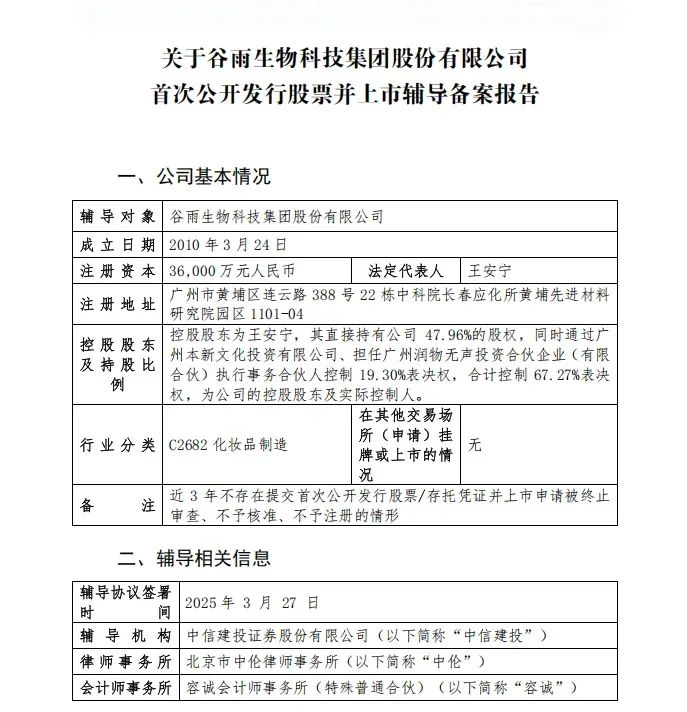
Core Viewpoint - The domestic skincare brand Gu Yu is set to launch its IPO process in A-shares, aiming to become the "first whitening stock" in the beauty market, despite facing challenges such as brand loyalty and high online sales ratio [1][3][25]. Company Overview - Gu Yu was established in March 2010 and has a registered capital of 36 million RMB. The company is headquartered in Guangzhou and is primarily engaged in cosmetics manufacturing [2]. - The company has shown rapid growth, with GMV reaching 10 billion RMB in 2010, and projected sales of 35 billion RMB in 2023 and over 50 billion RMB in 2024 [1][3]. Market Position - Gu Yu's sales growth positions it among leading domestic beauty brands, with competitors like Proya and Shiseido achieving significant revenue milestones [1][32]. - The brand's online sales ratio is projected to be 93% in 2024, indicating a heavy reliance on e-commerce channels [22]. Competitive Landscape - The domestic beauty market is experiencing intensified competition, with many brands accelerating their IPO processes as a survival strategy [25][26]. - Gu Yu has successfully leveraged various online platforms for marketing, including early adoption of live streaming on Taobao and collaborations with influencers on platforms like Xiaohongshu and Douyin [4][6]. Challenges and Risks - Despite its rapid growth, Gu Yu faces challenges such as insufficient brand loyalty, a lack of a diversified brand matrix, and the need to establish a stronger brand identity [3][14][20]. - The brand's reliance on a single product line and the potential for market saturation pose risks to its long-term sustainability [20][23]. Future Outlook - To succeed in the competitive landscape, Gu Yu must enhance its brand power and explore new product lines beyond its current offerings [20][30]. - The company aims to establish a more robust brand presence and diversify its product portfolio to mitigate risks associated with market fluctuations and consumer preferences [20][30].

尾盘放量,400亿龙头股冲击涨停
新华网财经· 2025-05-09 09:12
Group 1: A-Share Market Highlights - Construction Bank's stock rose by 1.54%, reaching a historical high, indicating continued market preference for high-dividend assets [1] - Jinbo Biological, a leader in the collagen protein sector, saw its stock increase by 9%, also hitting a historical high, reflecting the active new consumption concept market [1] - The micro-cap stock index rose by 0.18%, reaching a historical high, viewed as a risk appetite indicator [1] Group 2: Lithium Battery Sector - Near the market close, the lithium battery sector surged, with leading stock Guoxuan High-Tech rising by 9.15%, closing with a market value of 41.92 billion [4][6] - Guoxuan High-Tech announced a new high-safety solid-state battery with an energy density of 300Wh/kg, expected to be released in mid-May [6] Group 3: Technology Sector Adjustments - The technology sector experienced a pullback, particularly in the semiconductor, AI, and consumer electronics sectors, influenced by recent gains and external market uncertainties [8] - Despite the pullback, institutions remain optimistic about the technology sector, citing reduced crowding and a shift in focus towards long-term industry trends [8] - Key investment opportunities in May include multi-modal AI, AI/AR glasses, innovative drugs, and controlled nuclear fusion [9]


美容护理板块创两年新高,八大概念股盘点(名单)
Zheng Quan Zhi Xing· 2025-05-09 07:40
Group 1: Industry Overview - The beauty and personal care sector experienced a significant increase, with the index reaching a two-year high and the sector rising nearly 2% on May 9 [1] - Several companies within the sector reported notable growth in their financial performance, with leading company Proya (珀莱雅) achieving a revenue of 2.359 billion yuan, a year-on-year increase of 8.13%, and a net profit of 390 million yuan, up 28.87% [1] - Other companies in the sector, such as Nobon (诺邦股份), Qingsong (青松股份), and Jinbo (锦波股份), reported growth rates exceeding 50% in the first quarter [1] Group 2: Key Trends and Consumer Behavior - According to a report by Mintel, the trend of "Beauty in Body and Mind" is one of the three major trends influencing the global beauty and personal care industry in the coming years [2] - The rise of the "颜值经济" (beauty economy) and "悦己潮流" (self-pleasure trend) has led consumers to purchase functional skincare products, trendy makeup, and home fragrances for self-healing purposes [2] Group 3: Notable Companies in the Sector - Proya focuses on the research, production, and sales of cosmetic products, with brands including "Proya," "Caitang," "Off&Relax," and "Yuefuti" [2] - Shanghai Jahwa (上海家化) specializes in the research, production, and sales of daily chemical products, including personal care and beauty products [2] - Furuida (福瑞达) has transitioned into the health industry through acquisitions, creating a full industry chain from hyaluronic acid raw materials to products [2] - Huaxi Biological (华熙生物) is a leading high-tech enterprise in the production of hyaluronic acid through microbial fermentation technology [2] - Betaini (贝泰妮) operates a subsidiary focused on medical beauty services, including laser and micro-needle treatments [2] - Shuiyang (水羊股份) has launched a light medical beauty brand, primarily sold through online platforms [2] - Nobon produces water-jet non-woven materials used in beauty care, industrial materials, and medical supplies [2] - Marubi (丸美生物) specializes in the research, design, production, and sales of cosmetics, focusing on eye care, skincare, and cleansing products [2]

两大芯片巨头,股价重挫
Zheng Quan Shi Bao· 2025-05-09 04:33
Group 1 - A-shares market experienced a slight decline in the morning, with major indices such as the Shenzhen Component Index, ChiNext Index, and STAR Market 50 Index dropping over 1% [4] - The TMT sector saw significant adjustments, particularly in the electronics segment, which fell over 2%, impacting the overall market performance [5] - Semiconductor companies, including SMIC and Hua Hong Semiconductor, reported their Q1 2025 earnings, leading to substantial stock price declines [6][7] Group 2 - Hua Hong Semiconductor's stock plummeted, with a drop of up to 12% in A-shares and over 13% in Hong Kong shares, despite reporting a revenue increase of 18.66% year-on-year to 3.913 billion yuan for Q1 2025 [6] - SMIC's stock also faced a decline, with A-shares dropping over 4% and Hong Kong shares falling more than 10%. The company reported a Q1 2025 revenue of $2.247 billion, a 1.8% increase quarter-on-quarter, but provided a revenue guidance for Q2 indicating a potential decline of 4% to 6% [7] Group 3 - The beauty and personal care sector showed strength, with stocks like Shuiyang Co. rising over 10%, alongside other companies such as Beitaini and Runben [8] - The banking and utilities sectors also performed well, contributing to the overall market dynamics [9] Group 4 - In the Hong Kong market, the Hang Seng Index experienced low-level fluctuations, with notable gains in stocks like Henderson Land and Chow Tai Fook [13][14] - Several beverage stocks in Hong Kong saw significant increases, with Andeli Juice surging over 70% and other brands like Cha Baidao and Nayuki's Tea also showing strong performance [16] Group 5 - China Carbon Neutrality stock surged over 60% during trading, following a voluntary announcement of share purchases by a non-executive director [17][19]

从品类到品质,从品质到品牌
China Securities· 2025-05-09 01:20
Investment Rating - The report maintains a rating of "Outperform the Market" for the industry [3]. Core Insights - The industry fundamentals are expected to remain under pressure in 2024, with most sectors and companies still significantly affected by macroeconomic factors. However, a number of companies are emerging that are successfully navigating the challenges of consumer downgrade by upgrading from categories to quality and then to brand [1][2]. - The report highlights that companies with strong brand attributes are likely to continue outperforming as the market transitions from price-performance to quality-price comparisons [2]. Summary by Sections 1. Duty-Free Sector - The duty-free sales in Hainan are gradually stabilizing, with the implementation of the Hainan closure policy expected to benefit the duty-free sector. The market is seeing improvements in channel and supply chain capabilities, leading to a stable outlook for profitability [2][49]. - Key companies to watch include China Duty Free Group and Wangfujing [2]. 2. Tourism and Gaming - The tourism sector shows strong resilience in demand, becoming a crucial driver for domestic consumption. The recovery in inbound and outbound travel is significant, with a focus on new consumption scenarios and the silver-haired tourism market [2][3]. - Recommended companies include Jiuhua Tourism, Lingnan Holdings, and Sands China [2]. 3. Hotel Industry - The hotel sector is experiencing weak business travel demand, leading to pressure on RevPAR. However, leisure demand remains resilient, and leading companies are enhancing profitability through brand matrix validation and supply chain optimization [3][72]. - Companies to focus on include Huazhu Group, Atour, and Jinjiang Hotels [3]. 4. Restaurant Sector - Leading restaurant companies are demonstrating strong supply chain negotiation and profitability advantages. The overall supply in the restaurant industry is optimizing, with a competitive trend in price-performance [3][7]. - Notable companies include Mixue Ice City, KFC, and Haidilao [3][7]. 5. Cosmetics and Medical Aesthetics - The cosmetics sector is seeing a shift in focus towards profitability, with companies restructuring their product and channel strategies. High-growth companies are expected to achieve both revenue and profit increases [7][23]. - Key players include Juzhibio, Shumei, and Marubi [7][23]. 6. General Retail - The retail sector is undergoing digital upgrades and operational adjustments, with a focus on essential demand and cash flow stability. Companies like Yonghui Supermarket and Multi-Point Intelligence are recommended [8][30]. - The report also highlights the ongoing challenges in the jewelry sector due to rising gold prices [8][30]. 7. Overall Market Performance - The consumer services sector is expected to face challenges, with a projected performance of -8.70% in 2024. However, the beauty and personal care sector is anticipated to recover with a growth of +8.15% in 2025 [11][19].



福瑞达:瑷尔博士处于战略调整期,颐莲喷雾品线官宣新代言人销量同比增长69%
Cai Jing Wang· 2025-05-08 13:25
Group 1 - The core viewpoint of the news is that the company is focusing on innovation and brand development in the cosmetics sector, achieving significant revenue growth and maintaining a strong market position [1][2][4] - In Q1 2025, the cosmetics segment generated revenue of 526 million yuan with a gross margin of 61.06%, driven by key brands such as Yilian and Aier Doctor, which achieved revenues of 250 million yuan and 236 million yuan respectively [1] - The company launched 47 new products and obtained 12 new patents in the cosmetics segment during the reporting period, emphasizing a research-driven approach and technological innovation [1][2] Group 2 - The company is committed to a dual-brand strategy focusing on Yilian and Aier Doctor while optimizing the operations of other brands, transitioning from a single beauty business to a "beauty + medical beauty" model [3] - The company plans to enhance its core competitiveness through continuous R&D investment, with a projected R&D expenditure of 199 million yuan in 2024 and approximately 42 million yuan in Q1 2025 [2] - The company is advancing its product lines and brand strategies, including the introduction of innovative products and technologies, such as the membrane collagen technology launched by the Kemi brand [4]

餐饮和化妆品怎么没跟上消费板块?
Sou Hu Cai Jing· 2025-05-08 02:38
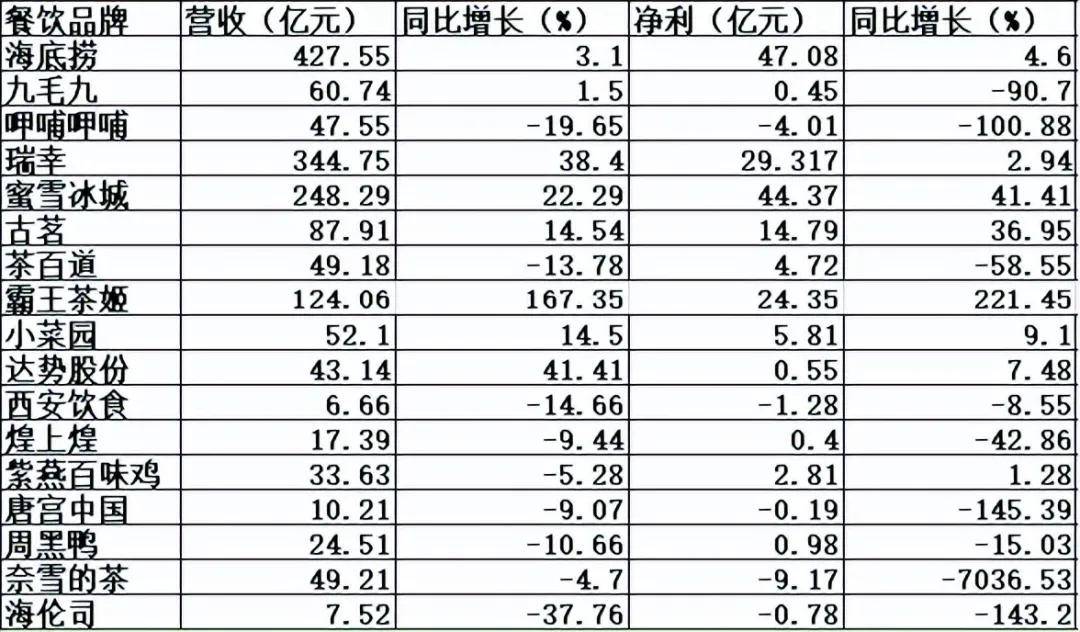
Core Viewpoint - The current hot sectors in the Chinese stock market are new consumption areas such as toys, tea drinks, and snacks, while traditional sectors like dining and cosmetics are lagging behind, with negative average growth rates in 2023 [1][14]. Dining Industry - The dining sector is experiencing a comprehensive downturn, with major players like Haidilao showing minimal growth, while tea drink companies are accelerating [1][7]. - The dining market is projected to grow at approximately 5.3% in 2024, contrasting with the 20% growth in the ready-to-drink tea segment, indicating a negative growth trend for dining [2][7]. - The dining industry faces challenges such as high competition, a saturated market with 9 million restaurants, and a business model that often prioritizes novelty over customer retention [7][9]. - Major dining companies are struggling with profitability, as evidenced by significant declines in net profits for brands like Jiumaojiu and Jiabujiahe [2][8]. - The dining sector's business model is unsustainable, with many restaurants failing to maintain long-term customer engagement, leading to a high turnover of brands [9][10]. Cosmetics Industry - The overall growth rate of the cosmetics industry is declining, with a notable 9% drop in imported cosmetics in 2024, indicating that domestic companies are not entirely to blame for the downturn [14][16]. - Consumer behavior is shifting towards reducing non-essential spending, impacting higher-priced cosmetics, which are often seen as replaceable [16][21]. - The performance of cosmetic companies is highly variable, with some achieving significant growth while others, like Aimeike and Huaxi Shengwu, face severe declines [18][21]. - The rise of new product trends, such as collagen-based skincare, is reshaping the competitive landscape, leading to the decline of established brands that fail to innovate [21][23]. - The cosmetics sector is characterized by intense competition and frequent brand turnover, making it difficult for companies to maintain long-term growth and stability [23][24]. Conclusion - Both the dining and cosmetics industries are facing significant challenges that hinder performance and valuation compared to more successful sectors like ready-to-drink tea and snacks [24].

零售行业2025年中期投资策略:悦享生活,深挖情绪消费景气赛道
KAIYUAN SECURITIES· 2025-05-07 07:04
Core Insights - The report emphasizes the emergence of "emotional consumption" as a significant trend in the retail industry, particularly benefiting brands that resonate with consumers' emotional needs [2][3][28] - The retail sector is experiencing a slow recovery, with varying performance across different segments, highlighting the resilience of brands linked to emotional value [3][10][39] Industry Review - In Q1 2025, social consumption showed a slow recovery, with retail businesses facing overall pressure. However, segments related to "emotional value" consumption, particularly leading brands, performed significantly better than the industry average [3][10][39] - The jewelry sector is under pressure due to high gold prices, while cross-border e-commerce remains stable but with profit pressures. The medical beauty and cosmetics sectors are facing intense competition, and offline retail is still exploring transformative models [3][6][39] Segment Analysis Jewelry - The jewelry industry is experiencing a shift in brand competition, with traditional brands facing challenges from differentiated product brands that are rapidly emerging and achieving high growth [6][39] - In Q1 2025, the jewelry sector's revenue was 431.6 billion yuan, down 25.9% year-on-year, with net profit also declining [39][64] Cosmetics - The cosmetics sector is benefiting from the rise of emotional consumption, with a focus on high-demand segments such as high-end beauty and differentiated personal care brands [5][39][64] - Brands like Mao Ge Ping and Proya are highlighted for their strong performance in this evolving market [5][39] Medical Beauty - The medical beauty sector is expected to recover as domestic demand increases, with a focus on differentiated product lines [5][39] - Companies like Ai Meike and Kedi-B are recommended for their unique offerings [5][39] Offline Retail - Offline retail is leveraging emotional consumption to regain market share, with companies like Yonghui Supermarket and Aiyingshi being recommended for their proactive transformation efforts [5][39] - The report notes that the shift towards a direct-to-consumer (DTC) model is crucial for offline retailers to enhance customer experience and emotional satisfaction [69] Investment Recommendations - For the jewelry sector, brands with differentiated product capabilities and deep consumer insights are recommended, including Lao Pu Gold and Chao Hong Ji [5][66] - In the cosmetics space, the report suggests focusing on high-demand segments and brands that can continuously innovate [5][66] - The medical beauty sector is advised to consider companies with unique product lines, such as Ai Meike and Kedi-B [5][66] - The report highlights the importance of emotional value in driving consumer preferences, suggesting that brands that can effectively tap into this trend will outperform their peers [5][66]



东吴证券晨会纪要-20250506
Soochow Securities· 2025-05-06 02:09
Macro Strategy - The external demand shock on the economy is beginning to manifest, with April manufacturing PMI data showing a month-on-month decline of 1.5 points, significantly exceeding the historical average decline of 0.7 points [1] - The decline in April's manufacturing PMI is the second largest for the same period in the past decade, only behind the declines in 2022 and 2023 [1] Fixed Income - In April 2025, MLF exceeded 500 billion yuan, indicating a loose liquidity stance from the central bank, with monetary policy working in coordination with fiscal policy [3] - The issuance pace of bonds may become a key factor in assessing the monetary easing window, with expectations for a potential reserve requirement ratio cut [3] - The week of April 21-25 saw the issuance of 16 green bonds totaling approximately 36.2 billion yuan, a significant increase from the previous week [4] - The same week also saw the issuance of 5 secondary capital bonds totaling 59 billion yuan, with a total trading volume of approximately 136.2 billion yuan [5] Company Analysis Foton Motor (600166) - The Q1 performance exceeded expectations, with a forecasted net profit of 16.66 billion yuan for 2025, reflecting a recovery in the heavy truck industry [10] - The company is rated "Buy" due to its low valuation and the industry's potential for recovery [10] KQ Group (873665) - The company reported a revenue of 3.37 billion yuan for 2024, down 3.69% year-on-year, and a net profit of 0.62 billion yuan, down 17.50% [11] - The decline in performance is attributed to intensified competition in the photovoltaic industry [11] Shenghui Integration (603163) - The company experienced a significant revenue increase in Q1, supported by a robust order backlog [12] Ganfeng Lithium (002460) - The company adjusted its profit forecast for 2025-2027, expecting net profits of 8.1 billion yuan, 15.8 billion yuan, and 24.5 billion yuan respectively, reflecting a year-on-year growth of 139%, 95%, and 55% [14] Anker Innovations (300866) - The company maintains a positive outlook with adjusted net profit forecasts for 2025 and 2026 at 24.9 billion yuan and 32.1 billion yuan, respectively, indicating a growth potential despite tariff pressures [15] YTO Group (601038) - The company’s net profit forecast for 2025-2027 is maintained at 10.2 billion yuan, 11.2 billion yuan, and 12.5 billion yuan, reflecting a "Buy" rating [16] Silver Capital (603277) - The company’s net profit forecast for 2025-2026 has been adjusted to 6.45 billion yuan and 7.70 billion yuan, with a new forecast for 2027 at 8.78 billion yuan [16] Hong Kong Stock Exchange (00388.HK) - The exchange reported a record high quarterly performance with revenues of 6.9 billion HKD, a 32% year-on-year increase, driven by improved investment sentiment and increased trading activity [18] Zhongxin Bo (688408) - The company maintains its profit forecast for 2025-2027, expecting net profits of 8.3 billion yuan, 10.6 billion yuan, and 12.8 billion yuan, reflecting a growth trajectory [19] Chongqing Beer (600132) - The company forecasts a net profit of 12.66 billion yuan for 2025, with a stable outlook for sales recovery [20] Top Group (601689) - The company reported a Q1 revenue of 57.68 billion yuan, with a net profit of 5.65 billion yuan, reflecting a year-on-year decline but maintaining a positive long-term outlook [31]