泸州老窖

Search documents
成都5亿元国资合资企业落地,国资产区平台成白酒第三极,与巨头共舞?|行业风向标
Tai Mei Ti A P P· 2025-11-28 10:32
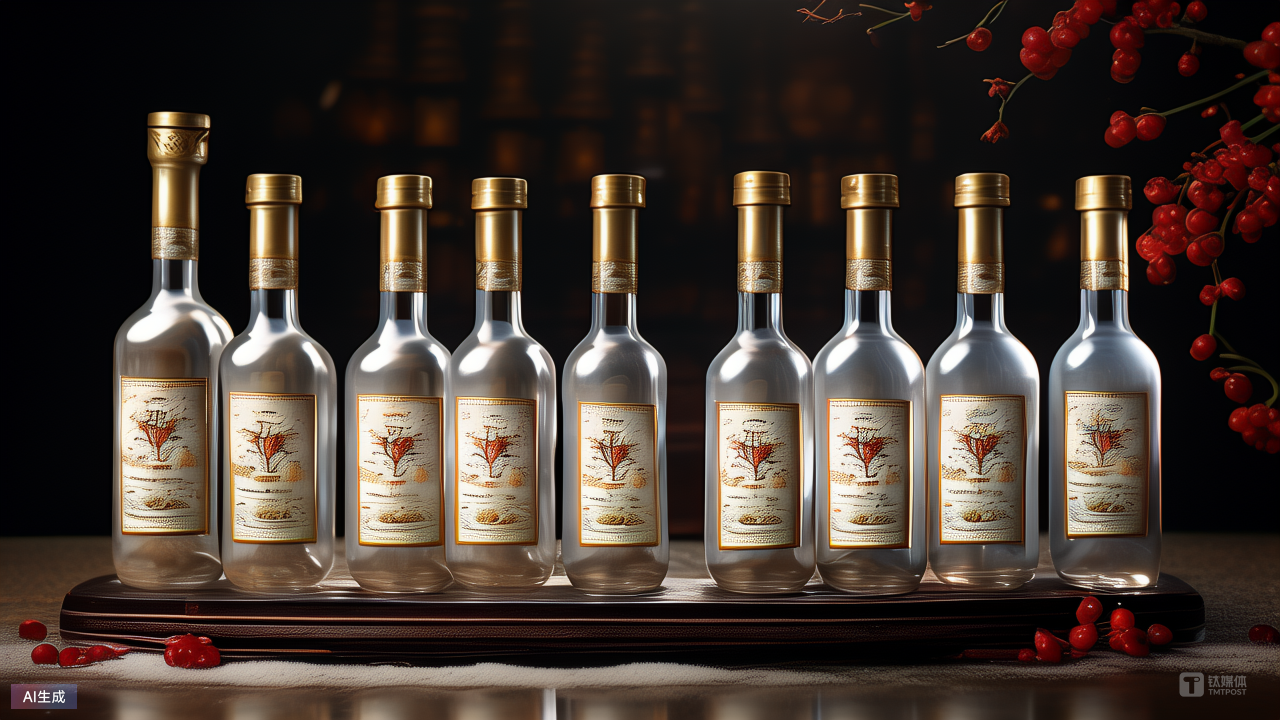
(图片系AI生成) 近日,注册资本5亿元的成都蓉酒酒业有限公司(下称"蓉酒酒业")成立,其股东名单清一色为国资企业——成都产业投资集团有限公司持股51%、成都酒 业集团有限公司持股34%,成都市大邑县邑岭仁安建设发展有限公司、成都蒲江产业投资集团有限公司、成都天府粮仓农旅投资发展集团有限公司各持股 5%,实际控制人为成都市国资委。 复盘来看,由国资联合推动的酒业布局,在白酒行业并非孤立事件。过去数年时间,仁怀酱酒集团、川酒集团、遵义酒业集团等区域性国资产区平台公司相 继落地。实践证明,当白酒行业从"增量狂欢"进入"存量内卷","政府+国资"的组合拳不再只是"扶小扶弱"的过渡手段,而是成长为一股有望与名酒巨头平 起平坐的结构性力量。 作为控股股东,成都产业投资集团是成都市政府设立的大型国有资本投资运营平台,注册资本100亿元,已组建150余只产业基金、总规模超1900亿元,其资 本运作与产业链整合能力,将为蓉酒酒业提供资金与资源支撑。 第二大股东成都酒业集团则是邛崃市专为白酒产区服务的国有独资企业,手握北纬三十度酒业等子公司,具备白酒行业专业运营经验。此外,成都市大邑 县、蒲江县等地的国资企业入股,进一步强化了 ...

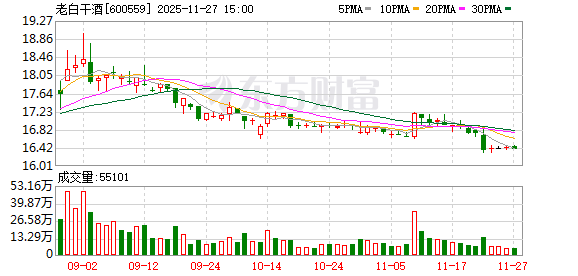
老白干酒开发低度果味及健康型酒品,低度能否解业绩之渴?
Nan Fang Du Shi Bao· 2025-11-27 10:05
Core Viewpoint - The company reported significant declines in revenue and net profit for the third quarter of 2025, prompting a strategic shift towards low-alcohol, fruit-flavored products targeting younger consumers [2][5][6] Financial Performance - In the first three quarters of 2025, the company achieved revenue of 3.33 billion yuan, a year-on-year decrease of 18.53% [2] - The net profit attributable to shareholders was 400 million yuan, down 28.04% year-on-year [2] - The third quarter alone saw revenue drop to 849 million yuan, a decline of 47.55%, and net profit fell to approximately 79.39 million yuan, down 68.48%, marking the largest drop in recent years [2] Product Structure - Revenue from products priced above 100 yuan was 1.738 billion yuan, down 14.96% year-on-year, while products priced below 100 yuan generated 1.574 billion yuan, down 22.06% [3] - The company is focusing on product innovation, developing low-alcohol and fruit-flavored products for younger consumers, as well as health-oriented products for older demographics [4][6] Market Strategy - The company plans to enhance its marketing efforts through social media and new media platforms, including Douyin and WeChat [3] - Initiatives include a short video creation contest for employees to promote brand awareness and collaborations with other industries to engage high-net-worth clients [3][4] - The company is also expanding its online sales presence through major e-commerce platforms and embracing instant retail channels to integrate online and offline resources [4] Industry Context - The shift towards low-alcohol products is part of a broader trend in the liquor industry, with major competitors also entering the low-alcohol market [5][6] - The low-alcohol and fruit-flavored beverage segment has become increasingly competitive, with established brands already having strong market recognition [6]

酒价内参11月27日价格发布:青花汾20价格下跌5元/瓶
Xin Lang Cai Jing· 2025-11-27 01:44
Core Insights - The white liquor market is experiencing a price adjustment, with the average retail price of the top ten products decreasing for the second consecutive day, currently priced at 9188 yuan, down 34 yuan from the previous day [1] - A notable increase in prices was observed for Qinghua Lang, which rose by 2 yuan per bottle, while Feitian Moutai saw a slight increase of 1 yuan per bottle [1] - The chairman of Jinshiyuan expressed optimism about a gradual recovery in the white liquor market next year, despite current challenges such as weak demand and intense competition [1] Price Trends - The average retail price of the top ten white liquor products has decreased, with specific products showing varied price movements: - Feitian Moutai: 1829 yuan, up 1 yuan - Premium Moutai: 2361 yuan, down 4 yuan - Wuliangye: 853 yuan, down 5 yuan - Guojiao 1573: 877 yuan, down 6 yuan - Yanghe Dream Blue M6+: 579 yuan, down 6 yuan - Xijiu Junpin: 669 yuan, down 6 yuan - Qinghua Lang: 720 yuan, up 2 yuan [3][4] Market Outlook - Jinshiyuan's chairman indicated that the company is seeing progress in expanding its market outside the province, which provides some resilience despite a decline in performance in the first three quarters [1] - The industry is believed to be at the bottom of its cycle, with a cautious optimism about future recovery as inventory levels among distributors have peaked [1]






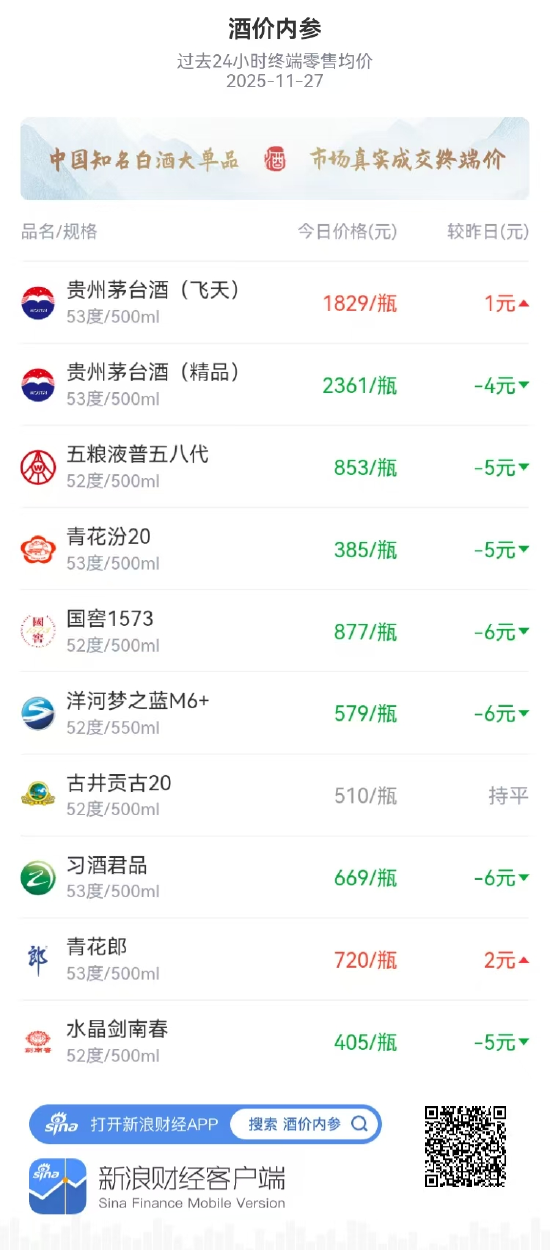
酒价内参11月27日价格发布:国窖1573价格环比下跌6元/瓶
Xin Lang Cai Jing· 2025-11-27 01:30
Core Insights - The white liquor market is experiencing a price adjustment, with the average retail price of the top ten products decreasing for the second consecutive day, currently at 9188 yuan, down 34 yuan from the previous day [1] - A notable increase in prices was observed for Qinghua Lang, which rose by 2 yuan per bottle, while Feitian Moutai saw a slight increase of 1 yuan per bottle [1] - The chairman of Jinshiyuan expressed optimism about a gradual recovery in the white liquor market next year, despite current challenges such as weak demand and intense competition [1] Price Trends - The average retail price of the top ten white liquor products is currently 9188 yuan, reflecting a decrease of 34 yuan from the previous day [1] - Specific price changes include: - Feitian Moutai: 1829 yuan (+1 yuan) - Premium Moutai: 2361 yuan (-4 yuan) - Wuliangye: 853 yuan (-5 yuan) - Guojiao 1573: 877 yuan (-6 yuan) - Yanghe Dream Blue M6+: 579 yuan (-6 yuan) - Xijiu Junpin: 669 yuan (-6 yuan) - Qinghua Lang: 720 yuan (+2 yuan) [3][4] Market Outlook - Jinshiyuan's chairman indicated that the company is cautiously optimistic about the market's recovery, noting that the peak inventory levels among distributors have passed, suggesting the industry is at a cyclical low [1] - This sentiment aligns with analyses from some brokerage firms, providing a boost of confidence to the white liquor industry, which is currently undergoing significant adjustments [1]
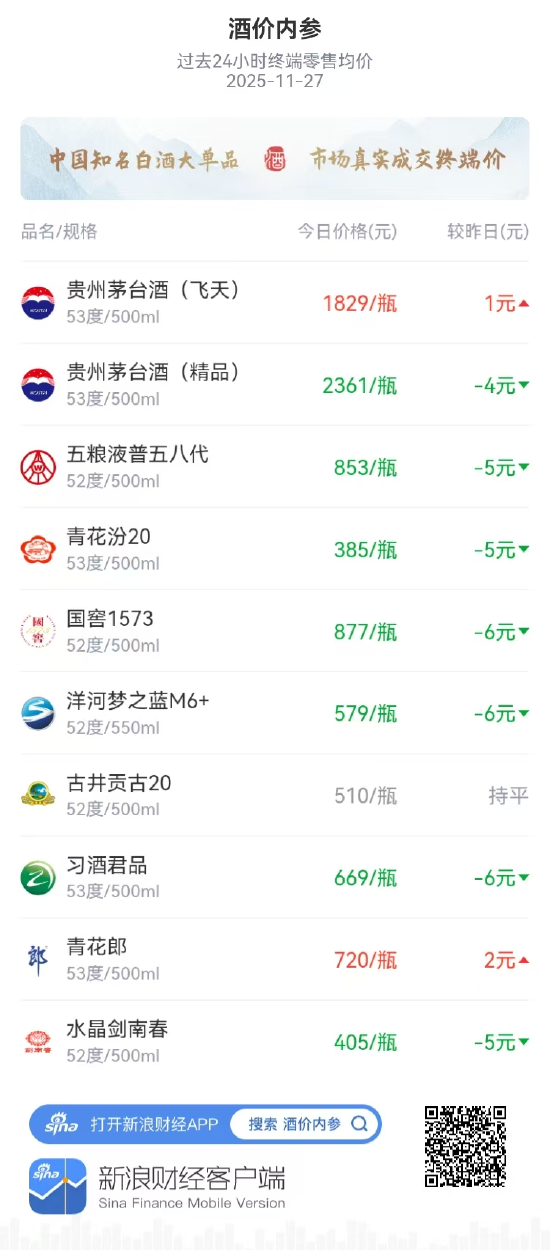
酒价内参11月27日价格发布 市场延续回调多款名酒价格下行
Xin Lang Cai Jing· 2025-11-27 01:10
Core Insights - The retail prices of the top ten Chinese liquor products continue to decline, with an overall drop of 34 yuan, bringing the total price for a bundled package to 9188 yuan, marking the second consecutive day of price reduction [1] - Among the products, Qinghua Lang saw a slight increase of 2 yuan per bottle, while Feitian Moutai rose by 1 yuan per bottle, indicating some resilience in specific brands [1] - Most other products experienced price declines, with notable drops including Guojiao 1573 down by 6 yuan, Yanghe Dream Blue M6+ down by 6 yuan, and Wuliangye Pu 58th generation down by 5 yuan [1][3][4] Price Summary - Feitian Moutai (53°/500ml) is priced at 1829 yuan, up by 1 yuan from the previous day [3] - The price of the premium Moutai (53°/500ml) has decreased significantly by 470 yuan, now at 2361 yuan [3] - Wuliangye Pu 58th generation (52°/500ml) is priced at 853 yuan, down by 5 yuan [3] - Guojiao 1573 (52°/500ml) is now at 877 yuan, down by 6 yuan [3] - Qinghua Lang (53°/500ml) is priced at 720 yuan, with a slight increase of 2 yuan [4] - Xijiu Junpin (53°/500ml) is priced at 669 yuan, down by 6 yuan [4]
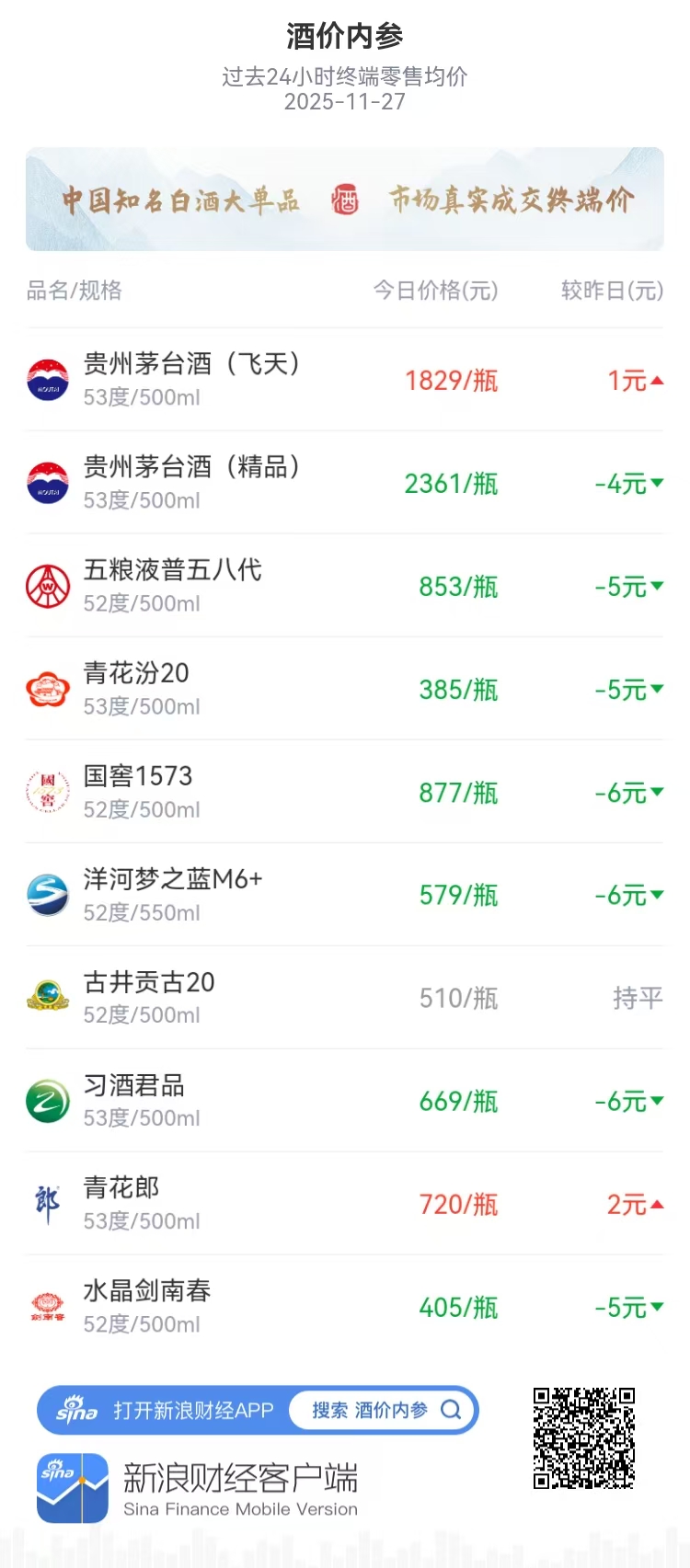
2025年第47周:酒行业周度市场观察
艾瑞咨询· 2025-11-27 00:04
Group 1: High-end Baijiu Industry Reflection - The high-end baijiu industry faces short-term challenges, but the core investment logic remains unchanged, with leading companies like Moutai and Wuliangye maintaining long-term investment value due to brand moat, high gross margins (over 85%), and stable cash flow [3][4] - Current inventory pressure is significant, with Moutai's price dropping below 1800 yuan, yet cultural foundations and business models support resilience [3] - Valuations have returned to reasonable levels, with Wuliangye's P/E ratio at 14 times, and high dividends (Luzhou Laojiao's dividend yield exceeds 6%) provide a safety net [3][4] Group 2: Instant Retail and Alcohol - Instant retail is rapidly penetrating the alcohol industry, but manufacturers experience uneven effects, with platforms like Douyin tightening regulations on low-price sales [5] - The online alcohol sales are primarily dominated by beer, with baijiu being less represented, indicating a need for balance between online and offline channels [5] - Challenges include high costs for distributors and risks of counterfeit products, necessitating a differentiated development approach rather than blindly following trends [5] Group 3: Domestic Wine Industry Challenges - The domestic wine industry faces a "bumper harvest but no profit" dilemma due to supply-demand imbalances, homogenization, and competition from imported wines [7] - Low capacity utilization and lack of product differentiation exacerbate the crisis, with high costs and weak industry chains further complicating recovery [7] - Solutions involve focusing on unique terroir characteristics, creating differentiated IP, and embracing new consumption scenarios to drive sustainable development [7] Group 4: E-commerce and Alcohol Market Dynamics - E-commerce platforms are aggressively using subsidies and low-price pre-sales to disrupt offline pricing, leading to conflicts with traditional alcohol distributors [12] - The market is experiencing a "tear and reconstruction" phase, with some distributors forced to supply online, creating a dependency relationship [12] - Future collaboration is essential, with e-commerce expanding breadth and alcohol distributors deepening service to achieve industry chain upgrades centered on consumer needs [12] Group 5: Young Consumer Trends - Young consumers are shifting their purchasing criteria from "value for money" to "worth it," with emotional resonance becoming a key factor in their buying decisions [15][16] - Products like Qingdao White Beer have gained popularity by aligning with emotional and quality expectations, reflecting a broader trend in consumer behavior [15][16] Group 6: Innovations in Alcohol Products - New product launches, such as the "No Rush Sparkling Yellow Wine," signify a shift towards value creation in the yellow wine industry, targeting younger consumers with innovative blends [18] - The introduction of limited-edition products, like the "Bingwu Horse Year Zodiac Wine" by Jianan Chun, highlights the importance of cultural significance and scarcity in appealing to high-end markets [37] Group 7: Industry Resilience and Transformation - The baijiu industry is transitioning from high-speed growth to a focus on quality, with leading brands maintaining their positions while smaller firms face increased pressure [11] - Companies are encouraged to concentrate on product quality, brand building, and operational efficiency to achieve sustainable growth amid industry adjustments [11] - The emergence of new business models, such as "group buying," reflects innovative approaches to address challenges like high inventory and price control [21]

泸州:奋楫逐新,逐浪长江畔
Si Chuan Ri Bao· 2025-11-26 21:52
新浪财经"酒价内参"重磅上线 知名白酒真实市场价尽在掌握 □卢世轩(图片由泸州市委宣传部提供) 清晨,泸州东门口。当第一缕阳光洒在长江与沱江交汇处,红嘴鸥掠过江面,泸州老窖国宝窖池 早已升腾起浓浓的酒香。 城市能级实现跃升 在热浪翻涌的国宝窖池旁边,"国字号"白酒博物馆四川中国白酒博物馆建设如火如荼。望向长江 边,"酒要会"项目也在加快推进,泸州正着力打造展示中国酒城魅力的"城市封面"。 老酒常新,城市向新,担当在心。 过去几年,泸州认真贯彻落实中央和省委决策部署,抢抓国家和全省多重战略叠加机遇,勇担经 济大市挑大梁的重任,全力以赴拼经济搞建设,持续用力抓改革强动能,用心用情惠民生增福 祉,以发展的成色酿就民生幸福的底色,以发展的成效让一域之光为全局添彩。 抢抓机遇 长江黄金水道和域内较为发达的水系,注定泸州这座城市与口岸经济相生相伴。泸州拥有四川最 大的水运港口——泸州港,连续5年获批国家临时开放水运口岸,集装箱吞吐量首次超过23万标 箱,水运货运量、货运周转量稳居全省第一。 省委十二届二次全会提出,支持泸州建设港口型国家物流枢纽城市和区域医药健康中心。泸州依 托西部陆海新通道、长江黄金水道和港口等优势,不 ...
五粮液为何跌到行业第三?
YOUNG财经 漾财经· 2025-11-26 11:56
Core Viewpoint - The article discusses the significant decline in Wuliangye's performance, leading to its drop to the third position in the A-share liquor market, primarily due to strategic missteps and market conditions [4][5][6]. Industry Overview - The liquor industry is undergoing a deep adjustment, with Wuliangye's revenue in Q3 2025 dropping by 52.66% year-on-year, marking its worst quarterly performance in nearly 20 years [4][6]. - The overall liquor production in China decreased by 9.9% year-on-year in the first nine months of 2025, reflecting a broader industry downturn [6]. Company Performance - Wuliangye's Q3 2025 revenue was 81.7 billion yuan, with a net profit of 20.2 billion yuan, both showing significant declines compared to previous years [4][6]. - In contrast, competitors like Moutai and Shanxi Fenjiu reported revenue growth during the same period, highlighting Wuliangye's underperformance [6][11]. Strategic Adjustments - The company is undergoing a strategic shift aimed at optimizing channels and stabilizing prices, which has led to short-term pain reflected in its financial results [7][12]. - Wuliangye's management has implemented measures such as reducing dealer quotas and controlling supply to stabilize prices, but these efforts have not yet yielded substantial results [12][14]. Management Changes - Frequent changes in Wuliangye's management have led to strategic inconsistencies, impacting the company's ability to respond effectively to market challenges [16][17]. - The restructuring of the sales team aims to improve coordination between brand, channel, and terminal sales, but has also created transitional challenges [17][18]. Product Strategy - Wuliangye's reliance on its flagship product, the "Eighth Generation Pu Wu," which accounts for over 60% of its revenue, poses risks as competition intensifies [19][20]. - The company has struggled to diversify its product offerings, leading to vulnerabilities in both high-end and mid-range markets [20]. Market Sentiment - Despite the poor performance, Wuliangye's stock price showed resilience, indicating that investors may have already adjusted their expectations following previous declines [21][24]. - The company announced a substantial dividend plan, which may help support its market valuation amid ongoing challenges [24]. Institutional Perspectives - There is a divide among analysts regarding Wuliangye's future, with some optimistic about its long-term brand strength and reform efforts, while others express concerns about ongoing operational challenges [25][26]. - The differing views reflect broader uncertainties in the liquor market, particularly regarding demand recovery and the effectiveness of Wuliangye's strategic adjustments [26].

中国银河证券:26年新消费具持续性但将内部轮动 传统消费有望迎来底部改善
Zhi Tong Cai Jing· 2025-11-26 11:06
Core Insights - The food and beverage index in early November showed a recovery, outperforming the broader market due to a shift in market style and a positive CPI growth rate [1][3] - The pre-processed food, baked goods, and dairy products sectors experienced the highest gains [1][3] - The konjac snack industry is expected to be highly prosperous in 2025, with a focus on the sustainability of this trend in 2026 [1] Group 1: Konjac Snack Industry - The konjac snack industry is projected to have strong growth in 2025, with companies like Salted Fish (002847) and Wei Long achieving significant revenue and stock price increases compared to the overall snack market [1] - The growth of konjac snacks is supported by health and taste trends, with potential for increased market penetration and innovation in "konjac+" products to attract new customers and boost repeat purchases [1] - The competitive landscape is favorable for leading companies, which are expected to maintain or increase market share through product innovation and supply chain capabilities [1] Group 2: Alcohol Industry Pricing - As of mid-November, the wholesale prices of Moutai have stabilized, with slight increases compared to the end of October, but still lower than the same period last year [2] - The prices of packaging materials have shown a mixed trend, with glass and PET prices decreasing, while aluminum and cardboard prices have increased [2] - Raw material prices for sugar, flour, palm oil, pork, and sunflower seeds have decreased year-on-year, while quail eggs and soybean prices have increased [2] Group 3: Food and Beverage Sector Performance - From November 1 to November 17, the food and beverage sector rose by 2.6%, matching the excess return of the overall A-share index [3] - Nine out of ten sub-sectors within the food and beverage industry reported positive returns, with pre-processed foods, baked goods, and dairy products leading the gains at 9.4%, 7.6%, and 4.5% respectively [3]

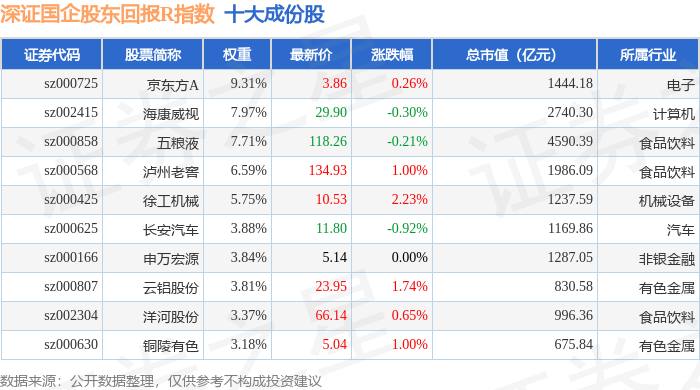
11月26日深证国企股东回报R(470064)指数涨0.1%,成份股中钢国际(000928)领涨
Sou Hu Cai Jing· 2025-11-26 10:35
Core Viewpoint - The Shenzhen State-Owned Enterprises Shareholder Return Index (470064) closed at 2205.76 points, with a slight increase of 0.1% on November 26, 2023, indicating mixed performance among its constituent stocks [1]. Group 1: Index Performance - The index recorded a trading volume of 19.838 billion yuan and a turnover rate of 0.78% on the same day [1]. - Among the constituent stocks, 16 companies experienced gains, with China Steel International leading with a 2.31% increase, while 33 companies saw declines, with China Merchants Shekou leading the drop at 1.77% [1]. Group 2: Top Constituents - The top ten constituents of the index include: - BOE Technology Group (9.31% weight) at 3.86 yuan, up 0.26%, with a total market value of 144.418 billion yuan [1]. - Hikvision (7.97% weight) at 29.90 yuan, down 0.30%, with a market value of 274.030 billion yuan [1]. - Wuliangye Yibin (7.71% weight) at 118.26 yuan, down 0.21%, with a market value of 459.039 billion yuan [1]. - Luzhou Laojiao (6.59% weight) at 134.93 yuan, up 1.00%, with a market value of 198.609 billion yuan [1]. - XCMG Machinery (5.75% weight) at 10.53 yuan, up 2.23%, with a market value of 123.759 billion yuan [1]. Group 3: Capital Flow - The constituent stocks of the index saw a net outflow of 421 million yuan from institutional investors, while retail investors experienced a net inflow of 148 million yuan [3]. - Notable capital flows include: - China National Materials (net inflow of 11.8 million yuan from institutional investors) [3]. - Luzhou Laojiao (net inflow of 69.6728 million yuan from retail investors) [3]. - XCMG Machinery (net inflow of 40.2421 million yuan from institutional investors) [3].