
台积电

Search documents
未知机构:光连接专家交流CPONPOLPOAOC技术进展客户订单价值量及拆分供应商-20260129
未知机构· 2026-01-29 01:50
Summary of Conference Call on Optical Interconnect Technologies Industry Overview - The discussion focused on optical interconnect technologies, specifically AOC (Active Optical Cable), LPO (Linear Passive Optical), NPO (New Passive Optical), and CPO (Coherent Passive Optical) [1][2][17]. Key Points and Arguments AOC Technology - AOC is defined as a fixed optical fiber module suitable for short-distance multimode transmission, particularly within 50 meters, as used by Google [2][19]. - AOC's cost structure was analyzed, with 800G AOC priced over a thousand dollars and 400G AOC costing several hundred dollars [2][19]. - AOC is expected to support 1.6T transmission capabilities in the future, although current limitations exist [20]. LPO Technology - LPO modules differ from traditional optical modules by omitting DSP (Digital Signal Processor), utilizing linear drive technology, and achieving a transmission distance of up to 500 meters [4][19]. - LPO is projected to see shipments of three to four million units in 2023, potentially doubling by 2027 due to demand from major clients like Google, Microsoft, and Meta [5][19]. - The combination of AOC and LPO is anticipated for different application scenarios, with AOC for short-distance interconnects and LPO for longer distances [19]. NPO Technology - NPO optical engines are compact, low-power, and do not require an external shell, making them suitable for high-density applications like AI accelerators [7][10]. - NPO technology is expected to mature and be sold to cloud providers and equipment manufacturers, with significant market potential [9][23]. - The cost of NPO components, such as the optical engine, is estimated to be around $35 to $40 per unit [26]. Market Dynamics - The market for 800G optical modules is currently in mass production, while 1.6T modules are still in early development, expected to mature in two to three years [5][6][22]. - The supplier landscape is concentrated, with limited opportunities for new entrants, particularly in the TIA (Transimpedance Amplifier) and driver chip sectors dominated by companies like Marvell [6][22]. Technical Challenges - The discussion highlighted challenges in the 200G optical module market regarding transmission distance and industry maturity [3]. - The transition from NPO to CPO technology was noted as technically feasible but with potential challenges in product form factor [9][23]. Future Trends - The integration of optical communication technologies in data centers is expected to grow, with a focus on reducing costs and power consumption while improving system latency [10][14]. - The potential for NPO to replace existing GB300 systems was discussed, contingent on its maturity and performance improvements [25]. Additional Important Content - The role of silicon photonics in NPO technology was emphasized, with key suppliers identified as Group, Tog, and TSMC [15][28]. - The discussion also touched on the advantages of glass substrates in CPU applications, highlighting their cost-effectiveness compared to ceramic and PCB substrates [27]. - The collaboration between Google and various suppliers for LPO technology was noted, with initial production expected from companies like Xuchuang [28]. This summary encapsulates the critical insights and developments in the optical interconnect technology sector as discussed in the conference call.
“存储超级周期”迎核爆级强化! DRAM霸主三星利润与营收齐创新高 半导体利润猛增465%
智通财经网· 2026-01-29 01:45
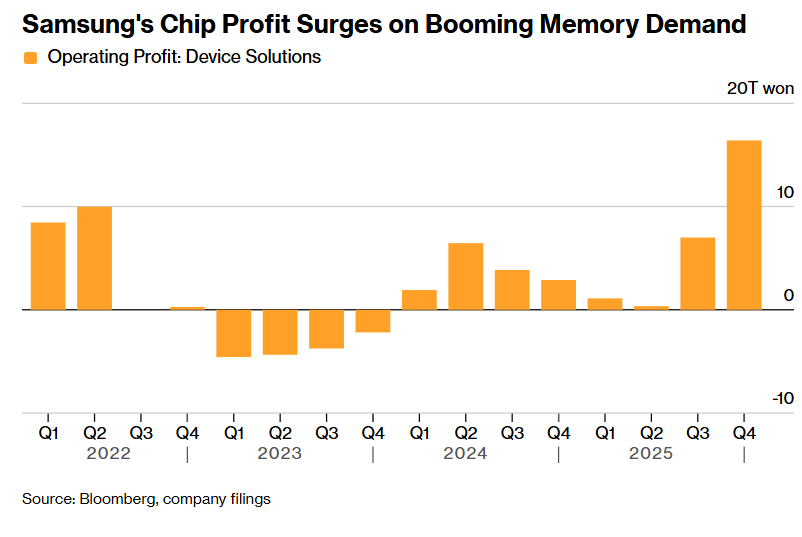
智通财经APP获悉,美国三大存储产品领军者之一的HDD霸主希捷科技,以及韩国存储芯片巨头SK海力士公布无 比强劲的业绩带动全球存储芯片/存储产品类股票集体狂欢之后,存储领域在今日可谓迎来"核爆级利好催化"。全 球最大规模DRAM存储芯片供应商三星电子(Samsung Electronics Co.)公布的最新业绩数据显示,该科技巨头旗下 的芯片业务以超过五倍的利润增幅超出几乎所有分析师预期,这无疑是史无前例的人工智能支出浪潮带动 DRAM/NAND存储芯片需求持续激增的超级重磅信号。 这家韩国科技巨头还计划扩大与AI训练/推理密切相关联芯片的销售规模,并且非常有望在第一季度开始向"AI芯 片超级霸主"英伟达(NVDA.US)交付其下一代高带宽存储系统——即HBM4存储系统。这是其在AI算力基础设施最 核心的技术环节之一,且高毛利的HBM存储产品市场份额上追赶另一韩国存储芯片巨头——整体市值规模逊于三 星的SK海力士(SK Hynix Inc.)的最为关键一步。 三星公布最新业绩显示,截至12月的三个月该公司芯片业务部门营业利润高达16.4万亿韩元(约合114亿美元),实 现同比暴增465%,而分析师们平均预期 ...

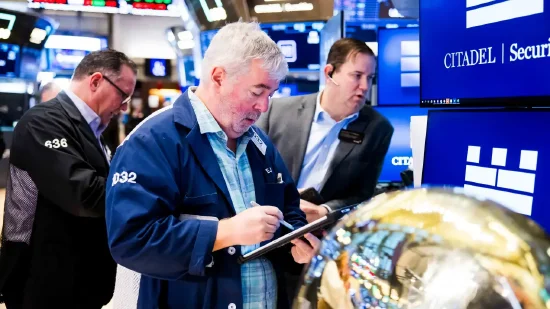
美股异动 | 英特尔(INTC.US)涨近9% 传将与英伟达就下一代GPU代工达成合作
智通财经网· 2026-01-28 15:18
据报道,供应链人士透露,英伟达将在与英特尔的合作中采用"量少、低阶、非核心"的合作策略。GPU 核心芯片仍由台积电 代工,而I/O芯片则部分采用英特尔18A或预定2028年量产的14A制程,最后由英 特尔EMIB进行先进封装。按先进封装比重计算,英特尔最高约占25%,台积电约占75%。 智通财经APP获悉,周三,英特尔(INTC.US)涨近9%,报47.85美元。消息面上,继苹果之后, 英伟达 计划将部分芯片制造业务转向英特尔代工。供应链人士透露,英伟达预计在2028年推出的Feynman架构 平台将与英特尔合作,这是美国科技巨头在特朗普政府推动"美国制造"目标下调整供应链策略的最新案 例。 ...

早盘:美股涨跌不一 标普500指数一度突破7000点
Xin Lang Cai Jing· 2026-01-28 15:11
北京时间1月28日晚,美股周三早盘涨跌不一,标普500指数一度突破7000点大关。市场关注美联储利率 决议,并等待一些重要科技公司公布财报。投资者普遍预计周三美联储将维持基准联邦基金利率不变, 今年将降息两次。 道指跌30.17点,跌幅为0.06%,报48973.24点;纳指涨125.32点,涨幅为0.53%,报23942.42点;标普 500指数涨13.18点,涨幅为0.19%,报6991.78点。 半导体设备巨头阿斯麦(ASML)在报告创纪录订单并因人工智能热潮发布强劲的2026年业绩指引后, 其美股股价大涨。 存储基础设施公司希捷科技(STX)宣布第二季度盈利和营收超预期,股价飙升。该公司首席执行官戴 夫·莫斯利(Dave Mosley)指出人工智能数据存储需求强劲。 多家科技巨头即将公布财报。微软、Meta Platforms和特斯拉将于周三收盘后公布季度财务业绩,苹果 将于周四公布财报。 标普500指数前一交易日收涨0.4%至历史新高,纳斯达克综合指数上涨0.9%。道琼斯指数30只成分股下 跌超400点,主要受联合健康股价暴跌近20%拖累。 除科技股财报外,据媒体周三报道称,英伟达H200人工智能芯 ...
AI“烧钱竞赛”迎来关键检验!微软(MSFT.US)、Meta(META.US)财报成风向标
智通财经网· 2026-01-28 13:15
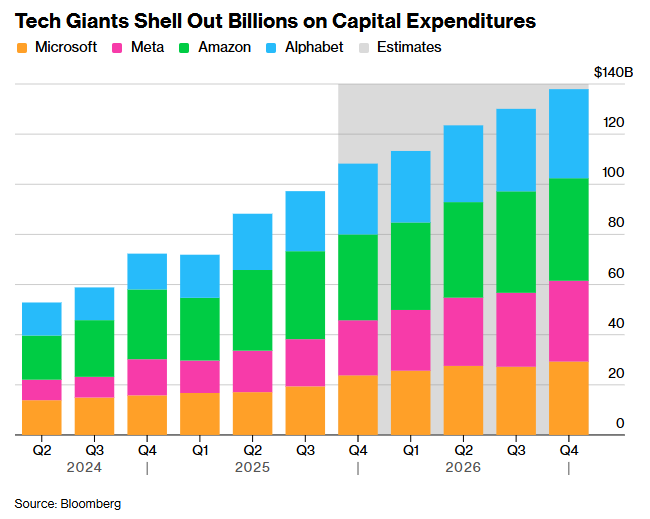
Core Viewpoint - Investors are concerned about the return on massive investments in artificial intelligence (AI) as Microsoft and Meta Platforms prepare to release their earnings reports, which may provide insights into the profitability of such expenditures [1][4]. Group 1: Company Earnings and Market Reactions - Microsoft and Meta are among the top four companies in the U.S. for AI spending, with a projected capital expenditure of approximately $505 billion in 2026, up from an estimated $366 billion in 2025 [1]. - Since the last earnings report on October 29, 2022, Microsoft's stock has dropped by 11%, while Meta's stock has decreased by about 10%, contrasting with a 1.3% increase in the S&P 500 index during the same period [1]. - Investors are closely monitoring the return on investment for these expenditures, with Jonathan Kofsky from Janus Henderson emphasizing that quarterly evaluations will be critical [1][4]. Group 2: AI Spending and Market Implications - Any indication that Microsoft and Meta plan to invest more than expected in AI could pressure their stock prices, while benefiting companies like Nvidia, Broadcom, and Micron that stand to gain from such spending [4]. - Seagate has reported strong demand for high-capacity hard drives, which is expected to continue at least until 2027, positively impacting the stock prices of related companies [4]. - Kofsky noted that investor expectations are that results will often meet or exceed the upper limits of projections, particularly for AI infrastructure companies like Nvidia and TSMC [4]. Group 3: Microsoft and Meta's Specific Challenges - For Microsoft, the focus will be on its Azure cloud computing business, which is experiencing strong demand for AI service development and operation [5]. - Azure's revenue is expected to grow by 38% year-over-year in the second quarter, following a 39% increase in the first quarter [5]. - Investors are also interested in the progress of Microsoft's Copilot product, which is a key AI software tool for office workers, although details on its contribution to overall sales growth remain limited [5]. Group 4: Meta's Growth Pressure - Unlike Microsoft, Meta lacks a cloud computing business and relies on AI to enhance advertising targeting and user engagement on its social media platforms [6]. - Meta faces significant pressure to demonstrate how its AI spending translates into growth, especially after a previous drop in stock price following its commitment to increased capital expenditures without clear return timelines [6]. - Market expectations for Meta's fourth-quarter revenue are optimistic, projecting a 21% increase to $58.4 billion, with earnings per share expected to rise by 2.1% to $8.19 [5].


环球市场动态:特朗普访华的可能性与潜在影响
citic securities· 2026-01-28 02:15
Market Overview - A-shares experienced slight gains with the Shanghai Composite Index up 0.18% to 4,139.90 points, while the Shenzhen Component rose 0.09%[15] - The S&P 500 index reached a new high, increasing by 0.41% to 6,978 points, supported by a strong performance in technology stocks[9] - European markets showed moderate gains, with the Euro Stoxx 600 up 0.6% and the UK FTSE 100 rising 0.58%[9] Currency and Commodity Trends - The US dollar index fell by 0.8%, leading to the euro surpassing 1.2 against the dollar[26] - Gold prices exceeded $5,100, and silver prices crossed the $110 mark, both reaching record highs[26] - Oil futures rose to their highest levels since October 2022, with NY crude oil up 2.9% to $62.39 per barrel[26] Economic Indicators - The US consumer confidence index dropped to its lowest level in over 11.5 years, impacting market sentiment[9] - The US Treasury yield curve steepened, with the 10-year yield rising to 4.24% and the 30-year yield reaching 4.86%[29] Corporate Highlights - Mobileye reported a decline in revenue due to low customer inventory but anticipates a rebound in Q1 2026 as customers restock[7] - Vale's iron ore production reached 336.1 million tons in 2025, the highest since the 2019 dam disaster, maintaining production guidance for 2026 at 335-345 million tons[7] Geopolitical Developments - Trump's potential visit to China in April 2026 could focus on US manufacturing investment, impacting China's manufacturing sector and pricing power[5] - The EU and India finalized a free trade agreement after nearly 20 years of negotiations, which may influence market dynamics[5]
跌超19%,拖累道指,黄金、原油齐涨
Zhong Guo Ji Jin Bao· 2026-01-28 00:31
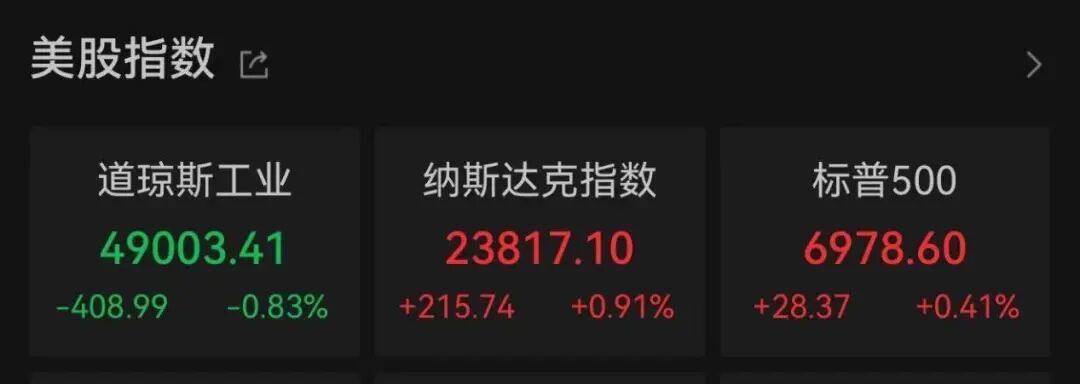
美东时间1月27日(周二),美股三大指数涨跌不一。受科技股和芯片股提振,标普500指数和纳斯达克综合指数收涨;拖累道琼斯指数收跌,成份股联合 健康集团跌超19%。 道指收跌 截至收盘,标普500指数上涨0.41%,报6978.60点;纳斯达克综合指数上涨0.91%,报23817.10点;道琼斯指数下跌0.83%,报49003.41点。 隔夜美股市场,科技和芯片股走高,提振市场;联合健康集团大跌,拖累道指。国际金价继续攀升,原油价格同步上涨。此外,周三美股盘中,美联储将 宣布今年的首次政策决定,共同关注。 近日,美元指数持续下跌。美国总统特朗普释放美元贬值信号,表示并不担心美元下跌。 关税方面,美国贸易政策持续调整,对印度商品仍维持50%的关税税率,同时威胁将韩国部分商品的关税提高至25%,并要求韩国在数字事务上不要歧视 美国企业。贸易政策的不确定性可能加剧市场对贸易环境的担忧。 此外,周三美股盘中,美联储将宣布今年的首次政策决定。 费城半导体指数收于新高 费城半导体指数上涨2.40%。美光科技涨超5%,科天半导体、应用材料涨超4%,阿斯麦、台积电等均收涨。 据报道,美光科技宣布了一项价值240亿美元的投资计划 ...
隔夜欧美·1月28日
Sou Hu Cai Jing· 2026-01-27 23:42
Market Performance - The three major US stock indices closed mixed, with the Dow Jones down 0.83% at 49,003.41 points, the S&P 500 up 0.41% at 6,978.6 points, and the Nasdaq up 0.91% at 23,817.1 points [1] - Major European indices showed mixed results, with Germany's DAX down 0.07% at 24,916.7 points, France's CAC40 up 0.27% at 8,152.82 points, and the UK's FTSE 100 up 0.58% at 10,207.8 points [1] Sector Performance - Technology stocks generally rose, with Intel up over 3% and Amazon up over 2% [1] - Popular Chinese concept stocks had mixed performances, with TSMC up 1.67%, Alibaba up 0.78%, Pinduoduo up 0.05%, and Baidu up 1.00% [1] Commodity Prices - COMEX gold futures increased by 1.91% to $5,179.60 per ounce, while COMEX silver futures fell by 2.73% to $112.34 per ounce [1] - International oil prices rose collectively, with WTI crude oil up 3.2% at $62.57 per barrel and Brent crude oil up 2.98% at $66.71 per barrel [1] Currency and Bond Markets - The US dollar index fell by 1.34% to 95.7455, while the offshore RMB appreciated by 156.2 basis points to 6.9336 against the US dollar [1] - US Treasury yields were mixed, with the 2-year yield up 0.64 basis points at 3.596% and the 10-year yield up 2.79 basis points at 4.243% [1] - European bond yields rose collectively, with the UK 10-year yield up 2.8 basis points at 4.523% [1]
混合键合设备:AI算力时代的芯片互连革命与BESI的领航之路
材料汇· 2026-01-27 15:17
Core Viewpoint - Advanced packaging is emerging as a new engine for computing power in the "post-Moore's Law" era, addressing the limitations of traditional chip performance improvements through innovative bonding technologies [4][5]. Group 1: Hybrid Bonding Overview - Hybrid bonding is an advanced packaging technology that combines dielectric bonding and metal interconnects, allowing for high-density, high-performance 3D integration [8][19]. - The development of hybrid bonding has evolved through various stages, from wire bonding to flip chip, and now to hybrid bonding, which enables ultra-fine pitch stacking and packaging [10][11]. - Hybrid bonding can be categorized into wafer-to-wafer (W2W) and chip-to-wafer (C2W) processes, with C2W offering higher flexibility and lower defect rates for smaller chips [14][16]. Group 2: Advantages and Challenges of Hybrid Bonding - The technology allows for extreme interconnect density and performance breakthroughs, achieving interconnect pitches below 1 μm, significantly enhancing data transfer bandwidth [23]. - Hybrid bonding is compatible with existing wafer-level manufacturing processes and can be integrated with TSV and micro-bump technologies, providing cost optimization potential [24]. - Challenges include yield issues, surface smoothness requirements, cleanliness standards, and complex testing processes that need to be addressed for successful mass production [26]. Group 3: Market Demand and Future Prospects - Major HBM manufacturers, including Samsung, Micron, and SK Hynix, have committed to adopting hybrid bonding technology for HBM5, which aims to meet the extreme demands of AI and high-performance computing [28]. - TSMC's SolC technology, which utilizes hybrid bonding, is expected to double its production by 2026, highlighting the growing adoption of this technology [29][30]. - The global market for hybrid bonding equipment is projected to exceed $600 million by 2030, with significant growth anticipated in the Asia-Pacific region [37]. Group 4: Competitive Landscape - The hybrid bonding equipment market is dominated by international players such as BESI, EV Group, and SUSS MicroTec, with BESI holding a market share of 67% in 2023 [44]. - The competitive landscape is evolving, with Chinese companies like Piotech entering the market, indicating advancements in domestic semiconductor equipment capabilities [42].


携手谷歌开发AI芯片,联发科两日暴涨19%创历史新高
智通财经网· 2026-01-26 10:22
摩根士丹利分析师Charlie Chan等人在上周五的一份报告中写道,看到联发科的AI专用集成电路"潜力巨 大"。分析师补充说,尽管谷歌也在与博通(AVGO.US)合作开发TPU,但随着联发科将更多与智能手机 相关的资源转向AI相关芯片,可能会获得更多增长。 周一,联发科与其他主要科技公司(包括芯片制造商南亚科技和联华电子)一同推动台湾基准股指加权指 数创下历史新高。台积电股价下跌0.9%。 晨星公司分析师Phelix Lee表示,联发科的最新业绩指引看起来较为保守,仅反映了截至10月的前景以 及来自谷歌的订单。他认为,市场可能希望公司最终能超越其目标。 智通财经APP获悉,受与谷歌(GOOGL.US)达成AI芯片合作的利好消息刺激,联发科股价强势攀升,近 两日累计暴涨19%,刷新历史最高纪录,市场投资热情被迅速点燃。 这家在台北上市的公司股价周一飙升8.6%,实现了连续两个交易日累计19%的上涨,并收于历史新高。 随着市场对联发科参与谷歌应用于人工智能的芯片张量处理单元(TPU)开发工作的认知度不断提高,这 轮涨势延续了其为期两个月的上涨行情。 由于对台积电的持股触及上限,部分基金经理正转而涌入联发科等其他 ...
