
华熙生物

Search documents
商贸零售行业周报:零售企业经营持续承压,关注高景气优质公司-20250505
KAIYUAN SECURITIES· 2025-05-05 15:25
Investment Rating - The industry investment rating is optimistic (maintained) [1] Core Insights - Retail enterprises are under continuous operational pressure, with a focus on high-prosperity quality companies [4][24] - The overall revenue of the retail industry decreased by 1.8% in 2024 and 13.3% in Q1 2025, while the net profit attributable to the parent company decreased by 20.6% and 21.3% respectively [4][24] - The jewelry sector faced revenue declines of 4.9% in 2024 and 25.9% in Q1 2025, with net profit declines of 17.7% and 18.8% respectively [4][33] - The beauty care sector showed a revenue increase of 5.3% in 2024 but a slight decline of 1.7% in Q1 2025, with net profit declines of 17.5% and 21.7% respectively [4][28] - The cross-border e-commerce sector experienced significant growth, with revenue increases of 31.9% in 2024 and 28.8% in Q1 2025, while net profit showed a decline of 4.6% and an increase of 4.9% respectively [4][38] Summary by Sections Retail Market Overview - The retail industry index decreased by 1.72% in the week of April 28 to April 30, 2025, underperforming the Shanghai Composite Index [6][15] - The beauty products sector had the highest growth, with a weekly increase of 7.49% and a year-to-date increase of 12.66% [15][19] Industry Dynamics - The financial reports for 2024 and Q1 2025 indicate that retail enterprises are facing operational challenges, with a focus on high-prosperity sectors [4][24] - The jewelry sector is under pressure due to rising gold prices affecting consumer demand and operational challenges for weaker franchisees [4][33] - The beauty care sector remains relatively stable, with strong performance from differentiated beauty brands [4][28] Investment Recommendations - Focus on traditional retail companies that adapt to consumer trends, such as Yonghui Supermarket and Aiyingshi [7][43] - Highlight jewelry brands with differentiated product offerings, recommending brands like Laopu Gold and Chaohongji [7][43] - Emphasize domestic beauty brands that are expanding into high-prosperity segments, recommending brands like Maogeping and Shangmei [7][44] - Target upstream medical beauty product manufacturers with strong profitability, recommending companies like Aimeike and Kedi [7][44]





国货美妆TOP10强变了
3 6 Ke· 2025-05-02 02:10
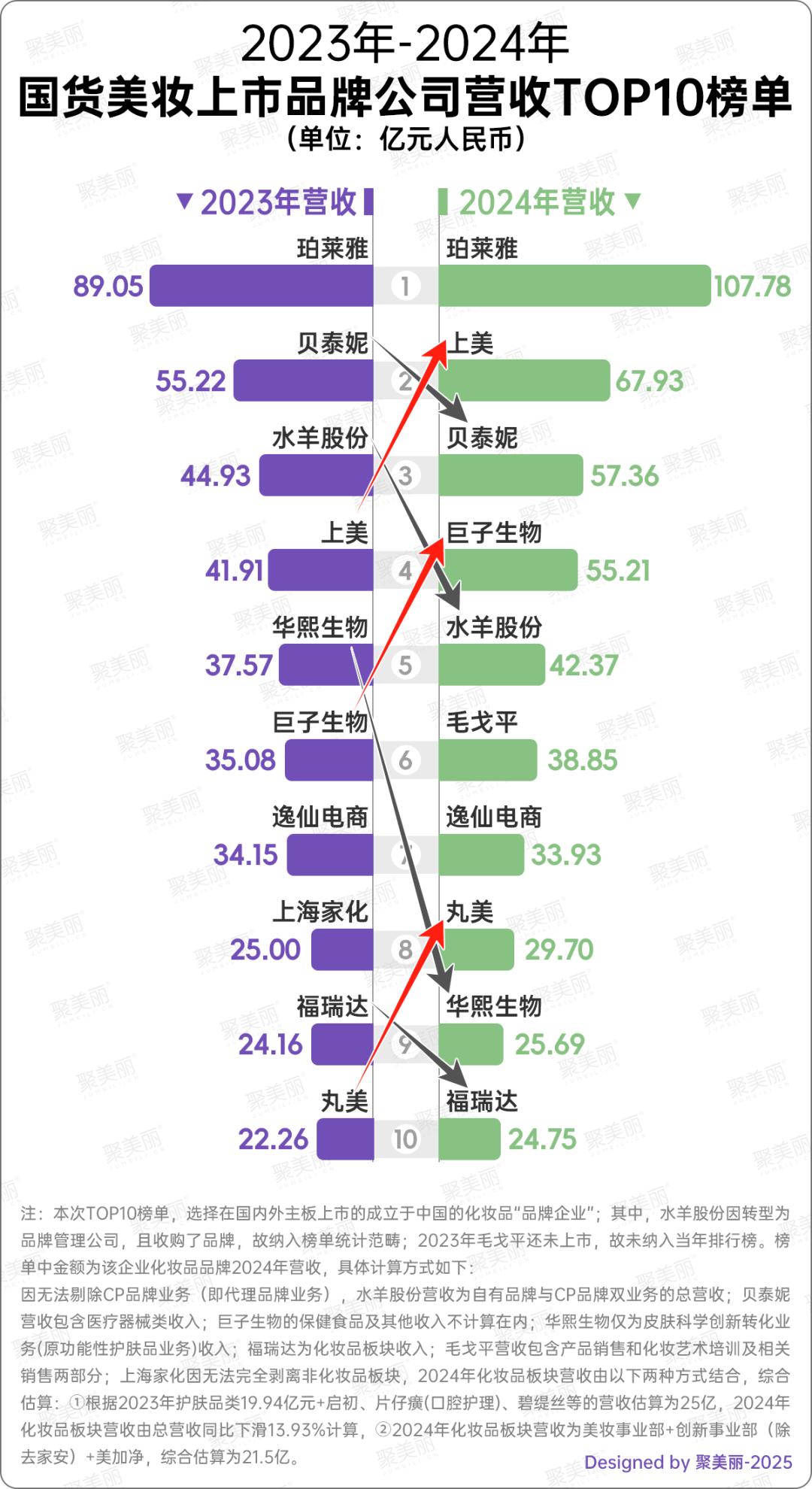
Group 1 - The beauty industry in China is witnessing a shift in the top 10 revenue rankings, with Proya leading at 10.778 billion, marking a significant milestone as the first domestic beauty brand to surpass 10 billion in revenue [1][8] - The entry of Mao Geping into the top 5 and the drop of Shanghai Jahwa from the top 10 indicates a dynamic change in the competitive landscape [1][3] - The revenue threshold for entering the top 10 has increased to nearly 2.5 billion, reflecting a more competitive environment compared to previous years [1] Group 2 - The top five companies have experienced a turnover, with companies like Shiseido and Juzhibio showing over 30% growth, while others like Huaxi and Beitaini have faced declines or stagnant profits [3] - Proya's main brand revenue ceiling has been raised to 8.581 billion, with a notable gap of nearly 3 billion between it and the next highest brand [8] - Han Shu has achieved a significant milestone by surpassing 5 billion in revenue, reaching 5.591 billion with an impressive growth rate of 80.9% [8] Group 3 - Online sales channels are crucial for the success of domestic beauty brands, with Proya, Shiseido, and Water Sheep achieving over 90% of their revenue from online sales [14] - Despite the strong online performance, the offline sales channels have seen a decline, with companies like Mao Geping and Shiseido managing to achieve double-digit growth in offline sales [15][14] - The overall sales structure indicates a need for brands to balance their online and offline strategies to sustain growth [11] Group 4 - Research and development (R&D) investments among the top 10 companies have increased, with total R&D spending rising from 1.559 billion to 1.753 billion [19] - Companies like Huaxi and Beitaini are leading in R&D expenditures, with Huaxi investing 466 million, representing 8.68% of its total revenue [19][20] - The competitive landscape is evolving, with an emphasis on scientific innovation and new product development becoming essential for maintaining market position [21][22] Group 5 - The beauty industry is expected to face challenges in 2024, with increased competition and a more complex market environment [21] - The competitive dynamics are shifting, as companies like Shiseido leverage innovative marketing strategies to secure their positions [22] - The future of the industry will require continuous evolution and adaptation from all players to remain relevant and competitive [23]


铁打的高毛利,流水的“医美茅”:胶原蛋白捧出山西女首富,玻尿酸富豪们身家大跌
Sou Hu Cai Jing· 2025-05-02 00:35
Group 1 - The core viewpoint of the articles highlights the rapid rise of recombinant collagen in the medical beauty and skincare industry, challenging the dominance of hyaluronic acid [1][2][16] - Jinjian Biological's stock price has surged over 100% since the beginning of the year, reaching a historical high of 442.00 yuan per share, with a listing price of 49 yuan per share in 2023 [1] - The founder of Jinjian Biological, Yang Xia, has seen a significant increase in wealth, ranking 2295th on the Hurun Global Rich List with a net worth of approximately 11.5 billion yuan, up 455 places year-on-year [1] Group 2 - The wealth of founders in the hyaluronic acid sector, such as Zhao Yan of Huaxi Biological and Jian Jun of Aimeike, has declined, indicating a shift in the industry landscape [2] - Huaxi Biological reported a revenue of 5.371 billion yuan in 2024, a year-on-year decrease of 11.61%, and a net profit decline of 70.59% [19] - Aimeike's revenue for 2024 was 3.026 billion yuan, with a slight growth of 5.45%, but faced a decline in net profit [19] Group 3 - Jinjian Biological's revenue for 2024 reached 1.443 billion yuan, a year-on-year increase of 84.92%, with a net profit of 732 million yuan, up 144.27% [6] - The company achieved a gross margin of 95.03% in its medical device segment, surpassing the gross margin of Kweichow Moutai [7] - Jinjian Biological's focus on medical devices and functional skincare products has positioned it as a strong competitor in the market [6][14] Group 4 - The competitive landscape is shifting, with Jinjian Biological and Juzhi Biological both expanding into medical beauty injections, potentially leading to direct competition [13][17] - Jinjian Biological has received approval for its injectable recombinant collagen gel, indicating ongoing product development and market expansion [14] - The industry is witnessing a trend towards international expansion, with companies like Jinjian Biological and Huaxi Biological exploring overseas markets [24][25] Group 5 - The financial performance of Chuangjian Medical has declined, with a revenue of 288.2 million yuan in 2024, a growth of only 1.82%, and a net profit drop of 50.84% [6][15] - Chuangjian Medical is attempting to pivot towards terminal products, including medical devices and cosmetics, but lacks strong competitive advantages [14][15] - The overall market for recombinant collagen is still in its early stages of international expansion, with companies planning to enhance their global presence [25]

国货美妆十强榜单揭晓:百亿时代,谁在引领变革?
FBeauty未来迹· 2025-04-30 09:27
2 0 2 4年在国货美妆发展史上是值得记录一年: 一方面,国内诞生首个突破百亿美妆企业,珀莱雅以1 0 7 . 7 8亿元营收首次跻身"百亿俱乐部", 成 为 行 业 里 程 碑 事 件 ; 同 时 , 十 强 门 槛 抬 高 至 近 3 0 亿 元 , 前 十 总 营 收 规 模 扩 大 至 5 4 3 . 7 7 亿 元。 另一方面,前十座次发生较大变化,毛戈平首次闯入榜单,上海家化、华熙生物等企业持续步 入变革期深水区,迎来业绩"震荡"。 在"突飞猛进"与震荡调整并存的阶段,头部国货企业的发展预示着行业怎样的未来? 综 合 2 0 2 1 年 至 2 0 2 4 年 国 货 美 妆 上 市 企 业 十 强 榜 单 情 况 来 看 , 可 以 发 现 , 名 次 发 生 了 较 大 变 化。每一年的前三名都不相同,并且持续有"突围者"闯入榜单,例如2 0 2 4年的毛戈平。 | | | | 2021年至2024年国货美妆上市企业十强榜单 | | | | | | | | | | | --- | --- | --- | --- | --- | --- | --- | --- | --- | --- | -- ...

美妆财报观察丨“二代”接班后首份成绩单:珀莱雅营收破百亿 线上增速放缓
2 1 Shi Ji Jing Ji Bao Dao· 2025-04-29 09:54
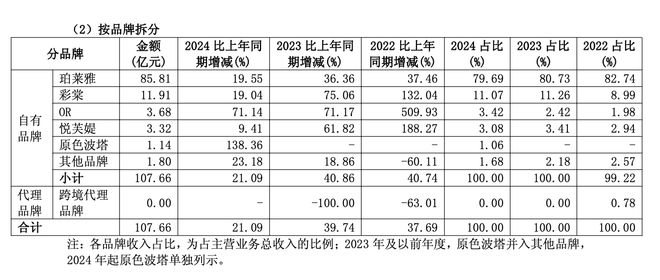
Core Viewpoint - The company, Proya (珀莱雅), has demonstrated resilience in the beauty industry with significant revenue and profit growth, contrasting with the declining performance of other A-share beauty companies [2][14]. Financial Performance - In 2024, Proya's revenue reached 10.778 billion yuan, a year-on-year increase of 21.04%, with net profit attributable to shareholders at 1.552 billion yuan, up 30.00% [2][4]. - For Q1 2025, revenue continued to grow by 8.13% to 2.359 billion yuan, and net profit increased by 28.87% to 390 million yuan [2]. - The main brand, Proya, contributed 8.581 billion yuan to the total revenue, accounting for nearly 80% of the total [5]. Brand Performance - The main brand's revenue growth slowed to 19.55% in 2024, compared to previous years' growth rates of 28.25%, 37.46%, and 36.36% [6]. - The brand has launched new product lines, including the "净源系列" for oily skin and the "光学系列" for whitening, to expand its market presence [6][7]. - The 彩棠 brand, which targets the Chinese market, generated 1.191 billion yuan in revenue, growing 19.04% year-on-year, and is becoming a second growth driver for the company [10]. Sales Channels - Online sales accounted for 95.06% of total revenue, contributing 10.234 billion yuan, although the growth rate has slowed to 23.68% compared to previous years [11][12]. - Offline sales decreased by 13.63% to 532 million yuan, with the revenue share dropping from 9.02% in 2022 to 4.94% in 2024 [14]. - The company has increased its marketing expenses significantly, with sales expenses reaching 5.161 billion yuan, representing 47.88% of total revenue [13]. Industry Context - Other A-share beauty companies, such as Shanghai Jahwa and Huaxi Biological, reported declines in revenue and profits, highlighting the challenging environment for the beauty industry [14][15].
福瑞达一季报|业绩双降、化妆品业务增长失速 经营活动不造血、资金链承压
Xin Lang Zheng Quan· 2025-04-29 08:23
Core Insights - The company is facing a deep crisis during its transformation period, with financial results showing a decline in revenue and net profit, indicating a struggle with dual weak business segments and cash flow issues [1] - The cosmetics segment, which accounts for over 60% of revenue, is experiencing significant challenges, with reliance on a single product leading to an imbalanced brand portfolio [2] - The strategic transition towards a dual business model of pharmaceuticals and cosmetics is hindered by slow innovation and cash flow deterioration, raising concerns about the company's market competitiveness [3] - To overcome its challenges, the company needs to strengthen its core competencies, innovate in product development, and optimize capital efficiency [4] Financial Performance - Revenue for Q1 2025 was 876 million yuan, a year-on-year decline of 1.63% [1] - Net profit attributable to shareholders was 51 million yuan, down 14.10% year-on-year [1] Cosmetics Business Challenges - The cosmetics segment's over-reliance on a single bestselling product has led to a structural imbalance, with other brands experiencing significant revenue declines [2] - High sales expenses have not translated into sustainable growth, resulting in increased accounts receivable and inventory issues [2] - Online sales growth is lagging behind industry averages, while offline channels are suffering from reduced foot traffic [2] Strategic Transition Issues - The pharmaceutical segment's revenue has slightly decreased, and new product trials have shown limited success [3] - The company's claims of integrating AI and data into its operations remain largely conceptual, with significant challenges in product line management and innovation [3] - Cash flow issues are exacerbated by rising accounts receivable and shortened accounts payable cycles, indicating weakened bargaining power [3] Recommendations for Improvement - The company must solidify its technological barriers in the cosmetics sector and innovate active ingredients to reduce reliance on bestsellers [4] - Accelerating the research and development of pharmaceutical products and genuinely integrating AI into product development processes is crucial [4] - Improving capital efficiency and focusing on strategic initiatives rather than blind expansion is necessary to regain market share [4]

财报面面观|旧胄溃退,新贵登场:美妆行业内卷重构
Zhong Guo Ji Jin Bao· 2025-04-29 03:29
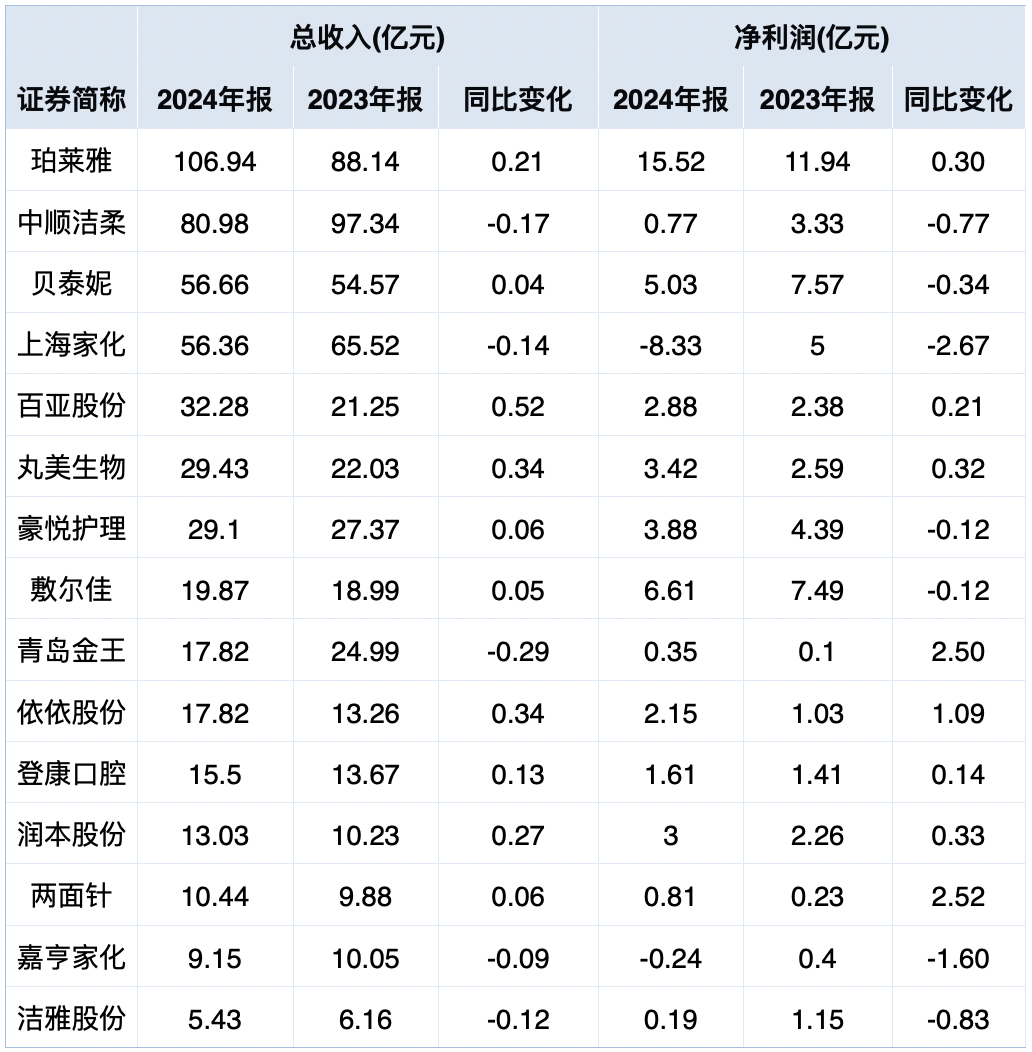
Core Viewpoint - The performance of beauty companies listed in 2024 reflects a challenging environment, with many traditional giants facing significant losses while some emerging brands show strong growth [1][2]. Industry Overview - In 2024, China's total retail sales of consumer goods grew by 3.5%, but the retail sales of cosmetics declined by 1.1%, amounting to 435.65 billion yuan [2]. - The overall industry is experiencing a downturn, leading to price cuts and store closures by several foreign brands [2]. - Major companies like Shanghai Jahwa reported a loss of 833 million yuan, highlighting the struggles of established players [2][4]. Company Performance - As of April 27, 2024, 15 A-share cosmetic companies reported a total revenue of 50.081 billion yuan, a year-on-year increase of 3.59%, but net profit fell to 3.765 billion yuan, down from 5.127 billion yuan [4]. - Notable performances include: - Proya achieved revenue of 10.778 billion yuan, becoming the first domestic beauty brand to surpass 10 billion yuan [2][11]. - Shanghai Jahwa's revenue decreased by 13.93% to 5.679 billion yuan, with a net profit loss of 833 million yuan [6]. - Betaini reported revenue of 5.736 billion yuan, up 3.87%, but net profit fell by 33.53% to 503 million yuan [8]. - Huaxi Biological's revenue dropped by 11.61% to 5.371 billion yuan, with net profit down 70.59% to 174 million yuan [8]. Emerging Brands - New entrants like Gu Yu Biotechnology are preparing to enter the capital market, showcasing strong growth with a revenue of 4 billion yuan and GMV exceeding 5 billion yuan [14][15]. - Gu Yu's success is attributed to its focus on a unique ingredient and effective online marketing strategies, although its reliance on a single product category may pose future challenges [15]. Market Trends - The market is witnessing a shift where traditional giants are retracting while new players are emerging, indicating a potential reshaping of the industry landscape [10][14]. - The global beauty market is expected to see a coexistence of domestic brands leading in niche segments while foreign brands focus on high-end markets [16].
华熙生物(688363):国内首款Ⅲ类械水光产品落地 期待皮肤科学创新转化业务变革成效落地
Xin Lang Cai Jing· 2025-04-29 02:40
Core Viewpoint - The company reported a decline in revenue and net profit for Q1 2025, but showed signs of improvement compared to the previous quarter, with expectations for gradual transformation effects to materialize [1][2]. Financial Performance - In Q1 2025, the company achieved revenue of 1.078 billion yuan, a year-on-year decrease of 20.77% [1]. - The net profit attributable to shareholders was 102 million yuan, down 58.13% year-on-year [1]. - Compared to Q4 2024, the net profit increased by approximately 290 million yuan, and when excluding impairment losses, the net profit rose by about 180 million yuan [2]. Business Segments - The bioactive substances and medical terminal businesses remained stable in Q1 2025, with accelerated R&D, registration, and marketization of new raw materials and pipelines [2]. - The skin science innovation transformation business is still undergoing an adjustment period, prompting the chairman and general manager to take a more hands-on management approach [2]. - The company launched the first Class III medical device for facial skin quality improvement, which is expected to contribute positively to the medical terminal business [2]. Future Outlook - The company anticipates revenue growth for 2025-2027, with projected revenues of 5.774 billion, 6.362 billion, and 7.221 billion yuan, corresponding to growth rates of 7.5%, 10.2%, and 13.5% respectively [3]. - The net profit attributable to shareholders is expected to be 455 million, 530 million, and 628 million yuan for the same period, with growth rates of 161.2%, 16.3%, and 18.7% respectively [3]. - Earnings per share (EPS) are projected to be 0.94, 1.10, and 1.30 yuan per share for 2025-2027 [3].
美护商社行业周报:珀莱雅收入破百亿,泡泡玛特25Q1海外大增-20250428
Guoyuan Securities· 2025-04-28 14:46
Investment Rating - The report maintains a "Recommendation" rating for the consumer discretionary sector [5] Core Insights - The beauty and personal care segment shows strong growth, with companies like Proya achieving over 10 billion RMB in revenue for the first time, and significant increases in net profit [3][26] - The retail sector is expanding, with ALDI opening new stores and achieving record sales, while companies like Yonghui Supermarket are recovering from previous losses [25][34] - The travel and leisure industry is also seeing growth, with increased flight operations and significant revenue increases for companies like Xiangyuan Culture [21][34] Summary by Sections Market Performance - For the week of April 21-25, 2025, the Shenyin Wanguo indices for retail, social services, and beauty care sectors showed mixed performance, with beauty care up by 3.80% [10][12] - The beauty care sub-sector outperformed others, with individual products and cosmetics increasing by 7.11% and 4.89% respectively [11] Key Industry Data and News - Proya's revenue for 2024 reached 10.778 billion RMB, marking a 21% increase, while its net profit rose by 30% [3][26] - Other companies like Marubi and Betaini also reported significant revenue growth, with Marubi's revenue increasing by 33.4% in 2024 [3][29] - The travel sector saw a rise in flight operations, with nearly 106,000 flights executed in the week of April 14-20, 2025, reflecting an 8.7% increase year-on-year [21][23] Key Company Announcements - Proya's Q1 2025 revenue was 2.359 billion RMB, a year-on-year increase of 8.13% [26] - Marubi reported a Q1 2025 revenue of 847 million RMB, up 28.01% from the previous year [29] - Bubble Mart's Q1 2025 revenue surged by 165%-170%, with overseas revenue increasing by over 475% [33]


一片面膜40元,陕西女富豪年赚20亿
创业邦· 2025-04-28 09:47
以下文章来源于财经天下WEEKLY ,作者财经天下 财经天下WEEKLY . 《财经天下》周刊官方账号,提供有品质的深度报道,讲述中国企业在时代浪潮中的精彩故事。 来源丨财经天下WEEKLY(ID:cjtxweekly) 作者丨林木 编辑丨吴跃 图源丨Midjourney 因为陷入"EGF(表皮生长因子)罗生门",可复美近期被推上风口浪尖。 不久前,有消费者反映可复美产品"违规添加EGF"。随后可复美母公司巨子生物予以否认,称"旗下所有 产品均未添加"。伴随着舆论发酵,社媒平台上,看客们吵得沸沸扬扬,力挺声、质疑声四起,也让"可 复美"这个名字被更多人知晓。 做过医美或者皮肤敏感的消费者,大多对"可复美"三个字不陌生。这个主打皮肤修复的品牌,早年间主 要深耕院线渠道,之后乘上直播电商风口,进入更多人视野,撬开更多钱包。过去6年,其母公司巨子生 物营收从9.57亿元涨至55.39亿元,翻了5倍多。 2024年,巨子生物一举超越珀莱雅,成为市值最高的国货美妆公司,此后一直保持至今。公司创始人, 现年59岁的陕西人范代娣,也因此登顶国货美妆首富。 95后女生冯琳第一次知道"可复美",是被皮肤敏感的姐姐种草的。202 ...