中金黄金

Search documents
史上首次!纽约期金上4000,商场黄金被抢购,婚嫁金火到排队
Sou Hu Cai Jing· 2025-10-08 11:00
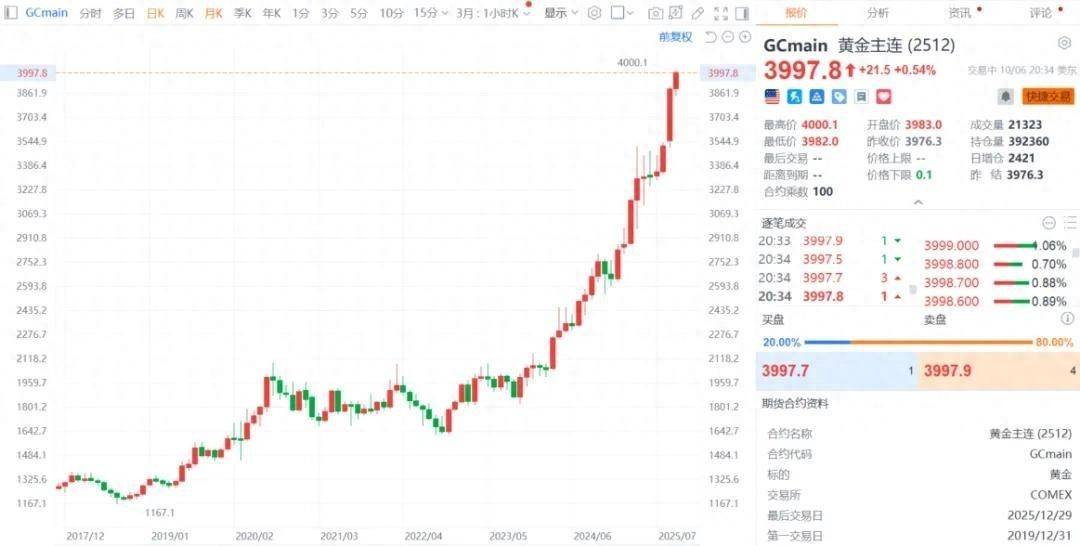
Core Insights - Spot gold has historically surpassed $3980 per ounce, with New York futures crossing $4000 per ounce, and domestic gold prices reaching around 1100 RMB per gram [1][5] - The surge in gold prices is attributed to multiple factors, including U.S. government shutdown risks, persistent geopolitical tensions, dovish signals from the Federal Reserve, and uncertainties in global economic recovery [3][5] - The demand for gold as a safe-haven asset is increasing, with significant retail activity observed during the holiday season, indicating a shift in consumer sentiment towards gold [5][9] Price Movements - Gold prices have seen a dramatic increase from $2625 in January to $4000 in October, reflecting a nearly continuous upward trend with minimal pullbacks [5][9] - The price of gold in China has also risen sharply, with domestic gold jewelry prices exceeding 1100 RMB per gram, marking a significant increase from previous levels [3][5] Market Dynamics - The gold mining sector is experiencing robust growth, with companies reporting increased revenues and profits, and a strong interest in expanding production capabilities [8][9] - Despite a decline in gold jewelry consumption in the first half of 2025, the recent holiday season has brought renewed activity in gold retail, suggesting a potential recovery in consumer demand [8][9] Future Outlook - Analysts predict that gold prices are likely to remain strong, supported by ongoing central bank purchases and macroeconomic uncertainties [9][11] - The World Gold Council forecasts record-high global gold demand in 2024, with central banks expected to purchase over 1000 tons of gold, further underpinning the market [9][11] - The volatility in gold prices is expected to continue, with market dynamics influenced by geopolitical risks and economic conditions [11]

国家连年降低电价,用户为何却表示越降越贵,3大原因很现实
Sou Hu Cai Jing· 2025-10-08 00:44
Core Insights - The article discusses the paradox of decreasing electricity prices while household electricity bills are increasing, highlighting a disconnect between official data and consumer experiences [1][2]. Group 1: Electricity Price vs. Electricity Bill - Official data indicates that electricity prices have been decreasing, with a cumulative reduction of approximately 0.15 yuan per kilowatt-hour from 2022 to mid-2025 for general industrial and commercial electricity [1][2]. - Despite the decrease in electricity prices, 68.3% of surveyed households reported an increase in electricity expenses over the past three years, with an average increase of 23.7% [1][2]. Group 2: Factors Contributing to Increased Electricity Bills - The primary driver of increased electricity bills is the explosive growth in household electricity consumption, attributed to the rise in the number and power of household appliances. The average number of appliances per urban household increased from 16.3 in 2020 to 22.7 in 2025, a growth of 39.3% [3][6]. - The adoption of electric vehicles (EVs) has also significantly contributed to increased household electricity consumption, with over 2.51 million charging stations established by mid-2025, representing an 82% increase from the end of 2023 [6]. - The tiered pricing system in China, which charges higher rates for increased consumption, exacerbates the situation. For instance, in Beijing, the price for the first tier (0-240 kWh) is 0.4883 yuan/kWh, while the third tier (over 400 kWh) reaches 0.8383 yuan/kWh [7][9]. Group 3: Fixed Costs and Additional Fees - Many consumers focus solely on the variable electricity price and overlook other components of their electricity bills, such as fixed basic fees and various additional charges. Basic fees account for about 7% of total electricity expenses, while additional fees make up approximately 10% [10]. - Seasonal pricing and peak pricing mechanisms can further increase costs during high-demand periods, leading to higher overall electricity bills despite lower average prices [10]. Group 4: Broader Economic Context - The increase in electricity consumption reflects broader economic growth and improved living standards, with per capita electricity consumption reaching 835 kWh in the first half of 2025, a 31.6% increase from 2020 [16]. - The State Grid Corporation of China reported that efforts to optimize the power grid and improve transmission efficiency saved users over 98 billion yuan in electricity costs from 2024 to mid-2025 [16].
再创新高!金价一路狂飙,这类ETF加速扩容
Sou Hu Cai Jing· 2025-10-07 10:29
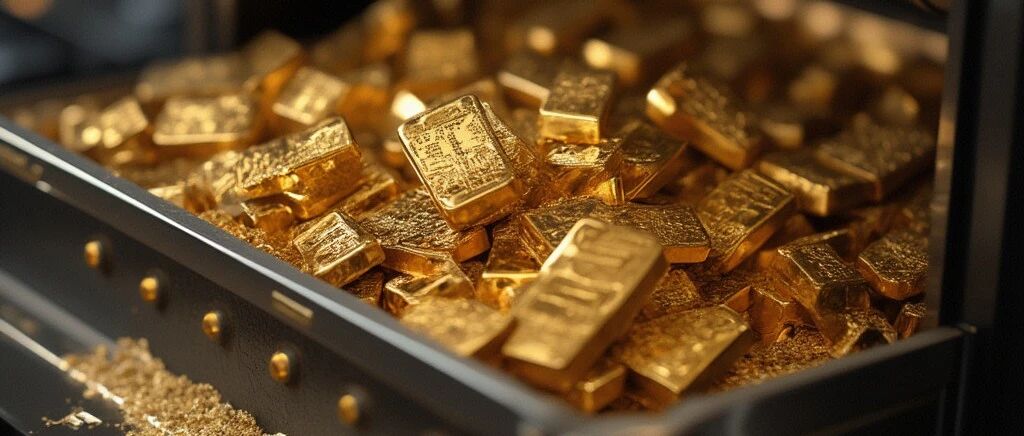
Group 1 - International gold prices have reached new highs, with New York futures hitting $4000 per ounce for the first time, driving a strong upward trend in the precious metals market [1] - The scale of domestic gold ETFs has rapidly expanded, with several products surpassing 10 billion yuan, indicating increased investor interest [1][2] - Institutional investors have shown heightened attention to gold-related listed companies, with significant stock price increases observed [1][3] Group 2 - The recent rise in gold prices has led to a notable increase in the scale of gold ETFs, with the Huaan Gold ETF growing to 68.263 billion yuan, marking an increase of 10.862 billion yuan in the last month [2] - The performance of gold stocks has attracted significant institutional interest, with companies like Shandong Gold and Zhaojin Mining seeing substantial participation from over a hundred institutions in their earnings meetings [3] - The performance of gold ETFs, such as the Yongying CSI Hong Kong and Shanghai Gold Industry ETF, has been impressive, with a year-to-date increase of 86.73% and a recent scale growth of 5.417 billion yuan [3] Group 3 - Historical data suggests that gold tends to perform better during periods of recession or stagflation, highlighting its value as a safe-haven asset [5] - The expectation of interest rate cuts by the Federal Reserve reflects economic pressures, which may further support gold prices [5] - The pricing logic of gold has shifted from being highly correlated with U.S. Treasury yields and the dollar index to being driven more by its reserve value, indicating a potential long-term bull market for gold [6]




山金期货资讯周报-20250930
Shan Jin Qi Huo· 2025-09-30 11:27
1. Report Industry Investment Rating No relevant content provided. 2. Core Viewpoints of the Report - Since 2025, precious metals have continued to rise, but gold and silver have shown divergence. Gold has repeatedly reached new historical highs, while silver has followed up slowly and faced pressure to fall back. The main driving factors include increased risk - aversion sentiment, expectations of interest rate cuts, and central banks' continued gold purchases. The current bull market in precious metals differs significantly from previous ones in terms of driving logic, amplitude, and the role of central banks. [4][5][7] - Looking ahead, before the Fed hints at the end of interest rate cuts around mid - 2026, precious metals may continue to rise. However, after the interest rate cuts enter the second half, attention should be paid to the risk of a rapid decline in precious metal prices due to profit - taking, and the overall volatility of precious metals may further increase. [64] 3. Summary by Relevant Catalogs 3.1. Market Review - Since 2025, gold has reached new highs, with London gold reaching a maximum of $3057.14 per ounce, Comex gold reaching $3065.2 per ounce, and domestic Shanghai gold reaching a maximum of 711.24 yuan per gram. Silver has followed up slowly, with London silver reaching a maximum of $34.224 per ounce and domestic Shanghai silver reaching a maximum of 8444 yuan per kilogram. [4] - The main logics for the rise of precious metals since the beginning of the year are: increased risk - aversion sentiment due to global economic and political restructuring, expectations of interest rate cuts, and central banks' continued gold purchases. [5][7] - This bull market in precious metals differs from previous ones in terms of driving logic (from "cyclical" to "structural"), amplitude and breadth (unprecedented global general increase), and the role of central banks (from "participants" to "leading forces"). [9][10] - The bull market in silver also differs from previous ones in terms of driving logic (from "investment - led" to "investment + industrial demand dual - driven"), breadth and synchronicity (global value re - evaluation), and the relationship with gold (from "following" to "potentially leading"). [12][13] 3.2. Evolution Logic of Safe - Haven Attribute - The world is in the process of transitioning to a new order, with the US no longer the dominant power. There are risks of trade wars, government shutdowns, and potential geopolitical conflicts, which may increase the demand for safe - haven assets. Trump's policy expectations affect precious metal prices through multiple channels, and in the short term, risk - aversion sentiment may support precious metal prices, while in the long term, trade frictions may increase inflation or lead to economic recession, making precious metals more attractive. [14][16] - The volatility of the US stock market may rise, which will increase the safe - haven value of precious metals. [19] 3.3. Evolution Logic of Monetary Attribute - In 2025, US inflation may experience "re - inflation", and the eurozone is close to achieving its anti - inflation target, but trade war risks pose pressure on future interest rate cuts. The Fed has adjusted its monetary policy framework, which may lead to potential changes in US dollar liquidity and have different impacts on various countries. [23] - The US employment situation may continue to weaken, and Trump's new policies may accelerate the decline in employment. Non - farm payroll data has a significant impact on the Fed's interest rate decisions and precious metal prices. [32][35] - The Fed is expected to continue to cut interest rates in 2025, with a total interest rate cut of about 50 basis points and the process expected to be completed around mid - 2026. The CME FedWatch Tool can help investors predict the Fed's interest rate trends. [41][42] - Global central bank monetary policies have shown significant divergence in recent years. The difference in interest rate cut expectations between the US and non - US countries is crucial. Later, the Fed's larger interest rate cut space may put pressure on the US dollar index. [45] 3.4. Evolution Logic of Commodity Attribute - In 2024, the global gold supply increased steadily, but demand declined. In 2025, demand is expected to continue to show structural divergence. Jewelry demand is suppressed by high gold prices, but official and private gold purchases offset some negative impacts. Gold ETFs, bars, and coins have strong demand, while gold jewelry demand shows a tonnage - consumption divergence. [51] - The World Silver Association predicts that in 2025, the global silver supply - demand gap will narrow by 21% to 117.6 million ounces (about 3658 tons) due to a 1% decline in demand and a 2% increase in total supply. [56] 3.5. Technical Analysis - London gold has been in an upward trend since 2000. After reaching a high in 2011 and then falling back, it has started a new upward trend since 2016. In 2025, it has accelerated its upward movement. It is expected to continue to rise before the Fed hints at the end of interest rate cuts around mid - 2026. Attention should be paid to the pressure levels of $3750 - 4000 (about 850 - 910 yuan for Shanghai gold) and the support level of $3400 (about 770 yuan for Shanghai gold). [58][59] - London silver has followed a similar trend to gold since 1994. Since 2016, it has oscillated upward along the 20 - year line. The recent rebound in global silver industrial demand may drive its price up. Attention should be paid to the pressure range of $49.8 - 55 (about 11780 - 13000 yuan for Shanghai silver) and the support level of $37.9 (about 8960 yuan for Shanghai silver). [62] 3.6. Future Market Development Direction from the Perspective of Long - Short Game - The reconstruction of the global economic and political system promotes the reconstruction of the monetary system. The safe - haven demand under global economic uncertainty and policy game are complexly intertwined. The continuous gold purchases by global central banks, the long - term Sino - US game, and repeated geopolitical conflicts still support the precious metal market. Before the Fed hints at the end of interest rate cuts around mid - 2026, precious metals may continue to rise, but attention should be paid to the risk of a rapid decline. [64] 3.7. Overview of the Domestic Precious Metal Industry Chain - In the first half of 2025, domestic raw material gold production was 179.083 tons, a year - on - year decrease of 0.31%. After including imported raw material gold, the total gold production was 252.761 tons, a year - on - year increase of 0.44%. Key gold mine projects are advancing rapidly, and large - scale gold enterprises' overseas mine production has increased. [67][68] - In the first half of 2025, domestic gold consumption was 505.205 tons, a year - on - year decrease of 3.54%. Gold jewelry consumption was suppressed by high prices, while demand for gold bars and coins increased, and industrial and other gold uses also increased. [69]
大A的荣耀不再属于“性价比”投资者
Hu Xiu· 2025-09-30 10:32
Core Insights - Deep value fund managers, who performed well during the bear market, are underperforming in the current bull market, primarily due to the significant rise in technology stocks and growth-oriented funds [1][2][10] - The average annual return of deep value fund managers is below the industry average, with many products yielding less than 20% year-to-date, while the CSI Active Equity Fund Index has achieved a return of 34.11% [3][9] - The investment philosophy of deep value managers focuses on long-term intrinsic value, safety margins, and stable business models, which contrasts sharply with the growth-oriented approach that prioritizes high growth potential and current market trends [10][11][12] Performance Comparison - As of September 24, 2023, prominent deep value fund managers like Xu Yan and Jiang Cheng have seen their flagship products yield less than 20%, with only a few exceeding 30% [3][9] - The performance of deep value funds is generally in line with the CSI 300 Index, which has a year-to-date return of 15.63% [10] - In contrast, growth-oriented funds have seen returns exceeding 200% in some cases, highlighting the stark difference in performance between the two styles [5][10] Market Trends - The current market environment favors growth-oriented strategies, particularly in sectors like technology and innovation, while deep value strategies are struggling due to their focus on low-valuation sectors such as finance and real estate [10][12][26] - The number of deep value fund managers is relatively small compared to growth-oriented managers, and many notable deep value figures have left the industry, further limiting the available options for investors [25][29] Investment Strategy - Deep value funds are recommended for conservative investors as a core holding, while growth funds may be allocated for those seeking higher returns [16][17] - A balanced approach that includes both deep value and growth strategies may provide better risk management and potential returns [18][19] - Investors should be cautious of deep value funds that show unusually high performance in a bull market, as this may indicate a shift in investment style [16]
有色金属行业双周报:钴价持续大涨,铜矿停产影响全球供应格局-20250930
Guoyuan Securities· 2025-09-30 09:02
Investment Rating - The report maintains a "Hold" rating for the industry [7] Core Views - The non-ferrous metals industry index decreased by 0.63% over the past two weeks, underperforming the CSI 300 index, ranking 12th among 31 first-level industries [2][14] - Energy metals (up 4.49%) and industrial metals (up 1.05%) showed positive performance, while metal new materials (-4.08%), precious metals (-0.95%), and minor metals (-8.51%) experienced declines [2][14] Price Trends - As of September 26, 2025, COMEX gold closed at $3,789.80 per ounce, up 2.96% over two weeks; COMEX silver closed at $46.37 per ounce, up 8.63% [3][21] - LME copper settled at $10,125.50 per ton, increasing by 1.21% over two weeks; LME aluminum fell to $2,643 per ton, down 2.38% [3][20] - Cobalt prices surged, with electrolytic cobalt averaging 310,000 CNY per ton, up 13.55% over two weeks, and cobalt sulfate averaging 65,000 CNY per ton, up 20.82% [3][53] Major Events - The Grasberg mine, one of the largest copper mines globally, has suspended operations due to a fatal landslide, significantly impacting global copper supply [4][59] - The U.S. Defense Logistics Agency awarded a contract to U.S. Antimony Corporation worth up to $245 million for supplying antimony metal [59][60] Investment Recommendations - Following the Federal Reserve's interest rate cut in September, the report suggests focusing on investment opportunities that combine "resources + growth" themes, while monitoring geopolitical and export policy changes in major resource countries [5]

贵金属板块9月30日涨1.85%,中金黄金领涨,主力资金净流出1.2亿元
Zheng Xing Xing Ye Ri Bao· 2025-09-30 08:42
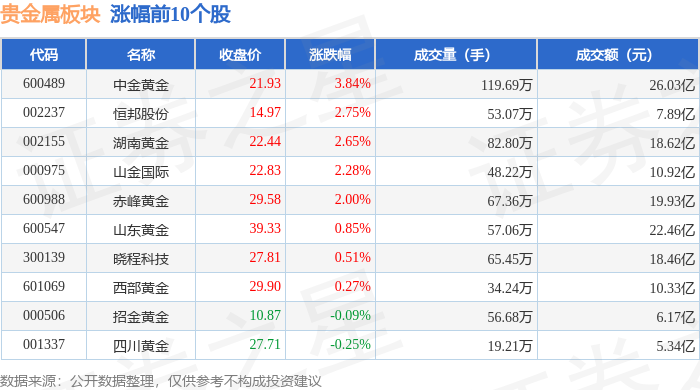
Core Insights - The precious metals sector experienced a rise of 1.85% on September 30, with Zhongjin Gold leading the gains [1] - The Shanghai Composite Index closed at 3882.78, up 0.52%, while the Shenzhen Component Index closed at 13526.51, up 0.35% [1] Precious Metals Sector Performance - Zhongjin Gold (600489) closed at 21.93, up 3.84% with a trading volume of 1.1969 million shares and a transaction value of 2.603 billion [1] - Hengbang Shares (002237) closed at 14.97, up 2.75% with a trading volume of 530,700 shares and a transaction value of 789 million [1] - Yunnan Tin (002155) closed at 22.44, up 2.65% with a trading volume of 828,000 shares and a transaction value of 1.862 billion [1] - Shandong Gold (600547) closed at 39.33, up 0.85% with a trading volume of 570,600 shares and a transaction value of 2.246 billion [1] Capital Flow Analysis - The precious metals sector saw a net outflow of 120 million from institutional investors, while retail investors had a net inflow of 140 million [3] - Major stocks like Zhongjin Gold and Shandong Gold experienced varying levels of net inflow and outflow from different investor types [4] - For instance, Zhongjin Gold had a net inflow of 196 million from institutional investors but a net outflow of 230 million from retail investors [4]


黄金再创新高!3860与上证试比高!银价4个月拉40%,原来它比黄金还能涨...
雪球· 2025-09-30 08:19
Group 1: Market Overview - The Shanghai Composite Index rose by 0.52% and the Shenzhen Component Index increased by 0.35%, while the ChiNext Index remained flat and the North Stock 50 fell by 0.70% [2] - The total trading volume across the Shanghai, Shenzhen, and Beijing markets reached 21,972 billion yuan, an increase of 191 billion yuan compared to the previous day, with over 2,600 stocks rising [2] Group 2: Semiconductor and Storage Chip Sector - The storage chip sector experienced a significant surge, with the sector's index rising nearly 4%, and stocks like Jiangbolong and Demingli hitting the daily limit [5] - Major global storage chip manufacturers, including SanDisk, Micron, and Western Digital, have announced price increases, with SanDisk's stock rising nearly 17% and Micron's over 4% [7] - The price increase is attributed to a restructuring of supply and demand in the storage industry, with major manufacturers reducing production and increasing demand driven by AI investments [7][8] Group 3: AI Application Sector - The AI application sector saw a strong performance, with companies like Kunlun Wanwei and Keda Xunfei showing notable gains [10] - DeepSeek announced the release of its new model, DeepSeek-V3.2-Exp, which significantly reduces service costs, leading to a 50% decrease in API usage costs for developers [12] - The adaptation of DeepSeek's new model by several domestic chip manufacturers indicates a significant breakthrough in the AI industry [12] Group 4: Precious Metals Sector - Gold prices reached a new high of $3,860 per ounce, with companies like Zhongjin Gold and Shengda Resources seeing gains of nearly 4% [15] - Silver futures experienced a surge of 4.5%, with silver prices rising by 40% since June, driven by industrial demand, particularly from the photovoltaic industry [18][19] - The supply constraints in the silver market are expected to continue, with a projected decline in global silver mine supply in 2024 [20]

金业弹性表:金业弹性表2025年9月30日版
ZHESHANG SECURITIES· 2025-09-30 08:08
Group 1: Industry Overview - The report maintains a positive outlook on the gold industry, with an industry rating of "Bullish" as of September 30, 2025[1] - The forecast for gold production from listed companies shows a compound annual growth rate (CAGR) of 10% to 32% for various companies from 2024 to 2027[4] Group 2: Company-Specific Insights - Shandong Gold is projected to produce 50 tons in 2025, with a market capitalization of 179.8 billion CNY, resulting in a market value per ton of 0.8 billion CNY[4] - Zijin Mining is expected to produce 85 tons in 2025, with a market capitalization of 764.6 billion CNY, leading to a market value per ton of 1.9 billion CNY[4] - The production forecast for China National Gold is 20 tons in 2025, with a market capitalization of 1.024 billion CNY, resulting in a market value per ton of 1.3 billion CNY[4] Group 3: Risks and Considerations - Risks include slower-than-expected expansion rates for companies and gold prices not rising as anticipated[6] - Production estimates are based on certain assumptions, which may lead to deviations from actual outcomes, indicating a need for caution[6]
有色ETF基金(159880)涨超3.7%,铜价有望创下一年来最大单月涨幅
Sou Hu Cai Jing· 2025-09-30 06:57
Group 1 - The core viewpoint is that the non-ferrous metal industry is experiencing a strong rally, driven by multiple favorable factors, including government initiatives to upgrade metal consumption and a tightening global copper supply [1] - As of September 30, 2025, the Guozheng Non-Ferrous Metal Industry Index (399395) rose by 3.27%, with significant gains in constituent stocks such as Placo New Materials (300811) up 12.90%, Tin Industry Co. (000960) up 9.98%, and Huayou Cobalt (603799) up 9.93% [1] - The non-ferrous ETF fund (159880) increased by 3.70%, with the latest price reported at 1.68 yuan [1] Group 2 - On September 28, eight departments jointly issued a document to promote the upgrade of bulk metal consumption, actively expanding the application of high-end aluminum, copper, and magnesium alloys [1] - The global copper supply is tightening due to a series of production disruptions, leading to a nearly 5% increase in three-month copper prices in September, marking the largest rise since the same month in 2024 [1] - Guotou Securities noted that interest rate futures have priced in expectations for three rate cuts by the Federal Reserve this year, totaling 75 basis points, indicating that the non-ferrous sector is one of the few industries that can significantly benefit from overseas inflation [1] Group 3 - The Guozheng Non-Ferrous Metal Industry Index (399395) selects 50 securities with outstanding scale and liquidity from the non-ferrous metal industry, reflecting the overall performance of listed companies in this sector on the Shanghai and Shenzhen stock exchanges [2] - As of August 29, 2025, the top ten weighted stocks in the index include Zijin Mining (601899), Northern Rare Earth (600111), and Luoyang Molybdenum (603993), with these ten stocks accounting for 50.35% of the total index weight [2]