
李宁

Search documents
70后至00后的新兴消费变迁史,是轮回还是演进?
2025-07-02 01:24
Summary of Key Points from Conference Call Records Industry Overview - **Emerging Consumer Trends**: The shift in consumer behavior reflects a focus on emotional value and self-satisfying consumption, particularly in low-priced items like trendy toys, pets, and beauty products, alongside gold jewelry which serves as a savings tool, indicating a macro downgrade but self-upgrading consumption trend [1][5][6]. Core Insights - **Rise of Domestic Brands**: Domestic brands have captured over 50% market share in the beauty sector, leveraging technological upgrades and the rise of national cultural trends to enhance their market presence across various categories [1][6][7]. - **Product-Driven Growth**: The consumer goods market has transitioned to a product-driven growth phase, moving away from channel and content marketing strategies, necessitating better value-for-money products to stimulate purchasing decisions [1][4][23]. - **New Trends in Gold Consumption**: The consumption of gold jewelry has shifted from wedding gifts to self-appreciation and value preservation, with new craftsmanship making gold products more diverse and appealing [1][10]. Economic and Social Background - **Quality Consumption Phase**: As GDP reaches a certain level, the Chinese market has entered a quality consumption phase, where consumers prioritize quality despite economic pressures, reflecting a trend of budget-first but quality-focused consumption [2]. - **Demographic Shifts**: The evolving consumer mindset across different age groups, particularly the younger generation, influences their purchasing decisions, with a notable shift towards emotional value and personal satisfaction [2][5]. Market Dynamics - **Current Market Trends**: The new consumer sector is rebounding after a period of adjustment, with a focus on identifying growth-oriented stocks and those that effectively combine public and private domain strategies for sustainable development [3][24]. - **Long-Term Potential Assessment**: Companies with high-quality products, strong service capabilities, and robust brand power are more likely to sustain long-term growth, with a focus on self-sustaining growth through product innovation [3][23][24]. Notable Changes in Consumer Behavior - **Emotional Value Premium**: In a declining economic environment, leveraging emotional value to achieve product premium pricing is effective, as seen with brands like Casefiy, which successfully command high prices through emotional appeal [1][12]. - **Consumer Preferences**: The current consumer landscape shows a preference for low-cost items that provide emotional satisfaction, with a notable shift from high-cost family-oriented purchases to affordable personal indulgences [5][6]. Brand Evolution - **Transformation of Domestic Brands**: The evolution of domestic brands from the early 2000s to now highlights a shift from reliance on external events to self-driven growth through product upgrades and international exposure [8]. - **Emerging Categories**: New categories such as trendy toys and personal care products are gaining traction, reflecting a broader trend towards low-cost, high-emotional-value items [6][9]. Future Outlook - **E-commerce Growth Potential**: Personal care categories show significant growth potential in e-commerce, with current penetration rates low compared to beauty products, indicating room for expansion through innovation and pricing strategies [19][20]. - **Retail Channel Evolution**: The shift from traditional retail models to innovative formats like membership stores requires brands to adapt their strategies to maintain consumer engagement and optimize procurement capabilities [21][22]. Conclusion - **Investment Opportunities**: Companies demonstrating strong self-sustaining growth capabilities, innovative product offerings, and effective brand strategies are positioned as key investment opportunities in the evolving consumer landscape [24].
重仓年轻人,比任何时候都重要
点拾投资· 2025-07-01 13:41
Core Viewpoint - The investment landscape is shifting towards understanding the consumption patterns of the younger generation, particularly the post-95 demographic, which is driving new consumption trends focused on emotional value rather than just functional satisfaction [1][2]. Group 1: New Consumption Trends - The core driving force of new consumption has transitioned from "functional satisfaction" to "emotional value," with young consumers willing to pay a premium for experiences and cultural recognition [2]. - The Z generation's consumption preferences are reshaping the market, challenging traditional valuation frameworks used in mature industries like liquor and home appliances [2][36]. - Investment strategies must adapt to these changes by focusing on emotional needs and innovative product categories that resonate with younger consumers [2][36]. Group 2: Investment Strategies - To effectively invest in new consumption, it is suggested to leverage fund managers who understand the younger demographic, such as those from Penghua Fund, which employs post-95 fund managers [3][36]. - The Penghua Fund's "Here is China" series has successfully engaged young consumers by appealing to their patriotic sentiments, showcasing the importance of aligning investment products with youth culture [3][36]. - The Penghua Fund's investment approach includes a mix of active and passive products, targeting sectors that emphasize experiential and emotional consumption [2][4]. Group 3: Fund Performance and Manager Insights - Fund manager Xie Tianyuan, one of the youngest in the industry, has achieved a net value growth rate of 27.55% in 2025, indicating strong performance in the new consumption sector [6]. - Xie Tianyuan's portfolio includes significant holdings in companies like Pop Mart (10.48%) and other brands that cater to the emotional and experiential needs of young consumers [7][6]. - His dual identity as both an investor and a consumer allows him to understand the underlying narratives and cultural significance of various IPs, enhancing his investment decision-making [8][9]. Group 4: ETF Products - The Hong Kong Stock Consumption 50 ETF (159265) is highlighted as a stable investment option that aligns with the "self-pleasing" consumption characteristics of the Z generation [20][29]. - This ETF focuses on companies that resonate with the younger demographic, emphasizing local brands and experiences over traditional imported goods [20][21][23]. - The ETF's structure is designed to capture the growth potential of new consumption trends, differentiating itself from traditional indices that are heavily weighted towards mature sectors like liquor [30][32]. Group 5: Market Dynamics - The shift in consumer demographics is leading to a new era of investment opportunities, as younger entrepreneurs and companies emerge to meet the evolving demands of the market [35][36]. - The current economic transition from debt-driven to innovation and consumption-driven growth highlights the importance of investing in youth-oriented sectors [35][36]. - The emergence of new consumption patterns indicates that understanding and investing in the preferences of younger consumers will be crucial for future growth [36][37].


不能为了贵而贵
Hu Xiu· 2025-07-01 12:42
Group 1 - The core point of the article is that the local automotive industry in China is undergoing significant upgrades, with brands like BYD, Li Auto, and NIO leading the charge in the smart electric vehicle market [9][16][24] - The article highlights the unsustainable nature of continuous price cuts in the automotive sector, indicating that market capacity is reaching its limits, necessitating a shift towards upgrades for sustainability [10][11] - It discusses the successful upgrade of local automotive brands, which have established themselves in the market with vehicles priced above 200,000 yuan, a segment previously dominated by foreign brands [17][18][40] Group 2 - The article contrasts successful brand upgrades, such as that of Bosideng, with the challenges faced by brands like Li Ning, which experienced consumer dissatisfaction despite initial success [7][8] - It emphasizes the importance of product differentiation in the automotive sector, where local brands have successfully created a new market segment by offering smart electric vehicles that differ significantly from traditional fuel vehicles [25][27] - The article warns that the automotive industry's sensitivity to public opinion and competition is much higher than in the fashion industry, making upgrades a risky endeavor [12][13][15] Group 3 - The article notes that the luxury automotive market is becoming increasingly competitive, with traditional brands like Volkswagen and Toyota attempting to upgrade their offerings but facing limited success [21][22] - It points out that the pricing strategy of local brands should be based on product value rather than arbitrary price points, highlighting the need for genuine product quality to justify higher prices [41] - The discussion includes the broader implications of market pricing structures, suggesting that opportunities exist for independent and premium brands to thrive between low-cost and luxury segments [39]

361度(01361):产品研发提升品牌专业属性,渠道革新夯实公司业绩增长
Hua Yuan Zheng Quan· 2025-07-01 11:14
Investment Rating - The report assigns a "Buy" rating for the company, indicating a positive outlook based on product development and channel innovation driving performance growth [5][8]. Core Insights - The company is positioned as a leading player in the domestic sports apparel market, with ongoing channel upgrades and sustained investment in research and development enhancing brand strength and operational efficiency [8]. - The forecasted net profit for the company is expected to grow from 1.315 billion RMB in 2025 to 1.670 billion RMB by 2027, reflecting year-on-year growth rates of 14.50%, 12.75%, and 12.63% respectively [6][8]. Summary by Sections Market Performance - As of June 27, 2025, the closing price is HKD 4.99, with a market capitalization of HKD 10,317.73 million and a debt-to-asset ratio of 26.72% [3]. Financial Forecast and Valuation - Revenue projections for 2025-2027 are 11,540.03 million RMB, 13,113.23 million RMB, and 14,773.90 million RMB, with corresponding growth rates of 14.56%, 13.63%, and 12.66% [6][8]. - The company’s price-to-earnings ratio is forecasted to decrease from 9.85 in 2023 to 5.67 by 2027, indicating an attractive valuation compared to peers [6]. Investment Logic - The company is leveraging traditional store upgrades and the introduction of "super stores" to capture the attention of new-generation consumers, which is expected to drive revenue growth [10]. - Continuous investment in research and marketing is enhancing the brand's professional image and recognition among target demographics [10]. - A stringent supply chain selection process is expected to improve operational efficiency [10]. Company Overview - The company has been deeply involved in the sports apparel sector for over 20 years, enhancing its brand image through partnerships with major international sporting events [15]. - The company’s revenue and gross profit have shown consistent growth, with 2024 revenue reaching 10.1 billion RMB, a year-on-year increase of 19.59% [18]. Channel and Product Upgrades - The company is focusing on channel upgrades, with a total of 7,115 stores globally by 2024, reflecting a 1.73% year-on-year increase [49]. - The children's business segment is growing rapidly, with revenue contribution increasing from 18.20% in 2020 to 23.20% in 2024 [61]. - Online sales are also on the rise, with a 12.21% increase in revenue from online channels in 2024 [64]. Market Trends - The global sports apparel market is expected to grow at a compound annual growth rate (CAGR) of 7% from 2023 to 2027, with emerging markets driving significant growth [32]. - The domestic sports apparel market is projected to reach 598.9 billion RMB by 2025, with a CAGR of 11.62% from 2021 to 2025 [33].
研判2025!中国防晒衣行业产业链图谱、市场规模、竞争格局及未来前景展望:大众防晒意识日益增强,防晒衣市场加速发展[图]
Chan Ye Xin Xi Wang· 2025-07-01 00:50
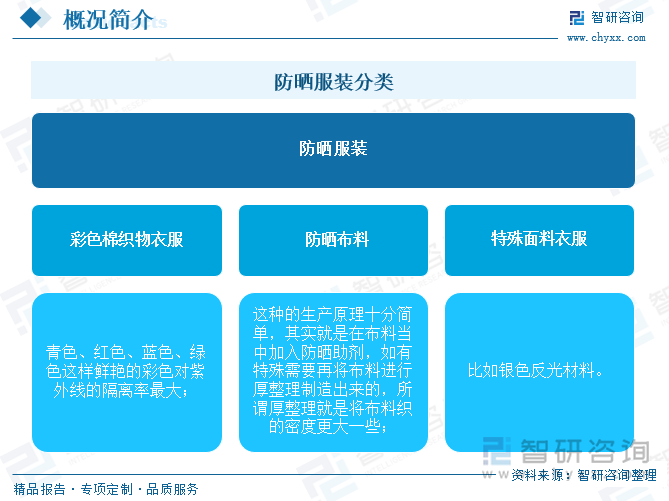
Industry Overview - Sunscreen clothing is designed to block direct exposure to ultraviolet rays, similar to the function of sun umbrellas, and has gained popularity since its introduction in the U.S. in 2007 and later in China [1][8] - The market for sunscreen clothing in China is projected to grow from 45.9 billion yuan in 2016 to 80.8 billion yuan in 2024, with expectations to reach 95.8 billion yuan by 2026 [1][8] Product Classification - Sunscreen clothing can be categorized into three types: colorful cotton fabric clothing, sunscreen fabric with added agents, and special materials like reflective silver fabric [2] Industry Status - The sunscreen market in China has rapidly expanded, becoming the second-largest consumer market globally, with a market share of 16.2% by 2024, up from 6.4% in 2008 [6] - The compound annual growth rate (CAGR) for sunscreen products in China over the past five years is 8.8%, significantly higher than Japan and South Korea [6] Competitive Landscape - The sunscreen clothing market is witnessing increased competition, with various brands entering the market, including established brands like Bosi Deng and Decathlon, as well as new entrants focusing on sunscreen products [10] - The market features a mix of established brands and "white label" products, with some white label sunscreen clothing achieving significant sales on e-commerce platforms [10][13] Key Companies - Major players in the sunscreen clothing market include Bosi Deng, Ternua, and other brands that have expanded their product lines to include sunscreen clothing [19][17] - Ternua reported revenues of 15.92 billion yuan in 2024, with a year-on-year growth of 14.44% [17] Development Trends - The market for sunscreen clothing is expected to continue expanding, with a projected CAGR of 13.6% and a shift towards diverse consumer scenarios [21] - Domestic brands are gaining market share, with Bosi Deng's sunscreen clothing sales increasing from 100 million yuan in 2022 to 1 billion yuan in 2024 [22] - Price competition is intensifying, with a focus on high cost-performance ratios, as the mainstream price range for sunscreen clothing shifts to 100-200 yuan [23]





险资频频举牌港股公司有四大逻辑
Zheng Quan Ri Bao· 2025-06-30 16:14
Core Viewpoint - The frequent acquisition of Hong Kong-listed companies by insurance capital has drawn significant market attention, driven by factors such as valuation opportunities, high-quality enterprises, diversification strategies, and new accounting standards [1][2][3][4] Group 1: Valuation Opportunities - Insurance capital is attracted to the low valuation of Hong Kong stocks, with the Hang Seng Index's price-to-earnings ratio at 10.7, lower than the 13.1 ratio of the CSI 300 Index as of June 30 [1] - The AH premium index, despite a 9.13% decline in the first half of the year, remains at 129.94, indicating that A-shares are priced 29.94% higher than H-shares, suggesting H-shares are undervalued [1] Group 2: High-Quality Enterprises - The influx of high-quality mainland companies listing in Hong Kong, along with the active performance of technology and consumer stocks, enhances the attractiveness of the Hong Kong market [3] - Leading technology firms like Tencent and Meituan are driving innovation, while consumer brands like Anta and Haidilao are capitalizing on global growth opportunities, creating unique investment value [3] Group 3: Diversification Strategies - The high internationalization of the Hong Kong market allows insurance capital to reduce overall portfolio volatility and improve risk-return ratios through dynamic balance between A-shares and H-shares [3] - Hong Kong's mature financial infrastructure and legal environment serve as a key hub for international asset allocation, aligning with the global expansion needs of insurance companies [3] Group 4: New Accounting Standards - The implementation of IFRS 9 and IFRS 17 by leading insurance firms necessitates a strategic approach to asset classification, with a preference for high-dividend Hong Kong stocks to stabilize earnings and enhance returns [4] - By classifying stock assets under FVOCI, insurance companies can smooth out performance fluctuations while benefiting from stable dividend income [4]
野村:李宁的销售额可能在下半年上升 维持16.20港元目标股价不变
news flash· 2025-06-30 04:15
Core Viewpoint - Nomura analysts predict that Li Ning's sales are likely to rebound in the second half of the year due to a lower comparative base, despite a decline in sales from May to June [1] Group 1: Sales Performance - Li Ning's sales experienced a decrease during the period from May to June [1] - The anticipated sales recovery is attributed to a lower comparative base in the second half of the year [1] Group 2: Brand Recognition - Recent operational improvements, such as brand ambassador Yang Hansheng's breakthrough in the NBA, are expected to enhance Li Ning's brand recognition in the long term [1] Group 3: Analyst Ratings - Nomura maintains a neutral rating on Li Ning with a target price of HKD 16.20 [1]
消费策略&组合配置:新消费创造成长主线,结构性牛市曙光已现
2025-06-30 01:02
Summary of Key Points from Conference Call Records Industry Overview - **Consumer Sector**: The consumer sector in China is currently facing challenges due to a lack of growth engines, but there are signs of recovery driven by export growth and improvements in domestic economic activities. [1][4] - **Retail Sector**: The retail sector is experiencing supply surplus and insufficient demand, necessitating a focus on new demand opportunities, including traditional channel transformations and the rise of instant retail. [1][7] Core Insights and Arguments - **Economic Recovery**: The recovery of exports is expected to positively impact domestic economic activities and consumption, with a notable rebound in personal income tax indicating a gradual recovery in residents' income. [1][4] - **Investment Strategy**: In July, the investment strategy should avoid liquidity-driven assets and focus on service consumption and high-turnover goods that are less affected by liquidity pressures. [1][4] - **New Consumption Trends**: New consumption is identified as a key growth driver for the next two to three years, emphasizing the creation of new consumption scenarios and business models, particularly in high-turnover and low-leverage service consumption. [1][5][6] Specific Areas of Focus - **Service Consumption**: Investment opportunities in the consumer sector are concentrated in emotional value consumption (e.g., trendy toys, pets) and functional value consumption (e.g., AI-related products). [6] - **Cross-Border Trade**: Companies engaged in cross-border trade should focus on supply chain management, brand premium capabilities, and channel premium capabilities due to tightening trade policies. [8] - **E-commerce Performance**: The 2025 618 e-commerce promotion met expectations, with Douyin's growth exceeding forecasts, highlighting a trend of collaboration across platforms. Instant retail channels performed exceptionally well during this event. [9][10] Additional Important Insights - **Tobacco Industry**: The tobacco industry is showing a stable upward trend, with new products like Glohilo from British American Tobacco expected to perform well in Japan. [3][11][12] - **Home Appliances**: The home appliance sector is expected to see double-digit growth driven by national policy support, with leading companies using pricing strategies to enhance market share. [3][22] - **Household Goods**: The household goods sector is stabilizing at the bottom, with a focus on companies that can demonstrate alpha capabilities. [3][13] - **Competition in Cleaning Appliances**: The competition in the cleaning appliance sector is easing, benefiting companies like Roborock and Ecovacs, with expectations of rising industry profit margins. [3][20] Conclusion The conference call highlighted the complexities and opportunities within various sectors of the Chinese economy, particularly in consumer and retail markets. The focus on new consumption trends, service-oriented products, and strategic adjustments in response to economic conditions will be crucial for navigating the current landscape.
伯希和招股书解读:高性能户外服饰领先品牌,成长空间广阔
Haitong Securities International· 2025-06-29 14:57
Investment Rating - The report assigns an "Outperform" rating to several companies in the high-performance outdoor apparel sector, including Anta Sports, Shenzhou International, Li Ning, Samsonite, Xtep International, and 361 Degrees, with target prices set for each [1]. Core Insights - The high-performance outdoor apparel industry in China is entering a trillion-yuan era, with significant growth potential. The market size increased from 53.9 billion yuan in 2019 to 102.7 billion yuan in 2024, reflecting a compound annual growth rate (CAGR) of 13.8%. It is projected to reach 215.8 billion yuan by 2029, with a CAGR of 16% from 2024 to 2029 [3]. - The report highlights Pelliot as a leading brand in high-performance outdoor apparel, which has established a broad product matrix and a direct-to-consumer (DTC) sales channel. The company reported a revenue of 1.766 billion yuan in 2024, a 94.5% year-on-year increase [2][17]. - Pelliot's product matrix includes four main series: Peak Series, Professional Performance Series, Mountain Series, and Classic Series, with the Classic Series contributing over 80% of sales revenue [34]. Summary by Sections Company Overview - Pelliot has been a key player in the high-performance outdoor apparel market since its establishment in 2012, focusing on a wide range of products suitable for outdoor activities, fitness, and urban commuting [2][10]. - The company has developed a multi-channel sales and distribution network, with online sales accounting for 76.5% of total revenue in 2024, while offline sales grew by 257.1% [2][19]. Financial Performance - Pelliot's revenue grew from 379 million yuan in 2022 to 1.766 billion yuan in 2024, with a remarkable growth rate of 139.9% in 2023 and 94.5% in 2024 [17][18]. - The company's gross margin improved from 54.3% in 2022 to 59.6% in 2024, driven by business scale expansion, enhanced pricing power, and effective cost control [7]. Market Position - The high-performance outdoor apparel market in China is relatively fragmented, with the top ten brands holding a combined market share of 27.3% in 2024. Pelliot's market share was 1.7% [3]. - Pelliot ranked third in online retail sales among high-performance outdoor apparel brands in mainland China, with a market share of 3.7% [3]. Product Development - The company employs a dual-track technology system of "internal innovation + external procurement," focusing on proprietary technologies such as Storm Breath and Storm Shield [6]. - Pelliot's core products demonstrate its technological capabilities and market positioning, contributing significantly to revenue and brand strength [39].
李宁(02331.HK):控股股东增持 关注公司长期积极变化
Ge Long Hui· 2025-06-27 19:08
Company Overview - The major shareholder, Everbright, announced an increase in its stake in Li Ning Company by acquiring 18.09 million shares for a total of HKD 275 million at an average price of HKD 15.20 per share [1] Business Performance - Li Ning's basketball business is under pressure, with retail sales expected to decline by 21% in 2024, accounting for 21% of the company's overall sales [1] - Despite the challenges, Li Ning continues to sponsor various basketball leagues and is focused on launching new products and technologies to maintain brand positioning [1] - The company signed a player who was selected 16th in the 2025 NBA Draft, marking the third Chinese player to be a first-round pick, which is expected to enhance brand visibility in the basketball sector [1] Strategic Initiatives - In the second quarter of 2025, Li Ning's brand is still facing pressure from a volatile market environment and intense competition, particularly in retail and discounting [2] - The company aims to innovate in core categories like running and basketball while increasing exposure and investment in sports like badminton and table tennis [2] - A contract with the Chinese Olympic Committee was completed at the end of April, which is anticipated to lead to more marketing events in the second half of 2025 [2] Shareholder Confidence - The major shareholder's increase in stake from January to June 2025 reflects confidence in Li Ning's "single brand, multiple categories, and multi-channel" core strategy [2] Financial Forecast - The earnings per share (EPS) forecast for 2025 and 2026 remains unchanged at CNY 0.92 and CNY 1.07, respectively, with the current stock price corresponding to 16 and 14 times the projected earnings for those years [2] - The target price is maintained at HKD 20.82, indicating a potential upside of 28% from the current stock price [2]