
新凤鸣

Search documents
商品研究晨报:能源化工-20260108
Guo Tai Jun An Qi Huo· 2026-01-08 02:52
Report Industry Investment Ratings No industry investment ratings are provided in the report. Core Views of the Report - The report provides trend analyses and investment suggestions for various energy and chemical futures, including PX, PTA, MEG, rubber, and others, based on market dynamics, fundamental data, and industry news [2][4]. - Overall, most futures are expected to show short - term fluctuations, with some facing supply - demand pressures and others influenced by cost, inventory, and macro - factors [10][11]. Summaries by Related Catalogs PX, PTA, MEG - **Market Conditions**: Crude oil prices declined due to the expected increase in Venezuelan production. PX physical market showed limited improvement, and polyester sales were mixed [6][8][10]. - **Trend and Suggestions**: PX is in a short - term high - level oscillation with weakened industrial aspects. PTA is in a high - level oscillation with cost weakness. MEG has limited upside and remains under medium - term pressure [10][11]. Rubber - **Fundamental Data**: Rubber futures showed changes in price, volume, and open interest. Spot prices of some rubber types increased, and Thai raw material prices rose [12][13][14]. - **Trend**: Rubber is expected to oscillate, supported by rising raw material costs and improved production orders [12][14]. Synthetic Rubber - **Fundamental Data**: Futures prices, trading volumes, and open interests of synthetic rubber changed. Spot prices of related products increased, and butadiene prices rose [15]. - **Trend**: Synthetic rubber is expected to be relatively strong, driven by improved spot trading and cost - push from butadiene [16][17]. LLDPE - **Fundamental Data**: Futures prices, basis, and spot prices of LLDPE changed. Trading volume was high, and open interest decreased [18]. - **Trend**: LLDPE shows a weak - stable basis. Supply - demand pressure may arise from high capacity and weakening demand [18][19]. PP - **Fundamental Data**: Futures prices, basis, and spot prices of PP changed. Trading volume was high, and open interest decreased [21]. - **Trend**: PP is boosted by macro - sentiment, but fundamental improvement is limited due to weak demand and high cost [21][22]. Caustic Soda - **Fundamental Data**: Futures and spot prices of caustic soda are provided, with a negative basis [24]. - **Trend**: The rebound of caustic soda is difficult to sustain due to high production, high inventory, and weak demand [25]. Pulp - **Fundamental Data**: Futures prices, basis, and spot prices of pulp changed. Trading volume increased, and open interest decreased [30]. - **Trend**: Pulp is expected to oscillate, with cost support and weak demand in a state of game [31][32]. Glass - **Fundamental Data**: Futures prices, basis, and spot prices of glass changed. Trading volume was high, and open interest increased [34]. - **Trend**: Glass prices are stable, with limited sales improvement during the holiday [34]. Methanol - **Fundamental Data**: Futures prices, basis, and spot prices of methanol changed. Trading volume increased, and open interest decreased [37]. - **Trend**: Methanol is expected to oscillate and decline, with coastal ports accumulating inventory and weakening basis [39]. Urea - **Fundamental Data**: Futures prices, basis, and spot prices of urea changed. Trading volume decreased, and open interest increased [42]. - **Trend**: Urea is expected to oscillate in the short - term, with a potential mid - term upward shift in the center, supported by agricultural demand expectations [43][44]. Styrene - **Fundamental Data**: Futures prices, spreads, and profit margins of styrene changed. Spot prices and inventory levels are provided [45]. - **Trend**: Styrene is expected to oscillate in the short - term, with high valuation and potential short - selling opportunities [46]. Soda Ash - **Fundamental Data**: Futures prices, basis, and spot prices of soda ash changed. Trading volume was high, and open interest decreased [51]. - **Trend**: The spot market of soda ash has little change, with high supply and weak demand [51]. LPG and Propylene - **Fundamental Data**: Futures prices, trading volumes, and open interests of LPG and propylene changed. Spot prices and spreads are provided [56]. - **Trend**: LPG has a firm import cost, and attention should be paid to the realization of negative feedback. Propylene demand is stable, and spot prices are slightly rising [55][56]. PVC - **Fundamental Data**: Futures prices, basis, and spot prices of PVC changed [64]. - **Trend**: PVC's short - term rebound is difficult to sustain due to high supply, high inventory, and weak demand, but potential supply - side improvements may occur in the future [64][65]. Fuel Oil and Low - Sulfur Fuel Oil - **Fundamental Data**: Futures prices, trading volumes, open interests, and spot prices of fuel oil and low - sulfur fuel oil changed [68]. - **Trend**: Fuel oil shows a narrow - range oscillation with support below. Low - sulfur fuel oil has reduced fluctuations, and the high - low sulfur spread in the spot market continues to narrow [68]. Container Shipping Index (European Line) - **Fundamental Data**: Futures prices, trading volumes, open interests, and freight rates of the container shipping index (European Line) changed [70]. - **Trend**: The freight rate peak has emerged. It is advisable to wait and see for the 02 contract and short at high prices for the 04 contract [70][79][82]. Short - Fiber and Bottle Chip - **Fundamental Data**: Futures prices, spreads, and spot prices of short - fiber and bottle chip changed. Sales rates are provided [84]. - **Trend**: Both short - fiber and bottle chip are expected to oscillate in the short - term [84][85]. Offset Printing Paper - **Fundamental Data**: Spot prices, cost - profit data, and futures prices of offset printing paper are provided [87]. - **Trend**: It is advisable to wait and see for offset printing paper, with stable spot prices and poor market demand [88][90]. Pure Benzene - **Fundamental Data**: Futures prices, spreads, and spot prices of pure benzene changed. Inventory levels are provided [91]. - **Trend**: Pure benzene is expected to oscillate in the short - term, with increasing port inventory [92].
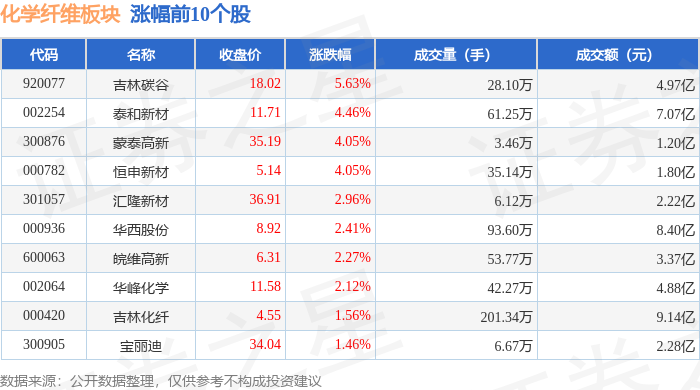
化学纤维板块1月7日涨0.11%,吉林碳谷领涨,主力资金净流出2.14亿元
Zheng Xing Xing Ye Ri Bao· 2026-01-07 08:58
Group 1 - The chemical fiber sector experienced a slight increase of 0.11% on January 7, with Jilin Carbon Valley leading the gains [1] - The Shanghai Composite Index closed at 4085.77, up 0.05%, while the Shenzhen Component Index closed at 14030.56, up 0.06% [1] - Notable gainers in the chemical fiber sector included Jilin Qigu, which rose by 5.63% to a closing price of 18.02, and Taihe New Materials, which increased by 4.46% to 11.71 [1] Group 2 - The chemical fiber sector saw a net outflow of 214 million yuan from main funds, while retail funds had a net inflow of 25.27 million yuan [2] - The trading volume for Jilin Qigu was 281,000 shares, with a transaction value of 497 million yuan, indicating strong investor interest [1][2] - The overall market sentiment reflected mixed performances, with some stocks like Sanfangxiang and Haiyang Technology experiencing declines of 6.20% and 4.10%, respectively [2] Group 3 - Main fund inflows were observed in stocks like Xinxiang Chemical Fiber, which had a net inflow of 36.42 million yuan, and Nanjing Chemical Fiber with 16.69 million yuan [3] - Retail investors showed a negative sentiment towards several stocks, with significant outflows from Xinxiang Chemical Fiber and Nanjing Chemical Fiber, indicating potential concerns among smaller investors [3] - The overall trading dynamics suggest a cautious approach among investors, with main funds favoring certain stocks while retail investors exhibited mixed reactions [3]


打造营商环境“升级版” 激活高质量发展新动能 “四力”协同 擦亮“心怡营商·赢在新沂”金字招牌
Yang Zi Wan Bao Wang· 2026-01-07 07:06
Core Viewpoint - The article highlights the rapid development and optimization of the business environment in Xinyi, showcasing successful projects like the Xin Feng Ming Group's textile production facility and the establishment of a favorable regulatory framework that supports high-quality economic growth [1][2][8]. Group 1: Project Development and Speed - Xin Feng Ming Group's project in Xinyi achieved remarkable speed, with the signing in January 2021 and construction starting in May 2021, leading to the production of 60,000 tons of short fibers by August 2022 and the launch of long fibers in 2023 [2][3]. - The first phase of the project includes 60,000 tons of short fibers and 1.08 million tons of functional fiber materials, with a second phase planned for 1.5 million tons of polyester new materials, projected to generate annual sales of 30 billion yuan [2][3]. Group 2: Administrative Efficiency - Xinyi has implemented an "extremely simplified approval" process, reducing project approval times by 65%, allowing major industrial projects to start construction immediately after planning permits are obtained [3][4]. - The introduction of a "one-stop review" service has improved efficiency by over 50%, with significant reductions in processing times for business registrations and permits [3][4]. Group 3: Legal Environment - The city emphasizes a stable and fair legal environment as essential for business operations, implementing measures to reduce administrative inspections by 40.5% by 2025 and offering leniency for minor violations [4][5]. - A credit classification supervision mechanism has been established, lowering inspection rates for compliant businesses to 5% while maintaining rigorous oversight for non-compliant entities [4][5]. Group 4: Market Environment - Xinyi is committed to creating a fair competitive market, attracting foreign investment such as the 614 million USD carbon fiber project by the Korean company, which is the largest single foreign investment in the area [5][6]. - The city has initiated a "financial marketplace" service, providing customized financing solutions for over 200 enterprises, contributing to a steady increase in medium to long-term loans for the manufacturing sector [6][7]. Group 5: Human Environment - The "Heartfelt Business Environment: Winning in Xinyi" initiative aims to enhance service quality and policy support, with significant media coverage to promote the city's efforts in improving the business climate [7][8]. - Xinyi has implemented a "government-enterprise co-travel" action plan, with city leaders directly engaging with 367 key enterprises to address their concerns and improve service delivery [7][8].
石化化工反内卷稳增长系列之十二:电石、氯碱工业:反内卷加速供给侧出清,龙头竞争力有望提升
EBSCN· 2026-01-07 06:22
Investment Rating - The report maintains an "Overweight" rating for the petrochemical and basic chemical industry [1] Core Insights - The "anti-involution" policy is expected to accelerate the elimination of excess supply in high-energy-consuming industries, enhancing the competitiveness of leading companies in the industry [4] - The Ministry of Industry and Information Technology has introduced a growth plan for the petrochemical and chemical industry, aiming for an average annual growth of over 5% in value-added from 2025 to 2026 [3] - The report highlights that the supply-side reforms in the calcium carbide and chlor-alkali industries are likely to improve industry concentration and overall competitiveness [5][6] Summary by Sections Section 1: Policy Impact - The "anti-involution" policy aims to eliminate outdated production capacity in high-energy-consuming sectors, including calcium carbide and chlor-alkali, which is expected to lead to a healthier industry development [3][4] - The government has set strict controls on new capacity in overproduced sectors, which will facilitate the modernization and large-scale development of production facilities [4] Section 2: Calcium Carbide Industry - The total production capacity of calcium carbide in China is projected to be 41.66 million tons by 2025, a decrease of 7.1% from the peak in 2022 [5] - The apparent consumption of calcium carbide is expected to decline by 6.45% year-on-year in 2025, reaching 24.9 million tons due to weak downstream PVC demand [5] - The introduction of the "anti-involution" policy is anticipated to enhance industry concentration and improve overall market conditions [5] Section 3: Chlor-alkali Industry - The total production capacity of caustic soda is expected to reach 51.66 million tons by the end of 2025, with a year-on-year growth of 2.46% [6] - The industry is currently experiencing a downturn, with a projected single-ton gross profit of 744 yuan, indicating a low level of profitability [6] - The "anti-involution" policy is expected to accelerate the exit of outdated production capacity, leading to improvements in supply-side conditions [6] Section 4: PVC Industry - The apparent consumption of PVC is projected to be approximately 18.66 million tons in 2025, a decrease of 7.1% compared to 2020, primarily due to low demand from the construction and real estate sectors [7] - The total production capacity of PVC is expected to be 30.38 million tons, with a low industry concentration of 26% among the top six companies [7] - Stricter environmental regulations and the "anti-involution" policy are expected to drive structural transformation and upgrade within the industry [7] Section 5: Investment Recommendations - The report suggests focusing on the calcium carbide-chlor-alkali-PVC industry chain, highlighting companies such as Luhua Technology, Chlor-alkali Chemical, and Xinjiang Tianye as potential beneficiaries of the improving supply-demand dynamics [8]
新凤鸣跌2.04%,成交额1.78亿元,主力资金净流入45.32万元
Xin Lang Cai Jing· 2026-01-07 05:27
Core Viewpoint - New Feng Ming's stock price has shown a positive trend in recent trading days, with significant increases over various time frames, indicating potential investor confidence in the company. Group 1: Stock Performance - On January 7, New Feng Ming's stock price decreased by 2.04%, closing at 20.15 CNY per share, with a trading volume of 1.78 billion CNY and a turnover rate of 0.57%, resulting in a total market capitalization of 30.72 billion CNY [1] - Year-to-date, the stock price has increased by 3.55%, with a 9.21% rise over the last five trading days, an 18.60% increase over the last 20 days, and a 24.69% increase over the last 60 days [1] Group 2: Financial Performance - For the period from January to September 2025, New Feng Ming reported a revenue of 51.542 billion CNY, representing a year-on-year growth of 4.77%, and a net profit attributable to shareholders of 0.869 billion CNY, reflecting a year-on-year increase of 16.53% [2] Group 3: Shareholder Information - As of December 19, the number of shareholders for New Feng Ming was 18,100, a decrease of 8.20% from the previous period, with an average of 83,564 circulating shares per shareholder, which is an increase of 8.93% [2] - Since its A-share listing, New Feng Ming has distributed a total of 1.733 billion CNY in dividends, with 720 million CNY distributed over the last three years [3] - As of September 30, 2025, Hong Kong Central Clearing Limited was the ninth largest circulating shareholder, holding 16.7314 million shares as a new shareholder [3]

光大证券:石化化工行业“反内卷”加速供给侧出清 龙头竞争力有望提升
智通财经网· 2026-01-07 03:14
Group 1 - The core viewpoint of the report is that the Chinese government is promoting "anti-involution" policies and stable growth initiatives, which are expected to lead to the elimination of outdated production capacity in the petrochemical industry and foster healthy industry development [1][2] - The Ministry of Industry and Information Technology (MIIT) plans to implement a stable growth work plan for the petrochemical industry from 2025 to 2026, targeting an average annual growth of over 5% in the industry's added value [2][3] - The focus will be on structural adjustments, optimizing supply, and eliminating outdated production capacity in key industries, including steel, non-ferrous metals, and petrochemicals [2][3] Group 2 - Strict control policies on high-energy-consuming industries such as calcium carbide and caustic soda have been in place since 2016, aiming to limit new production capacity and promote energy-saving and pollution-reduction upgrades [3] - The report indicates that the calcium carbide industry is expected to see an increase in concentration as outdated capacity is eliminated, which will improve overall industry conditions [4] - The liquid alkali industry is currently at a low point, with a projected single-ton gross profit of 744 yuan by the end of 2025, indicating a need for supply-side improvements to drive industry recovery [5] Group 3 - The PVC market is closely tied to the real estate and infrastructure sectors, with a projected apparent consumption of approximately 1,866 million tons in 2025, reflecting a 7.1% decline from 2020 [6][7] - The PVC industry is characterized by low concentration, with the top six companies holding only 26% of the total production capacity, which is expected to change as environmental policies tighten and outdated capacities are phased out [7] - Investment opportunities are identified in various sectors, including the calcium carbide-chloralkali-PVC industry chain and nitrogen fertilizer industry, with specific companies highlighted for potential investment [8]

对二甲苯:短期高位震荡市PTA:高位震荡市MEG:上方空间有限,中期仍有压力
Guo Tai Jun An Qi Huo· 2026-01-07 02:48
1. Report Industry Investment Ratings - PX: Short - term high - level volatile market [1] - PTA: High - level volatile market [1] - MEG: Limited upside space, medium - term pressure remains [1] 2. Core Views - PX: Cost support is relatively strong, hold long spreads. Supply is gradually loosening, and attention should be paid to the reduction scale caused by Zhejiang Petrochemical's maintenance [4] - PTA: Unilateral high - level volatile market, maintain long spreads. The PTA segment is still in continuous de - stocking [5] - MEG: The medium - term trend is still weak, conduct short spreads on the calendar spread. The supply of domestic ethylene glycol is still at a high level, and the rigid demand is declining [5] 3. Summary by Related Contents 3.1 Market Data - **Futures Prices**: PX主力昨日收盘价7336, up 126 (1.75%); PTA主力5150, up 104 (2.06%); MEG主力3838, up 106 (2.84%); PF主力6532, up 70 (1.08%); SC主力428.2, up 6.5 (1.54%) [2] - **Calendar Spreads**: PX5 - 9 yesterday's closing price was 112, down 12; PTA5 - 9 was 90, unchanged; MEG5 - 9 was - 86, up 4; PF12 - 1 was - 54, up 16; SC11 - 12 was - 0.7, down 2.2 [2] - **Spot Prices**: PX CFR China was 902.67 dollars/ton, up 19; PTA in East China was 5080 yuan/ton, up 50; MEG spot was 3680 yuan/ton, up 40; Naphtha MOPJ was 534.25 dollars/ton, up 11.75; Dated Brent was 62.91 dollars/barrel, down 0.04 [2] - **Spot Processing Margins**: PX - naphtha spread was 363.88, up 7.92; PTA processing margin was 361.63, up 6.66; Staple fiber processing margin was 120.64, down 21.37; Bottle chip processing margin was 43.68, down 25.41; MOPJ naphtha - Dubai crude oil spread was - 4.34, unchanged [2] 3.2 Market Dynamics - Crude oil: The market is worried about the long - term oversupply pressure, and the geopolitical situation has not shown new intensification, so international oil prices have fallen [2] - PX: In the afternoon, PX negotiation prices were stalemate. May paper goods were negotiated at 903/905, and there were buy - orders for June at 900 [3] - PTA: Turkey launched an investigation at the request of local PTA producers, focusing on the sharp increase in PTA imports, industrial damage and causal relationships. No interim measures have been proposed yet, and the investigation period is generally 6 - 12 months [3] - MEG: From January 5th to January 11th, the arrival quantity in Zhangjiagang was about 6.2 tons, in Taicang Port about 7.9 tons, in Ningbo about 3.7 tons, and in Shanghai about 0 tons. The planned arrival quantity at the main ports was about 17.8 tons [3] - Polyester: The sales of direct - spun polyester staple fibers improved moderately today. As of around 3:00 pm, the average sales - to - production ratio was 77%. The sales - to - production ratios of some factories were 80%, 80%, 60%, 90%, 80%, 60%, 100%, 30%, 80%, 30%. The sales of polyester yarn in Jiangsu and Zhejiang showed individual differentiation. As of around 3:30 pm, the average sales - to - production ratio was estimated to be about 50% [3][4] 3.3 Trend Intensity - PX trend intensity: 0 [4] - PTA trend intensity: 0 [4] - MEG trend intensity: 0 [4] 3.4 Supply and Demand - **PX Supply**: Fushun Petrochemical's 1 million - ton PX unit was restarted, and India's GAIL purchased Middle - East PX supplies for startup in March - April. The domestic PX operating rate increased to 90%. Attention should be paid to the maintenance plan of Yisheng New Materials' 3.6 million - ton unit [4] - **PTA Supply and Demand**: The processing fee of the 05 contract on the disk rose to over 300 yuan/ton. New Fengming's 2.5 million - ton Phase 1 and Zhongtai Chemical's 1.2 million - ton units were restarted, and the operating rate is expected to recover. The overall operating rate will remain at around 78%. Polyester filament factories cut production, while the operation of bottle chips and staple fibers remained stable. PTA is still in de - stocking [4][5] - **MEG Supply and Demand**: The domestic ethylene glycol supply is still at a high level of 73.73%, and Guangxi Huayi's 200,000 - ton unit was restarted. Overseas units such as China Taiwan's Nan Ya Plastics 720,000 - ton, Kuwait's 530,000 - ton, and Iran's 400,000 - ton units were under maintenance. The arrival volume this week rebounded to over 170,000 tons. The polyester unit operating rate is 90%, and the rigid demand for ethylene glycol is declining [5]
PTA检修更主动
Ning Zheng Qi Huo· 2026-01-07 02:40
Report Industry Investment Rating No relevant content provided. Core Views of the Report - The concentrated shutdown and maintenance of PTA enterprises remain the main means to balance the market; some old facilities in countries such as Japan and South Korea still drag down the Asian operating rate, with concentrated maintenance in the second quarter. Therefore, PXN will continue to improve in the first half of the year and face pressure in the second half as new production capacity is put into operation. The strategy is to seize low - level long - position opportunities in the first half of the year and follow crude oil operations in the second half [4][122]. Summary by Directory Chapter 1: Market Review - In 2025, PTA reached a high of around 5300 yuan/ton at the beginning of the year. Then, due to seasonal inventory accumulation expectations in the first quarter, the market pressure increased, and the price declined. In the second quarter, tariff increases and new device commissions put pressure on the market. In the second half of the year, supply - demand drivers were weak, and the price fluctuated widely between 4400 - 5000 yuan/ton. In the fourth quarter, there was a significant rebound driven by concentrated PTA maintenance and PXN rebound [9]. Chapter 2: PTA Supply and Demand Situation 2.1 PTA Supply Situation - **PTA投产高峰结束, 2026年无新增产能**: As of the end of 2024, the global PTA capacity was about 110 million tons, expected to reach 116.25 million tons/year in 2025. Asia accounted for over 90%, and China accounted for over 78% of Asian capacity. In 2025 - 2030, new global PTA capacity will mainly come from Asia and the Middle East. China's PTA capacity will see a significant reduction in new capacity after 2025, with no clear new capacity planned for 2026 [13][14]. - **PTA低开工、低利润;主动检修平衡供需**: In 2025, due to over - capacity and losses, many PTA devices were shut down for maintenance. The average domestic PTA device operating rate from January to November was 77.9%, 1.98% lower than the previous year. In 2025, the PTA processing fee was at a low level, and device shutdowns and production cuts increased to balance supply and demand [18][21]. - **国外新装置投产压制, PTA出口量缩减**: In 2025, China's PTA exports declined significantly. From January to October, the cumulative export was 309.64 million tons, a 16.95% decrease compared to the same period in 2024. The main reason was the slowdown in overseas polyester production and the progress of PTA certification in India. However, there were some increases in exports to emerging markets such as the UAE and Russia [28][29]. - **PTA社会库存降低**: By the end of December, PTA social inventory was 3.19 million tons, a significant decrease due to increased maintenance and high polyester production growth [32]. 2.2 PTA Demand Analysis - **内需内生动力仍不足**: In 2025, the retail sales of clothing, footwear, and textiles in China showed a mild recovery. From January to October, the cumulative retail sales reached 1.2053 trillion yuan, a 3.5% year - on - year increase. However, in 2026, although there were policies to support consumption, the slowdown in economic growth and the decrease in residents' income and expenditure would still restrict domestic demand [36][40]. - **外需结构性分化**: In 2025, Sino - US tariff disputes affected textile and clothing exports. From January to October, the cumulative year - on - year growth rates of textile yarn and clothing exports were 1.8% and - 3% respectively. The export market showed a clear differentiation of "growth in textiles and decline in clothing". In 2026, textile exports may show positive signs, while clothing exports will still face pressure [43][46]. - **聚酯产能扩张**: From 2016 - 2024, China's polyester capacity had an average annual growth rate of 7.09%. In 2025, 3.5 million tons of new polyester capacity was added, and in 2026, about 4 million tons of new capacity is planned. The main products for new capacity in 2026 are filaments and staple fibers [47][49]. - **聚酯开工率高、出口增速高,利润压缩**: In 2025, the average polyester operating rate was around 90%. From January to November, polyester production was 72.87 million tons, a 7.56% year - on - year increase. Polyester products were mainly exported, but the industry's profit was compressed. In 2026, the new polyester capacity growth rate will still be high, and profits are expected to remain low, but the average operating rate can maintain resilience [52][66]. Chapter 3: Upstream Analysis 3.1 Crude Oil Situation - **原油供需概况**: In 2025, international oil prices trended downward. The global crude oil market faced weak demand and increased production. IEA adjusted the supply and demand growth forecasts for 2025 and 2026. OPEC+ started to increase production in April 2025 and paused in the first quarter of 2026. The return of OPEC+'s remaining 1.65 million barrels/day of production in 2026 will be an important variable. Non - OPEC+ supply will increase by 1.2 million barrels/day in 2026, with certain increases in Brazil, Guyana, and Canada, while US production is under pressure [68][78]. - **原油消费情况**: IEA, EIA, and OPEC predict an increase in global crude oil demand in 2025 and 2026. In 2026, petrochemical raw materials will be the core source of demand growth. China's crude oil demand will still increase, with petrochemical raw materials being the main growth source [89][97]. - **原油供需结论**: Most institutions predict that the growth of crude oil demand in 2026 will be around 1 million barrels/day. The supply surplus in the 2026 crude oil market is a relatively certain prediction, but the oil price may be more resilient than in 2025, and 2026 is likely to be a bottom - building year for oil prices [98]. 3.2 PX Situation - **PX产能投放进入尾声**: In 2025, the global PX capacity was about 80.68 million tons/year, with Asia dominating the supply. China contributed over 90% of the new global capacity. In 2025, there were no new PX devices in China, and the planned new capacity in 2026 is 2.6 million tons. If the Yulong Petrochemical device is put into operation, the total capacity will approach 47 million tons [99][100]. - **中国开工率偏高,亚洲开工率低**: In 2025, China's average PX operating rate was 87.1%, higher than in 2024, due to sufficient raw material supply and good short - process profits. The Asian PX operating rate was mostly between 78% - 80% due to frequent maintenance of old devices in Japan and South Korea, diversion of aromatic raw materials for oil blending, and slow progress of PX device construction in emerging markets [103]. - **中国产量微增,亚洲产量降低**: In 2025, China's PX production remained stable, with a 0.1% year - on - year increase from January to October. Asian PX production decreased by 2.4% year - on - year from January to October, mainly due to production declines in regions other than China [107]. - **中国进口量增加**: From January to October 2025, China's PX imports were 7.8569 million tons, a 3.85% year - on - year increase. The main trading partners were South Korea, Japan, etc. [111]. - **PX社会库存下降**: By December 27, PX social inventory was 4.07 million tons [114]. - **调油利润偏低迷;PXN改善**: In 2026, there will be more new PX capacity, but it will be concentrated in the second half of the year. PXN will continue to improve in the first half of the year and face pressure in the second half [120]. Chapter 4: Market Outlook and Investment Strategy - **行情展望**: In 2026, the crude oil market will still face a supply surplus, but the oil price may be more resilient. PX will see more new capacity in the second half of the year, with PXN facing pressure. PTA will have no new capacity, but the output of new devices in 2025 will gradually increase, and concentrated maintenance will still be the main means to balance the market. Polyester will have a high new capacity growth rate, with low profits, but the operating rate can maintain resilience [121]. - **投资策略**: In the first half of 2026, seize low - level long - position opportunities; in the second half, follow crude oil operations [122].
国泰君安期货商品研究晨报-能源化工-20260107
Guo Tai Jun An Qi Huo· 2026-01-07 02:29
1. Report Industry Investment Ratings Not provided in the content. 2. Core Views of the Report - The report provides daily research and analysis on various energy - chemical futures, including trends, fundamentals, and investment suggestions for each product [2]. - Different products have different market outlooks, such as short - term high - level consolidation, upward movement of the central price range, and limited upward space [2]. 3. Summary by Related Catalogs PX, PTA, MEG - **Market Trends**: PX is in a short - term high - level consolidation market; PTA is in a high - level consolidation market; MEG has limited upward space and medium - term pressure [2][4]. - **Fundamentals**: PX domestic supply increases, PTA device restarts, and MEG has high domestic supply and increasing port arrivals [5][7][8]. - **Investment Suggestions**: PX holds positive spreads; PTA maintains positive spreads; MEG conducts reverse spreads on monthly spreads [7][8]. Rubber - **Market Trends**: The rubber market is oscillating strongly [2][9]. - **Fundamentals**: Futures prices, trading volumes, and positions increase, and overseas raw material prices rise [9]. - **Industry News**: Qingdao's natural rubber inventory increases, and domestic production areas enter the off - season [10][11]. Synthetic Rubber - **Market Trends**: The short - term central price range moves upward [2][12]. - **Fundamentals**: Futures prices rise, trading volumes increase, and the price of raw material butadiene goes up [12]. - **Industry News**: The inventory of domestic butadiene in ports increases, and the inventory of domestic cis - polybutadiene rubber decreases [13]. LLDPE - **Market Trends**: The standard product production decreases, and the spot is firm [2][15]. - **Fundamentals**: Futures prices rise, and the inventory shifts to the middle - stream [15]. - **Market Analysis**: The raw material price stabilizes and rebounds, and the supply and demand face medium - term pressure [16]. PP - **Market Trends**: There are few ongoing maintenance projects, and the basis weakens passively [2][18]. - **Fundamentals**: Futures prices rise, and the spot sales pressure is moderate [18]. - **Market Analysis**: The cost is high, the demand is weak, and the overall fundamentals have limited support [19]. Caustic Soda - **Market Trends**: It is strong in the short - term and oscillating in the medium - term [2][20]. - **Fundamentals**: The spot price is weakly stable [21]. - **Market Analysis**: The short - term decline is limited, and there may be a short - term rebound, but the overall supply and demand situation is not optimistic [22]. Pulp - **Market Trends**: The pulp market is oscillating strongly [2][25]. - **Fundamentals**: Futures prices rise, and the price of broad - leaf pulp increases [27][28]. - **Industry News**: The downstream demand is rigid, and the price of household paper may be range - bound [29]. Glass - **Market Trends**: The price of the original sheet is stable [2][30]. - **Fundamentals**: Futures prices rise slightly, and the spot price is stable [31]. - **Market Analysis**: The holiday atmosphere is strong, and the sales of enterprises are average [31]. Methanol - **Market Trends**: It is strong in the short - term [2][33]. - **Fundamentals**: Futures prices, trading volumes, and positions increase, and the spot price rises in some regions [34][36]. - **Market Analysis**: Affected by geopolitical conflicts and inventory expectations, it is expected to be strong in the short - term, but the MTO fundamentals are weak [37]. Urea - **Market Trends**: The central price range moves upward [2][38]. - **Fundamentals**: Futures prices rise, and the inventory of enterprises decreases [39][40]. - **Market Analysis**: The demand improvement drives the price up, but the upward strength needs dynamic observation [41]. Styrene - **Market Trends**: It is in short - term oscillation [2][45]. - **Fundamentals**: Futures prices rise, and the current valuation is high [43][44]. - **Market Analysis**: Pay attention to short - selling opportunities at high levels, and there is pressure in the first quarter [44][46]. Soda Ash - **Market Trends**: The spot market changes little [2][47]. - **Fundamentals**: Futures prices rise slightly, and the supply is high while the demand is tepid [48]. LPG, Propylene - **Market Trends**: LPG has a firm import cost, and propylene's demand is stable with a slight price increase [2][51]. - **Fundamentals**: Futures prices rise, and the operating rates of relevant industries change [51]. PVC - **Market Trends**: It is strong in the short - term but has limited upward space [2][59]. - **Fundamentals**: Futures prices rise, and the spot price increases [60]. - **Market Analysis**: Cost support and maintenance expectations drive the price up, but high inventory and weak demand limit the increase [61]. Fuel Oil, Low - Sulfur Fuel Oil - **Market Trends**: Fuel oil turns strong and is prone to rise and hard to fall in the short - term; low - sulfur fuel oil follows the upward trend [2][64]. - **Fundamentals**: Futures prices rise, and the spot price increases [64]. Container Freight Index (European Line) - **Market Trends**: The 02 contract subsidizes the premium, and the far - month contracts focus on premium subsidies and geopolitical events [2][66]. - **Fundamentals**: Futures prices rise, and the shipping capacity and freight rates change [66][72]. - **Market Analysis**: The valuation of the 02 contract rises, and the 04 contract may provide a suitable short - selling ratio after the premium subsidy [73][74]. Short - Fiber, Bottle Chip - **Market Trends**: They are in short - term oscillation [2][76]. - **Fundamentals**: Futures prices and spot prices change, and the short - fiber sales rate improves [76]. Offset Printing Paper - **Market Trends**: It is advisable to wait and see [2][79]. - **Fundamentals**: The spot price is stable, and the cost and profit change slightly [79]. - **Market Analysis**: The market demand is weak, and the trading is light [80][82]. Pure Benzene - **Market Trends**: It is in short - term oscillation [2][83]. - **Fundamentals**: Futures prices rise, and the port inventory increases [83][84].
新凤鸣1月6日获融资买入3165.32万元,融资余额1.52亿元
Xin Lang Cai Jing· 2026-01-07 01:31
1月6日,新凤鸣涨6.25%,成交额4.24亿元。两融数据显示,当日新凤鸣获融资买入额3165.32万元,融 资偿还2062.21万元,融资净买入1103.11万元。截至1月6日,新凤鸣融资融券余额合计1.58亿元。 机构持仓方面,截止2025年9月30日,新凤鸣十大流通股东中,香港中央结算有限公司位居第九大流通 股东,持股1673.14万股,为新进股东。 责任编辑:小浪快报 截至12月19日,新凤鸣股东户数1.81万,较上期减少8.20%;人均流通股83564股,较上期增加8.93%。 2025年1月-9月,新凤鸣实现营业收入515.42亿元,同比增长4.77%;归母净利润8.69亿元,同比增长 16.53%。 分红方面,新凤鸣A股上市后累计派现17.33亿元。近三年,累计派现7.20亿元。 融资方面,新凤鸣当日融资买入3165.32万元。当前融资余额1.52亿元,占流通市值的0.49%,融资余额 低于近一年40%分位水平,处于较低位。 融券方面,新凤鸣1月6日融券偿还6.64万股,融券卖出2600.00股,按当日收盘价计算,卖出金额5.35万 元;融券余量28.13万股,融券余额578.55万元,超过近一 ...