嘉能可

Search documents
高铜价加速铜产业发展出现阶段性分化
Xin Lang Cai Jing· 2026-01-13 11:54
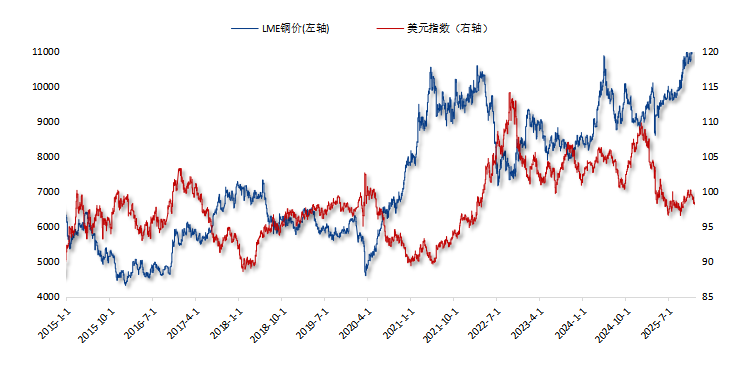
Core Viewpoint - The recent surge in copper prices on the London Metal Exchange and the Shanghai Futures Exchange reflects a fundamental transformation in the global copper industry, driven by long-term supply constraints and structural demand growth from new economic sectors such as electric vehicles, photovoltaic energy storage, and AI data centers [1][20]. Group 1: Copper Price Trends - From 2015 to 2025, copper prices transitioned from a bear market to a structural bull market, influenced by macroeconomic cycles and global monetary policy adjustments [2][21]. - The year 2021 marked a turning point for copper prices, as the global economy shifted from recovery to growth, supported by new technologies and expansive monetary policies [2][22]. - The current price increase is characterized by a dual support of macroeconomic conditions and structural industry changes, with significant demand growth from new sectors [3][22]. Group 2: Supply Constraints - The global copper supply system is facing a long-term dilemma of declining stock and limited incremental supply, exacerbated by deteriorating resource quality, extended development cycles, and increased geopolitical risks [5][24]. - The average grade of global copper mines is declining, leading to higher extraction costs, while new resource discoveries have significantly decreased [7][26]. - Geopolitical risks, such as nationalization discussions in Chile and labor strikes in Peru, have increased supply disruptions, contributing to a long-term unstable supply situation [8][27]. Group 3: Demand Growth from Emerging Sectors - The demand for copper is increasingly driven by the electric vehicle industry, with each electric vehicle requiring 80-100 kg of copper, significantly more than traditional vehicles [10][28]. - Renewable energy and energy storage sectors are forming a second growth curve for copper demand, with wind and solar energy applications expanding rapidly [11][29]. - The AI data center revolution is expected to significantly increase copper demand, with projections indicating a substantial rise in copper usage in clean energy sectors by 2030 [11][29]. Group 4: Industry Chain Differentiation and Value Reconstruction - The high copper prices are reshaping the value distribution logic within the copper industry, concentrating value towards resource-rich and high-value segments [12][30]. - Upstream mining companies are benefiting the most, with firms like Glencore and Freeport-McMoRan seeing profit increases of over 50% [12][30]. - The midstream smelting sector is facing challenges, with some companies forced to reduce production due to tight copper concentrate supplies and low processing fees [12][30]. Group 5: Future Trends in the Copper Industry - The structural transformation of the copper industry is irreversible, with copper evolving from a traditional industrial metal to a critical resource for energy transition [14][32]. - Future trends will focus on optimizing existing resources, increasing industry concentration, and emphasizing green transformation and technological innovation as core competitive advantages [14][32].

高盛:力拓(RIO.US)收购嘉能可若成,将大幅提升2030年后铜矿产量
智通财经网· 2026-01-13 11:16
Core Viewpoint - Goldman Sachs reports that Rio Tinto (RIO.US) and Glencore are in early discussions regarding a potential merger through "agreement arrangements" [1] Group 1: Rio Tinto's Position - Rio Tinto is in a strong position with attractive growth projects in copper, iron ore, and lithium, with 15-20 projects under development [1] - The company is expected to achieve a 3%-4% annual copper equivalent production growth over the next decade, primarily between 2025-2030 [1] - The potential merger with Glencore is surprising to the market, especially as Rio Tinto plans to divest $5-10 billion in non-core assets and reduce capital expenditure guidance by $1 billion to $10 billion annually [2] - Rio Tinto's copper growth options are limited and technically complex, while Glencore has lower capital intensity brownfield projects [4] Group 2: Glencore's Perspective - Glencore emphasizes the importance of industry consolidation and prudent acquisitions to enhance global influence and negotiation power [5] - The merger would provide Glencore with synergies from its coal business, copper growth options, and marketing department, supporting incremental production [5] - The opportunity to merge with Rio Tinto would allow Glencore to gain world-class iron ore and aluminum businesses, which have high entry barriers [5] Group 3: Valuation and Market Sentiment - Goldman Sachs does not provide a valuation for any potential transaction but notes that Glencore is regaining market trust after years of underperformance [7] - The ongoing dialogue between Glencore and Rio Tinto has been intermittent for over a decade, with renewed discussions starting more than a year ago [7] - As of January 9, Rio Tinto's London-listed stock has an enterprise value/EBITDA of 5.1 times, while Glencore's is 6.4 times [7] - Goldman Sachs maintains a "buy" rating for Rio Tinto with a 12-month target price of £71 per share, based on a weighted calculation of net asset value and enterprise value/EBITDA [8]


每日核心期货品种分析-20260113
Guan Tong Qi Huo· 2026-01-13 11:12
1. Report's Industry Investment Rating - No relevant content provided. 2. Core Viewpoints of the Report - As of the close on January 13, domestic futures main contracts showed mixed performance. Carbonate lithium rose over 7%, silver futures over 5%, tin futures over 4%, and SC crude oil over 2%. On the other hand, container shipping to Europe and palladium dropped over 5%, polysilicon over 4%, glass and platinum over 3%, and caustic soda and coking coal over 2%. Stock index futures mostly declined, while treasury bond futures generally rose. In terms of capital flow, some contracts had capital inflows, while others had outflows [4][5]. 3. Summary by Related Catalogs 3.1 Futures Market Overview - As of the close on January 13, domestic futures main contracts had different trends. Carbonate lithium, silver, tin, and SC crude oil had significant increases, while container shipping to Europe, palladium, and other commodities declined. Stock index futures mostly fell, and treasury bond futures generally rose. As of 15:17 on January 13, some contracts had capital inflows, and some had outflows [4][5]. 3.2 Market Analysis 3.2.1 Copper - Shanghai copper opened high and then declined during the session. In terms of supply, copper smelters are having difficulty making profits from long - term contracts, and the spot market is weakly stable. The production of refined copper is expected to decline in January. The merger negotiation between Rio Tinto and Glencore may lead to them controlling 15% of the global copper resources. In terms of demand, terminal demand is growing strongly, but the copper products sector is cautious. Copper inventory has increased significantly. The market is worried about US copper tariffs, and the high - price copper has suppressed downstream demand. However, the weakening of the US dollar supports copper prices, and the copper market is expected to have limited decline [7]. 3.2.2 Carbonate Lithium - Carbonate lithium continued to rise significantly today with a narrowing increase and opened the daily limit at noon. The adjustment of the export tax - rebate policy for battery products may lead to a rush - to - export situation. Although the fundamentals are weakening with inventory accumulation, the demand for energy storage batteries is still booming. The market is expected to be strong in the medium and long - term under the stimulation of the rush - to - export, but the potential negative impact of CATL's resumption of production should be noted [9]. 3.2.3 Crude Oil - OPEC+ decided to maintain the production plan and suspend production increase in February and March 2026. The US crude oil inventory decreased unexpectedly, but the refined oil inventory increased more than expected. The US oil production is still near the historical high. The market is worried about oil demand, and the global oil supply is in an oversupply situation. The situation in Venezuela and Iran may affect the oil market, and the oil price is expected to fluctuate [10][12]. 3.2.4 Asphalt - The asphalt production rate decreased last week, and the expected production in January 2026 decreased. The downstream construction rates mostly declined, and the national shipment volume decreased. The refinery inventory rate increased but remained at a low level. The situation in Venezuela may affect the supply and cost of domestic asphalt. The asphalt production rate will remain low, and the demand in the north will slow down, while the winter - storage demand is being released. It is recommended to use the reverse - spread strategy before March [13]. 3.2.5 PP - After the New Year's Day, the downstream PP operating rate decreased slightly. On January 13, the PP enterprise operating rate increased but remained at a low level. The petrochemical inventory is at a neutral level. The cost is affected by geopolitical factors, and the new production capacity has been put into operation. The downstream is at the end of the peak season, and the order volume is decreasing. The macro - economic environment is improving, but the improvement of the PP supply - demand pattern is limited, and the upward space is expected to be limited. The L - PP spread is expected to narrow [15]. 3.2.6 Plastic - On January 13, the plastic operating rate decreased to a neutral level. After the New Year's Day, the PE downstream operating rate increased slightly, but the agricultural film is out of the peak season, and the order volume is decreasing. The petrochemical inventory is at a neutral level. The cost is affected by geopolitical factors, and new production capacity has been put into operation. The downstream demand is expected to decline. The macro - economic environment is improving, but the improvement of the plastic supply - demand pattern is limited, and the upward space is expected to be limited. The L - PP spread is expected to narrow [16][17]. 3.2.7 PVC - The calcium carbide price in the northwest region is stable. The PVC operating rate increased, and the downstream operating rate increased slightly but is still at a low level. The export signing decreased, and the social inventory is still high. The real estate market is still in the adjustment stage. New production capacity has been put into operation. The macro - economic environment is improving, but the supply - demand pattern improvement is limited. The 03 - 05 contract is expected to fluctuate strongly under the stimulation of the cancellation of the export tax - rebate [18]. 3.2.8 Coking Coal - Coking coal opened high and then declined during the session. The spot price increased. The supply increased as mines resumed production, and the inventory of mines and coking enterprises increased. The coking enterprise's profit decreased, and the steel mill has a production - resuming expectation but is expected to operate at a low load. The coking coal price is expected to have limited decline [20]. 3.2.9 Urea - Urea opened high and then declined during the session. The upstream factory price is stable, and the order volume is sufficient. The daily production of urea has increased. The agricultural dealers' fertilizer - preparation enthusiasm has increased, but the industrial demand is weak due to the approaching Spring Festival. The inventory is at a low level compared to last year. The urea price is expected to be stable in the short - term and strong in the long - term [21].
沪铜日报:铜盘面高位调整-20260113
Guan Tong Qi Huo· 2026-01-13 11:12
Group 1: Investment Rating - No investment rating provided in the report Group 2: Core Viewpoints - The copper market shows a structure of strong expectations but weak reality. Although downstream demand is weak and there are concerns about tariffs and inventory imbalances, the copper price is supported by the weakening trend of the US dollar, and the copper market is unlikely to experience a sharp decline [1] Group 3: Summary by Section Market Analysis - In 2026, copper smelters cannot profit from long - term contracts, and by - products like sulfuric acid and gold are the main profit sources. The refined - scrap copper price difference is still abnormal, but the weak downstream demand restricts scrap copper trading. Five smelters plan to stop production in January, and one new smelter's operation is postponed, leading to a decline in refined copper production. The potential merger of Rio Tinto and Glencore may control 15% of global copper supply, highlighting the tight supply expectation. Terminal demand grows strongly, but the copper product sector is cautious, and high prices and year - end holidays slow down raw material procurement, resulting in a significant increase in copper inventory. The market is worried about US refined copper tariffs, and the high price suppresses downstream demand. The weakening US dollar supports the copper price [1] Futures and Spot Market - Futures: Shanghai copper opened and closed lower today with intraday fluctuations [4] - Spot: The spot premium in East China is 50 yuan/ton, and in South China is 20 yuan/ton. On January 12, 2026, the LME official price was 13310 US dollars/ton, with a spot premium of +70 US dollars/ton [4] Supply - side - As of January 12, the spot rough smelting fee (TC) is - 45.1 US dollars/dry ton, and the spot refining fee (RC) is - 4.6 cents/pound [6] Inventory - SHFE copper inventory is 122,100 tons, an increase of 5505 tons from the previous period. As of January 12, Shanghai bonded - area copper inventory is 111,000 tons, an increase of 9200 tons; LME copper inventory is 137,200 tons, a decrease of 1750 tons; COMEX copper inventory is 520,400 short tons, an increase of 3042 short tons [9]
铜价维持高位,下游采购意愿受到抑制
Hua Tai Qi Huo· 2026-01-13 05:14
1. Report Industry Investment Rating - Copper: Cautiously bullish [8] - Arbitrage: On hold - Options: Sell put options 2. Core View of the Report - Although domestic demand is affected by high copper prices, subsidies for certain end - products (such as home appliances and new energy vehicles) will continue in 2026. TC is still at a low level, and mine - end supply remains tight. It is recommended to conduct buy - hedging on dips in the range of 99,600 yuan/ton to 101,500 yuan/ton, while paying attention to the impact of Trump's tariff policy on Comex inventory [8]. 3. Summary by Related Catalogs Market News and Important Data Futures Quotes - On January 12, 2026, the main contract of Shanghai copper opened at 101,910 yuan/ton and closed at 103,800 yuan/ton, a 2.36% increase from the previous trading day's close. In the night session, it opened at 104,500 yuan/ton and closed at 103,450 yuan/ton, a 0.54% increase from the afternoon close [1]. Spot Situation - SMM 1 electrolytic copper spot quoted a discount of 30 yuan to a premium of 150 yuan per ton against the 2601 contract, with an average premium of 60 yuan, a 105 - yuan increase from the previous day. The spot price ranged from 102,870 to 103,600 yuan/ton. As the delivery approaches, the premium pattern is expected to continue, but further upward movement is limited by downstream acceptance and warehouse receipt declaration [2]. Important Information Summary Geopolitical Aspect - Trump stated that any country doing business with Iran will face a 25% tariff on all its business with the US. Iran is prepared for all possibilities. The UK and Germany are leading European countries to discuss deploying troops in Greenland [3]. Mine End - Lundin Mining plans to invest $150 million to upgrade its Caserones copper - molybdenum mine, extending its operation until 2039. In November, Codelco's copper production decreased by 3% to 130,900 tons, Escondida's production dropped by 12.8% to 94,400 tons, and Collahuasi's production increased by 2.7% to 37,700 tons [4]. Smelting and Import - Last week, LME copper inventory first increased and then decreased to 138,975 tons, a two - month low. SHFE copper inventory increased by 24.22% to 180,543 tons, a nine - month high. New York copper inventory continued to rise. Pan Pacific Copper proposed a 2026 copper premium of $330 per ton to Japanese customers, due to a significant decline in TC/RC and concerns about US tariffs [5]. Consumption - In the past week, the operating rate of domestic refined copper rod enterprises was 47.82%, a 1.01 - percentage - point week - on - week decrease and a 28.54 - percentage - point year - on - year decrease. The operating rate of copper cable enterprises was 56.58%, a 2.37 - percentage - point week - on - week decrease and a 12.73 - percentage - point year - on - year decrease. High copper prices suppressed downstream procurement, but some orders were released when prices briefly declined. It is expected that the operating rate of refined copper rod enterprises will rise to 58.83%, and that of copper cable enterprises will rise to 56.88% [6][7]. Inventory and Warehouse Receipts - LME warehouse receipts decreased by 2,100 tons to 137,225 tons, SHFE warehouse receipts increased by 5,406 tons to 116,622 tons. On January 12, the domestic electrolytic copper spot inventory was 293,400 tons, a 19,600 - ton increase from the previous week [7]. Strategy - Copper: Cautiously bullish. It is recommended to conduct buy - hedging on dips in the range of 99,600 yuan/ton to 101,500 yuan/ton. - Arbitrage: On hold. - Options: Sell put options [8].
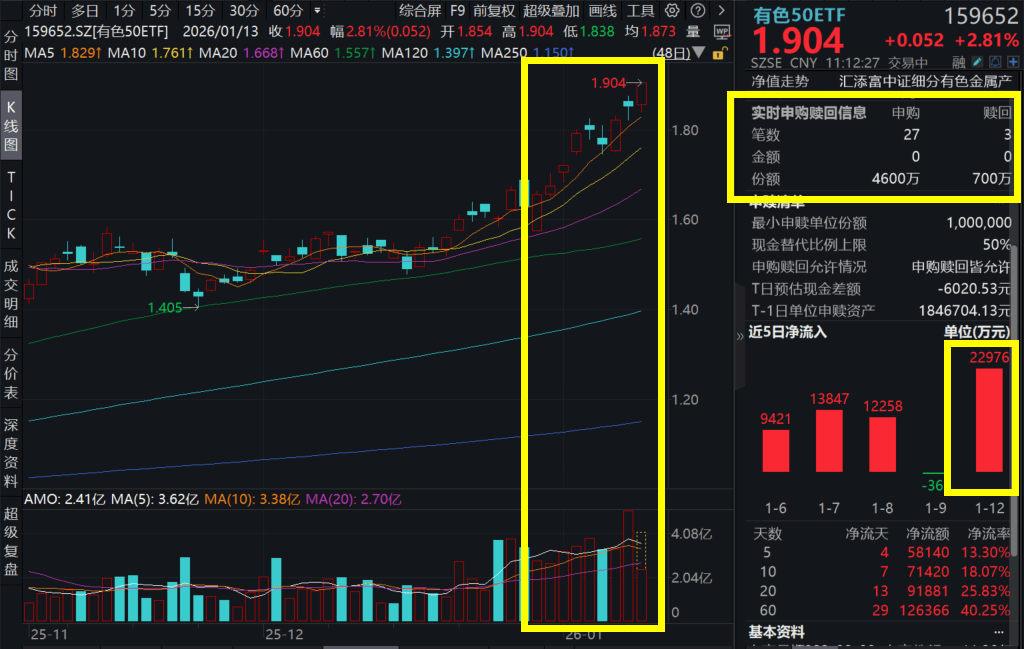
碳酸锂期货12%涨停!赣锋锂业暴涨超8%,有色50ETF(159652)大涨2.8%,早盘净申购超7000万,近2日吸金超3亿元!金铜锂三大金属逻辑一文读懂
Sou Hu Cai Jing· 2026-01-13 03:47
Core Viewpoint - The A-share market is experiencing volatility with a strong performance in the non-ferrous metal sector, particularly driven by the surge in lithium carbonate futures and geopolitical tensions supporting gold prices [1][5][6]. Group 1: Market Performance - As of January 13, the non-ferrous 50 ETF (159652) saw a significant increase, rising over 2.8% and attracting more than 730 million yuan in capital inflow, totaling over 300 million yuan in the last two days [1]. - Key stocks in the non-ferrous sector showed varied performance, with Zijin Mining up 3.89%, Ganfeng Lithium soaring 8.71%, and Shandong Gold increasing by 5.49% [2][7]. Group 2: Sector Analysis - The non-ferrous sector is currently influenced by multiple factors including frequent macroeconomic disturbances, rigid supply-side conditions, and new demand-side dynamics [5]. - Lithium, as an energy metal, is expected to benefit from export tax adjustments, potentially leading to increased battery production and tighter supply-demand dynamics for lithium carbonate [5][8]. - Gold prices are supported by rising geopolitical tensions and weak employment data, with expectations for prices to remain above $4,500 per ounce [5][9]. - Copper prices are driven by structural supply concerns and regional mismatches, with expectations for continued price increases due to a projected supply gap of over 100,000 tons by 2026 [9]. Group 3: Investment Opportunities - The non-ferrous 50 ETF (159652) is highlighted as a comprehensive investment vehicle covering various metal sectors, with a high concentration of strategic assets [11]. - The ETF's index shows a leading concentration in copper and gold, with a copper content of 34% and gold content of 12%, making it attractive for investors looking to capitalize on the ongoing non-ferrous market cycle [11][13]. - The ETF has demonstrated superior performance with a cumulative return of 99.61% since 2022, driven by earnings rather than valuation expansion, indicating a strong investment case [13].




1.13犀牛财经早报:境内首家万亿级ETF基金公司诞生
Xi Niu Cai Jing· 2026-01-13 01:37
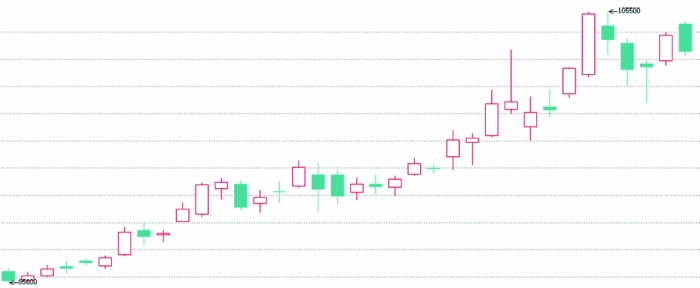
Group 1: ETF Market Development - China’s ETF market has reached a milestone with the first fund management company, Huaxia Fund, surpassing 1 trillion yuan in ETF assets under management, totaling 10096.84 billion yuan [1] - Non-monetary ETFs account for 10095.9 billion yuan, representing 16% of the total ETF market size of approximately 6.25 trillion yuan [1] - Huaxia Fund has maintained the leading position in ETF management for 21 consecutive years since the launch of the first domestic ETF in 2005, with a cumulative growth of 3356.84 billion yuan since 2025 [1] Group 2: Emerging Market ETF Inflows - Investors have continued to pour money into emerging market ETFs for the 12th consecutive week, with inflows reaching 39.7 billion USD, the highest in over a year [2] - The inflow includes 39.6 billion USD into stock ETFs and 770 million USD into bond ETFs, increasing total assets from 442.7 billion USD to 452.6 billion USD [2] - The MSCI Emerging Markets Index rose by 1.6% to 1452.35 points during the same week [2] Group 3: Fund Management and IPO Trends - Debon Fund has implemented emergency purchase limits after reportedly attracting 12 billion yuan in a single day, adjusting purchase limits for its funds [3] - The proportion of IPO cases using a "tiered fee" model has significantly decreased from about 38% in 2023 to 6% in 2025, with a hybrid fee model becoming mainstream [3] Group 4: Commodity Market Developments - The price of lithium carbonate has surged to over 150,000 yuan per ton, with a daily increase of 9%, driven by high demand in the lithium battery sector [5] - Copper and aluminum prices have reached historical highs, with domestic copper contracts hitting 105,500 yuan per ton and aluminum contracts at 24,915 yuan per ton [5] - Major mining companies are consolidating to gain strategic pricing power in the copper market, with a potential merger between Rio Tinto and Glencore being discussed [5] Group 5: Transformer Industry Growth - The transformer industry is experiencing high demand due to accelerated global grid construction and AIDC needs, with several companies reporting a surge in orders [6] - The industry is expected to continue benefiting from a favorable market environment for the next 2 to 3 years [6] Group 6: Semiconductor Industry Trends - The semiconductor sector is witnessing a rise in merger and acquisition activities, with a 15% increase in cases year-on-year, although the failure rate of these mergers has also increased [7] - Industry experts suggest differentiated mergers and phased incubation of acquisition funds to mitigate risks associated with semiconductor mergers [7] Group 7: Corporate Developments - JA Solar has announced an expected net loss of 4.5 to 4.8 billion yuan for 2025, compared to a loss of 4.656 billion yuan in the previous year [11] - Mingyang Smart Energy plans to acquire control of Dehua Company, with the transaction currently in the planning stage [12]


新浪财经隔夜要闻大事汇总:2026年1月13日
Sou Hu Cai Jing· 2026-01-12 23:08
Market - The US stock market reached new highs on January 13, with the Dow Jones and S&P 500 indices both setting record levels, as investors overlooked the potential impact of a criminal investigation into Federal Reserve Chairman Jerome Powell [1][2][3] - Notable stock movements included a 10.17% increase in Alibaba and an 8.96% rise in Bilibili among popular Chinese stocks, contributing to a 4.26% gain in the Nasdaq Golden Dragon China Index [2][3] - Oil prices rose due to concerns over reduced exports from Iran amid anti-government protests, with Brent crude futures increasing by 1.1% to $64.01 per barrel [4] Company - Alphabet's market capitalization surpassed $4 trillion, making it the fourth company to reach this milestone, driven by positive developments in AI technology and partnerships with Apple [1][2] - Apple and Google have finalized a collaboration where Google will provide technical support for Apple's AI functionalities, including Siri, potentially involving a payment of around $1 billion [2][3] - Meta Platforms plans to cut approximately 10% of jobs in its Reality Labs division, shifting focus from virtual reality products to artificial intelligence [3][4] - Paramount Pictures has filed a lawsuit against Warner Bros. to disclose details of its $827 billion deal with Netflix, as it seeks to convince investors that its cash acquisition proposal is superior [4] - Nvidia and Eli Lilly announced a $1 billion joint research lab to develop new drug therapies using advanced AI models, aiming to shorten the time to market for new medications [8]
周二你需要知道的隔夜全球要闻:美联储调查风波引爆金属市场,金银齐创新高;伊朗风险推高油价;中国市场独揽9亿美元登顶新兴市场吸金榜
Sou Hu Cai Jing· 2026-01-12 22:39
【周二你需要知道的隔夜全球要闻:美联储调查风波引爆金属市场,金银齐创新高;伊朗风险推高油 价;中国市场独揽9亿美元登顶新兴市场吸金榜】 1、美国司法部威胁要对美联储提起刑事诉讼,再度 引发市场对美联储独立性的担忧,金属普遍上涨,黄金和白银攀升至纪录高位,现货黄金升破每盎司 4600美元;现货白银一度上涨8%,突破86美元;LME基准铜期货一度上涨2.5%至每吨13,323美元,之 后回吐部分涨幅。 2、伊朗局势动荡引发投资者对伊朗供应中断的担忧,原油价格周一升至12月初以来 的最高水平。WTI 2月原油期货收于每桶59.50美元,涨幅为0.64%,此前三个交易日累计上涨超过6%; 布伦特3月原油期货收于每桶63.87美元,涨幅为0.84%。 3、截至1月9日当周,美国上市新兴市场ETF资 金单周流入创逾一年新高,达39.7亿美元,较前一周的10.9亿美元大幅增加。其中中国市场获最大流 入,资金达9.074亿美元,较前一周增长超4倍。 4、谷歌证实与苹果达成一项为期多年的协议,将为苹 果的人工智能技术提供支持,其中包括语音助手Siri。马斯克对此评价称,这种合作似乎使其权力得到 了不合理集中。 5、美股三大指数 ...
铜铝价格齐创新高 国际矿企纷纷整合 争夺战略资源定价权
Shang Hai Zheng Quan Bao· 2026-01-12 18:58
Group 1 - The market sentiment for non-ferrous metals, particularly copper and aluminum, is strong, with both domestic and international prices reaching historical highs in early January 2026 [2] - The Shanghai Futures Exchange's copper futures hit 105,500 yuan/ton, while aluminum futures reached 24,915 yuan/ton, marking record levels [2] - Major mining companies Rio Tinto and Glencore have initiated merger talks, which could lead to the creation of a mining giant valued over $260 billion, enhancing their influence over copper pricing [2][3] Group 2 - The merger of Anglo American and Teck Resources is set to create the fifth-largest copper mining company globally, indicating a trend towards increased concentration in the mining sector [3] - Analysts suggest that the consolidation of mining giants will strengthen their bargaining power and pricing authority in the market, especially for copper, which is facing supply shortages [3] - Chile's national copper company reported a 3% year-on-year decline in copper production, further reinforcing expectations of supply constraints [3] Group 3 - The copper-aluminum price ratio is becoming an important indicator for aluminum price trends, with a shift in consumption patterns observed, particularly in the air conditioning industry favoring aluminum over copper [4] - Concerns over supply chain security amid geopolitical tensions are expected to sustain interest in non-ferrous metals, driving prices higher due to both industrial demand and speculative investments [4]