
沐曦

Search documents
国内AI芯片的出货量、供需关系
傅里叶的猫· 2025-07-21 15:42
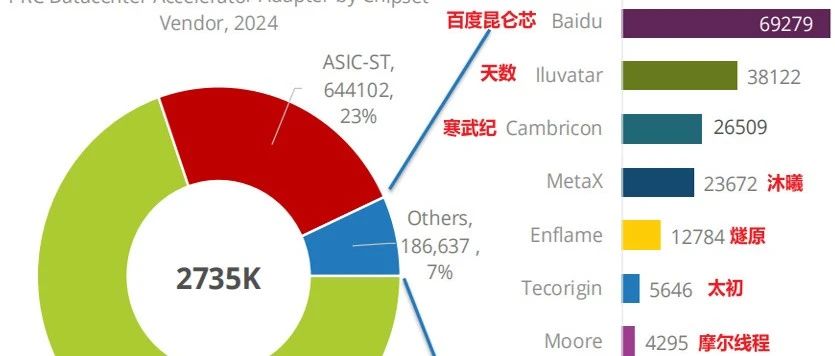
Core Viewpoint - The article discusses the impact of recent restrictions on AI chip sales in China, particularly focusing on the market dynamics for Nvidia and local manufacturers, and the projected growth of the AI accelerator market in the coming years [2][3]. Group 1: Market Projections - Bernstein estimates that the Chinese AI accelerator market will reach $39.5 billion by 2025, primarily driven by Nvidia H20 ($22.9 billion), AMD MI308 ($2 billion), and local manufacturers ($14.6 billion) [2]. - Following the sales ban, Nvidia is expected to lose $1.68 billion in H20 sales, while AMD may lose $150 million, with some orders shifting to local manufacturers, potentially increasing their revenue by about 10% [2]. - Despite local manufacturers' growth, Bernstein believes they cannot fully cover the $18.3 billion gap due to production bottlenecks in 7nm wafers and CoWoS technology [2]. Group 2: Nvidia's Strategy - Nvidia plans to apply for the resumption of H20 sales and introduce a compliant NVIDIA RTX PRO GPU, with initial demand projected at $10.5 billion, although it will not meet the initial demand of $16.8 billion [2][3]. - The anticipated shipment of B30 chips to China is expected to reach 400,000 units, generating $2.8 billion in revenue, while local manufacturers may only gain an additional $1.5 billion due to new restrictions [3]. Group 3: Competitive Landscape - Major cloud service providers in China, including ByteDance, Alibaba, Tencent, and Baidu, are the primary buyers of H20, accounting for 87% of total sales [5]. - By 2027, local manufacturers are projected to capture 55% of the market share, while global competitors may face technological stagnation and lose their competitive edge [3]. Group 4: Supply and Demand Dynamics - The article highlights discrepancies between GPU shipment data from Bernstein and IDC, noting that Huawei holds a 23% market share, while Nvidia's share is overstated by IDC by 7 percentage points [16][20]. - The supply-demand relationship indicates that aside from Alibaba and Baidu, other major companies are purchasing Huawei's AI chips, raising questions about the accuracy of reported data [23]. Group 5: Local Manufacturers - The report identifies local GPU manufacturers, with Huawei leading the market, followed by Cambricon, Haiguang, and Tianshu [20][21]. - The revenue of local manufacturers is expected to increase significantly, with Moore Threads projected to boost its revenue through substantial AI computing GPU shipments in 2024 [36][38].


东吴证券:AI需求带动设备供应链,先进制程持续扩产
news flash· 2025-07-21 00:27
Group 1 - The report from Dongwu Securities indicates that AI demand is driving the equipment supply chain, with advanced processes continuing to expand production [1] - Historically, training cards were primarily supplied by Nvidia, with the necessary advanced processes like 3D stacking being outsourced to TSMC; however, inference cards do not necessarily require 3-5nm advanced processes and can be effectively produced on domestic 12nm platforms [1] - Domestic IC design companies such as TianShu ZhiXin, MuXi, SuiYuan, and DengLin are beginning to migrate inference cards to the domestic supply chain, with companies like ShengHe JingWei and SMIC expected to benefit from this shift [1] Group 2 - From an advanced logic perspective, domestic advanced logic production is expected to exceed expectations by 2025 [1] - In terms of memory, a new iteration cycle is anticipated next year, which is expected to lead to more projects being launched [1]

半导体行业点评报告:关注AI算力需求快速发展,看好国产设备商充分受益
Soochow Securities· 2025-07-19 11:27
Investment Rating - The report maintains an "Overweight" rating for the semiconductor industry, indicating a positive outlook for the sector in the next 6 months [1][7]. Core Insights - The rapid development of AI computing demand is a key driver for the semiconductor industry, with domestic equipment manufacturers expected to benefit significantly [1][4]. - The high-end SoC testing machine market presents substantial opportunities, necessitating breakthroughs from domestic manufacturers due to the complexity of testing [4]. - The demand for AI is driving the equipment supply chain, with advanced processes continuing to expand, particularly in domestic IC design companies [4]. - Silicon photonics equipment leaders are seeing a surge in orders, benefiting from the industrialization of silicon photonics driven by AI [4]. - Investment recommendations include focusing on advanced packaging, backend testing, front-end processes, and silicon photonics equipment [4]. Industry Trends - The semiconductor industry is projected to outperform the CSI 300 index, with a forecasted growth trajectory that shows a significant increase in demand for AI-related technologies [3][4]. - The report highlights the importance of domestic supply chains in the production of inference chips, which are becoming increasingly competitive on cost [4]. - The anticipated expansion in advanced logic and memory sectors is expected to lead to new project launches in the coming year [4].
瀚博半导体正式启动A股IPO:国内几乎所有头部GPU企业均已启动上市流程
IPO早知道· 2025-07-19 02:31
Group 1 - The core viewpoint of the article highlights that several leading GPU companies established between 2018 and 2020, including Hanbo Semiconductor, Moer Technology, and Muxi, have initiated their A-share IPO processes, indicating a growing trend in the semiconductor industry [3][4]. - Hanbo Semiconductor has signed a counseling agreement with CITIC Securities to officially start its A-share IPO process, marking a significant step for the company [3]. - Moer Technology and Muxi's IPO applications have been accepted by the Sci-Tech Innovation Board as of June 30, 2023, further emphasizing the momentum in the GPU sector [3]. Group 2 - Hanbo Semiconductor, founded in 2018, specializes in high-end GPU chip solutions for AI core computing power and graphics rendering, and has developed two generations of GPU chips that are now in mass production [4][5]. - The company offers a full-stack chip solution with three main product lines: graphics rendering GPUs, data center GPUs, and edge GPUs, catering to various applications including AI, cloud graphics rendering, and smart transportation [5]. - The core technical team of Hanbo Semiconductor comprises experienced professionals from renowned companies like AMD, NVIDIA, and Intel, with an average industry experience of over 18 years [5].
人工智能软硬件协同加速创新
Zhong Guo Jing Ji Wang· 2025-07-18 05:46
Group 1 - The conference highlighted five major trends in artificial intelligence, including accelerated iteration of foundational large models, a shift in focus towards post-training and inference stages, deep collaboration between hardware and software, the rise of intelligent agents and the intelligent agent economy, the promotion of open-source ecosystems, and increasing demands for AI safety governance [1] - Beijing Economic-Technological Development Area is committed to building a comprehensive AI city, with plans to establish a national AI data training base, the largest public computing power platform in the city, and to implement special policies and funding exceeding 1 billion yuan to support major projects in various AI-related fields [1] - By the end of 2025, the development goals include opening 100 landmark application scenarios, gathering 600 core enterprises, and achieving an industry scale target of 80 billion yuan [1] Group 2 - The AI hardware and software testing and verification center was officially launched, aiming to provide key testing and verification capabilities for AI hardware and software, with four core capabilities established [2] - The center has partnered with major companies to create innovation labs and testing facilities to accelerate the innovation and prosperity of intelligent computing technologies [2] - Five major achievements in AI hardware and software collaborative innovation were announced, showcasing significant breakthroughs across the entire technology chain from foundational computing power to framework software [2] Group 3 - The center completed the first batch of testing and evaluation for the adaptation of large models and domestic hardware and software, with several companies successfully passing the evaluation [3] - The conference awarded certificates to institutions that passed the unified benchmark testing, marking a new stage in the standardized and quantifiable development of AI collaborative innovation ecosystems [3] - The AI safety governance initiative was highlighted, with 18 companies disclosing their safety practices, contributing to the establishment of a solid foundation for responsible AI development [3] Group 4 - The vice president of the China Academy of Information and Communications Technology emphasized the urgent need to address challenges in hardware and software collaboration for building an open intelligent computing ecosystem [4] - The AISHPerf 2.0 benchmark system was officially released, featuring upgrades to support multiple inference engines and domestic open-source model loads, addressing various evaluation needs [4] - The academy has initiated a series of collaborative testing and verification efforts based on AISHPerf, focusing on large model adaptation and key collaborative technologies [4]


英伟达H20重回市场,但中国芯片过去三个月已爆单
36氪· 2025-07-16 00:12
Core Viewpoint - Nvidia's founder Jensen Huang is making significant efforts to regain market share in China's AI computing sector after losing ground to domestic chip companies during the U.S. export restrictions [4][5][8]. Group 1: Nvidia's Market Strategy - Jensen Huang's visit to China includes meetings with government officials and key industry players, aiming to restore confidence in Nvidia's operations in the region [4][5]. - Nvidia has received assurances from the U.S. government to resume sales of the H20 chip in China, which is a downgraded version of the H100 series designed to comply with export regulations [5][11]. - The company's market share in China has dropped from 95% during the export control period in 2022 to 50% due to the emergence of local competitors [8]. Group 2: Domestic Competitors - Chinese chip manufacturers have rapidly developed alternatives to Nvidia's H20 chip, including products from Kunlun, Moore Threads, Huawei, and Cambricon, which are aggressively targeting Nvidia's market share [7][12]. - Domestic chip companies have reported significant demand, with some experiencing a surge in orders and achieving substantial revenue growth, such as Cambricon's quarterly revenue increasing by 42.3 times [12][13]. - The competitive landscape is shifting as local firms focus on AI inference capabilities, which are less complex than training models, allowing them to better compete against Nvidia [14][15]. Group 3: Financial Implications - Nvidia's revenue loss due to the H20 ban is projected to be around $8 billion (approximately 57.3 billion yuan) in Q2 2025 [17]. - China represents a crucial market for Nvidia, contributing about 15% of its global revenue, equating to approximately $18 billion annually [16]. - The ongoing geopolitical tensions and export restrictions have created uncertainty for Nvidia's long-term prospects in China, despite the potential for short-term sales recovery with the H20's return [19][20].

全球算力爆发!这些特色ETF火了
Ge Long Hui· 2025-07-15 09:17
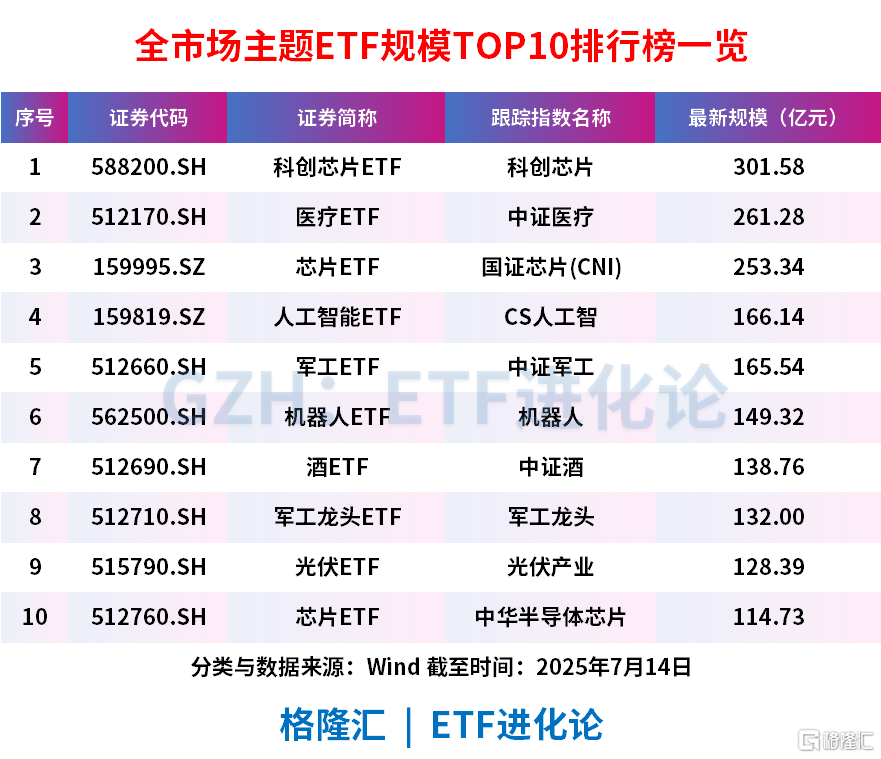
Group 1 - The explosive growth in global computing power demand is reshaping international capital flows, with Nvidia's stock price reaching new highs and the A-share computing power sector experiencing significant activity since June [1] - The launch of ChatGPT in November 2022 sparked a global enthusiasm for generative AI, leading to a surge in investments in artificial intelligence [1][3] - The 2024 Hurun Global Rich List indicates that over half of the new wealth generated globally comes from AI, with Nvidia's CEO Huang Renxun's net worth rising to $82.8 billion, ranking him 17th globally [1] Group 2 - The Sci-Tech Chip ETF (588200) has seen its scale grow from 367 million yuan to 30.158 billion yuan, an increase of over 80 times since its launch in October 2022, making it the largest thematic ETF in its category [1] - In the first quarter of 2023, global semiconductor manufacturing equipment sales reached $32 billion, a 21% year-on-year increase, highlighting the industry's high prosperity [14] - The Chinese market has maintained its position as the largest global semiconductor market for eight consecutive quarters, becoming a key driver of the industry's recovery [14] Group 3 - The release of DeepSeek-R1 in January 2024 marked a significant milestone for Chinese AI, indicating that domestic open-source models are nearly on par with the world's leading models [3] - The performance of various indices from January 21 to February 27, 2024, showed significant gains, with the Sci-Tech Machinery Index rising by 19.38% and the Sci-Tech Chip Index increasing by 18.47% [5] - The AI sector has experienced a rebound since June 2024, with the Sci-Tech Chip ETF attracting 6.524 billion yuan in inflows over the past 60 days [7] Group 4 - Seven Sci-Tech chip companies have released mid-year profit forecasts, all indicating profit growth, with notable increases from companies like Lanqi Technology and Hengxuan Technology [9][11] - The establishment of the Sci-Tech Growth Layer on the Sci-Tech Board aims to support technology innovation and provide a smoother IPO pathway for companies in emerging fields like AI and commercial aerospace [20] - The ongoing support for technology enterprises from the government, including financing initiatives and policy reforms, is expected to bolster the development of the AI and semiconductor sectors [19][27]
央企牵头!这个AI开源社区要让大模型跑遍「中国芯」
机器之心· 2025-07-15 05:37
Core Viewpoint - The article discusses the challenges and solutions related to the adaptation of large models to domestic chips in China, emphasizing the need for a collaborative platform to bridge the gap between model development and chip compatibility [2][3][35]. Group 1: Model Adaptation Challenges - The successful deployment of large models requires overcoming three main hurdles: adapting the inference engine, adapting the computing platform, and adapting the upper scheduling for business system integration [9][10]. - Current tools for supporting large model inference and adaptation are diverse, but the challenge lies in effectively connecting and coordinating these fragmented tools and experiences [11]. Group 2: Collaboration Initiatives - The "Model Inference Adaptation Collaboration Plan" was launched by the Modelers community to gather developers, algorithm teams, chip manufacturers, and inference tool partners to build an open-source collaborative ecosystem [5][30]. - The community upgraded its "Mirror Center" to a "Tool Center," elevating the importance of the toolchain to be on par with model libraries and datasets [13][14]. Group 3: Community Engagement and Development - The community introduced a "Collaboration Space" where all users can submit pull requests (PRs) to contribute to documentation, adaptation code development, and optimization of inference configurations [20][29]. - The collaboration mechanism aims to aggregate dispersed adaptation efforts into a unified platform, allowing for easy downloading and secondary development [29]. Group 4: Industry Partnerships - The community collaborates with various domestic computing power manufacturers to provide developers with hardware, tools, and technical support [31]. - The initiative also integrates a diverse ecosystem of adaptation and inference software, helping developers quickly master the adaptation toolchain [32]. Group 5: Future Prospects - The "Adaptation Plan" will continue to be open for more chip manufacturers, model developers, and developers to join, with a focus on standardizing adaptation technology [34]. - If successful, this collaborative mechanism could address the critical "coordination shortfall" in the domestic chip ecosystem, facilitating the systematic implementation of models on chips [35].

申万宏源 TMT+洞见:每周
2025-07-14 00:36
Summary of Key Points from Conference Call Records Industry and Company Involved - **Industry**: Technology, specifically focusing on AI computing, IDC (Internet Data Center), and smart connected vehicles - **Companies**: Xiaomi, Alibaba, Tencent, Huawei, and other domestic chip manufacturers Core Insights and Arguments - **Xiaomi's New Chip Development**: Xiaomi has launched the Xuanjie O1 chip with a three-tier architecture and an NPU computing power of 15 TOPS, targeting mobile, tablet, and automotive markets. Initial production is small to ensure market reputation, but long-term, self-developed SOC chips could significantly enhance profit margins and brand positioning [1][3][6] - **Alibaba and Tencent's Capital Expenditure**: Both companies reported weaker capital expenditures in Q1, primarily due to order delays rather than a lack of commitment. Alibaba's full-year capital expenditure commitment remains at 45.32 billion yuan, indicating ongoing investment in AI computing and IDC services [4][5][10] - **IDC Industry Outlook**: The IDC industry is expected to see steady progress in component delivery and bidding by 2025, with improvements anticipated in financial performance starting in Q3 due to traditional data center upgrades and new data center deliveries [8] - **AI Computing Demand Growth**: There is a rapid increase in AI computing demand, particularly in consumer applications, with significant user growth in platforms like Doubao and Tencent Yuanbao. The demand from government, finance, and education sectors is also strong, indicating a real growth in future financial reports from major companies [11] - **Domestic Chip Supply**: Domestic chip supply is gradually increasing, with Huawei and other manufacturers like Haiguang and Muxi expected to enhance their contributions to AI computing supply [12][13] Other Important but Possibly Overlooked Content - **Impact of New National Standards for Smart Connected Vehicles**: The new national standards draft for smart connected vehicles involves over 80 scenarios and function tests, which will benefit leading companies and accelerate market differentiation. The finalization and implementation are expected by mid-2027 [2][28][29] - **Market Competition Dynamics**: The new standards will favor top-tier companies, potentially pushing second-tier brands out of the market, thus accelerating the elimination of competitors lacking genuine technological capabilities [29] - **Investment Opportunities in AI Computing**: Despite short-term stock price reactions reflecting pessimism, the long-term investment intentions of major companies remain strong, with ongoing trends in IDC and computing rental services indicating sustained opportunities [7][15] - **Tencent and Alibaba's Cloud Business Performance**: Tencent's cloud revenue growth has been driven by AI-related income, while Alibaba's cloud business growth is primarily supported by AI products, indicating a strong market demand for cloud services [15][16] This summary encapsulates the critical insights from the conference call records, highlighting the ongoing developments in the technology sector, particularly in AI computing and smart vehicle standards.

国产算力掘金系列之一:交换机产业链
2025-07-14 00:36
Summary of Key Points from Conference Call Records Industry Overview - The conference call discusses the **domestic computing power industry chain**, particularly focusing on the **switching industry** and its performance in the context of recent market trends and regulatory changes [1][5]. Core Insights and Arguments - **Strong Demand in North America**: There is robust demand for computing power infrastructure in North America, as evidenced by the performance of companies like Nvidia, Stargate Construction, and CO CO Wave, which supports ongoing capital expenditures [1][2]. - **Rising Token Consumption**: Google’s rapid increase in TOKEN consumption indicates a growing demand for vertical industry applications and inference needs, which is expected to sustain capital expenditures [4][14]. - **Impact of H20 Ban**: The H20 ban has accelerated training demand within the domestic data center industry, with companies like Century Internet raising their annual performance guidance, and significant improvements in revenue and profit forecasts from optical module companies [1][5]. - **Profitability Improvement**: In Q2, domestic computing power profitability improved significantly, with Ruijie Network's quarterly profit growth ranging from 93% to 160%, and StarNet Ruijie's growth between 21% and 74% [1][5]. Key Industry Trends - **White Box Switches**: The rise of data center white box switches is meeting the customization needs of internet companies, with Ruijie and Unisoc leading the domestic market, while traditional brands like Cisco are losing their competitive edge [1][7]. - **High Sales and R&D Expenses**: Ruijie Network's sales expense ratio is 15.5% and R&D expense ratio is 16%, attributed to the need for channel establishment and high customization in their switching business [3][9][10]. - **Market Challenges**: The domestic computing power market faces challenges due to the H20 ban leading to reduced capital expenditures, with major companies like Alibaba and Tencent reporting lower capital spending [12]. Future Outlook - **Positive Market Trends**: The domestic computing power market is expected to improve, with indicators such as the rapid increase in Google TOKEN consumption and optimistic performance guidance from Oracle, Broadcom, and Marvell [14]. - **Performance Predictions**: Ruijie Network is projected to generate approximately 11.6 billion RMB in revenue in 2024, with a significant portion of profits expected from its data center switching business [9][15]. - **Investment Recommendations**: There is a suggestion to focus on investing in early performers in the domestic computing power sector, such as StarNet Ruijie and Ruijie Network, due to their favorable valuation compared to peers [15].
