蜜雪冰城

Search documents
新茶饮集体去美国开店
Di Yi Cai Jing Zi Xun· 2025-12-25 14:56
Group 1: Industry Overview - The new tea beverage industry in China is expected to reach a market size of over 200 billion yuan by 2025, driven by increasing consumer demand and the entry of multiple brands into the capital market [3][4] - The industry is transitioning from incremental competition to stock competition, with a common phenomenon of "ten tea shops on one street" leading brands to seek differentiation [3][4] - New trends include the solidification and dessertification of beverages, with products like "solid mango sago" gaining popularity among consumers [4][5] Group 2: Market Dynamics - The launch of solid products like "solid mango sago" has led to significant sales, with one brand reporting over 8 million cups sold since its introduction [5] - The trend towards solid and dessert-like beverages aligns with younger consumers' preferences for health-conscious options, incorporating nutritious ingredients [5][6] - The competition in the Southeast Asian market has intensified, prompting brands to shift their focus to North America, where there is perceived growth potential [7][8] Group 3: International Expansion - Brands like Mixue Ice City have opened stores in North America, with strategic locations in Los Angeles and New York, marking a shift from previous focus on Southeast Asia [7][8] - The complexity of establishing overseas supply chains poses significant challenges for brands looking to expand internationally [8] - Successful internationalization requires understanding and catering to local consumer preferences, moving beyond just serving Chinese customers [8][9]

A股IPO回暖、港股上市潮涌,2025年投行人“忙到飞起”
Di Yi Cai Jing· 2025-12-25 14:50
业内认为,在即将到来的2026年,A股和港股IPO还将继续活跃。 今年年中,李励有一次去香港工作的机会。当时,港股IPO市场持续火热,他所在的券商开展内部选 调,拟调配员工赴港做投行业务,并开出了可观的薪酬。但李励考虑一番后最终没有报名,原因 是:"我是看生物医药这块的,当时科创板第五套标准重启,手头有一些项目正在推进。" 而一些身处香港的投行人,今年"忙到飞起"。罗恩供职于某华尔街大行,他说,从今年的电话会、客户 需求反馈都能明显感觉到,海外投资者对中国市场的兴趣回暖,一些港股IPO项目里,海外主权基金更 是争抢基石份额。 投行人的直观感受,映射出2025年IPO市场的变化。这一年里,A股股权融资市场回暖、港股IPO持续火 热,包括投行在内的中介机构感受到了业务暖意。 安永大中华区上市服务主管合伙人何兆烽告诉第一财经,今年以来,伴随IPO市场动态发展,中介机构 获得了新的业务增长动力。"内地企业赴港上市意愿持续增强,中介机构从其现有的A股客户群中,拓 展出一定程度的业务增量。"他说。 Wind和交易所数据显示,截至12月25日,年内A股市场迎来111只新股,IPO募资总额约1253亿元,三大 交易所年内合计 ...
雀巢新帅谈裁员1.6万:把资源更多投入到销售团队丨消费参考
2 1 Shi Ji Jing Ji Bao Dao· 2025-12-25 08:19
Group 1 - Nestlé plans to cut approximately 16,000 jobs over the next two years, which is about 6% of its total workforce, including 12,000 white-collar positions across all functions and regions [1] - The new CEO, Philipp Navratil, indicated that the layoffs are part of a broader efficiency evaluation, particularly focusing on marketing processes and reallocating resources to sales teams [2][3] - The layoffs are a response to declining growth, with Nestlé's total sales for the first nine months of the year at 65.9 billion Swiss francs, a year-on-year decrease of 1.9% [4] Group 2 - The Greater China region has been a significant drag on Nestlé's performance, with an organic growth rate of -10.4% in Q3, continuing a downward trend from Q2 [5] - The company is working on rebuilding its team in China, emphasizing the need for improved innovation and targeted strategies in the rapidly growing e-commerce channel [5]


全球亿万富豪调查:投资黄金,看好中国
Xin Lang Cai Jing· 2025-12-25 02:40
Group 1 - The core finding of the UBS report indicates that 34% of surveyed billionaires believe that Greater China will provide the greatest investment opportunities in the next year, a significant increase from 11% in 2024 [1][26] - By 2025, the number of billionaires in mainland China is expected to reach 470, with a total wealth of $1.8 trillion, reflecting a year-on-year growth of 22.2% [1][15] - The report highlights that 98% of Chinese billionaires are self-made entrepreneurs, primarily emerging from the IT and high-tech sectors, with a younger average age compared to billionaires in other regions [1][21] Group 2 - Globally, the number of billionaires is projected to increase by 287 to a total of 2,919 by 2025, marking the second-highest growth since 2015, with total wealth rising by 13% to $15.8 trillion [2][16] - The Asia-Pacific region leads in billionaire growth, with numbers rising from 981 to 1,036, while the U.S. saw an increase of 89 billionaires to 924, accounting for one-third of the global total [2][16] Group 3 - The technology sector is expected to see a significant increase in billionaire wealth, with a projected growth of 23.8% to $3 trillion by 2025, driven by advancements in artificial intelligence [4][19] - In contrast, the consumer and retail sectors are experiencing slower growth, with total wealth increasing by 5.3% to $3.1 trillion, although they remain among the top sectors for billionaire creation [5][20] Group 4 - Among newly minted billionaires, 68.3% are self-made, with a total wealth increase of $386.5 billion, primarily from sectors like marketing software and infrastructure [6][21] - The report notes that 91 billionaires inherited wealth totaling $297.8 billion, marking a 36% increase from 2024, with Western Europe having the highest number of inheritors [7][22] Group 5 - The report indicates that there are currently 374 female billionaires, whose average wealth growth rate is double that of their male counterparts, with an 8.4% increase expected by 2025 [9][25] - Female billionaires primarily derive their wealth from the consumer and retail sectors, while male billionaires predominantly gain wealth from the technology sector [10][25] Group 6 - Billionaires are increasingly diversifying their investment strategies, with 42% planning to increase exposure to emerging market stocks and 49% intending to boost private equity allocations [12][27] - Concerns among billionaires include tariffs (66%), geopolitical conflicts (63%), and policy uncertainty (59%), with regional differences in focus [12][27]
中国内地亿万富豪增至470位,98%白手起家
Xin Lang Cai Jing· 2025-12-25 02:12
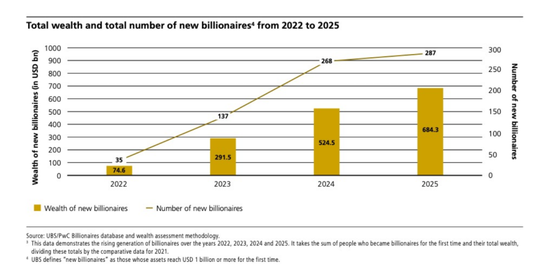
Group 1 - In 2025, China will see the addition of 70 new billionaires, bringing the total number of billionaires in mainland China to 470, ranking second in the world after the United States [2][19] - The total wealth of billionaires in mainland China has reached $1.8 trillion, reflecting a year-on-year growth of 22.2% [2][19] - The majority of new billionaires in China (98%) are self-made entrepreneurs, primarily from the IT and high-tech sectors, with a younger average age compared to billionaires in other regions [20][23] Group 2 - Globally, the number of billionaires increased by 287 to 2,919 in 2025, marking the second-highest growth since 2015, with total wealth rising by 13% to $15.8 trillion [3][20] - The Asia-Pacific region saw the largest increase in billionaires, growing from 981 to 1,036 [3][20] - The United States added 89 billionaires, totaling 924, which accounts for about one-third of the global billionaire population, with total wealth increasing by 18% to $6.9 trillion [3][20] Group 3 - The technology sector is experiencing significant growth, with total wealth among tech billionaires increasing by 23.8% to $3 trillion, driven by advancements in artificial intelligence [8][22] - The industrial manufacturing sector also saw a wealth increase of 27.1% to $1.7 trillion, while the financial sector's wealth grew by 17% to $2.3 trillion [8][22] - In contrast, the consumer and retail sector's wealth growth was slower, at 5.3% to $3.1 trillion, although it remains one of the top sectors for creating billionaires [8][22] Group 4 - Among the newly minted billionaires globally, 196 are self-made, accounting for 68.3% of the new billionaire population, with a total wealth increase of $386.5 billion [9][23] - The Asia-Pacific region has the highest proportion of self-made billionaires at 79%, with China having 98% of its billionaires being self-made [10][23] - Notable new billionaires include the founders of the Chinese tea chain Mixue Ice City and the founders of BYD in the industrial manufacturing sector [10][23] Group 5 - In 2025, 91 billionaires inherited wealth totaling $297.8 billion, marking a 36% increase from 2024 and setting a record for the largest inheritance scale [11][24] - The majority of inheritors are from Western Europe, with 48 inheritors collectively receiving $149.5 billion, significantly more than those in North America and Southeast Asia [11][24] - It is projected that over the next 15 years, billionaires' children will inherit at least $5.9 trillion, with significant amounts expected in the U.S. and China [11][24] Group 6 - There are currently 374 female billionaires globally, with their wealth growth rate being double that of male billionaires, averaging an 8.4% increase [13][27] - The primary source of wealth for female billionaires is the consumer and retail sector, where they hold approximately $619.9 billion [13][27] - In contrast, male billionaires derive most of their wealth from the technology sector, holding $2.9 trillion, with 98.1% being self-made [13][27] Group 7 - A growing number of billionaires are looking to China for investment opportunities, with 34% believing it offers the best prospects in the next 12 months, a significant increase from 11% in 2024 [14][28] - While North America remains a preferred investment region, its attractiveness has decreased, with 63% of billionaires seeing it as the best return opportunity, down from 80% in 2024 [14][28] - Over the next five years, 48% of billionaires view the Greater China region as the most attractive investment destination, up from 34% in 2025 [14][28] Group 8 - Billionaires are increasing their investments in alternative assets and gold, with 49% planning to boost private equity allocations and 43% looking to increase hedge fund investments [15][29] - Concerns among billionaires include tariffs (66%), geopolitical conflicts (63%), and policy uncertainty (59%), with regional differences in focus [15][29] - A significant portion of billionaires believe that the younger generation will face multiple global challenges, with 75% citing technology and AI as urgent issues [15][30]

蜜雪翻车、古茗出圈,奶茶店卖早餐究竟有多难
3 6 Ke· 2025-12-25 00:25
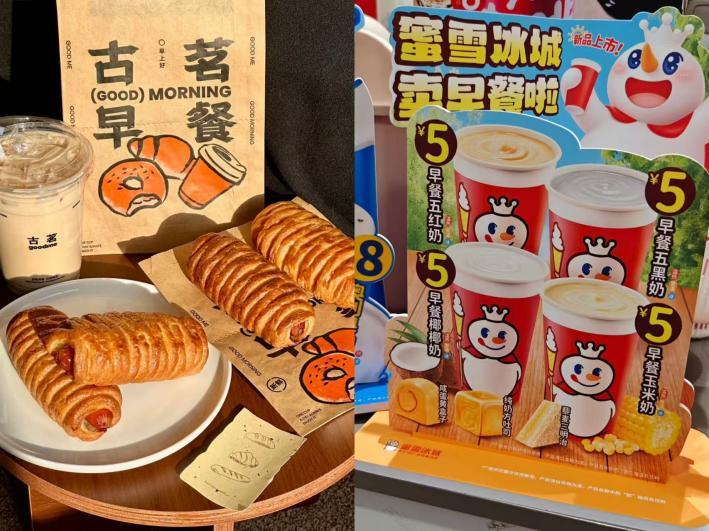
Core Insights - The tea beverage brands are entering the breakfast market to fill the operational gaps during morning hours, aiming to enhance store efficiency and increase average transaction value through breakfast combo offerings [1][8][12] - Despite the potential, the breakfast market presents challenges such as low average transaction prices, high convenience demands, and complex consumer preferences [2][13][15] Group 1: Market Dynamics - The new breakfast offerings from brands like Mixue Ice City and Gu Ming represent a significant shift as tea brands officially enter the breakfast segment, previously dominated by other food service providers [1][6] - The breakfast market is characterized by low average prices (6-10 yuan) and strong regional preferences, making it a challenging segment for tea brands to penetrate effectively [12][13][15] - The saturation of the tea beverage market has led to a slowdown in growth, with a projected market growth rate of only 6.4% in 2024 compared to 52% three years ago [8][9] Group 2: Product Offerings and Consumer Response - Mixue Ice City has introduced a breakfast menu featuring dairy drinks priced at 5 yuan and combo meals at 7.9 yuan, while Gu Ming offers a breakfast combo at 13 yuan, which has received a more favorable consumer response [6][18] - Consumer feedback indicates that while some breakfast offerings are perceived as expensive compared to local alternatives, others, like Gu Ming's coffee and bread combo, are viewed as more attractive [16][18] - The success of breakfast offerings may depend on aligning products with consumer expectations and preferences, particularly in terms of pricing and variety [15][19] Group 3: Strategic Considerations - The operational complexity of introducing breakfast items requires careful consideration of supply chain logistics, staffing, and product differentiation to meet consumer demands [2][13][19] - Brands must cultivate consumer habits around breakfast purchases at tea shops, similar to established practices in coffee shops, which may take time and consistent marketing efforts [19][20] - The experience of McDonald's in the breakfast segment highlights the importance of localizing offerings and maintaining competitive pricing to establish a strong market presence [20][24]
情绪消费撑起万亿蓝海
Zhong Guo Xin Wen Wang· 2025-12-24 15:39
Core Insights - The "Love Yourself" trend reflects a growing attitude among young people towards self-pleasure and emotional spending, which is becoming a significant driver of market growth in 2025 [2] Group 1: Emotional Consumption Trends - A report indicates that 56.3% of young consumers are willing to spend for emotional value and interests, marking a 16.2 percentage point increase from 2024 [2] - Young consumers are actively participating in emotional consumption, as evidenced by long queues for popular products and sold-out concert tickets [4] - The emotional consumption trend is closely tied to cultural confidence, with young people favoring domestic products and traditional experiences to express their cultural identity [7] Group 2: Market Potential and Economic Impact - The emotional economy market in China is projected to reach 2.3 trillion yuan in 2024, with expectations to exceed 4.5 trillion yuan by 2029 [8] - The rise of emotional consumption is expected to create new job opportunities and boost creative industries, enhancing product value [9] - This trend fosters a sustainable consumption model, where frequent, smaller purchases contribute significantly to overall market vitality [10]
带着200%的糖度,雪王征战北美市场!
Jin Tou Wang· 2025-12-24 10:06
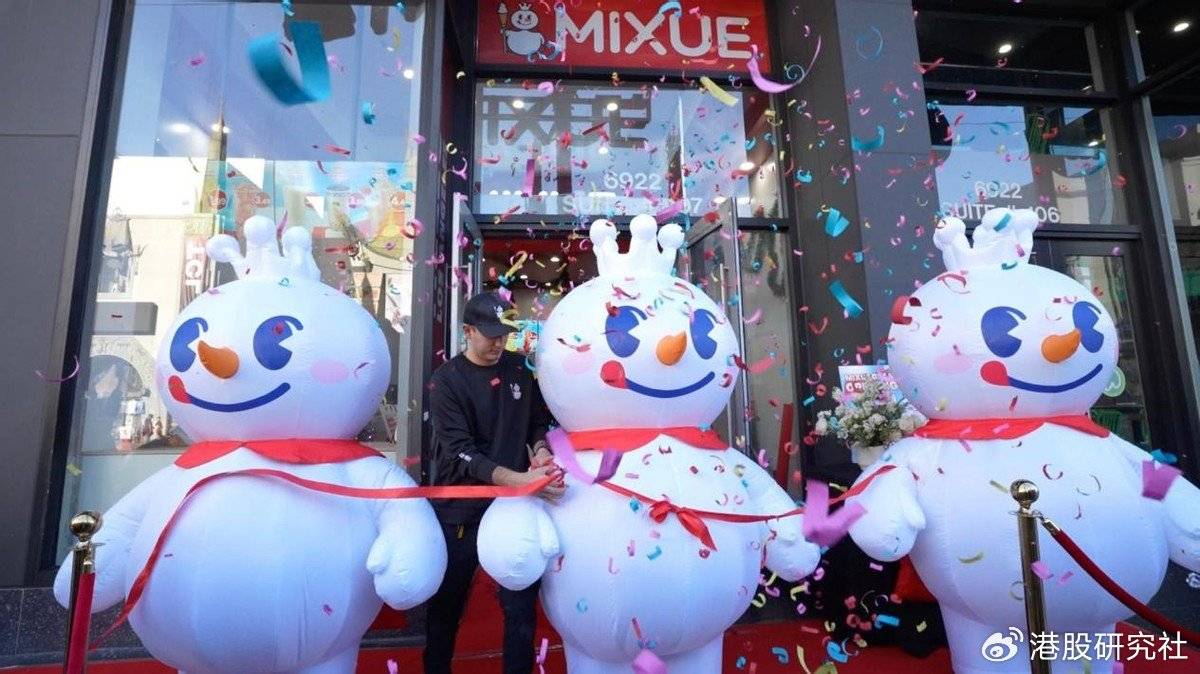
Core Insights - The opening of the first US store of Mixue Ice City in Hollywood marks a significant step in the brand's global expansion strategy, aiming to capture the sweet-toothed American market with high sugar content offerings [1][6] - The brand's competitive pricing strategy, with products priced significantly lower than local competitors, positions it favorably in both domestic and international markets [1][4] Expansion Strategy - Mixue Ice City has rapidly expanded its international presence, with over 4,733 overseas stores across 14 countries, surpassing major global brands like McDonald's and KFC [3] - The company has recently entered new markets, including Japan, Kazakhstan, and Brazil, indicating a robust global growth strategy [3][4] Market Performance - In Southeast Asia, Mixue Ice City has established itself as a leading tea brand, with over 370 stores in Jakarta and a strong presence in Vietnam and Thailand, showcasing its popularity and operational efficiency [2] - The brand's ability to maintain a gross profit margin of 32.5% in a competitive market reflects its effective cost management and supply chain optimization [5] Supply Chain and Cost Management - Mixue Ice City operates a highly integrated supply chain, controlling production from ingredient sourcing to final product delivery, which allows for significant cost reductions [4][5] - The company has established multiple production bases in China, ensuring quality control and cost stability, which is a key factor in its pricing strategy [4] Brand Positioning - The brand's marketing strategy emphasizes affordability and accessibility, aiming to provide a pleasurable experience for consumers without financial strain, which resonates well in various markets [5][6] - Mixue Ice City's success in the US market could serve as a benchmark for other Chinese food and beverage brands looking to expand globally [7]
未来五年,郑州锚定“七个强市”这样干
He Nan Ri Bao· 2025-12-24 00:01
Core Insights - Zhengzhou is set to achieve a GDP of 1.5 trillion yuan by 2025, having crossed four trillion yuan milestones during the "14th Five-Year Plan" period, and aims for a GDP of 2 trillion yuan in the upcoming "15th Five-Year Plan" [1][4] Group 1: Economic Development - Zhengzhou has been recognized as one of the top ten automobile cities in China, with a vehicle production of 956,300 units from January to October this year, showing strong growth [2] - The city has seen significant advancements in the electronic information and digital economy sectors, with a leading market share in domestic server production [2] - The diamond industry in Zhengzhou has evolved from industrial applications to a focus on high-end jewelry, enhancing the city's manufacturing reputation [2] Group 2: Urban and Cultural Development - Zhengzhou's commercial districts, including Erqi Square and Zhengdong CBD, have entered the top 100 consumer business circles in the country, reflecting a vibrant consumer economy [2] - The city has been awarded the "World Smart City Award - China" for its innovative governance model, indicating progress in urban management [2][3] Group 3: Innovation and Technology - Zhengzhou's R&D investment intensity has reached 2.85%, with eight top universities establishing research institutes in the city, fostering a robust innovation ecosystem [3] - The city aims to create a "strong city" through the development of two leading technology cities and a collaborative innovation framework with surrounding areas [5] Group 4: Future Goals - The "15th Five-Year Plan" outlines ambitious targets for Zhengzhou, including the establishment of seven strong sectors: science and technology, manufacturing, openness, digital intelligence, transportation, culture and tourism, and urban agriculture [4][6] - The city plans to enhance its role as a hub for international trade and logistics, particularly through the "Air Silk Road" initiative, and aims to become a leader in future industries [6]
200%糖度、9.9%涨幅,蜜雪冰城把“中国效率”卖进了美国
Sou Hu Cai Jing· 2025-12-23 18:10
Core Viewpoint - The entry of Chinese brand Mixue Ice City into the U.S. market represents a significant demonstration of Chinese efficiency and cost-effectiveness, challenging traditional assumptions about the viability of low-cost models in high-cost environments [1][12]. Group 1: Market Entry Strategy - Mixue Ice City has chosen to establish its first U.S. store on Hollywood Boulevard, a prime location, showcasing a stark contrast between its low pricing strategy and the high rental costs typical of such areas [5][6]. - The brand's pricing strategy includes ice cream priced at $1.19, lemonade at $1.99, and pearl milk tea starting at $3.99, maintaining a low price point despite the high costs associated with its location [6][10]. - Unlike previous Chinese companies that preferred to target Chinese communities, Mixue has opted for mainstream commercial areas, indicating a more aggressive market positioning [5][6]. Group 2: Product and Cultural Adaptation - Mixue's approach does not emphasize cultural storytelling but focuses on price, turnover efficiency, and operational capabilities, which are central to its market strategy [3][8]. - The brand has adapted its product offerings to align with local preferences, such as offering a "200% sugar" option, which resonates with American consumers' tastes and cultural norms around sweetness [7][10]. Group 3: Operational Efficiency - The operational model of Mixue is characterized by a highly standardized system of raw materials, equipment, and recipes, supported by digital systems that enhance store operations [10][11]. - This model has been validated in domestic and Southeast Asian markets, and its application in the U.S. serves as a test for its adaptability in a complex regulatory environment [10][12]. Group 4: Market Perception and Valuation - The U.S. market is viewed as a "model validation market" rather than a profit-driven one, where the ability to maintain a low-margin, high-turnover model is crucial for long-term success [14][16]. - Capital markets are beginning to reassess Mixue's value, with institutions recognizing its potential for sustained expansion despite current limited contributions from U.S. operations [13][16]. - The strategic presence in the U.S. is seen as a way to reduce uncertainty costs associated with global expansion, enhancing Mixue's overall market positioning [16][17].