上海家化

Search documents
美容护理行业10月20日资金流向日报
Zheng Quan Shi Bao Wang· 2025-10-20 09:11
Market Overview - The Shanghai Composite Index rose by 0.63% on October 20, with 26 out of 28 sectors experiencing gains, led by the communication and coal industries, which increased by 3.21% and 3.04% respectively [1] - The market saw a net outflow of 4.601 billion yuan in major funds, with 12 sectors recording net inflows, primarily in the communication sector, which attracted 4.397 billion yuan [1] Sector Performance - The communication sector had the highest net inflow of funds, contributing to its 3.21% increase, while the coal sector followed with a net inflow of 1.148 billion yuan [1] - Conversely, the non-ferrous metals sector experienced the largest net outflow, totaling 4.699 billion yuan, followed by the computer sector with a net outflow of 2.390 billion yuan [1] Beauty and Personal Care Industry - The beauty and personal care sector declined by 0.38%, with a net outflow of 24.996 million yuan [2] - Among the 29 stocks in this sector, 15 saw gains while 12 experienced declines [2] - The top net inflow stock was Shanghai Jahwa, with an inflow of 22.996 million yuan, followed by Liangmianzhen and Jiaheng Jiahua with inflows of 12.992 million yuan and 6.235 million yuan respectively [2] Individual Stock Performance - The stocks with the highest net outflows included Proya, Aimeike, and Huaxi Biology, with outflows of 26.186 million yuan, 23.826 million yuan, and 9.397 million yuan respectively [2] - A detailed table of stock performance indicates various changes in price and turnover rates, highlighting the dynamics within the beauty and personal care sector [3]





化工行业周报2025年10月第3周:硫酸、双氧水价格涨幅居前,建议关注六氟磷酸锂板块-20251020
CMS· 2025-10-20 09:02
Investment Rating - The report suggests a focus on the lithium hexafluorophosphate sector due to rising prices of related products [4]. Core Insights - The chemical sector experienced a decline of 3.95% in the third week of October, underperforming the Shanghai Composite Index by 2.80 percentage points [10]. - The dynamic PE for the chemical sector is 24.75 times, which is significantly higher than the average PE of 9.73 times since 2015 [10]. - The report highlights significant price increases for sulfuric acid (+6.21%) and hydrogen peroxide (+6.04%), while liquid chlorine saw a dramatic rise of +176.79% [3][17]. - The report indicates that only one sub-industry, daily chemical products, saw an increase (+0.51%), while 31 sub-industries declined, with fiberglass experiencing the largest drop (-10.12%) [2][14]. Industry Performance - The top five stocks in the chemical sector for the week included Chengxing Co. (+25.12%) and Shida Shenghua (+18.01%), while the worst performers included Hubei Yihua (-14.09%) and Guoci Materials (-13.8%) [10]. - The report notes that the chemical industry had a total of 449 listed companies with a total market value of 6710.3 billion [5]. Price and Spread Trends - The report lists the top five products with the highest weekly price increases, including liquid chlorine (+176.79%) and sulfuric acid (+6.21%) [3][17]. - The report also details the top five products with the largest price spread increases, such as PTA spread (+28.74%) and heavy soda ash spread (+18.88%) [38][40]. Inventory Changes - Significant inventory changes were noted, with the largest decrease in inventory for chlorpyrifos (-8.70%) and an increase for urea (+8.16%) [57].

化妆品板块10月20日跌0.33%,丸美生物领跌,主力资金净流出1061.54万元
Zheng Xing Xing Ye Ri Bao· 2025-10-20 08:37
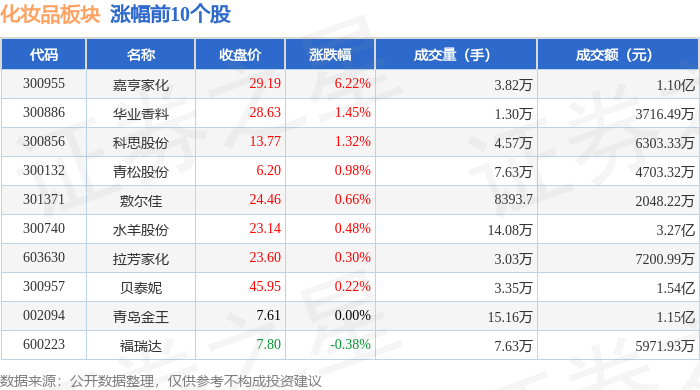
Core Insights - The cosmetics sector experienced a decline of 0.33% on October 20, with Marubi Biotechnology leading the drop [1] - The Shanghai Composite Index closed at 3863.89, up 0.63%, while the Shenzhen Component Index closed at 12813.21, up 0.98% [1] Market Performance - Notable gainers in the cosmetics sector included: - Jiahen Homecare (300955) with a closing price of 29.19, up 6.22% [1] - Huaye Fragrance (300886) with a closing price of 28.63, up 1.45% [1] - Keshare (300856) with a closing price of 13.77, up 1.32% [1] - Marubi Biotechnology (603983) closed at 36.84, down 2.57%, marking the largest decline in the sector [2] Trading Volume and Capital Flow - The cosmetics sector saw a net outflow of 10.6154 million yuan from institutional investors, while retail investors experienced a net outflow of 15.8642 million yuan [2] - Conversely, speculative funds recorded a net inflow of 26.4796 million yuan [2] Individual Stock Capital Flow - Shanghai Jahwa (600315) had a significant net outflow of 23.5185 million yuan from institutional investors, while it attracted a net inflow of 7.4057 million yuan from speculative funds [3] - Jiahen Homecare (300955) saw a net inflow of 8.9635 million yuan from institutional investors, but a net outflow of 3.4693 million yuan from speculative funds [3] - Keshare (300856) experienced a net inflow of 5.6164 million yuan from institutional investors, with a net outflow of 680.09 million yuan from retail investors [3]


大消费行业周报(10月第3周):海南离岛免税政策5大调整落地-20251020
Century Securities· 2025-10-20 00:44
Investment Rating - The report does not explicitly state an investment rating for the industry, but it suggests focusing on the duty-free retail sector and the ice and snow economy as potential investment opportunities. Core Insights - The recent adjustments to the Hainan duty-free shopping policy are expected to enhance the attractiveness of Hainan as a free trade port, expanding the range of duty-free goods and increasing consumer participation [2][3]. - The early onset of the snow season in Xinjiang is anticipated to benefit the ice and snow economy, with government initiatives aiming for a total output value of 200 billion yuan by 2030 [2][3]. - The report highlights the performance of various sectors within the consumer industry, noting significant stock price changes among leading companies [2][3]. Summary by Sections Market Weekly Review - The consumer sector showed mixed performance, with food and beverage, retail, and home appliances experiencing gains, while beauty care and textiles saw declines [2][3]. - Notable stock performances included Kuaijishan (+11.08%) and Dongbei Group (+8.97%) leading the gains, while Jinzi Ham (-17.80%) and Biyi Co. (-19.63%) faced significant losses [2][3]. Industry News and Key Company Announcements - The Hainan duty-free policy adjustments include expanding the range of duty-free goods to 47 categories and allowing more consumer participation [2][3]. - The ice and snow industry is projected to exceed 1 trillion yuan by 2025, driven by upcoming major events and government support [2][3]. - Various companies reported significant revenue growth, such as Spring Breeze Power with a 28.56% increase in Q3 revenue [2][3].


品牌工程指数 上周收报1956.62点
Zhong Guo Zheng Quan Bao· 2025-10-19 22:33
Core Viewpoint - The market experienced a correction last week, but certain stocks within the brand index showed resilience, indicating potential investment opportunities in sectors like electronics, new energy, new consumption, and real estate as uncertainties ease [1][4]. Market Performance - The market indices saw declines: Shanghai Composite Index down 1.47%, Shenzhen Component down 4.99%, ChiNext down 5.71%, and CSI 300 down 2.22%. The brand index fell 3.58% to 1956.62 points [2]. - Notable gainers in the brand index included Shanghai Jahwa up 9.42%, Changbai Mountain up 7.19%, and Darentang up 5.34%. Other stocks like Luzhou Laojiao and Yiling Pharmaceutical also saw gains exceeding 4% [2]. Stock Performance Since H2 - Since the beginning of the second half of the year, Zhongji Xuchuang has surged 156.40%, leading the gains, followed by Sunshine Power at 114.27%. Other significant performers include Lanke Technology and Yiwei Lithium Energy, both up over 60% [3]. Market Outlook - Looking ahead, the market is expected to maintain upward momentum as uncertainties gradually diminish. Liquidity is anticipated to remain supportive, with domestic interest rates low and overseas liquidity remaining loose, encouraging investment in Chinese equity assets [4][5]. - The current market environment is characterized by a shift in investment styles, with a focus on sectors that offer higher investment certainty, particularly in electronics, new energy, new consumption, and real estate [5].


品牌工程指数上周收报1956.62点
Zhong Guo Zheng Quan Bao· 2025-10-19 20:13
Group 1 - The core index of the Xinhua National Brand Project reported 1956.62 points, with several constituent stocks rising against the market trend [1] - Shanghai Jahwa increased by 9.42%, leading the gains among constituent stocks, followed by Changbaishan at 7.19% and Darentang at 5.34% [1] - The overall market saw declines, with the Shanghai Composite Index down 1.47% and the Shenzhen Component Index down 4.99% [1] Group 2 - Since the second half of the year, Zhongji Xuchuang has risen by 156.40%, ranking first in gains, followed by Sunshine Power at 114.27% [2] - The market is expected to maintain upward momentum, with liquidity driving potential growth and fundamental support gradually increasing [2] - Domestic interest rates remain low, and overseas liquidity is expected to remain loose, indicating continued capital allocation towards Chinese equity assets [2] Group 3 - Recent market adjustments are attributed to a decline in global market risk appetite and a shift in investment style towards defensive sectors [3] - The current market environment is characterized by high levels, increased uncertainty, and a slowdown in previous catalysts, leading to cautious trading [3] - Investors are encouraged to seek opportunities in sectors with higher investment certainty, particularly in electronics, new energy, new consumption, and real estate [3]




天猫双11国货开门红,毛戈平上美强者恒强:——化妆品医美行业周报20251019-20251019
Shenwan Hongyuan Securities· 2025-10-19 13:23
Investment Rating - The report maintains a positive outlook on the cosmetics and medical beauty sector, highlighting strong performance relative to the market [5][6]. Core Insights - The Tmall Double 11 event showcased strong sales for domestic brands, with significant demand for products from brands like Maogeping and Winona, indicating a robust market response [9][10]. - The cosmetics and medical beauty sector is expected to see continued growth, with Q3 performance meeting expectations and Q4 anticipated to benefit from promotional activities [10][11]. - The report emphasizes the importance of online channels, particularly Tmall and Douyin, in driving sales for domestic brands, which are gaining market share against international competitors [24][26]. Summary by Sections Industry Performance - The cosmetics and medical beauty sector outperformed the market from October 10 to October 17, 2025, with the Shenwan Beauty Care Index declining by 2.5%, which is better than the overall market performance [5][6]. - Key stocks in the sector included Jiaheng Jiahu (+35.0%), Yiyi Co. (+18.6%), and Yanjing Co. (+15.6%), while Maogeping (-7.2%) and Shangmei Co. (-5.4%) lagged [6]. Sales and Market Trends - The report notes that the overall retail sales of cosmetics in China reached 291.5 billion yuan in the first eight months of 2025, with a year-on-year growth of 3.3% [10][16]. - The Tmall Double 11 event attracted over 10 million viewers, with domestic brands experiencing sell-out conditions, indicating strong consumer interest and demand [9][10]. Company Highlights - Han Shu, a brand under Shangmei Co., has shown significant improvement in Tmall channel performance, collaborating with popular influencers to enhance sales [9][10]. - The report highlights the strategic partnership of Han Shu with global ambassador Wang Jiaer, aiming to elevate the brand's international presence and market perception [20][21]. Investment Recommendations - The report recommends focusing on brands with strong online sales growth, such as Maogeping, Shangmei Co., and Shanghai Jahwa, while also monitoring companies like Proya and Marubi for potential performance improvements [12][13]. - In the medical beauty segment, the report suggests investing in companies with strong R&D capabilities and product pipelines, recommending Aimeike as a key player [12][13].
化妆品医美行业周报:天猫双11国货开门红,毛戈平上美强者恒强-20251019
Shenwan Hongyuan Securities· 2025-10-19 12:19
Investment Rating - The report maintains a "Positive" outlook on the cosmetics and medical beauty industry [2]. Core Views - The cosmetics and medical beauty sector has shown stronger performance than the market, with the Shenwan Beauty Care Index declining by 2.5% from October 10 to October 17, 2025, which is better than the overall market performance [4][5]. - The Tmall Double 11 event has seen significant success for domestic brands, with brands like Maogeping experiencing high demand and sold-out products [10]. - The overall performance for Q3 2025 is expected to meet expectations, with a continued upward trend into Q4, driven by promotional events [11][12]. Summary by Sections Industry Performance - The cosmetics and medical beauty sector outperformed the market during the specified period, with the Shenwan Cosmetics Index down by 1.1%, which is 2.3 percentage points better than the Shenwan A Index [4][5]. - Key stocks in the sector included Jiaheng Jiahua (+35.0%), Yiyi Co. (+18.6%), and Yanjing Co. (+15.6%) [6]. Market Trends - The Tmall Double 11 event on October 15 attracted over 10 million viewers, with domestic brands like Maogeping experiencing supply shortages due to high demand [10]. - The overall sales performance is expected to improve in the coming weeks, particularly with the upcoming Douyin Double 11 event [10]. Q3 Performance Outlook - The demand for cosmetics remains robust, with retail sales growth in July and August outpacing the overall market [11]. - The total retail sales of cosmetics for the first eight months of 2025 reached 291.5 billion yuan, a year-on-year increase of 3.3% [11]. - Domestic brands are leveraging online channels effectively, with Han Shu achieving over 2 billion yuan in GMV in Q3 [12]. Company Highlights - Han Shu announced a global partnership with Wang Jiaer, enhancing its international presence and brand recognition [19][22]. - The report recommends focusing on companies with strong channel and brand matrices, such as Maogeping, Shanghai Jahwa, and Up Beauty [14]. E-commerce Data - The report highlights significant growth in e-commerce sales for various brands, with Han Shu achieving a 37% increase in GMV [15]. - The overall e-commerce landscape for domestic brands is expected to continue thriving, supported by promotional events and strategic partnerships [15][18]. Market Dynamics - The report notes that the Chinese skincare market is projected to reach 271.2 billion yuan in 2024, despite a slight decline in growth [26]. - Domestic brands are increasingly capturing market share, with a notable presence in the top ten rankings [26][27]. Investment Recommendations - The report suggests investing in companies with strong growth potential and robust product pipelines, particularly in the cosmetics and medical beauty sectors [14]. - Specific recommendations include Maogeping, Up Beauty, and Shanghai Jahwa for cosmetics, and Aimeike for medical beauty [14].
林小海和上海家化的青浦棋局:“国货样本不只卖产品,还要卖标准”
Guan Cha Zhe Wang· 2025-10-18 15:01
Core Insights - The article discusses the transformation of Shanghai Jahwa, a traditional cosmetics company, from performance decline to recovery, highlighting its strategic shift towards supply chain control and innovation [1][4][10] Industry Overview - Shanghai is a major hub for the cosmetics industry in China, with 230 production enterprises and 3,200 registered entities, dominating the import registration market [1] - The industry faces common challenges such as supply chain restructuring, innovation in research and development, and brand rejuvenation [1][4] Company Strategy - Shanghai Jahwa has strategically relocated its production from OEM factories back to its own facilities in Qingpu, reflecting a broader trend in the cosmetics industry to reassess supply chain structures [5][7] - The company increased its R&D investment by 26.3% year-on-year, indicating a commitment to innovation despite overall cost control measures [8] Supply Chain Dynamics - The return of production to Qingpu is not merely a logistical move but signifies a deeper restructuring of the supply chain, focusing on cost efficiency, quality control, and risk management [5][7] - The establishment of a "factory-to-consumer" (C2M) model aims to enhance product freshness, cost optimization, and delivery efficiency, although it poses significant operational challenges [7] R&D and Innovation - Shanghai Jahwa's 35 years of R&D experience and over 400 patents highlight the importance of long-term investment in research as a competitive advantage [8] - The company is focusing on leveraging traditional Chinese medicine in its product development, collaborating with research institutions to modernize and scientifically validate its offerings [8][11] Market Positioning - The rise of domestic brands is not just about market share but involves a systemic reconstruction of technology, cultural confidence, and industry ecology [10][12] - Successful domestic brands are transitioning from "Chinese elements" to "Chinese values," integrating traditional culture with modern consumer needs [11] Industry Collaboration - The Qingpu industrial cluster exemplifies the importance of collaborative innovation, where the efficiency of various industry segments determines overall competitiveness [11][12] - Shanghai Jahwa's willingness to share testing facilities with peers reflects a recognition of the need for collective industry standards to enhance competitiveness on a global scale [11]

中证A500指数承压,ETF规模跌破2000亿元
2 1 Shi Ji Jing Ji Bao Dao· 2025-10-17 11:53
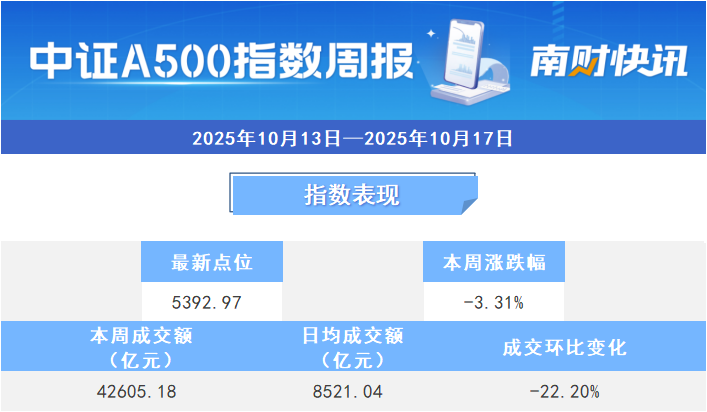
Index Performance - The CSI A500 Index decreased by 3.31% this week, closing at 5392.97 points on October 17 [5] - The average daily trading volume for the week was 8521.04 billion yuan, reflecting a 22.20% decrease compared to the previous week [5] Top Performers - The top ten gainers in the CSI A500 index included: 1. Shanghai Pudong Development Bank (600000.SH) with a gain of 12.50% 2. Agricultural Bank of China (601288.SH) with a gain of 11.57% 3. Huatian Technology (002185.SZ) with a gain of 10.02% 4. Shanghai Jahwa United Co., Ltd. (600315.SH) with a gain of 9.42% 5. Hainan Airport (600515.SH) with a gain of 8.96% 6. Shaanxi Coal and Chemical Industry (601225.SH) with a gain of 8.61% 7. Jiangsu Bank (600919.SH) with a gain of 8.60% 8. Tongwei Co., Ltd. (600438.SH) with a gain of 8.31% 9. Air China (601111.SH) with a gain of 7.63% 10. China Pacific Insurance (601319.SH) with a gain of 7.32% [2] Bottom Performers - The top ten losers in the CSI A500 index included: 1. Shengquan Group (605589.SH) with a loss of 18.04% 2. Wentai Technology (600745.SH) with a loss of 17.17% 3. Betta Pharmaceuticals (300558.SZ) with a loss of 16.98% 4. Leo Group (002131.SZ) with a loss of 16.55% 5. Jinlang Technology (300763.SZ) with a loss of 15.40% 6. Tongfu Microelectronics (002156.SZ) with a loss of 14.98% 7. Yake Technology (002409.SZ) with a loss of 14.35% 8. Lens Technology (300433.SZ) with a loss of 14.26% 9. Zhongding Sealing Parts (000887.SZ) with a loss of 13.99% 10. Robot Technology (300757.SZ) with a loss of 13.95% [2] Fund Performance - All 40 CSI A500 ETFs experienced declines, with notable drops in Huatai-PB's CSI A500 Enhanced ETF and Guolian's A500 Enhanced ETF, both falling over 4% [5] - The total scale of the CSI A500 ETFs fell below 200 billion yuan, with Huatai-PB's fund at 249.03 billion yuan, Guotai's at 226.56 billion yuan, and E Fund's at 221.29 billion yuan [5] Market Insights - Pacific Securities research team suggests a balanced allocation towards low-position sectors, particularly banks and insurance with dividend protection attributes, as well as coal and agriculture sectors benefiting from domestic demand recovery [6] - Guohai Securities research team indicates that uncertainties from trade frictions may lead to a rotation in market styles, with a shift from overvalued growth sectors to undervalued sectors [6]