蔚来

Search documents
仪表、中控存黑屏隐患,蔚来召回超24万辆汽车
Guan Cha Zhe Wang· 2026-02-10 01:53
【文/观察者网 潘昱辰 编辑/高莘】日前,上海蔚来汽车有限公司根据《缺陷汽车产品召回管理条例》和《缺陷汽车产品召回管理 条例实施办法》的要求,受委托向国家市场监督管理总局备案了召回计划。 召回编号S2026M0017I:自即日起,召回2018年3月16日至2023年1月16日期间生产的ES8、ES6和EC6纯电动汽车,共计246229 辆。 上海蔚来汽车有限公司将通过远程升级(OTA)技术,免费为召回范围内的车辆升级软件至Aspen 3.5.6、Alder 2.1.0或更高版本, 对于无法通过OTA技术升级的车辆,将通过蔚来服务中心联系相关用户实施召回,以消除安全隐患。因部分车辆之前已升级优化 后的软件,本次召回此部分车辆无需再次升级。 上海蔚来汽车有限公司将以手机APP、短信、电话等方式通知相关用户,安排召回事宜。用户可致电上海蔚来汽车有限公司客户 服务热线:400-999-6699,了解此次召回的详细信息。此外,也可登录市场监管总局召回中心网站www.samrdprc.org.cn,关注微信 公众号(SAMRDPRC),了解更多信息,反映缺陷线索。 本文系观察者网独家稿件,未经授权,不得转载。 蔚来召回超 ...



蔚来召回24万余辆纯电动汽车:部分可能在特定条件下出现短时间仪表及中控黑屏
Xin Lang Cai Jing· 2026-02-10 01:53
召回编号S2026M0017I:自即日起,召回2018年3月16日至2023年1月16日期间生产的ES8、ES6和EC6纯 电动汽车,共计246229辆。 上海蔚来汽车有限公司将通过远程升级(OTA)技术,免费为召回范围内的车辆升级软件至Aspen 3.5.6、Alder 2.1.0或更高版本,对于无法通过OTA技术升级的车辆,将通过蔚来服务中心联系相关用户 实施召回,以消除安全隐患。因部分车辆之前已升级优化后的软件,本次召回此部分车辆无需再次升 级。 国家市场监督管理总局网站2月9日发布上海蔚来汽车有限公司的汽车召回信息,共有246229辆纯电动汽 车被召回,部分车辆由于软件问题,可能在特定条件下出现短时间的仪表及中控屏黑屏。 上海蔚来汽车有限公司根据《缺陷汽车产品召回管理条例》和《缺陷汽车产品召回管理条例实施办法》 的要求,受委托向国家市场监督管理总局备案了召回计划。 本次召回范围内的部分车辆,由于软件问题,可能在特定条件下出现短时间的仪表及中控屏黑屏,期间 无法为驾驶员提供必要的车辆信息及功能(如车速信息、故障报警提示、除霜除雾功能等),存在安全 隐患。 ...
信达国际控股港股晨报-20260210
Xin Da Guo Ji Kong Gu· 2026-02-10 01:49
Market Overview - The Hang Seng Index is expected to hold at 26,000 points, with the U.S. Federal Reserve's hawkish stance influencing market dynamics and leading to a rebound in the U.S. dollar index [2] - The Chinese government is anticipated to focus on expanding domestic demand and technological self-sufficiency in 2026, with GDP growth targets expected to be set between 4.5% and 5% [2] - Regulatory measures are being implemented to cool the market, including increased financing margin ratios and a reduction in leverage across major exchanges [2] Company News - Alphabet plans to issue high-rated U.S. bonds to raise approximately $15 billion, continuing the trend of significant debt issuance among companies investing heavily in AI infrastructure [4][10] - Alibaba's Gaode Dache has been summoned by the Ministry of Transport due to issues related to price management and operational oversight [4][10] - BYD has filed a lawsuit against the U.S. government seeking the return of all tariffs imposed [4] - Hong Kong Telecom reported a 4% increase in profit for the previous year, with a dividend of 47.97 cents [4] Sector Focus - The travel sector is expected to see strong demand as the Lunar New Year approaches, with an estimated 2,200 inbound tours from mainland China to Hong Kong, involving around 86,000 visitors [9] - The semiconductor industry is projected to experience significant growth driven by strong demand for AI technologies [7] - The logistics sector in China reported a total logistics volume of 368.2 trillion yuan for 2025, reflecting a year-on-year growth of 5.1% [8] Economic Indicators - The U.S. Federal Reserve maintained interest rates in January, indicating a cautious approach to future adjustments based on economic data [5] - The international oil market is expected to face upward pressure on prices due to geopolitical factors, despite an oversupply situation [5] - The Chinese central bank is expected to inject liquidity into the market ahead of the Lunar New Year, with estimates suggesting a liquidity gap of over 3 trillion yuan [8]
中泰国际每日晨讯-20260210
ZHONGTAI INTERNATIONAL SECURITIES· 2026-02-10 01:41
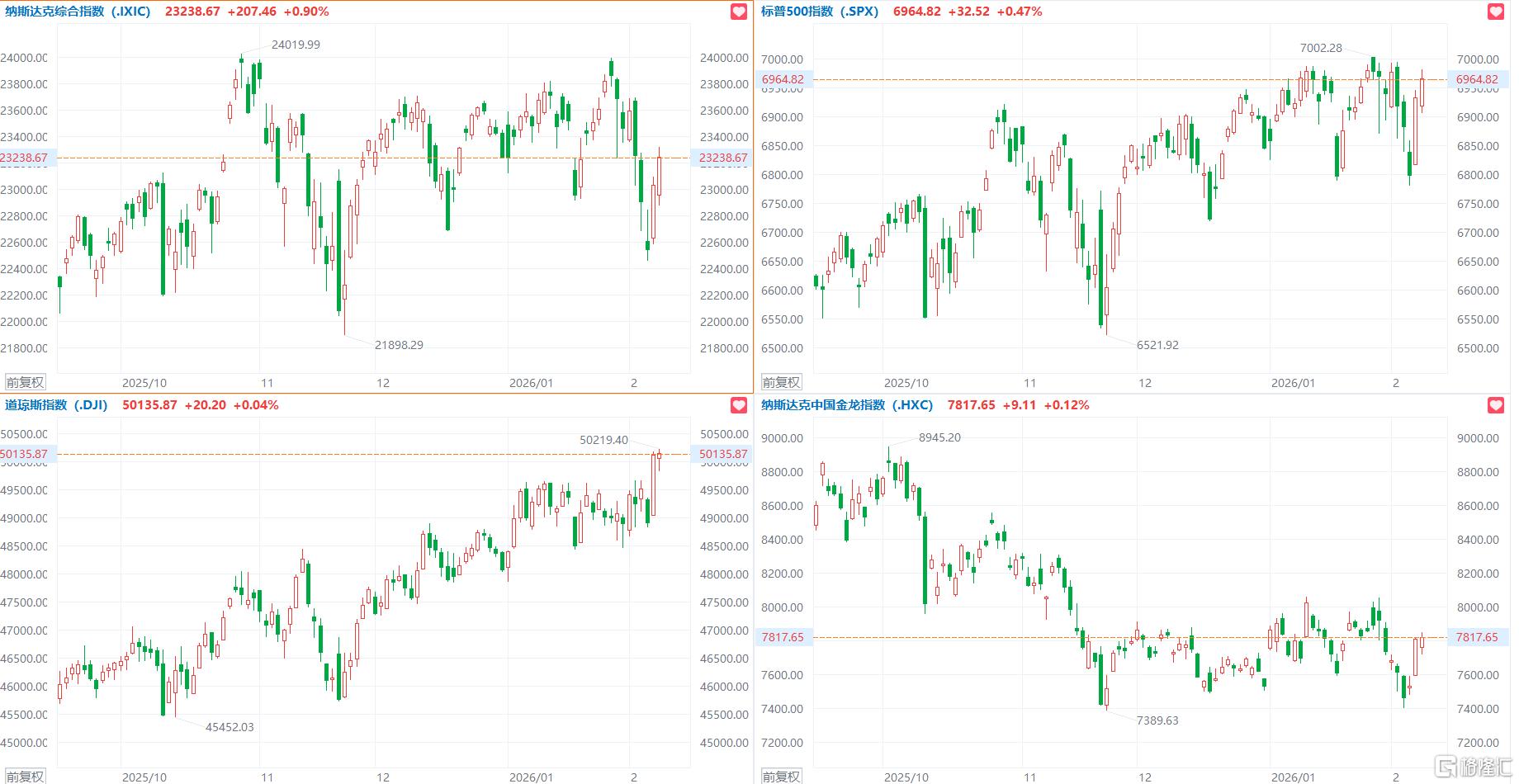
Market Overview - On February 9, Hong Kong stocks followed the positive trend of global markets, with the Hang Seng Index rising by 467 points (1.7%) to close at 27,027 points[1] - The Hang Seng Tech Index increased by 71 points (1.3%), closing at 5,417 points, with total market turnover reaching HKD 255.1 billion[1] - Southbound capital recorded a net outflow of HKD 1.89 billion[1] Insurance Sector - In January, the new premium scale for 79 life insurance companies through bancassurance channels increased by 27.6% year-on-year[1] - China Life (2628 HK) and Ping An (2318 HK) saw their stock prices rise by 4% and 4.9%, respectively[1] - Other insurance stocks like China Taiping (966 HK), PICC (1339 HK), and China Pacific Insurance (2328 HK) increased by 3.5%-4%[1] Precious Metals - Precious metal prices rebounded, leading to stock increases for China Gold International (2099 HK), Zhaojin Mining (1818 HK), and Zijin Mining (2899 HK), which rose by 4.5%-5.6%[1] U.S. Market Insights - The U.S. economy is expected to see a slight decline in employment numbers, with the market anticipating an addition of 69,000 jobs and an unemployment rate holding steady at 4.4%[2] - The Dow Jones Index closed slightly higher, up 20 points (0.04%) at 50,135 points, while the Nasdaq and S&P 500 indices rose by 207 points (0.9%) and 32 points, respectively[2] Automotive Sector - Minth Group (425 HK) announced a joint venture with Gree Harmonic (688017 CH) in the U.S. for humanoid robot joint module design, resulting in a 7.5% stock increase[3] - Other automotive stocks like Xpeng Motors (9868 HK) and Seres (9927 HK) rose by 2.7%-2.9%, while NIO (9866 HK) fell by 0.5%[3] Pharmaceutical Developments - The Hang Seng Healthcare Index rose by 2.1%, with Innovent Biologics (1801 HK) announcing a strategic partnership with Eli Lilly (LLY US) for global R&D in oncology and immunology[3] - Innovent will receive an upfront payment of USD 350 million and could earn up to USD 8.5 billion in milestone payments[3]
A股指数涨跌不一:沪指微涨0.11%,传媒、算力租赁等板块涨幅居前
Feng Huang Wang Cai Jing· 2026-02-10 01:33
Market Overview - The three major indices opened mixed, with the Shanghai Composite Index up 0.11%, the Shenzhen Component down 0.05%, and the ChiNext down 0.33%. Sectors such as media and computing leasing saw gains, while photovoltaic, superhard materials, and power grid equipment sectors experienced declines [1] External Market - U.S. stock indices closed higher, led by technology stocks, with the Nasdaq up nearly 1%. The Dow Jones increased by 0.04%, reaching a new historical high, while the S&P 500 rose by 0.5%, nearing its historical peak. The closing figures were: Dow Jones at 50,135.87 points, S&P 500 at 6,964.82 points, and Nasdaq at 23,238.67 points [2] - Chinese concept stocks showed mixed performance, with the Nasdaq Golden Dragon China Index up 0.12%. Notable movements included Alibaba up 0.30%, JD down 0.21%, and NIO down 2.98% [2] Industry Insights - CITIC Securities maintains an optimistic outlook for precious and non-ferrous metal prices through 2026, despite recent volatility in gold prices driven by market concerns over the Federal Reserve's independence and changes in the Iranian situation. The firm suggests that the market may have overestimated the hawkish stance of the new Fed Chair, Kevin Walsh, and anticipates that gold market fluctuations will stabilize once uncertainties are resolved [3] - Huatai Securities reports a significant increase in excavator sales, with January 2026 sales reaching 18,700 units, a year-on-year increase of 49.5%. Domestic sales were 8,723 units, up 61.4%, and exports were 9,985 units, up 40.5%. The firm expects a positive resonance in the excavator industry driven by key infrastructure projects and a potential recovery in real estate [4] - China Galaxy Securities identifies the current moment as a new starting point for the storage chip sector, driven by rapid growth in AI server demand and domestic production. The firm sees investment opportunities in related listed companies within the domestic storage industry [5] - CITIC Securities notes strong replenishment intentions in the liquor sector as the Spring Festival approaches, predicting that the 2026 Spring Festival will see better-than-expected performance in liquor sales due to increased consumer activity. The firm suggests that the liquor industry is at a long-term fundamental bottom, and any marginal improvements could significantly boost investment sentiment in the sector [6]


蔚来汽车李斌:2026年计划新建1000座换电站
Xin Hua Cai Jing· 2026-02-10 01:31
Group 1 - The core viewpoint of the article is that NIO plans to significantly expand its battery swap station network by building 1,000 new stations by 2026 and increasing the number of charging routes to 100 [1] - NIO has already established battery swap routes along the G318 and Yunnan-Tibet roads and aims to connect the Silk Road battery swap route this year [1] - The company is set to commence large-scale construction of its fifth-generation battery swap stations this year [1]
2026年中国换电站行业保有量、投资规模、企业排名速览:蔚来保有量占比超7成[图]
Chan Ye Xin Xi Wang· 2026-02-10 01:23
Core Insights - The article discusses the development and trends of battery swapping stations in China, highlighting their increasing importance in the electric vehicle (EV) ecosystem and the projected growth in the number of stations and investment scale by 2025. Group 1: Industry Overview - Battery swapping stations provide battery replacement services for electric vehicles, functioning as centralized charging facilities for battery storage, charging, and distribution [1] - By 2025, the number of battery swapping stations in China is expected to reach 5,155, representing a year-on-year growth of approximately 16% [7] - The investment scale for battery swapping stations in China is projected to be 3.418 billion yuan by 2025, showing a slight decrease compared to previous years [8] Group 2: Charging Methods - Current charging methods for new energy vehicles in China are divided into charging mode and battery swapping mode, with the latter being less mature but increasingly popular [2] - Battery swapping can be categorized into fixed swapping (swapping stations) and mobile swapping (swapping service vehicles), with fixed swapping being the primary method [2] Group 3: Pricing Structure - Revenue from battery swapping stations is mainly derived from package income and usage income, with C-end users paying around 1,000 yuan monthly for battery rental, while B-end users pay approximately 3,000 yuan for unlimited swaps [3] - Usage income is based on actual swapping volume, with two pricing options available for C-end users [3] Group 4: Policy Background - A comprehensive policy support system has been established for the battery swapping industry in China, including standards, subsidies, and operational guidelines [4][5] - Key policies include the release of design standards for battery swapping stations and initiatives to enhance charging infrastructure in county areas [4][5] Group 5: Industry Chain - The battery swapping industry chain consists of upstream battery suppliers, station component suppliers, and charging system suppliers, with midstream operators responsible for station construction and operation [6] Group 6: Current Market Status - The number of battery swapping stations in China is on a steady growth trajectory, driven by the rapid adoption of new energy vehicles and supportive policies [7] - By 2025, the market is expected to see a concentration of battery swapping stations in economically strong coastal provinces and major cities [9][10] Group 7: Competitive Landscape - The battery swapping market in China is characterized by a few dominant players, with NIO leading the market with a significant share of 71.6% of the total stations [11][12] - NIO's strategy includes building a self-operated battery swapping network, while other companies like Aodong focus on shared swapping services for high-frequency operational scenarios [11][12] Group 8: Future Trends - Battery swapping stations are evolving into integrated energy nodes that combine solar, storage, and V2G functionalities, enhancing operational efficiency and reducing costs [14] - The industry is shifting towards a more open and standardized model, allowing for compatibility across different vehicle brands and types, which is expected to increase station utilization and profitability [14]

2026格局与趋势 |(上):天黑请睁眼
3 6 Ke· 2026-02-10 01:20
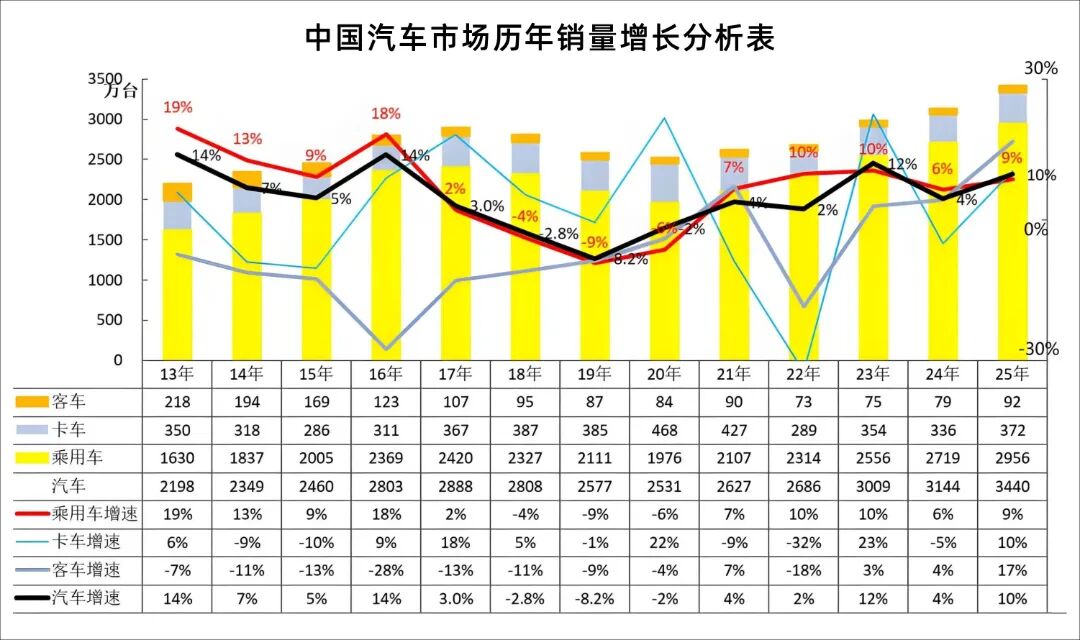
Core Viewpoint - The Chinese automotive market is facing significant challenges in 2026, with predictions of a decline in sales due to economic pressures and changing consumer behavior, despite some optimistic forecasts for growth in exports and specific segments like new energy vehicles [1][3][4]. Group 1: Market Trends and Predictions - In 2026, the overall automotive sales in China are expected to range between 34.5 million to 35 million units, with a potential decline in domestic retail sales by over 5% if no significant policy changes occur [3][7]. - January 2026 data shows a dramatic decline in retail sales, with a 28% year-on-year drop, indicating a challenging start to the year [6]. - Various institutions predict a range of outcomes for 2026, with the most pessimistic forecasts suggesting a 7% decline in sales, while the most optimistic predict only a 1% increase [4][7][8]. Group 2: Policy and Economic Influences - Key factors affecting the market include adjustments to subsidy policies for new energy vehicles, which have shifted from full exemptions to partial reductions, impacting consumer purchasing behavior [6][9]. - The decline in consumer confidence and shrinking middle-class income due to economic downturns are expected to further suppress automotive sales [6][9]. Group 3: Competitive Landscape - The automotive industry is experiencing intense competition, with a shift from price wars to a focus on technological advancements and value creation as companies seek to stabilize their market positions [12][16]. - Major players are adjusting their sales targets, with some aiming for significant growth while others adopt more conservative strategies in response to market conditions [18][19]. Group 4: Export Opportunities - Exports are projected to be a key growth area, with expectations of a 12-15% increase, potentially reaching 8 million units, which could help offset domestic market declines [22][26]. - The global supply chain dynamics are pushing Chinese automotive companies to enhance their international presence, with a focus on building global production and R&D capabilities [26][28]. Group 5: Segment-Specific Insights - The new energy vehicle segment is anticipated to grow, with retail sales expected to increase by 12-15%, driven by favorable policies for mid-range models [9][10]. - The large six-seat SUV market is projected to maintain strong growth, with expectations of a 30-50% increase in sales, despite overall market challenges [31][32].



板块一年暴涨80%,AI 吞噬式需求引爆存储超级周期
3 6 Ke· 2026-02-10 01:15
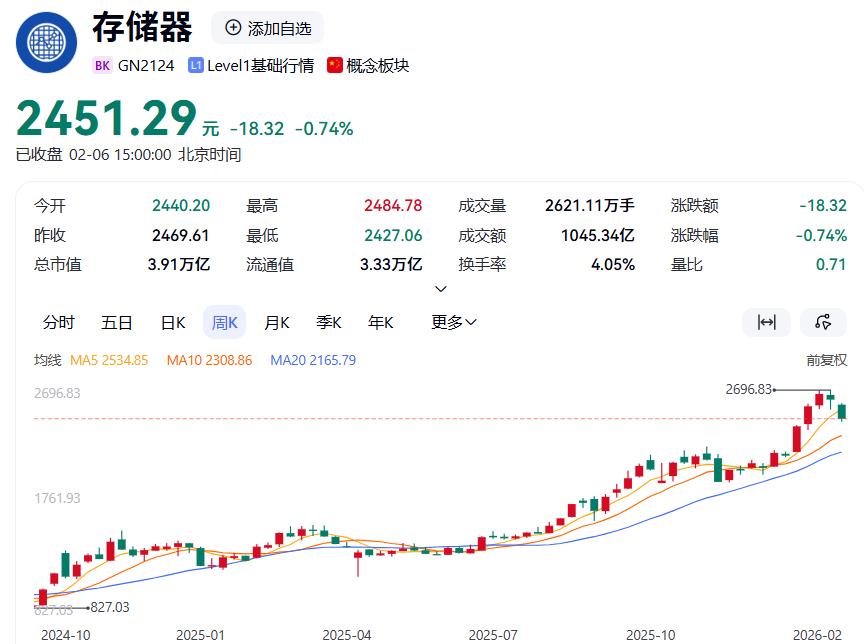
Core Viewpoint - The Chinese storage industry is experiencing a "value reassessment" with a significant surge in stock prices and a 50% increase in the storage sector within a month, marking the onset of a "super bull market" driven by AI demand and domestic production capabilities [1][3][5]. Group 1: Market Dynamics - Over ten trading days, more than 20 stocks hit the daily limit, with companies like Zhaoyi Innovation seeing an 80% increase in ten days and Changjiang Storage achieving a 180% rise this year [3][5]. - The price of 256GB DDR5 server memory has exceeded 50,000 yuan, while the price of 16GB DDR4 memory has surged from 180 yuan to 420 yuan, indicating extreme market volatility [5][7]. - The current demand for AI servers is 8-10 times higher than traditional servers, consuming 53% of global memory production capacity, while supply is constrained due to major manufacturers reallocating 80% of advanced capacity to higher-margin products [7][9]. Group 2: Technological Advancements - The establishment of the domestic storage ecosystem alliance and a 5 billion yuan special fund aims to focus on core technologies such as DRAM and NAND Flash, with significant improvements in efficiency and cost reductions [3][9]. - The HBM3e high-bandwidth memory has achieved mass production, and Changjiang Storage's 232-layer 3D NAND has reduced unit storage costs by 70% [3][9]. - The transition from imported reliance to domestic alternatives in storage chips signifies a major shift in the industry, with the storage cycle moving from "moderate growth" to a "super bull market" [3][9]. Group 3: Financial Performance - SK Hynix's net profit is expected to surge by 119% in Q3 2025, while Samsung's semiconductor business profits are projected to grow by 31.81% [11][12]. - Domestic module manufacturers like Jiangbolong are experiencing a V-shaped recovery, with net profits increasing by 1994% year-on-year [11][12]. - The overall market for storage chips in China is projected to reach nearly 500 billion yuan by 2026, with domestic manufacturers rapidly filling the gap in mature process fields [12][13]. Group 4: Industry Structure and Future Outlook - The storage chip industry is evolving from a traditional cyclical market to a core component of AI infrastructure, necessitating a comprehensive restructuring of the industry chain [13][25]. - The domestic storage industry is poised for a significant rebound in 2026, supported by government initiatives and market demand, with a focus on high-end breakthroughs [25][26]. - Companies that can integrate data, storage, and computing solutions will establish barriers in AI inference, edge computing, and smart terminals, positioning themselves as key players in the storage era [23][25].
美股三大指数集体收涨,纳指涨0.9%,甲骨文涨超9%
Ge Long Hui· 2026-02-10 01:04
Market Performance - The three major U.S. stock indices closed higher, with the Dow Jones up 0.04%, the Nasdaq up 0.9%, and the S&P 500 up 0.47% [1] - Major technology stocks saw significant gains, with Oracle rising over 9%, Microsoft and Broadcom up over 3%, and Nvidia and Meta up over 2% [1] Sector Performance - Cryptocurrency mining companies, precious metals, and non-ferrous metals led the gains, with Vista Gold up over 14%, Hut 8 up over 7%, and Pan American Silver up over 6% [1] - Other notable performers included Alcoa and Royal Gold, both rising over 5%, and Southern Copper up over 4% [1] - Retail and insurance brokerage sectors faced declines, with Macy's and Kohl's both down over 5%, and the American Reinsurance Group down over 2% [1] Chinese Stocks - The Nasdaq Golden Dragon China Index rose 0.12%, with notable gains in Chinese concept stocks such as Kingsoft Cloud, Pony.ai, and JinkoSolar, which rose up to 3.79% [1] - Other gainers included Zai Lab up 2.44%, Huazhu up 1.66%, while companies like Yum China, XPeng, Ctrip, Bilibili, NIO, Li Auto, and New Oriental experienced declines, with New Oriental down 4.24% [1]