华菱钢铁

Search documents
钢铁价格或筑底抬升,继续看多钢铁板块
Xinda Securities· 2025-11-09 12:40
Investment Rating - The investment rating for the steel industry is "Positive" [2] Core Viewpoints - The steel sector has shown a weekly increase of 4.57%, outperforming the broader market, with specific segments like special steel and iron ore seeing significant gains [2][10] - Despite facing supply-demand imbalances and declining overall industry profits, the steel demand is expected to stabilize or slightly increase due to government policies aimed at economic growth, particularly in real estate and infrastructure [3][34] - The report highlights that the steel industry is likely to maintain a stable supply-demand situation, with a focus on high-end steel products benefiting from macro trends [3] Supply Situation - As of November 7, the capacity utilization rate for blast furnaces in sampled steel companies is 87.8%, down 0.80 percentage points week-on-week [24] - Electric furnace capacity utilization is at 50.9%, a decrease of 2.12 percentage points week-on-week [24] - The total production of five major steel products is 749.1 million tons, a week-on-week decrease of 18.53 million tons [24] Demand Situation - The consumption of five major steel products reached 866.9 million tons as of November 7, down 49.47 million tons week-on-week [34] - The transaction volume of construction steel by mainstream traders is 96,000 tons, a decrease of 0.79 million tons week-on-week [34] Inventory Situation - Social inventory of five major steel products is 10.75 million tons, a week-on-week decrease of 2.10 million tons [42] - Factory inventory stands at 4.286 million tons, down 8.09 million tons week-on-week [42] Price & Profit Situation - The comprehensive index for ordinary steel is 3,419.8 yuan/ton, down 37.72 yuan/ton week-on-week [48] - The comprehensive index for special steel is 6,592.5 yuan/ton, down 7.02 yuan/ton week-on-week [48] - The profit for rebar produced in blast furnaces is -39 yuan/ton, an increase of 18.0 yuan/ton week-on-week [51] Raw Material Situation - The spot price index for Australian iron ore (62% Fe) is 776 yuan/ton, down 30.0 yuan/ton week-on-week [66] - The price for coking coal at Jingtang Port is 1,800 yuan/ton, up 60.0 yuan/ton week-on-week [66] - The average profit for independent coking enterprises is -22 yuan/ton, an increase of 10.0 yuan/ton week-on-week [66] Investment Recommendations - The report suggests focusing on regional leading enterprises with advanced equipment and environmental standards, as well as companies with strong growth potential and those benefiting from the new energy cycle [3]
证券研究报告行业周报:修复低估-20251109
GOLDEN SUN SECURITIES· 2025-11-09 06:15
Investment Rating - The report maintains a "Buy" rating for the steel industry, indicating a positive outlook for selected companies [7]. Core Insights - The steel industry is currently experiencing a recovery from undervaluation, with significant potential for price and profit improvement as supply-side policies are implemented [2]. - The report highlights that the average daily pig iron production has decreased, while inventory reduction has slowed down, indicating a tightening supply [3][26]. - Demand for steel products has shown a decline in apparent consumption, particularly in rebar and hot-rolled coil, reflecting a temporary market adjustment [43]. - The report emphasizes the continued high growth rate of steel exports, with a net export increase of 7.6% year-on-year, suggesting robust international demand [4][14]. - The report identifies key companies that are expected to benefit from the current market conditions, including Hualing Steel, Nanjing Steel, Baosteel, and New Steel [2][10]. Summary by Sections Supply - Daily pig iron production has decreased by 21,000 tons to 2.342 million tons, with a reduction in production from long-process steelmaking [13]. - The capacity utilization rate for 247 domestic steel mills is at 87.8%, down 0.8 percentage points from the previous week [19]. Inventory - Total steel inventory has seen a reduced decline, with a week-on-week drop of 0.7%, indicating a tighter market [26]. - The social inventory of five major steel products stands at 10.75 million tons, down 0.2% week-on-week but up 29.8% year-on-year [28]. Demand - Apparent consumption of five major steel products has decreased by 5.4% week-on-week, with rebar consumption down by 5.9% [54]. - Weekly average transaction volume for construction steel has fallen to 96,000 tons, a decrease of 7.6% [44]. Raw Materials - Iron ore prices have declined, with the Platts 62% iron ore price index at $102.1 per ton, down 5.0% week-on-week [64]. - The report notes an increase in port iron ore inventory, suggesting a potential oversupply situation [53]. Prices and Profits - The comprehensive steel price index has decreased by 1.1% week-on-week, with current rebar prices in Beijing at 3,190 RMB per ton [76]. - The report indicates that the immediate gross profit margins for long-process rebar and hot-rolled coil remain relatively stable despite price fluctuations [76].


2025年1-9月黑色金属矿采选业企业有1538个,同比增长0.2%
Chan Ye Xin Xi Wang· 2025-11-09 03:38
Core Viewpoint - The report highlights the current state and future outlook of the black metal mining industry in China, indicating a slight increase in the number of enterprises and their contribution to the industrial sector [1]. Industry Overview - As of January to September 2025, the number of enterprises in the black metal mining sector reached 1,538, which is an increase of 3 compared to the same period last year, reflecting a year-on-year growth of 0.2% [1]. - The black metal mining enterprises account for 0.29% of the total industrial enterprises in China [1]. Related Companies - The report mentions several listed companies in the black metal mining sector, including CITIC Special Steel, Hebei Iron and Steel, and Baosteel, among others [1].


钢铁周报20251109:逐步进入淡季,品种表现分化-20251109
Minsheng Securities· 2025-11-09 02:37
Investment Rating - The report maintains a "Buy" rating for several steel companies, including Hualing Steel, Baosteel, Nanjing Steel, and others [3][4]. Core Views - The steel industry is gradually entering the off-season, with differentiated performance among various products. Steel production and apparent consumption are both declining, indicating seasonal characteristics. Inventory reduction rates are similar to previous years, but absolute inventory levels remain high. Steel mill profits are at low levels, and a seasonal downward trend is expected in both supply and demand [3][4]. - The report highlights that the production structure is changing, with some steel mills shifting from rebar production to plate production due to weak real estate demand. This has led to an increase in plate production and a decrease in rebar production, with supply changes outpacing demand changes in the short term [3][4]. Summary by Sections Price Trends - As of November 7, 2025, steel prices have decreased, with rebar priced at 3200 CNY/ton, down 10 CNY/ton from the previous week. Hot-rolled and cold-rolled prices also saw declines of 60 CNY/ton and 50 CNY/ton, respectively [1][10]. Production and Inventory - Total steel production for the week was 8.57 million tons, a decrease of 185,500 tons from the previous week. Social inventory decreased by 20,400 tons to 10.7383 million tons, while steel mill inventory fell by 80,900 tons [2][3]. Profitability - Steel mill profits have declined, with rebar, hot-rolled, and cold-rolled margins decreasing by 7 CNY/ton, 38 CNY/ton, and 10 CNY/ton, respectively. Electric arc furnace steel margins also fell by 14 CNY/ton [1][3]. Investment Recommendations - The report recommends several stocks, including Hualing Steel, Baosteel, Nanjing Steel, and others, highlighting their potential for recovery in profitability due to capacity regulation and precise management [3][4].


钢铁行业周报(20251103-20251107):淡季来临供需双弱,短期关注库存降库节奏-20251108
Huachuang Securities· 2025-11-08 14:04
Investment Rating - The report maintains a "Recommendation" rating for the steel industry, indicating a cautious outlook due to seasonal demand weakness and supply constraints [2][4]. Core Viewpoints - The steel industry continues to experience a dual weakness in supply and demand, with average daily pig iron production from sample steel mills decreasing by 21,400 tons. The industry is entering a traditional off-season, leading to a seasonal decline in demand, with weekly consumption of major materials dropping by 494,700 tons. Profit margins for sample enterprises have fallen below 40%, indicating ongoing profit contraction and potential for increased maintenance activities among steel mills. Consequently, the supply side may see further reductions, but weak demand during the off-season is unlikely to provide effective support for steel prices in the short term [3][10]. - The steel sector index closed at 2,736.97 points, reflecting a weekly increase of 4.39%, outperforming the broader market index which rose by 0.63% during the same period [4][6]. - The report emphasizes a long-term positive outlook on the "anti-involution" trend, which is expected to optimize the supply structure and align it better with demand changes, potentially leading to a revaluation of industry logic and recovery in sector valuations [10]. Summary by Sections Industry Overview - As of November 7, the steel industry comprises 53 listed companies with a total market capitalization of 1,086.616 billion yuan and a circulating market value of 971.138 billion yuan [6]. Production Data - The total production of the five major steel products reached 8,567,400 tons, with a week-on-week decrease of 185,500 tons. The average daily pig iron production from 247 steel enterprises was 2,342,200 tons, down by 21,400 tons week-on-week. The capacity utilization rate for blast furnaces was 87.81%, a decrease of 0.8 percentage points [9][10]. Consumption Data - Weekly consumption of the five major materials totaled 8,669,300 tons, reflecting a week-on-week decline of 494,700 tons. Specific product consumption changes included a decrease of 136,700 tons for rebar and 102,100 tons for wire rods [9][10]. Inventory Situation - Total steel inventory reached 15,035,700 tons, with a week-on-week decrease of 101,900 tons. Social inventory decreased by 21,000 tons to 10,750,000 tons, while steel mill inventory fell by 80,900 tons to 4,285,700 tons [9][10]. Profitability - As of November 7, the gross profit margins for high furnace rebar, hot-rolled sheets, and cold-rolled sheets were -39 yuan/ton, -80 yuan/ton, and -118 yuan/ton, respectively. The profitability rate among the sample steel enterprises was 39.83%, down by 5.19 percentage points week-on-week [9][10].
华创证券:钢铁迎来新一轮“反内卷” 行业格局有望重构
Zhi Tong Cai Jing· 2025-11-07 06:03
Core Viewpoint - The steel industry is facing a significant supply-demand imbalance, primarily due to a rapid decline in demand for construction steel since the second half of 2021, leading to an oversupply in the market [1][2][3]. Supply and Demand Analysis - Since the second half of 2021, domestic steel demand has sharply decreased following negative growth in real estate construction starts, while supply has not adjusted accordingly, resulting in an oversupply situation [2][3]. - The current oversupply cycle is characterized by a rapid decline in demand for construction steel, while demand for manufacturing steel remains resilient, causing a shift in some companies' product focus and exacerbating competition within the industry [2][3]. - The industry is trapped in a negative cycle of oversupply leading to price declines, which in turn compresses profits and limits the ability to reduce production significantly, further worsening supply-demand conditions [2][3]. Policy and Structural Changes - The macroeconomic environment shows a continuous decline in the Producer Price Index (PPI), with industrial profits significantly lower than during previous supply-side reforms, necessitating a resolution to the structural imbalance in supply and demand [3][4]. - Historical supply-side reforms during the "13th Five-Year Plan" and "14th Five-Year Plan" have led to positive changes in the industry, suggesting that similar policies could benefit the steel sector again [4][5]. - The upcoming "15th Five-Year Plan" aims to address the structural issues by promoting capacity control and supporting advanced enterprises while phasing out outdated production capacity [5][6]. Investment Opportunities - The shift towards high-end and green production since the 2016 supply-side reform has created differentiation among companies, with the current "anti-involution" policies expected to further optimize the industry structure and support leading enterprises [7]. - Companies such as Hualing Steel, Nanjing Steel, Baosteel, Shougang, Hebei Steel, and Xinxing Ductile Iron Pipes are highlighted as potential investment opportunities due to their favorable positioning in the evolving market landscape [7].
钢铁反内卷:十年供给侧,行业新征程:\内卷\下的钢铁,总量与结构的失衡
Huachuang Securities· 2025-11-06 09:06
Investment Rating - The report maintains a "Recommendation" rating for the steel industry [4]. Core Viewpoints - The steel industry is currently facing an imbalance in both total supply and structural demand, leading to oversupply and price declines. The demand for construction steel has rapidly decreased since the second half of 2021, while supply has not adjusted accordingly, resulting in a negative cycle of oversupply and price drops [2][14]. - A "de-involution" in the steel industry is deemed necessary to address the structural imbalance and enhance competition. The report suggests that past supply-side reforms have positively impacted the industry, and similar measures could benefit the current situation [2][51]. Summary by Sections 1. Imbalance in Total and Structural Supply - Since the second half of 2021, the demand for construction steel has declined sharply due to negative growth in new housing starts, while supply has not decreased proportionately, leading to a clear oversupply situation [14][22]. - The structural issue arises as the demand for construction steel weakens, while the manufacturing sector shows resilience, causing a shift in supply from construction to manufacturing steel, exacerbating the competition in the manufacturing sector [2][25]. - The result has been a long-term decline in steel prices, with the CISA steel price index dropping by 47.82% from its peak in 2021 [33]. 2. Necessity of "De-involution" in the Steel Industry - The macroeconomic environment is under pressure, with the PPI in a downward trend for 36 consecutive months, leading to a significant drop in industrial profits [42][51]. - The report highlights that the previous supply-side reforms during the "13th Five-Year Plan" and "14th Five-Year Plan" brought about positive changes, suggesting that a new round of "de-involution" could similarly benefit the industry [51][52]. 3. Investment Recommendations - The report indicates that leading steel companies are likely to benefit in the long term from the "de-involution" policies, which are expected to optimize the supply structure and support advanced enterprises [8][28]. - The report recommends focusing on high-quality leading companies such as Hualing Steel, Nanjing Steel, Baosteel, Shougang, Hebei Steel, and Xinxing Ductile Iron Pipes, as they are expected to experience profit growth and improved operational conditions [8][28].
普钢板块11月6日涨1.73%,华菱钢铁领涨,主力资金净流出1.39亿元
Zheng Xing Xing Ye Ri Bao· 2025-11-06 08:51
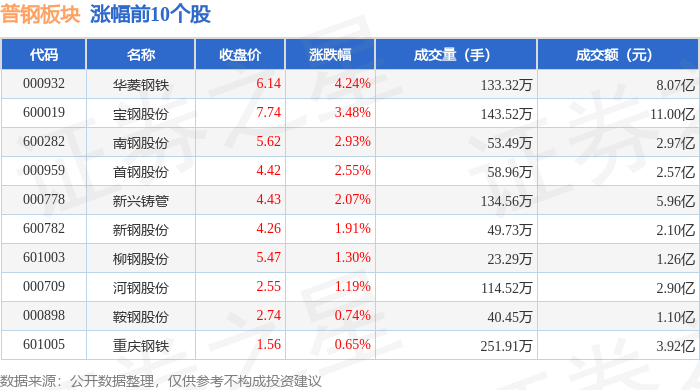
Market Performance - On November 6, the general steel sector rose by 1.73%, with Hualing Steel leading the gains [1] - The Shanghai Composite Index closed at 4007.76, up 0.97%, while the Shenzhen Component Index closed at 13452.42, up 1.73% [1] Individual Stock Performance - Hualing Steel (code: 000932) closed at 6.14, up 4.24% with a trading volume of 1.33 million shares and a transaction value of 807 million yuan [1] - Baosteel (code: 600019) closed at 7.74, up 3.48% with a trading volume of 1.44 million shares and a transaction value of 1.1 billion yuan [1] - Other notable performers include Nanjing Steel (code: 600282) up 2.93%, Shougang (code: 000959) up 2.55%, and Xinxing Ductile Iron Pipes (code: 000778) up 2.07% [1] Capital Flow Analysis - The steel sector experienced a net outflow of 139 million yuan from institutional investors, while retail investors saw a net inflow of 183 million yuan [2] - The overall capital flow indicates a mixed sentiment, with institutional investors withdrawing funds while retail investors increased their positions [2][3] Detailed Capital Flow for Selected Stocks - Xinxing Ductile Iron Pipes saw a net inflow of 51.83 million yuan from institutional investors, while retail investors had a net outflow of 48.95 million yuan [3] - Hualing Steel had a net inflow of 34.51 million yuan from institutional investors, with retail investors also experiencing a net outflow of 19.45 million yuan [3] - Chongqing Steel recorded a net inflow of 23.21 million yuan from institutional investors, while retail investors had a net outflow of 7.42 million yuan [3]
总量联合行业《“十五五”规划建议》解读:“十五五”规划引领,资本市场谱写创新升级新机遇
EBSCN· 2025-11-06 08:49
Group 1: Economic Development Goals - The "15th Five-Year Plan" emphasizes maintaining economic growth within a reasonable range, targeting a growth rate of 4.5% to 5% during this period[14] - The plan aims for a significant increase in total factor productivity, which will be a key indicator of economic efficiency and new quality productivity development[15] - The plan highlights the importance of increasing the resident consumption rate, enhancing domestic demand as a primary driver of economic growth[16] Group 2: Capital Market Opportunities - The "15th Five-Year Plan" provides a clear policy direction that is expected to reduce market uncertainties and attract long-term investments into the capital market[20] - Historical trends show that the A-share market performed well during the opening years of previous five-year plans, indicating a potential for similar performance in 2026[21] - The plan outlines three main focus areas for capital market attention: industrial structure upgrading, technological self-reliance, and boosting domestic consumption[22] Group 3: Industry Development Focus - The plan identifies key industries for development, including traditional sectors like mining and machinery, as well as emerging sectors such as new energy and artificial intelligence[18] - It emphasizes the need for a modern industrial system that strengthens the foundation of the real economy and promotes high-level technological self-reliance[19] - The plan encourages the optimization of traditional industries and the cultivation of new and future industries, aiming for a comprehensive upgrade of the industrial structure[19] Group 4: Financial Sector Initiatives - The term "finance" is mentioned 17 times in the plan, underscoring the importance of building a strong financial nation and enhancing the financial system to support high-quality development[26] - The plan calls for improvements in the monetary policy transmission mechanism, aiming to enhance the effectiveness of interest rate adjustments in influencing actual loan rates[27] - It highlights the need for a more market-oriented interest rate formation and transmission mechanism to better serve the real economy[28]
11月5日深证国企股东回报R(470064)指数跌0.32%,成份股云铝股份(000807)领跌
Sou Hu Cai Jing· 2025-11-05 10:15
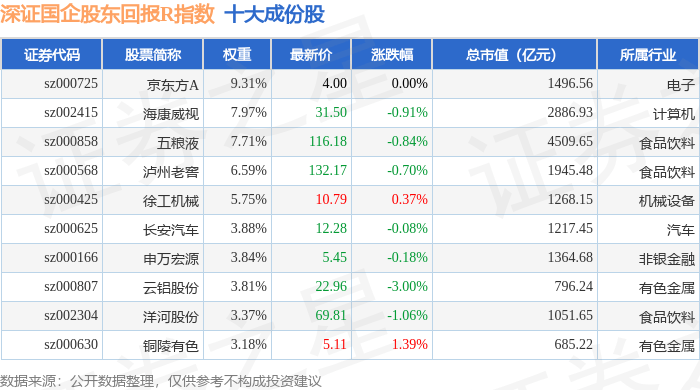
Core Points - The Shenzhen State-Owned Enterprises Shareholder Return Index (470064) closed at 2257.45 points, down 0.32%, with a trading volume of 24.053 billion yuan and a turnover rate of 0.97% [1] - Among the index constituents, 27 stocks rose while 22 stocks fell, with Beixin Building Materials leading the gainers at 2.45% and Yun Aluminum leading the decliners at 3.0% [1] Index Constituents Summary - The top ten constituents of the Shenzhen State-Owned Enterprises Shareholder Return Index include: - BOE Technology Group (9.31% weight, latest price 4.00 yuan, market cap 149.656 billion yuan) in the electronics sector - Hikvision (7.97% weight, latest price 31.50 yuan, market cap 288.693 billion yuan) in the computer sector - Wuliangye Yibin (7.71% weight, latest price 116.18 yuan, market cap 450.965 billion yuan) in the food and beverage sector - Luzhou Laojiao (6.59% weight, latest price 132.17 yuan, market cap 194.548 billion yuan) in the food and beverage sector - Xugong Machinery (5.75% weight, latest price 10.79 yuan, market cap 126.815 billion yuan) in the machinery equipment sector - Changan Automobile (3.88% weight, latest price 12.28 yuan, market cap 121.745 billion yuan) in the automotive sector - Shenwan Hongyuan (3.84% weight, latest price 5.45 yuan, market cap 136.468 billion yuan) in the non-banking financial sector - Yun Aluminum (3.81% weight, latest price 22.96 yuan, market cap 79.624 billion yuan) in the non-ferrous metals sector - Yanghe Brewery (3.37% weight, latest price 69.81 yuan, market cap 105.165 billion yuan) in the food and beverage sector - Tongling Nonferrous Metals (3.18% weight, latest price 5.11 yuan, market cap 68.522 billion yuan) in the non-ferrous metals sector [1] Capital Flow Summary - The net outflow of main funds from the index constituents totaled 1.125 billion yuan, while speculative funds saw a net inflow of 243 million yuan and retail investors saw a net inflow of 882 million yuan [3] - Detailed capital flow for selected stocks includes: - Tongling Nonferrous Metals: main net inflow of 88.024 million yuan, speculative net outflow of 53.924 million yuan, retail net outflow of 34.100 million yuan - Luzhou Laojiao: main net inflow of 57.790 million yuan, speculative net outflow of 22.566 million yuan, retail net outflow of 35.224 million yuan - Beixin Building Materials: main net inflow of 56.578 million yuan, speculative net outflow of 24.593 million yuan, retail net outflow of 31.985 million yuan [3]