太保寿险

Search documents
又一大型机构入场!险资系私募证券基金,增至6家!
券商中国· 2025-08-10 07:52
Core Viewpoint - The article discusses the recent approval of Taiping Asset's establishment of a private equity securities investment fund management company, marking a significant step in the long-term investment pilot program for insurance funds in China [2][4]. Group 1: Approval and Establishment - Taiping Asset, a subsidiary of China Taiping, has received approval from the National Financial Regulatory Administration to establish Taiping (Shenzhen) Private Securities Investment Fund Management Co., Ltd. [2][3] - This approval adds to the growing number of insurance-related private equity securities fund companies, with a total of six now approved [2][7]. Group 2: Long-term Investment Pilot Program - The long-term investment pilot program for insurance funds allows insurance companies to establish private equity securities funds primarily targeting the secondary market for stocks, with a focus on long-term holding [4]. - The pilot program has seen three batches of approvals, with the first batch in October 2023 involving China Life and Xinhua Insurance, each contributing 25 billion yuan to a total fund size of 50 billion yuan [4]. - The second batch included eight insurance companies with a total scale of 112 billion yuan, while the third batch amounted to 60 billion yuan [4]. Group 3: Impact on Capital Markets - The establishment of Taiping's private equity securities fund is expected to enhance the investment capacity of long-term funds in the capital market, with Taiping Asset managing over 1.5 trillion yuan in assets by the end of 2024 [5]. - The initiative aims to align with national strategies and support the real economy, reinforcing the role of insurance funds as stabilizers in the market [5]. Group 4: Current Fund Operations - Currently, six insurance-related private equity securities investment funds are operational, including various funds managed by Guofeng Xinghua, Taikang, and Taibao [8][9]. - The first pilot fund, managed by Guofeng Xinghua, began investing in March 2024, with a total scale of 50 billion yuan fully deployed by March of the same year [8]. - The ongoing pilot program is designed to optimize the asset-liability matching of insurance funds under new accounting standards, thereby improving capital efficiency [9].





汇丰晋信等公募联手险企 权益类产品代销密集落地
Mei Ri Jing Ji Xin Wen· 2025-08-03 13:08
Core Viewpoint - The collaboration between public funds and insurance companies is increasing, with several public fund institutions announcing partnerships with specific insurance companies for product distribution, indicating a shift in sales strategies within the insurance industry [1][2][4]. Group 1: Collaboration Between Public Funds and Insurance Companies - On August 1, public fund institutions such as HSBC Jintrust, Rongtong, and Nuoan announced the inclusion of specific insurance companies, including Sunshine Life and China Life, as distribution partners for their products [1][2]. - The number of funds distributed by insurance companies is relatively low, with China Life leading among licensed insurance companies with 6,250 funds, compared to 11,114 by Shanghai TianTian Fund Sales [2]. - Recent announcements show a notable increase in the distribution of equity products by insurance companies, contrasting with their historical focus on fixed-income or money market funds [2][3]. Group 2: Changes in Insurance Sales Strategies - Insurance companies are adjusting their sales strategies due to a decline in the preset interest rates for traditional life insurance products, which have been reduced from 2.5% to 2.0% [4]. - The insurance industry is exploring diversified sales models, with some companies encouraging internal staff to transition to external sales roles and implementing more motivating assessment mechanisms [5][6]. - The complexity of insurance sales processes compared to the quicker sales cycles of funds has led companies to use funds as a primary sales tool, enhancing customer engagement and potentially boosting insurance sales [5][6].
股市周评:慢牛走势不变,科技低位补涨或迎主升行情
Chang Sha Wan Bao· 2025-07-28 03:40
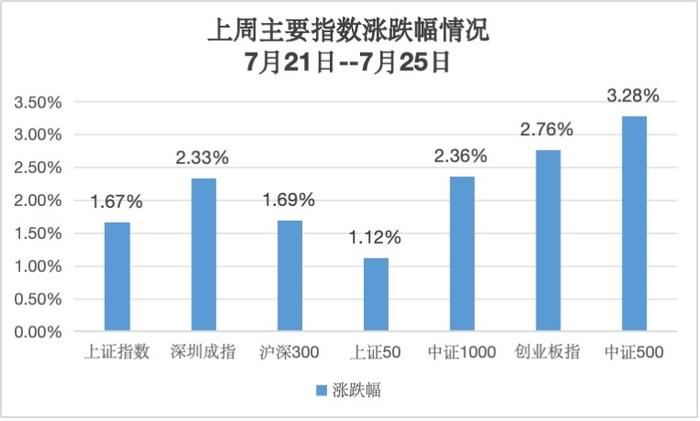
Market Performance - The A-share market maintained a strong performance last week, with major indices rising, particularly the CSI 500 which led with a 3.28% increase, while the CSI 1000 rose over 2.36% [1] - The construction materials, steel, non-ferrous metals, engineering machinery, and coal sectors showed significant gains, each exceeding 6%, while banking and diversified finance sectors experienced declines, indicating a clear rotation of market hotspots [3] - Northbound capital saw a substantial net sell-off totaling 69.817 billion RMB for the week, with notable sell-offs on July 23 and July 25 amounting to 41.445 billion RMB and 40.696 billion RMB respectively, reflecting a cautious attitude from foreign investors as the index approached 3600 points [3] Key Industry News - The photovoltaic sector has shown remarkable performance, with silicon wafer prices rising significantly from July 21 to 24. The average transaction price for N-type G10L monocrystalline wafers increased by 4.76% to 1.1 RMB per piece, while N-type G12R wafers surged by 870% to 1.25 RMB per piece, and N-type G12 wafers rose by 6.67% to 1.44 RMB per piece [4] - Longjiang Securities noted that the photovoltaic industry, facing severe supply-demand imbalances and profit pressures, is expected to benefit from recent policy enhancements aimed at regulating low-price competition and promoting the orderly exit of outdated production capacities [4] Future Market Outlook - Longjiang Securities' senior investment advisor Liu Lang observed that the market maintained a bullish sentiment, with the Shanghai Composite Index fluctuating around 3600 points and the Shenzhen Component Index and ChiNext Index reaching new highs for the year [5] - The market style is shifting, with significant capital inflow into lower-priced technology stocks, particularly in the semiconductor and AI sectors, which collectively attracted over 10 billion RMB, driving the STAR 50 Index to surpass its May high [6] - Key macroeconomic data indicated a decline in profits for industrial enterprises, with total profits for the first half of the year at 34,365 billion RMB, down 1.8% year-on-year, and a 4.3% decline in June [6] - The China Securities Regulatory Commission emphasized the need to consolidate the market's recovery and promote long-term capital inflow, alongside reforms in public funds and mergers and acquisitions [6] Agricultural and Insurance Developments - The Ministry of Agriculture and Rural Affairs, along with ten other departments, issued a plan to promote agricultural product consumption, focusing on optimizing supply, innovating circulation, and activating market demand [7] - The insurance industry announced a reduction in the guaranteed interest rates for traditional life insurance products, with rates adjusted from 2.5% to 2.0% for ordinary life insurance and from 2% to 1.75% for participating insurance [7] AI Innovations - Tesla showcased its latest advancements in AI at the World Artificial Intelligence Conference, including smart electric vehicles and humanoid robots, highlighting the deployment of its Robotaxi service based on a visual architecture [8] - Alibaba introduced its self-developed AI glasses, "Quark AI Glasses," which integrate various functionalities and support multiple applications within the Alibaba ecosystem [8] Investment Strategy - From a medium to long-term perspective, technology sectors such as robotics, semiconductors, and AI applications are recommended for investment due to improved cost-effectiveness after a three-month correction [8] - The "anti-involution" sectors, including photovoltaic, lithium battery, automotive, steel, construction materials, coal, and pork, are also highlighted as potential investment opportunities [8] - The non-ferrous metals sector is showing signs of a "dilemma reversal," with noticeable profit improvements in cyclical industries [8]
西部证券晨会纪要-20250728
Western Securities· 2025-07-28 02:27
Group 1: Inner Mongolia First Machinery Group (600967.SH) - The company is the only main battle tank research and manufacturing base in China, driven by both domestic demand and foreign trade [1][6] - In 2024, the company achieved revenue of 9.792 billion yuan, a year-on-year decrease of 2.18%, and a net profit of 500 million yuan, down 41.33% year-on-year [6] - In Q1 2025, the company reported revenue of 2.731 billion yuan, an increase of 19.6% year-on-year, and a net profit of 186 million yuan, up 11.03% year-on-year, indicating an improvement in performance [6] - The company is actively expanding into the unmanned military equipment sector, leveraging its technological advantages in armored vehicles [6][7] - The company expects a significant increase in foreign trade sales, with projected sales reaching 4.517 billion yuan in 2025, a 64% increase from 2024 [7] - Revenue forecasts for 2025-2027 are 11.5 billion yuan, 13.1 billion yuan, and 14.8 billion yuan, with net profits of 750 million yuan, 950 million yuan, and 1.2 billion yuan respectively [7] Group 2: North Navigation (600435.SH) - The company is a core supplier of military guidance systems, benefiting from the rising demand for long-range fire systems [9][10] - In 2024, the company achieved revenue of 2.748 billion yuan, a year-on-year decrease of 22.91%, and a net profit of 59 million yuan, down 69.29% year-on-year [10] - The company anticipates a turnaround in H1 2025, with projected net profit between 105 million and 120 million yuan, compared to a loss of 74.42 million yuan in the same period last year [10] - The company has developed a unique "8+3" technology system and is integrating big data, AI, and IoT into its production processes [9] - Revenue forecasts for 2025-2027 are 5.24 billion yuan, 6.44 billion yuan, and 7.64 billion yuan, with net profits of 310 million yuan, 400 million yuan, and 510 million yuan respectively [11] Group 3: Hainan Free Trade Port - The Hainan Free Trade Port is set to officially close on December 18, 2025, which has been confirmed as a significant development for regional growth [13][16] - The report identifies four categories of companies that are expected to benefit from the Hainan Free Trade Port: those with significant foreign trade, those involved in supporting construction, tourism-related companies, and other local beneficiaries [16] - The current market liquidity is relatively ample, and the risk appetite is high, suggesting that the Hainan theme could continue to perform well as long as policy details are implemented as planned [16] Group 4: Medical Devices - The National Health Commission is promoting a "reverse involution" policy in medical procurement, which is expected to lead to a revaluation of the medical device sector [18][19] - The 11th batch of centralized procurement has been initiated, with a focus on optimizing selection rules and ensuring quality, which may lead to a recovery in the performance of some domestic manufacturers [19][21] - Recommendations include companies involved in already centralized consumables, those expected to benefit from a slowdown in procurement, innovative devices, and stable equipment manufacturers [21] Group 5: Commercial Aerospace - The commercial aerospace sector is witnessing significant developments, with major contracts being signed for eVTOL aircraft, indicating a potential transformation in the low-altitude economy [37][39] - The report highlights the importance of commercial rocket capacity for the rapid development of low-orbit satellites, suggesting that commercial rocket orders will be a key indicator for the sector's growth [25][39] - Companies involved in liquid rocket engines, structural components, and specialized manufacturing processes are recommended for investment [25][39]
【钛晨报】农产品消费迎利好,10部门最新发布;吴清挂帅!资本市场超级智囊团亮相,释放重磅信息;从智能眼镜到具身智能,阿里、京东、腾讯公布AI新进展
Tai Mei Ti A P P· 2025-07-27 23:39
Group 1 - The Ministry of Agriculture and Rural Affairs, along with ten other departments, released a plan to boost agricultural product consumption with 23 specific measures across nine areas [2][3] - E-commerce platforms are encouraged to support rural areas by nurturing local farmers as influencers and conducting themed live broadcasts to promote agricultural products [2][3] - The "Internet+" initiative aims to enhance agricultural product distribution from rural to urban areas, improving user experience and expanding local retail supply [2][3] Group 2 - Support for food companies to collaborate with research institutions to develop new food ingredients and technologies for preservation and quality control [3][4] - Promotion of quality standards for agricultural products, including geographical indication fruits and green food certifications, to enhance consumer trust and demand [4] - Financial institutions are encouraged to innovate in providing loans and marketing support for agricultural products, integrating consumption policies across various sectors [4][5] Group 3 - Strengthening the regulatory framework for food safety, particularly in the production and transportation of agricultural products, to ensure quality and safety [4][22] - Enhancing urban and rural consumption infrastructure, including modern distribution networks and cold chain logistics, to facilitate the movement of fresh agricultural products [4][22] - Encouraging local cultural events to promote rural consumption and showcase local products and heritage [4][22]

证监会:全力巩固市场回稳向好态势;新央企中国雅江集团董事长、总经理亮相……周末要闻汇总
证券时报· 2025-07-27 14:25
Macro News - In the first half of the year, industrial enterprises above designated size in China achieved a total profit of 34,365 billion yuan, a year-on-year decrease of 1.8%. In June, profits fell by 4.3% year-on-year, although the decline was less severe than in May. The equipment manufacturing sector showed rapid profit growth, indicating a positive trend in corporate performance despite the overall profit decline [2]. Industry and Company Developments - The Chinese government has proposed the establishment of a World Artificial Intelligence Cooperation Organization, with initial considerations for its headquarters to be located in Shanghai. This initiative aims to promote multilateralism and address the digital and intelligence divide globally [3]. - A joint implementation plan to promote agricultural product consumption has been released by ten departments, focusing on optimizing supply, innovating circulation, and activating market potential. The plan encourages e-commerce platforms to support rural areas and enhance the visibility of agricultural products through live streaming and other digital means [4]. - The China Securities Regulatory Commission (CSRC) is revising the Corporate Governance Code for listed companies, emphasizing the need to limit significant adverse impacts from competitive practices and improve the responsibilities and decision-making processes related to related-party transactions [11]. - The CSRC is also focused on stabilizing the market, promoting long-term capital inflows, and supporting significant reforms in public funds and mergers and acquisitions [12]. - The insurance industry is experiencing a reduction in the preset interest rates for traditional and participating insurance products, with rates dropping to 2.0% and 1.75% respectively, reflecting the ongoing low-interest-rate environment [13]. - Tesla showcased its latest advancements in AI and autonomous driving technology at the World Artificial Intelligence Conference, with plans to further implement its smart driving system in China by the end of the year [14]. - Alibaba announced progress on its self-developed AI glasses, integrating various functionalities and AI capabilities, aimed at enhancing user experience across multiple applications [15]. - A record land price was set in Shanghai, with a plot in Xuhui district sold for a floor price of over 200,000 yuan per square meter, indicating strong demand in the real estate market [16]. - China Mobile's chairman emphasized the company's commitment to enhancing its "AI+" initiative, aiming to integrate AI deeply into various industries and promote technological innovation [20]. - Taiyuan Heavy Industry is under investigation by the CSRC for suspected violations related to information disclosure, highlighting ongoing regulatory scrutiny in the sector [21].

《人身保险业责任准备金评估利率专家咨询委员会2025年二季度例会》点评:预定利率非对称下调,分红险迎来发展窗口期
EBSCN· 2025-07-26 12:09
Investment Rating - The report maintains an "Accumulate" rating for the non-bank financial sector [1] Core Insights - The scheduled interest rate for traditional insurance products has been adjusted down to 2.0%, while the maximum scheduled interest rate for dividend insurance products is set at 1.75% [2][4] - The scheduled interest rate research value has decreased by 14 basis points to 1.99%, indicating a downward trend in the insurance sector's interest rates [3] - The adjustment mechanism for scheduled interest rates is triggered when the maximum scheduled interest rate for insurance products exceeds the research value by more than 25 basis points for two consecutive quarters [4] Summary by Sections Event Overview - On July 25, the China Insurance Industry Association held a meeting to discuss the scheduled interest rates for life insurance products, concluding that the current research value is 1.99% [2] - Major insurance companies announced adjustments to their scheduled interest rates, with traditional insurance products set at a maximum of 2.0% and dividend insurance products at 1.75% [2] Rate Adjustments - The scheduled interest rates for traditional, dividend, and universal insurance products have been reduced to 2.0%, 1.75%, and 1.0% respectively [4] - The adjustment mechanism is activated due to the current scheduled interest rates being significantly higher than the research value, necessitating a reduction [4] Market Implications - The reduction in scheduled interest rates is expected to create a favorable environment for the development of dividend insurance products, as the previous higher rates had led to a significant increase in their market share [5] - The adjustment may cause short-term disruptions in new policy growth, but long-term benefits are anticipated as the proportion of floating income products increases [9] - The report suggests that companies with strong investment capabilities and higher dividend levels will gain a competitive advantage in the evolving market [5]

保险行业事件点评:人身险预定利率再下调,缓解负债成本压力
Dongguan Securities· 2025-07-25 09:37
Investment Rating - The industry investment rating is "Overweight" (maintained), indicating an expectation that the industry index will outperform the market index by more than 10% over the next six months [5]. Core Viewpoints - The recent adjustment of the predetermined interest rate for life insurance products is a necessary response to the ongoing decline in market interest rates. The current research value for ordinary life insurance products is set at 1.99%, with traditional life insurance rates being lowered from 2.5% to 2.0% and guaranteed rates for participating insurance dropping from 2% to 1.75% [1][2]. - The downward adjustment of the predetermined interest rate is expected to have a short-term impact on new premium growth due to potential product discontinuations and reduced attractiveness of ordinary life insurance products. However, it will help alleviate the rigid cost pressure on liabilities in the long term by encouraging insurance companies to optimize product structures and increase the development of flexible yield products [3]. Summary by Sections Industry Overview - The adjustment of predetermined interest rates reflects the insurance industry's gradual adaptation to changes in market interest rates, with historical data showing a consistent decline in rates since 2019 [2]. - The establishment of a dynamic adjustment mechanism linking predetermined rates to market rates is aimed at ensuring the stability of the insurance industry amid declining interest rates [2]. Short-term and Long-term Impacts - In the short term, the adjustment may lead to a wave of product discontinuations and pressure on new premium growth due to decreased product attractiveness [3]. - In the long term, the adjustment is expected to promote the development of participating and universal insurance products, enhancing investment returns and addressing the challenges posed by reduced interest rate spreads [3]. Investment Strategy - The report suggests focusing on companies with stable operations such as China Pacific Insurance (601601), Ping An Insurance (601318), and New China Life Insurance (601336), which have greater asset flexibility [3].


政策“组合拳”协同发力险资“长钱长投”打开空间
Shang Hai Zheng Quan Bao· 2025-07-13 19:46
Group 1 - The core viewpoint of the articles highlights the acceleration of insurance capital's entry into the market, driven by a series of supportive policies aimed at promoting long-term investments [1][2][4] - Insurance capital has made 19 equity stakes in listed companies this year, which is consistent with the total from the previous year, indicating a stable investment trend [2][4] - The implementation of policies such as increasing the proportion of equity asset allocation and expanding long-term investment pilot programs has provided more opportunities for insurance capital to invest [2][4][5] Group 2 - A total of 1,720 billion yuan has been approved for long-term investment pilot funds, with many insurance companies actively participating in these initiatives [2][4] - The financial regulatory authority has raised the equity asset allocation limits for insurance companies, potentially increasing their investment capacity by approximately 500 billion yuan [5] - The recent adjustments in risk factors for insurance stock investments are expected to lower the capital requirements, allowing more funds to be allocated to the stock market [5][7] Group 3 - The introduction of a long-term assessment mechanism for state-owned insurance companies aims to encourage a shift from short-term to long-term investment strategies [6][8] - There is a growing interest among smaller insurance companies to participate in long-term stock investment trials, indicating a broader industry trend towards long-term capital deployment [3][4] - Industry experts suggest further optimization of solvency requirements and risk factor assessments to enhance the effectiveness of insurance capital in the market [7][8]
入市重点投向,长钱长投制度优化……多家险资巨头发声
证券时报· 2025-07-13 09:14
Core Viewpoint - The necessity and feasibility of increasing equity asset allocation by insurance funds are emphasized, alongside the importance of optimizing equity asset allocation capabilities and fostering a healthy capital market development environment [1]. Group 1: Value Investment Essence - The essence of equity investment for insurance funds is highlighted as a return to value investment principles, focusing on acquiring assets at reasonable prices for long-term growth [3][4]. - Insurance funds should prioritize investing in "good companies" to achieve "good returns," thereby promoting a shift towards long-term and value investment philosophies in the market [3]. Group 2: Selection Criteria for Investment Targets - Key indicators for selecting investment targets include long-term competitive advantage, sustainable profitability (with metrics like ROE, ROIC, EBITDA, and FCFF), operational stability, and shareholder return capabilities [4]. - These criteria form a framework for ensuring that investment targets meet the long-term and stable appreciation needs of insurance funds [4]. Group 3: Focus Areas for Investment Opportunities - Investment opportunities are identified in new productive forces, new economy sectors, high-dividend low-volatility assets, and overseas expansion of manufacturing and consumer brands [5][6]. - Specific sectors of interest include technology growth areas like AI and robotics, stable traditional industries, and industries with potential for domestic substitution and growth, such as pharmaceuticals and high-value consumables [7]. Group 4: Global Value Chain Core Assets - The importance of increasing allocation to global value chain core assets is stressed, with a focus on leading manufacturing companies that have shown strong performance and stability [8]. - The ongoing global economic restructuring and geopolitical factors are seen as catalysts for investment opportunities in strategic industries and resources [8]. Group 5: Enhancing the Investment Environment - Suggestions for improving the environment for long-term capital investment include cultivating a value investment ecosystem, enhancing the institutional framework for long-term investments, and improving the investment capabilities of insurance funds [10][11]. - Recommendations include optimizing market structures, enhancing investor protection, and providing a wider range of investment products suitable for long-term investors [10][11].