
康师傅控股

Search documents
食品饮料行业周报:周观点:白酒底部建议乐观,大众品关注强α-20250817
GOLDEN SUN SECURITIES· 2025-08-17 10:02
Investment Rating - The report maintains an "Increase" rating for the food and beverage industry, indicating a positive outlook for the sector [4]. Core Insights - The report highlights optimism for the liquor sector, particularly for premium brands like Moutai and Wuliangye, and suggests focusing on three main lines: leading brands, high-certainty regional wines, and elastic stocks benefiting from recovery [1][2]. - In the beverage segment, companies like Master Kong and Angel Yeast are noted for their strong profit growth, while Chongqing Beer shows stable volume but slight price declines [3][8]. - The report emphasizes the importance of innovative product strategies and market positioning for companies to capture emerging market opportunities [2][3]. Summary by Sections Liquor Sector - Moutai's H1 2025 revenue reached 91.094 billion yuan, up 9.16% year-on-year, with a net profit of 45.403 billion yuan, up 8.89% [2]. - The introduction of new products, such as the competitively priced "Dazhen" by Zhenjiu Li Du, is expected to drive sales growth and improve the company's fundamentals [2]. Beer and Beverage Sector - Chongqing Beer reported H1 2025 revenue of 4.48 billion yuan, down 1.8% year-on-year, with a net profit of 390 million yuan, down 12.7% [3]. - Master Kong's H1 2025 revenue was 40.09 billion yuan, down 2.7%, but net profit increased by 20.5% [3][8]. - The report suggests focusing on companies with strong growth potential and those benefiting from policy improvements or recovery [1][3]. Growth Opportunities - The report identifies high-growth companies such as Yanjing Beer and Zhujiang Beer as key players to watch in the beer segment [3]. - In the snack sector, companies like Wei Long and Sanhua are highlighted for their impressive revenue growth, with Wei Long's H1 2025 revenue increasing by 18.5% to 3.48 billion yuan [8].
3年少卖40亿包:国民速食“扛把子”为啥失宠?
Qi Lu Wan Bao Wang· 2025-08-17 09:40
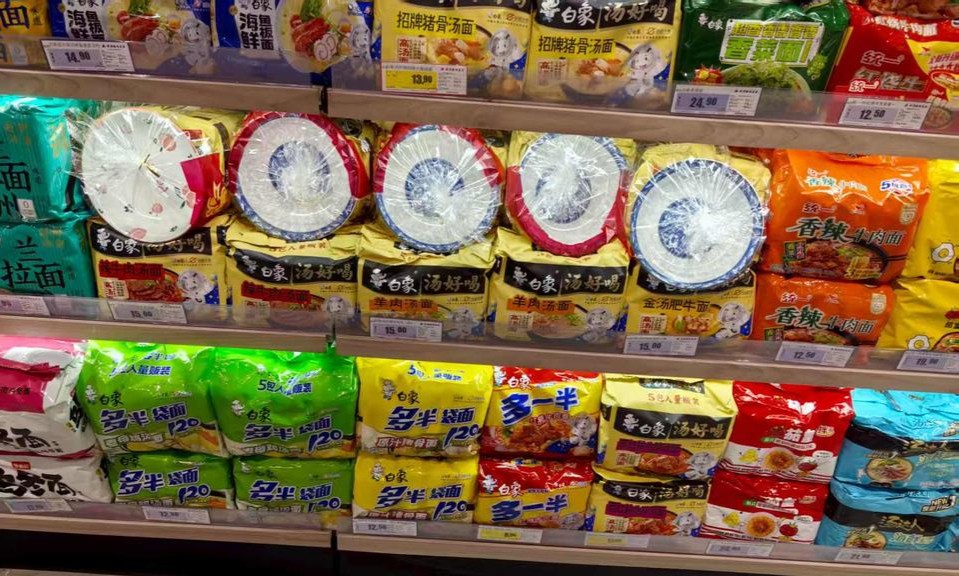
Core Viewpoint - The instant noodle industry in China is experiencing a significant decline in consumption, with a reduction of 4 billion packages from 2020 to 2023, and a projected sales drop of 8.9% in the second quarter of 2025 compared to the previous year [3][4]. Group 1: Market Dynamics - The rise of food delivery services has severely impacted the instant noodle market, with the Chinese food delivery market expected to exceed 1.27 trillion yuan in 2024, serving 592 million users [3]. - The price of traditional instant noodles has increased from 4.5 yuan to 5 yuan, but this is still less appealing compared to the convenience and variety offered by food delivery options [3][4]. - A study indicates that for every 1% increase in the food delivery market, instant noodle consumption decreases by 0.0533% [3]. Group 2: Health Consciousness - Growing health awareness among consumers has led to a decline in the popularity of instant noodles, with 59.3% of consumers expressing concerns about the unhealthy aspects of fried instant noodles [4]. - A typical instant noodle package contains 6 grams of salt and 25 grams of fat, exceeding daily recommended limits, reinforcing its "unhealthy" image [4]. - Attempts to reposition instant noodles as premium products have failed, as consumers remain skeptical about the health benefits of higher-priced options [4][5]. Group 3: Changing Consumption Habits - The expansion of high-speed rail has diminished the traditional demand for instant noodles during travel, with a 1% increase in high-speed rail mileage correlating to a 0.3191% decrease in instant noodle consumption [4]. - Passengers are increasingly opting for local food delivery services over instant noodles, with daily orders for local specialties exceeding 300, and average spending reaching 50 yuan [5]. - The shift in consumer preferences and the introduction of fresh meal options on trains have further eroded the market for instant noodles [5]. Group 4: Future Outlook - The decline in instant noodle consumption is seen as a natural evolution of consumer demand rather than a failure of the product itself [5]. - The industry must adapt to the changing landscape by balancing convenience, nutrition, and affordability to regain consumer interest and restore its former status as a staple food [5].

3年少卖40亿包!涨价的方便面正被年轻人抛弃
2 1 Shi Ji Jing Ji Bao Dao· 2025-08-17 02:05
Industry Overview - Instant noodle consumption in China has significantly declined, with a drop of 4 billion packages from 2020 to 2023, leading to a projected consumption of 438 billion packages in 2024, marking a notable decrease in popularity [1] - The industry leader, Master Kong, has experienced a revenue decline of 1.1 billion yuan in the first half of the year, with instant noodle revenue falling by 2.53% to 13.465 billion yuan, a decrease of 350 million yuan [2] - Competitors like Uni-President and White Elephant have shown growth, while Master Kong and Jinmailang have faced contraction [4] Consumer Behavior - Young consumers are increasingly opting for alternatives such as takeout, pre-prepared meals, and self-heating foods, which offer better value compared to instant noodles [5] - The price of instant noodles has risen, with classic varieties now costing around 6 yuan and premium options reaching 15-20 yuan, with some high-end products priced at 79.9 yuan [7] Market Dynamics - The convenience of high-speed rail has reduced the demand for instant noodles traditionally consumed during travel, further impacting sales [8] - In response to market challenges, companies are innovating with new flavors and ingredients, such as adding unconventional items like herbs and even dessert flavors, which have gained popularity on social media [8]


康师傅控股(00322.HK):股息价值凸显 利润率持续提升
Ge Long Hui· 2025-08-16 19:05
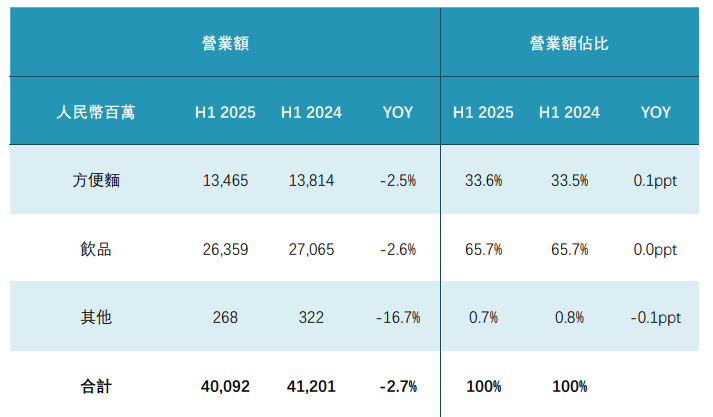
Core Insights - The company has shown continuous improvement in profitability despite a slight decline in revenue, reflecting effective high-quality development strategies and operational resilience [1][2] Revenue Performance - In H1 2025, the company achieved revenue of 40.092 billion RMB, a year-on-year decrease of 2.7% [1] - The beverage segment reported revenue of 26.359 billion RMB, down 2.6% year-on-year, with specific declines in tea drinks, packaged water, and fruit juice [1] - The instant noodle segment generated revenue of 13.465 billion RMB, a slight decrease of 2.5% year-on-year, with mid-priced products showing an 8.0% increase [2] Profitability Metrics - The company's net profit attributable to shareholders reached 2.271 billion RMB, a year-on-year increase of 0.5% [1] - The gross margin for the beverage segment improved to 37.7%, up 2.5 percentage points, primarily due to cost reductions [1] - The gross margin for the instant noodle segment increased by 0.7 percentage points to 27.8%, driven by pricing and product mix [2] Cash Flow and Dividend Policy - As of June 30, 2025, the company had bank deposits and cash totaling 19.49 billion RMB, indicating strong cash flow [2] - The company has maintained a consistent dividend payout ratio of 100% over the past years, with a projected dividend yield of 7.2% based on current market capitalization [2] Future Projections - Revenue forecasts for 2025-2027 are 79.89 billion RMB, 81.96 billion RMB, and 84.10 billion RMB, with expected growth rates of -0.9%, +2.6%, and +2.6% respectively [3] - Projected net profits for the same period are 4.24 billion RMB, 4.51 billion RMB, and 4.79 billion RMB, with corresponding EPS of 0.75, 0.80, and 0.85 RMB [3]
康师傅与海尔结成绿色低碳战略合作伙伴:“尔康组合”共同携手高质量发展
Xin Hua Wang· 2025-08-16 01:37
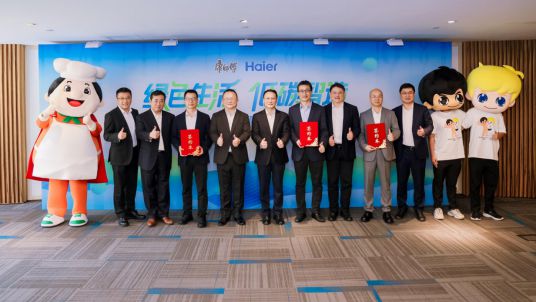
Core Viewpoint - The strategic partnership between Master Kong and Haier aims to promote green living and low-carbon manufacturing through collaboration in various sectors, including eco-friendly food and beverage, green low-carbon manufacturing, and social welfare initiatives [1][3][6] Group 1: Strategic Collaboration - Master Kong and Haier will leverage their respective brand strengths, with Master Kong's "Kang Baobao" and Haier's "Haier Brothers" becoming ambassadors for green living [3] - The collaboration is rooted in shared corporate cultural values and aims for mutual success and industry leadership in high-quality development [3][6] Group 2: Focus Areas - The partnership will focus on three main areas: "Joyful Diet," "Smart Supply Chain and Park," and "Smart Logistics," emphasizing deep collaboration based on ESG principles [3][5] - In the smart kitchen sector, Haier will provide energy-efficient solutions, while Master Kong will deploy vending machines offering a range of green products [4] Group 3: Environmental Initiatives - Master Kong's "Suda Noodle Shop" will use eco-friendly packaging that reduces plastic usage by 90%, potentially saving 800-1000 tons of plastic for every 100 million servings sold [4] - The introduction of a "no-label lightweight bottle" for drinking water will further reduce carbon emissions and simplify recycling processes [4] Group 4: Supply Chain and Logistics - The partnership will establish a smart energy management system in industrial parks, aiming for a 30% reduction in energy consumption on Master Kong's production lines [5] - Collaborative efforts in logistics will explore customized solutions to enhance efficiency and promote low-carbon transportation models [5] Group 5: Economic and Environmental Impact - The collaboration is expected to transform environmental benefits into economic value, with significant cost savings anticipated from energy-efficient technologies [6] - Plans include creating a green low-carbon case library and hosting events to share technological innovations and promote high-quality industry development [6]

食饮吾见 | 一周消费大事件(8.11-8.15)
Cai Jing Wang· 2025-08-15 14:06
Group 1: Guizhou Moutai and Chongqing Beer - Guizhou Moutai reported a total revenue of 91.094 billion yuan for the first half of 2025, a year-on-year increase of 9.16%, and a net profit of 45.403 billion yuan, up 8.89% [1] - Chongqing Beer experienced a slight revenue decline of 0.24% to 8.839 billion yuan, with a net profit decrease of 4.03% to 865 million yuan, while maintaining a sales volume of 1.8008 million kiloliters, a 0.95% increase [1] Group 2: Wei Long and Angel Yeast - Wei Long reported total revenue of 3.483 billion yuan for the first half of 2025, an increase of 18.5%, with a net profit of 736 million yuan, also up 18.5% [3] - Angel Yeast achieved a revenue of 7.899 billion yuan, a 10.10% increase, and a net profit of 799 million yuan, reflecting a growth of 15.66% [5] Group 3: Jinlongyu and Master Kong - Jinlongyu's revenue for the first half of 2025 was 115.682 billion yuan, a 5.67% increase, with a net profit of 1.756 billion yuan, up 60.07% [5] - Master Kong reported a revenue of 40.092 billion yuan, a decrease of 2.7%, but a net profit of 2.271 billion yuan, an increase of 20.5% [7] Group 4: Budweiser and Step by Step - Budweiser's response to market changes indicated a significant increase in the number of new distributors compared to those eliminated, reflecting a normal dynamic optimization of its distribution system [6] - Step by Step reported a revenue of 2.129 billion yuan, a 24.45% increase, and a net profit of 201 million yuan, marking a turnaround from losses [10] Group 5: Wanchen Group - Wanchen Group plans to acquire 49% of Nanjing Wanyou for 1.379 billion yuan, aiming to enhance its core team and improve long-term development [11]
一文搞懂港股A股差异:从市场特征到风险模型
Minsheng Securities· 2025-08-15 10:53
Quantitative Models and Construction Methods 1. Model Name: Barra Risk Model - **Model Construction Idea**: The model identifies and quantifies common factors (industry and style factors) and idiosyncratic factors affecting stock returns, aiming to decompose return sources and provide risk constraints such as industry and style neutrality[119][121]. - **Model Construction Process**: - **Data Processing**: - Align reporting periods due to varying fiscal years among Hong Kong-listed companies[120]. - Standardize accounting standards using Wind GSD reports, converting to IFRS[120]. - Normalize financial reporting currencies using time-series exchange rates[120]. - Exclude dual-counter trading stocks and REITs for consistency[120]. - **Factor Construction**: - Constructed for three pools: Southbound Stock Connect, full Hong Kong market, and full market excluding penny stocks[121]. - Includes 10 major style factors (e.g., Beta, Momentum, Size, Earnings Yield) and industry factors[121]. - Factors are standardized using median-based outlier removal and normalized to standard normal distribution[122]. - Factor returns are calculated using Weighted Least Squares (WLS) with free-float market cap weights[122]. - Formula for WLS: ``` min Σ sqrt(w_i,t-1) * (r_i,t - Σ β_i,k,t-1 * f_k,t + Σ γ_i,m,t-1 * g_m,t)^2 ``` where weights are the fourth root of free-float market cap proportions[123]. - **Factor Definitions**: - Beta: Systematic risk derived from regression of stock returns against market returns[125]. - Momentum: Weighted log returns over a 500-day period[125]. - Size: Logarithm of total market capitalization[125]. - Earnings Yield: Inverse of P/E ratio[125]. - Volatility: Derived from residual standard deviation and monthly return ranges[125]. - Growth: Based on regression of past five years' revenue and earnings per share[125]. - Value: Inverse of P/B ratio[125]. - Leverage: Includes metrics like market leverage and debt-to-asset ratio[125]. - Liquidity: Based on trading volume relative to free-float shares over different time horizons[125]. - **Model Evaluation**: The model demonstrates good applicability in the Hong Kong market, with stable R² values across different pools[126][152]. --- Model Backtesting Results 1. Barra Risk Model - **R² Values**: - Southbound Stock Connect: Average R² = 36.7% since 2014[126][152]. - Full Hong Kong Market: Average R² = 17.4%[126][152]. - Full Market (Excluding Penny Stocks): Average R² = 21.9%[126][152]. - **Factor Cumulative Returns**: - Positive: Beta, Momentum, Liquidity, BP, Earnings Yield[130][149]. - Negative: Size, Growth, Non-Linear Size[130][149]. - Mixed: Volatility (positive for full market, negative for Southbound Stock Connect), Leverage (positive for full market, negative for Southbound Stock Connect)[130][149]. --- Quantitative Factors and Construction Methods 1. Factor Name: Penny Stock Screening - **Factor Construction Idea**: Screen stocks based on price, financial, and behavioral metrics to identify and exclude penny stocks[117][118]. - **Factor Construction Process**: - **Price Metrics**: - Rolling one-month average closing price < 1 HKD and market cap < 10 billion HKD[117]. - Rolling one-month average closing price < 1 HKD and average trading volume in the lowest 20% of the market[117]. - **Financial Metrics**: - ROE and debt-to-asset ratio thresholds[118]. - **Behavioral Metrics**: - History of stock splits or rights issues in the past year[118]. - **Exclusion of "Three Highs"**: High equity pledges, high debt ratios, and frequent fundraising activities[118]. - **Factor Evaluation**: Helps mitigate risks associated with high-volatility, low-liquidity stocks prevalent in the Hong Kong market[117][118]. --- Factor Backtesting Results 1. Penny Stock Screening - **Market Characteristics**: - As of June 2025, 56% of Hong Kong stocks are priced below 1 HKD, with 14.5% below 0.1 HKD[112][113]. - Penny stocks exhibit high volatility and low liquidity, making them risky for investment[112][117]. 2. Barra Risk Model Factors - **Cumulative Returns by Factor**: - Beta: Positive across all pools[130][149]. - Momentum: Positive across all pools[130][149]. - Size: Negative across all pools[130][149]. - Earnings Yield: Positive across all pools[130][149]. - Volatility: Positive for full market, negative for Southbound Stock Connect[130][149]. - Growth: Negative across all pools[130][149]. - Value: Positive across all pools[130][149]. - Leverage: Positive for full market, negative for Southbound Stock Connect[130][149]. - Liquidity: Positive across all pools[130][149].
康师傅控股(00322):股息价值凸显,利润率持续提升
Haitong Securities International· 2025-08-15 08:04
Investment Rating - The report maintains an "Outperform" rating for Tingyi Holdings Corp. (康师傅控股) [2] Core Views - The company demonstrates a prominent value in dividends, with a projected dividend yield of 7.2% based on a historical 100% payout ratio [6][14] - Profitability continues to improve despite slight revenue pressure, reflecting effective implementation of a high-quality development strategy [3][11] Financial Summary - Revenue for 2025 is expected to be 79.886 billion yuan, with a slight year-on-year decrease of 0.9% [15] - Net profit attributable to shareholders is projected to be 4.235 billion yuan for 2025, representing a year-on-year growth of 13.4% [15] - The gross profit margin is expected to increase from 33.1% in 2024 to 34.0% in 2025 [10] Segment Performance - The beverage segment experienced a revenue decline of 2.6% in the first half of 2025, with a notable increase in gross profit margin to 37.7% [4][12] - The instant noodle segment saw a slight revenue decrease of 2.5% in the first half of 2025, but the gross profit margin improved to 27.8% [5][13] Cash Flow and Dividends - As of June 30, 2025, the company had cash and bank deposits totaling 19.49 billion yuan, indicating strong cash flow [14] - The company has consistently maintained a high dividend payout ratio, with historical ratios of 100% or more from 2020 to 2024 [6][14]
康师傅少卖11亿元,方便面饮料都在跌......冰红茶还要涨价?
Zhong Guo Jing Ji Wang· 2025-08-15 04:24
Core Viewpoint - The financial performance of Master Kong Holdings in the first half of 2025 shows a decline in revenue, primarily driven by decreased sales in its instant noodle and beverage segments, despite an increase in net profit [1][2]. Revenue Summary - Total revenue for the first half of 2025 was approximately 400.92 billion RMB, a year-on-year decrease of 2.7%, with a drop of over 1.1 billion RMB in sales [1][2]. - Instant noodle revenue was 134.65 billion RMB, down 2.5% year-on-year [2]. - Beverage revenue was 263.59 billion RMB, down 2.6% year-on-year, with a decrease of 7.06 billion RMB compared to the same period in 2024 [1][2]. Business Segment Analysis - The instant noodle segment has been experiencing a continuous decline in revenue, dropping from 295.1 billion RMB in 2020 to 284.14 billion RMB in 2024, with further decline in 2025 [2]. - The beverage segment has seen a slight decrease in revenue, but the company has improved its gross margin by 2.5 percentage points to 37.7% through better management and raw material efficiency [3]. Distribution Network Changes - The company is reducing its distribution network in response to market pressures, with the number of marketing distributors decreasing from 67,215 to 63,806, and direct retailers from 220,623 to 219,124 [3]. Pricing Strategy - The decline in beverage revenue is partly attributed to previous price increases, with 1L iced tea prices raised from 4 RMB to between 4.5 RMB and 5 RMB [4]. - Management indicated that despite ongoing challenges, there will be no rollback on the price increases, as maintaining quality is a priority [5].
康师傅控股(0322.HK):营收阶段承压 盈利维持良好
Ge Long Hui· 2025-08-15 03:03
Core Insights - The company has experienced short-term revenue pressure in H1 2025, but has maintained strong profitability due to improved gross margins and one-time gains [1] - The earnings forecasts for 2025-2027 have been revised upwards, with EPS estimates now at 0.78, 0.88, and 0.99 yuan respectively [1] Financial Performance - In H1 2025, the company achieved revenue of 40.092 billion yuan, a year-over-year decrease of 2.7%, but gross margin improved by 1.84 percentage points [1] - The net profit attributable to shareholders reached 2.271 billion yuan, reflecting a year-over-year increase of 20.46% [1] Beverage Segment - The beverage business generated revenue of 26.359 billion yuan in H1 2025, down 2.6% year-over-year, but gross margin increased by 2.5 percentage points to 37.7% [2] - The breakdown of beverage revenue includes tea at 10.670 billion yuan (down 6.3%), water at 2.377 billion yuan (down 6.0%), juice at 2.956 billion yuan (down 13.0%), and carbonated drinks at 10.356 billion yuan (up 6.3%) [2] Instant Noodle Segment - The instant noodle business reported revenue of 13.465 billion yuan in H1 2025, a decrease of 2.5% year-over-year, but gross margin improved by 0.7 percentage points to 27.1% [3] - The performance of different product categories includes a decline in container noodles by 1.3% and high-priced bag noodles by 7.25%, while mid-priced bag noodles grew by 8.0% and dry noodles and others increased by 14.5% [3]