
方大特钢

Search documents
“反内卷”政策持续发力,钢铁板块估值修复未止
Xinda Securities· 2025-07-12 13:18
Investment Rating - The investment rating for the steel industry is "Positive" [2] Core Viewpoints - The steel sector has shown a 3.90% increase this week, outperforming the broader market, with specific segments like special steel and plate steel also experiencing gains [2][10] - Despite a decrease in iron and steel production, the average daily molten iron output remains above last year's levels, indicating resilience in the market [3][25] - The report highlights the ongoing "anti-involution" policies aimed at stabilizing the market, which may lead to a gradual recovery in steel prices and profitability [3][41] - The demand for steel is expected to stabilize or slightly increase due to government policies supporting real estate and infrastructure investments [3][34] Summary by Sections 1. Market Performance - The steel sector's performance this week was 3.90%, with sub-segments like special steel up by 1.64% and plate steel up by 4.51% [2][10] - Iron ore prices increased by 7.16%, indicating strong demand for raw materials [12] 2. Supply Data - As of July 11, the capacity utilization rate for blast furnaces was 89.9%, down by 0.39 percentage points week-on-week [25] - The total production of five major steel products was 7.61 million tons, a decrease of 1.59% from the previous week [25][30] 3. Demand Data - The consumption of five major steel products was 8.73 million tons, reflecting a week-on-week decrease of 1.38% [34] - The transaction volume for construction steel was 99,000 tons, down 7.04% week-on-week [34] 4. Inventory Levels - Social inventory of five major steel products was 9.14 million tons, a slight decrease of 0.23% week-on-week, but down 29.02% year-on-year [41][39] - Factory inventory increased to 4.26 million tons, up 0.42% week-on-week [41][40] 5. Price and Profitability - The comprehensive index for ordinary steel increased to 3,428.5 CNY/ton, up 1.14% week-on-week [47] - The profit for rebar production was 196 CNY/ton, an increase of 4.81% week-on-week [56] - The average cost of molten iron was 2,173 CNY/ton, reflecting a week-on-week increase of 25 CNY/ton [56] 6. Company Valuations - The report includes a valuation table for key listed companies, indicating potential investment opportunities in firms like Baosteel and Hualing Steel, which are expected to see earnings growth [72]
枕戈待旦——钢铁行业2025年度中期投资策略
2025-07-07 16:32
Summary of Steel Industry Conference Call Industry Overview - The steel industry is experiencing a significant decline in demand due to the downturn in the real estate market, with the demand share from real estate dropping from nearly 40% in 2020 to 22% in 2024, leading to a contraction in total demand [1][2] - High prices of iron ore and coke are squeezing profit margins, with these materials accounting for 70%-80% of steel production costs [2] Key Insights - **Cost Dynamics**: In 2025, there are signs of weakening cost pressures, with coking coal prices significantly dropping and iron ore fundamentals deteriorating. Domestic coking coal inventories have increased, leading to lower market prices [3] - **Supply Changes**: The Guinea Simandou project is expected to begin shipments between October and November 2025, with a planned capacity of 120 million tons, potentially impacting global iron ore supply significantly [4] - **Profitability Trends**: The proportion of steel companies achieving quarterly profitability has increased from 20%-30% in 2024 to 50%-60% in 2025, indicating a rebound in profitability due to falling raw material prices [6] Demand and Supply Factors - **Domestic vs. Export Demand**: Domestic demand has decreased by 2.9% in the first five months of 2025, but strong export performance has narrowed the total demand decline to 1.2%. Exports of semi-finished products like steel billets have surged by 300% [7] - **Price Expectations**: Current rebar prices are around 3,000 RMB, with a higher probability of price increases in the long term due to new low-cost production projects [8] Strategic Developments - The steel industry is focusing on increasing high-end production while reducing low-end homogeneous production, differing from past reforms that were more rigid [8][10] - Future trends indicate a shift towards high-end and sustainable development, with leading companies expected to play a crucial role in both domestic and international markets [10] Investment Opportunities - Potential investment opportunities include high-quality steel companies linked to manufacturing upgrades, regional companies benefiting from production cuts, and state-owned enterprises undergoing reforms [11] Cost Management Strategies - High-end and mid-range companies are responding to cost pressures by enhancing product value and implementing regional self-discipline measures to achieve supply reductions [12]
钢铁行业反内卷的路径
Changjiang Securities· 2025-07-06 23:30
Investment Rating - The investment rating for the steel industry is Neutral, maintained [9] Core Insights - The report highlights a strong expectation for short-term production cuts as a "stopgap" measure against industry overcapacity, with a neutral assumption of a 30 million ton year-on-year reduction in crude steel production in 2025, potentially leading to a 229 CNY/ton increase in rebar prices and an 86 CNY/ton rise in profit per ton [2][7] - The report emphasizes the gradual advancement of medium-term capacity reduction, with the "2025 Steel Industry Normative Conditions" clarifying standards for "compliant capacity," indicating that about 20% of capacity, primarily from small private enterprises, may face exit pressure starting in 2026 [2][7] - Recent market sentiment has improved, with a slight increase in demand, as evidenced by a 0.68% week-on-week rise in average daily sales of construction steel to 106,800 tons [4][5] - The report notes a decrease in average daily pig iron production to 2.4085 million tons, reflecting a 1.44 million ton day-on-day drop, and a year-on-year decline of 4.09% in total steel production [4][5] Summary by Sections Section 1: Market Dynamics - The central financial committee's meeting has sparked optimism regarding supply-side optimization in the steel market, leading to a recovery in steel prices [4] - The report indicates that the total inventory of steel has decreased slightly, with a year-on-year decline of 30.61% for long products and 15.96% for sheet products [5] Section 2: Policy Implications - The report discusses the significance of the "anti-involution" policy, which aims to address overcapacity in the steel industry, suggesting that administrative measures could stabilize steel prices and improve profitability [6][30] - The report anticipates that the "anti-involution" policy could lead to a significant transformation in the industry, comparable to previous supply-side reforms [6][30] Section 3: Investment Opportunities - The report identifies four main investment lines: 1. Companies benefiting from cost reductions due to new capacities in iron ore and coke, such as Nanjing Steel and Baosteel [30] 2. Companies with low price-to-book ratios that may see significant performance and valuation recovery, such as New Steel and Fangda Special Steel [30] 3. Mergers and acquisitions under the state-owned enterprise reform initiative, which could enhance asset quality and valuation [31] 4. High-quality processing leaders and resource companies, particularly those in specialized fields or benefiting from macroeconomic recovery [31]
钢铁行业2025年度中期投资策略:枕戈待旦
Changjiang Securities· 2025-07-06 08:41
Core Insights - The report highlights the steel industry's two main contradictions: weak demand and strong costs, with the industry entering its fourth year of a downward cycle in 2025. The effective demand has significantly decreased, particularly in the real estate sector, leading to a 42.9% drop in demand for steel used in real estate from 377 million tons in 2020 to 215 million tons in 2024 [6][18][25]. - The report anticipates a marginal rebound in the steel sector due to weakening costs and resilient demand, driven by a decline in coking coal prices and an expected increase in iron ore supply [6][37][45]. Demand and Cost Analysis - Weak demand is characterized by insufficient effective demand, making it easier to maintain volume than prices. The real estate sector's demand for steel has plummeted, contributing to a significant overall decline in steel prices [6][18][25]. - Strong costs are attributed to tight supply of raw materials like iron ore and coking coal, which have severely squeezed steel profits. The profit share of steel in the industrial chain has dropped to 16%, significantly below the historical average of 28% [6][31][34]. Supply-Side Strategies - The report discusses the "anti-involution" policy aimed at addressing excess capacity in the steel industry, which is expected to stabilize steel prices and improve profitability for steel companies. A potential reduction of 30 million tons in crude steel production in 2025 could lead to a price increase of 229 yuan per ton for rebar [6][8][37]. - Long-term capacity reduction is expected to be gradual, with approximately 20% of capacity facing compliance challenges, particularly among small private enterprises, which may face pressure to exit the market starting in 2026 [6][8][37]. Investment Opportunities - The report suggests focusing on leading companies in high-end steel products, such as Nanjing Steel, Hualing Steel, and Baosteel, which are expected to maintain profitability and enhance shareholder returns through capital expenditure and asset optimization [6][8][37]. - It also highlights the potential for recovery in valuation and performance for companies with low price-to-book ratios, such as New Steel and Fangda Special Steel, as well as opportunities in state-owned enterprise reforms and mergers and acquisitions [6][8][37].


周期论剑|重申布局周期的弹性与价值
2025-07-02 15:49
Summary of Key Points from Conference Call Records Industry Overview - The conference call discusses the economic governance and policy changes in various industries, particularly focusing on the steel, non-ferrous metals, coal, and engineering machinery sectors [1][5][6][13]. Key Insights and Arguments Economic Governance and Policy Changes - The Central Financial Committee emphasizes the need to regulate low-price disorderly competition and promote the orderly exit of backward production capacity, which is crucial for building a unified national market [1][3][4]. - Current economic policies have shifted from controlling high prices to managing low prices, reflecting a focus on high-quality development rather than mere scale expansion [5][6]. - The governance approach has transitioned from anti-monopoly to addressing disorderly competition, indicating a response to insufficient total demand and low-price competition [5][6]. Steel Industry - The steel industry is experiencing a demand downturn due to real estate sector weaknesses, with manufacturing demand now accounting for over 50% of total demand [1][16]. - The average net profit of listed companies in the steel sector has turned negative for three consecutive years, indicating a supply-side contraction [1][17]. - The steel demand cycle is gradually bottoming out, with exports performing better than expected [1][16]. - Future steel prices are expected to rebound as demand stabilizes and supply contracts, with a projected upturn in the industry over the next two to three years [19]. Non-Ferrous Metals - The non-ferrous metals market is characterized by resource scarcity and the interplay of U.S.-China liquidity cycles, with a focus on tin and copper due to their technological applications [21][22]. - Tin demand is expected to rise due to its applications in technology, despite a temporary increase in supply from the resumption of production in certain regions [21][22]. - Copper prices are anticipated to reach historical highs driven by U.S. debt relief and seasonal demand [22]. Coal Market - The coal market is showing signs of price stabilization, with overall coal prices slowly rising after a challenging first half of 2025 [23][24]. - The relationship between electricity consumption and GDP is expected to remain stable, with new policies reducing the expected returns on renewable energy installations [23][24]. - Future coal supply is likely to decrease, particularly in Xinjiang, impacting China's overall coal production landscape [25][26]. Engineering Machinery - The engineering machinery sector is facing severe internal competition, but leading companies are beginning to raise product prices, which may improve profit margins [29][30]. - Domestic sales are projected to grow by 15%-20% this year, with exports performing better than initially expected [31][32]. - The cyclical growth in the machinery industry is expected to continue for the next three to five years, benefiting major manufacturers [34][35]. Other Important but Overlooked Content - The governance of low-price competition and the orderly exit of backward production capacity are seen as critical to addressing the internal competition and ensuring sustainable economic growth [3][4][6]. - The focus on high-quality development and the regulation of local government behaviors are essential for stabilizing the market and fostering investment opportunities in various sectors [5][6][12]. - The anticipated structural investment opportunities arising from the exit of underperforming companies in the manufacturing sector could lead to a healthier market environment [12][13].
“反内卷式竞争”的投资机会
2025-07-02 15:49
"反内卷式竞争"的投资机会 20250702 摘要 反内卷政策升级,人民日报等媒体密集发文,预示行业协会将密集发文 控价控产能,主要集中在新能源车和光伏行业,可能引发市场预期波动, 影响相关公司股价和大宗商品价格。 大宗商品价格下跌源于需求侧居民收入和地产下滑。传统行业经过前期 去产能和企业整合,供给侧大幅出清空间有限,本轮周期股反弹更多源 于市场内生需求,而非供给侧改革。 新能源车和光伏领域是反内卷政策重点,政府鼓励民营企业信心。未来 或通过控制价格实现红利,但难以复制 2015-2016 年供给侧改革驱动 的大宗商品牛市。 钢铁行业:限产政策短期影响有限,但制造业需求超预期增长,成本端 双胶价格下跌提升钢厂利润。关注电炉减产及低位库存对钢铁价格和利 润的推动作用,预计 7-8 月钢铁股将有一波反弹行情。 水泥行业:协会推动供给侧改革,要求企业严格按照设计产能生产,有 望提升标的配置性价比。今年企业具备底线思维,避免激烈价格战,确 保行业微盈利,但需求淡季和错峰执行力度不足构成不利因素。 Q&A 如何理解中央财经委关于建设全国统一大市场的政策? 中央财经委近期强调建设全国统一大市场,旨在依法依规治理企业低价 ...
钢铁:持续看好钢铁板块行情,迎接转折之年
2025-07-02 15:49
Summary of Steel Industry Conference Call Industry Overview - The steel sector is expected to experience a turning point after a downturn since 2021, with demand stabilizing due to manufacturing growth and steady exports, offsetting the decline in real estate [1][3][4] - Supply-side reforms have limited new capacity, and measures to reduce outdated capacity are enhancing expectations for supply contraction, which is favorable for supply-demand balance [1][8] Key Points Demand Dynamics - Manufacturing demand has increased to 50%-60% of total steel demand, with significant growth in automotive, home appliances, and shipbuilding sectors, mitigating the negative impact of real estate decline [1][4][5] - Despite a 70%-80% drop in new real estate projects over the past four years, total crude steel demand has only seen a slight decline, indicating resilience in the manufacturing sector [4][5] Supply-Side Factors - The steel industry has been in a production reduction cycle since 2016-2018, with no new production capacity approved since 2018, which has helped stabilize market prices and improve profitability [8][9] - Recent policies have further pushed for the orderly exit of outdated capacity, enhancing supply contraction expectations [2][3] Cost Trends - Raw material costs are expected to decline due to falling coking coal prices and the commissioning of large mines, which will alleviate cost pressures in the midstream smelting sector [1][11] - The overall industry profitability is anticipated to recover as raw material prices decrease while demand remains stable [18] Investment Opportunities - The steel sector is projected to enter a volatile upward cycle over the next two to three years, with high dividend yield companies like Baosteel, CITIC Special Steel, and Hesteel being recommended due to their stable performance and potential for valuation reassessment [1][12][15] - Other recommended stocks include New Steel and Fangda Special Steel for their defensive and elastic characteristics, and Liugang for its pure elasticity [14][19] Company-Specific Insights - **Baosteel**: Largest steel producer in China with a strong product structure including high-value products like automotive and home appliance steel [16][20] - **Hesteel**: Expected to increase dividend payout to 50% following completion of environmental upgrades, making it a high dividend stock [21] - **Fangda Special Steel**: Known for its cost reduction and efficiency improvement capabilities, with potential for mergers and acquisitions to enhance growth [22] - **Liugang**: Recently commissioned a project with significant capacity, expected to contribute positively to performance [23][24] Market Performance - In the first 26 weeks of 2025, the apparent consumption of five major steel products showed a year-on-year decline of only 0.36%, indicating a narrowing decline compared to previous years [17] - The overall supply-demand data is favorable, with crude steel production down 1.7% year-on-year, suggesting a balanced market [17] Future Outlook - The steel industry is expected to stabilize and potentially see positive growth in demand due to urbanization and industrialization in Southeast Asia and the Middle East, as well as manufacturing returning to the U.S. and Europe [6][7] - The overall sentiment is optimistic for the next two to three years, with a focus on leading companies and those with defensive characteristics [26]


午后爆拉!发生了什么?
Feng Huang Wang Cai Jing· 2025-07-02 13:38
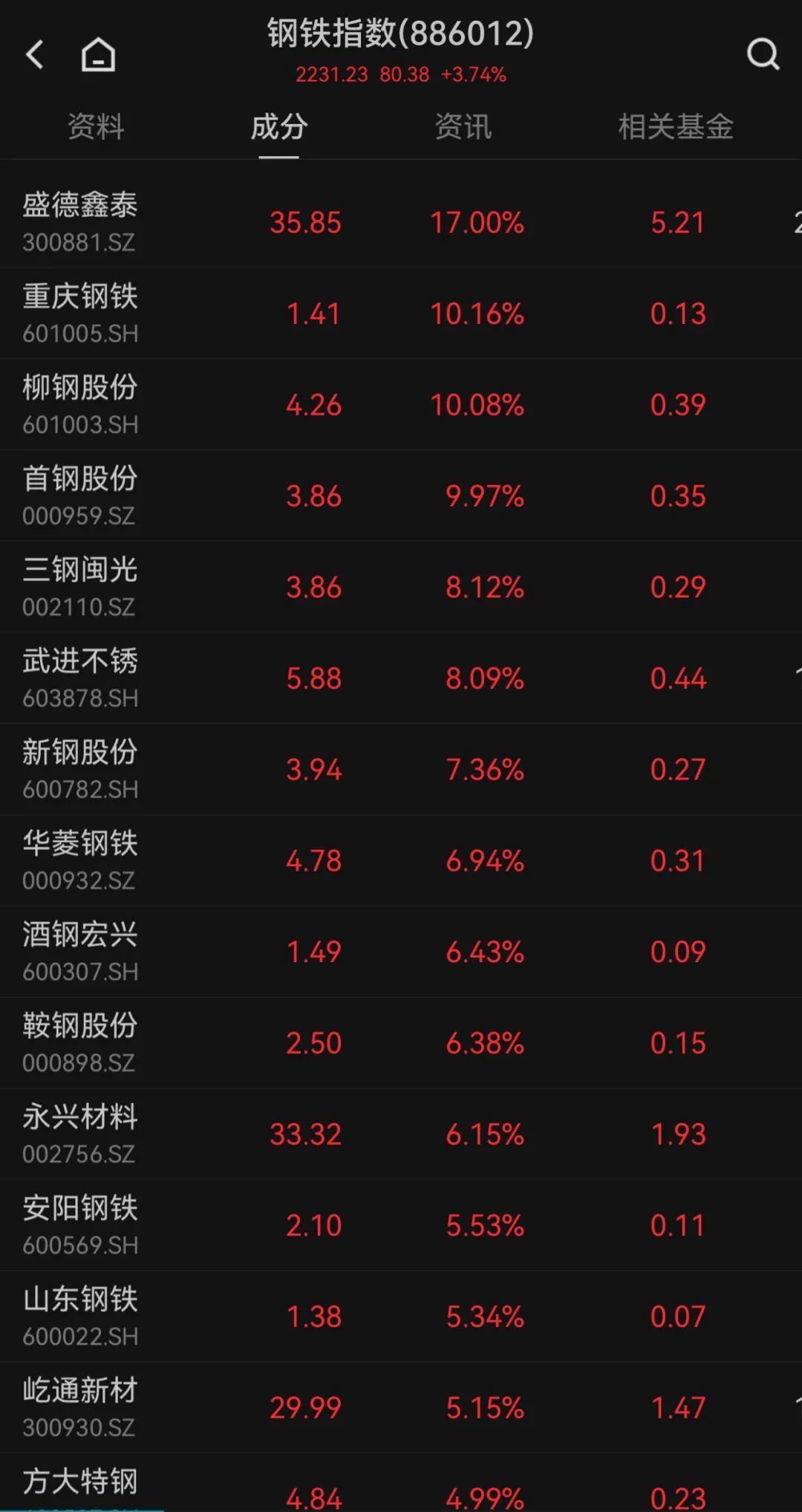
Group 1: Steel Industry Performance - The steel sector experienced significant gains, with the steel index rising by 3.74% to 2231.23 points [2] - Notable stocks included 盛德鑫泰, which surged by 17%, and 重庆钢铁, 柳钢股份, and others reaching their daily limit [3] - The market saw a strong correlation between the A-share market and commodity markets, with polysilicon and glass futures leading the gains [1] Group 2: Environmental Regulations Impact - Increased environmental restrictions in Tangshan are expected to affect steel production, with about half of the steel mills reporting notifications of production cuts [4] - The China Iron and Steel Association is set to hold a meeting to discuss the industry's progress and challenges, indicating a focus on future development strategies [4] Group 3: Marine Economy Development - The central government is promoting high-quality development of the marine economy, with policies encouraging social capital participation and innovation in marine technology [8] - The marine economy is expected to accelerate, supported by various regional policies aimed at optimizing and upgrading the marine industry structure [8] Group 4: Marine Economy Industry Chain - The marine economy industry chain is categorized into three levels: infrastructure, equipment technology, and resource development [9] - Key areas of focus include deep-sea technology, offshore wind power, and marine biological medicine, with significant investment opportunities identified [10]

热门板块纷纷回调 钢铁股却午后爆拉!发生了什么?
Mei Ri Jing Ji Xin Wen· 2025-07-02 07:53
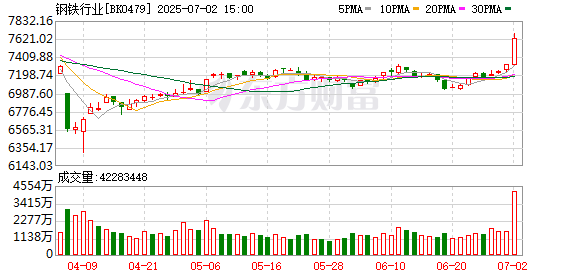
Market Overview - The market experienced fluctuations on July 2, with the ChiNext Index leading the decline. The Shanghai Composite Index fell by 0.09%, the Shenzhen Component Index decreased by 0.61%, and the ChiNext Index dropped by 1.13% [2] - The total trading volume in the Shanghai and Shenzhen markets was 1.38 trillion yuan, a decrease of 89.1 billion yuan compared to the previous trading day [2] - Only 1,945 stocks rose, indicating a weak performance among individual stocks despite the indices not showing significant weakness [2] Sector Performance - Steel, photovoltaic, coal, and marine economy sectors showed strong gains, while military, brain-computer interface, CPO, and semiconductor sectors faced declines [2] - The steel sector saw a significant surge in trading volume, with stocks like Wujin Stainless Steel hitting the daily limit, and other companies such as Shougang Co., Shengde Xintai, and Liugang also rising [6][7] Steel Industry Insights - The steel industry is projected to have an overall dividend yield of 3.82% in 2024, ranking fifth among all industries, but its dividend stability is weaker compared to "class debt dividends" like banks and utilities [11] - Despite facing supply-demand contradictions, the steel industry is expected to benefit from "stabilizing growth" policies, leading to marginal improvements in demand [11] - There are structural investment opportunities in the steel sector, particularly for high-margin special steel companies and leading steel enterprises with strong cost control [12] Photovoltaic Sector Developments - The photovoltaic glass industry is planning collective production cuts of approximately 30% starting in July to address the current supply-demand imbalance [17] - This reduction is expected to enhance the competitive landscape, allowing leading companies to consolidate market share and improve overall industry conditions [17] Marine Economy Initiatives - The Central Financial Committee's recent meeting emphasized the need for high-quality development in the marine economy, advocating for increased policy support and social capital involvement [18] - The marine economy is expected to develop in a "high-end, intelligent, and green" manner, with investment opportunities identified in deep-sea material research, equipment manufacturing, and smart applications [18]
方大特钢(600507):内生成本管控好、盈利弹性大 外延注入确定性强
Xin Lang Cai Jing· 2025-07-01 08:27
Industry Beta - The steel industry is transitioning from administrative to market-driven capacity reduction, with a turning point already evident [1] - The demand side of the steel industry is under pressure, and new supply-side reforms are being initiated, emphasizing high-end, green, and intelligent production, as well as industry consolidation [1][2] - The strategic importance of supply-side capacity reduction has reached unprecedented heights, with various sectors, including photovoltaic and non-ferrous metals, undergoing significant policy changes [1] Company Alpha - The company operates with a flexible management structure typical of private enterprises, resulting in lower sales expense ratios and strong internal incentives linked to performance [2] - The differentiation strategy has proven effective, with core products such as spring flat steel and automotive leaf springs achieving prices and profitability above industry averages [2] - Systematic cost reduction measures have led to noticeable declines in raw material, labor, and manufacturing costs from 2022 to 2024 [2] - There is strong potential for asset injections from within the group, specifically from Dazhou Steel and Pinggang Co., as well as opportunities for external acquisitions to strengthen the steel segment [2]