
LV

Search documents
一周上新!小白心里软、家悦烘焙、多乐之日...海内外新品资讯抢先看 | 全球职人情报
东京烘焙职业人· 2025-08-17 08:33
Group 1 - The article highlights the latest and most valuable new products and brand information in the baking industry, providing insights into various baked goods and innovations [2][3][4][5][6][8]. - Several brands are featured, including DINGDONG, Ole, Costco, and others, showcasing a variety of products such as cakes, pastries, and bread [2][3][4][5][6][8]. Group 2 - Specific products mentioned include the "Coconut Mango Swiss Roll" and "Milk Protein Triangle Cake" from DINGDONG, which emphasize tropical flavors and health-conscious ingredients [9][12]. - Ole's "Blueberry Caramel Cloud Bun" is noted for its fluffy texture achieved through 48 hours of low-temperature fermentation [12]. - Costco offers two types of Swiss rolls, highlighting a combination of black sugar and glutinous rice flavors [14]. Group 3 - The article also discusses various seasonal and limited-edition products, such as the "Qixi Festival Limited Cake" from Holiland, which targets festive occasions [4]. - Joybake's "Explosive Cheese Sausage Corn Ciabatta" combines cheese and corn for a unique flavor profile, appealing to consumers looking for indulgent snacks [26]. - The "Lemon Angel Cake" from Jinyuanlang is described as refreshing and not overly sweet, catering to those who prefer lighter desserts [28]. Group 4 - The article mentions collaborations and marketing strategies, such as Kudi Coffee announcing Yang Mi as its global brand ambassador, enhancing brand visibility [121]. - Hema has launched a new line of low-GI products, indicating a trend towards healthier eating options in the market [123]. - Starbucks has partnered with fragment design to introduce a new beverage, showcasing innovation in product offerings [124].

8点1氪|中公教育17000元退款需17年退完;鹤岗过去5年房价涨超800元;证监会开出1.6亿元罚单
3 6 Ke· 2025-08-10 23:57
Group 1: Company Announcements - Kewei Medical plans to issue H-shares and apply for listing on the Hong Kong Stock Exchange to enhance its global strategy and brand image [1] - Shuangdeng Group has passed the listing hearing on the Hong Kong Stock Exchange, with joint sponsors including CICC, Huatai International, and Jianyin International [2] Group 2: Financial Issues and Consumer Concerns - Zhonggong Education faces criticism for a refund policy that could take 17 years to process, attributed to financial chain issues [3] - ST Gaohong is under investigation for serious financial fraud, with a proposed fine of 160 million yuan and potential delisting risks [4] - Crocs' stock plummeted nearly 30% after announcing expected revenue declines due to cautious consumer spending and increased tariffs, with an estimated additional cost of $40 million in the second half of the year [5] Group 3: Real Estate Trends - In Hegang, the average price of new commercial housing has risen from 3046 yuan/m² to 3860 yuan/m² over five years, with a significant increase in transactions from 1134 units in 2019 to 5680 units in 2024 [4] Group 4: Market Insights - A survey indicates that only about one-third of large Japanese companies expect economic growth due to uncertainties from U.S. tariffs, a significant drop from 70% earlier in the year [9][10] - The U.S. government’s tax credit for electric vehicles is set to end, leading to a surge in electric vehicle sales, which reached a record 9.1% of total passenger car sales in July [11]




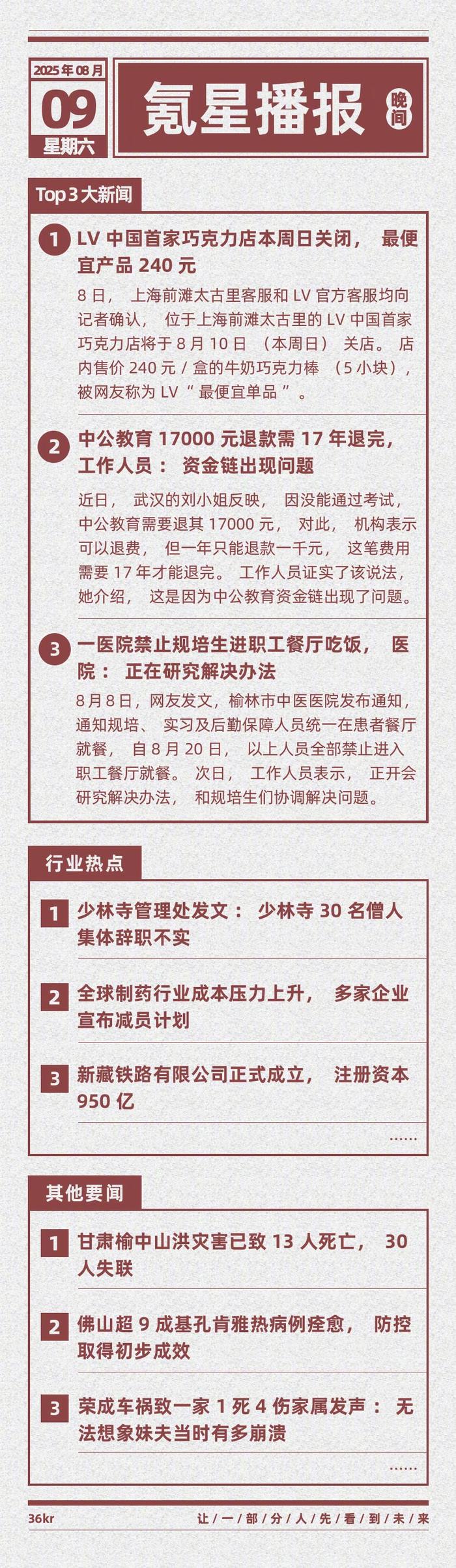
LV中国首家巧克力店本周日关闭,中公教育退款需17年
3 6 Ke· 2025-08-09 13:36
Group 1 - LV's first chocolate store in China will close on August 10, with the cheapest product priced at 240 yuan [5] - Zhonggong Education is facing a funding issue, requiring 17 years to refund 17,000 yuan, with only 1,000 yuan refunded per year [6] - A hospital in Yulin has prohibited training and intern students from dining in the staff cafeteria, and is currently seeking solutions [7] Group 2 - The global pharmaceutical industry is experiencing rising cost pressures, leading several companies to announce layoffs [9] - The New Tibet Railway Company has been officially established with a registered capital of 95 billion yuan [9] - A flood disaster in Gansu has resulted in 13 deaths and 30 people missing [9]
涨价、停运、利润受损......欧洲企业直面关税冲击
Hua Er Jie Jian Wen· 2025-08-01 09:04
Group 1: Impact of New Tariffs - The U.S. has implemented a 15% tariff on most European exports, marking the highest tariff on European goods since the 1930s [1] - This policy is a continuation of the Trump administration's trade protectionism aimed at correcting trade imbalances and revitalizing U.S. manufacturing [1] - European companies are feeling the impact, with some pausing shipments, raising prices, or sacrificing profit margins [1] Group 2: Industry-Specific Reactions - Wine producers in Germany, such as Johannes Selbach, express concern over the 15% tariff, which affects both European and American families reliant on the wine trade [2] - The champagne industry, represented by producers like Drappier, faces unique challenges as the product can only be produced in specific regions of France, making relocation impossible [2] - High-end brands like Chanel and LV can pass on costs through price increases, while multinational companies like Procter & Gamble and Adidas are considering local price hikes or absorbing some profit losses [3][4][5] Group 3: Challenges for Small Businesses - Small and medium-sized enterprises (SMEs) are struggling to adapt quickly to the new tariffs, with many unable to adjust production capacity or supply chains [5] - Companies like Corania, a budget perfume brand, are under significant pressure due to their reliance on U.S. sales, prompting them to seek alternative markets or reduce costs [5] - According to Reuters, at least 99 out of nearly 300 monitored companies have announced price increases due to the trade war, predominantly among European firms [5]
2025年7月商业地产零售新趋势:优质资产上市加速,跨界扩张与消费政策并进
Sou Hu Cai Jing· 2025-07-29 01:41
Group 1 - Recent policies and market dynamics in the domestic commercial sector indicate vitality and diversity in industry development, with multiple cities implementing departure tax refund policies to attract foreign tourists and boost the duty-free economy [1] - Guangzhou's Tianhe District has launched the city's first "immediate refund" centralized refund point for departure tax, marking a significant step in enhancing inbound consumption efficiency [1] - Dalian and Hubei Province have also started implementing departure tax refund policies for foreign travelers, while Shanghai plans to optimize the consumption environment by adding more refund stores [1] Group 2 - Companies are selling non-core assets for strategic focus or capital recovery, such as Vanke in Hangzhou selling its Zhishanghui commercial center project, which has a total construction area of approximately 10,000 square meters [1] - He Youjun has become the largest shareholder of Huanyu Commercial through his controlled company, indicating a potential integration of eSports IP into Huanyu's shopping malls and ski resorts, creating a "eSports + night economy" business model [1] Group 3 - Commercial enterprises are expanding their business through light asset cooperation, with China Resources Vientiane Life signing a cooperation agreement with Fujian Sanxin Group to upgrade the Putian Jinding Plaza project, set to reopen in 2026 as the first Vientiane Hui commercial entity in Fujian [4] - The expansion and renovation of shopping malls are becoming important means to enhance space value, with Shanghai Hang Lung Plaza's expansion expected to add approximately 3,080 square meters of floor area by the second half of 2026 [4] - Community commercial developments are also on the rise, such as the transformation of the former Hualian supermarket in Beijing into a DT-X neighborhood center, enhancing residents' convenience [4] Group 4 - Commercial brands are actively expanding into new markets, with BaWang Tea accelerating its layout in Hong Kong and launching multiple new stores [6] - Lao Xiang Ji has submitted a listing application on the Hong Kong Stock Exchange, showing continuous growth in revenue and gross profit [6] - The REITs market is showing vitality, with the listing of CICC China Green Development Commercial REIT seeing a 30% increase on its first day, reflecting investor enthusiasm for consumer infrastructure REITs [6][8]

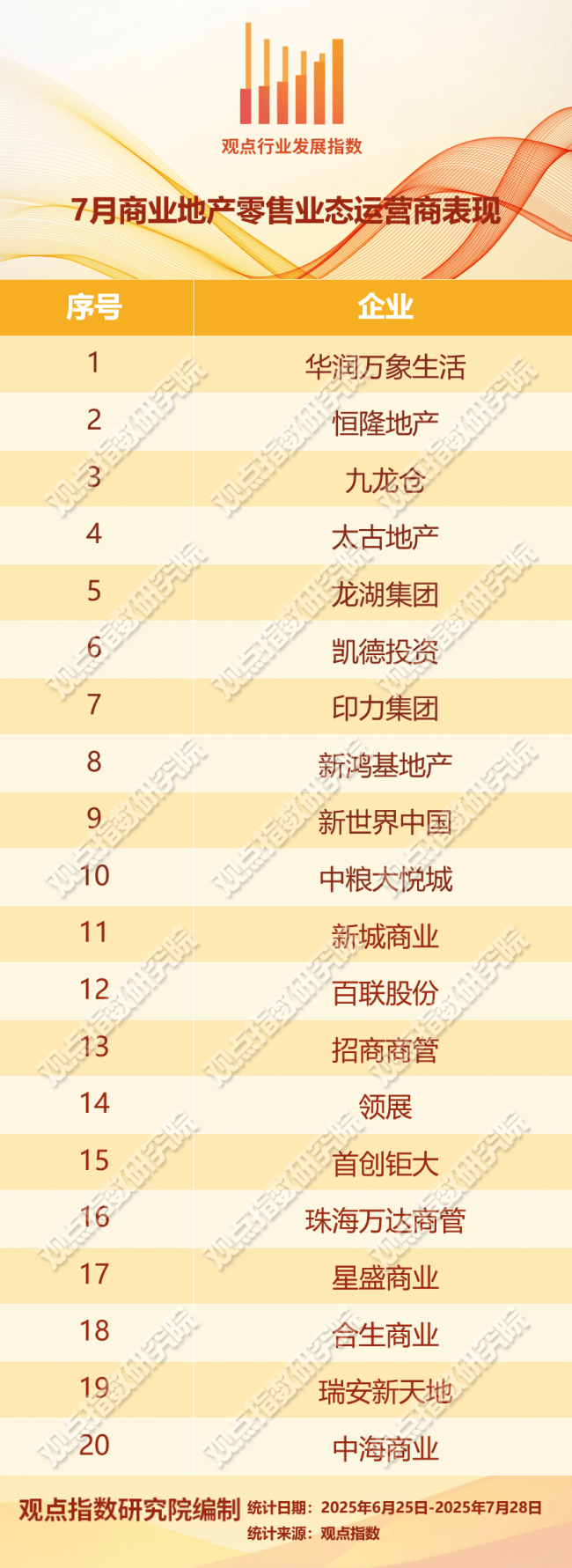
优质资产加速上市 | 2025年7月商业地产零售业态发展报告
Sou Hu Cai Jing· 2025-07-28 11:44
Group 1 - The core viewpoint highlights the ongoing development of commercial real estate, particularly in retail, with various companies expanding their operations and enhancing consumer experiences through innovative strategies [3][5][8] - Multiple cities are implementing or enhancing tax refund policies to stimulate inbound consumption, with notable examples including Guangzhou and Dalian, which have introduced convenient tax refund services for foreign tourists [5][6] - Companies like China Resources and Poly are expanding their commercial footprints through strategic partnerships and new project developments, targeting both core cities and emerging markets [10][11] Group 2 - Alibaba is raising funds to support its international e-commerce and cloud computing businesses, while competitors like JD.com and Meituan are intensifying their efforts in instant retail [4][28] - The REITs market is experiencing significant activity, with several companies, including Cinda and China Overseas, pushing for the listing and expansion of quality assets, indicating a robust interest from investors [31][33] - High-end brands are innovating their retail experiences, as seen with LV's unique store concept in Shanghai, which has attracted considerable foot traffic and consumer interest [19][21] Group 3 - The retail landscape is evolving with brands like Ba Wang Cha Ji and Lao Xiang Ji expanding into Hong Kong, indicating a trend of brands using the city as a launchpad for global expansion [18][24] - Nike is facing challenges in the Chinese market, with a reported 13% decline in revenue, while luxury brands are leveraging experiential marketing to attract consumers [19][20] - Community-focused commercial projects are on the rise, with new concepts like DT-X aiming to enhance local shopping experiences and meet consumer demands for convenience [17][18]



老铺黄金:2025年上半年单个商场收入近5亿元
Sou Hu Cai Jing· 2025-07-27 12:41
Group 1 - Laopu Gold (HK06181) expects a significant increase in sales for the first half of 2025, projecting revenue between RMB 138 billion to 143 billion, representing a growth of approximately 240% to 252% year-on-year [1] - The adjusted net profit for the same period is anticipated to be around RMB 23 billion to 23.6 billion, reflecting a year-on-year increase of approximately 282% to 292% [1] - The growth is attributed to the expanding brand influence and market advantages, leading to substantial revenue increases from both online and offline stores, along with continuous product optimization and new launches [1] Group 2 - Laopu Gold has entered over 30 major commercial centers and opened its first overseas store in Singapore in June 2025 [1] - The company reportedly generates nearly RMB 5 billion in revenue per commercial center for the first half of 2025 [1] - In contrast, LVMH's financial report for the first half of 2025 shows a decline in revenue by 4% to €398.1 billion, with a 15% drop in operating profit and a 22% decrease in net profit [2] - Morgan Stanley's report highlights the threat posed by Laopu Gold to traditional luxury brands, suggesting that its strong performance could disrupt the long-held perception that European luxury brands are not threatened by local competitors [2]
从“具体情绪”到“空间环绕”,2025下半年六大营销趋势洞察
3 6 Ke· 2025-07-23 04:02
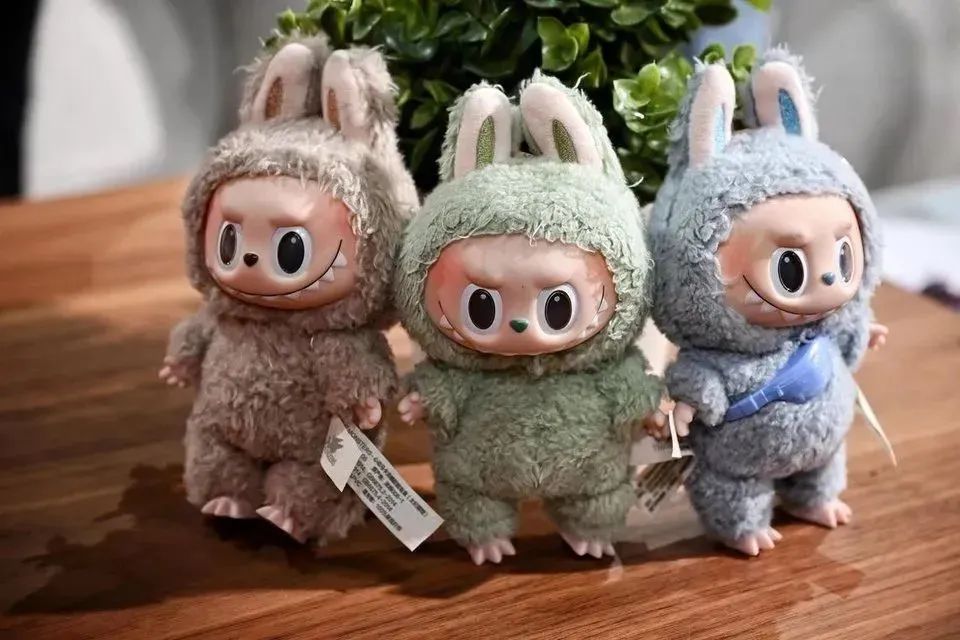
Group 1 - The core viewpoint emphasizes the importance of analyzing marketing trends and case studies to identify potential growth opportunities for brands in the second half of 2025 [1] - Six forward-looking marketing trends have been identified through the analysis of over a hundred cases, providing actionable insights for brands [1] - Emotional marketing has become a key driver of consumer behavior, with brands needing to integrate emotional elements into their strategies [2][4] Group 2 - LABUBU serves as a prime example of emotional marketing, resonating with young consumers by embracing a rebellious and non-conformist identity [4][7] - Emotional marketing is evolving towards more specific and precise expressions, with different emotions being assigned distinct meanings [4][7] - Brands are encouraged to adopt a long-term approach to emotional marketing, ensuring that emotional connections are deeply embedded in their brand identity [7] Group 3 - Brands are increasingly recognizing the need to return to the essence of marketing by focusing on quality content rather than short-term traffic [8] - Leveraging trending content can help brands establish emotional connections with consumers, transforming them from mere observers to active participants in cultural conversations [10] - Successful collaborations, such as the partnership between Mengniu and the animated film "Nezha," demonstrate the effectiveness of aligning brand values with popular cultural narratives [10][12] Group 4 - Long-form video content is gaining traction as a means to create deeper emotional connections with consumers, moving beyond traditional advertising methods [15] - Brands are utilizing long-form content to build a narrative that resonates with audiences, enhancing brand perception and loyalty [15] Group 5 - The concept of female empowerment in marketing is shifting from superficial representations to a deeper understanding of women's real needs and experiences [19][26] - Successful female-focused marketing campaigns are characterized by genuine empathy and respect for women's diverse roles and challenges in society [19][22] - Brands must elevate their narratives around women from mere commercial strategies to social responsibility practices to foster authentic emotional connections [23] Group 6 - The emergence of experiential marketing, exemplified by LV's "Louis Ship," highlights the importance of creating immersive brand experiences that resonate with consumers [27][29] - This trend reflects a broader consumer desire for emotional connections and meaningful interactions in physical spaces [31] - Brands are encouraged to craft their stories through experiential marketing, integrating their history and values into the consumer experience [31] Group 7 - Scene-based marketing is becoming a vital strategy for brands to connect with consumers by tapping into specific emotional needs and contexts [32][35] - Brands are increasingly recognizing the importance of predicting consumer scenarios and tailoring marketing activities to meet those needs [35] Group 8 - AI marketing is transforming the landscape by enhancing content production and user experience, with a significant penetration rate of 72% for AIGC in content creation [36] - Brands are exploring AI's potential to streamline marketing processes, from ideation to execution, creating a more efficient and engaging consumer experience [36][39] - The integration of AI in marketing is not just about technology but also about fostering long-term emotional trust with consumers [39]
从卖货场到价值策源地,美妆“旗舰店”浪潮再起
FBeauty未来迹· 2025-07-16 12:40
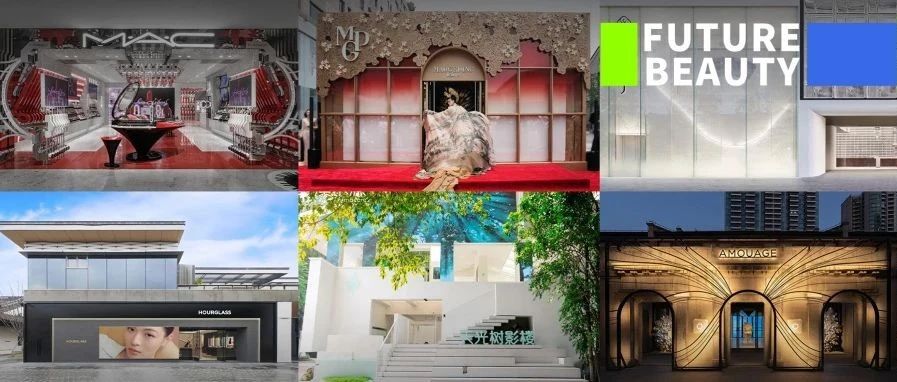
Core Viewpoint - The beauty flagship stores in China are evolving into cultural and experiential hubs, moving beyond traditional retail functions to create immersive brand experiences and deeper consumer connections [4][11][24]. Group 1: Flagship Store Evolution - The flagship stores have undergone three stages of evolution: 1. High luxury experimentation phase (pre-2010) with brands like Chanel and LV establishing their presence [7]. 2. International scale expansion phase (2020) where major brands like Lancôme and Dior opened flagship stores, validating their core value [7]. 3. New explosion cycle (2023 onwards) led by domestic brands and emerging international players, focusing on unique cultural narratives [7][11]. Group 2: Structural Changes in Retail - The offline retail landscape is experiencing structural changes, with a significant reduction of nearly 6,000 cosmetic counters in 51 cities from 2019 to 2023, while high-end beauty areas in shopping centers remain vibrant [6]. - Brands are simplifying their counter networks and increasing flagship store layouts, positioning flagship stores as the heart of brand strategy and cultural embodiment [6][11]. Group 3: Experience and Engagement - Flagship stores are redefining the concept of "experience," serving as value hubs that deepen service, content production, and scientific communication [19][21][24]. - The focus is on creating immersive experiences that resonate with new-generation consumers, moving away from traditional shelf-based shopping [9][24]. Group 4: Location and Design Strategies - The selection of flagship store locations emphasizes cultural significance, transforming brand narratives into spatial experiences [13][15]. - Innovative store designs reflect brand philosophies, with elements that foster a dialogue between nature and consumer, enhancing brand differentiation [16][18]. Group 5: Future Trends - The future of beauty retail may hinge on spatial imagination and a sense of belonging, as brands strive to create unique, immersive environments that resonate with consumers on a deeper level [33].
黄金珠宝奢侈品运营情况更新系列四—高端商圈运营专家交流
2025-07-16 06:13
Summary of Conference Call Company and Industry - The conference call primarily discusses the performance of the luxury goods industry, specifically focusing on the sales data of various stores in Beijing, Xi'an, Chengdu, and Wuhan, as well as the performance of specific brands like Cartier, Tiffany, and Bulgari. Key Points and Arguments 1. **Sales Performance in April**: - Beijing's SKP store achieved sales of 450 million, with a year-on-year growth of over 150% [1] - Xi'an's store recorded 140 million in sales with a 120% growth, while Chengdu's store approached 100 million with nearly 200% growth [2] - Wuhan's new store generated 60 million, with no year-on-year comparison available [2] 2. **Factors Influencing Sales**: - Increased promotional activity days contributed to the sales boost in April [3] - The performance of stores in Xi'an and Chengdu met expectations, while Chengdu's growth was attributed to a low base last year [3] 3. **Consumer Behavior Trends**: - There is a noticeable shift in consumer demographics, with younger consumers increasingly purchasing luxury items, including gold [4] - The phenomenon of "黄牛" (scalpers) has emerged, with scalpers contributing significantly to sales, particularly from entry-level customers [5] 4. **Customer Loyalty and Spending**: - Existing high-end customers contribute significantly to sales, with average spending reaching 200,000 [7] - The loyalty of younger, entry-level customers is lower, necessitating efforts to convert them into repeat customers [7] 5. **Store Expansion Plans**: - Plans for expanding store sizes in Beijing and other locations are underway, with expectations of increased sales following these expansions [8][30] - The anticipated increase in store size is expected to lead to proportional sales growth, although this is not guaranteed [9] 6. **Sales Forecasts**: - For the first four months of 2025, sales in Beijing are projected to reach 1.2 billion, with annual expectations of 2.1 to 2.2 billion [9] - The potential for significant sales during upcoming promotional events in August and November is highlighted, with expectations of achieving over 500 million in sales during these periods [10] 7. **Market Dynamics**: - The luxury goods market is experiencing fluctuations, with brands like Cartier and Tiffany seeing stable growth, while others like Bulgari are facing declines due to reduced promotional activities [13][14] - The overall sentiment in the luxury market remains cautious, with brands adjusting their strategies in response to changing consumer behaviors and economic conditions [36] 8. **Impact of Gold Prices**: - The recent decline in gold prices has not significantly affected the sales of luxury gold brands, as consumer confidence in gold as an investment remains high [17][18] - The perception of gold as a stable investment has led to increased purchases, particularly during price fluctuations [28] 9. **Regional Differences**: - Consumer preferences vary significantly between first-tier cities like Beijing and second-tier cities like Xi'an, with the latter showing a preference for domestic brands [29] 10. **Future Outlook**: - The luxury goods market is expected to continue evolving, with brands focusing on enhancing customer experience and expanding their reach to younger demographics [32] - The overall economic environment remains a critical factor influencing consumer spending and brand performance [36] Other Important but Overlooked Content - The discussion includes insights into the competitive landscape among luxury brands, with specific mentions of how brands are adjusting their marketing strategies to attract consumers amidst economic challenges [22][36] - The importance of experiential retail and customer service in driving sales is emphasized, particularly in the current economic climate where consumers prioritize experience [25]