三星

Search documents
Omdia:2025年全球智能手机出货量增长2%,苹果创历史新高,2026年或迎挑战
Canalys· 2026-01-30 01:03
Core Insights - Omdia's latest research indicates that global smartphone shipments are expected to grow by 2% in 2025, reaching 1.25 billion units, marking the highest level since 2021. All regions except Greater China are projected to see year-on-year growth, while mainland China is expected to experience a slight decline due to underwhelming effects of national subsidy policies in 2025 [1][9] Group 1: Market Performance - In Q4 2025, global smartphone shipments increased by 4% year-on-year, driven by seasonal factors and strong performance from manufacturers. However, rising costs of key components and memory are beginning to suppress shipment forecasts for 2026 [2] - Apple achieved a record annual shipment high in 2025, with iPhone shipments growing by 7% to 240.6 million units, maintaining its position as the largest smartphone manufacturer globally for the third consecutive year. The fourth quarter saw the highest single-quarter iPhone shipments, with mainland China market growth of 26% driven by strong demand for the iPhone 17 series [5] - Samsung rebounded significantly in 2025 after three consecutive years of decline, with a 7% year-on-year increase in shipments, slightly below Apple's figures. The company ended the year strongly with a 16% increase in Q4 shipments, supported by resilient demand for flagship models and a recovery in the mass market [5] - Xiaomi maintained its top three position in 2025 despite facing challenges at year-end, with a 2% decline in Q4 shipments. The company's strategy of expanding its product range from entry-level to high-end models, along with AIoT products, is central to its value growth [6] - Vivo entered the fourth position for the first time, with a 4% year-on-year increase in shipments to 10.53 million units, benefiting from continued success in the Indian market and stable performance in the domestic market. OPPO ranked fifth, with annual shipments of 10.07 million units, down 3% year-on-year [6] Group 2: Emerging Trends and Challenges - Outside the top five, several manufacturers continued to show positive growth despite a challenging market environment. Honor and Lenovo grew by 11% and 6% respectively, achieving historical highs. Huawei regained the top position in mainland China for the first time in five years, while Nothing became the fastest-growing manufacturer in 2025, with shipments surging by 86% to over 3 million units [7] - Omdia's senior analyst highlighted that while 2025 was positive for most manufacturers, concerns about the outlook for 2026 have emerged. Supply-side pressures on DRAM, NAND, and other semiconductors are causing significant worry among manufacturers, potentially compressing profit margins and forcing price adjustments, which could ultimately suppress consumer demand [9][11] - As market contraction becomes increasingly inevitable in 2026, manufacturers will focus on profitability and explore alternative revenue sources. The current market volatility presents a competitive window for manufacturers, suppliers, and partners to quickly respond to challenges and capture opportunities among upgrade and replacement users [11][12]




HDD双寡头吃满“AI基建红利”!继希捷之后,西部数据也实现炸裂式增长,净利润激增296%
Sou Hu Cai Jing· 2026-01-30 00:43
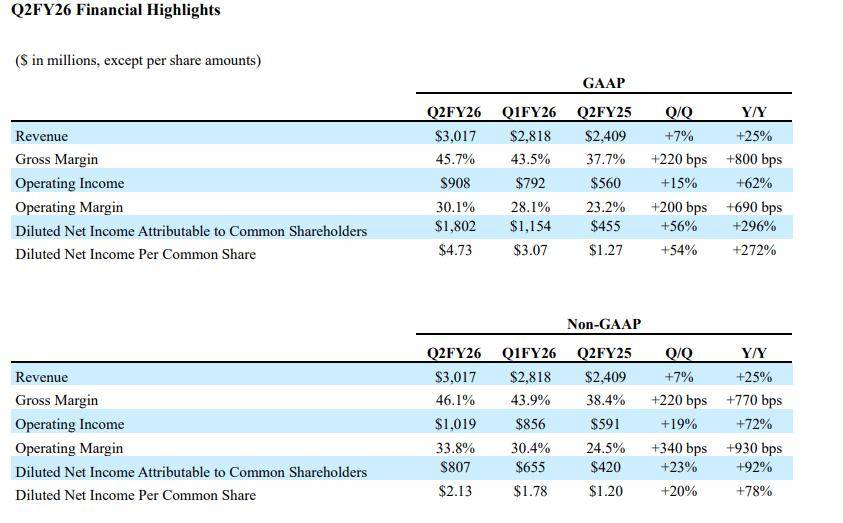
Core Viewpoint - Western Digital Corporation (WDC) reported strong quarterly results and future outlook, driven by unprecedented demand for high-capacity HDDs due to the AI data center boom, exceeding Wall Street expectations [1][2][6]. Financial Performance - For Q2 FY26, Western Digital's total revenue increased by 25% year-over-year to $3.02 billion, surpassing analyst expectations of approximately $2.95 billion [2][3]. - The adjusted gross margin under non-GAAP was 46.1%, exceeding the expected 44.5% [2]. - Free cash flow was approximately $653 million, also above the forecast of $637 million [2]. - The adjusted EPS was $2.13, higher than the anticipated $1.93, with net profit increasing by 92% year-over-year to about $807 million [2][3]. Market Outlook - The company expects Q3 FY26 diluted EPS to range between $2.15 and $2.45, significantly above the consensus estimate of $1.99 [3]. - Total revenue for the upcoming quarter is projected to be between $3.1 billion and $3.3 billion, again exceeding analyst expectations [3]. Industry Context - The demand for enterprise-level high-capacity HDDs and SSDs is being driven by the rapid expansion of AI data centers, with major tech companies investing heavily in AI infrastructure [6][11]. - Western Digital, along with Seagate and SanDisk, has seen stock prices rise significantly, with Western Digital's stock increasing by 285% in 2025 and 60% since 2026 [1][6]. - The storage industry is experiencing a "super cycle," with a strong focus on nearline HDDs and enterprise SSDs to meet the growing storage needs of AI applications [7][11]. Supply Strategy - Western Digital and Seagate are not rushing to increase HDD production capacity, adhering to a "supply discipline" to avoid past cycles of overproduction and price wars [12][13]. - The company aims to enhance output through product structure and technology upgrades rather than expanding capacity aggressively [12].


突发!马斯克直言:特斯拉必须建内存厂,TerraFab扛起芯片自主大旗
是说芯语· 2026-01-30 00:42
Core Viewpoint - Tesla's CEO Elon Musk emphasized the importance of chip autonomy as a core growth driver, announcing plans for a mega wafer fab (TerraFab) and self-developed AI chips to support its AI and robotics business, aiming to reduce supply chain dependencies and enhance production capabilities [1][4]. Financial Performance - Tesla reported Q4 revenue of $24.9 billion and adjusted EPS of $0.50, both exceeding market expectations; automotive gross margin rose to 17.9%, with cash and investments exceeding $44 billion, providing a solid financial foundation for its chip autonomy and capacity expansion initiatives [3][8]. Chip Strategy - The demand for AI and memory chips is expected to surge, particularly with the production of Cybercab and Optimus robots, with an estimated annual chip demand of $6 billion when Optimus reaches a production capacity of 1 million units [3][4]. TerraFab Wafer Fab - The TerraFab facility will focus on integrating logic and memory chip production, aiming for an initial monthly output of 100,000 wafers, with a long-term goal of 1 million wafers per month, comparable to TSMC's 2024 capacity [4][5]. - The facility will utilize innovative "wafer isolation" technology to reduce costs and construction time, although challenges remain due to Tesla's lack of manufacturing experience and the lengthy construction timeline of 5-7 years [4][5]. Chip Development - Tesla is advancing the development of AI5 and AI6 chips, with AI5 nearing completion and expected to deliver significant performance improvements, while AI6 aims for a modular design to support various applications [5][8]. Capital Expenditure - Tesla plans to increase its capital expenditure to over $20 billion in 2026, primarily for new factories and AI infrastructure, excluding the investment for TerraFab, indicating a substantial commitment to chip development [8].


AI巨头抢完了车规级内存,你的车可能因此减配
3 6 Ke· 2026-01-30 00:31
Core Viewpoint - The automotive industry is facing a severe crisis due to skyrocketing prices of automotive-grade memory chips, particularly DRAM and DDR5, which have surged over 300% since the second half of 2025, significantly impacting production costs without a corresponding increase in vehicle prices [1][3]. Group 1: Price Surge and Cost Impact - Automotive-grade memory prices have dramatically increased, with DRAM prices rising over 300% and automotive-grade DDR5 memory exceeding 300%, leading to an increase of approximately 1,000 yuan in the cost of each vehicle [1][3]. - Despite the rising costs, vehicle prices have remained stable, with industry leaders indicating that the pressure from memory price increases has not yet been passed on to end consumers [1][3]. Group 2: Supply Chain Challenges - The memory shortage has begun to affect production schedules for some automakers, with concerns about supply interruptions leading companies to deploy personnel to monitor supplies and develop alternative sourcing strategies [3][4]. - The automotive industry is facing a significant challenge in securing memory supplies, as the demand from the AI sector is siphoning off production capacity, with AI data centers expected to consume over 70% of high-end memory chips by 2026 [4][6]. Group 3: Market Dynamics and Competition - The automotive memory market is highly concentrated, with Samsung, SK Hynix, and Micron controlling over 90% of the market, leaving automakers with little bargaining power during the supply crisis [7][9]. - The shift in production focus towards AI-related memory products, which offer significantly higher profit margins, has led to a reduction in the availability of automotive-grade memory, exacerbating the supply issues faced by car manufacturers [4][6]. Group 4: Strategic Responses from Automakers - In response to the memory shortage, automakers are adopting strategies such as direct supply agreements with memory manufacturers and establishing strategic safety stock to mitigate the risks of supply disruptions [10][12]. - The competition in the automotive sector is increasingly centered around "smart driving" capabilities, with memory being a critical component that influences the performance and features of intelligent vehicles [10][12]. Group 5: Future Outlook and Industry Trends - The memory shortage is expected to persist until at least 2028, with new chip manufacturing facilities taking 3-5 years to establish, indicating a prolonged period of supply constraints for the automotive industry [9]. - The automotive sector is witnessing a shift towards self-developed technologies, with a significant portion of the market being dominated by domestic brands that are focusing on in-house development of smart driving features [17][18].




马斯克考虑将SpaceX与特斯拉或xAI公司合并;阿里自研AI芯片“真武”曝光;英伟达等公司商谈向OpenAI投资至多600亿美元丨邦早报
创业邦· 2026-01-30 00:30
Group 1 - Nvidia, Microsoft, and Amazon are discussing a potential investment of up to $60 billion in OpenAI as part of a larger funding round that could total $100 billion [1] - Nvidia is negotiating to invest up to $30 billion, while Microsoft plans to invest less than $10 billion, and Amazon's investment could exceed $10 billion, potentially reaching $20 billion [1] Group 2 - ByteDance has initiated the official version of the Doubao mobile assistant project, with a new device expected to be released in late Q2 2026 [3] - ByteDance and Alibaba are both preparing to launch new AI models around mid-February, with ByteDance planning three new models including a large language model, an image generation model, and a video generation model [3] - Tesla CEO Elon Musk announced the company will cease production of the Model S and Model X, transitioning the production line to focus on autonomous driving technology [3] Group 3 - Tesla's electric vehicle production reached approximately 1.655 million units in 2025, with a record delivery of 1.636 million units, and the Model Y was the best-selling SUV in multiple markets [12] - The Shanghai Gigafactory delivered 851,000 electric vehicles, accounting for over half of Tesla's global deliveries [12] Group 4 - Sony and Singapore's GIC are investing between $2 billion and $3 billion to build a music copyright library through a joint venture [6] - Mirxes completed a placement of 21.88 million shares, raising approximately HKD 711 million, with a share price premium of nearly 40% compared to its listing price [8]





马斯克「食言」!改口承认Optimus机器人并未上岗,此前多次宣传机器人进厂;阿里发布性能比肩英伟达H20的芯片;华为终端春节最高降4000元
雷峰网· 2026-01-30 00:29
Key Points - Elon Musk admitted that Tesla's Optimus robot is not yet performing actual work in factories, stating it is still in the early development stage and expected to produce significant output by the end of the year [4][5] - Alibaba launched its self-developed AI chip "Zhenwu," which features a 96GB HBM2e memory and a bandwidth of 700 GB/s, aimed at competing with Nvidia's H20 [7][8] - DeepSeek is expanding its AI product matrix by recruiting talent for a multilingual AI search engine and investing in agent technology to compete with OpenAI and Alphabet [10][11] - Kimi K2.5, a new open-source model, topped multiple global rankings within 24 hours of its release, showcasing its capabilities in various tasks and outperforming many closed-source models [12][13] - Huawei announced significant discounts on its products for the Spring Festival, with reductions up to 4000 yuan on select models [15] - The luxury car dealer Baolide has entered bankruptcy proceedings, with its founder applying for bankruptcy after facing operational difficulties [17][18] - Volkswagen is recalling 44,551 ID.4 electric vehicles due to battery fire risks linked to SK batteries, highlighting ongoing safety concerns in the EV sector [47][48] - Tesla plans to build a large semiconductor manufacturing plant named "TeraFab" to meet its growing chip demands, indicating a strategic move towards vertical integration [50] - SK Hynix announced record bonuses for employees, reflecting strong financial performance driven by the AI chip market [51][52] - Amazon is closing all 72 of its self-operated grocery stores and convenience stores, acknowledging challenges in the physical retail sector while shifting focus to online grocery delivery [52]


存储芯片赚疯了,曝又要涨价
3 6 Ke· 2026-01-30 00:25
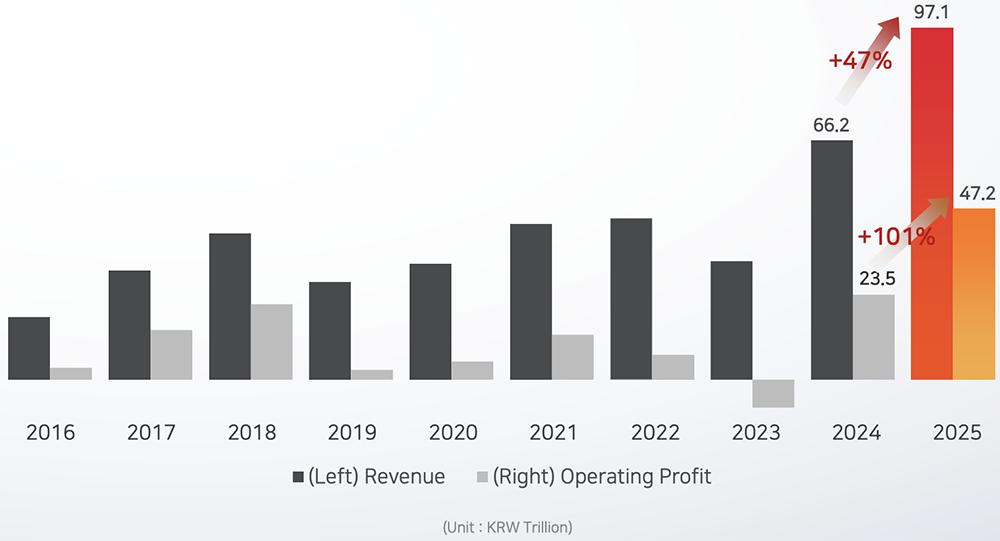
Core Insights - The storage chip industry is undergoing significant changes, with SK Hynix projected to surpass Samsung in operating profit for the first time in 2025, reaching a record 47.2 trillion KRW (approximately 22.8 billion RMB) [1] - Samsung's operating profit for 2025 is estimated at 43.6 trillion KRW (approximately 21.1 billion RMB), with its memory business contributing 24.9 trillion KRW (approximately 12.1 billion RMB) [3] - Both companies are engaged in a competitive landscape for the HBM4 market, with SK Hynix claiming a technological edge and significant customer trust, while Samsung emphasizes its production capabilities and plans for HBM4 mass production [5][6] Financial Performance - SK Hynix reported a 66.1% year-on-year revenue increase to 32.8 trillion KRW in Q4, with operating profit soaring by 137.2% to 19.2 trillion KRW, achieving a remarkable operating margin of 58% [11] - Samsung's Q4 revenue reached 93.8 trillion KRW, a 23% year-on-year increase, with operating profit rising to 20.1 trillion KRW, marking a 208% year-on-year growth [14] - The average selling price of DRAM increased by approximately 40% quarter-on-quarter, while NAND flash prices rose by about 20% [21][22] Market Dynamics - SK Hynix is expected to double its HBM revenue in 2025, with a significant increase in HBM4 sales driven by AI demand [5][11] - Samsung plans to increase its investment in memory capacity in 2026, although supply expansion is expected to be limited [7] - The rapid growth of AI is driving structural changes in the memory market, with both companies anticipating strong demand for HBM products throughout the year [7][18] Competitive Landscape - SK Hynix has reportedly secured over 70% of HBM4 orders from Nvidia, while Samsung is working to regain market leadership with its HBM4 products [9][10] - Both companies claim to have achieved the industry's fastest stable speed for HBM4 at 11.7 Gbps, with Samsung utilizing self-developed 1c DRAM for enhanced performance [9][10] - Market research indicates that by 2026, SK Hynix is expected to hold a 54% share of the global HBM4 market, followed by Samsung at 28% and Micron at 18% [10] Strategic Initiatives - SK Hynix plans to establish a new company in the U.S. focused on AI solutions, committing at least $10 billion to capitalize on growth opportunities in the AI sector [33] - Samsung aims to enhance its focus on high-performance products to leverage the ongoing growth in AI and server demand [33]
汰劣立规“反内卷” 中国电池产业转向价值竞争
Zhong Guo Chan Ye Jing Ji Xin Xi Wang· 2026-01-30 00:20
Core Insights - The battery industry is entering a phase of "de-involution" as government policies aim to optimize capacity planning and regulate market competition, signaling an end to the era of disorderly growth in battery production [1][2]. Group 1: Policy Changes - A joint meeting by four government departments emphasized the need to optimize capacity planning and avoid overcapacity risks in the battery sector [1]. - The Ministry of Finance and the State Taxation Administration announced a phased reduction of the export VAT rebate for battery products, decreasing from 9% to 6% from April 1, 2026, and completely eliminating it by January 1, 2027 [1][2]. - The phased approach to the export VAT rebate aims to provide a transition period for the industry, allowing for the orderly exit of low-quality production capacities [3][4]. Group 2: Industry Challenges - The reduction in export rebates is expected to increase export costs for companies, particularly affecting small and medium-sized enterprises that rely on low-price strategies [2][6]. - Current production capacity in China's battery sector exceeds 3000 GWh, while actual demand is projected to be around 1500 GWh by 2025, leading to low utilization rates [2][3]. - The price of storage systems has dropped by 80% over three years, with some battery export prices falling below production costs, resulting in negative profit margins for certain companies [2]. Group 3: Market Dynamics - Despite challenges, the demand for electric and storage batteries remains strong, with expectations for the share of storage batteries to increase from one-quarter to potentially one-half of the market [3][4]. - The new policies are expected to accelerate industry consolidation, pushing companies to focus on technological innovation and brand strength rather than price competition [2][3]. - The upcoming changes may lead to a surge in exports as companies rush to ship products before the rebate reduction takes effect, potentially causing supply chain strains [5][6]. Group 4: Globalization and Competitive Landscape - The shift away from subsidy dependence is anticipated to enhance the competitive edge of Chinese battery companies in the global market, focusing on technology, branding, and supply chain integration [9][10]. - Companies are expected to adapt by strengthening international collaborations and optimizing production strategies to mitigate the impact of rising costs due to the rebate changes [10][11]. - The long-term outlook suggests that the balance of supply and demand will increasingly depend on global market needs and technological advancements rather than just domestic production capacity [4][10].

8点1氪丨国铁回应“抢票神器诱导加价”:12306是唯一官方售票渠道;iPhone 16成去年全球最畅销智能手机;UC浏览器开发商被罚没126万元
3 6 Ke· 2026-01-30 00:14
今日热点导览 麦趣尔,被申请破产清算 银河系新发现一颗"潜在宜居"候选行星 白银基金,1月30日全天停牌 2026年春运全社会跨区域人员流动量预计将达95亿人次 好想来回应消费者质疑"称不准" :新员工操作失误 TOP3大新闻 国铁集团回应"三方平台加价抢票" 1月29日,国铁集团客运部主任朱文忠在国新办新闻发布会上的公开声明:"一些第三方平台以各种'抢 票神器'名目,诱导旅客加价抢票。铁路12306客户端是中国铁路唯一官方火车票网络售票渠道,没有与 任何第三方平台合作。"他同时强调,针对第三方平台高频访问对铁路12306系统安全稳定运行构成的严 重冲击,将进一步优化风控系统实行有效识别。 朱文忠直言,"买火车票历来是广大旅客关注的焦点。我们重点抓好四个方面售票组织工作"。一是关注 学生、务工人员及老年人等重点群体的购票需求;二是首次推出互联网误购限时免费退票的新举措;三 是持续优化和改进售票策略;四是确保12306系统平稳运行。(封面新闻) iPhone 16成去年全球最畅销智能手机 1月28日,市场调查机构Counter Point Research发布博文,公布了2025年全球最畅销智能手机榜单,苹果 ...
8点1氪:国铁回应“抢票神器诱导加价”:12306是唯一官方售票渠道;iPhone 16成去年全球最畅销智能手机;UC浏览器开发商被罚没126万元
36氪· 2026-01-30 00:10
Group 1 - The core viewpoint of the article emphasizes that the China Railway Group has declared the 12306 platform as the only official ticket sales channel, stating that it has not partnered with any third-party platforms and will enhance its system to combat ticket scalping [2][3] - The China Railway Group's passenger department director, Zhu Wenzhong, highlighted the negative impact of third-party platforms on the stability of the 12306 system and announced plans to optimize the risk control system for effective identification [3] - The railway authority is focusing on four key areas for ticket sales organization: addressing the needs of students, workers, and the elderly; introducing a limited-time free refund policy for erroneous purchases; continuously improving ticket sales strategies; and ensuring the stable operation of the 12306 system [5] Group 2 - The article mentions that the 2026 Spring Festival travel period is expected to see a record 9.5 billion person-times of cross-regional movement, with self-driving travel being the main mode of transport, accounting for about 80% [6] - The article also notes that the total passenger volume for railways and civil aviation is projected to reach 540 million and 95 million respectively during the Spring Festival travel period, with both figures expected to exceed historical peaks [6]