吉利

Search documents
刘强东穿猪猪侠T恤现身日本:背后还有二维码;消息人士称马云回归绝不可能,其从来没离开过;王兴兴回应人形机器人产业泡沫化丨邦早报
创业邦· 2025-05-11 01:06
Group 1 - Alibaba has reportedly streamlined its internal network and adjusted employee mobility mechanisms, with internal sources stating that Jack Ma's return is impossible, emphasizing he has never truly left the company [2] - Apple has officially announced price reductions for the iPhone 16 Pro and Pro Max models, with the Pro Max dropping by $160 and the Pro version by $176, likely in preparation for the upcoming 618 shopping festival [2][3] Group 2 - Wang Xingxing, founder of Yushu Technology, addressed concerns about a potential bubble in the humanoid robot industry, stating that while demand may not align with reality, public acceptance is crucial for growth [4] - LiSuan Technology has faced rumors of pausing employee salaries for two consecutive months, with management indicating that new financing is expected soon, although they did not confirm the salary situation [6] Group 3 - Xiaomi has signed a lease for its largest automotive flagship center in Shanghai, set to open in October 2025, which will showcase its entire range of vehicles and provide various services [7] - The latest automotive quality rankings revealed that Xiaomi's SU7 model ranked last among 29 electric vehicles, indicating potential quality issues and high complaint rates [10][11] Group 4 - Apple is reportedly preparing to launch its first foldable iPhone by the second half of 2026, with key components already sent for testing [12] - Google has agreed to a $1.375 billion settlement with Texas over allegations of user data privacy violations, resolving claims related to location tracking and data collection practices [16] Group 5 - Tesla has informed workers at its Austin factory to take a week off at the end of May, indicating a shift in production schedules and reduced overtime since February [18] - Volkswagen is recalling nearly 89,417 vehicles in the U.S. due to potential issues with cylinder head screws that could lead to oil leaks and fire risks [18]



中小零部件企业困于“账期游戏” 万亿汽车产业链的生死博弈
Jing Ji Guan Cha Bao· 2025-05-10 05:00
Core Insights - The Chinese automotive industry has maintained its position as the world's largest producer and seller for 14 consecutive years, leveraging new energy vehicles to lead the global transformation of the automotive sector [2][3] - A significant number of small and medium-sized parts suppliers are facing severe cash flow issues due to extended payment terms imposed by major manufacturers, leading to a silent "accounting war" [2][3] Group 1: Payment Terms and Regulations - Major automotive manufacturers are extending payment terms, pushing many suppliers to the brink of financial collapse. The State Council introduced the "Regulations on Ensuring Payment to Small and Medium Enterprises" in 2020, which was revised in March 2023 to strengthen payment responsibilities and improve regulatory mechanisms [3][4] - The revised regulations will take effect on June 1, 2025, providing hope for small and medium enterprises, although many remain skeptical about their enforcement [3][4] Group 2: Impact of Long Payment Terms - Long payment terms are exacerbated by practices such as "consignment," where suppliers must build warehouses near manufacturers, leading to increased inventory costs and cash flow issues [4][5] - The average payment cycle for suppliers can extend to 10 months, significantly increasing the financial burden on small and medium enterprises [5][8] Group 3: Comparison Between Domestic and Foreign Enterprises - Domestic automotive manufacturers typically have payment terms ranging from 90 to 120 days, while foreign joint ventures generally maintain shorter terms of 45 to 60 days. However, even foreign companies are beginning to adopt longer payment terms [6][10] - Suppliers working with foreign companies often experience better payment conditions, including upfront payments and quicker settlements, contrasting sharply with domestic practices [11][12] Group 4: Industry Challenges and Future Outlook - The prolonged payment terms are leading to systemic risks within the supply chain, as evidenced by the bankruptcy of several companies due to cash flow issues [5][13] - The current payment environment is detrimental to the competitiveness of small and medium enterprises, hindering their ability to invest in research and development [13][14] - There is a call for stricter enforcement of regulations and innovative supply chain financing solutions to alleviate the financial pressures faced by suppliers [13][14]
德系汽车三巨头一季度业绩承压 中国市场销量均现下滑
Zheng Quan Ri Bao· 2025-05-09 17:01
Core Insights - The three major German automakers, Volkswagen, BMW, and Mercedes-Benz, reported a decline in profits for Q1 2025, attributing the downturn primarily to challenges in the Chinese market [1][2][3] - All three companies are implementing localization strategies to counteract declining sales in China, but the effectiveness of these strategies remains uncertain [1][4][7] Financial Performance - Volkswagen's global deliveries reached 2.1336 million units, a 1.4% increase year-on-year, but deliveries in China fell by 7.1% [2] - BMW's global sales continued to grow, yet sales in China dropped by 17.2%, leading to a 7.8% decrease in revenue to €33.758 billion and a 26.4% decline in net profit to €2.173 billion [2] - Mercedes-Benz saw a 7% decline in global sales to 529,200 units, with a 10% drop in China, resulting in a 7.4% decrease in revenue to €33.224 billion and a 42.8% drop in net profit to €1.731 billion [3] Market Challenges - The decline in sales reflects a broader trend of shrinking fuel vehicle markets and the inability of German automakers to compete effectively in the growing electric vehicle sector [1][6] - Local Chinese brands like NIO and BYD are rapidly gaining market share, intensifying competition for foreign brands [1][3][6] Localization Strategies - Volkswagen is actively engaging in partnerships with local companies to enhance its electric vehicle offerings and integrate into China's digital ecosystem [4][5] - Mercedes-Benz has invested over €100 billion in China over the past 20 years, focusing on local R&D and production to better serve the market [5] - BMW plans to launch over 10 new models in China by 2025, emphasizing its commitment to the market [5] Competitive Landscape - The automotive market in China is experiencing heightened price competition, with consumers becoming increasingly price-sensitive [7] - German automakers are accelerating product refresh cycles and adopting fixed pricing strategies to maintain market share, but face challenges from local brands with technological advantages [7]
李想的6.39亿年薪,凭什么?
Sou Hu Cai Jing· 2025-05-09 04:41
作者 | 贝塔商业 阿康 李想拿了6.39亿年薪,上热搜了。然而相比起之前雷军"疑似"成为首富时的赞赏,网友更多的是吐槽甚至嘲讽: "天天亏钱的车企,高管却年年高薪" "销售提成才1200" "我的理想年薪和李想年薪差不多"。 一时间,吃瓜群众将李想连同整个电动车新势力行业,一起拷打。 这事儿,不只是钱的数字刺激人,更像是大众情绪的错位释放——为什么李想挣钱,有人会觉得不舒服? 我认真扒完财报、翻了新势力们的近况,答案或许在这些真实的对比里。 李想的6.39亿,并不是白拿。这6.39亿并不是直接从公司账户上打走6.39亿现金。这笔钱里,99.6%是股权激励,不是现金工资。具体拆开是: 基本年薪:266.5万元; 期权激励:6.36亿元,源于公司达成2024年交付50万辆目标; 行权价格:14.63美元/股,而理想当下股价约26美元/股; 实现方式:李想需掏出约19亿元现金才能行权。 换句话说,这不是公司送钱给他,而是他自己必须出钱买股票,然后承担波动,未来可能赚、也可能赔。而这套期权,是2021年就设定的,属于"达标才 解锁"的里程碑机制。 2024年,理想完成了50万辆交付,目标达成。那问题来了,原定目标不 ...

孚能科技2024年营收116.8亿元大幅减亏,毛利率稳步提升
Jing Ji Guan Cha Wang· 2025-05-09 01:05
Core Viewpoint - Company Fudi Technology (孚能科技) has significantly reduced its losses in 2024, achieving a revenue of 11.68 billion yuan and a net loss of 0.332 billion yuan, marking an 82.22% reduction in losses year-on-year. The company is positioned as a leader in the global soft-pack power battery market and is set to benefit from a strategic partnership with Guangzhou Industrial Control Group, enhancing its capital strength and business expansion capabilities [1][2][5]. Financial Performance - In 2024, Fudi Technology's revenue reached 11.68 billion yuan, with a net loss of 0.332 billion yuan, reflecting an 82.22% reduction in losses compared to the previous year. The first quarter of 2025 shows a further narrowing of losses [1][2]. - The company reported a significant improvement in key financial metrics, with basic and diluted earnings per share losses narrowing by 82.35%, and cash flow from operating activities increasing by 36.86% year-on-year [2][3]. Product Development - Fudi Technology launched its SPS large soft-pack product in 2024, which features a high-integration battery system that enhances vehicle space efficiency while ensuring safety [3][7]. - The company has developed a super-fast charging lithium iron phosphate (LFP) battery capable of over 6C charging and more than 5000 cycles, suitable for various applications including PHEV and BEV [3][7]. Market Expansion - Over half of Fudi Technology's revenue comes from international clients, with significant partnerships established with companies like Mercedes-Benz and Mahindra Group. The company ranked third in China for power battery exports in 2024 [4][5]. - The establishment of a 6GWh production line in Turkey by Fudi's joint venture Siro supports its international operations and market expansion efforts [4][5]. Strategic Partnership - The acquisition of a controlling stake by Guangzhou Industrial Control Group is expected to enhance Fudi Technology's capital strength and facilitate collaboration within the local automotive supply chain, particularly with GAC Group [5][6]. - Guangzhou Industrial Control Group aims to leverage its resources to support Fudi Technology's growth in the low-altitude economy and enhance its financing capabilities [6][7]. Future Outlook - Fudi Technology is advancing its semi-solid and solid-state battery technologies, with plans to start mass production of its second-generation semi-solid battery in 2025 and to commercialize solid-state batteries in the coming years [7]. - The company anticipates that new capacity releases and product innovations in the next three years will significantly enhance its market position and growth trajectory [7].

特斯拉再挺“纯视觉方案”引发争议,技术路线生态博弈升级
Hua Xia Shi Bao· 2025-05-08 07:48
Core Viewpoint - Tesla emphasizes its commitment to a vision-based processing solution for affordable and safe intelligent products, contrasting with the rising popularity of LiDAR technology in the automotive industry [2][3]. Group 1: Technology Disagreement - Tesla's upcoming Full Self-Driving (FSD) solution relies solely on camera and AI chip collaboration, while companies like Huawei and Li Auto advocate for LiDAR, citing its ability to detect obstacles without needing to identify them [3][4]. - The divergence between Tesla and domestic automakers reflects a philosophical debate between "algorithm-driven" and "hardware-driven" approaches, with Tesla focusing on data-driven algorithms and others prioritizing hardware redundancy for safety [4][5]. Group 2: Cost and Market Strategy - Tesla's insistence on a vision-based approach is partly due to cost considerations, as CEO Elon Musk has labeled LiDAR as an "expensive crutch" [5][6]. - The removal of radar from Tesla's Model 3 and Model Y has reduced hardware costs, allowing for competitive pricing in the global market, although there are concerns about the affordability of Tesla's FSD package compared to offerings from domestic brands [6][7]. Group 3: Market Trends and Adjustments - The automotive market is witnessing a shift in how companies configure their vehicles, with many adjusting their marketing strategies regarding intelligent driving features, particularly in light of stricter regulations and intense price competition [7][8]. - Companies are increasingly recognizing that adding LiDAR may only provide additional safety redundancy rather than a significant upgrade in system capabilities, leading to a potential reduction in the emphasis on high-end features in favor of more competitive pricing [7][8].

【重磅深度/福达股份】曲轴龙头,新能源+机器人打开全新增长曲线
东吴汽车黄细里团队· 2025-05-08 02:24
Core Viewpoint - The company, a leader in crankshafts, is leveraging opportunities in the new energy and robotics sectors to create new growth trajectories [1][5]. Group 1: Company Overview and Growth Strategy - Established in 1995 and listed in 2014, the company specializes in crankshafts, clutches, precision forgings, gears, and bolts, positioning itself as a domestic leader in crankshafts [1][12]. - In 2022, the company entered the new energy sector with electric drive gears and plans to develop robotic gear products by 2024, indicating a strategic shift towards new growth areas [1][5]. Group 2: Crankshaft Demand and Market Dynamics - The demand for crankshafts is expected to rise due to the increasing sales of hybrid vehicles, which still require crankshafts despite the rise of pure electric vehicles [2][48]. - The company has successfully transitioned its crankshaft business from commercial vehicles to passenger vehicles, with over 50% of its crankshaft supply for BYD in 2024 [2][58]. - A new production line with a capacity of 1 million hybrid crankshafts is expected to be operational by May 2025, further enhancing the company's market position [2][53]. Group 3: New Energy Gear Expansion - The company established a new energy electric drive technology subsidiary in May 2022, investing 408 million yuan to develop precision gear products, with production expected to start in July 2024 [3][18]. - The company has secured multiple projects with major clients like BYD and Geely, indicating strong demand for its new energy gear products [3][18]. Group 4: Robotics Business Development - In 2024, the company entered the robotics sector by acquiring a 35% stake in Changban (Yangzhou) Robot Technology, showcasing its commitment to diversifying its business [5][18]. - The company aims to leverage its existing customer base and technical expertise in precision gears to establish a foothold in the robotics market [5][18]. Group 5: Financial Performance and Projections - The company experienced a significant rebound in 2022, with revenues of 1.135 billion yuan, a 37.5% decline from the previous year, but is projected to achieve revenues of 1.648 billion yuan in 2024, a 21.89% increase [24][25]. - Forecasts suggest revenues of 2.434 billion yuan, 3.019 billion yuan, and 3.394 billion yuan from 2025 to 2027, with corresponding net profits of 301 million yuan, 385 million yuan, and 460 million yuan [6][25].


4 月中国电动车卖爆了!90 万辆、33% 增长、51% 渗透率…麦格理推荐关注这些股票
Zhi Tong Cai Jing· 2025-05-08 01:02
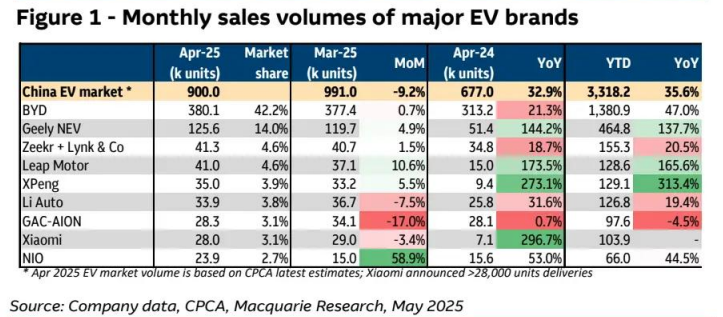
Core Insights - Macquarie updated its report on China's electric vehicle (EV) sales, predicting that the mass market will continue to outperform the high-end market in May [1] Industry Overview - In April, plug-in electric vehicle sales reached 900,000 units, a year-on-year increase of 33%, while the overall automotive market grew by 14%; the EV penetration rate remained at 51% [1] - The low-cost new energy vehicle startups (Xpeng, Leap Motor) maintained growth momentum, while high-end electric vehicles lagged behind [1] - BYD showed strong export performance, but demand for plug-in hybrid electric vehicles (PHEVs) is slowing [1] Company Performance - **BYD**: Sales increased by 21% year-on-year, driven by a record export volume of 79,000 units, with a year-to-date increase of 105%. Domestic sales grew by 11% year-on-year, lagging behind market performance due to slowing PHEV demand [3] - **Geely**: April sales remained flat month-on-month, but year-to-date sales increased by 49%, exceeding the company's annual growth target of 25%. April new energy vehicle sales reached 126,000 units, a significant year-on-year increase of 144% [4] - **Xpeng**: April sales exceeded 30,000 units, with a year-to-date increase of 313%, reflecting strong demand for popular models M03, P7t, and the refreshed G6 and G9 [5] - **Li Auto**: Sales decreased by 8% month-on-month, with a year-to-date increase of only 20%, falling behind the 36% growth rate of the new energy vehicle market [6] - **NIO**: Sales rebounded by 59% month-on-month, with brand sales increasing by 90% to 19,500 units, benefiting from increased promotions and the launch of the ET9 model [7] - **Zeekr**: Total sales for Zeekr and Lynk & Co increased by 19% year-on-year, slightly lagging behind the overall new energy vehicle market [8] - **Xiaomi**: Demand for the SU7 sports sedan remained strong, with April sales exceeding 28,000 units, reaching maximum production capacity [9] Sales Data Summary - In April 2025, the total EV market in China was 900,000 units, a decrease of 9.2% from March 2025, but a year-on-year increase of 32.9% [10] - BYD accounted for 42.2% of the market share with 380,100 units sold, a year-on-year increase of 21.3% [10] - Geely's new energy vehicle sales reached 125,600 units, a year-on-year increase of 144.2% [10] - Xpeng sold 35,000 units, reflecting a year-on-year increase of 273.1% [10] - Li Auto's sales were 33,900 units, with a year-on-year increase of 31.6% [10] - Xiaomi's sales were 28,000 units, a year-on-year increase of 296.7% [10]



汽车行业24Q4&25Q1业绩综述 - 总体符合预期,内外需均有韧性
2025-05-06 15:27
Summary of Automotive Industry Conference Call Industry Overview - The automotive industry performance for Q4 2024 and Q1 2025 is generally in line with expectations, showing resilience in both domestic and international demand [1][2] - The "old-for-new" policy significantly boosts retail sales, although the growth rate of new energy vehicle penetration is slowing down [1][9] - The heavy truck sector began to recover from Q4 2024, benefiting from the "old-for-new" policy, with Q1 2025 wholesale sales down 3% year-on-year but insurance volume up 14% [1][27][29] Key Points on Passenger Vehicle Sector - The passenger vehicle segment saw improved single-vehicle profits, particularly for leading brands like Li Auto and Geely, which exceeded expectations [1][4] - The average selling price (ASP) for most manufacturers showed year-on-year growth in Q4 2024 but declined quarter-on-quarter in Q1 2025 due to seasonal factors [1][11][12] - The performance of new energy vehicles is under pressure, with penetration growth slowing down and ASP trends reflecting a downward trajectory [10][12] Key Points on Parts Sector - The parts sector's overall performance met expectations, but there is a noticeable internal differentiation, with high-quality companies performing well [1][5][16] - Stable raw material prices and a decrease in shipping costs positively impacted the exchange gains for parts companies due to a stronger USD against RMB [1][16] - The profitability of the parts industry remains stable, although accounting policy adjustments have caused some fluctuations in gross margins [3][17] Heavy Truck Sector Insights - The heavy truck industry is recovering, with significant growth in wholesale sales in Q4 2024, driven by domestic demand and the "old-for-new" policy [27][29] - Key players like Sinotruk and Weichai performed better than the industry average, although gross margins have declined [1][30][31] Bus Sector Performance - The bus sector is in a phase of full performance realization, with leading companies like Yutong showing strong results [1][32] - Q1 2025 bus industry sales grew 7% year-on-year, driven by the "old-for-new" policy, with significant growth in public transport vehicle sales [1][33] Company-Specific Highlights - Yutong's 2024 performance exceeded expectations, with profit growth doubling and a strong dividend potential [3][35] - Jinlong is expected to turn positive in non-recurring profits in 2025, while Zhongtong anticipates double-digit profit growth [3][36] - The profitability of parts companies like Desay SV and others remains robust, with some companies benefiting from improved capacity utilization [19][23] Future Outlook - The trends of rising domestic brands, new energy development, and deepening intelligence are expected to continue until 2027, with leading companies likely to benefit from domestic electrification and intelligence dividends [3][26] - The overall sentiment for the bus sector is positive, with expectations of continued growth and no significant need for additional capacity investments [37]
拆解全球车企财报:高负债背后的真相与启示
2 1 Shi Ji Jing Ji Bao Dao· 2025-05-06 12:48
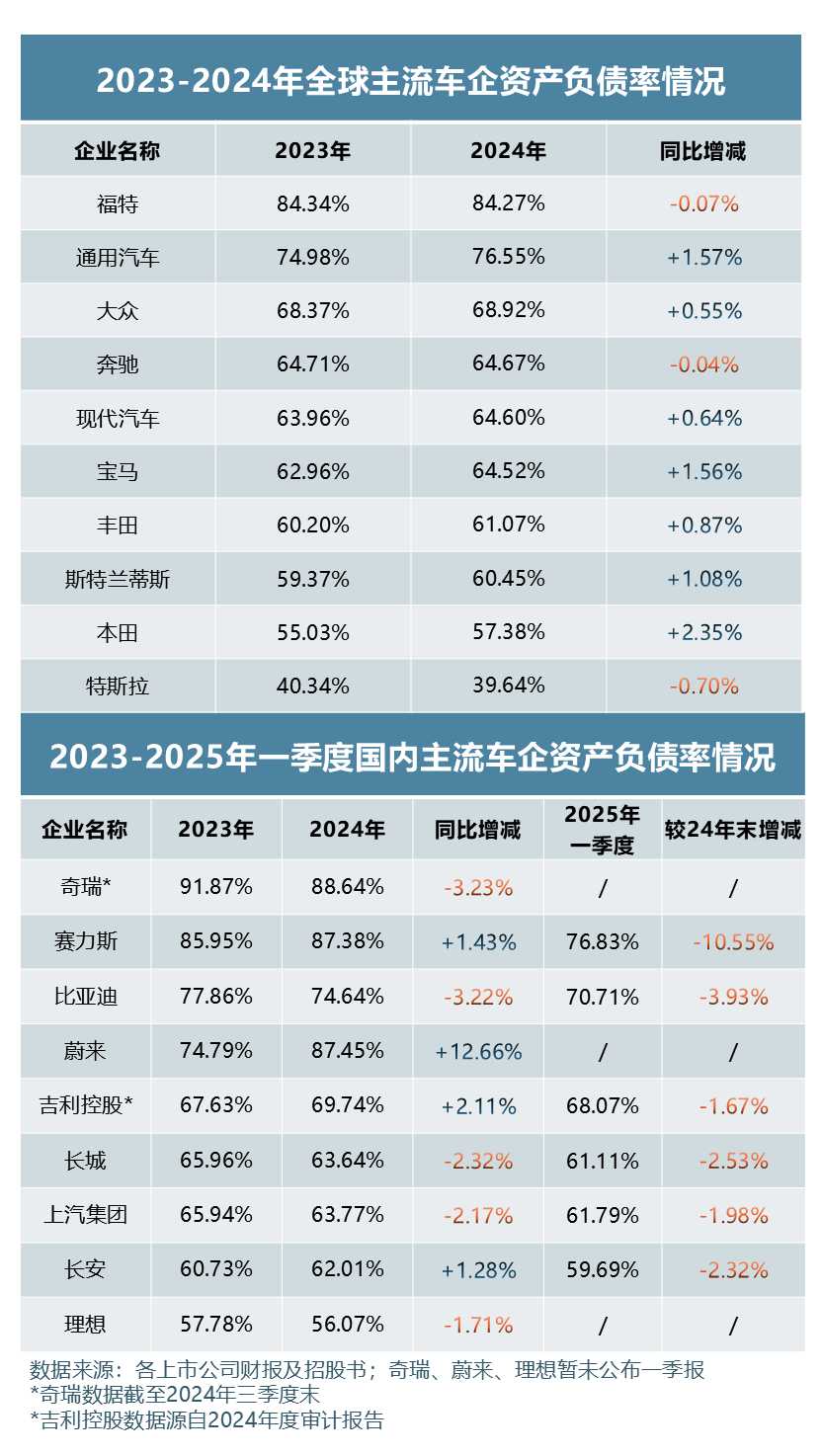
Core Viewpoint - The financial health of automotive companies is under scrutiny due to rising debt levels amid global economic pressures, with a focus on the debt-to-equity ratio as a key indicator of financial stability [1] Group 1: Debt Ratio Trends - The debt ratio is high among major automotive companies globally, with most falling between 60% and 80%, including General Motors, Volkswagen, Mercedes-Benz, and Toyota, as well as leading domestic firms like BYD and Geely [1] - Notably, while overseas companies are experiencing rising debt ratios, domestic companies are seeing a decline, with BYD's debt ratio dropping nearly seven percentage points to 70.7% [4][5] Group 2: Interest-Bearing Debt - The automotive industry typically sees larger companies carrying higher debt levels; for instance, Volkswagen has total liabilities of 3.4 trillion yuan and Toyota 2.7 trillion yuan, totaling over 6 trillion yuan [6] - Interest-bearing debt is a critical concern, as it poses liquidity risks; for example, General Motors faced bankruptcy in 2009 due to an inability to manage its debt [10] - Domestic companies maintain lower interest-bearing debt levels, with BYD at just 286 billion yuan, representing only 5% of its total liabilities, indicating a more cautious financial approach [10] Group 3: Supplier Relationships - Lower interest-bearing debt allows Chinese automotive companies to operate effectively through non-interest-bearing liabilities, with accounts payable being a significant component [11] - The accounts payable to revenue ratio for major domestic companies like BYD is 31%, while others like Great Wall and Changan are at 39% and 49%, respectively, indicating a healthy balance [12][14] - Efficient payment cycles enhance supplier relationships, with BYD averaging 127 days to settle accounts, which is favorable compared to other companies [14][15] Group 4: Industry Outlook - The automotive industry, traditionally reliant on substantial debt, is witnessing a shift as Chinese companies demonstrate robust financial performance while expanding rapidly, particularly in the electric vehicle sector [15]