
大秦铁路

Search documents
频频举牌 险资入市步伐加快 险资长期投资试点的资金规模将达2220亿元
Guang Zhou Ri Bao· 2025-05-11 21:02
Core Viewpoint - Insurance funds are increasingly entering the market as long-term capital, with significant investments in various sectors, particularly banking and transportation [1][2][3]. Group 1: Insurance Fund Activities - As of May 9, 2023, insurance funds have made 13 equity stakes this year, including 6 in bank stocks [2]. - Ping An Life increased its stake in China Merchants Bank by acquiring 3.4755 million H-shares, raising its holding from 11.92% to 12% [2]. - Postal Insurance acquired 79.4201 million shares of Eastern Airlines Logistics, representing 5% of the total share capital, triggering a stake disclosure [2]. Group 2: Regulatory Support and Investment Trends - The National Financial Regulatory Administration announced plans to approve an additional 60 billion yuan for long-term investment reforms, bringing the total scale of insurance fund pilot projects to 222 billion yuan [1][3]. - The first pilot companies, China Life and New China Life, each invested 25 billion yuan to establish a private equity fund, which has shown good performance [3]. Group 3: Investment Strategy Insights - Analysts suggest that insurance funds are likely to focus on high dividend, high ROE (Return on Equity) assets, and may gradually increase allocations to stocks in the CSI A500 index, benefiting from economic stabilization [4].
大秦铁路:2024年报及2025年一季报点评煤炭运量承压致业绩下滑,4月大秦线运量转正,持续看好公司核心资产价值-20250511
Huachuang Securities· 2025-05-11 13:30
Investment Rating - The report maintains a "Recommendation" rating for Daqin Railway (601006) [1] Core Views - The coal transportation volume is under pressure, leading to a decline in performance, but the company’s core asset value remains promising [1] - In April, the Daqin line's transportation volume turned positive, indicating potential recovery [1] - The company is viewed as a high-dividend stock with significant allocation value, especially given its core asset's strategic importance in China's energy transportation system [6] Financial Summary - For 2024, total revenue is projected at 74,627 million, a year-on-year decrease of 7.9%, with net profit at 9,039 million, down 24.2% [2][6] - The first quarter of 2025 shows a revenue of 17,801 million, a decline of 2.56%, and a net profit of 2,571 million, down 15.61% [6] - The company’s earnings per share (EPS) for 2025 is estimated at 0.49, with a price-to-earnings (P/E) ratio of 13 [2][6] Operational Performance - The freight business, which is the main revenue source, generated 53,441 million in 2024, a decrease of 12.73%, accounting for 72.88% of total revenue [6] - The company transported 70,622 million tons of goods in 2024, down 2.7% year-on-year [6] - Passenger transport revenue increased by 12.23% in 2024, reaching 10,010 million, with 46.41 million passengers transported [6] Investment Recommendations - The report suggests adjusting profit forecasts for 2025-2026 to 99,520 million and 103,360 million respectively, with a new forecast for 2027 at 104,260 million [6] - The target price is set at 7.7 yuan, indicating a potential upside of 16% from the current price of 6.66 yuan [2][6] - The company is expected to maintain a high dividend payout ratio, with a projected dividend yield of 4.3% based on 2025 earnings [6]

大秦铁路(601006):2024年报及2025年一季报点评:煤炭运量承压致业绩下滑,4月大秦线运量转正,持续看好公司核心资产价值
Huachuang Securities· 2025-05-11 11:11
Investment Rating - The report maintains a "Recommendation" rating for Daqin Railway, indicating an expectation to outperform the benchmark index by 10%-20% over the next six months [6][19]. Core Insights - The company's coal transportation volume has been under pressure, leading to a decline in performance. However, the Daqin line's transportation volume turned positive in April, and the core asset value of the company remains promising [1][6]. - For 2024, the company reported total revenue of 746.27 billion yuan, a year-on-year decrease of 7.89%, and a net profit attributable to shareholders of 90.39 billion yuan, down 24.23% year-on-year [6]. - The report highlights a significant drop in the freight business, which is the main source of revenue, with a revenue of 534.41 billion yuan in 2024, down 12.73% year-on-year [6]. - The passenger transport business showed good growth, with revenue of 100.1 billion yuan in 2024, up 12.23% year-on-year [6]. Financial Summary - The projected total revenue for 2025 is 787.43 billion yuan, with a growth rate of 5.5% [2]. - The net profit for 2025 is estimated at 99.52 billion yuan, reflecting a recovery from previous declines [6]. - The earnings per share (EPS) for 2025 is projected to be 0.49 yuan, with a price-to-earnings (P/E) ratio of 13 [2][6]. - The company maintains a high dividend payout ratio of 57.31% for 2024, corresponding to a dividend yield of 4.1% based on the closing price on May 9, 2025 [6]. Operational Performance - The Daqin line completed a freight volume of 39.215 million tons in 2024, a decrease of 7.1% year-on-year, but showed signs of recovery with a 0.99% increase in April 2025 [6]. - The average daily loading and unloading operations were reported at 29,350 and 23,703 cars, respectively, with a freight car turnaround time of 2.3 days [6]. Investment Recommendation - The report suggests that Daqin Railway is a high-dividend stock with significant allocation value, emphasizing its strategic position in China's energy transportation system [6]. - The target price is set at 7.7 yuan, indicating a potential upside of 16% from the current price of 6.66 yuan [2][6].
交运24年度复盘及25Q1总结:交运整体稳健,看好物流发展
Xinda Securities· 2025-05-11 05:23
Investment Rating - The overall investment rating for the transportation industry is "Positive" [2][17]. Core Viewpoints - The logistics sector is expected to continue its robust growth, driven by the rise of e-commerce and changing consumer behaviors [28]. - The express delivery industry maintained a relatively high growth rate in volume, with a year-on-year increase of 21.5% in 2024, reaching 175.08 billion packages, and a 21.6% increase in Q1 2025, totaling 45.14 billion packages [26][30]. - The price competition in the express delivery sector has intensified, leading to pressure on single-package profitability, with the average price per package dropping by 8.8% year-on-year in Q1 2025 [3][32]. Summary by Sections Express Delivery - **Volume Growth**: The express delivery industry experienced a strong growth in volume, with major companies like Shunfeng, YTO, Yunda, and Shentong reporting package volumes of 3.541 billion, 6.779 billion, 6.076 billion, and 5.807 billion respectively in Q1 2025, with growth rates of 19.7%, 21.7%, 22.9%, and 26.6% [26][30]. - **Price and Profitability**: The average price per package in the industry was 7.66 yuan, down 8.8% year-on-year. Shunfeng's net profit increased by 16.9% year-on-year, while YTO, Yunda, and Shentong saw net profit changes of -9.2%, -22.1%, and +24.0% respectively [3][32]. - **Investment Recommendation**: The report recommends focusing on Shunfeng Holdings due to its strong cash flow and potential for growth in the express delivery sector [3][32]. Aviation - **Operational Status**: The aviation industry saw a recovery in passenger load factors, reaching 83.3% in 2024, slightly above 2019 levels. Domestic and international flight turnover volumes increased by 12.0% and 85.2% respectively [4][6]. - **Financial Performance**: Major airlines reduced losses significantly in 2024, with revenue growth for Air China, China Southern Airlines, and China Eastern Airlines at 18.1%, 8.9%, and 16.2% respectively [5][6]. - **Investment Recommendation**: The report suggests focusing on airlines like Air China and China Southern Airlines, anticipating improved performance as supply constraints and ticket prices recover [6]. Ports - **Operational Data**: The total cargo throughput for national ports reached 1.7595 billion tons in 2024, a year-on-year increase of 3.66%. In Q1 2025, throughput was 422.2 million tons, up 3.23% [7][8]. - **Financial Data**: Qingdao Port showed a net profit growth of 6.33% in 2024, while China Merchants Port's net profit increased by 26.44% [8]. - **Investment Recommendation**: The report recommends focusing on Qingdao Port due to its superior return on equity (ROE) and dividend capabilities [8]. Highways - **Performance Overview**: The highway sector showed stable growth in Q1 2025, with passenger and freight volumes increasing by 0.5% and 5.4% respectively [9][10]. - **Investment Recommendation**: The report highlights the importance of focusing on leading highway operators like China Merchants Highway and Shandong Highway for their strong cash flow and growth potential [10]. Railways - **Operational Status**: Railway freight and passenger turnover volumes declined in 2024, with significant drops in the Daqin Line's freight volume [11][12]. - **Financial Performance**: Daqin Railway's net profit fell by 24.23% in 2024, while Beijing-Shanghai High-Speed Railway's net profit increased by 10.6% [12]. - **Investment Recommendation**: The report suggests a positive outlook for Daqin Railway and Beijing-Shanghai High-Speed Railway as freight volumes are expected to recover [12]. Shipping - **Operational Data**: Oil shipping rates remained around $50,000 per day, while container shipping rates showed slight declines [13][14]. - **Financial Performance**: COSCO Shipping Holdings reported a net profit increase of 105.78% in 2024 [14]. - **Investment Recommendation**: The report recommends focusing on stable companies like China Merchants Energy and Zhonggu Logistics amid fluctuating shipping rates [14]. Bulk Supply Chain - **Operational Status**: The bulk supply chain sector faced weak downstream demand, leading to a slight decrease in cargo volume for leading companies [15][16]. - **Financial Performance**: Major companies like Xiamen Xiangyu and Xiamen Guomao reported significant declines in net profit [16]. - **Investment Recommendation**: The report suggests that the sector may see a recovery in profits as demand improves and recommends focusing on companies with high dividend yields [16].



红利低波100为啥这么牛?
雪球· 2025-05-10 03:18
风险提示:本文所提到的观点仅代表个人的意见,所涉及标的不作推荐,据此买卖,风险自负。 2.1 什么是红利低波100指数 ? 红利低波100指数 ( 代码 : 930955 ) 是中证红利低波动100指数的简称 , 由中证指数有限公司于 2017年5月26日发布 , 是一只以 " 高股息和低波动 " 为核心逻辑的指数 。 作者: 王博雅投资 来源:雪球 1 引言 红利低波100指数是仅有的2个五星级红利指数之一 。 它可以看做中证红利的升级版 , 在保持优秀分散性 的情况下实现了更高的收益和更低的波动 , 因此在市场上备受关注 。 图1 沪深300 、 中证红利与红利低波指数全收益对比 在之前 , 我已经对追踪中证红利的基金进行了分析。 今天我将对红利低波100指数进行简介 , 然后从 费用 、 规模 、 流动性 、 收益与分红频率 等几个关键角 度 , 对红利低波100ETF进行横评 , 看看谁最好 ! 2 红利低波100指数简介 红利低波100指数构成逻辑如下 : 1 中证全指中过去一年日均成交金额前 80%的公司 。 这是为了避免流动性过差 。 2 过去三年连续现金分红 。 这是为了确保公司具有良好的分红 ...


万联晨会-20250509
Wanlian Securities· 2025-05-09 05:26
市 场 研 究 [Table_Title] 万联晨会 [Table_MeetReportDate] 2025 年 05 月 09 日 星期五 研报精选 "五一"旅游市场平稳增长,长线游与入境游表现亮眼 家电行业 25Q1 基金持仓跟踪报告 交运行业 25Q1 公募基金持仓跟踪报告 | [Table_InnerMarketIndex] 国内市场表现 | | | | --- | --- | --- | | 指数名称 | 收盘 | 涨跌幅% | | 上证指数 | 3,352.00 | 0.28% | | 深证成指 | 10,197.66 | 0.93% | | 沪深 300 | 3,852.90 | 0.56% | | 科创 50 | 1,026.44 | -0.36% | | 创业板指 | 2,029.45 | 1.65% | | 上证 50 | 2,679.51 | 0.33% | | 上证 180 | 8,546.20 | 0.14% | | 上证基金 | 6,902.65 | 0.35% | | 国债指数 | 224.77 | 0.05% | | [Table_InterIndex] | 国际市场表现 | ...
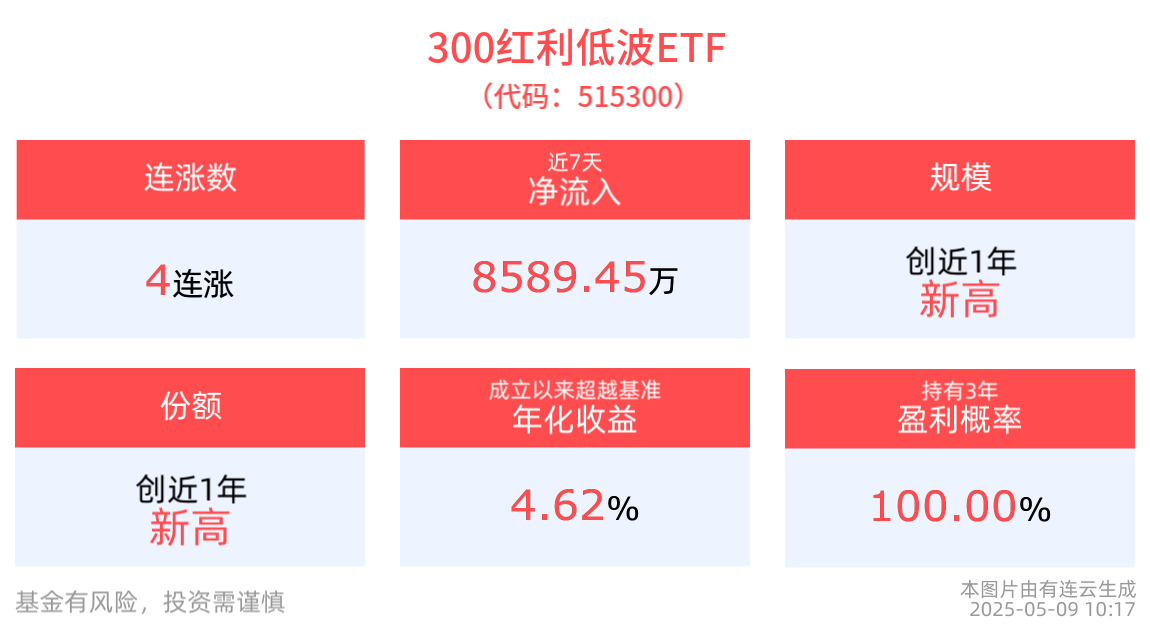
单日获资金净流入超5200万元,300红利低波ETF(515300)冲击4连涨
Xin Lang Cai Jing· 2025-05-09 02:45
Group 1 - The core viewpoint of the news highlights the strong performance and increasing popularity of the 300 Dividend Low Volatility ETF, with significant trading volume and net inflows indicating investor confidence [1] - As of May 8, the average daily trading volume of the 300 Dividend Low Volatility ETF over the past week reached 115 million yuan, with a total trading volume of 17.2858 million yuan on a single day [1] - The latest scale of the 300 Dividend Low Volatility ETF has reached 5.497 billion yuan, marking a one-year high, with the latest share count at 4.015 billion shares, also a one-year high [1] Group 2 - The net inflow of funds into the 300 Dividend Low Volatility ETF was 52.0532 million yuan, with six out of the last seven trading days showing net inflows totaling 85.8945 million yuan [1] - The top ten weighted stocks in the CSI 300 Dividend Low Volatility Index as of April 30, 2025, include major companies such as China Shenhua, Gree Electric, and Sinopec, accounting for a total of 37.43% of the index [1] - A report from Huatai Securities indicates that recent financial policies aimed at stabilizing the market and improving expectations, along with positive developments in Sino-US trade relations, are likely to support the risk appetite of market participants [1] Group 3 - The report suggests that mid-term investments should focus on large-cap stocks, particularly in sectors like technology and consumer goods, which are expected to benefit from policy support [1] - For investors without stock accounts, there is an opportunity to invest in the corresponding CSI 300 Dividend Low Volatility ETF linked fund (007606) [2]
中证ECPI ESG可持续发展40指数下跌0.02%,前十大权重包含大秦铁路等
Jin Rong Jie· 2025-05-08 12:30
Core Viewpoint - The China Securities Index ECPI ESG Sustainable Development 40 Index (ESG 40) experienced a slight decline of 0.02%, closing at 1624.85 points, with a trading volume of 30.04 billion yuan. Over the past month, the index has increased by 5.98%, but it has decreased by 4.08% year-to-date [1]. Group 1: Index Performance - The ESG 40 Index is composed of 40 listed companies selected based on high ECPI ESG ratings from the Shanghai Stock Exchange 180 Corporate Governance Index, reflecting the overall performance of these high-rated companies [1]. - The index was established on June 30, 2010, with a base value of 1000.0 points [1]. Group 2: Top Holdings - The top ten weighted companies in the ESG 40 Index include SANY Heavy Industry (3.14%), Shengyi Technology (2.91%), Hengrui Medicine (2.89%), China Unicom (2.83%), Industrial Bank (2.83%), Huaneng International (2.81%), Daqin Railway (2.79%), Kweichow Moutai (2.76%), New China Life Insurance (2.76%), and Juhua Co., Ltd. (2.75%) [1]. Group 3: Sector Allocation - The sector distribution of the ESG 40 Index holdings is as follows: Industrial (34.64%), Utilities (12.16%), Financials (10.83%), Materials (9.63%), Consumer Staples (7.64%), Consumer Discretionary (7.12%), Healthcare (5.33%), Energy (4.41%), Information Technology (2.91%), Communication Services (2.83%), and Real Estate (2.49%) [2]. Group 4: Sample Adjustment Process - The index samples are adjusted biannually, with adjustments occurring on the next trading day after the second Friday of January and July. The sample adjustment typically does not exceed 10% unless more than 10% of the old samples are removed [3]. - Old samples with the same rating that rank in the top 60% by average market capitalization will be prioritized for retention during adjustments [3]. - The index can undergo temporary adjustments if there are significant changes in the ECPI ESG ratings of the samples or if a sample is removed from the index [3].
财经聚焦丨上市公司年度“红包”创新高 常态化分红机制逐渐形成
Xin Hua Wang· 2025-05-08 09:48
Group 1 - The core viewpoint of the article highlights that A-share listed companies are experiencing a significant increase in cash dividends, with a trend towards regularized dividend mechanisms being established [1][4][10] - In the 2024 fiscal year, nearly 70% of over 5,400 listed companies announced dividends, totaling approximately 2.39 trillion yuan, marking a year-on-year increase of over 7% and setting a new historical high [1][3] - The total cash dividends and the number of companies distributing dividends have been steadily increasing over the years, with the total cash dividends nearly doubling compared to 2018 and the number of dividend-paying companies growing by nearly 50% [1][3] Group 2 - The banking sector remains a major contributor to dividends, with 42 listed banks distributing over 630 billion yuan, accounting for more than 30% of their net profits [3][4] - State-owned enterprises continue to play a significant role in dividend distribution, with nearly 1,000 state-owned companies collectively distributing 1.5 trillion yuan, representing over 60% of the total market dividends [3][4] - New trends in dividend distribution include multiple distributions within a year, with over 90% of newly listed companies in the North Exchange announcing dividend plans [6][7] Group 3 - The introduction of the new "National Nine Articles" policy has strengthened the regulation of cash dividends, encouraging companies to increase dividend frequency and ratios [6][8] - A total of 985 companies in the Shanghai and Shenzhen markets announced interim dividends, with the total amount reaching 699.47 billion yuan, representing 4.3 times the number of companies and 2.7 times the amount from 2023 [7][8] - Companies are increasingly focusing on enhancing investment value and long-term dividend stability, with significant actions taken by nearly 60% of companies in the Shanghai market to improve quality and returns [8][9]

交通运输行业周报第39期:OPEC+加速增产,需求回升有望驱动油运景气高位运行
EBSCN· 2025-05-08 07:25
Investment Rating - The report maintains an "Overweight" rating for the transportation sector [6] Core Insights - OPEC+ is set to increase oil production by 410,000 barrels per day in June, which is expected to positively impact oil transportation demand [1] - The oil transportation market is anticipated to tighten, with a projected increase in oil transportation demand of 0.8% in 2025, while capacity is expected to grow by only 0.7% [2] - The decline in oil prices is likely to improve the cost structure for airlines, potentially accelerating their profitability recovery [3] Summary by Sections Oil Transportation - OPEC+ agreed to maintain the production increase of 410,000 barrels per day, driven by non-compliance from key member countries [1] - As of May 2, 2025, the TD3C-TCE spot rate was reported at $49,908 per day, reflecting a 25.1% increase since early April [2] - The oil transportation supply-demand balance is expected to tighten in 2025, with VLCC demand increasing by 1.7% and capacity decreasing by 0.2% [2] Aviation - In Q1 2025, domestic air passenger volume reached 166.93 million, a year-on-year increase of 2.3%, while international passenger volume surged by 34.0% [3] - Airlines reported a total revenue of 147.3 billion yuan in Q1 2025, with a net loss of 2.4 billion yuan, indicating ongoing challenges in profitability recovery [3] Market Performance - The transportation sector's performance over the past three trading days showed a decline of 1.3%, ranking 21st among all sectors [4] - The top-performing sub-sectors included highways (+0.42%), while public transport (-3.70%) and logistics (-3.45%) faced significant declines [12] Investment Recommendations - Focus on state-owned enterprises in the transportation sector, particularly in highways, railways, and ports, as they are expected to benefit from ongoing reforms [5] - Given the geopolitical tensions and slow capacity growth, oil and container shipping sectors are expected to maintain favorable conditions [5] - The recovery in air transportation demand suggests potential investment opportunities in major airlines and airports [5] - The express delivery sector is showing signs of recovery, with a recommendation to monitor leading companies in this space [5]