宝马

Search documents
俄罗斯又拖全球车市后腿了
Zhong Guo Qi Che Bao Wang· 2025-10-14 02:09
Group 1 - Global automotive markets, except for Russia, showed growth in September and the first three quarters of the year, driven by various factors such as electric vehicle (EV) subsidies in the US and tax reforms in India [2] - In the US, electric vehicle sales surged before the expiration of a $7,500 subsidy, with Q3 sales exceeding 438,000 units, marking a record quarter and a market share of 10.5% [3][4] - Major automakers in the US reported increased sales, with Ford's sales up 8.2%, General Motors up 8%, and Hyundai up 13%, largely driven by electric vehicle demand [4] Group 2 - In Europe, the automotive market saw a slight increase in passenger car sales, with a total of 8.69 million units sold from January to August, a 0.4% year-on-year growth [6] - Chinese automakers, particularly BYD and SAIC, have become significant players in the European market, with BYD's sales skyrocketing by 280% [7] - The UK experienced its highest new car sales in September since 2015, driven by strong electric vehicle performance and government subsidies [8] Group 3 - India's automotive market showed resilience with a total of 3.8 million new vehicles sold in the first three quarters, a 2.3% increase year-on-year, supported by tax reforms [9][10] - The new GST 2.0 tax structure in India has significantly improved the affordability of small cars, boosting consumer confidence and sales [10] - In Japan, new car sales reached 3.465 million units in the first nine months, a 5% increase, although the market faced challenges in the latter part of the year [11][12] Group 4 - Brazil's automotive market reported a 2.9% increase in September sales, with a total of 1.91 million vehicles sold in the first nine months, driven by strong export performance [13][14] - The Brazilian government plans to reintroduce tariffs on electric and hybrid vehicles starting in 2024, aiming to stimulate local production [15] - Russian automotive sales plummeted by 23% in the first nine months, with a significant decline in new car sales due to geopolitical factors and rising costs [16][17]






从技术狂欢到企业落地,智能编程的全球破局战
AI前线· 2025-10-13 13:54
Core Insights - The article emphasizes that intelligent programming is rapidly evolving from simple code completion to an era of AI autonomous development, driven by advancements in technology and changing industry dynamics [2][5][10]. Industry Overview - Historically, the "development tools" sector has not been among the most profitable in the software industry, but this is changing as 60% of global developers now utilize AI to build tools [3][10]. - The shift towards intelligent programming is marked by a transition from basic functionalities to complex software development needs, with companies like Alibaba leading the charge [5][10]. Technological Advancements - Intelligent programming is moving beyond code completion to address real software construction challenges, focusing on three core capabilities: deepening value-driven scenarios, achieving productivity transformation through Spec-driven development, and enhancing context engineering [5][6][7][9]. - Alibaba's Qoder emphasizes the importance of engineering knowledge and code documentation, which are critical for effective collaboration and knowledge sharing among developers [6]. Productivity Transformation - The transition to AI autonomous programming allows developers to delegate tasks to AI, significantly increasing productivity—up to 10 times—by enabling AI to work independently for extended periods [7][8]. - Developers can now manage multiple tasks simultaneously, akin to leading an AI development team, which enhances overall efficiency [8]. Context Engineering - As software systems grow in complexity, the ability of AI to accurately understand context becomes crucial. Alibaba's approach combines vectorized retrieval and memory extraction to improve context processing capabilities [9][10]. - This context engineering is particularly vital in complex scenarios, such as modifying legacy systems, where understanding historical code and business rules is essential [9]. Market Dynamics - The penetration of intelligent programming tools is accelerating, with a notable difference in usage depth among developers. Some utilize AI for simple tasks, while others have achieved full-scale autonomous development [10]. - The future of intelligent programming is envisioned as a connector between the digital and physical worlds, facilitating code generation for smart devices and applications [10][22]. Enterprise Implementation Challenges - Despite the potential of intelligent programming, enterprises face challenges such as adapting to complex scenarios, ensuring security compliance, and improving knowledge transfer and asset reuse [11][14]. - Companies are encouraged to create clear engineering specifications and documentation to enhance AI's understanding of historical assets and business logic [15]. Case Studies - Successful implementations, such as that of China Pacific Insurance, demonstrate significant productivity gains through intelligent programming tools, with code generation rates reaching 41.26% [12]. - Hisense Group's comprehensive evaluation of AI coding tools highlights the importance of balancing cost, quality, and security in tool selection [13]. Competitive Landscape - Domestic AI programming tools are increasingly competitive with international counterparts, with Alibaba's Qwen3-Coder model surpassing others in capabilities [16][17]. - The strategy of combining model development with data advantages and ecosystem collaboration is crucial for domestic firms to thrive in the global market [17][19]. Future Outlook - The demand for intelligent programming is evolving from a mere efficiency tool to a vital partner in productivity, reflecting a deeper desire for digital transformation within enterprises [21]. - The ultimate goal of intelligent programming is to eliminate barriers to innovation, positioning code production as a catalyst for business growth [22].

BBA在华销量失守,加速布局纯电赛道
2 1 Shi Ji Jing Ji Bao Dao· 2025-10-13 12:21
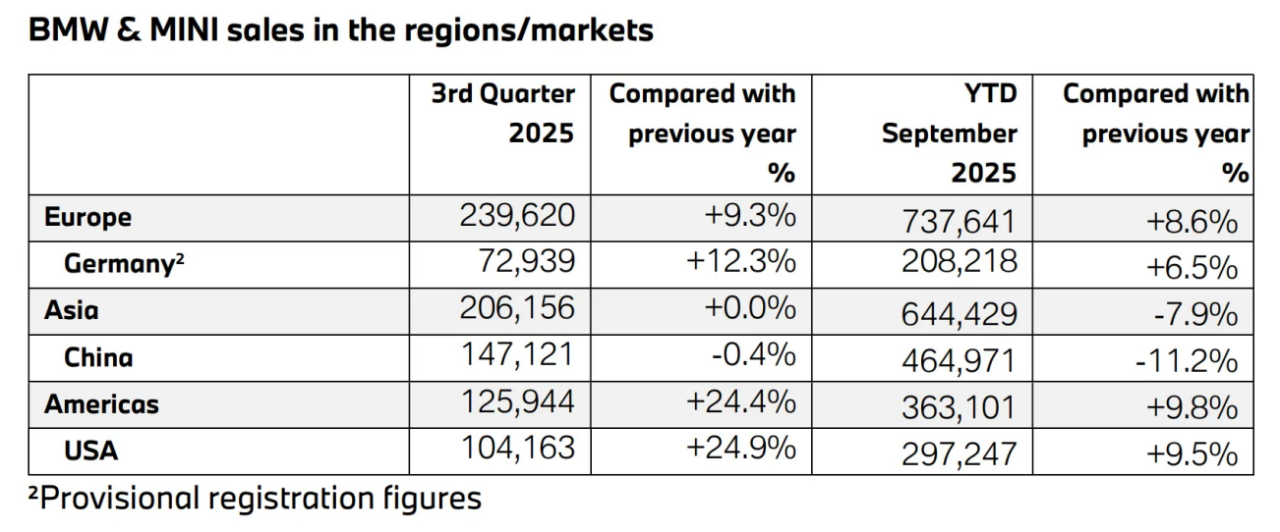
Core Insights - The luxury car market is undergoing significant adjustments, with BBA (BMW, Mercedes-Benz, Audi) showing a divergence in performance: BMW is leading, Mercedes-Benz is under pressure, and Audi is catching up [1] BMW Performance - BMW is the only company among BBA to achieve positive sales growth, with global deliveries reaching 588,300 units in Q3, a year-on-year increase of 8.8%, and a total of 1,795,900 units for the first three quarters, up 2.4% [1] - Strong performance in North America and Europe has offset the decline in the Chinese market [1] - In China, BMW delivered 147,121 vehicles in Q3, a slight decrease of 0.4%, with a cumulative drop of 11.2% to 464,971 units for the first three quarters [2][3] Mercedes-Benz Performance - Mercedes-Benz faced more significant sales pressure, with Q3 global sales dropping to 525,300 units, down 12% year-on-year and 4% quarter-on-quarter, totaling 1,601,600 units for the first three quarters, a decrease of 9% [1][4] - In China, Mercedes-Benz's Q3 deliveries plummeted by 27% to 125,000 units, with a cumulative decline of 18% to 418,000 units for the first three quarters [4] Audi Performance - Audi's Q3 global sales were 397,100 units, a year-on-year decline of 2.5%, with a total of 1,191,100 units for the first three quarters, down 4.8% [1] - The sales gap between Audi and BMW has widened to over 600,000 units [1] Market Dynamics - The luxury car market in China is becoming increasingly competitive, with domestic brands challenging BBA's entry-level models in the 200,000 to 400,000 yuan price range [4][5] - The market share of German brands has decreased from 18.4% in January 2025 to 14.3% in September 2025 [4] Profit Outlook - Due to the impact of the Chinese market, BMW has revised its full-year profit forecast, expecting a pre-tax profit "slightly below" last year's €10.97 billion (approximately 90.98 billion yuan) [5][6] Electrification Strategies - BBA's electrification paths are diverging: BMW is leading, Mercedes-Benz is aggressively pushing forward, and Audi is taking a more pragmatic approach [7] - BMW's electric vehicle sales reached 323,000 units in the first three quarters, a year-on-year increase of 10% [8] - Mercedes-Benz is launching a major product offensive in the electric vehicle sector, with plans to introduce at least 40 new models by the end of 2027 [9] - Audi is adjusting its electrification strategy, focusing on a balanced approach between long-term electric goals and flexible product offerings [9] Hybrid Market - The hybrid market remains a crucial support for BBA, with BMW's hybrid vehicle sales increasing by 8% to 152,000 units in Q3 [10] - Mercedes-Benz also relies on the hybrid market, delivering 96,000 hybrid vehicles, a year-on-year increase of 10% [11]
阿斯麦慌了,欧洲裂了,中国动了
Sou Hu Cai Jing· 2025-10-13 10:08
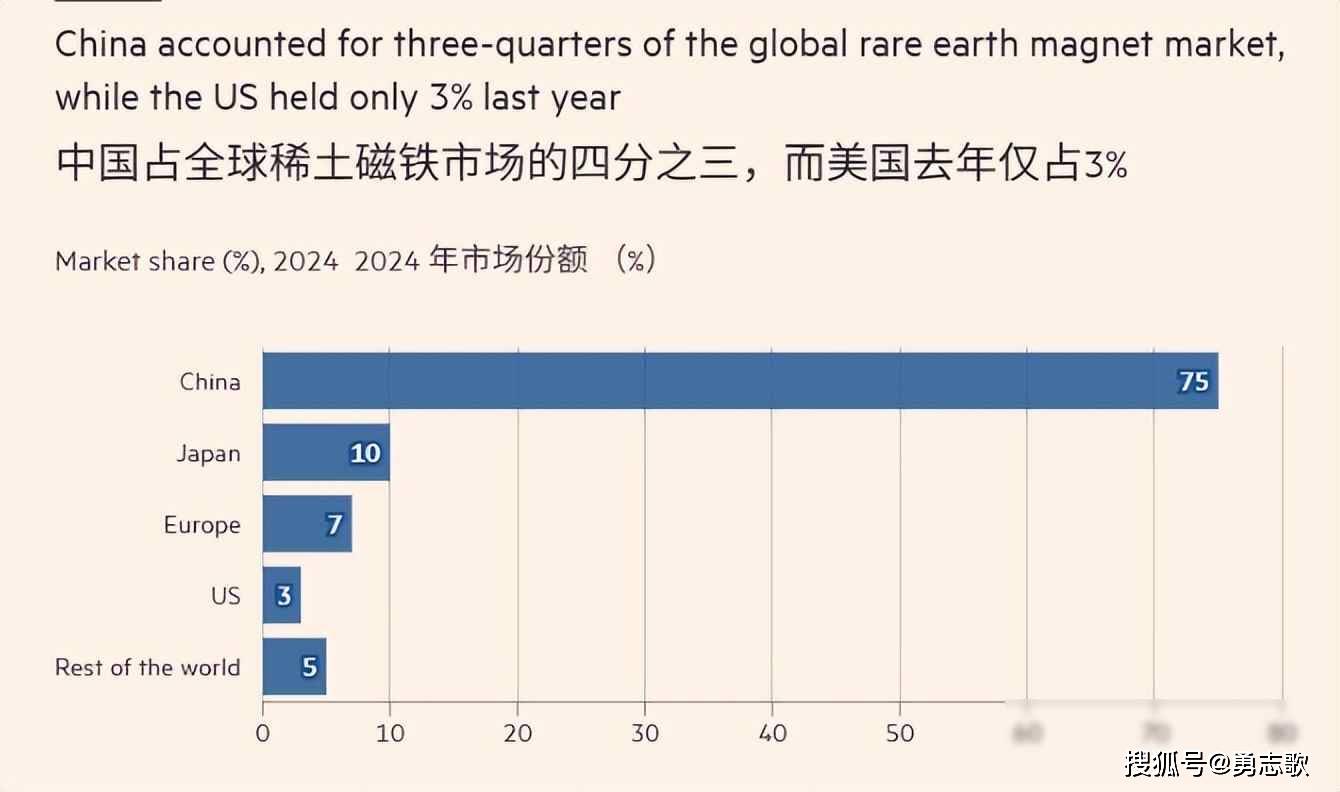
2025年10月9日,中国商务部突然把稀土的开采、冶炼和磁材制造技术加进了出口管制名单,新规说得很明白,只要产品里有百分之零点一的中国稀土成 分,就得先找中国审批,不管你是在德国生产,还是在日本制造,只要用了中国的技术,就绕不开这一关,这一招正好打在了荷兰阿斯麦公司的软肋上。 欧洲这边更乱,德国最头疼,大众、宝马这些大车企,还有西门子的风力发电机,全靠稀土磁体,德国经济部嘴上说在评估,心里早慌了,不敢明着反对中 国,又怕被牵连,法国倒干脆,拿出一亿零六百万欧元,拉上日本建了个稀土回收厂,想彻底绕开中国供应链,这是欧洲唯一真动手去中的人。 欧盟内部吵个不停,北欧国家想着跟中国搭伙干活,东欧国家偏要联手施压,委员会发了个声明说有点担心,可谁也拿不出个能落地的法子,各人盘算各人 的,谁也不买谁的账,阿斯麦夹在中间,两边都不敢得罪,美国惹不起,中国也动不得,只能硬着头皮撑着。 数据不会说谎,2023年阿斯麦在中国赚了六十四亿多欧元,占它总收入的近三成,现在这笔钱基本没了,不是它不想卖,是中国不让卖,稀土不是普通东 西,它是机器的心脏,EUV光刻机的激光系统、磁悬浮平台、伺服控制器,全靠稀土永磁体撑着,全球眼下找不到替 ...

买车像炒股?有车主爱车一年跌价近5万
经济观察报· 2025-10-12 07:47
Core Viewpoint - The current automotive market is undergoing a transformation, with rapid technological advancements and frequent new model launches significantly impacting vehicle depreciation rates, particularly for electric vehicles [3][7]. Group 1: Market Trends - The automotive market is experiencing a surge in new model releases, with over 70 new models launched in September alone, indicating a vibrant sales season [6]. - The average depreciation rate for three-year-old plug-in hybrid vehicles is 43.9%, while pure electric vehicles have an average depreciation rate of 42.6%, both lower than traditional fuel vehicles, which maintain an average depreciation rate above 50% [4][6]. Group 2: Factors Influencing Depreciation - The rapid iteration of technology, especially in electric vehicles, leads to accelerated depreciation of older models, as the technology update cycle has shortened from 3-5 years to 1-2 years [9]. - Brand influence remains a core factor in determining vehicle depreciation rates, with luxury and mainstream brands maintaining higher resale values due to brand equity [8]. - Market ownership levels directly affect the liquidity of the used car market, with models that have higher ownership typically offering better after-sales service and parts supply, thus preserving their second-hand value [8]. Group 3: Consumer Guidance - Consumers are advised to focus on the three-year depreciation rate data of target models before purchasing, as this reflects the long-term value trajectory of vehicles [11]. - Choosing brands with stable pricing strategies is crucial, as those that avoid frequent price wars tend to maintain higher depreciation rates [11]. - The importance of after-sales service and warranty policies, particularly for electric vehicles, is emphasized, as these factors can alleviate consumer concerns about battery degradation and enhance vehicle resale value [12].

2026年第30届墨西哥国际工业制造展览会
Sou Hu Cai Jing· 2025-10-11 03:23
Event Overview - The Mexico International Industrial Manufacturing Exhibition will take place from February 3-5, 2026, at the Cintermex Exhibition Center in Monterrey, Mexico, organized by the Monterrey International Exhibition Company and EJK [1] - This exhibition is the leading manufacturing industry event in Mexico and Latin America, focusing on mechanical manufacturing, automotive, automotive parts, metal processing, industrial automation, and electrical fields [1] - The event aims to gather manufacturing owners and advanced technology suppliers for effective collaboration and cost reduction, especially in the post-COVID-19 era [1] Market Advantages - Mexico's export value reached $5,930.1 million in 2023, marking a historical high, and it has become the largest trading partner of the U.S. [2] - The country benefits from geographical proximity to the U.S. and trade agreements like the USMCA, making it a key destination for global supply chain shifts [2] - Key states such as Coahuila, San Luis Potosí, Baja California, Nuevo León, Jalisco, Sonora, and Guanajuato have become hubs for automotive, aerospace, medical devices, electronics, and consumer goods manufacturing [2] Foreign Investment - Major global companies, including Ford, General Motors, Caterpillar, and Bosch, are establishing operations in Mexico, alongside nearly 3,000 Chinese enterprises, which saw a 48% increase in direct investment in 2023 [3] - This trend indicates Mexico's growing importance in the global supply chain [3] Venue Insights - Monterrey is Mexico's third-largest city and an industrial hub, hosting numerous automotive and automotive parts manufacturers, as well as steel, electronics, cement, and glass industries [4] - The city is home to many headquarters of major industrial companies and financial groups, enhancing its significance in the manufacturing sector [4] Exhibition Scope - The exhibition will cover a wide range of sectors, including industrial parts and metal processing equipment, automation and transmission equipment, plastic and rubber machinery, and medical and pharmaceutical equipment [8][9][10]
企业培训| 未可知 x 上汽集团: 除了自动驾驶,AI还能对汽车做什么?
未可知人工智能研究院· 2025-10-11 03:02
Core Viewpoint - AI has become an essential component for the survival of automotive enterprises, transitioning from an optional technology to a core competitive advantage for the next decade [6][7]. Design Phase - AI enhances the efficiency of "creative realization" by tenfold, significantly reducing the automotive design cycle from weeks to hours through systems like AiCube [12][13]. - Custom design processes have been revolutionized by NVIDIA RTX AI workstations, compressing development timelines from six months to six weeks while improving efficiency and quality [15][16]. - Future automotive design will increasingly rely on "human-machine collaboration" as AI capabilities are integrated into modeling tools [18]. Manufacturing Phase - AI is transforming automotive manufacturing from mass production to flexible intelligent manufacturing, enhancing resilience [19]. - The Li-Mos system at Li Auto's manufacturing base has improved production efficiency by 20% and reduced operational costs by 25% through real-time AI monitoring [21]. - AI-driven flexible production lines have decreased model switching time from four hours to 27 minutes, allowing for the simultaneous production of multiple vehicle models [23]. Product Value Reconstruction - The automotive industry is evolving from "wheeled sofas" to "mobile intelligent terminals," with AI as the driving force behind this transformation [24]. - Tesla's Full Self-Driving (FSD) system exemplifies AI's role in enabling complex decision-making capabilities in autonomous driving [25][27]. - Huawei's investment in AI has led to advancements in human-vehicle interaction, shifting competition from hardware specifications to AI-driven user experiences [29]. Sales and After-Sales Service - AI is transforming marketing from one-way communication to interactive engagement, as demonstrated by Dongfeng's AI co-creation launch event that attracted 280,000 participants [38][40]. - The digital upgrade of the vehicle pickup process by Autox3 enhances transparency and efficiency, creating a win-win situation for vehicle owners, service centers, and parts suppliers [42]. Implementation Insights - Four key actions for AI transformation in automotive enterprises include building a closed-loop technology system, restructuring traditional business processes around AI, establishing high-quality data governance, and cultivating cross-disciplinary talent [43]. - The integration of AI into the automotive industry is a long-term ecological reconstruction rather than a one-time technological upgrade [45].

今日新闻丨新能源减免购置税政策延续两年,技术要求更加严苛!多款新车登录工信部!新款吉利星愿上市,限时售价6.58-9.58万元!
电动车公社· 2025-10-10 17:20
Core Viewpoint - The article highlights the introduction of a new policy for the exemption of vehicle purchase tax for new energy vehicles (NEVs) in 2026-2027, emphasizing the need for manufacturers to enhance their technology and efficiency to qualify for subsidies [2][5]. Group 1: Policy Changes - The Ministry of Industry and Information Technology, Ministry of Finance, and State Taxation Administration jointly announced adjustments to the technical requirements for NEVs to qualify for purchase tax exemptions in 2026-2027 [2]. - The existing policy of halving the purchase tax for NEVs will continue, but vehicles with high energy consumption or insufficient electric range will not receive subsidies, indicating a competitive environment focused on technology [5]. Group 2: New Vehicle Launches - The new Geely Star Wish was launched on October 10, with a limited-time price range of 65,800 to 95,800 yuan [6][7]. - The new model offers six variants with prices and specifications aimed at maintaining competitive positioning in the market [10]. - The vehicle features a design that retains the current model's aesthetics while introducing new color options and upgraded configurations without increasing prices, which may help sustain sales performance [18]. Group 3: Market Dynamics - The introduction of the new tax exemption policy and the launch of new models like the Geely Star Wish indicate a shift in the NEV market towards a focus on technological advancements and competitive pricing [5][18]. - Other manufacturers are also launching new models, such as the Tesla Model Y and Xpeng P7+, which aim to meet diverse consumer needs and enhance market share [22][32].


政策消费双驱动 石家庄“十一”车市热度与理性并存
Sou Hu Cai Jing· 2025-10-10 13:29
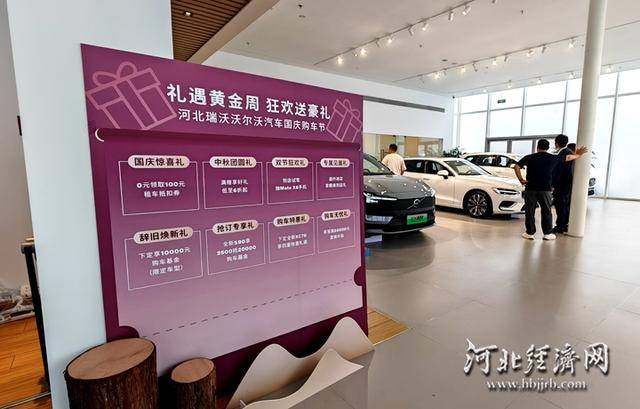
Core Insights - The automotive market in Shijiazhuang experienced a surge in consumer activity during the National Day and Mid-Autumn Festival holiday, driven by government subsidies and promotional events [1][3] - This year's market showed a combination of enthusiasm and rationality, with consumers making more informed purchasing decisions compared to previous years [1] Group 1: Policy and Promotions - The increase in market activity was initiated by the early release of policy benefits, including a vehicle trade-in subsidy and a promotional event organized by 13 cities in Hebei [1] - From September 26 to October 5, a limited number of vehicle trade-in qualification vouchers were distributed through the "Dongche Di" app, which significantly boosted consumer interest [1] Group 2: Sales Performance - During the holiday, foot traffic in many 4S stores increased dramatically, with some reporting a rise of 30% to 200% compared to pre-holiday levels [3][5] - Certain brands, such as BYD and Great Wall Motors, reported order volumes that exceeded their typical monthly sales, with increases of up to 400% in some cases [5][8] Group 3: Consumer Behavior - Consumers are increasingly taking a rational approach to purchasing, often comparing multiple brands and models before making a decision, with the decision-making period extending from 15-30 days [10][15] - Factors influencing consumer choices have diversified, including price, configuration, range, charging convenience, after-sales service, and resale value [15][17] - Sales strategies have adapted to this shift, with many dealerships offering test drive events and personalized service to meet consumer needs [17]
15.98万元起!鸿蒙智行攻入主流大众车市!或将重塑行业竞争格局|人民智行
Zheng Quan Shi Bao Wang· 2025-10-10 03:14
Core Insights - Huawei's automotive division, Hongmeng Zhixing, has officially launched the Shangjie H5, its most affordable model, priced starting at 159,800 yuan, marking its entry into the sub-200,000 yuan automotive market [1][2] - The launch of Shangjie H5 is expected to intensify competition in the domestic automotive market, particularly affecting self-owned and some joint venture brands in the same price range [2][6] Market Dynamics - In 2024, vehicles priced below 200,000 yuan are projected to account for over 70% of the domestic automotive market share, with the segment currently dominated by fuel vehicles, while the penetration rate of new energy vehicles stands at approximately 40% [2][5] - Over the past four years, Huawei has captured a significant share of the traditional luxury car market, delivering 930,000 vehicles, and has positioned itself as a leader among new force brands in the automotive sector [3][4] Competitive Landscape - The Shangjie H5 is designed to compete directly with models like Tesla Model Y and BYD Song PLUS, potentially forcing joint venture brands to accelerate their electrification efforts [4][6] - Traditional luxury brands, including BMW, Mercedes-Benz, and Audi, are experiencing declining sales, with each brand's sales dropping over 10% year-on-year, indicating increased pressure from new entrants like Huawei [3][4] Strategic Implications - Huawei's dual strategy of high-end and mainstream market penetration is seen as a significant move to challenge traditional luxury brands while expanding its market presence [4][9] - The introduction of Shangjie H5 is expected to push the automotive industry towards greater technological integration and lower pricing, altering consumer expectations regarding the value of smart vehicles [5][6] Future Outlook - The automotive industry is anticipated to shift from mechanical manufacturing to smart terminal production, with technology capabilities becoming the core competitive advantage [9] - Companies are advised to enhance their product intelligence, optimize cost structures, and explore new markets to maintain competitiveness against emerging players like Huawei [7][8]