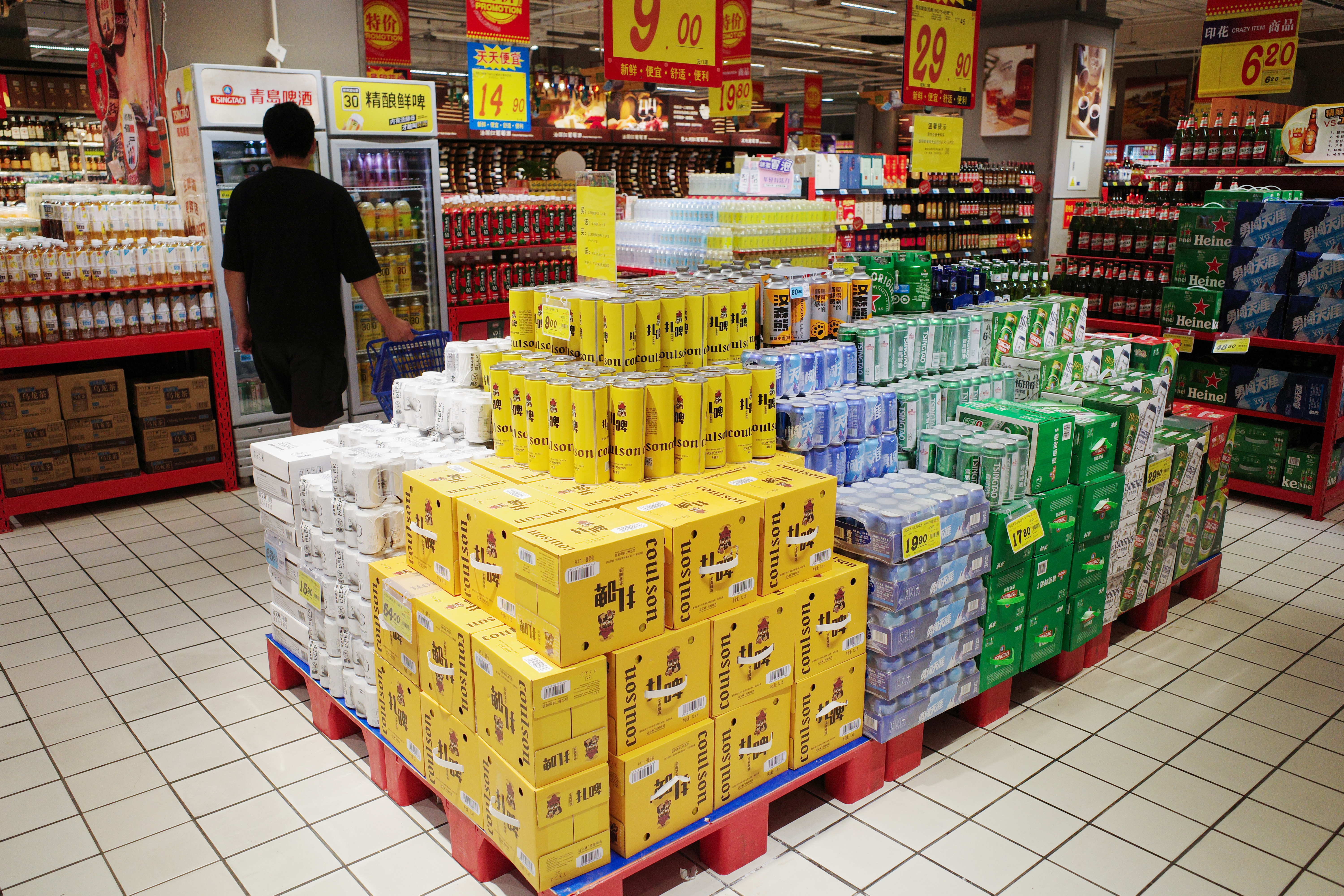
青岛啤酒

Search documents
罗永浩,新纪录
Zheng Quan Shi Bao Wang· 2025-06-16 05:00
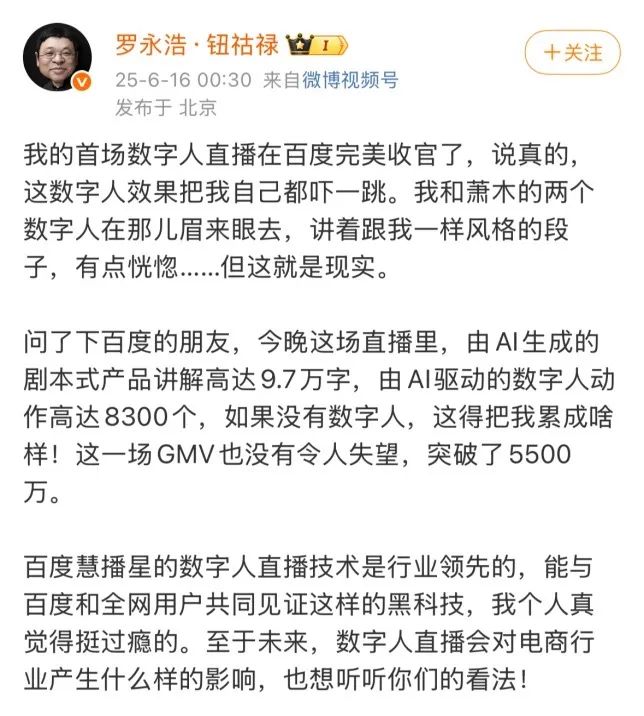
Core Insights - The digital human live streaming by Luo Yonghao on Baidu E-commerce achieved over 13 million views and generated a GMV of over 55 million yuan, setting a new record for digital human live streaming [1][3] - The digital human effectively mimicked Luo Yonghao's personal style, showcasing high levels of interaction and engagement with viewers, making it difficult to distinguish between the digital human and the real person [2][3] - Baidu E-commerce highlighted that this live streaming event marked several industry firsts, including the use of a digital human for over six hours and the natural interaction between multiple digital humans [3] Company Developments - Baidu Youxuan, launched in 2023, is positioned as a new generation of smart e-commerce platform driven by AI technology, aiming to differentiate itself from competitors like Douyin and Kuaishou [4] - The collaboration between Luo Yonghao and Baidu is based on a shared vision of leveraging AI technology to transform e-commerce, enhancing product offerings and promoting intelligent, efficient live streaming [3][4] Industry Trends - The digital human live streaming market is rapidly evolving, with IDC predicting that the overall market size will exceed 10 billion yuan by 2026, driven by advancements in AIGC technology [5] - The concept of "highly persuasive digital humans" was introduced by Baidu's founder, emphasizing the integration of script generation with digital human expressions and actions to create a more engaging experience [5] - Despite the rapid technological advancements, the industry faces challenges in achieving emotional resonance, balancing platform stability with technological risks, and establishing regulatory frameworks [6]


食品饮料行业2025年中期投资策略:结构分化,聚焦景气
Dongguan Securities· 2025-06-13 09:21
Group 1 - The food and beverage industry outperformed the CSI 300 index from January to May 2025, with a decline of 1.52%, surpassing the index by approximately 0.89 percentage points [6][15][16] - The industry valuation has decreased, with a current PE (TTM) of about 21 times, below the five-year average of 34 times [20][24] - Positive consumer policy signals have been established, with significant government initiatives aimed at boosting consumption and expanding domestic demand [24][27] Group 2 - The liquor sector is experiencing weak demand and internal differentiation, with a notable decline in sales during the Dragon Boat Festival [28] - Liquor companies are controlling supply to maintain prices, with several major brands implementing stock control measures [29][31] - Companies like Kweichow Moutai and Wuliangye are engaging in share buybacks to boost market confidence [34][36] Group 3 - The beer sector is showing stable performance with expectations for marginal improvement in 2025, driven by a recovery in demand [4][14] - The condiment sector is anticipated to benefit from the recovery in the restaurant industry, leading to increased demand for condiments [5][18] - The dairy sector is expected to see improved supply-demand dynamics due to favorable fertility policies [22][24] Group 4 - The snack sector is experiencing steady growth, with a focus on multi-channel penetration to enhance brand influence [25][27] - The overall performance of the snack sector is mixed, with some brands outperforming others [27][45]






腾讯云 TVP 走进青岛啤酒,解码数字化驱动智慧零售增长引擎
Sou Hu Cai Jing· 2025-06-13 03:31
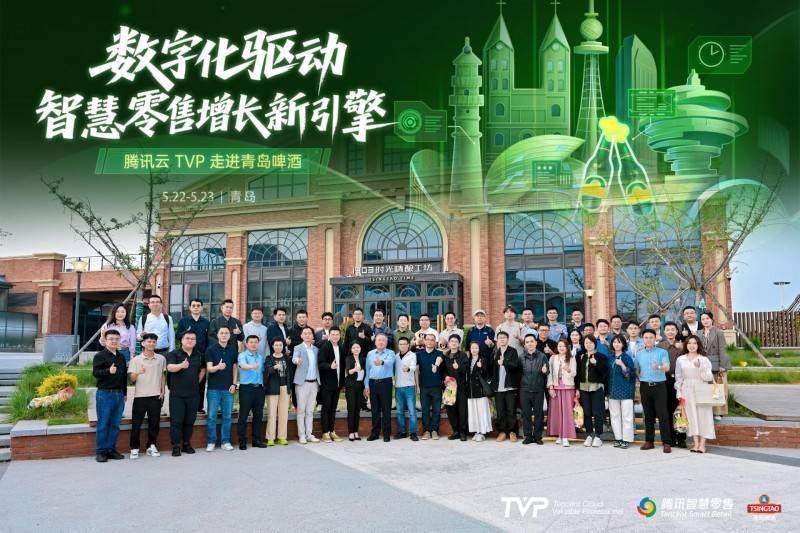
Core Insights - The retail industry is undergoing significant transformation driven by the integration of digital technologies, focusing on building intelligent operational systems to promote smart retail growth [1] Group 1: Event Overview - The event "Digitalization Drives Smart Retail Growth New Engine - Tencent Cloud TVP Visits Tsingtao Brewery" was successfully held on May 22-23, featuring experts sharing industry dynamics, technological advancements, and case studies [3] - The event included a visit to Tsingtao Brewery, allowing participants to experience the blend of traditional craftsmanship with modern digital management and production technologies [3] Group 2: Tencent's Role - Tencent Smart Retail aims to assist retailers in achieving digital transformation and comprehensive business growth, providing a platform for open and equal communication among industry partners [6][9] - Tencent's investment in technology and product capabilities is evident, with R&D expenditures reaching 18.9 billion yuan, a 21% year-on-year increase, indicating a strategic move towards the next generation of technology ecosystems [12] Group 3: Tsingtao Brewery's Digital Transformation - Tsingtao Brewery, established in 1903, is the fifth-largest brewery globally and is focusing on digital solutions for the fast-moving consumer goods sector through its subsidiary, Jiuyuan Technology [9] - The digital transformation journey of Tsingtao Brewery includes comprehensive coverage of the end-to-end business chain, utilizing technologies like "one code for one item" for data collection and sharing [15] - The brewery's digital marketing strategy involves creating an integrated service platform for distributors and leveraging a multi-code interconnected data ecosystem to enhance consumer engagement [15] Group 4: Smart Manufacturing and Sustainability - Tsingtao Brewery's smart manufacturing project aims to evolve into a sustainable lighthouse factory by 2024, focusing on personalized cloud customization and end-to-end demand management [24][25] - The brewery has implemented advanced technologies such as supply planning platforms and manufacturing execution systems to support its sustainable development goals [25] Group 5: Industry Trends and Future Outlook - The exploration of AI in retail is shifting from isolated tool applications to a comprehensive reconstruction of the entire supply chain, emphasizing the importance of embracing change and innovation [12] - The concept of "smart enterprises" is evolving, with a focus on replacing repetitive tasks with intelligent systems, allowing human resources to concentrate on higher-value activities [19][20]

“像极了交易中心的数据大屏”,买啤酒当“股”炒!被挤爆的“青岛啤酒交易所”能否形成长久消费模式?
Mei Ri Jing Ji Xin Wen· 2025-06-12 12:59
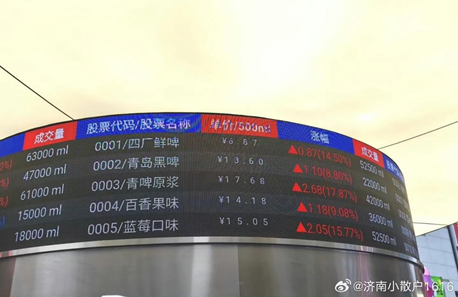
Core Viewpoint - The "Qingdao Beer Exchange" has become a popular attraction, merging the experience of drinking beer with stock trading, creating a unique consumer experience that drives sales and engagement during the beer season [2][4][10]. Group 1: Business Model and Consumer Engagement - The "Qingdao Beer Exchange" allows consumers to buy various types of beer, such as Qingdao Pure Draft and Qingdao White Beer, using a stock-like trading mechanism where prices fluctuate based on real-time demand [2][4]. - The exchange has seen significant foot traffic, with daily visitor numbers exceeding 10,000 during the Dragon Boat Festival, and beer sales reaching 120,000 milliliters in a single day [4][5]. - This innovative model combines elements of financial trading with consumer behavior, creating a social and engaging atmosphere that enhances the overall drinking experience [4][10]. Group 2: Market Trends and Consumer Preferences - The trend of "dopamine consumption" is emerging in the beverage market, with consumers seeking new and exciting experiences, such as the interactive nature of the beer exchange [6][10]. - A report indicates that diverse flavors, including tea and floral-infused beers, are gaining popularity among consumers, reflecting a shift towards more varied taste preferences [6]. - The beer industry is increasingly focused on attracting younger consumers by providing emotionally engaging experiences, which is essential for driving sales in a competitive market [8][10]. Group 3: Future Implications and Innovations - Experts suggest that the "Qingdao Beer Exchange" represents a new marketing model that could lead to a transformation in consumer experiences, moving from traditional consumption to emotionally-driven engagement [10]. - The concept of integrating trading-like experiences into beverage consumption could be replicated in various settings, potentially changing how consumers interact with beer and other alcoholic beverages [10].
不到两千买茅台?618酒水集体大降价
2 1 Shi Ji Jing Ji Bao Dao· 2025-06-12 08:47
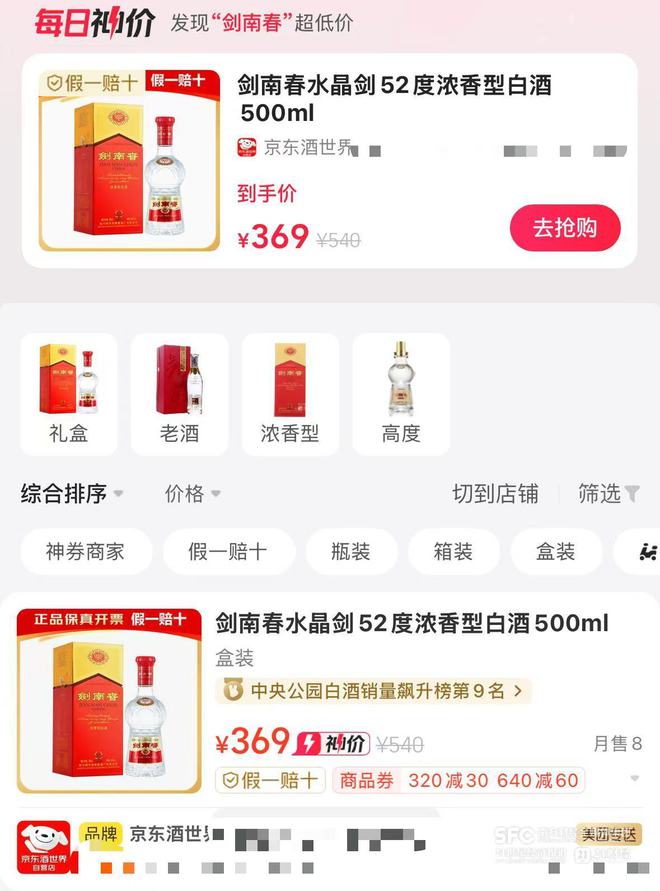
Core Viewpoint - The significant price reductions in alcoholic beverages during the 618 shopping festival are attributed to increased competition among e-commerce platforms and substantial subsidy investments in the liquor category [3][4]. Group 1: Price Reductions - Major liquor brands, including Moutai and Jian Nan Chun, have seen their prices drop significantly, with Moutai available for around 1900 yuan and Jian Nan Chun for 369 yuan [1][3]. - Beer prices have also decreased, with brands like Snow Beer and Budweiser priced under 4 yuan [2]. Group 2: E-commerce Competition - The competition among leading e-commerce platforms has intensified, leading to increased subsidies for liquor products, with some brands offering official subsidies of up to 10% [3][4]. - The 618 shopping festival has expanded its subsidy coverage to the liquor sector, further driving down online prices [3]. Group 3: Consumption Trends - The summer season typically sees a decline in liquor consumption, contributing to lower market prices [3]. - Beer consumption has shifted from on-premise channels like restaurants to off-premise channels, prompting beer companies to focus on flash sales and delivery services [5][6]. - Non-on-premise beer is generally cheaper, and with additional subsidies during the 618 festival, prices are expected to decrease further [6][7].
A股三大股指涨跌互现:沪指涨0.01%报3402.66点,IP经济概念股活跃
Xin Lang Cai Jing· 2025-06-12 07:19
Market Overview - The three major A-share indices opened lower on June 12 but turned positive during the morning session, with a narrow range of fluctuations in the afternoon [1] - The Shanghai Composite Index rose by 0.01% to 3402.66 points, while the ChiNext Index increased by 0.26% to 2067.15 points [1] - Total trading volume in the Shanghai and Shenzhen markets reached 12,717 billion, an increase of 162 billion from the previous trading day [1] Sector Performance - The computing power industry chain showed strength, with CPO direction leading the gains; gold jewelry, innovative pharmaceuticals, rare earth permanent magnets, quantum technology, and IP economy stocks were active [1] - Gold stocks continued to perform well, with several stocks like Ying Si Te and Da Di Xiong hitting the daily limit or rising over 10% [3] - The home appliance sector led the declines, with stocks like Dongfang Electric and He Sheng New Materials dropping over 2% [3][4] Stock Movement - A total of 2,325 stocks rose while 2,864 stocks fell, with 223 stocks remaining flat [1] - There were 94 stocks with gains exceeding 9%, while no stocks experienced declines of 9% or more [2] Market Sentiment and Outlook - Zhongyuan Securities anticipates a steady upward trend in the short term, supported by a loose monetary policy and fiscal measures [5] - Huashan Securities notes that small-cap stocks are performing significantly better than large-cap stocks, indicating strong investment opportunities in this segment [6] - Dongfang Securities emphasizes the importance of a rotation strategy in the current market environment, with a focus on low-position stocks [7] - Galaxy Securities highlights three main lines for investment: high safety margin assets, technology as a long-term focus, and consumer sectors boosted by policy support [8]
中国必需消费品:5月检查及消费品公司日总结:政策波动与通缩下渠道转变的崎岖之路
Goldman Sachs· 2025-06-11 02:50
Investment Rating - The report indicates a preference for Beverage, followed by Pet Foods, Beer, and Dairy, with specific stock ideas highlighted for Eastroc, Tingyi/CR beverage, and Tsingtao-H [9][10]. Core Insights - The industry is experiencing a bumpy recovery in demand, particularly in the spirits, beer, and dairy sectors, with recent policy changes impacting consumption sentiment [1][3]. - Emerging channel shifts, such as instant shopping and discounter channels, are gaining traction, although their overall contribution to the staples universe remains small [1][8]. - Profitability resilience is supported by cost deflation and agile investment strategies, with companies focusing on margin visibility amid muted demand trends [1][9]. Demand Recovery - The demand recovery in Q2 has been lackluster, with notable declines in spirits and dairy products, while beer performance varies across brands [2][11]. - Retail performance has been conservative, with spirits and dairy showing year-over-year declines, particularly in the upper mid-end segments [2][11]. - The beverage sector shows solid volume momentum, although mixed performance is noted across brands [2][11]. Policy Impact - Recent policy tightening on alcohol consumption has created headwinds for spirits and beer companies, particularly affecting high-end catering and on-trade consumption [3][6][34]. - The government has implemented regulations prohibiting the serving of alcoholic drinks during working meals, impacting consumption sentiment during peak seasons [3][6][34]. Emerging Trends - There is a notable shift towards discounter channels and instant shopping platforms, with companies customizing products to meet rising demand [8][10]. - The pet food and beverage categories are experiencing positive product cycles, contributing to growth despite overall market challenges [7][41]. Pricing and Cost Trends - Pricing pressures persist across various sectors, with dairy and beverages introducing more value-for-money products in response to declining raw milk prices [12][36]. - Cost benefits from declining commodity prices are expected to support margin resilience across multiple sectors, including beer and dairy [7][12]. Company Performance - Companies like Yili and Mengniu are facing weak demand trends in UHT liquid milk, while fresh milk and chilled yogurt categories are performing better [38]. - CR Beer and Chongqing Brewery are focusing on in-home consumption and premiumization strategies to counteract weak on-trade demand [35][40]. - The pet food sector remains strong, with companies like China Pet expecting significant year-over-year growth driven by new product launches [41].
618酒水促销新战场:即时零售频现名酒“地板价”
2 1 Shi Ji Jing Ji Bao Dao· 2025-06-10 09:55
Core Viewpoint - The article discusses the evolution of e-commerce promotions for alcoholic beverages, particularly during the 618 shopping festival, highlighting the shift towards instant retail platforms offering significant discounts through subsidies [1][5][20]. Group 1: E-commerce Competition - Major e-commerce platforms like Meituan, Taobao, and JD.com are competing fiercely in the instant retail space, offering substantial discounts on alcoholic beverages during the 618 promotion [1][5]. - Instant retail has emerged as a new battleground for low-priced alcoholic beverages, with platforms providing subsidies that allow them to offer prices significantly lower than traditional retail [5][10]. Group 2: Pricing Strategies - Discounts on premium liquors have become more common, with some high-end products being sold at prices significantly below market rates due to platform subsidies [1][10]. - For example, a premium liquor was priced at 1999 yuan after subsidies, while another high-end product was available for as low as 859 yuan [1][10]. Group 3: Sales Performance - Meituan reported a staggering 18-fold increase in sales for alcoholic beverages during the 618 event, with white liquor sales increasing over 70 times compared to previous years [20]. - Other platforms like Tmall also reported significant growth in sales for various domestic liquors, with some brands experiencing over 400% growth [20]. Group 4: Industry Response - Traditional liquor companies have shown a degree of acceptance towards the lower prices offered by instant retail platforms, indicating a shift in strategy to maintain sales volume during a downturn [19][21]. - Many well-known liquor brands have partnered with e-commerce platforms for instant retail services, allowing for faster delivery and maintaining product authenticity [19][21]. Group 5: Future Outlook - While instant retail is gaining traction, industry experts believe it will serve as a supplement rather than a replacement for traditional sales channels, as the primary market for liquor remains focused on bulk purchases [22][23]. - The long-term impact of e-commerce promotions on liquor pricing and sales dynamics is still uncertain, with concerns about potential harm to brand value and traditional retail channels [23].

“每食每刻”系列之(十三):即时零售,啤酒消费的“硬折扣”
Changjiang Securities· 2025-06-10 09:12
行业研究丨深度报告丨啤酒 [Table_Title] "每食每刻"系列之(十三):即时零售,啤酒 消费的"硬折扣" %% %% %% %% research.95579.com 1 丨证券研究报告丨 报告要点 [Table_Summary] 依托于互联网发展,具有"快"、"近"、"多"特征的即时零售业务近年来得到高速发展,酒小 二、歪马送酒等酒水垂直类即时零售平台渐渐走入消费者生活,2025 年酒小二/歪马送酒门店 预计已突破 2000/1400 家。本文主要探讨酒水即时零售平台运营模式、单店模型及其为啤酒行 业带来的变化。 分析师及联系人 [Table_Author] 董思远 徐爽 冯萱 SAC:S0490517070016 SAC:S0490520030001 SAC:S0490524060001 SFC:BQK487 请阅读最后评级说明和重要声明 2 / 22 %% %% %% %% research.95579.com 2 [Table_Title "每食每刻"系列之(十三):即时零售,啤酒 2] 消费的"硬折扣" [Table_Summary2] 中国酒水消费线上化率不断提升 中国饮酒文化源远流长, ...
见手青、茶叶等中式精酿催热赛道,啤酒高端化路径生变
Di Yi Cai Jing· 2025-06-10 08:21
Group 1 - The craft beer market in China is experiencing a resurgence, particularly with the rise of Chinese craft beer, which is expected to lead a new wave of premiumization in the beer industry [1][3] - Various unique flavors such as tea, chili, and other niche tastes are gaining popularity, indicating a shift in consumer preferences towards more diverse and personalized beer options [2][3] - The number of craft beer-related enterprises in China has significantly increased, with 1,749 new registrations in 2024 and 1,063 in 2025, reflecting a 20.6% year-on-year growth in the first five months of 2025 [3] Group 2 - Despite an overall decline in the beer industry in 2024, many craft beer companies report sales growth, indicating a potential industry boom [3][7] - The craft beer segment is attracting not only traditional beer companies but also distributors and restaurants, further broadening its market reach [3][7] - Major beer companies are increasingly investing in craft beer production, with notable expansions and new facilities being established to meet the growing demand [10][11] Group 3 - The craft beer trend is seen as a response to changing consumer behaviors, particularly among younger generations who prioritize unique experiences and emotional value in their purchases [7][8] - The market is witnessing a diversification of beer products, with many new offerings that do not strictly adhere to traditional definitions of craft beer, appealing to the curiosity of younger consumers [8] - The overall beer market in China is transitioning towards a new phase of premiumization, with craft beer positioned as a key driver for this evolution [9][11]