
应流股份

Search documents
2025年中国航空发动机行业成本结构分析:材料成本占比最大【组图】
Qian Zhan Wang· 2025-06-05 02:10
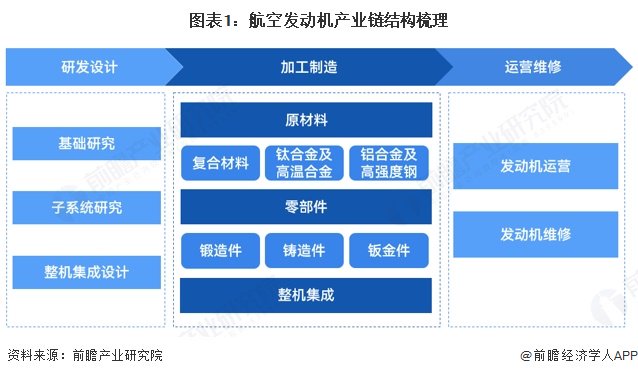
转自:前瞻产业研究院 行业主要上市公司:航发科技(600391);航发动力(600893);航发控制(000738);应流股份(603308);中航重机 (600765)等 ——制造阶段成本结构:原材料成本占比最高 航空发动机制造成本(不含控制系统)主要由两部分组成:原材料成本、劳动力成本,分别占比在 40%-60%,25%-35%。发动机使用的原材料主要是高温合金、钛合金,两者价值占比分别在35%、30% 左右。高温合金涉及的主要材料是镍、钴金属,钛合金主要是钛。发动机应用的其他材料还包括铝合 金、钢等。 ——中国已基本建立完整的研制生产体系 航空发动机产业链包括研发设计、加工制造(原材料、零部件、整机制造)、运营维修等环节。我国目前 已基本建立了完整的航空发动机研制和生产体系。 ——研发阶段成本结构:实验费用占比50% 据《航空发动机-飞机的心脏》所述,航空发动机研发阶段费用按成本构成拆分,设计费用占比10%、 试验费用占比50%、研发阶段制造费用占比40%。 本文核心数据:成本结构等 ——维护阶段成本结构:零备件航材成本占比过半 《发动机制造商另辟商机谈航空发动机售后服务和热端部件的典型修理技术》数据显 ...


AI基建产业梳理:基建加速迎景气周期
Guoxin Securities· 2025-06-04 00:45
Investment Rating - The report rates the AI infrastructure industry as "Outperform" compared to the broader market [1]. Core Insights - The explosive demand for intelligent computing is driving continuous growth in data centers, with power distribution and cooling being the core components of AI infrastructure [3]. - Capital expenditures in the AI infrastructure sector are expected to reach hundreds of billions, with major companies like Google, Microsoft, and Amazon projected to spend $320 billion in FY2025, a 39% increase from FY2024 [3][22]. - The report emphasizes the importance of power supply systems, particularly gas turbines, which are becoming the preferred primary power source for data centers due to their short construction cycles and low costs [3][60]. Summary by Sections AI Infrastructure Overview - The AI infrastructure industry is entering a prosperous cycle driven by significant capital investments and policy support [3][22]. - The demand for intelligent computing centers (AIDC) is expected to lead to a substantial increase in power requirements, with global IT power demand projected to grow from 49 GW in 2023 to 96 GW by 2026 [19][26]. Main Power Supply - Gas Turbines - Gas turbines are anticipated to benefit from a long-term upcycle, with global orders expected to increase by 38% year-on-year in 2024 [3][60]. - The gas turbine market is projected to reach an average annual market size of nearly $40 billion over the next five years [3]. - The report highlights the scarcity of production capacity for turbine blades, which constitute over one-third of the turbine's core value [3]. Backup Power Supply - Diesel Generators - The global market for diesel generators in data centers is expected to reach $9 billion by 2026, with a near double-digit growth rate until 2030 [3]. - The supply chain for diesel generators is experiencing tightness, leading to price increases and improved performance for companies in this sector [3]. Cooling Systems - Liquid cooling is expected to replace air cooling as the industry standard, with the market for cooling systems projected to exceed $100 billion by 2028 [3]. - Chilled water units are identified as a key beneficiary of the shift towards liquid cooling, with robust growth anticipated [3]. Investment Recommendations - The report suggests focusing on segments within the supply chain that are positioned to benefit from the explosive demand, particularly those with supply constraints and strong customer ties [3]. - Recommended companies include Yingliu Technology, Haomai Technology, and Ice Wheel Environment, among others [7][8].
可控核聚变商业化有望提速 多家上市公司协同布局
Zheng Quan Ri Bao· 2025-06-03 16:29
Group 1: Industry Developments - Recent breakthroughs in controlled nuclear fusion in China, including the early start of the BEST project and the successful operation of the "Chinese Circulation No. 3" at high performance levels, indicate significant advancements in the field [1][2] - The Chinese government has increased policy support for controlled nuclear fusion, designating it as a key area for low-carbon technology development and future energy solutions [2][3] - Multiple projects in the controlled nuclear fusion sector are accelerating, with significant international collaboration, such as the completion of components for the world's largest superconducting electromagnetic system [3] Group 2: Market Opportunities - The controlled nuclear fusion industry is projected to create substantial opportunities for related upstream and downstream companies, with a focus on commercializing the technology [1][4] - A report indicates that 26 out of 37 surveyed commercial nuclear fusion companies expect to achieve their first grid-connected fusion reactor by 2035, signaling a shift towards commercial viability [3] - The domestic nuclear fusion sector is experiencing a surge in project tenders, marking a new phase of development and potential growth in the coming years [3][4] Group 3: Company Strategies - Companies in the nuclear fusion supply chain are actively positioning themselves to capitalize on the emerging market, with significant investments and strategic partnerships being formed [4][5] - Key players are focusing on the development of advanced materials and equipment, with notable contracts already signed for major projects, indicating a robust pipeline of opportunities [4][5] - The industry is encouraged to enhance collaboration across the supply chain and focus on technological advancements to secure a competitive edge in the evolving energy landscape [5][6]
可控核聚变行业系列报告之一:产业化进程加速,中国领航开启聚变元年
Shenwan Hongyuan Securities· 2025-06-03 13:14
Investment Rating - The report maintains a positive outlook on the controllable nuclear fusion industry, indicating a strong belief in the investment opportunities across the entire industry chain [3][4]. Core Insights - The controllable nuclear fusion technology is transitioning from laboratory research to engineering verification, with significant advancements in China and international collaboration through the ITER project [3][5]. - The global controllable nuclear fusion market is projected to grow from $331.49 billion in 2024 to $479.5 billion by 2029, with a substantial construction phase expected between 2025 and 2035 [3][4]. - The report emphasizes the importance of high-barrier and high-value segments within the industry chain, recommending specific companies for investment [4][5]. Summary by Sections 1. Controllable Nuclear Fusion: Progress Towards the "Eternal" 50 Years - The D-T reaction is identified as the mainstream approach for nuclear fusion, offering high energy density and sustainability compared to traditional nuclear fission [14][21]. - The magnetic confinement route is confirmed as the dominant technical pathway, with significant research and development efforts in China [26][27]. 2. Global Fusion Landscape: ITER and International Cooperation - The ITER project is highlighted as the largest international scientific collaboration aimed at developing a self-sustaining nuclear fusion reactor, with China playing a crucial role [48][51]. - Various countries are increasing their investments in fusion energy, with significant funding allocated to projects like ITER and national initiatives [61][63]. 3. China's Rise in Fusion Technology - China is advancing rapidly in nuclear fusion technology, with multiple research institutions and private companies contributing to the development of various fusion routes [3][5]. - The BEST project in China has commenced ahead of schedule, indicating a robust pace in fusion technology development [3][5]. 4. Market Potential and Investment Opportunities - The report forecasts a market space of approximately $203.5 billion for controllable nuclear fusion from 2025 to 2035, with a focus on high-value segments such as superconducting materials and core components [3][4]. - Recommended companies for investment include Lianchuang Optoelectronics, Guoguang Electric, and others involved in the high-barrier segments of the industry [4][5].
机械行业周报2025年第22周:“格物:致知”通用具身智能开发平台发布,工程机械景气度持续复苏
EBSCN· 2025-06-03 10:35
Investment Rating - The report maintains a "Buy" rating for the machinery industry, indicating a positive outlook for investment opportunities in the sector [1]. Core Insights - The machinery industry is experiencing a continuous recovery in its economic climate, particularly in the engineering machinery segment, with significant growth in sales and production expected in 2025 [6][13]. - The introduction of the "Ge Wu - Zhi Zhi" general embodied intelligence development platform is expected to accelerate the application and research of humanoid robots, addressing existing challenges in the field [3]. - The report highlights the importance of various sub-industries, including humanoid robots, machine tools, agricultural machinery, and engineering machinery, each showing distinct trends and growth potential [4][7][8][13]. Summary by Relevant Sections Humanoid Robots - The launch of the "Zhi Zhi" platform aims to enhance humanoid robot development by integrating core technologies across operating systems, middleware, and software frameworks [3]. - Companies like Shanghai Aoyi Information Technology and Hefei Zero Point are introducing innovative humanoid robots targeting various applications, including healthcare and hospitality [4][5]. - The humanoid robot industry is projected to see significant production increases in 2025, with a focus on high-complexity dexterous hands and cost reduction in production [6]. Machine Tools - Japan's machine tool orders in April 2025 reached 130.206 billion yen, showing a year-on-year increase of 7.7% [7]. - China's metal cutting machine tool production in the first four months of 2025 was 264,000 units, reflecting a year-on-year growth of 16.8% [7]. Agricultural Machinery - The agricultural machinery market in China showed a decline in the AMI index to 47.9% in April 2025, indicating a downturn in the sector [8]. - Despite the current challenges, long-term demand for agricultural machinery is expected to rise, particularly in the context of the Belt and Road Initiative [9]. Engineering Machinery - The engineering machinery sector is witnessing a recovery, with excavator sales in April 2025 reaching 22,142 units, a year-on-year increase of 17.6% [13]. - The report suggests that infrastructure investment will remain robust, supporting the demand for engineering machinery [13]. Semiconductor Equipment - The report notes that the implementation of reciprocal tariffs is accelerating the domestic substitution of key semiconductor equipment, particularly photolithography machines [16]. - The establishment of the third phase of the Big Fund, with a registered capital of 344 billion yuan, is expected to significantly boost the domestic semiconductor industry [17]. New Energy Equipment - The report highlights several new energy projects, including the launch of a 100GW monocrystalline silicon wafer production line by Longi Green Energy, indicating a strong push towards renewable energy technologies [19]. - The market for photovoltaic components is expected to stabilize and grow due to policy support and technological advancements [19]. Low-altitude Economy and EVTOL - The report discusses the government's initiatives to promote the low-altitude economy, including the development of drone delivery systems and infrastructure [20][22]. - The low-altitude economy is anticipated to drive new consumption patterns and industry growth, with significant investments being made in this area [22].
AI基建行业专题:AI基建产业梳理:基建加速迎景气周期-20250603
Guoxin Securities· 2025-06-03 09:48
Investment Rating - The report rates the AI infrastructure industry as "Outperform" compared to the market [1]. Core Insights - The demand for intelligent computing is driving the continuous growth of data centers, with power distribution and cooling being core components of AI infrastructure [3]. - Capital expenditures in the AI infrastructure sector are expected to reach hundreds of billions, with major companies like Google, Microsoft, and Amazon projected to spend $320 billion in FY2025, a 39% increase from 2024 [3][22]. - The report emphasizes the importance of power supply systems, particularly gas turbines, which are becoming the preferred primary power source for data centers due to their short construction cycles and low costs [3][60]. Summary by Sections AI Infrastructure Overview - The AI infrastructure industry is entering a prosperous cycle driven by increased demand and supportive policies [3][19]. - The global computing power scale is expected to reach approximately 910 EFLOPS by the end of 2023, with a 40% year-on-year growth [19]. Power Supply Systems - Gas turbines are expected to benefit from a long-term upcycle, with global orders projected to increase by 38% year-on-year in 2024 [3][60]. - The report highlights that gas turbines account for over 50% of the value in AI infrastructure, while cooling systems account for over 20% [3][37]. Cooling Systems - Liquid cooling is anticipated to replace air cooling as a trend in the industry, with the market for cooling systems expected to exceed 100 billion by 2028 [3][32]. - The report identifies external cooling units, such as chillers, as key beneficiaries of this transition [3]. Investment Recommendations - The report suggests focusing on segments within the supply chain that are core to the industry, have rigid supply, and are linked to major clients [3]. - Recommended companies include Yingliu Co., Haomai Technology, and Ice Wheel Environment, among others [7][8].
可控核聚变行业专题报告:核聚成能,众志成城
Changjiang Securities· 2025-06-03 05:16
Investment Rating - The report does not explicitly state an investment rating for the controlled nuclear fusion industry. Core Insights - Controlled nuclear fusion is considered a strategic energy source that is safe, clean, low-carbon, and has high energy density, potentially solving humanity's energy problems [12][18]. - The energy balance is a critical indicator for the commercial viability of controlled nuclear fusion, with future energy gain indicators expected to exceed 10 [22]. - The global timeline for achieving operational demonstration reactors is set for 2050, with significant advancements expected in the coming years [54][56]. Summary by Sections Section 1: Energy Solutions - Controlled nuclear fusion is a promising solution to energy needs, utilizing abundant fuel sources like deuterium from seawater, which could support humanity's energy demands for thousands of years [18][20]. - The energy gain (Q value) is a key metric, with a threshold of Q=1 indicating feasibility for scientific and engineering applications [22][23]. Section 2: Technological Progress - The report highlights the transition from copper-based magnets to high-temperature superconductors in fusion devices, which enhances efficiency and reduces costs [52][73]. - Major global projects like ITER are pivotal in advancing fusion technology, with significant international collaboration [59][62]. Section 3: Industry Structure - The current focus is on the midstream components of fusion devices and upstream materials, with a detailed breakdown of the value chain [98][100]. - Key materials include low-temperature superconductors, high-temperature superconductors, tungsten, and stainless steel, which are essential for the construction of fusion reactors [100][103]. Section 4: Market Opportunities - The report identifies upstream material suppliers and midstream equipment manufacturers as core beneficiaries of the fusion industry, with specific companies highlighted for their roles [114][117]. - The downstream segment includes research institutions and private fusion companies, indicating a growing market for fusion technology applications [117].
黑色产业链负循环时,权益是怎么表现的?
Changjiang Securities· 2025-06-02 23:30
Investment Rating - The industry investment rating is Neutral, maintained [9] Core Views - The report highlights that during the negative cycle of the black industrial chain, steel prices are more indicative of market expectations for future profitability than immediate profits. A rebound in steel prices is necessary to break the negative cycle and reverse the industry's loss expectations [2][6][7] - The report notes that recent trends show a synchronized decline in steel prices and steel stocks, driven by weak terminal demand and falling raw material prices, which have weakened cost support for finished products [4][6] - The report emphasizes that while immediate profits may still be present, they are insufficient to stabilize equity prices. Only a rebound in steel prices can alter the industry's outlook [7] Summary by Sections Market Performance - Recent data indicates a slight increase in apparent steel consumption, with a year-on-year increase of 0.06% and a week-on-week increase of 0.53%. However, expectations for demand are weakening as the industry enters a seasonal downturn [4] - The average daily pig iron output from sample steel companies has decreased to 2.4191 million tons, reflecting a downward trend [5] - Inventory levels continue to decline, with total inventory of long products down 27.92% year-on-year and plate inventory down 16.62% year-on-year [5] Historical Context - The report draws parallels to historical instances of synchronized declines in steel and raw material prices, particularly from 2012 to 2014, where weak demand and oversupply led to significant price drops [6][7] - It notes that the current situation mirrors past cycles, with the potential for further declines in steel prices if the negative cycle continues [6][7] Investment Opportunities - The report suggests focusing on undervalued quality companies in the steel sector, such as Baosteel and Nanjing Steel, which are expected to enhance shareholder returns. It also highlights the potential for mergers and acquisitions in the sector [28] - In the new materials sector, companies like Fushun Special Steel and Huafeng Aluminum are identified as having strong recovery potential [28]
ETF热门榜(2025年5月30日):基准国债ETF(511100.SH)交易活跃,债券板块活跃度提升
Sou Hu Cai Jing· 2025-05-30 09:11
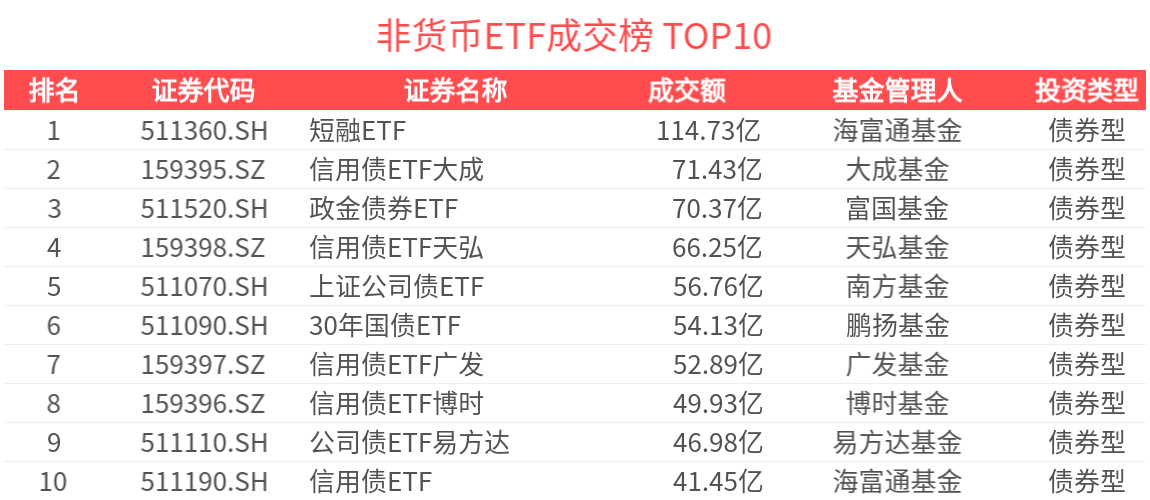
Summary of Key Points Core Viewpoint - The trading volume of non-monetary ETFs reached 201.245 billion yuan, with 48 ETFs exceeding 1 billion yuan in trading volume, indicating a significant market activity in the ETF sector [1]. Trading Volume and Performance - The top three ETFs by trading volume are Short-term Bond ETF (114.73 billion yuan), Credit Bond ETF Dacheng (71.43 billion yuan), and Policy Financial Bond ETF (70.37 billion yuan) [1][4]. - The Short-term Bond ETF saw a trading volume increase of 234.12% compared to the previous trading day, with a turnover rate increase of 233.00% [1]. - The Standard & Poor's 500 ETF had an average trading volume of 21.72 billion yuan over the past five days, indicating increased market activity [2]. Turnover Rates - The top three ETFs by turnover rate are Benchmark National Bond ETF (344.82%), 5-Year Local Bond ETF (193.45%), and Standard & Poor's 500 ETF (183.43%) [6]. - The Credit Bond ETF Daceng and Credit Bond ETF Tianhong appeared on both trading volume and turnover rate lists, highlighting their popularity [1][6]. ETF Characteristics - The Short-term Bond ETF tracks the China Securities Short-term Bond Index, reflecting the performance of investment-grade short-term bonds [1]. - The Policy Financial Bond ETF tracks the China Bond 7-10 Year Policy Financial Bond Index, which includes bonds issued by major policy banks [2]. - The Standard & Poor's 500 ETF tracks the S&P 500 Index, representing 500 leading companies in the U.S. stock market [2]. Sector and Industry Focus - The industry-themed ETFs include Hong Kong Medical ETF and Hong Kong Innovative Drug 50 ETF, indicating a focus on healthcare and innovation sectors [1]. - The Technology Pioneer ETF and General Aviation ETF are among the top performers in terms of volatility, suggesting investor interest in these sectors [7][10].
应流股份(603308) - 应流股份2024年度权益分派实施公告
2025-05-29 10:30
证券代码:603308 证券简称:应流股份 公告编号:2025-019 安徽应流机电股份有限公司2024年年度权益分派实施 公告 本公司董事会及全体董事保证本公告内容不存在任何虚假记载、误导性陈述 或者重大遗漏,并对其内容的真实性、准确性和完整性承担法律责任。 重要内容提示: 每股分配比例 差异化分红送转: 否 一、 通过分配方案的股东大会届次和日期 本次利润分配方案经公司2025 年 4 月 22 日的2024年年度股东大会审议通过。 二、 分配方案 截至股权登记日下午上海证券交易所收市后,在中国证券登记结算有限责任公司上海分 公司(以下简称"中国结算上海分公司")登记在册的本公司全体股东。 3. 分配方案: 本次利润分配以方案实施前的公司总股本679,036,441股为基数,每股派发现金红利0.07 元(含税),共计派发现金红利47,532,550.87元。 1. 发放年度:2024年年度 2. 分派对象: A 股每股现金红利0.07元 相关日期 | 股份类别 | 股权登记日 | 最后交易日 | 除权(息)日 | 现金红利发放日 | | --- | --- | --- | --- | --- | | A股 ...
