海螺水泥

Search documents
“安徽军团”展现焕新动能
Xin Hua Wang· 2025-09-17 01:06
Core Insights - The "2025 China Top 500 Enterprises" list was released, with a revenue threshold of 47.96 billion yuan, an increase of 579 million yuan from the previous year [1] - The total revenue of the top 500 enterprises reached 11.015 trillion yuan, showing a growth trend compared to the previous year [1] - The number of enterprises with revenue exceeding 100 billion yuan increased to 267, accounting for 53.4% of the total [1] - The average R&D intensity of the listed companies reached a new high of 1.95%, marking an increase for eight consecutive years [1] - The balance between state-owned and private enterprises remains stable, with 251 state-owned and 249 private enterprises on the list [1] Summary by Category Company Performance - Ten enterprises from Anhui province made the list, including Chery Holding Group, Tongling Nonferrous Metals Group, and NIO, marking a slight increase from eight in 2024 [2] - The revenue of Anhui's listed enterprises generally increased, with several companies improving their rankings significantly, indicating growth above the average of the top 500 [3] - NIO ranked 367th, reflecting its recognition in the market despite being in a critical development phase [4] - Tongling Nonferrous Metals and Anhui Conch Cement, ranked 109th and 193rd respectively, remain key pillars of Anhui's industrial economy [3][4] Industry Trends - The list highlights the dual drive of traditional and emerging industries in Anhui, with both resource-based enterprises and high-end manufacturing firms contributing to growth [4] - Sunpower, a leading company in the photovoltaic inverter and energy storage system sector, advanced from 335th to 318th place, showcasing its competitive advantage despite industry adjustments [3][4] - The presence of both traditional and new energy companies aligns with Anhui's strategy of becoming a manufacturing powerhouse [4] Future Outlook - The province is expected to see continued growth in the number of top 500 enterprises, particularly in cutting-edge fields such as integrated circuits, artificial intelligence, and biomedicine [5] - There is potential for growth in large enterprises in northern Anhui, which will be crucial for balanced regional development [6] - The list serves as an important window into the economic performance of Anhui, indicating a phase of high-quality development [6]



联合深度专题:反内卷,细分行业如何选?
2025-09-17 00:50
Summary of Conference Call Records Industry Overview - **Steel Industry**: Profitability improvement relies on supply-demand optimization and capacity exit. Anti-dumping measures aim to suppress raw material positions and promote profit return to the industry chain, aligning with national strategic direction. Expected implementation of graded management starting in 2026, with non-compliant companies facing significant production cuts, thus driving market clearance [1][6][4]. - **Cement Industry**: Facing supply-side overproduction governance. Strict implementation and cooperation among companies could lead to price elasticity. Current actual capacity utilization is around 50%, with regional variations [13][14]. - **Photovoltaic Glass**: Low profitability but high capacity utilization, with long-term demand growth expected. Strong necessity for anti-involution measures due to low profitability [16][12]. - **Express Delivery Industry**: Rapid effects from anti-involution, with significant price increases and high profit elasticity. Each listed express company could add 500 to 1,000 million profits per quarter [20][23]. - **Aviation Industry**: Affected by weak business demand, but typically performs well in Q4. Structural oversupply is a challenge, with North American routes not recovering, leading to increased domestic capacity [22][29]. - **Chemical Industry**: Influenced by inventory cycles and new capacity launches, with most sub-industries in a wait-and-see state. Focus on opportunities for clearing outdated capacities in specific sectors [31][32]. Key Points and Arguments - **Steel Industry Profitability**: Post anti-involution policy, profitability surged from 40-50 RMB per ton to over 200 RMB, but has since declined due to rising raw material prices [2]. The industry needs supply-demand balance and capacity exit for sustained profitability [9]. - **Profit Distribution in Steel**: Iron ore accounts for 70-75% of the profit distribution, while steel and coking coal each account for 15%. The reliance on imported iron ore necessitates adjustments through anti-involution policies for reasonable profit distribution [5]. - **Future Management of Steel Capacity**: Starting in 2025, a limit of 50 million tons will be implemented, with graded management expected in 2026 to drive the exit of outdated capacities [6]. - **Cement Price Elasticity**: Price elasticity in the cement industry will depend on strict implementation of overproduction governance and cooperation among companies [17]. - **Photovoltaic Glass Supply Changes**: The industry has seen price increases due to production limits, with a current capacity utilization of about 70%. Long-term supply changes will depend on policy advancements [19]. - **Express Delivery Price Trends**: The express delivery industry has seen significant price increases, with regulatory measures supporting price hikes through warehouse locking and feedback mechanisms [26]. - **Aviation Industry Challenges**: The aviation sector is facing structural oversupply and weak business demand, with a projected low growth rate in supply over the next few years [28][30]. Additional Important Insights - **Investment Recommendations**: - For the steel sector, focus on leading companies like Hualing Steel and Baosteel, which could see profit elasticity of 40-80% if profitability rebounds [10]. - In the cement sector, Huaxin Cement is recommended due to its domestic and overseas business potential [18]. - In the express delivery sector, stocks of tail-end companies like Shentong, YTO, and Yunda are recommended for investment [27]. - **Chemical Industry Opportunities**: Potential for collaborative production cuts in sectors like organic silicon and polyester filament, which are currently underperforming [34]. - **Coal Industry Outlook**: The coal sector is expected to benefit from macroeconomic factors and supply restrictions, with specific recommendations for Yanzhou Coal and Electric Power [45]. This summary encapsulates the key insights and recommendations from the conference call, providing a comprehensive overview of the discussed industries and their future outlooks.
【宏观*芦哲】特朗普干预美联储独立性的三个途径
Sou Hu Cai Jing· 2025-09-17 00:28
Macro - Trump's intervention in the independence of the Federal Reserve is primarily through three avenues: 1) Nominating a Federal Reserve Chair who aligns with his views, expected to be nominated in November this year and take office in May next year; 2) Adjusting the personnel structure of the Federal Reserve Board to exclude "outsiders" like Cook, while appointing "loyalists" like Milan to strengthen his influence; 3) Intervening in the appointment of regional Federal Reserve presidents, whose terms will expire at the end of February next year [1] - With the new Federal Reserve Chair's appointment, 4 out of 7 members of the Federal Reserve Board will be "loyalists," giving Trump greater influence, which implies: 1) On a macroeconomic level, the expected rate cuts by the Federal Reserve in 2026 may exceed the current market pricing of three cuts, with policy rates potentially falling below the neutral level of 3%, leading to a shift from a soft landing to moderate expansion in the U.S. economic cycle; 2) On the asset class level, excessive rate cuts under political pressure may weaken dollar interest rate expectations and widen dollar credit risks, corresponding to declines in 2-year Treasury yields and the dollar index, while the decline in 10-year Treasury yields may be hindered by widening term premiums [1]

5000字深度报告 | “反内卷”与“供给侧”改革底层逻辑是康波大周期!
对冲研投· 2025-09-16 12:05
Core Viewpoint - The article discusses the cyclical nature of economic development and the historical patterns of supply-side reforms in various countries, emphasizing the importance of understanding these cycles for future investment strategies [4][5][6]. Group 1: Historical Context of Supply-Side Reforms - The article highlights the cyclical characteristics of technological advancements, noting that each revolution leads to changes in production methods and societal structures [5][6]. - It reviews the supply-side reforms in Western countries, particularly the UK and the US, and compares them with China's historical reforms [8][9]. - The UK's supply-side reform from 1979 to 1990 is examined, detailing the economic challenges faced, including high public debt and inflation [10][14][15]. Group 2: Economic Challenges and Responses - The UK faced a public debt-to-GDP ratio of 55.2% in 1979, significantly higher than Germany and France at the time [15]. - The article outlines the inefficiencies of state-owned enterprises in the UK, which contributed to the public debt crisis [18]. - Key reform measures included privatization, tax reductions, and spending cuts, which improved market efficiency and reduced public debt [19][20][22]. Group 3: Comparison with China - The article draws parallels between the UK's and China's economic situations, particularly during the late 1970s and 2016, when both faced significant unemployment and economic restructuring [24][26]. - China's supply-side structural reform initiated in 2016 aimed to address multiple structural contradictions in the economy, similar to the UK's earlier reforms [61][64]. - The goals of China's reform included reducing excess capacity and improving production efficiency, aligning with the historical context of supply-side reforms [63][64]. Group 4: Future Economic Cycles - The article predicts that the global economy will enter a new cycle around 2030, with the current period likely being the tail end of a downward phase [59]. - It emphasizes the importance of understanding the Kondratiev wave theory, which suggests that economic cycles last 40-60 years and consist of phases of prosperity, recession, depression, and recovery [60]. - The article suggests that the upcoming reforms in 2025 will focus on high-quality development and address issues of resource allocation between new and old economies [69][72]. Group 5: Impact of Policy Changes - The article discusses the "反内卷" (anti-involution) policy in China, which aims to restructure market competition and promote innovation by addressing low-quality competition [69][72]. - It highlights the positive effects of these policies on various industries, such as the solar energy sector, which saw a significant price rebound and improved profitability [72][74]. - The shift in consumer behavior, driven by policy changes, is noted, with an increase in service consumption as a result of reduced aggressive pricing strategies [74][75].

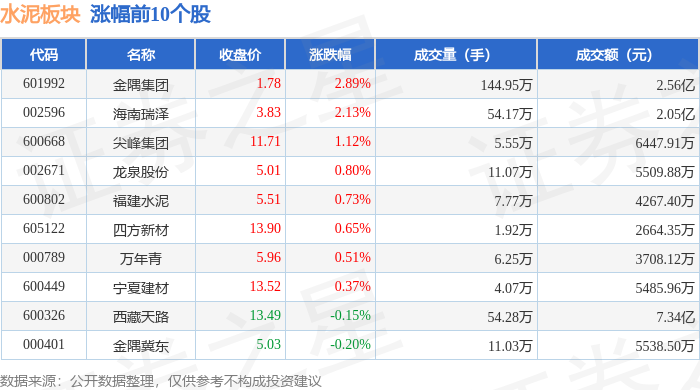
水泥板块9月16日跌0.94%,华新水泥领跌,主力资金净流出3.25亿元
Zheng Xing Xing Ye Ri Bao· 2025-09-16 08:46
Market Overview - The cement sector experienced a decline of 0.94% on September 16, with Huaxin Cement leading the drop [1] - The Shanghai Composite Index closed at 3861.87, up 0.04%, while the Shenzhen Component Index closed at 13063.97, up 0.45% [1] Individual Stock Performance - Huaxin Cement (600801) closed at 17.84, down 2.41%, with a trading volume of 321,400 shares and a transaction value of 578 million yuan [2] - Other notable declines include Tianshan Shares (000877) down 2.40% and Shangfeng Cement (000672) down 2.02% [2] - Jin Yang Heavy Industry (601992) was one of the few gainers, closing at 1.78, up 2.89% [1] Capital Flow Analysis - The cement sector saw a net outflow of 325 million yuan from institutional investors, while retail investors contributed a net inflow of 296 million yuan [2] - The data indicates that retail investors are more active in the sector despite the overall decline in stock prices [2] Detailed Capital Flow by Stock - Notable net inflows from retail investors were observed in Wan Nian Qing (000789) with 658,170 yuan and Ningxia Building Materials (600449) with 532,940 yuan [3] - Conversely, significant net outflows from institutional investors were recorded for Hainan Ruize (002596) at 22.48 million yuan and Fujian Cement (600802) at 749,200 yuan [3]


中金:水泥等建材淡季需求延续弱势 关注行业格局优化机遇
Zhi Tong Cai Jing· 2025-09-16 07:33
Group 1: Cement Industry - The average national cement shipment rate in August 2025 was 45.2%, down from 48.8% in the same period last year, with a year-on-year decrease in cement production of 6.2% to 148 million tons [1][2] - The average price of cement from July to September 2025 was 338 yuan/ton, showing a slight rebound from the low point in August, with a month-on-month increase of 2 yuan/ton [2] - Companies to watch include Conch Cement (600585), Shangfeng Cement (000672), and China Resources Cement Technology (01313) due to potential marginal improvements in demand as the peak season approaches [2] Group 2: Glass Industry - From January to August 2025, the area of completed housing decreased by 17% year-on-year to 27.7 million square meters, indicating significant pressure on glass demand due to ongoing real estate downturn [3] - The daily melting capacity of float glass was 15.9 million tons as of September 2025, remaining stable compared to the end of last year, with high inventory levels of 55 million boxes [3] - Companies to focus on include Xinyi Glass (00868) and Qibin Group (601636) as the industry may see improvements in structure due to supply contraction [3] Group 3: Steel Industry - In August, both supply and demand in the steel sector weakened, with crude steel production at 77.37 million tons, a year-on-year decrease of 0.7%, and apparent domestic consumption at 68.39 million tons, down 0.8% year-on-year [4] - Anticipated production adjustments in the fourth quarter may improve industry supply and demand dynamics, leading to a potential recovery in the profitability cycle [4] - Key companies to monitor include Hualing Steel (000932) as the industry’s core assets are currently undervalued [4]


中邮证券:化债政策持续加码 关注内需预期加强的防水、水泥等行业
智通财经网· 2025-09-16 03:17
Group 1: Economic Outlook - The expectation for domestic demand is strengthening due to intensified debt reduction policies and a backdrop of overseas interest rate cuts [1][2] - The government aims to establish a debt management mechanism that aligns with high-quality development, focusing on reducing existing hidden debts while promoting economic stability [2] Group 2: Cement Industry - The cement industry is expected to see a gradual recovery in demand as it enters the peak season in September, although growth remains limited [2] - The implementation of policies to restrict overproduction is anticipated to enhance capacity utilization in the medium term, with current low demand and prices [2] - Key companies to watch include Conch Cement and Huaxin Cement [2] Group 3: Glass Industry - The glass industry currently lacks fundamental support, with supply-demand imbalances persisting and limited improvement in downstream demand [3] - The industry is expected to experience bottom-level price fluctuations, with environmental regulations likely to accelerate the pace of industry upgrades [3] - Key company to monitor is Qibin Group [3] Group 4: Fiberglass Industry - The fiberglass sector is experiencing a surge in demand driven by the AI industry, with a notable increase in both volume and price for low dielectric products [3] - The industry is expected to see explosive growth in demand alongside AI advancements [3] - Key companies to focus on include China Jushi and China National Building Material [3] Group 5: Consumer Building Materials - The consumer building materials sector has reached a profitability bottom, with no further downward price pressure expected [3] - The sector is experiencing strong calls for price increases and profitability improvements, with several product categories issuing price increase notices [3] - Key companies to watch include Oriental Yuhong, Skshu Paint, Beixin Building Materials, and Rabbit Baby [3]
建筑材料行业继续关注内需变化 | 投研报告
Zhong Guo Neng Yuan Wang· 2025-09-16 03:14
Core Viewpoint - The construction materials sector has shown a positive performance with a weekly increase of 2.45%, outperforming the Shanghai Composite and Wind All A indices, which rose by 1.38% and 2.12% respectively, resulting in excess returns of 1.07% and 0.33% [2][3] Group 1: Cement Market - The national high-standard cement market price is 344.0 CNY/ton, up by 1.3 CNY/ton from last week, but down by 40.7 CNY/ton compared to the same period in 2024 [3][8] - Average cement inventory among sample enterprises is 65.0%, an increase of 0.9 percentage points from last week and 0.2 percentage points from 2024 [3] - The average cement shipment rate is 46.7%, up by 0.9 percentage points from last week but down by 4.5 percentage points from 2024 [3] Group 2: Glass Market - The average price of float glass is 1197.0 CNY/ton, increasing by 4.0 CNY/ton from last week but down by 86.9 CNY/ton from 2024 [3] - The inventory of sample enterprises for float glass is 55 million heavy boxes, a decrease of 1.04 million heavy boxes from last week and 8.62 million heavy boxes from 2024 [3] - The domestic market for fiberglass has seen slight price increases, with mainstream prices for 2400tex alkali-free yarn ranging from 3250 to 3700 CNY/ton, reflecting an increase of 50-150 CNY/ton from previous periods [3][6] Group 3: Industry Outlook - The construction materials sector is expected to benefit from government policies aimed at boosting domestic demand, with a focus on stabilizing the real estate market [4][10] - The cement industry is anticipated to see a rebound in prices due to improved supply-demand balance and the exit of zombie capacities, with leading companies likely to benefit from this optimization [8] - The fiberglass sector is projected to experience a recovery in profitability as supply pressures ease and demand from new applications in renewable energy and electric vehicles grows [6][7]
资本市场“安徽板块”提质向新 经营业绩、市场表现“双丰收”
Shang Hai Zheng Quan Bao· 2025-09-15 19:09
Group 1 - In the first half of the year, 186 A-share listed companies in Anhui achieved a total operating income of 722.08 billion yuan and a total profit of 55.54 billion yuan, with 152 companies making profits, accounting for 81.72% [1][3] - 96 companies reported a year-on-year increase in operating profit, representing over 50% of the total [1][3] - As of September 15, 154 companies in the Anhui sector saw their stock prices rise since the beginning of the year, with 15 companies doubling their market value [3] Group 2 - The "2025 Anhui Listed Companies Investor Online Reception Day" was held, where 77 companies presented their performance and business layout for the first half of the year, responding to nearly a thousand investor inquiries [2][4] - Companies like Anhui Huabei Group are focusing on digital transformation in retail and standardization in agricultural product circulation, aiming to enhance core competitiveness [4] Group 3 - There is a strong investor interest in enhancing market value management, with many companies expressing a desire to improve their market value [5] - Several companies, including Yangguang Electric and Conch Cement, announced mid-term dividends, with Conch Cement planning a dividend payout of 1.266 billion yuan, representing a 29% payout ratio [5] Group 4 - Chip Microelectronics is progressing with its H-share listing application, indicating a significant step in its dual financing strategy [6][7] - The company has been experiencing strong production and sales growth, driven by the demand in AI computing and the electronicization of new energy vehicles [7]


1-8月地产链数据联合解读
2025-09-15 14:57
Summary of Conference Call Records Industry Overview - The real estate market is expected to benefit from policy stimulus and the traditional sales peak in the short term, but faces challenges in Q4 due to high base effects. Attention is needed on whether sales data can remain stable, while investment data shows a trend of stabilization despite a decrease, and new home prices still face downward pressure [1][3][4]. Key Points and Arguments Real Estate Sector - The investment success rate in the real estate sector is improving, with a better competitive landscape among leading companies. Gross margins are expected to improve significantly by Q2 next year. Recommended companies include Shenzhen Investment, China Resources, and China Overseas, as well as diversified targets like Zhangjiang Hi-Tech and Quzhou Development [1][7]. - As of August 2025, real estate sales data showed a year-on-year decline of approximately 7%, an improvement from a 14% decline the previous year. This decline is attributed to a significant reduction in land purchases and falling prices of existing assets [3]. - The second-hand housing market is currently more reflective of consumption rather than investment attributes, with price fluctuations primarily influenced by depreciation logic until new housing stabilizes [6]. Construction Industry - The construction industry has been under pressure recently, with cautious performance noted over the past two months. However, there is optimism for Q4 due to expected policy support for stable growth [8][9]. - Investment opportunities in the construction sector are suggested to be focused on high-dividend assets, metal asset revaluation, and companies benefiting from debt resolution policies, such as China Railway Construction [11][12]. Building Materials Sector - August data for the building materials sector was weak, with cement sales down approximately 8% year-on-year. However, expectations for fiscal stimulus are increasing, and companies focused on domestic demand have shown improved fundamentals [10][12]. - The waterproofing sector is highlighted as a key area for investment, with companies like Dongfang Yuhong recommended due to their strong fundamentals and potential benefits from policy planning [1][12]. Additional Important Insights - The global context of interest rate cuts is creating more certainty in external markets, particularly in overseas cement, fiberglass, and photovoltaic glass sectors. Companies like Huaxin Cement, China Jushi, and Xinyi Solar are noted as potential investment opportunities [13]. - The 2025 anti-involution policy is expected to have a profound impact on the supply side, with a focus on sectors like cement and photovoltaic glass, and companies with independent growth logic such as Henkel Group and Puyang Huicheng [14][15]. - Strategies for addressing poor performance in August include focusing on domestic demand, overseas demand, and anti-dumping measures, with specific recommendations for companies like China Jushi, Huaxin Cement, and Xinyi Solar [16].