
永兴材料

Search documents
从“高股息”到“可持续分红”,新时代红利投资策略进化,中证红利ETF(515080)单日吸金1.8亿元
Sou Hu Cai Jing· 2026-02-03 07:17
Market Overview - The market has experienced increased volatility this week, with sectors such as liquor and food and beverage showing signs of rebound from low levels. The net inflow of 180 million yuan into the CSI Dividend ETF (515080) indicates a potential increase in market risk aversion [1] - As of the latest data, the CSI Dividend ETF (515080) has risen by 0.39% during the trading session, with several constituent stocks, including Zoomlion Heavy Industry and Conch Cement, seeing gains of over 3% [1] Dividend Strategy Insights - The latest dividend yield for the CSI Dividend Index is 5.02%, significantly higher than the 10-year government bond yield of 1.82%, highlighting the relative attractiveness of high dividend investments [2] - According to Guotai Junan Securities, the dividend strategy has underperformed the market due to a shift in investor focus towards growth sectors, particularly in AI-related industries. This trend is expected to continue into 2026, where dividend strategies will still serve as a stabilizing component in investment portfolios [3][21] Investment Recommendations - Long-term investment in high-dividend stocks is recommended, particularly those with a strong history of dividend payments and solid cash flow. The CSI Dividend ETF (515080) has outperformed its benchmark index by 71.28% since its inception, making it a viable option for investors seeking stable returns [5] - The focus of dividend investment should shift from merely seeking high dividend yields to ensuring sustainable dividend-paying capabilities, as this is crucial for long-term value [24] Performance Metrics - The CSI Dividend Index has shown a 40-day return difference of -7.04% compared to the Wind All A Index, indicating a recent recovery but still underperforming relative to the broader market [1][13] - Historical performance data shows that the CSI Dividend Index has delivered returns of 5.60% over the past year and 66.14% over the past decade, while the CSI Dividend Total Return Index has achieved 159.95% over the same period [8]


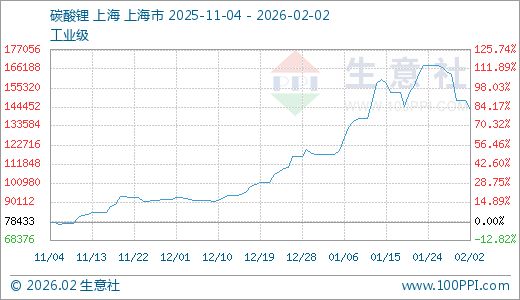
02月02日碳酸锂145000.00元/吨 30天上涨21.44%
Xin Lang Cai Jing· 2026-02-03 05:48
Group 1 - The latest price of lithium carbonate is 145,000.00 yuan per ton as of February 2, with a 21.44% increase over the last 30 days and a 55.30% increase over the last 60 days [2][4] - Relevant producers in the lithium carbonate market include companies such as Chuaneng Power (000155), Cangge Mining (000408), Tibet Mining (000762), and Ganfeng Lithium (002460) among others [2][4] - The method for selecting cyclical stocks involves monitoring raw material price fluctuations, which significantly impact the profits of raw material production companies [2][4]
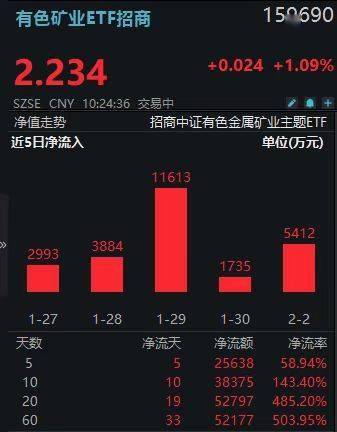
反弹还是反抽?有色矿业ETF招商(159690)涨1.22%,湖南黄金、盛和资源领涨
Sou Hu Cai Jing· 2026-02-03 02:42
Group 1 - The core viewpoint of the articles indicates a significant rebound in the non-ferrous metals sector, driven by a reassessment of long-term investment value following a period of panic selling [2][3] - The non-ferrous mining ETF (招商 159690) saw a rise of 1.22%, with leading stocks such as 盛和资源, 湖南黄金, 云南锗业, and 永兴材料 showing notable gains, reflecting a recovery in market sentiment [2][3] Group 2 - Strong macroeconomic and commodity fundamentals are supporting the current cycle, with global liquidity expectations and geopolitical uncertainties providing a solid financial foundation for precious metals like gold, while industrial metals such as copper and aluminum benefit from structural demand due to global energy transition and manufacturing recovery [3] - National policies promoting large-scale equipment upgrades are providing clear demand guidance for downstream applications of non-ferrous metals, shifting market perception from mere cyclical plays to a long-term reassessment of the strategic value of upstream mineral resources [3] - The technical correction has largely released short-term trading risks, leading to renewed interest from funds in non-ferrous mining ETFs, indicating that long-term investors view this adjustment as an opportunity to optimize their positions [3]

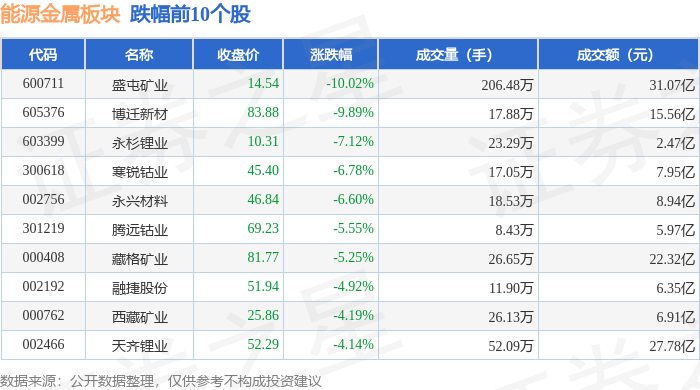
能源金属板块2月2日跌5%,盛屯矿业领跌,主力资金净流出23.16亿元
Zheng Xing Xing Ye Ri Bao· 2026-02-02 09:07
Market Overview - The energy metals sector experienced a decline of 5.0% on February 2, with Shengtun Mining leading the drop [1] - The Shanghai Composite Index closed at 4015.75, down 2.48%, while the Shenzhen Component Index closed at 13824.35, down 2.69% [1] Individual Stock Performance - Jidian Mining (600711) closed at 14.54, down 10.02% with a trading volume of 2.0648 million shares and a transaction value of 3.107 billion [1] - BQ New Materials (605376) closed at 83.88, down 9.89% with a trading volume of 178,800 shares [1] - Yongxing Materials (002756) closed at 46.84, down 6.60% with a trading volume of 185,300 shares and a transaction value of 894 million [1] - Other notable declines include: - Tengyuan Diamond (301219) down 5.55% - Cangge Mining (000408) down 5.25% - Tianqi Lithium (002466) down 4.14% [1] Capital Flow Analysis - The energy metals sector saw a net outflow of 2.316 billion from main funds, while retail investors contributed a net inflow of 2.012 billion [1] - The table indicates that major funds had significant outflows in several companies, including: - Tengyuan Diamond with a net outflow of 68.91 million [2] - Rongjie Co. with a net outflow of 69.43 million [2] - BQ New Materials with a net outflow of 22.7 million [2] - Retail investors showed positive net inflows in companies like: - BQ New Materials with 61 million [2] - Cangge Mining with 63.39 million [2]

东方证券:有色金属供需预期双向扭转 价格再启新周期
智通财经网· 2026-02-02 04:04
Group 1: Lithium Market Insights - The supply of lithium is experiencing short-term disruptions and long-term growth limitations, leading to a mid-term supply gap expected to persist until 2026-2027 [1][2] - Demand for lithium is being driven by the growth of energy storage and the commercialization potential of solid-state batteries, which may increase lithium consumption per unit [2] - From the second half of 2025, supply disruptions in Jiangxi, China, combined with strong downstream demand, are expected to lead to a rebound in lithium prices, maintaining a tight market through 2026-2027 [2] Group 2: Cobalt Market Dynamics - The supply of cobalt is significantly influenced by the export quota system in the Democratic Republic of Congo, resulting in a clear supply gap and strong price support [3] - Demand for cobalt products is currently weak due to high prices, and the potential recovery in demand hinges on the adoption of solid-state batteries [3] - The Congolese government's strong price control and willingness to maintain prices, along with slower-than-expected export rhythms, suggest that cobalt prices are likely to remain strong in the mid-term [3] Group 3: Market Feedback Mechanisms - In an upward cycle, it is crucial to consider the self-reinforcing and cross-reinforcing attributes between stock prices and commodity prices, alongside fundamental factors [4] - The sequence of "stocks → futures → spot" illustrates how stock prices often react first to anticipated turning points, followed by futures and then spot prices, creating a positive feedback loop [4] - Investment recommendations include lithium-related companies such as Yongxing Materials, Ganfeng Lithium, and Tianqi Lithium, as well as cobalt-related companies like Huayou Cobalt and Luoyang Molybdenum [4]

新任美联储主席政策引发担忧,金银价格回调
Guolian Minsheng Securities· 2026-02-01 13:35
Investment Rating - The report maintains a "Buy" rating for the industry and specific companies within the non-ferrous metals sector, highlighting a positive outlook for gold and silver prices in the medium to long term [2][4]. Core Views - The new Federal Reserve Chairman's policies have raised concerns, leading to a correction in gold and silver prices. However, the long-term trend remains bullish due to central bank gold purchases and a weakening dollar credit [2][8]. - The report emphasizes the importance of geopolitical factors and macroeconomic policies in influencing metal prices, particularly in the context of expanding domestic demand in China [8][24]. Summary by Sections 1. Industry and Stock Performance - The SW Non-ferrous Index increased by 3.37% during the week, while the Shanghai Composite Index fell by 0.44% [8]. - Key companies recommended for investment include Zijin Mining, China Molybdenum, and Yunnan Aluminum, among others, with a focus on their earnings forecasts and valuations [2][8]. 2. Base Metals - Aluminum prices are influenced by geopolitical tensions and domestic production adjustments, with a notable increase in aluminum inventory [24][28]. - Copper prices are expected to remain stable, supported by a weak dollar and increased import activity, despite a generally subdued demand environment [45][48]. - Zinc prices have shown volatility due to external factors and domestic supply disruptions, with a recent increase in prices observed [49][50]. 3. Precious Metals and Minor Metals - Gold and silver prices are projected to rise in the medium term, driven by central bank purchases and a weakening dollar [2][8]. - The report highlights the potential for price increases in cobalt and nickel due to supply constraints and geopolitical factors [2][24][63]. 4. Rare Earths - The report does not provide specific insights into rare earths, focusing instead on the broader non-ferrous metals market [10].




钢铁行业周度更新报告:25Q4板块预披业绩总亏约119亿
GUOTAI HAITONG SECURITIES· 2026-02-01 13:30
Investment Rating - The report maintains an "Overweight" rating for the steel industry [5]. Core Insights - Demand is expected to gradually stabilize, while supply-side constraints are anticipated to continue, leading to a potential recovery in the steel industry's fundamentals. If supply policies are implemented, the contraction in supply may accelerate, facilitating a quicker industry upturn [3][4]. Summary by Sections Steel Market Overview - Steel prices have decreased, with the Shanghai rebar price dropping by 20 CNY/ton to 3240 CNY/ton, a decline of 0.61%. The total inventory of steel has increased by 1.70% to 12.7851 million tons [8][12]. - Apparent consumption of five major steel products was 8.0174 million tons, down 0.96% week-on-week but up 28.96% year-on-year [21]. - The production of five major steel products was 8.2317 million tons, an increase of 0.44% week-on-week [12][37]. Supply and Demand Dynamics - Approximately 60% of steel companies are currently operating at a loss, indicating a market-driven supply clearance is beginning to occur [4]. - The construction sector's demand for steel is expected to stabilize, while demand from infrastructure and manufacturing is projected to grow steadily [4]. Profitability and Production Margins - The average gross profit for rebar was 196.9 CNY/ton, down 11.7 CNY/ton from the previous week, while hot-rolled coil profit increased by 2.3 CNY/ton to 46.9 CNY/ton [39]. - The profitability rate of 247 steel companies was 39.39%, a decrease of 1.3% from the previous week [28]. Recommendations - The report recommends focusing on companies with leading technology and product structures, such as Baosteel and Hualing Steel, as well as low-cost firms like Fangda Special Steel and New Steel [4]. - It also highlights the potential of upstream resource companies like Hebei Resources and Erdos, which may benefit from a recovery in demand [4].




钴锂有色金属研究框架:供需预期双向扭转,价格再启新周期
Orient Securities· 2026-02-01 12:42
Investment Rating - The report maintains a "Positive" investment rating for the non-ferrous metals industry [1] Core Insights - The supply and demand expectations for lithium and cobalt are reversing, indicating the start of a new price cycle [2][3] - Lithium demand is expected to recover, leading to a replenishment cycle, while supply disruptions will create a medium-term gap [2] - Cobalt supply is dominated by export quotas from sovereign nations, leading to a raw material shortage that supports prices [3] Summary by Sections Lithium - Supply disruptions from African lithium projects and stable production from South American salt lakes are expected, while China's regulatory management will lead to a temporary supply contraction of lithium mica [2] - Demand for lithium is driven by the growth of energy storage as a second growth driver after electric vehicles, with solid-state batteries opening up potential for increased lithium consumption [2] - From the second half of 2025, supply disruptions in Jiangxi and strong downstream demand will lead to a price rebound for lithium, maintaining a tight supply situation through 2026-2027 [2] Cobalt - The supply side is significantly influenced by the export quota system in the Democratic Republic of Congo, resulting in a definitive raw material shortage [3] - Demand for cobalt products is currently weak due to high prices, and the recovery of demand hinges on the adoption of solid-state batteries [3] - The Congolese government has a strong ability and willingness to support prices, with expectations for cobalt prices to remain strong in the medium term [3] Investment Strategy - In an upward cycle, it is essential to consider the self-reinforcing attributes of stock prices and commodity prices, alongside fundamental factors [4] - The interplay between stock prices, futures, and spot prices creates a positive feedback loop, where stock prices often react first to anticipated changes [4] Investment Recommendations - Recommended lithium-related stocks include Yongxing Materials, Ganfeng Lithium, and Tianqi Lithium, among others [5] - Recommended cobalt-related stocks include Huayou Cobalt and others [5]






有色金属大宗商品周报(2026/1/26-2026/1/30):宏观波动加剧,铜铝价格或迎来震荡调整-20260201
Hua Yuan Zheng Quan· 2026-02-01 12:00
Investment Rating - The investment rating for the non-ferrous metals industry is "Positive" (maintained) [4] Core Views - The report indicates that macroeconomic fluctuations are intensifying, leading to potential price adjustments for copper and aluminum. The copper prices may experience volatility due to a strong dollar and profit-taking by long positions in the market. Meanwhile, aluminum prices are also expected to face similar adjustments due to macroeconomic pressures [3][4]. Summary by Sections 1. Industry Overview - The macroeconomic environment is characterized by the Federal Reserve's decision to maintain interest rates at 3.75% during its January meeting, with Kevin Warsh nominated as the next Fed Chair, viewed as a hawkish choice [9]. - Initial jobless claims in the U.S. exceeded expectations, indicating potential economic challenges [9]. 2. Market Performance - The non-ferrous metals sector outperformed the Shanghai Composite Index, with a weekly increase of 3.37%, while the index itself fell by 0.44% [11]. - The sector ranked fourth among all sectors in terms of performance, with notable movements in gold, copper, and tungsten [11]. 3. Price and Inventory Changes - Copper prices saw an increase of 3.54% in London and 2.31% in Shanghai, while aluminum prices fluctuated with a 4.89% increase in Shanghai but a 1.39% decrease in London [22][36]. - Inventory levels for copper and aluminum showed mixed trends, with copper inventories increasing and aluminum inventories showing both increases and decreases across different markets [22][36]. 4. Specific Metal Insights - **Copper**: The report notes a potential shift from a tight balance to a shortage in the copper supply-demand landscape, driven by insufficient capital expenditure in copper mining and frequent supply disruptions [5]. - **Aluminum**: The aluminum market is expected to face a supply surplus in the short term, but with stable demand growth, a potential shortage may arise later in the year [5]. - **Lithium**: Despite a seasonal downturn, lithium demand remains strong, with a reversal in supply-demand dynamics expected to drive prices upward [5]. - **Cobalt**: The cobalt market is experiencing tight supply conditions, with prices expected to continue rising due to structural constraints [5]. 5. Recommendations - The report suggests monitoring specific companies within the sector, including Zijin Mining, Jiangxi Copper, and Ganfeng Lithium, which are positioned to benefit from the anticipated market dynamics [5].
钢铁行业周度更新报告:25Q4板块预披业绩总亏约119亿-20260201
GUOTAI HAITONG SECURITIES· 2026-02-01 11:28
Investment Rating - The report maintains an "Overweight" rating for the steel industry [5] Core Viewpoints - Demand is expected to gradually stabilize, while supply-side constraints are anticipated to continue, leading to a potential recovery in the steel industry's fundamentals [3][5] - The industry has been experiencing prolonged micro-profit conditions, and market-driven supply adjustments have begun to emerge [3][5] - The report highlights that approximately 60% of steel companies are currently operating at a loss, indicating ongoing supply-side challenges [5] Summary by Sections Steel - Steel prices have decreased week-on-week, with the Shanghai rebar price dropping by 20 CNY/ton to 3240 CNY/ton, a decline of 0.61% [8] - The apparent consumption of five major steel products was 8.0174 million tons, down 0.96% week-on-week but up 28.96% year-on-year [21] - The total inventory of steel reached 12.7851 million tons, increasing by 1.70% week-on-week, maintaining a low level [5][12] - The operating rate of blast furnaces among 247 steel mills rose to 79%, an increase of 0.32 percentage points from the previous week [28] - The average gross profit for rebar was 196.9 CNY/ton, down 11.7 CNY/ton from the previous week, while hot-rolled coil profit increased by 2.3 CNY/ton to 46.9 CNY/ton [39] Raw Materials - Iron ore spot prices decreased, with the price for PB powder (61.5% iron content) at 792 CNY/ton, down 9 CNY/ton [46] - The port inventory of iron ore rose to 17.022 million tons, an increase of 1.53% [50] - The total shipment volume of major iron ore producers increased, with Brazil's shipment at 4.852 million tons, up 1.06% week-on-week [51] Investment Recommendations - The report recommends focusing on companies with leading technology and product structures, such as Baosteel and Hualing Steel, as well as low-cost firms like Fangda Special Steel and New Steel [5] - It also highlights the potential of upstream resource companies benefiting from demand recovery trends, recommending Hebei Resources and Erdos among others [5]