五粮液

Search documents
茅台价格“松动”掀起连锁降价潮?酒商坦言:行业大洗牌在即
Nan Fang Du Shi Bao· 2026-01-15 11:45
Core Viewpoint - The white liquor market is experiencing unexpected price declines instead of the anticipated seasonal increase, driven by price adjustments of benchmark products like Feitian Moutai, leading to a widespread price reduction across various brands and price segments [1][13]. Price Trends - In major cities like Guangzhou, Shenzhen, Foshan, and Dongguan, the average retail prices of high-end white liquors have generally decreased, with many premium products, especially sauce-flavored liquors, seeing significant price drops [1][11]. - In Guangzhou, the average price of sauce-flavored liquors has fallen sharply, with products like Junpin Xijiu dropping from approximately 731 yuan to around 698 yuan [2][3]. - The average retail price of Feitian Moutai in Shenzhen is reported at 1734.21 yuan, with some channels offering it as low as 1699 yuan [5][6]. Market Dynamics - The price adjustments are attributed to high inventory pressures and a shift towards "price for volume" strategies among distributors, indicating a challenging market environment for the white liquor industry [1][13]. - The introduction of the "i Moutai" platform has intensified competition, causing price fluctuations across the market, particularly affecting products in the 1000 yuan price range [2][7]. Regional Insights - In Shenzhen, high-end products like the eighth-generation Wuliangye have seen a price drop of approximately 39 yuan, while Junpin Xijiu's price has decreased by 22 yuan [5][6]. - In Dongguan, 13 out of 16 comparable high-end liquors have experienced price declines, with the eighth-generation Wuliangye averaging 884.43 yuan, down 20.57 yuan [11][12]. Future Outlook - The current price reductions reflect a lack of market momentum and high inventory levels, with many distributors indicating that clearing stock remains a primary focus [1][13]. - As the Spring Festival approaches, the ability of white liquor prices to stabilize will be a key indicator of the industry's recovery trajectory, with companies demonstrating brand resilience and channel control likely to emerge stronger from this market adjustment [13].


穿透消费分化迷雾:CBI品牌榜中的“真增长”挖掘
Ge Long Hui· 2026-01-15 11:25
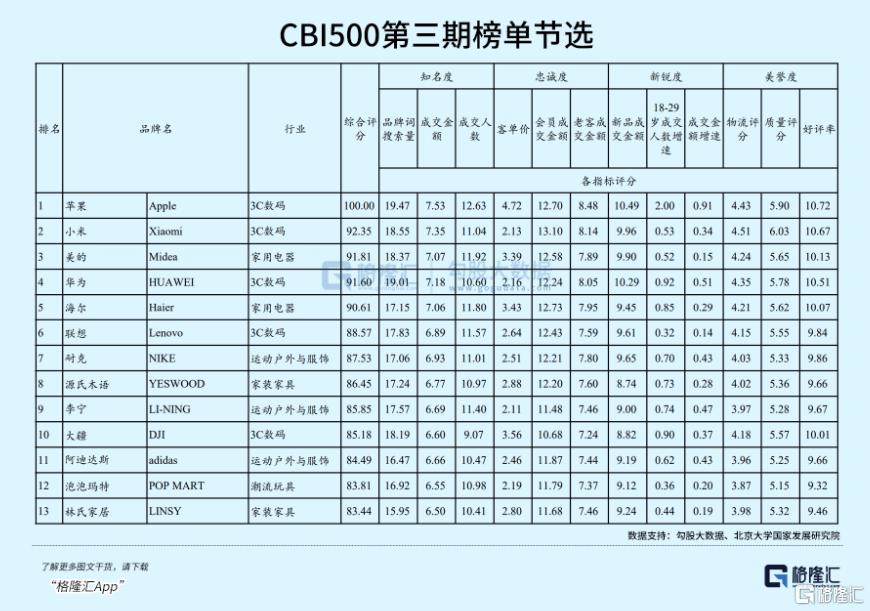
Group 1 - The Chinese consumer market has shown a steady recovery since 2025, with a year-on-year growth of 6.8% in retail sales of consumer goods in the first three quarters, contributing 53.5% to economic growth [1] - The recovery trend in the consumer sector is not uniform, with traditional brands struggling due to lack of innovation, while new brands are breaking through with technological advancements and innovative models [1] - The need for a quantitative evaluation tool to identify structural opportunities in the market has led to the development of the "China Online Consumption Brand Index (CBI)" and the "Global Brand China Online Top 500 List (CBI500)" by Peking University [2] Group 2 - The CBI500 list is based on real consumer data from Taobao and Tmall, utilizing a comprehensive brand quality indicator that includes new product capability, user reviews, and search popularity [2][5] - The top five brands in the CBI500 list—Apple, Xiaomi, Midea, Huawei, and Haier—demonstrate a "stronger gets stronger" logic, maintaining competitive advantages through balanced performance across various dimensions [6][8] - DJI has achieved significant growth, moving from a score of 78.53 to 85.18, entering the top ten for the first time, driven by continuous technological innovation and market expansion [9][12] Group 3 - Pop Mart has shown strong resilience in the collectible toy sector, climbing from 31st to 12th place in the CBI500 list, with leading scores in loyalty and customer spending [14][17] - The growth logic of Pop Mart is based on deep insights into emotional consumption needs, utilizing an IP matrix and a robust membership system to create a strong emotional connection with consumers [17] - The differentiation in the consumer market has created opportunities for brands that adapt to trends, as seen with Fenjiu's rise in rankings due to its "youthful" strategy targeting younger consumers [22][23] Group 4 - The CBI list serves as a data-driven tool for observing the consumer market, helping investors identify brands that capture product innovation opportunities and possess anti-cyclical potential [27][29] - The evaluation logic of the CBI list helps to avoid misleading short-term sales data, focusing instead on loyalty and reputation metrics to identify brands that achieve sustainable growth [27][29] - The current economic recovery phase presents a critical window for brand restructuring and value selection, emphasizing the importance of understanding consumer behavior changes [26][29]






穿透消费分化迷雾:CBI品牌榜中的“真增长”挖掘
格隆汇APP· 2026-01-15 11:15
Core Insights - The article highlights the steady recovery of China's consumer market since 2025, with a year-on-year growth of 6.8% in retail sales of consumer goods in the first three quarters, contributing 53.5% to economic growth [2] - However, the consumer sector faces challenges with increasing internal differentiation, where traditional brands struggle due to lack of innovation while new brands succeed through technological breakthroughs and innovative models [2][3] Group 1: Consumer Brand Landscape - The CBI500 ranking reflects a stable top tier of brands, emphasizing the "stronger get stronger" logic in the consumer market [7] - Leading brands like Apple, Xiaomi, Midea, Huawei, and Haier maintain competitive barriers through balanced performance across four dimensions: brand awareness, innovation, loyalty, and reputation [8][10] - DJI and Pop Mart have shown significant growth, with DJI entering the top ten for the first time, driven by continuous technological innovation and market expansion [11][16] Group 2: Brand Performance and Growth Strategies - DJI's growth is attributed to its focus on technology innovation and creating benchmark products, leading to a 66% market share in the global action camera market as of Q3 2025 [11][14] - Pop Mart's rise in the rankings is due to its strong loyalty metrics and effective IP matrix operation, which resonates with emotional consumer needs [19][20] - The brand's strategy includes a robust membership system that enhances customer loyalty through emotional engagement [19] Group 3: Market Differentiation and Opportunities - The differentiation in the consumer market presents challenges for traditional brands while creating opportunities for those that adapt to trends [21][22] - Brands like Fenjiu have successfully capitalized on changing consumer preferences, with a notable increase in their ranking due to a focus on younger consumers [26] - The article emphasizes the importance of aligning with policy support and consumer trends to identify quality brands that can thrive in a competitive landscape [27][28] Group 4: CBI Index and Its Value - The CBI index serves as a data-driven tool for observing the consumer market, helping investors identify brands that capture product innovation opportunities and possess resilience against economic cycles [30][31] - The index's multidimensional evaluation framework allows for a deeper understanding of consumer demand and brand performance, aiding in long-term investment decisions [32]

1月15日深证国企ESG(970055)指数涨0.27%,成份股中钨高新(000657)领涨
Sou Hu Cai Jing· 2026-01-15 10:39
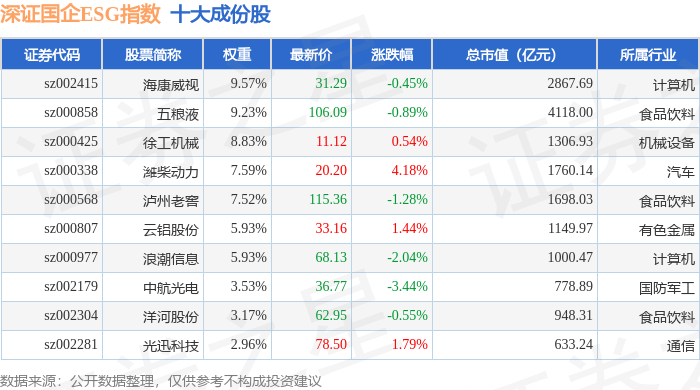
Core Viewpoint - The Shenzhen State-owned Enterprise ESG Index (970055) closed at 1472.43 points, up 0.27%, with a trading volume of 49.598 billion yuan and a turnover rate of 1.79% [1] Group 1: Index Performance - On the day, 23 constituent stocks rose, with Zhongtung High-tech leading with a 5.52% increase, while 25 stocks fell, with Taisen Wind Power leading the decline at 6.2% [1] - The index's constituent stocks experienced a net outflow of 1.149 billion yuan from major funds, while retail investors saw a net inflow of 1.065 billion yuan [1] Group 2: Top Constituents - The top ten constituents of the Shenzhen State-owned Enterprise ESG Index include: - Hikvision (sz002415) with a weight of 9.57%, latest price at 31.29 yuan, down 0.45% [1] - Wuliangye (sz000858) with a weight of 9.23%, latest price at 106.09 yuan, down 0.89% [1] - Xugong Machinery (sz000425) with a weight of 8.83%, latest price at 11.12 yuan, up 0.54% [1] - Weichai Power (sz000338) with a weight of 7.59%, latest price at 20.20 yuan, up 4.18% [1] - Luzhou Laojiao (sz000568) with a weight of 7.52%, latest price at 115.36 yuan, down 1.28% [1] - Yun Aluminum (sz000807) with a weight of 5.93%, latest price at 33.16 yuan, up 1.44% [1] - Inspur Information (sz000977) with a weight of 5.93%, latest price at 68.13 yuan, down 2.04% [1] - AVIC Optoelectronics (sz002179) with a weight of 3.53%, latest price at 36.77 yuan, down 3.44% [1] - Yanghe Distillery (sz002304) with a weight of 3.17%, latest price at 62.95 yuan, down 0.55% [1] - Guangxun Technology (sz002281) with a weight of 2.96%, latest price at 78.50 yuan, up 1.79% [1] Group 3: Fund Flow Details - Major funds saw significant inflows in stocks such as: - Deep Technology (000021) with a net inflow of 503 million yuan [2] - Weichai Power (000338) with a net inflow of 1.12 million yuan [2] - Zhongtung High-tech (000657) with a net inflow of 95.263 million yuan [2] - Conversely, stocks like Yun Aluminum (000807) and Xugong Machinery (000425) experienced net outflows from major funds [2]




银发人群洞察报告:3.51亿活跃人群带来三大变化,商机持续涌现……
Tai Mei Ti A P P· 2026-01-15 10:18
Core Insights - The active user base of the silver-haired population in China reached 351 million by November 2025, marking a year-on-year growth of 5.8% [2][12] - This demographic is transitioning from passive internet users to deeply engaged participants, with average monthly usage time increasing to 135 hours and usage frequency to 1,345 times, reflecting growth rates of 11.1% and 6.5% respectively [15][14] Group 1: User Engagement and Behavior - The silver-haired population's engagement has led to a shift in active usage patterns, with a peak activity rate of 75.4% around 4 PM, indicating a preference for off-peak usage times [17] - There is a notable change in application usage across different sectors, with online video consumption rising by 63.5% year-on-year, while short video usage declined by 2% [2] - The adoption of AIGC and smart living applications is increasing, showcasing a growing acceptance of technology among this demographic [2] Group 2: Consumption Patterns - The proportion of silver-haired individuals with moderate online consumption willingness has reached 48.9%, an increase of 2.1% year-on-year [3] - Key areas of growth in active user numbers include mobile gaming (16%), travel services (15.4%), smart devices (13.5%), life services (13.1%), and office business applications (10.4%) [3] - Major e-commerce platforms like Taobao, Pinduoduo, and JD.com have seen significant user engagement from this demographic, with Taobao's active user count reaching 205 million [3] Group 3: Health and Lifestyle - The silver-haired population is increasingly focusing on health management, utilizing health management apps for monitoring key health indicators like blood sugar and blood pressure [37] - There is a growing interest in health and wellness products, with a shift towards proactive health management rather than reactive medical care [37] Group 4: Digital and Technological Adoption - The silver-haired demographic is embracing higher-end smartphones, with 46.6% of users opting for devices priced above 3,000 yuan, reflecting a 9.1% increase [23] - This group is also becoming content creators, leveraging platforms like Douyin and Kuaishou, with active user numbers reaching 214.58 million and 106.74 million respectively [56] Group 5: Emotional and Social Engagement - The silver-haired population is increasingly engaging in social and emotional consumption, with a strong preference for nostalgic and light social gaming experiences [46] - Travel services tailored for this demographic are on the rise, with platforms like Ctrip and Tongcheng Travel seeing significant growth in user engagement [43]

食品饮料:2026 年行业投资策略报告:破晓启航-20260115
Huafu Securities· 2026-01-15 09:22
Group 1 - The food and beverage sector is showing signs of recovery after a prolonged adjustment period, with macroeconomic indicators stabilizing and the restaurant industry experiencing a rebound in daily operations [2][14][15] - The report suggests that investment opportunities in 2026 should focus on three main directions: capturing the recovery rhythm, identifying growth opportunities within existing markets, and leveraging emotional consumption trends [2][3][4] - The restaurant industry is expected to lead the recovery, with a projected annual revenue of 5.7 trillion yuan in 2025, reflecting a 3.3% year-on-year growth [20][26] Group 2 - The report highlights the importance of focusing on demand-driven scenarios, channels, and product innovations, particularly in the snack and beverage sectors, which are expected to continue their growth trajectories [3][4][66] - The snack retail sector is experiencing significant growth, with a projected GMV of 600 billion yuan by 2029, driven by the expansion of major players like Wanchen Group and Mingming Hen Mang [68][74] - The beverage and low-alcohol sectors are also identified as areas of growth, with companies like Kuaijishan and Nongfu Spring expected to benefit from ongoing market expansion [4][66] Group 3 - The beer sector is anticipated to benefit directly from the recovery of the restaurant industry, with a notable trend towards premiumization and a shift in consumer preferences towards higher-priced products [40][41] - The white wine industry is undergoing a rebalancing, with demand expected to show weak recovery in 2026, characterized by a concentration of high-priced products and minor innovations in mid-priced segments [48][49][64] - The report emphasizes the need for companies to manage supply effectively in response to weak demand, with a focus on optimizing product offerings and enhancing operational efficiency [49][53][64]
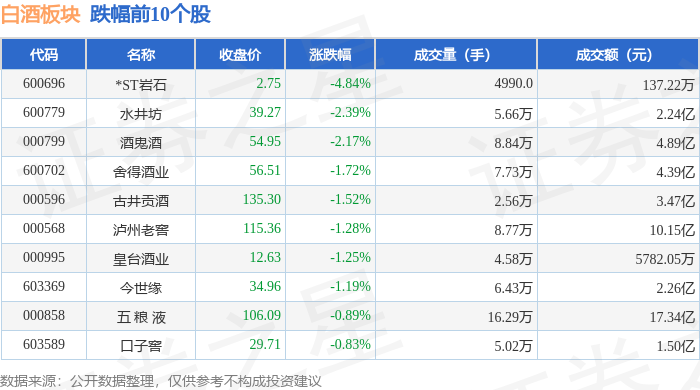
白酒板块1月15日跌0.77%,*ST岩石领跌,主力资金净流出11.52亿元
Zheng Xing Xing Ye Ri Bao· 2026-01-15 08:59
Group 1 - The liquor sector experienced a decline of 0.77% on January 15, with *ST Rock leading the drop [1] - The Shanghai Composite Index closed at 4112.6, down 0.33%, while the Shenzhen Component Index rose by 0.41% to 14306.73 [1] - Major liquor stocks showed varied performance, with *ST Rock down 4.84% to 2.75, and other notable declines including Shui Jing Fang down 2.39% and Moutai down 7.31% in net outflow [1][2] Group 2 - The liquor sector saw a net outflow of 1.152 billion yuan from main funds, while retail investors contributed a net inflow of 528 million yuan [1] - Specific stocks like Moutai and Wuliangye faced significant net outflows of 416 million yuan and 201 million yuan respectively, indicating a shift in investor sentiment [2] - The data indicates that retail investors are increasingly active, with a notable net inflow into stocks like Wuliangye, which saw 157 million yuan from retail investors [2]


2025中国企业ESG“金责奖”最佳社会S责任奖揭晓
Xin Lang Cai Jing· 2026-01-15 07:31
Core Viewpoint - The 2025 China Enterprise ESG "Golden Responsibility Award" aims to recognize companies that have made significant contributions to ESG (Environmental, Social, and Governance) practices, with over 5,000 enterprises participating in the evaluation process [1][4]. Group 1: ESG Services and Initiatives - Sina Finance ESG Rating Center offers 14 ESG services, including information, reports, training, and consulting, to help listed companies promote ESG concepts and enhance their sustainable development performance [1][4]. - In 2025, many quality enterprises in China are actively practicing their responsibilities in environmental, social, and governance aspects, while domestic financial institutions are steadily integrating ESG investment concepts into their entire business processes [1][4]. Group 2: Award Selection and Winners - The award selection process involved over three months of competition, combining ESG performance, professional evaluation scores, and online voting results [1][4]. - The winners of the 2025 China Enterprise ESG "Golden Responsibility Award" for Best Social Responsibility include China Shenhua, China General Nuclear Power, China Resources Sanjiu, Sinopec, Shougang, Wuliangye, Yangtze Power, China Telecom, CNOOC Services, and LONGi Green Energy [2][5]. Group 3: ESG Rating Center Overview - The Sina Finance ESG Rating Center is the first Chinese ESG professional information and rating aggregation platform, dedicated to promoting sustainable development and responsible investment [3][6]. - The center aims to establish ESG evaluation standards suitable for China's characteristics and enhance corporate ratings, while also launching multiple ESG innovation indices for investors [3][6].




中国消费板块 2026 展望:消费信心复苏是否已开启?-China Consumer Sector_ 2026 Outlook_ are we at the beginning of consumer confidence recovery_
2026-01-15 06:33
Summary of the Conference Call Transcript Industry Overview - **Industry**: China Consumer Sector - **Outlook**: The sector is believed to be in the early stage of a multi-year recovery cycle that began in Q3 2024, with expectations for gradual improvement in consumer sentiment and spending through 2026E [2][11][12] Key Insights - **Valuation**: MSCI China Consumer Discretionary and Staples are trading at 17x and 15x 12-month forward PE, approximately one standard deviation below the 10-year averages, indicating that current valuations do not reflect a potential consumption recovery [2][9] - **Consumer Confidence**: The China Consumer Confidence Index has been trending upwards since September 2024, suggesting a gradual restoration of consumer confidence despite ongoing challenges in the property market [12][19] - **K-shaped Recovery**: The recovery is characterized by a K-shaped trend, where mid- to high-income consumers in tier-1 cities are expected to lead spending, while lower-tier city consumers remain focused on value for money [3][48] Consumer Behavior Trends - **Shifting Preferences**: A UBS Evidence Lab survey indicates a divergence in consumer behavior, with over 50% of mid- to high-income consumers reporting investment gains and showing strong spending intentions, particularly in premium and experiential categories [3][37] - **Spending Intentions**: The strongest spending intentions are noted in beauty and skincare (41%) and tourism (37%), reflecting a shift towards experiential and premium spending [51] - **Investment Gains**: 64-74% of mid- to high-income consumers reported increased investment returns, with many planning to reinvest or spend on travel, health services, and consumer electronics [40][41] Stock Implications - **Company Ratings**: - Upgrades to Neutral for Fenjiu due to expected benefits from non-business baijiu consumption - Buy ratings maintained for companies like MIXUE, Guming, China Foods, CR Beer, and YUM China, among others [4] - **Dividend Payouts**: Premium baijiu companies are noted for their >75% dividend payout, which is expected to protect share prices from downside risks [4] Structural Growth Opportunities - **Emerging Themes**: Key investment themes for 2026E include changing consumer preferences, corporate restructuring, and industry consolidation, particularly in sectors like home appliances and mass-market consumption [14][50] - **Corporate Restructuring**: Companies are expected to adapt their business models to align with changing consumer behaviors, which may lead to sustainable long-term earnings growth [4][50] Risks and Challenges - **Property Market Downturn**: The ongoing downturn in the property market is anticipated to weigh on household balance sheets, potentially impacting consumer spending [13][48] - **Policy Support**: The pace of recovery is contingent on stabilizing the property market and effective policy implementation to boost consumption [13][48] Conclusion - The China consumer sector is poised for a recovery, driven by improving consumer confidence and shifting spending patterns. However, the recovery will be uneven across different income groups and city tiers, necessitating a nuanced investment approach to capture emerging opportunities while being mindful of potential risks associated with the property market downturn.



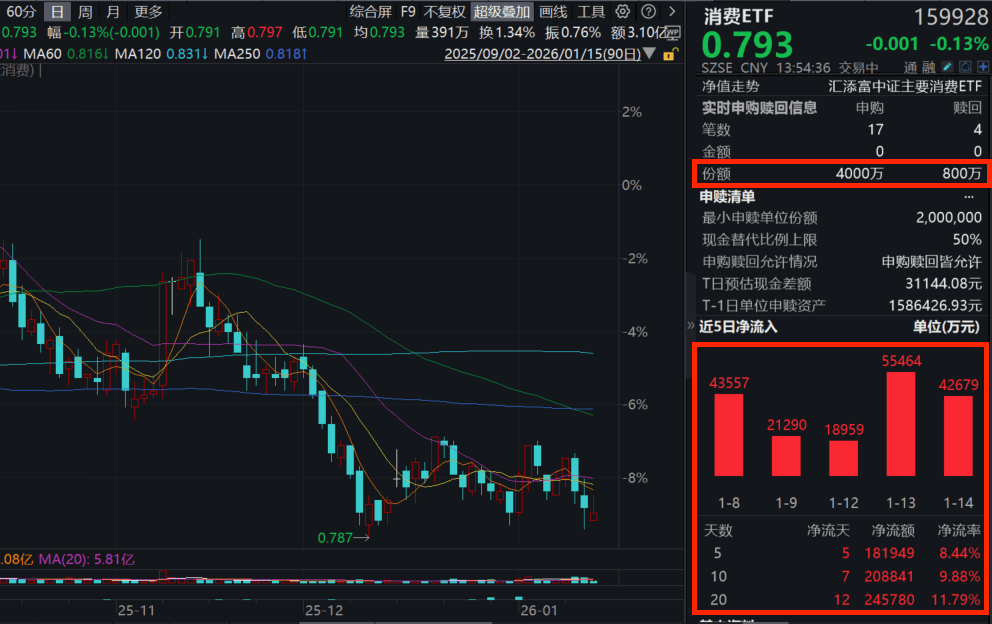
资金高低切换,大消费再受青睐!消费ETF(159928)近5日大举净流入超18亿元!CPI连续三月同比涨幅扩大!
Sou Hu Cai Jing· 2026-01-15 06:19
Group 1: Market Overview - The Shanghai Composite Index experienced fluctuations, with the consumer sector slightly retreating, and the Consumer ETF (159928) declining by 0.13% on January 15, with a trading volume exceeding 315 million yuan [1] - The Consumer ETF has attracted significant capital, accumulating over 1.8 billion yuan in the past five days [1] Group 2: Policy Impact - The policy extending the tax refund for residents switching homes will remain in effect until the end of 2027, providing tax incentives for those selling and repurchasing homes within a year [3] - The valuation of the Consumer ETF is currently attractive, with a TTM P/E ratio of 19.17, placing it in the 2.18% percentile over the past decade, indicating it is cheaper than 98% of historical periods [3] Group 3: Stock Performance - In the Hong Kong market, the Hong Kong Stock Connect Consumer 50 ETF (159268) showed slight gains, with notable stocks like Anta Sports and Mengniu Dairy rising over 1%, while others like Pop Mart and Yum China fell over 1% [5] Group 4: Kweichow Moutai's Strategy - Kweichow Moutai is restructuring its pricing system to promote market-oriented transformation, focusing on a differentiated product structure to meet diverse consumer needs [7] - The company is shifting from a traditional sales model to a multi-channel marketing system, enhancing its distribution channels to include wholesale, offline retail, online retail, dining, and private domain [7] - The new pricing strategy will be market-driven, aiming for a dynamic adjustment mechanism to stabilize retail prices [7] Group 5: Consumer Price Index (CPI) Trends - The CPI has shown a continuous increase for three months, with December's CPI rising by 0.8%, indicating potential improvement in traditional consumer goods [8][10] - The white liquor sector is highlighted as having significant investment value, with expectations for performance recovery as demand improves during the upcoming Spring Festival [8] Group 6: Investment Recommendations - The traditional consumer goods sector is expected to see a fundamental turning point, supported by policy catalysts and improved economic indicators [9] - Focus on sectors such as the restaurant supply chain and dairy industry for recovery opportunities, while also considering innovative product categories and new distribution channels as growth drivers [9]