
网易

Search documents
美三大股指集体下跌,携程重挫18%,“妖镍”直线急升,加密货币反弹,超13万人爆仓
21世纪经济报道· 2026-01-14 16:31
Market Overview - U.S. bank stocks experienced a significant decline, with major banks like Bank of America dropping over 4%, marking the largest drop in October, while Wells Fargo fell over 5% [1] - Several popular Chinese concept stocks also saw declines, with Ctrip initially plummeting 18% and closing down 16% in pre-market trading due to an antitrust investigation by the State Administration for Market Regulation [1] - Other notable declines included Atour Group and Dingdong Maicai, both down over 4%, while companies like Full Truck Alliance, Lufax, and New Oriental fell around 3% [1] Stock Performance - The current price and performance of various stocks indicate a bearish trend, with Dingdong Maicai at $2.791 (-4.42%), Lufax at $2.595 (-3.89%), and New Oriental at $139.340 (-2.50%) [2] - In contrast, stocks like Huya and Bilibili saw gains of approximately 5%, and Alibaba rose over 2.5% [1] Precious Metals - Silver prices surged, with spot silver surpassing $92 per ounce, marking a 28.6% increase year-to-date [2] - Gold prices also saw a rise, with spot gold reaching $4640 per ounce, reflecting a 1% increase [2][3] Commodities - Nickel futures experienced a significant increase, with the main contract rising over 7% [3] - Oil prices also saw a rise, with WTI and ICE Brent crude both increasing by over 0.7% amid escalating tensions in the Middle East [3] Cryptocurrency Market - The cryptocurrency market rebounded sharply, with Bitcoin rising over 4% and Ethereum nearly 6% [4] - The market saw significant liquidation, with over 130,000 individuals facing liquidation in the past 24 hours [4][6] Economic Indicators - Despite lower-than-expected CPI data, U.S. stocks did not rally, reflecting market concerns over political uncertainty, potential inflation rebound, and high valuation levels in the stock market [8] - The current valuation levels, particularly in tech stocks, are perceived as high, leading investors to lock in profits and shift towards defensive strategies [8]


美股集体下跌,携程重挫18%,“妖镍”直线急升,加密货币反弹,超13万人爆仓
2 1 Shi Ji Jing Ji Bao Dao· 2026-01-14 15:45
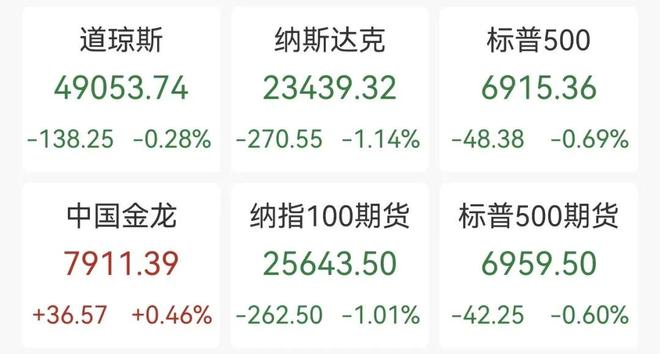
Market Overview - The US stock market experienced a collective decline, with the Nasdaq index dropping over 1% as of 23:00 [1] - The Dow Jones, Nasdaq, and S&P 500 indices closed at 49,053.74, 23,439.32, and 6,915.36 respectively, with declines of 0.28%, 1.14%, and 0.69% [2] Technology Sector - The technology sector saw significant losses, particularly in chip stocks, with ARM falling nearly 5% and other major companies like Nvidia and Marvell Technology declining around 2% [2][3] - The "big seven" tech companies in the US all experienced declines [2] Chinese Stocks - Several popular Chinese stocks faced downturns, with Ctrip initially plunging 18% due to an investigation by the market regulator for alleged monopolistic behavior [4] - Other Chinese companies like Dada Group and New Oriental also saw declines of over 3% [4] Precious Metals - Silver prices surged, breaking through $92 per ounce, marking a 28.6% increase year-to-date [5][6] - Gold prices also rose, reaching over $4,640 per ounce, with a 7.32% increase since the beginning of the year [6] Cryptocurrency Market - The cryptocurrency market rebounded significantly, with Bitcoin rising over 4% and Ethereum nearly 6% [8] - Over 130,000 traders faced liquidation in the past 24 hours, indicating high volatility [8][10] Economic Indicators - Despite lower-than-expected CPI data, the US stock market declined, reflecting concerns over political uncertainty, potential inflation rebound, and high valuation levels in the market [12][13] - The current valuation levels of US stocks, particularly in the tech sector, are perceived as high, leading investors to lock in profits and shift towards defensive strategies [13]
传媒行业1月投资策略:GEO重构流量与内容服务生态,AI应用开启向上新周期
Guoxin Securities· 2026-01-14 13:27
Group 1: Market Overview - In December 2025, the media sector (Shenwan Media Index) declined by 1.60%, underperforming the CSI 300 Index by 3.88 percentage points, ranking 25th among 31 industries [4][18][23]. - The current TTM-PE for the Shenwan Media Index is 45.8x, which is at the 69.7th percentile over the past five years, indicating a relatively high valuation [4][23][27]. - Notable stock performances in December included gains from Sanrenxing (30%), Baina Qiancheng (25%), and Guangxi Guangdian (19%), while ST Fanli and Zhejiang Wenlian saw declines of 20% and 19% respectively [4][28][29]. Group 2: Gaming Sector - In December 2025, a total of 144 domestic games and 3 imported games were approved, with a cumulative issuance of 1,772 game licenses in 2025, representing a year-on-year increase of 25.1% [4][38]. - The Chinese gaming market is projected to generate revenues of 350.79 billion yuan in 2025, reflecting a growth of 7.7%, with mobile and client games expected to reach 257.1 billion and 78.2 billion yuan respectively, growing by 7.9% and 15.0% [4][39][46]. - The self-developed games' overseas revenue is expected to reach 20.5 billion USD in 2025, with a year-on-year growth of 10.2% [4][49]. Group 3: Film and Television Sector - The total box office in December 2025 reached 3.712 billion yuan, a significant increase of 58.0% year-on-year, primarily driven by the success of "Zootopia 2" [4][59]. - The top five films in December by box office included "Zootopia 2" (2.097 billion yuan), "Avatar 3" (774 million yuan), and "The Amazing Heist 3" (380 million yuan) [4][66]. - In the drama market, "The Big Businessman" led with 754 million views, followed by "Old Uncle" and "Tang Dynasty Mystery" with 667 million and 567 million views respectively [4][75]. Group 4: AI Applications - The global GEO market is expected to reach 24 billion USD by 2026 and 100 billion USD by 2030, with the domestic market projected to reach 11.1 billion yuan by 2026 [6]. - GEO is reshaping the flow of traffic and content service ecosystems, transitioning from "list links" to "direct answers," which compresses intermediary value and amplifies the value of content sources [6][7]. - The application of AI is anticipated to enhance the overall valuation of the sector, with a focus on gaming and publishing industries benefiting from strong new product cycles [7].




游戏ETF(159869)狂飙近4%,2026年多款游戏储备上线,布局新品周期正当时
Mei Ri Jing Ji Xin Wen· 2026-01-14 13:06
Group 1 - The gaming sector experienced a significant rise on January 14, with the gaming ETF (159869) increasing nearly 4% during intraday trading [1] - The gaming ETF (159869) reached a scale of 16.217 billion yuan as of January 13, attracting a total of 1.405 billion yuan in the last 10 trading days, providing investors with a convenient tool for investing in A-share gaming leaders [1] - Major game updates are anticipated, including the launch of the "Moon's Four" version of "Genshin Impact" on January 14, which will feature storyline updates and various events, while "Ming Chao" will introduce its 3.0 second half card pool on January 15 [1] Group 2 - According to Huafu Securities, there are multiple game releases planned for 2026, with at least 25 new games expected to launch based on App Store pre-order information [1] - Tencent is expected to release 8 new games, while NetEase and Bilibili are projected to release 2 games each, with over half of these products anticipated to launch in Q1 2026 [1] - The gaming sector is experiencing a surge due to multiple catalysts, including policy benefits, product cycles, and AI empowerment, making it a focal point for investment opportunities [1]
陈天桥重出江湖
投资界· 2026-01-14 08:32
Core Viewpoint - The article discusses the return of Chen Tianqiao, a prominent figure in the Chinese internet industry, who is now focusing on brain-computer interface (BCI) technology and artificial intelligence (AI) research, marking a significant shift in his career and investment strategy [4][15]. Group 1: Chen Tianqiao's Return and Investments - Chen Tianqiao announced a $1 billion investment in computing power to support global AI research, emphasizing his commitment to advancing scientific discovery through AI [4][15]. - He co-founded "Gestalt," the first domestic ultrasound brain-computer interface company in China, which aims to develop non-invasive BCI technology [8][9]. - Chen's approach contrasts with Elon Musk's invasive BCI strategy, focusing instead on a non-invasive method that poses fewer ethical and safety concerns [9][19]. Group 2: AI and Brain Science Integration - Chen Tianqiao's new company "Tanka" is defined as a communication platform integrating AI with long-term memory capabilities, aiming to redefine organizational management in the AI era [9][10]. - He believes that AI should execute tasks while humans take responsibility for outcomes, highlighting a shift in the role of leadership in organizations [9][11]. - The integration of brain science and AI is seen as a potential pathway to understanding human cognition and emotional regulation, creating new opportunities for innovation [20]. Group 3: Historical Context and Personal Journey - Chen's interest in brain science began after experiencing panic attacks during his peak career, prompting him to explore the workings of the human brain [12][13]. - Over the past decade, he has invested in brain science research, establishing the Tianqiao Brain Science Research Institute (TCCI) with a $1 billion donation, focusing on understanding and treating brain diseases [14][15]. - His return to the public eye is characterized by a long-term vision, aiming to build a comprehensive chain from basic research to commercial application in the fields of brain science and AI [19][20].

港股收评:恒指涨0.56%、科指涨0.66%,科网股走势分化、AI医疗、黄金股及加密货币概念股集体走高
Jin Rong Jie· 2026-01-14 08:23
Market Overview - The Hong Kong stock market experienced fluctuations on January 14, with the Hang Seng Index closing up 0.56% at 26,999.81 points, the Hang Seng Tech Index up 0.66% at 5,908.26 points, and the National Enterprises Index up 0.32% at 9,315.56 points. The Red Chip Index fell by 0.2% to 4,137.69 points [1] Company News - **Q Technology (01478.HK)**: Announced an expected net profit growth of approximately 400% to 450% for the year ending December 31, 2025 [2] - **China Coal Energy (01898.HK)**: Projected a 10.2% decrease in coal sales volume to approximately 256 million tons for 2025, with December sales down 23% year-on-year to 21.88 million tons [2] - **Keenovo Technology (01274.HK)**: Selected as a supplier for a Korean automotive group's driver assistance solutions for four vehicle models [2] - **Kanzai Real Estate (00832.HK)**: Reported a 16.3% decrease in property contract sales to 8.467 billion yuan for 2025 [3] - **China Resources Land (00754.HK)**: Estimated total contract sales of approximately 15.607 billion yuan for 2025, a decrease of 6.15% [4] - **Suteng Juchuang (02498.HK)**: Forecasted laser radar product sales of approximately 912,000 units for 2025 [5] - **Xiaocai Garden (00999.HK)**: Plans to establish a joint venture for online shopping and "community ready-to-eat stores" [6] - **GDS Holdings (09698.HK)**: Recovered approximately 95% of the investment principal from DayOne, with an investment return rate of nearly 6.5 times [7] - **China Biologic Products (01177.HK)**: Proposed to acquire 100% of Hejiya for a maximum base price of 12 million yuan to accelerate the development of the siRNA liver delivery platform [7] - **Fuhong Hanlin (02696.HK)**: Received acceptance from the FDA for the biological product license application for Hanbeitai® (Bevacizumab injection) [7] - **Xiaomi Group (01810.HK)**: Repurchased 4 million shares for 152 million HKD at prices between 37.94 and 38.04 HKD [8] - **Tencent Holdings (00700.HK)**: Repurchased 1.012 million shares for 636 million HKD at prices between 623 and 638 HKD [9] - **Sunny Optical Technology (02382.HK)**: Repurchased 640,000 shares for 41.78 million HKD at prices between 64.55 and 65.8 HKD [10] Institutional Insights - **Dongwu Securities**: Suggests that the window for the Federal Reserve to cut interest rates is limited this year, and the rebound of the Hong Kong stock market will depend on fundamental conditions. The overall strategy remains a barbell approach, focusing on value dividends and sectors like AI technology, non-ferrous metals, and innovative pharmaceuticals [11] - **CITIC Securities**: Notes that the Hong Kong market has lagged behind A-shares due to overseas liquidity dynamics. The US unemployment rate drop supports a pause in rate cuts, and the stabilization of the Shanghai Composite Index at 4,000 points limits downward pressure on Hong Kong stocks. Anticipates a rebound in tech stocks driven by sentiment recovery and southbound capital [12] - **Industrial Securities**: Recommends leading internet companies in the AI sector, expecting a resonance in buying from domestic and foreign investors. Also suggests focusing on dividend assets in a low-interest-rate environment, including insurance, banking, energy, and public utilities [12] - **Zheshang International**: Optimistic about sectors benefiting from policy support, such as new energy, innovative pharmaceuticals, and AI technology. Expects the Hong Kong market's performance in spring 2026 to be driven by "AI applications + PPI improvement + expanded domestic demand" [13]

中国玩家,为何不再青睐韩国网游?
3 6 Ke· 2026-01-14 07:13
Core Viewpoint - The article discusses the decline of Korean online games in the Chinese market, which were once dominant but have lost their appeal among younger players, leading to a significant shift in the gaming landscape [1][3][12]. Group 1: Historical Context - Korean online games, such as "Dungeon & Fighter," generated 94% of their sales from Chinese players in 2019, amounting to 6.2 billion RMB [2]. - The peak of Korean online games in China occurred around the early 2000s, with titles like "Legend of Mir" and "MapleStory" becoming immensely popular [6][8]. - By 2002, Korean games had already earned 600 million RMB from Chinese internet users [7]. Group 2: Reasons for Decline - The primary reason for the decline is the conflict over profit-sharing between Korean game developers and Chinese agents, leading to a breakdown in collaboration [12][21]. - Korean game companies often require Chinese agents to invest heavily in marketing and localization, which has led to dissatisfaction and disputes over revenue sharing [21][22]. - Recent legislative changes in South Korea have made it more difficult for Chinese companies to act as agents, increasing operational costs and prompting many to develop their own games instead [22][23]. Group 3: Market Dynamics - In 2017, Korean game exports to China accounted for 60% of total exports, reaching 3 to 4 billion USD [24]. - The deterioration of Sino-Korean relations, particularly due to geopolitical tensions, has further restricted the entry of Korean games into the Chinese market, allowing local companies to thrive [25]. - Chinese gaming companies have begun to dominate the Korean market, with titles like "The Last War: Survival" generating significant revenue in Korea, indicating a reversal of fortunes [30][33]. Group 4: Financial and Operational Challenges - Korean game developers face significant financial constraints, limiting their ability to innovate and compete with Chinese firms that have stronger capital backing [30][31]. - The success of Chinese games like "Black Myth: Wukong" highlights the disparity in capital and operational capabilities between Chinese and Korean gaming companies [27][29]. - Many smaller Korean companies struggle to survive, as failed game projects can lead to immediate financial crises due to their limited resources [33].

游戏ETF(516010)近5日资金净流入超5亿元,行业景气度获多方关注
Mei Ri Jing Ji Xin Wen· 2026-01-14 02:55
Group 1 - The media and gaming industry has shown active performance recently, with new game "Goose Goose Duck" attracting over 5 million new users on its first day, and "Heartbeat Town" topping the Apple Store free charts in over 50 countries and regions, indicating a continuous recovery in the gaming sector driven by innovative products [1] - The Steam platform reached a record high of 41.81 million concurrent users, reflecting explosive growth in the PC gaming ecosystem [1] - Policies from Hangzhou support the overseas expansion of online literature, web dramas, and online games, providing a subsidy of 0.2% of actual revenue for original games with annual sales exceeding 50 million yuan, further promoting high-quality development in the industry [1] Group 2 - The gaming ETF (516010) tracks the anime and gaming index (930901), which selects listed companies involved in anime production, game development, and platform operations to reflect the overall performance of related securities [2] - The anime and gaming index focuses on content creation, technology research and development, and industry chain collaboration, covering the entire industry chain from upstream IP incubation to downstream distribution channels, demonstrating significant industry representation and market influence [2] - This index embodies the high growth characteristics of the digital entertainment industry, providing investors with an effective tool for investing in the cultural and technological integration sector [2]
港股开盘:恒指涨0.46%、科指涨0.42%,消费股及创新药概念股走高,AI应用板块回暖,汽车股走低
Jin Rong Jie· 2026-01-14 01:30
Market Overview - The Hong Kong stock market opened higher on January 14, with the Hang Seng Index rising by 0.46% to 26,971.97 points, the Hang Seng Tech Index up by 0.42% to 5,894.63 points, the State-Owned Enterprises Index increasing by 0.46% to 9,328.05 points, and the Red Chip Index gaining 0.25% to 4,156.46 points [1] Company News - Q Technology (01478.HK) expects a net profit growth of approximately 400% to 450% for the year ending December 31, 2025 [2] - China Coal Energy (01898.HK) anticipates a 10.2% decrease in coal sales volume to approximately 256 million tons for 2025, with December sales down by 23% year-on-year to 21.88 million tons [2] - Zhixing Technology (01274.HK) has been selected as a supplier for a Korean automotive group's driver assistance solutions for four vehicle models [2] - Country Garden (00832.HK) projects a total property contract sales amount of 8.467 billion yuan for 2025, a decrease of 16.3% year-on-year [3] - Hopson Development (00754.HK) expects total contract sales of approximately 15.607 billion yuan for 2025, down 6.15% year-on-year [4] - Chuangjie Tong (01588.HK) anticipates a profit attributable to the parent company between 76 million and 85 million yuan for 2025, representing a year-on-year increase of 127% to 154% [4] - SUTENG (02498.HK) forecasts laser radar product sales of approximately 912,000 units for 2025 [5] - Xiaocaiyuan (00999.HK) plans to establish a joint venture to develop an online mall and "community ready-to-eat stores" [6] - GDS Holdings (09698.HK) has recovered approximately 95% of the investment principal from DayOne, with an investment return rate of nearly 6.5 times [7] - China Biologic Products (01177.HK) intends to acquire 100% of Hejiya for a maximum base price of 12 million yuan to accelerate the development of its siRNA liver delivery platform [7] - Innovent Biologics (02696.HK) has had its Biologics License Application for Hanbeitai® (Bevacizumab Injection) accepted by the FDA [7] - Xiaomi Group (01810.HK) repurchased 4 million shares for 152 million HKD at prices between 37.94 and 38.04 HKD [8] - Tencent Holdings (00700.HK) repurchased 1.012 million shares for 636 million HKD at prices between 623 and 638 HKD [9] - Sunny Optical Technology (02382.HK) repurchased 640,000 shares for 41.7878 million HKD at prices between 64.55 and 65.8 HKD [10] Institutional Insights - Dongwu Securities suggests that the window for the Federal Reserve to cut interest rates this year is limited, and the impact of fiscal policies on the economy is still forthcoming. If the Fed does not cut rates in the first quarter, the rebound pace of the Hong Kong stock market will depend more on fundamental factors. The overall allocation strategy for Hong Kong stocks remains a barbell strategy, recommending a controlled allocation while waiting for more news [11] - Wanlian Securities highlights that policy opinions indicate a push to accelerate the industrialization and commercialization of brain-computer interfaces. The global competitive landscape in this sector shows the U.S. leading in invasive methods while China leads in non-invasive methods, focusing on key elements such as electrodes, chips, and algorithms [11][12]


新浪财经隔夜要闻大事汇总:2026年1月14日
Sou Hu Cai Jing· 2026-01-13 22:43
Market - On January 14, US stocks closed lower, with the Dow Jones falling by approximately 400 points. JPMorgan Chase dropped over 4% despite exceeding revenue and earnings expectations for Q4, as investment banking fees declined and did not meet forecasts [1] - The Nasdaq Golden Dragon Index, which tracks Chinese stocks, fell by 1.86% on January 14, with Alibaba rising by 0.40% and Pinduoduo dropping by 5.40% [2] - Oil prices surged due to concerns over potential supply disruptions around Iran, with West Texas Intermediate crude oil rising by 2.77% to $61.15 per barrel [4] Company - Netflix is considering modifying its acquisition terms for Warner Bros. Discovery, discussing an all-cash purchase of its film and streaming business to expedite the transaction, which faces political opposition and competitive challenges [1] - Delta Air Lines reported cautious earnings forecasts below Wall Street expectations, leading to a 1.5% drop in its stock price [7] - ExxonMobil's CEO stated that Venezuela does not present suitable investment conditions, reflecting the risks of opposing Trump’s policies, as the company faces pressure to invest in the Venezuelan oil sector [8] - Microsoft announced new measures to control data center electricity costs and water consumption, aiming to mitigate potential price increases for local communities [9] - Meta is reportedly planning to double the production capacity of its AI-driven smart glasses, targeting an annual output of 20 million units by the end of this year [5] - Intel's stock rating was upgraded to "outperform" by Capital Economics, driven by strong demand for data center AI, resulting in a stock price increase of over 5% [6]