
龙湖集团

Search documents
专题 | 2025年上半年房企盈利能力报告——毛利率修复至10.87%,净利润维持亏损
克而瑞地产研究· 2025-09-24 09:08
Core Viewpoint - The real estate industry in China continues to face significant challenges, with a decline in both revenue and profit, leading to a net profit loss for four consecutive years. The industry is undergoing deep adjustments, and companies must adapt their operational strategies to ensure profitability and navigate through the current cycle [3][6][18]. Group 1: Revenue and Profit Decline - The overall revenue of typical listed real estate companies decreased by 15% to 12,868 billion, while gross profit fell by 9% [4][6]. - The gross profit margin for the industry was recorded at 10.87%, with a net profit margin of -7.45%, indicating a sustained loss [8][6]. - The net profit loss reached 902 billion, with attributable net profit loss at 954 billion, marking a continuous decline in profitability since 2022 [6][8]. Group 2: Industry Trends - 66% of real estate companies reported net profit losses, with four companies experiencing losses exceeding 10 billion [12][15]. - The industry’s return on equity (ROE) has further declined, remaining at historically low levels [15]. - Nearly 60% of companies saw a decrease in gross profit, while operational business recovery is essential for improving profitability [15][12]. Group 3: Inventory and Asset Valuation - The period saw inventory impairment losses amounting to 49.4 billion, with over 70% of companies recognizing such losses [13][16]. - The fair value of investment properties suffered a loss of 3.3 billion due to declining demand in commercial properties [16][13]. - The overall income from investment properties decreased by 3%, accounting for 5% of total revenue [11][23]. Group 4: Strategic Shifts - Companies are shifting focus from scale expansion to quality competition, with asset operations becoming a stabilizing factor during the cycle [17][19]. - Major firms are planning to enhance their operational capabilities and asset management through public REITs and other innovative financing methods [21][19]. - The industry outlook suggests that the second half of 2025 or 2026 could be pivotal for market stabilization, emphasizing the need for precise investment and product upgrades [19][18].



房地产行业第38周周报:本周新房二手房成交面积同比涨幅均扩大,上海优化非户籍居民二套及以上房产税政策-20250924
Bank of China Securities· 2025-09-24 08:21
Investment Rating - The report rates the real estate sector as "Outperform the Market" [5] Core Insights - New home transaction area has turned positive on a month-on-month basis, with a year-on-year increase expanding. The transaction area for new homes reached 1.87 million square meters, up 11.8% month-on-month and 25.8% year-on-year, with a significant increase in year-on-year growth by 20.6 percentage points [5][15][24] - The Shanghai government has optimized the property tax policy for non-resident buyers, allowing for a tax exemption on 60 square meters per person for families purchasing second or more homes, effective from January 1, 2025 [1] Summary by Sections 1. Key City New Home Market, Second-Hand Home Market, and Inventory Tracking - In the week of September 13 to September 19, 2025, the new home transaction area increased month-on-month, while the second-hand home transaction area decreased month-on-month. The inventory area for new homes increased month-on-month, and the de-stocking cycle rose [15] - New home transaction volume in 40 cities was 19,000 units, up 12.8% month-on-month and 37.8% year-on-year. The new home transaction area was 1.87 million square meters, with similar increases [16][24] - The inventory of new homes in 12 cities was 1.404 million units, with a month-on-month increase of 0.5% and a year-on-year decrease of 15.0% [27][39] 2. Land Market Tracking - The total land transaction area across 100 cities was 1.115 million square meters, down 10.9% month-on-month and 39.5% year-on-year. The total land transaction price was 14.33 billion yuan, down 49.1% month-on-month and 73.1% year-on-year [60][64] - The average land price per square meter was 1,289.5 yuan, with a month-on-month decrease of 42.9% and a year-on-year decrease of 55.5% [61][66] 3. Company Announcements and Bond Issuance - The total bond issuance in the real estate sector was 8.71 billion yuan, up 18.9% month-on-month and 2.1% year-on-year. The total repayment amount was 15.8 billion yuan, up 43.5% month-on-month and 102.6% year-on-year [54][56] - The report highlights key companies such as Binjiang Group, China Resources Land, and Yuexiu Property as potential investment opportunities based on their market positioning and performance [5][13]




恒生指数四连跌,内房地、科技持续跳水,内银行止跌企稳
Ge Long Hui· 2025-09-24 03:48
Group 1 - The Hang Seng Index opened lower and maintained a downward trend throughout the day, closing down by 0.7% [1] - The real estate sector experienced significant declines, with major companies like Longfor Group down by 3.78% and Beike down by 3.08% [3] - The banking sector showed resilience, with a slight increase of 0.38% at the close, led by Chongqing Rural Commercial Bank which rose by 2.94% [3] Group 2 - The Hang Seng Technology Index initially dropped sharply, reaching a low of 2.94% before recovering slightly to close down by 1.45% [3] - Notable declines in technology stocks included NIO down by 5.95% and Baidu down by 5.38% [3] - Other sectors such as utilities and finance saw gains, contrasting with the overall market trend [1]

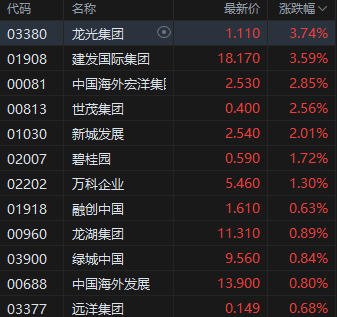
港股异动丨内房股集体上涨 龙光集团涨近4% 世茂集团涨近3%
Ge Long Hui· 2025-09-24 03:27
Group 1 - The core viewpoint of the article highlights a collective rise in Hong Kong's property stocks, driven by government reforms aimed at stabilizing the real estate market and addressing sector challenges [1] - The Ministry of Housing and Urban-Rural Development of China has announced plans to deepen reforms and promote breakthroughs in housing, real estate, urban construction, and the construction industry [1] - Several property companies are undergoing domestic debt restructuring, including Country Garden, Sunac China, Longfor Group, and CIFI Holdings [1] Group 2 - Notably, the luxury housing market in Shanghai has seen a surge, with a recent launch of 120 units in the Kerry Jinling Huating Phase II selling out completely, generating a sales revenue of 9.843 billion yuan in a single day [1] - Specific property stocks such as Longfor Group and Jianfa International have seen increases of nearly 4%, while Shimao Group and China Overseas Grand Oceans have risen by nearly 3% [1] - The article provides a detailed list of stock performance for various property companies, indicating positive market sentiment [1]




紧贴环线的外环板块吃到政策红利了吗?
3 6 Ke· 2025-09-24 02:32
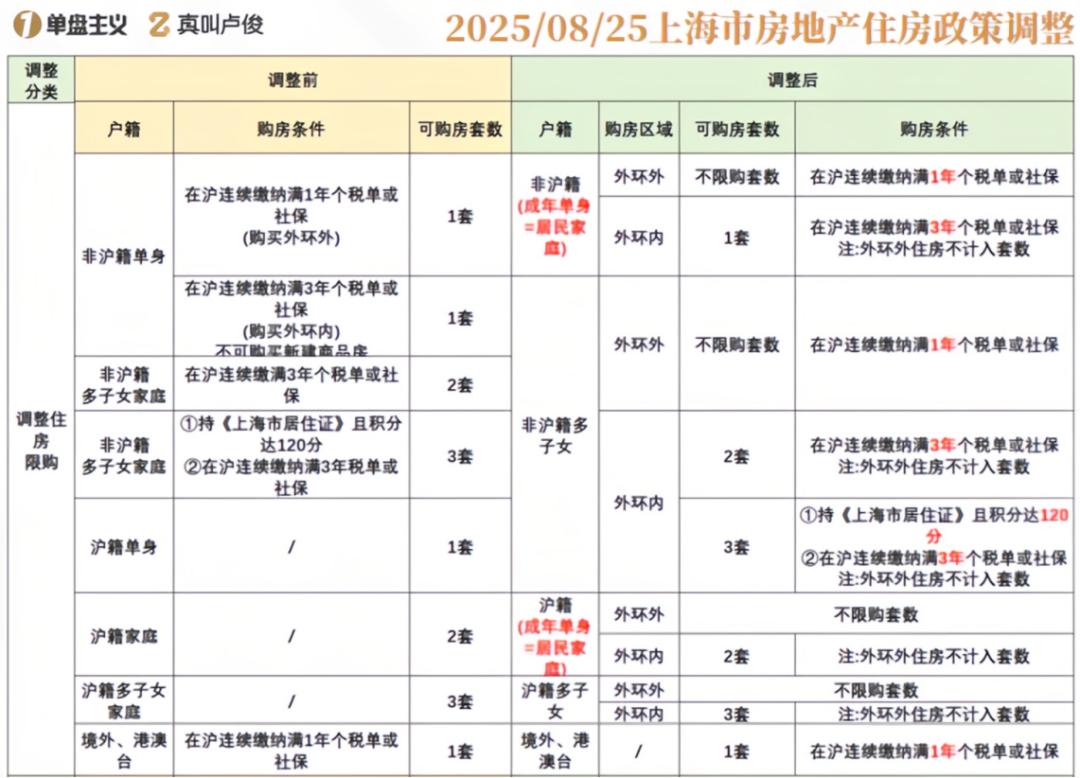
Core Viewpoint - The new housing policy in Shanghai has led to significant changes in the real estate market, particularly benefiting properties located just outside the outer ring road, with increased demand and sales activity observed in these areas [1][4][32]. Summary by Sections Policy Changes - The new policy reduces the social security requirement for non-local residents from three years to one year, allowing quicker access to home purchases [3]. - Non-local residents can now buy unlimited properties outside the outer ring, reducing barriers for upgrading homes [3]. - Local single residents are now considered as families, stimulating local demand for improved housing [3]. Market Response - Following the policy announcement, there was a 19% increase in new customer inquiries for properties outside the outer ring [6]. - The areas closest to the outer ring, such as Chunshen and Shangda, have seen the highest interest, with viewing-to-listing ratios indicating strong demand [7][8]. Sales Performance - Sales data shows that properties just outside the outer ring experienced a notable increase in transaction volumes, with some areas reporting over 50% growth in sales post-policy [10][12]. - Specific neighborhoods like Taopu and Tangzhen saw transaction volumes rise by 30% and 53.85%, respectively, compared to the week before the policy [9][10]. Price Trends - Despite some areas experiencing price drops, many neighborhoods saw price increases, with the average price in the Chuansha area rising by 12.82% post-policy [12][13]. - The overall sentiment among property owners in outer ring areas has shifted positively, with an increase in the proportion of listings at higher prices [17][19]. Buyer Behavior - The policy has shifted buyer focus towards high-quality new developments, with significant sales increases in new properties located outside the outer ring [28][29]. - The demand for new homes is driven by middle-class families transitioning from first-time buyers to seeking improved living conditions [28][29]. Market Dynamics - The policy has led to a re-evaluation of property values, with a focus on product quality, location, and living experience becoming more critical in buyer decision-making [35][36]. - The market is witnessing a shift where properties with better amenities and transportation links are favored, while older, less desirable properties struggle to attract buyers [26][30].
中国城市更新坎坷难行,究竟问题在哪里?
3 6 Ke· 2025-09-24 01:53
Group 1 - The commercial real estate sector is facing unprecedented challenges due to economic slowdown and weak consumer demand, leading to rising vacancy rates and shrinking rental negotiation space [1][2] - Historical experiences from markets like the US and Japan indicate that commercial real estate is a "slow-moving asset" that typically lags behind macroeconomic recovery, often requiring two years or more to stabilize after an economic downturn [2][3] - In China, the retail and dining sectors are experiencing the slowest recovery, with shopping center vacancy rates nearing 20%, while office buildings and hotels are rebounding faster due to the resumption of business activities [2][3] Group 2 - State-owned enterprises (SOEs) are deemed essential for urban renewal projects due to their ability to handle large-scale funding and long-term investment cycles, providing necessary stability during economic uncertainty [2][3] - The role of SOEs is not seen as excessive intervention but rather as a necessary responsibility to support urban renewal efforts [3] - The operational phase of urban renewal, which is crucial for project success, requires the flexibility and responsiveness of private enterprises, as they can adapt quickly to market changes [4][6] Group 3 - The current slow progress in urban renewal is attributed to misaligned governance structures, where operational teams are often integrated into engineering logic, hindering independent decision-making [7][8] - Data shows that companies like China Resources Land and Longfor Group have demonstrated stable revenue growth and high occupancy rates, indicating the importance of effective operational management in the current market [7][8] - The shift from ROI to NOI and cash flow metrics is necessary for evaluating the viability of projects in the current market environment [11][12] Group 4 - To resolve existing contradictions in urban renewal, adjustments are needed across five levels: organizational independence, administrative management transformation, government coordination, financial evaluation methods, and capability upgrades [8][9][11] - A clear division of responsibilities is essential, with SOEs providing a safety net, private enterprises driving innovation, and government facilitating coordination to enhance overall urban asset efficiency [13]
房地产行业周报(2025年第38周):上海优化房产税政策,旭辉中标成都代建项目-20250923
Huachuang Securities· 2025-09-23 07:45
Investment Rating - The report maintains a "Buy" recommendation for the real estate sector [2] Core Insights - The real estate index increased by 0.7% in the 38th week, ranking 9th among 31 primary industry sectors [9][10] - New housing demand is declining, inventory issues remain unresolved, and land finance continues to negatively impact the economy, necessitating stronger policy measures to alleviate downward pressure on the real estate fundamentals [34] Summary by Sections Industry Basic Data - Total number of stocks: 107 - Total market capitalization: 1,233.623 billion - Circulating market capitalization: 1,183.334 billion [3] Relative Index Performance - Absolute performance over 1 month: 4.7% - Absolute performance over 6 months: 12.2% - Absolute performance over 12 months: 31.4% - Relative performance over 1 month: 1.4% - Relative performance over 6 months: -3.4% - Relative performance over 12 months: -9.9% [4] Policy News - Various local governments are implementing measures to boost housing consumption and support affordable housing development, including adjustments to housing provident fund contributions and property tax policies [15][18] Sales Data - New housing transactions in 20 monitored cities increased by 32% year-on-year, with a total transaction area of 176 million square meters in the 38th week [21] - Second-hand housing transactions in 11 monitored cities increased by 71% year-on-year, with a total transaction area of 191 million square meters [25][29] Financing Data - Most bond issuances this week were by local state-owned enterprises, with the largest issuance being 1.98 billion by Jinqiao Group [30][32] Investment Strategy - Focus on companies with strong product differentiation and stable rental income from quality commercial real estate, as well as stock brokerage businesses in the existing housing market [34]



央行调整14天期逆回购操作方式,资金面有所改善,债市延续调整
Dong Fang Jin Cheng· 2025-09-23 06:21
1. Report Industry Investment Rating - No relevant information provided 2. Core Viewpoints of the Report - On September 19, the liquidity situation improved, with major repo rates declining; the bond market continued to adjust, with long - term bonds performing weaker; the convertible bond market's main indices followed the decline, and most convertible bond issues fell; yields of U.S. Treasury bonds across various maturities generally rose, and yields of 10 - year government bonds in major European economies generally increased [1] 3. Summary by Relevant Catalogs 3.1 Bond Market News 3.1.1 Domestic News - The central bank adjusted the operation mode of 14 - day reverse repurchase, which released three key signals: strengthening the policy status of the 7 - day reverse repurchase operation rate, promoting the transformation of the monetary policy framework to price - based regulation, and enhancing the flexibility and precision of liquidity regulation [3] - The State Council Executive Meeting discussed and basically approved the "Revised Draft of the Law of the People's Republic of China on Banking Supervision and Administration" to promote the healthy development of the banking industry [3] - In August, foreign investors net - bought domestic stocks and bonds overall, and the foreign exchange market was stable with active trading and balanced supply and demand [4] - The Shanghai, Shenzhen, and Beijing Stock Exchanges issued new regulations to optimize bond repurchase business, aiming to optimize corporate debt structure and resolve credit risks [5] - The inter - bank lending center launched new optimization functions for "North - bound Swap Connect" to meet the risk - management needs of overseas institutions [6] - As of September 21, the issuance scale of securities firms' bonds this year reached 1.23 trillion yuan, with the issuance scale of science and technology innovation bonds exceeding 57 billion yuan; the redemption scale of banks' "Tier 2 and perpetual bonds" reached 729.28 billion yuan [7] 3.1.2 International News - The Bank of Japan maintained the interest rate at 0.5% and announced the start of ETF and J - REIT reduction, with two members proposing a 25bp interest rate hike [8] - Minneapolis Fed President Kashkari supported the Fed's rate - cut decision and predicted two more rate cuts this year, also raising the estimate of the neutral interest rate [9] 3.1.3 Commodity News - On September 19, international crude oil futures prices continued to fall, and international natural gas prices declined; COMEX gold futures rose [10] 3.2 Funding Situation 3.2.1 Open - Market Operations - On September 19, the central bank conducted 354.3 billion yuan of 7 - day reverse repurchase operations, with a net capital injection of 124.3 billion yuan [12] 3.2.2 Funding Rates - On September 19, after the tax - payment period ended, the funding situation improved, and major repo rates declined [13] 3.3 Bond Market Dynamics 3.3.1 Interest - Rate Bonds - **Spot Bond Yield Trends**: On September 19, the bond market continued to adjust, with long - term bonds performing weaker. Yields of 10 - year Treasury bonds and 10 - year CDB bonds increased [16] - **Bond Tendering Situation**: Information on the tendering of 10 - year and 30 - year bonds was provided, including issuance scale, winning yields, and multiples [18] 3.3.2 Credit Bonds - **Secondary - Market Transaction Anomalies**: On September 19, the transaction prices of two industrial bonds deviated by more than 10% [18] - **Credit Bond Events**: Some bonds, such as "H16 Tianjian 2" and "20 Xingfu 01", had events like suspension and debt - repayment plan formulation [19] 3.3.3 Convertible Bonds - **Equity and Convertible Bond Indices**: On September 19, the three major A - share indices and convertible bond market indices all declined, and the convertible bond market's trading volume decreased [20] - **Convertible Bond Tracking**: Some companies' convertible bond issuance was approved, and some bonds had events like suspension, cancellation of issuance, and debt restructuring [22][23] 3.3.4 Overseas Bond Markets - **U.S. Bond Market**: On September 19, yields of most U.S. Treasury bonds rose, and the yield spreads between different maturities changed [24][25] - **European Bond Market**: Yields of 10 - year government bonds in major European economies generally increased [27] - **Price Changes of Chinese - Issued U.S. Dollar Bonds**: Information on the daily price changes of Chinese - issued U.S. dollar bonds as of September 19 was provided, including the top gainers and losers [29]
9月两个期限LPR报价维持不变,资金面转松,债市有所回暖
Dong Fang Jin Cheng· 2025-09-23 04:40
1. Report Industry Investment Rating - No relevant content provided 2. Core Viewpoints - On September 22, the central bank restarted the 14 - day reverse repurchase operation, the capital market continued to loosen, and the bond market recovered; the main indices of the convertible bond market closed down collectively, and most convertible bonds declined; the yields of US Treasury bonds of various maturities generally increased, and the 10 - year Treasury bond yields of major European economies remained unchanged [1] 3. Summary by Directory 3.1 Bond Market News 3.1.1 Domestic News - Vice - Premier He Lifeng met with a US congressional delegation, emphasizing the importance of Sino - US communication and cooperation in promoting bilateral economic and trade relations [3] - The LPR quotes for two tenors in September remained unchanged, with the 1 - year LPR at 3.00% and the over - 5 - year LPR at 3.50%, which was in line with market expectations [3] - As of the end of June this year, China's banking industry's total assets were nearly 470 trillion yuan, ranking first in the world; the stock and bond markets ranked second in the world; and the foreign exchange reserves ranked first in the world for 20 consecutive years. During the 14th Five - Year Plan period, China's financial risks were generally controllable, and the financial system operated steadily [4] - The CPC Party Group of the Ministry of Finance will coordinate debt replacement, financing platform reform, and accountability for illegal debt - raising [5] - The CPC Party Committee of the CSRC will coordinate the resolution of local financing platform and real - estate enterprise bond risks and support reasonable financing [5] 3.1.2 International News - Three Fed officials expressed concerns about inflation and believed that the space for further interest - rate cuts was limited this year, which may affect the Fed's interest - rate policy in the remaining two meetings [6] 3.1.3 Commodities - On September 22, international crude oil futures prices continued to fall, with WTI October crude futures down 0.06% and Brent November crude futures down 0.16%; COMEX December gold futures rose 1.87%, and NYMEX natural gas prices fell 3.77% [7][8] 3.2 Capital Market 3.2.1 Open Market Operations - On September 22, the central bank conducted 2405 billion yuan of 7 - day reverse repurchase operations and 3000 billion yuan of 14 - day reverse repurchase operations, with a net capital injection of 2605 billion yuan after 2800 billion yuan of reverse repurchases matured [10] 3.2.2 Capital Interest Rates - On September 22, the central bank restarted the 14 - day reverse repurchase operation, and the capital market continued to warm up. Major repurchase interest rates continued to decline, such as DR001 down 3.67bp to 1.428% and DR007 down 2.08bp to 1.489% [11] 3.3 Bond Market Dynamics 3.3.1 Interest - Rate Bonds - **Spot Bond Yield Trends**: On September 22, due to the central bank's restart of the 14 - day reverse repurchase and the loosening of the capital market, the bond market recovered. The yield of the 10 - year Treasury active bond 250011 fell 0.75bp to 1.7875%, and the yield of the 10 - year CDB active bond 250215 fell 1.00bp to 1.9280% [14] - **Bond Tendering Situation**: Information on the issuance scale, winning bid yields, and other aspects of multiple bonds such as 25 Agricultural Development Discount 08 (Increment 3) was provided [16] 3.3.2 Credit Bonds - **Secondary - Market Transaction Anomalies**: On September 22, the transaction prices of 2 industrial bonds deviated by more than 10%, with "16 Longhu 04" down more than 12% and "H1 Yangcheng 01" up more than 1592% [16] - **Credit Bond Events**: There were announcements from companies such as China Aoyuan, Newmi Caiyuan Investment Group, and Kaisa Group regarding debt restructuring, warnings, and other matters [19] 3.3.3 Convertible Bonds - **Equity and Convertible Bond Indices**: On September 22, the three major A - share indices closed up, with the Shanghai Composite Index, Shenzhen Component Index, and ChiNext Index up 0.22%, 0.67%, and 0.55% respectively. The main indices of the convertible bond market closed down, with the China Bond Convertible Bond Index, Shanghai Bond Convertible Bond Index, and Shenzhen Bond Convertible Bond Index down 0.43%, 0.43%, and 0.40% respectively [18] - **Convertible Bond Tracking**: On September 22, Fushi Convertible Bond announced that it was about to meet the early redemption conditions [21] 3.3.4 Overseas Bond Markets - **US Bond Market**: On September 22, the yields of US Treasury bonds of various maturities generally increased, with the 2 - year US Treasury yield up 4bp to 3.61% and the 10 - year US Treasury yield up 1bp to 4.14%. The yield spreads of 2/10 - year and 5/30 - year US Treasury bonds narrowed [22][23] - **European Bond Market**: On September 22, the 10 - year Treasury bond yields of major European economies remained unchanged, including Germany, France, Italy, Spain, and the UK [25] - **Daily Price Changes of Chinese - Issued US - Dollar Bonds**: Information on the daily price changes, including the top 10 gainers and losers, of Chinese - issued US - dollar bonds as of the close on September 22 was provided [27]
行业从“增量扩张”走向“存量运营” 数智化转型成房企必答题
Zhong Guo Jing Ying Bao· 2025-09-23 04:00
Core Insights - The transformation towards digital intelligence in the real estate industry is deemed essential for survival and improvement, moving from traditional construction to a new paradigm of "space operation + data empowerment" [1][3] Group 1: Industry Transformation - The real estate sector is undergoing a significant shift from an incremental to a stock-based era, driven by digital transformation [2] - From 2000 to 2010, new housing construction reached 115% of the initial stock, doubling growth; from 2010 to 2020, it achieved 80% growth on an already expanded stock; projections for 2020 to 2030 indicate new construction will decline to around 40% [2] - The focus of the industry is shifting from large-scale new construction to stock operation and quality enhancement, with future growth rates stabilizing at 20% to 25% [2] Group 2: Key Elements of Change - In the incremental era, core elements were land and capital; in the stock era, data and operational capability become central [3] - The redefinition of real estate to include data alongside physical rights and location is expected to fundamentally alter the industry's value recognition system [3] Group 3: Digital Transformation in Practice - The past two years have seen rapid digital transformation in the real estate sector, driven by the need to improve space, energy, organizational, and service efficiencies [3] - Companies like Longfor Group have reported significant efficiency improvements, with project design times reduced by 64% to 72% due to digitalization [3] - Over half of the companies have initiated digital transformation, anticipating disruptive impacts within five years, although challenges such as assessing economic benefits and data quality persist [3][4] Group 4: Recommendations for Companies - Companies are advised to maintain their core business while enhancing productivity through digital means, focusing on information, digitalization, and intelligent applications [4][5] - Exploring related or innovative business areas, including horizontal expansion and strategic emerging industries, is recommended to create comprehensive service solutions [5]