伊利股份

Search documents
CBA新赛季增设“潜力赛” 各俱乐部再获15个品类招商权益
Zhong Guo Jing Ying Bao· 2025-12-02 07:33
Core Viewpoint - The 31st season of the Chinese Basketball Association (CBA) League is set to begin on December 12, with significant changes in the competition format and rules aimed at enhancing the league's appeal and player development [1][2]. Group 1: Competition Format Changes - The regular season will be reduced from 46 rounds to 42 rounds [1]. - Game time will be adjusted from 12 minutes per quarter to 10 minutes, aligning more closely with FIBA rules, and certain special regulations will be eliminated [1]. - The CBA Club Cup will continue with an upgrade, adding three NBL teams, bringing the total to 23 participating teams [2]. - A new "CBA Potential Game" will be introduced, allowing for more exposure and playing time for young players [2]. Group 2: Player Demographics and Transactions - Among the 339 registered domestic players, 62 are first-time registrants, making up 18%, while "post-2000" players account for 58% [3]. - The number of players aged 31 and above has decreased to 29, the lowest in the past three seasons [3]. - A total of 48 domestic player transactions were completed, including 18 transfers and 17 free agent signings, marking a new high in transaction volume [3]. Group 3: Sponsorship and Media Partnerships - The number of sponsors has decreased from 16 to 14, with notable exits and new entries among sponsors [4]. - The league will continue with a five-tier sponsorship system, including major sponsors like China Life and strategic partners like Li Ning [4]. - Media partnerships have shifted to primarily include CCTV Sports for the new season [5]. Group 4: Team Naming and Marketing Strategies - Several teams have undergone name changes due to new sponsorship agreements, reflecting a trend in sports marketing [6]. - Alcohol brands are prominent sponsors, with five teams in the CBA and three in the WCBA being sponsored by liquor companies [6]. - The trend in sports marketing is shifting towards deeper engagement strategies, combining online and offline interactions to enhance brand recognition [7].
天图投资,“亏本”卖优诺丨消费参考
2 1 Shi Ji Jing Ji Bao Dao· 2025-12-02 03:57
Core Viewpoint - The French yogurt brand Yuno has changed ownership in China, with Tian Tu Investment announcing the sale of its shares to Kunshan Noyuan Ruiyuan Management Consulting Co., backed by IDG Capital, for approximately 814 million yuan, indicating a potential loss for Tian Tu Investment [1][2]. Group 1: Transaction Details - Tian Tu Investment plans to sell its 45.22% stake in Yuno for about 814 million yuan, expecting a loss of 847,000 yuan from the transaction [1]. - The total price for the shares being sold, including other sellers, amounts to 751 million yuan [1]. - IDG Capital's acquisition cost for Yuno exceeds 1.6 billion yuan, with reports suggesting the total transaction price could reach 1.8 billion yuan [2]. Group 2: Company Performance - Yuno China reported revenues of 454 million yuan and a net profit of 8.515 million yuan in 2023, with revenues increasing to 810 million yuan and net profit rising to 95.454 million yuan in 2024 [3]. - Despite the growth, the yogurt market in China is facing challenges, with a projected decline of 10.68% in market size for 2024 [4]. Group 3: Market Dynamics - The yogurt market is experiencing polarization, with leading brands like Yili and New Dairy achieving growth in the low-temperature yogurt segment, while the overall market is under pressure from price wars [4]. - The mainstream price range for yogurt has decreased from 8-10 yuan five years ago to around 5 yuan currently, impacting sales of lower-end products [4].


老牌饮料的转型挑战,维他奶上半财年营收承压下滑6%
Xi Niu Cai Jing· 2025-12-02 02:22
Core Viewpoint - Vitasoy International Holdings Limited reported a decline in overall revenue for the first half of the fiscal year 2025/26, primarily due to weak performance in traditional retail channels in mainland China, despite some growth in emerging channels [2][3]. Group 1: Financial Performance - Total revenue for the six months ending September 30, 2025, was HKD 3.227 billion, a decrease of 6% from HKD 3.443 billion in the same period last year [2]. - Profit attributable to equity holders slightly increased by 1% to HKD 172 million [2]. - Revenue from mainland China, the largest market for Vitasoy, was HKD 1.778 billion, down 9% year-on-year, significantly impacting overall performance [2]. Group 2: Market Challenges and Strategies - The decline in revenue was mainly attributed to the poor performance of traditional retail channels, although all-channel business showed steady growth [2]. - Vitasoy is focusing on core product categories such as soy milk, plant-based milk, and ready-to-drink tea, implementing competitive pricing strategies and product innovations to adapt to market changes [2]. - New product launches, including the "Duck Shit Lemon Tea," and competitive pricing for existing products have helped improve market share in the soy and plant-based milk categories [2]. Group 3: Regional Performance - The Hong Kong business, including Macau and exports, remains stable, with Vitasoy consolidating its leadership in the non-alcoholic beverage market [3]. - New product launches like low-sugar white peach soy milk and the Duck Shit Lemon Tea, along with strong sales of zero-sugar lemon tea and sparkling series, have reinforced category leadership [3]. - However, adverse weather conditions and weak retail performance in Macau, along with fluctuating U.S. tariff policies affecting North American exports, have negatively impacted overall performance in Hong Kong [3]. Group 4: Competitive Landscape - Vitasoy faces increasing competition in the soy milk sector from major players like Mengniu, Yili, and DaLi Foods, which are launching their own soy milk products [3]. - The tea beverage segment is also under pressure from the rise of sugar-free tea trends and various fresh lemon tea brands, challenging Vitasoy's traditional lemon tea offerings [3]. Group 5: Leadership Transition - The company is in a gradual leadership transition phase, with 84-year-old executive chairman, Lo Kwei Cheung, still actively involved, while his daughter, Lo Chi Mei, was appointed vice-chairman in 2023, signaling a potential succession [4]. - Despite the challenges in revenue growth, strategies focused on cost control and efficiency improvements have begun to show results in maintaining profitability [4]. - To achieve a true business recovery, Vitasoy needs to seek breakthroughs in product innovation, channel expansion, and brand rejuvenation to address increasing market competition and changing consumer preferences [4].

12月1日中证消费(399932)指数跌0.22%,成份股温氏股份(300498)领跌
Sou Hu Cai Jing· 2025-12-01 15:35
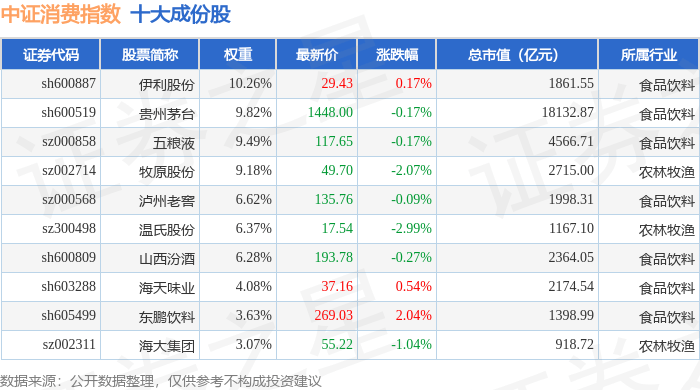
Core Viewpoint - The China Securities Consumer Index (399932) closed at 16047.2 points on December 1, with a slight decline of 0.22%, indicating a mixed performance among its constituent stocks [1]. Group 1: Index Performance - The total trading volume for the index was 19.806 billion yuan, with a turnover rate of 0.76% [1]. - Among the constituent stocks, 23 companies saw an increase, with COFCO Sugar leading with a rise of 3.38%, while 15 companies experienced a decline, with Wens Foodstuffs leading the drop at 2.99% [1]. Group 2: Top Constituents - The top ten constituents of the index include: - Yili Group (10.26% weight) at 29.43 yuan, up 0.17% - Kweichow Moutai (9.82% weight) at 1448.00 yuan, down 0.17% - Wuliangye (9.49% weight) at 117.65 yuan, down 0.17% - Muyuan Foods (9.18% weight) at 49.70 yuan, down 2.07% - Luzhou Laojiao (6.62% weight) at 135.76 yuan, down 0.09% - Wens Foodstuffs (6.37% weight) at 17.54 yuan, down 2.99% - Shanxi Fenjiu (6.28% weight) at 193.78 yuan, down 0.27% - Haitian Flavoring (4.08% weight) at 37.16 yuan, up 0.54% - Dongpeng Beverage (3.63% weight) at 269.03 yuan, up 2.04% - Haida Group (3.07% weight) at 55.22 yuan, down 1.04% [1]. Group 3: Capital Flow - On the same day, the net outflow of main funds from the index constituents totaled 968 million yuan, while speculative funds saw a net inflow of 1.063 billion yuan, and retail investors experienced a net outflow of 95.5649 million yuan [3]. - Notable capital flows included: - COFCO Sugar with a net inflow of 68.7449 million yuan from main funds and 29.1858 million yuan from speculative funds - Yili Group with a net inflow of 64.4441 million yuan from main funds but a net outflow of 61.2934 million yuan from retail investors [3]. Group 4: Index Adjustments - Recent adjustments to the index included the addition of one stock and the removal of three stocks, effective December 15, 2025 [4]. - The newly added stock is Zhengbang Technology (002157) from the agriculture and forestry sector, with a total market value of 28.12 billion yuan [4].





新帅在华动刀:雀巢、惠氏营养品合并
2 1 Shi Ji Jing Ji Bao Dao· 2025-12-01 13:21
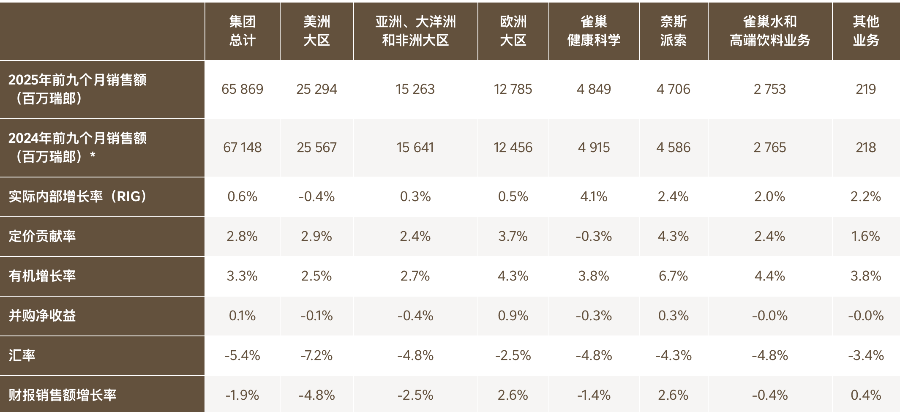
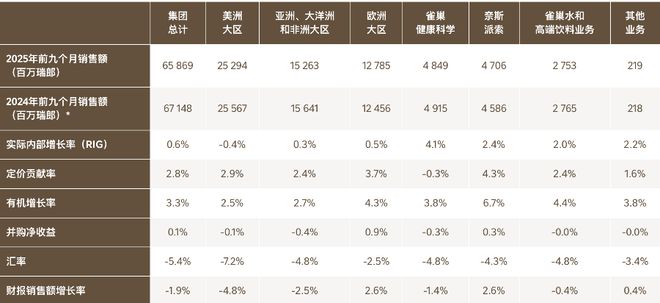
Core Viewpoint - Nestlé is undergoing a significant restructuring, merging its Wyeth Nutrition and Nestlé Infant Nutrition units into a single Nestlé Nutrition business starting January 1, 2026, to enhance growth and consolidate its leadership in the Chinese infant nutrition market [1][9]. Group 1: Business Restructuring - The merger aims to reduce internal competition and leverage the strong brand influence of Wyeth and the operational advantages of Nestlé's infant nutrition team [10][9]. - Joel Seah will lead the newly formed Nestlé Nutrition business [1]. - The restructuring is part of a broader strategy to prioritize high-potential opportunities and foster a performance-oriented culture within the company [13]. Group 2: Market Dynamics - The infant formula market in China is experiencing stagnation, with a growth rate of only 0.6% in Q2 2025, as the new birth rate declines and marriage registrations drop by over 20% in 2024 [4]. - The ultra-premium segment is becoming mainstream, with a 13.3% year-on-year growth in the ultra-premium+ market, while other segments are declining [5]. - Domestic brands like Feihe and Yili have surpassed foreign brands in market share, indicating a shift in competitive dynamics [8]. Group 3: Financial Performance - Nestlé's organic growth rate in the Greater China region was -10.4% in Q3, continuing a downward trend from Q2, highlighting the operational pressures faced by the company [10]. - The overall sales figures for the first nine months of 2025 show a slight decline compared to the same period in 2024, with total sales of 65,869 million Swiss francs [3]. Group 4: Leadership Changes - Recent leadership changes include the appointment of a new CEO, who emphasizes a cautious approach to resource allocation and a focus on growth [12][13]. - The restructuring is being executed under the guidance of the new management team, which includes key personnel with experience in the Southeast Asian market [16][15].

新帅在华动刀:雀巢、惠氏营养品合并丨消费一线
2 1 Shi Ji Jing Ji Bao Dao· 2025-12-01 13:12
Core Viewpoint - Nestlé is undergoing a significant top-down reform, merging its Wyeth Nutrition and Nestlé Infant Nutrition businesses into a single Nestlé Nutrition unit starting January 1, 2026, to enhance growth and consolidate its leadership in the Chinese infant nutrition market [1][2]. Business Strategy - The merger aims to leverage the strong brand influence of Wyeth and S-26 with Nestlé's industry and channel advantages to achieve sustainable development in a competitive market [6][8]. - Nestlé emphasizes that this restructuring will not affect existing operations, and both Wyeth Nutrition (China) Co., Ltd. and Wyeth (Shanghai) Trading Co., Ltd. will continue to operate [1][2]. Market Dynamics - The infant formula market is transitioning to a mature phase, with a reported growth rate of only 0.6% in Q2 2025, as the newborn demographic advantage diminishes [3]. - The ultra-premium segment is becoming mainstream, with a 13.3% year-on-year growth in the ultra-premium+ market, while other segments are experiencing declines [4]. Competitive Landscape - The competition in the ultra-premium market is intensifying, as evidenced by Feihe's revenue decline of 9.36% to 9.151 billion yuan in the first half of the year [5][6]. - Domestic brands like Feihe and Yili have surpassed foreign brands in market share, indicating a shift in the competitive landscape [6]. Management Changes - Recent leadership changes at Nestlé include the appointment of a new CEO, who is focused on resource allocation towards high-potential opportunities and fostering a performance-driven culture [7][8]. - The restructuring is part of a broader strategy to simplify the organizational structure and enhance operational efficiency under the new management [9][10]. Key Personnel - Joel Seah has been appointed as the head of the newly formed Nestlé Nutrition business, bringing experience from his previous roles in Southeast Asia [11][12].
中国必选消费品11月需求报告:所有品类增速均放缓
Haitong Securities International· 2025-12-01 11:31
Investment Rating - The investment rating for the essential consumer goods sector is "Outperform" for multiple companies including Kweichow Moutai, Wuliangye, and Yili [1] Core Insights - In November 2025, four out of eight monitored essential consumer sectors showed positive growth, while four experienced negative growth, with the growth sectors being condiments, frozen foods, soft drinks, and catering services [29] - The overall growth rates across all sectors have slowed compared to the previous month, attributed to macroeconomic conditions, structural industry challenges, and seasonal factors [29] Subsector Summaries Mid-to-High-End and Above Baijiu - Revenue for the mid-to-high-end and premium baijiu sector in November was RMB 24 billion, down 13.0% year-on-year, with cumulative revenue from January to November at RMB 349.2 billion, a decline of 6.2% [30] - The market is experiencing simultaneous declines in both volume and price, with a conservative consumer spending trend [30] Mass-Market and Below Baijiu - Revenue for the mass-market and lower-tier baijiu industry reached RMB 18.9 billion in November, marking a 3.3% year-on-year decline, with cumulative revenue from January to November totaling RMB 180.9 billion, down 8.5% [30] - The production of baijiu in October was 276,000 kiloliters, down 18.3% year-on-year, indicating a challenging market environment [30] Beer - The domestic beer industry generated revenue of RMB 9.9 billion in November, a 2.0% year-on-year decline, with cumulative revenue from January to November at RMB 162.6 billion, representing a 0.2% year-on-year increase [31] - Seasonal demand has decreased due to a nationwide temperature drop, leading to subdued overall demand [31] Condiments - The condiments sector reported revenue of RMB 418 billion in November, a year-on-year increase of 0.8%, with cumulative revenue from January to November at RMB 4,129 billion, up 1.3% [18] Frozen Foods - The frozen foods sector achieved revenue of RMB 81.6 billion in November, a year-on-year increase of 4.0%, with cumulative revenue from January to November at RMB 964 billion, up 2.2% [22] Soft Drinks - Revenue for the soft drinks sector was RMB 388 billion in November, a year-on-year increase of 2.1%, with cumulative revenue from January to November at RMB 6,583 billion, up 4.1% [24] Catering - The catering industry reported revenue of RMB 130.4 billion in November, a year-on-year increase of 0.3%, with cumulative revenue from January to November at RMB 1,607 billion, down 0.7% [26]
饮料乳品板块12月1日涨1.12%,阳光乳业领涨,主力资金净流出1.45亿元
Zheng Xing Xing Ye Ri Bao· 2025-12-01 09:03
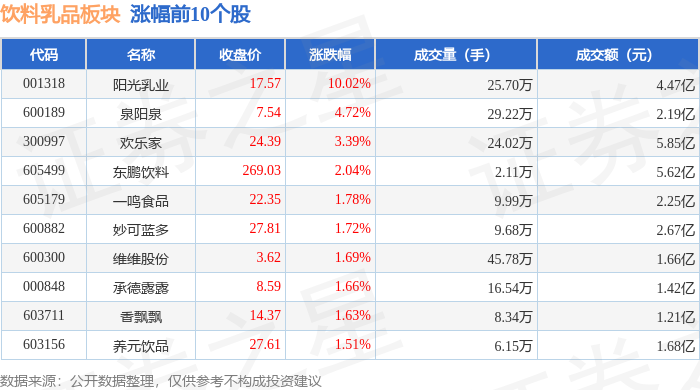
Market Overview - The beverage and dairy sector increased by 1.12% on December 1, with Sunlight Dairy leading the gains [1] - The Shanghai Composite Index closed at 3914.01, up 0.65%, while the Shenzhen Component Index closed at 13146.72, up 1.25% [1] Stock Performance - Sunlight Dairy (001318) closed at 17.57, up 10.02% with a trading volume of 257,000 shares and a transaction value of 447.1 million [1] - Other notable performers included: - Quan Yang Quan (600189) at 7.54, up 4.72% [1] - Huanle Jia (300997) at 24.39, up 3.39% [1] - Dongpeng Beverage (605499) at 269.03, up 2.04% [1] - Yiming Food (605179) at 22.35, up 1.78% [1] Fund Flow Analysis - The beverage and dairy sector experienced a net outflow of 145 million from institutional investors, while retail investors saw a net inflow of 117 million [2] - The main stocks with significant fund flows included: - Yili Group (600887) with a net outflow of 64.44 million from institutional investors [3] - Sunlight Dairy (001318) with a net inflow of 42.02 million from institutional investors [3] - Chengde Lolo (000848) had a net inflow of 4.49 million from retail investors [3]


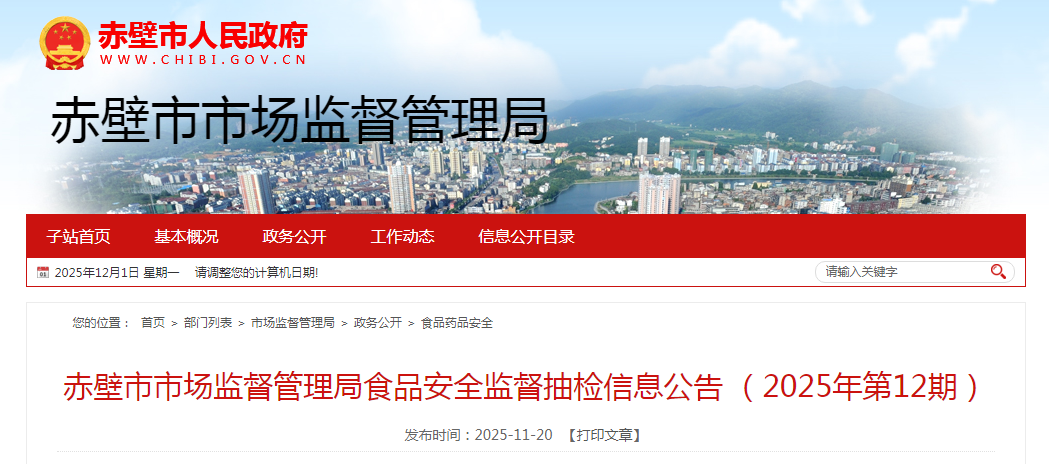
湖北省赤壁市市场监督管理局食品安全监督抽检信息公告(2025年第12期)
Zhong Guo Zhi Liang Xin Wen Wang· 2025-12-01 08:22
Summary of Key Points Core Viewpoint - The announcement from the Chibi City Market Supervision Administration indicates that all 154 batches of food products tested, including various categories such as condiments, meat products, dairy, beverages, and more, passed inspection without any non-compliant samples detected [2]. Group 1: Food Categories - A total of 22 categories of food products were sampled, including condiments, meat products, dairy products, beverages, convenience foods, biscuits, canned foods, frozen drinks, frozen foods, potato and puffed foods, candy, fruit products, nuts, sugar, aquatic products, starch and starch products, pastries, bean products, honey products, health foods, catering foods, and edible agricultural products [2]. - The breakdown of the 154 batches includes: - Condiments: 2 batches - Meat products: 8 batches - Dairy products: 2 batches - Beverages: 12 batches - Convenience foods: 11 batches - Biscuits: 4 batches - Canned foods: 2 batches - Frozen drinks: 5 batches - Frozen foods: 2 batches - Potato and puffed foods: 6 batches - Candy: 6 batches - Fruit products: 5 batches - Nuts: 8 batches - Sugar: 5 batches - Aquatic products: 4 batches - Starch and starch products: 4 batches - Pastries: 2 batches - Bean products: 2 batches - Honey products: 2 batches - Health foods: 4 batches - Catering foods: 22 batches - Edible agricultural products: 36 batches [2]. Group 2: Compliance Results - All 154 batches of food products tested were found to be compliant with safety standards, indicating a successful inspection process by the Chibi City Market Supervision Administration [2].
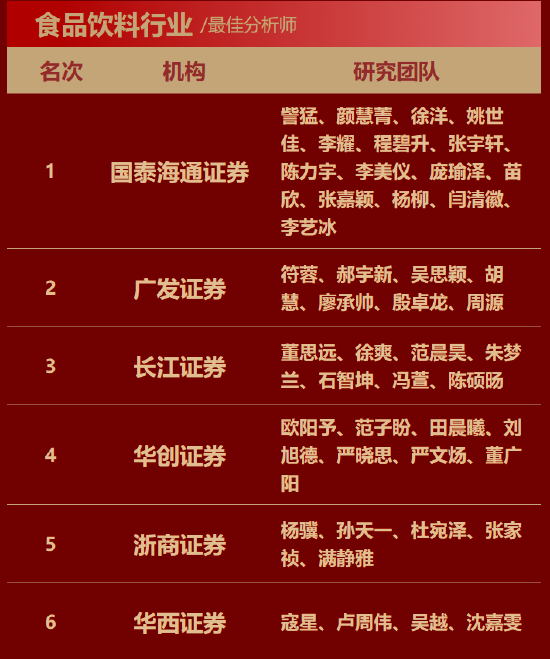
国泰海通证券訾猛团队荣获第七届金麒麟食品饮料行业最佳分析师第一名 最新研究观点:周期筑底,期待反转
Xin Lang Zheng Quan· 2025-12-01 08:13
Core Viewpoint - The Guotai Junan Zimeng team has achieved significant recognition in the food and beverage research sector, winning the title of "Best Analyst in the Food and Beverage Industry" at the 2025 Analyst Conference and the 7th Sina Finance "Golden Unicorn" Awards, reflecting their deep understanding of consumer trends and a mature research framework [1][2]. Group 1: Team Performance - The Guotai Junan Zimeng team moved from second place in the 2024 awards to first place in 2025, indicating a strong competitive potential and improvement in research capabilities [2]. - The competition landscape changed significantly, with the GF Securities team ranking second and Huachuang Securities team dropping to fourth place [2]. Group 2: Award Details - The Guotai Junan team members include Zimeng, Yan Huijing, Xu Yang, Yao Shijia, Li Yao, Cheng Biheng, Zhang Yuxuan, Chen Liyu, Li Meiyi, Pang Yuze, Miao Xin, Zhang Jiaying, Yang Liu, Yan Qinghui, and Li Yibing [1]. - The awards highlighted the top teams in the food and beverage sector, with Guotai Junan taking first place, GF Securities second, and Changjiang Securities third [3]. Group 3: Industry Insights - The Zimeng team believes that the liquor industry is currently undergoing a rapid clearing adjustment phase, with inventory levels decreasing and stock prices potentially rising amidst market pessimism [9]. - The beer industry is expected to clear earlier than the liquor sector, with increasing differentiation within the industry, suggesting investors should focus on regionally competitive beer leaders [9].