
凯恩斯主义

Search documents
刘世锦:经济刺激的“怪圈”,为何我们越用力,市场越疲软?
Sou Hu Cai Jing· 2026-02-27 09:13
文 | 刘世锦国家"十五五"规划专家委员会委员、国务院发展研究中心原副主任 宽松的货币政策、扩张的政府投资——这两大工具长期以来被视为应对经济下行的"标准答案"。但回顾过去十几 年的数据,我们却发现一个令人困惑的现象:M2持续走高,政府投资持续加码,而居民消费却始终低迷,经济增 速也一路放缓。钱去了哪里?刺激为什么失效?这不仅是宏观政策制定者需要面对的问题,也与每一个普通人的 生活息息相关——关乎就业、收入,也关乎未来的保障。 越刺激,需求越不足? 流行观点普遍认为,如果总需求不足,就需要以宽松的货币政策和扩大政府投资的财政政策来刺激经济。但从数 据上看,持续扩张的货币政策和财政政策似乎并未改变我国需求不足、经济下行的趋势。 数据显示,在过去十几年间,货币刺激的力度一直没有减弱。从2008年开始,我们的广义货币M2增长,就长期跑 赢了名义GDP。国际金融危机结束后,宽松的货币政策也并未退出。到2024年,M2已经超过了313万亿元,是当 年名义GDP的2.3倍。 这就形成了一个恶性循环:面对经济下行问题,我们不断刺激投资,投资最终带来新产能,但本就低迷的最终需 求难以消化新的产能,就会面临严重的产能过剩问题, ...


不仅全员失业,资本主义也将终结?德银重磅推演AI发展两种终局
Hua Er Jie Jian Wen· 2026-02-27 02:04
当讨论AI时,绝大多数人还在纠结"工作会不会被抢走"。但德银认为,这个视角或许有点狭窄了。 据追风交易台,德银外汇研究全球主管George Saravelos撰写的最新报告,推演了AI发展的两个极端终 局: 第一种结局是"彻底替代"。如同180多年前马克思的预言与如今马斯克的愿景:在经济学的生产要素 中,"资本"本身变成了"劳动力"本身,劳动价值归零,资本主义将变得过时。AI大规模取代人类工作, 财富和收入高度集中在少数资本所有者手中,普通人的收入和需求被削弱,经济陷入"东西很多、但没 人买得起"的困境。 马克思预测了人工智能吗?大约200年前,他写了一部关于"机器"的著作,构想了全面自动 化的场景。在这个世界里,稀缺性问题得到了解决。但是,随着劳动力价值降至零,资本主 义将变得过时,我们将过渡到一个物质极大丰富的全新世界。马克思构想的终点,与如今埃 隆·马斯克的愿景出奇地相似。 从亚当·斯密(Adam Smith)开始,所有古典经济学家都基于一个最基本的假设:资本和劳动是两个完 全独立的生产要素。无论是资本还是劳动,其价格(利率和工资)都是由它们在市场上的"相对稀缺 性"决定的。 回顾过去两百年的历史,以前 ...
创金合信基金魏凤春:周期复辟与成长分化的考量
Xin Lang Cai Jing· 2026-02-25 03:50
上期首席视点明确提出分化是2026年资产走势的明确特征,开年以来投资者将这种分化聚焦在周期的复 辟与复兴,成长的真与伪中。我们的观点是从短期战术的视角考虑,与其担心周期复辟不如担心成长分 化。 一、逆周期与顺周期的政策 往期首席视点对2026年资产配置的分析中,指出市场周期的力量强于政策的力量,政策对趋势的扰动明 显要弱于2025年。背后的一个基础判断是全球进入了新的周期,政策的重点在顺周期而不是逆周期调 节。何为顺周期,何为逆周期?一般认为,当主导产业尚未确立的时候,经济的波动对增长产生的负面 影响可以通过凯恩斯主义的逆周期调节来化解。这时候政策的重点是参与市场运行之中,目的是解决市 场的失灵,修复原有产业的秩序。这好比恋爱中的男女,自己的选择和父母的选择发生了冲突,在婚姻 未定前父母的干预一定程度上是可以起作用的。等到婚姻已成,父母再用自己的主张去指点,大概率会 影响家庭的和谐。 从经济学上讲,政策的操作和家庭的行为有些类似,父爱主义都是二者共同行动的准则,父爱的好坏关 键在于审时度势,明确行动的边界。等主导产业已经被确认后,产业转换带来的J曲线效应通常无法通 过常规的政策刺激来消解,政策的重点就会发生变 ...
海外宏观专题报告:不是选择,是必然——政治经济学眼中的美国政策
2026-02-10 03:24
Summary of Key Points from the Conference Call Industry or Company Involved - The report focuses on the macroeconomic policies of the United States, particularly under the Trump administration, and their implications for global markets and domestic socio-economic conditions [1][2][3]. Core Insights and Arguments - **Trump's Unconventional Policies**: The report argues that Trump's policies are a response to escalating domestic social contradictions, rooted in long-term distribution imbalances caused by neoliberalism since the 1980s [1][2][10]. - **Economic and Financialization Trends**: The acceleration of financialization in the U.S. economy has led to systemic financial crises, with the 2008 subprime crisis being a significant outcome of these trends [18][32]. - **Normalization of Keynesian Policies**: Post-crisis, Keynesian policies have been normalized in the U.S., leading to concerns about inflation and rising debt levels, which are now at historical highs [34][41]. - **Distribution Imbalances**: The report highlights that income and wealth distribution issues are central to the growing social tensions in the U.S., with a significant gap between corporate profits and worker wages [17][24]. - **Impact of Monetary Policy**: Trump's nomination of a new Federal Reserve chair aims to shift monetary policy towards a combination of interest rate cuts and balance sheet reductions, which could lead to market volatility [3][40]. Other Important but Possibly Overlooked Content - **Public Concerns**: According to Pew Research, American citizens are increasingly focused on economic pressures, such as inflation and healthcare affordability, rather than climate change or other issues [10][11]. - **CEO Compensation Disparities**: The report notes that by 2024, the average CEO compensation in the U.S. is projected to be 1,094% higher than in 1978, while average worker compensation has only increased by 26% during the same period [24][26]. - **Financial Regulation Erosion**: The report discusses how deregulation in the financial sector has contributed to the rise of shadow banking and increased systemic risks, particularly highlighted during the 2008 financial crisis [22][37]. - **Structural Reforms Needed**: There is a call for structural reforms to address the underlying issues of income inequality, aging population, and infrastructure deficits, which are not adequately addressed by Keynesian policies alone [45][49]. This summary encapsulates the critical insights from the conference call, emphasizing the socio-economic dynamics in the U.S. and the implications of current policies on both domestic and global scales.
华尔街如何看美联储新主席
2026-02-10 03:24
Summary of Key Points from the Conference Call Company/Industry Involved - The discussion primarily revolves around the Federal Reserve and its new chairman nominee, Kevin Walsh, along with the implications for various financial markets and sectors. Core Insights and Arguments 1. **Market Reactions to Walsh's Nomination**: - The nomination of Kevin Walsh has led to significant volatility in precious metals markets, with gold volatility reaching a near 50-year high. This is attributed to his opposition to quantitative easing (QE) and advocacy for balance sheet reduction, which contrasts with current market expectations of dollar depreciation [1][8]. 2. **Walsh's Policy Stance**: - Walsh's monetary policy approach is rooted in monetarism, advocating for reduced intervention by the Federal Reserve in market and fiscal policies. This is expected to strengthen the dollar and steepen the U.S. Treasury yield curve, benefiting bank stocks [1][2]. - He has criticized the Fed's reliance on economic data and forward guidance, suggesting a return to core responsibilities and a reduction in the Fed's power and asset size [1][4]. 3. **Proposed Reforms**: - Walsh has proposed several reforms, including limiting data dependency, reducing the balance sheet size, promoting financial liberalization, supporting digital currency development, and enhancing coordination between fiscal and monetary policies [1][5][10]. 4. **Inflation and Interest Rate Outlook**: - Walsh has expressed concerns over uncontrolled inflation and the Fed's failure to maintain financial stability, particularly highlighted during recent bank failures. He suggests that interest rates may need to be lowered soon due to current negative CPI data indicating high rates [2][11]. 5. **Impact on Financial Markets**: - The anticipated policies under Walsh could lead to a steepening of the yield curve, a stronger dollar, and a rise in bank stocks due to his stance on financial liberalization and potential reduction in capital requirements for banks [8][9]. 6. **AI's Role in Economic Productivity**: - AI investments are noted to significantly enhance U.S. productivity, although job growth remains lagging. Walsh's familiarity with AI technology may bring fresh perspectives to the Fed, potentially improving productivity further [3][12]. 7. **Challenges Facing the Fed**: - The Fed is currently facing internal divisions and challenges related to data accuracy and macroeconomic forecasting, which complicate the decision-making process. Walsh's leadership may address these issues by emphasizing accountability and clearer communication with the public [4][6]. 8. **Global Asset Allocation Trends**: - There is an increasing interest in Chinese assets among Wall Street investors, driven by improved U.S.-China relations and the performance of emerging markets. This shift may lead to capital inflows into China, particularly if Indian markets underperform [3][18]. Other Important but Possibly Overlooked Content 1. **Long-term Economic Outlook**: - The U.S. economy is currently performing well on a macro level, but micro-level adjustments are necessary due to the disruptive impact of AI on various industries. The transition to an AI-driven economy is expected to continue reshaping traditional sectors [13]. 2. **Future of Inflation and Interest Rates**: - The outlook for inflation suggests a potential long-term deflationary trend, with the Fed likely to focus on service sector prices when determining future interest rate strategies [16]. 3. **Dollar and Yuan Exchange Rate Dynamics**: - The strong dollar policy may be reinforced under Walsh, but the yuan's stability will be more influenced by U.S.-China political relations rather than solely economic factors [17]. 4. **Investment Sentiment in Commodities**: - While gold is expected to remain a strong investment in the medium to long term, the outlook for other commodities like oil is less favorable due to oversupply and pressures from the energy transition [19]. 5. **AI Stock Investment Caution**: - Despite recent declines in AI-related stocks, the demand for AI infrastructure remains robust, indicating a need for cautious investment strategies that balance opportunity with risk management [20].
中金:不是选择,是必然——政治经济学眼中的美国政策
Xin Lang Cai Jing· 2026-02-09 02:49
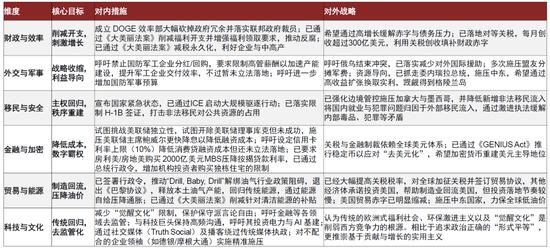
Core Viewpoint - Trump's unconventional policies are a response to escalating domestic social contradictions in the U.S., rooted in long-term distribution imbalances caused by neoliberalism since the 1980s [2][3][4]. Group 1: Domestic Policies - Trump has initiated measures to cut government spending and stimulate growth, including the establishment of the DOGE Efficiency Department to reduce government redundancy and accelerate federal layoffs [6]. - He has challenged the independence of the Federal Reserve and proposed a cap on credit card interest rates at 10% to lower consumer loan financing costs [6][4]. - The administration has implemented policies to limit executive compensation and has pressured allies to share military expenses [6][4]. Group 2: International Strategies - Trump's foreign policy includes imposing tariffs on a wide range of imports and advocating for the end of the Russia-Ukraine conflict while reducing international aid [6][4]. - The administration aims to strengthen control over overseas resources and energy to lower domestic living costs [3][4]. Group 3: Economic Implications - The ongoing internal contradictions in the U.S. are contributing to a relative decline in its international standing, with Trump's policies likely to expand in scope as he seeks to win midterm elections and achieve the goal of "Making America Great Again" [4]. - The proposed monetary policy changes, such as the nomination of Warsh as Fed Chair, aim to shift from a large fiscal framework to a model involving interest rate cuts and balance sheet reductions, which could lead to significant market volatility [4][6]. Group 4: Structural Issues - The article highlights the widening gap in income distribution in the U.S., with labor's share of income remaining stable while corporate profits have increased [9][10]. - The disparity between actual household income and the "qualified" income needed for affordable housing has widened significantly, indicating a growing financial burden on American families [9][11]. Group 5: Theoretical Framework - The return of neoclassical economics is identified as a key factor in the exacerbation of social contradictions in the U.S., with Keynesian policies being normalized in response to crises without addressing structural reforms [39][66]. - The article suggests that the challenges faced by the U.S. in implementing structural reforms are compounded by political and economic factors, including the weakening of labor unions and regional inequalities [58][66].
中金:不是选择,是必然——政治经济学眼中的美国政策
中金点睛· 2026-02-08 23:37
Core Viewpoint - Trump's unconventional policies are a response to escalating domestic social contradictions in the U.S., rooted in long-term distribution imbalances caused by neoliberalism since the 1980s [2][4]. Group 1: Domestic Policies - Trump's administration has implemented measures to cut government spending, such as the "Great Beautiful Act," which reduces welfare spending and increases eligibility requirements [6]. - The establishment of the DOGE Efficiency Department aims to eliminate government redundancies and promote federal layoffs [5]. - The administration has challenged the independence of the Federal Reserve and proposed a cap on credit card interest rates at 10% to lower consumer loan financing costs [5][6]. - Measures to limit institutional investors from purchasing single-family homes have been introduced to address housing affordability [5][6]. Group 2: Foreign Policies - Trump's foreign strategy includes imposing tariffs on a wide range of imports to protect domestic industries and reduce living costs [5][6]. - The administration has called for an end to the Russia-Ukraine conflict and reduced international aid commitments [5][6]. - There is a focus on increasing military spending and pressuring allies to share defense costs [5][6]. Group 3: Economic Implications - The policies aim to alleviate internal contradictions but are unlikely to resolve them fundamentally, reflecting a tendency for short-term gains at low costs [4][5]. - The proposed changes in monetary policy, such as the nomination of Warsh to the Federal Reserve, could lead to significant market volatility [4][5]. - The ongoing financialization of the U.S. economy has led to a widening gap between corporate profits and worker wages, with the share of labor income remaining stable while corporate income has increased [9][11]. Group 4: Structural Challenges - The U.S. faces significant structural challenges, including income inequality, healthcare affordability, and educational disparities, which have been exacerbated by the pandemic [7][39]. - The political landscape shows increasing polarization regarding economic issues, making it difficult to implement necessary reforms [56][57]. - The return of neoclassical economics has contributed to the exacerbation of social contradictions, with a reliance on Keynesian policies without substantial structural reforms [60][61].

对2026房价的侧面判断
Sou Hu Cai Jing· 2026-01-21 15:34
Group 1 - The core viewpoint indicates that the real estate market in Shanghai is currently driven by low-priced properties under 3 million, primarily catering to first-time homebuyers, with a notable decrease in the influx of new residents [1] - Shanghai's permanent resident population is projected to be 24.8 million, with a target of 25 million by 2035, suggesting limited growth in demand for affordable housing in the coming years [1] - The effective demand for properties priced around 3 million is expected to be low unless there is significant urban renewal, which may create new demand [1] Group 2 - The article suggests that the cyclical nature of the real estate market is unavoidable, and the best approach is to manage the pain through policy measures rather than attempting to eliminate the cycle [2] - There are rumors of potential policy relaxations in 2026, but the effectiveness of such measures in meeting market expectations is uncertain [2] - The current stability in the Shanghai real estate market indicates a period of observation is advisable, with ongoing policies suggesting that the market will continue in its current state [2]
增长的潜力在于关键领域的市场化改革
Xin Lang Cai Jing· 2026-01-13 00:09
Core Viewpoint - The presentation emphasizes the need for a mathematical logic approach to understand the relationship between economic reform and growth in China, highlighting the unique characteristics of China's gradual transition economy and the necessity for further reforms to achieve medium to high-speed growth [3][4][5]. Group 1: Reform and Growth Mathematical Logic - China is characterized as a long-cycle transitional economy, with a gradual transition period that has lasted 47 years and is expected to continue for another 15 to 20 years [4][5]. - Current mainstream economic models used to measure China's growth are deemed inaccurate due to their assumption of a stable system, which does not reflect the ongoing changes in China's economic structure [5][6]. - Previous methods for measuring the impact of reform on growth, such as the "before-and-after comparison" and "expert scoring method," are criticized for lacking scientific rigor and failing to reveal the underlying mechanisms of reform [6][7]. Group 2: Sources of Economic Growth - The contribution of Total Factor Productivity (TFP) to growth has shown significant variation in estimates, with some studies suggesting contributions as low as 0.6% and others as high as 4% [6][8]. - The research indicates that approximately 40% of TFP growth since the reform began is attributed to the monetization and assetization of physical goods, highlighting the importance of market reforms in driving economic growth [10][44]. - The analysis reveals that China's agricultural employment rate is significantly higher than that of comparable countries, indicating a potential for labor reallocation from low-productivity sectors to higher-productivity sectors [35][46]. Group 3: Growth Potential and Key Reforms - The potential for economic growth lies not only in structural transformation but also in addressing systemic inefficiencies, referred to as "systemic surplus," which can be quantified and leveraged for growth [19][46]. - Key areas for reform include labor mobility, capital market reforms, and land market liberalization, which are expected to contribute significantly to economic growth rates [22][23]. - The combination of supply-side and demand-side reforms is essential for achieving a balanced economic growth rate of 5% to 5.5% in the coming years [24][27].

2026年经济目标怎么设定?宏观与微观“温差”成关键考量?
Jing Ji Guan Cha Bao· 2025-12-18 05:12
Group 1 - The central economic work meeting emphasizes the importance of expanding domestic demand as a primary task for the upcoming year [4][5] - There is a notable "temperature difference" between macroeconomic performance and microeconomic sentiment, with macro indicators showing strength while micro experiences remain subdued [1][2] - The "involution" phenomenon in enterprises is linked to this temperature difference, where companies focus on maintaining cash flow stability, leading to increased production but declining profit margins [2] Group 2 - Suggestions for effective consumption support policies include increasing income, ensuring leisure time, improving consumption scenarios, and providing quality products [2] - The central economic work meeting proposes enhancing counter-cyclical and cross-cyclical adjustments, focusing on demand-side short-term adjustments and supply-side structural improvements [3] - Economic growth targets for 2026 are suggested to be set between 4.5% and 5.0%, slightly lower than the previous year's target, aligning with long-term GDP growth trends [4][5] Group 3 - The macroeconomic policy direction is expected to lean towards easing, with one interest rate cut and one reserve requirement ratio reduction anticipated [5] - The construction of a modern industrial system is highlighted as a crucial aspect of cross-cyclical policies, focusing on upgrading traditional industries and fostering emerging sectors [5][6] - There is a call for deeper market-oriented reforms to stimulate microeconomic vitality and establish a unified national market, which is essential for effective policy transmission [6]