尾部风险对冲

Search documents
高盛闭门会-中东事件对金属价格的风险
Goldman Sachs· 2026-03-04 14:17
Investment Rating - The report maintains a bullish outlook on gold prices, with a target of $5,400 per ounce by the end of 2026 under certain demand scenarios [1][2]. Core Insights - Gold price movements are driven by demand structure, with central bank purchases expected to remain resilient, while private sector demand could significantly elevate price volatility [1][5]. - The geopolitical situation in the Middle East poses a risk to global aluminum supply, potentially affecting prices and leading to significant production cuts if disruptions persist [1][8]. - The aluminum market is experiencing extreme liquidity constraints, with current market depth at only 10% of normal levels, necessitating pre-arranged trades for volatility transactions [1][11]. Summary by Sections Gold Market - Central banks are likely to continue purchasing gold, with current reserves at approximately 12% of total foreign reserves, indicating room for growth towards a 20% target [4]. - Two scenarios for gold price paths are outlined: one where central banks maintain current purchasing levels leading to a gradual price increase, and another where private sector demand spikes, resulting in higher volatility and price levels [2][3]. - The pricing of gold options is seen as undervalued, particularly for long-dated calls, suggesting potential upside risks not fully priced in [1][6]. Aluminum Market - The Middle East accounts for about 9% of global primary aluminum supply, with the UAE contributing 4% of global production [1][8]. - Disruptions in shipping or energy supply could lead to significant price increases, with potential support levels around $3,600 per ton if production is materially affected [1][8]. - Recent increases in aluminum premiums, particularly in Europe, are attributed to supply chain disruptions and heightened demand for specific aluminum products in the automotive and construction sectors [1][13][14]. Market Dynamics - The aluminum market is currently characterized by a high level of speculative positioning, with prices showing resilience despite broader market volatility [1][9]. - The report suggests that if the geopolitical situation stabilizes, aluminum prices may revert to more normalized levels, but ongoing disruptions could lead to sustained upward pressure [1][10]. - The liquidity in the aluminum options market is low, complicating the establishment of new positions, and indicating a cautious approach among traders [1][12].
“软件行业恐将破产”
3 6 Ke· 2026-02-25 07:41
Group 1 - Nassim Taleb warns investors about the increasing volatility and potential bankruptcy risks in the software industry driven by artificial intelligence (AI) [1] - Taleb believes that the market is currently underestimating structural risks while overestimating the durability of leading AI companies [1] - He emphasizes that while some will profit from AI, it does not guarantee that current AI companies will be the ones to benefit [1] Group 2 - A report from Citrini Research predicts a dystopian scenario by June 2028, where AI disruption leads to mass unemployment, decreased consumer spending, and economic contraction [2] - Taleb's warnings align with the concerns raised in the Citrini Research report, amplifying market fears [2] Group 3 - Taleb notes that the recent stock market gains have been driven by a small number of AI concept stocks, and a rotation in leading sectors could pose risks to broader indices [3] - He states that structural tail risks across industries are being underestimated, suggesting that potential market corrections could be significant [3] - Taleb anticipates that market gains may continue in the short term, but the scale of potential declines is a greater concern [3] Group 4 - Taleb highlights a structural shift in the market, particularly in the gold sector, which has seen a price increase of approximately 30% since October of the previous year [3] - He expresses concerns about the ongoing U.S. fiscal deficit and the "weaponization" of the dollar through sanctions, which could undermine the dollar's status as a reserve currency [3] Group 5 - Taleb discusses the unpredictable nature of tariffs, stating that if tariffs are permanent and clear, businesses can adapt, but erratic policies will deter investment [4] - He warns that tariffs have a regressive tax nature, disproportionately affecting low-income consumers and exacerbating social inequality [4] Group 6 - Taleb emphasizes the risk of oil supply disruptions due to U.S.-Iran tensions, warning that the global economy cannot withstand another shock similar to the 1970s [5] - He asserts that commodity-driven stagflation cannot be easily remedied through monetary policy [5] - Universa Investments, where Taleb serves as a distinguished scientific advisor, focuses on tail risk hedging strategies to achieve excess returns during market crises, having achieved an annualized return of over 100% last year [5]
知名“黑天鹅基金”创始人警告:标普500或达8000点后暴跌!
Jin Shi Shu Ju· 2026-02-18 06:22
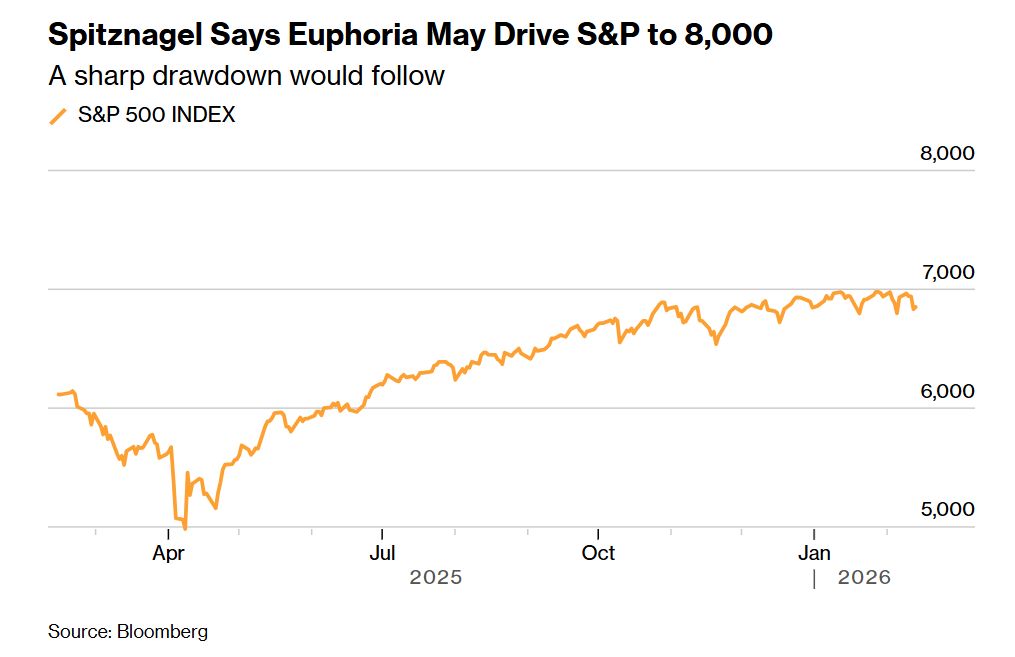
Core Viewpoint - Mark Spitznagel, founder and CIO of Universa Investments, believes that the upward trend in the U.S. stock market is far from over, at least for the time being, predicting continued market growth in the next year before a significant downturn occurs [1][4]. Group 1: Market Outlook - Spitznagel describes the current market conditions as being in a "Goldilocks zone," characterized by declining inflation and interest rates, economic slowdown without excessive contraction, and a shift in market sentiment towards euphoria, which will lead to a rise in stock prices [1]. - He anticipates that the S&P 500 index could reach 8000 points or higher, followed by a sharp reversal, with the index currently at 6843.22 points [1][4]. Group 2: Economic and Monetary Policy Concerns - Concerns arise that if the Federal Reserve maintains current interest rates for an extended period, companies may struggle to raise funds, potentially leading to a market downturn [4]. - Spitznagel warns that the Fed's focus on lagging indicators like inflation may result in a delayed response to economic deterioration, similar to the events of 2007 and 2008 [4]. Group 3: Tail Risk and Defensive Strategies - Universa Investments specializes in tail risk hedging, aiming to protect investors from significant market downturns, and has consistently outperformed peer risk mitigation portfolios since its inception [4]. - Recent market volatility driven by geopolitical risks, bond fluctuations, and concerns over the sustainability of AI trade has favored defensive strategies that prepare for one-off shocks [4]. Group 4: Criticism of Tail Risk Funds - Critics question the value of tail risk funds, especially during prolonged market uptrends, suggesting that such strategies may lag behind the market [5]. - Spitznagel emphasizes the need for preparedness for extreme market conditions, which could lead to declines of 80% or more, and expresses skepticism about the protective capabilities of gold and diversification strategies during widespread sell-offs [5].

华尔街2026美股热门交易策略:把握AI分化、博弈波动率、对冲科技股尾部风险
智通财经网· 2026-01-18 23:45
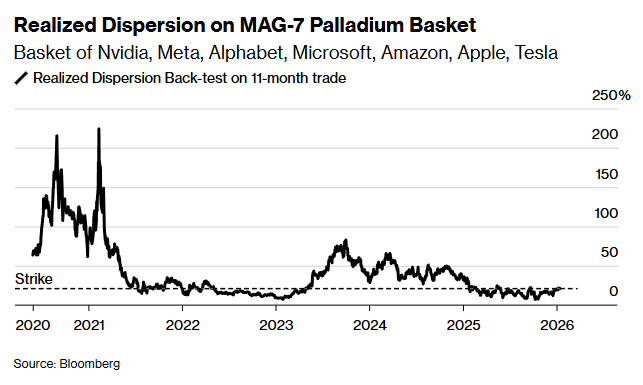
Group 1 - The article discusses the current market sentiment where investors are torn between the fear of missing out on stock market gains and concerns over escalating geopolitical risks, particularly influenced by U.S. President Trump's unpredictable policies [1] - Bloomberg Intelligence's chief global derivatives strategist, Tanvir Sandhu, highlights that the combination of AI momentum and government-induced volatility creates a favorable backdrop for the market, suggesting that both the S&P 500 index and volatility may rise simultaneously [1] - Strategies are being promoted to manage volatility changes and headline risks, transitioning from conventional tail hedging to customized differentiated baskets [1] Group 2 - The "Magnificent Seven" tech stocks are expected to continue leading market gains, but Barclays strategists note that direct purchases of call options are not cost-effective, recommending a Palladium structure that bets on the dispersion of a basket of stocks rather than the overall performance [2] - The Palladium structure is actively utilized among a wide range of clients, including hedge funds and pension funds, and is typically built around investment themes such as cyclical versus defensive stocks and AI versus robotics [6] - The UpVar swap strategy is gaining popularity as it bets on rising volatility when assets exceed a certain level, with several banks recommending 1 to 2-year UpVar swaps on the S&P 500 or Nasdaq 100 [7][10] Group 3 - European banks are considered a hot investment, with expectations of strong rebounds in 2025, and various trading strategies are being developed around cheaper upside options [11] - Barclays reports that European mining stocks are also gaining attention, with potential improvements in fundamentals driven by supportive Chinese policies and AI infrastructure demand [11] - Investors are increasingly inclined to buy volatility exposure in large tech stocks as a hedge against concentrated risks and uncertainties in AI capital expenditures, with recommendations to purchase out-of-the-money put options on companies like Apple and Nvidia [15]

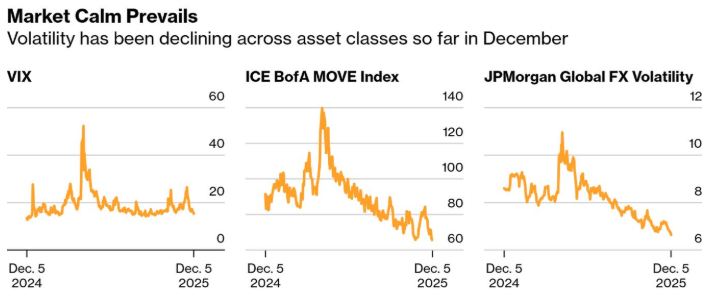
【美联储决议前夕,美国市场“超级平静”】数据显示,恐慌指数VIX和追踪债券市场预期波动率的MOVE指数均降至低位,尾部风险对冲大量平仓。但分析师警告这种平静较为脆弱:美联储内部出现政策分歧,可能出现分裂投票;鹰派降息或就业恶化都可能迅速引发新一轮波动。
Sou Hu Cai Jing· 2025-12-06 11:46
Core Viewpoint - The U.S. market is experiencing an unusual calm ahead of the Federal Reserve's decision, with low levels of the VIX and MOVE indices indicating reduced volatility expectations [1] Group 1 - The VIX, a measure of market volatility, has dropped to low levels, suggesting a lack of fear among investors [1] - The MOVE index, which tracks bond market volatility, has also decreased, indicating a similar trend in the fixed income market [1] - Analysts warn that this calmness is fragile due to internal policy disagreements within the Federal Reserve, which could lead to a split vote [1] Group 2 - Potential hawkish rate cuts or deteriorating employment conditions could quickly trigger a new wave of market volatility [1]
美国股债波动率指数齐跌至低位 市场“静待”美联储决议
智通财经网· 2025-12-06 06:34
Core Viewpoint - The current market calmness is fragile, with potential volatility looming due to diverging views among Federal Reserve officials and concerns over a weakening labor market [2][4]. Group 1: Market Indicators - The VIX index, a measure of market fear, is hovering near its lowest level since the beginning of the year, while the MOVE index has reached its lowest point since early 2021 [1]. - Recent economic data, including a consumer inflation report that met expectations, has led traders to anticipate a rate cut by the Federal Reserve next week [2][4]. Group 2: Economic Conditions - The latest inflation indicator favored by the Federal Reserve rose by 0.2%, keeping year-over-year data below 3%, indicating persistent inflationary pressures [4]. - Concerns about a weakening labor market are growing, with the highest number of layoffs reported since early 2023, according to ADP Research [4]. Group 3: Investor Behavior - The S&P 500 index rose by 0.3% this week, nearing historical highs, while the Nasdaq 100 index increased by 1% [7]. - Investors are increasingly moving into equity markets, with U.S. stock funds experiencing inflows for twelve consecutive weeks [7]. Group 4: Risk Management - Despite the current low volatility, there are signs of caution, as the amount of money flowing into money market funds reached a record high for a single week [8]. - Tail risk hedging products have shown some strength in 2025, but their significant gains have not been maintained through recent market turbulence [8].
美联储决议前夕,美国市场“超级平静”
Hua Er Jie Jian Wen· 2025-12-06 03:02
Core Viewpoint - The market is experiencing an unusual calmness with low volatility indicators, such as the VIX and MOVE indices, near their yearly lows, despite recent fears and fluctuations in AI stocks and credit markets [1][2]. Group 1: Market Sentiment - The VIX index, a measure of market volatility, is hovering near its lowest point of the year, while the MOVE index has reached its lowest level since early 2021, indicating a significant drop in fear among investors [1]. - Just weeks ago, the market was filled with panic, particularly around AI stocks, which saw a rapid rise and subsequent fall, leading to increased volatility in stock and credit markets [2]. - Investors are currently betting on the continuation of this calm state, with U.S. stock funds recording inflows for 12 consecutive weeks [2]. Group 2: Economic Data and Confidence - Stable economic data is a key reason for the current market calm, with the Fed's preferred inflation measure showing a monthly increase of 0.2% and an annualized increase slightly below 3%, indicating persistent but stable inflation pressures [3]. - Despite signs of weakness in the labor market, such as the largest layoffs since early 2023 reported by ADP, confidence in economic resilience is supporting the low volatility environment [3][4]. - The potential for increased layoffs could change the current sentiment, as rising unemployment may reflect greater recession risks that have not yet been priced in [4].
金价续创历史新高!现货黄金站上3950美元/盎司
Jin Shi Shu Ju· 2025-10-06 14:44
Core Insights - Gold prices have surged significantly due to increasing uncertainty from the U.S. government shutdown and rising expectations of interest rate cuts, reaching a new historical high of $3,940 per ounce, with a year-to-date increase of over 50% [1] - The phenomenon of "gold-plated FOMO" (fear of missing out) is driving investors to include gold in their portfolios amid concerns over inflation risks [2] Market Dynamics - The ongoing trade war initiated by former President Trump has led to a surge in demand for safe-haven assets like gold, contributing to its record high prices this year [3] - In September alone, gold prices increased by nearly 12%, marking the largest monthly gain since 2011, as central banks and various types of investors have been accumulating gold [3] - The inflow of funds into gold exchange-traded funds (ETFs) has been a significant catalyst for the price increase, with net inflows reaching $13.6 billion over the past four weeks and over $60 billion year-to-date, setting a new record [4] Investment Trends - The total amount of gold held by ETFs has surpassed 3,800 tons, nearing the peak levels seen during the COVID-19 market sell-off [5] - Analysts suggest a shift in investor behavior, with a growing trend of long-term allocation to precious metals, akin to traditional stock and bond investments [5] - A recent survey indicated that fund managers currently allocate only 2% to gold, but a shift to a "60/20/20" asset allocation model could lead to trillions of dollars flowing into the gold market [5] Economic Factors - The current state of the bond market, characterized by record sovereign debt issuance, has diminished the appeal of fixed-income assets, making gold a more attractive option for portfolio diversification [7] - Concerns over policymakers potentially tolerating inflation rates above target levels to manage record sovereign debt are also driving interest in gold as a hedge against asset depreciation [7] - The prevailing sentiment in the market is to prepare for scenarios where the Federal Reserve may lose its independence, further emphasizing the need for gold as a risk management tool [8]
“崩盘专家”黑天鹅基金:美股将大幅上涨,随后是“1929式崩盘”
华尔街见闻· 2025-09-24 04:27
Core Viewpoint - Mark Spitznagel, manager of Universa Investments, predicts a significant rise in the U.S. stock market, potentially reaching 8000 points on the S&P 500, which represents about a 20% increase from current levels, but warns of an impending severe market correction akin to the 1929 crash [1][4][6]. Group 1: Market Conditions - Spitznagel compares the current market environment to the "roaring twenties" before its end, suggesting that the market is experiencing a euphoric phase [1]. - He attributes the favorable conditions for market growth to factors such as potential interest rate cuts by the Federal Reserve [1]. - Historical data indicates that significant price increases often signal market tops, with the S&P 500 averaging a 26% annual return in the year leading up to bear markets since 1980 [4]. Group 2: Warning Signals - Institutional investors' stock exposure has reached its highest level since November 2007, just before the financial crisis [5]. - The proportion of U.S. households invested in stocks has surpassed the peak levels seen during the tech bubble [5]. - Other indicators of market exuberance include the risk premium on investment-grade bonds dropping to its lowest since 1998 and trading volumes on U.S. exchanges nearing historical highs [5]. Group 3: Systemic Risks - Spitznagel likens the current market situation to a "powder keg" due to prolonged government and central bank interventions, which have inflated market valuations to near-record levels [6][7]. - He warns that these interventions, while temporarily mitigating losses, have allowed systemic risks to accumulate, setting the stage for a potential catastrophic market event [6][7]. - Spitznagel's previous predictions have shown that despite warnings, markets can continue to rise significantly before any downturn occurs [7][8]. Group 4: Investment Strategy - Universa Investments employs a unique tail risk hedging strategy, focusing on buying protection during optimistic market conditions rather than timing the market [2][8]. - Spitznagel emphasizes that the greatest risk for investors is not the market itself but their own behavior, advocating for long-term holding strategies [9].

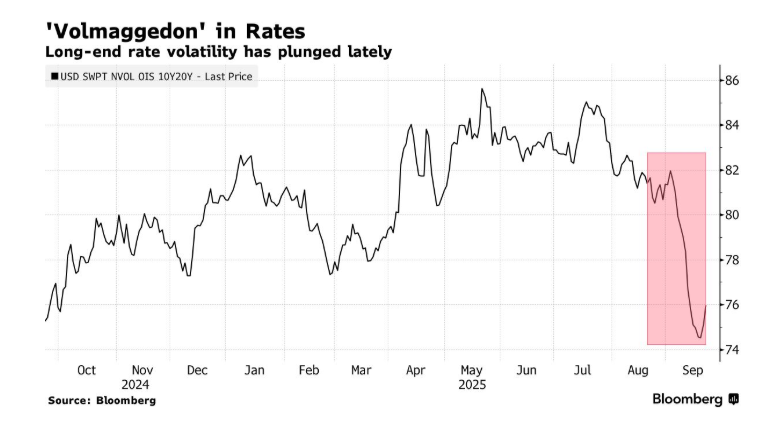
美国利率上演“波动性末日”,华尔街热门对冲策略失效
Jin Shi Shu Ju· 2025-09-23 14:49
Core Insights - The volatility of long-term interest rates has recently plummeted, causing difficulties for popular financial market hedging strategies on Wall Street [1][2][3] - Quantitative Investment Strategies (QIS) have been developed by banks to provide protection against significant economic risks, primarily through swap contracts [1][3] - The implied volatility of 10-year/20-year swaptions has experienced its largest monthly decline since November 2023, leading to an average loss of 2.6% for QIS strategies this month [1][3][6] Group 1: Market Dynamics - The sudden drop in volatility has transformed previously defensive positions into sources of loss, with some strategists referring to this phenomenon as "volmaggedon" [3] - The decline in long-term interest rate volatility is attributed to investors unwinding hedges related to mortgage-backed securities (MBS) [3][4] - A general decrease in volatility across various markets is linked to expectations that the Federal Reserve will continue to lower interest rates, which supports risk appetite and the U.S. economy [3][4] Group 2: Technical Factors - The attractiveness of long-term interest rate volatility as a hedging tool has diminished as the short-term volatility has also begun to decline, eroding the previously advantageous yield spread [5][6] - The Bank of America MOVE index, which tracks expected interest rate volatility, recently fell to its lowest level in nearly four years, indicating a significant shift in market sentiment [6] - Concerns are rising about potential further deleveraging in the QIS sector, as the performance of different QIS products may vary due to design differences [6] Group 3: Future Outlook - Despite the current decline, some analysts believe that the drop in long-term interest rate volatility may not be sustained, as large-scale liquidations of QIS products have not yet occurred [7] - Transactions that may show slightly negative yield spreads can still be justified if they help investors hedge against risks such as U.S. debt default or political instability in Europe [7]