TACO策略

Search documents
特朗普还能压制油价多久?时间节点爆出来了
华尔街见闻· 2026-03-26 12:11
Core Viewpoint - The current tension in the global energy market is characterized by a disconnect between physical realities and financial narratives, as evidenced by the WTI oil price remaining below $100 despite a significant daily shortfall of 10 million barrels of crude oil due to geopolitical conflicts [4][7]. Group 1: Market Dynamics - The closure of the Strait of Hormuz and ongoing US-Iran conflict have resulted in a daily crude oil supply gap of at least 10 million barrels, which historically could trigger an energy crisis [7]. - Despite this supply disruption, WTI crude oil prices have been maintained below the psychological threshold of $100, currently around $94, due to strategic interventions by the White House [7][9]. - The market's unexpected stability, with WTI remaining in the $90 range during the month-long closure of the Strait, has surprised many observers [9]. Group 2: Intervention Strategies - The White House has employed a multi-faceted approach to suppress oil prices, including the release of strategic petroleum reserves, easing sanctions on Russia and Iran, and ongoing verbal interventions [7]. - Trump's "TACO" strategy, which reflects his unpredictable nature, has created uncertainty in the market, preventing traders from fully committing to bullish positions [11]. - Social media has been utilized as a real-time market intervention tool, with Trump making statements that have temporarily calmed market fears and delayed price surges [12][13]. Group 3: Physical Market Pressures - Industry leaders, including Chevron's CEO, have noted that the physical supply disruptions have not yet fully impacted the oil futures market, indicating a potential future reckoning [17]. - Countries like South Korea and the Philippines are already implementing measures in response to rising fuel prices, highlighting the real-world effects of the supply crisis [17]. - The next two weeks are critical for the physical oil market, as the US and Iran are both aware that the situation could escalate if no ceasefire is reached [18]. Group 4: Future Outlook - The initial expectation was for a four to five-week conflict, and as the situation approaches the fifth week, market sensitivity to verbal interventions may diminish significantly [20]. - If a ceasefire is not achieved, the physical oil shortages currently seen in Asia are likely to spread to Europe and the US West Coast, potentially undermining the effectiveness of verbal interventions [20]. - The ongoing battle between verbal narratives and physical realities is approaching a critical juncture, with the potential for significant market shifts as inventory levels deplete [21].


若美伊冲突长期化,对全球资产有何影响?
李迅雷金融与投资· 2026-03-06 07:09
Core Viewpoint - The article discusses the implications of the recent US-Israel military actions against Iran, highlighting the potential for prolonged conflict and its impact on global geopolitical dynamics and asset pricing. Group 1: Reasons for Prolonged Conflict - The current military actions represent a shift in US strategy from targeting Iran's nuclear capabilities to regime change, indicating a fundamental change in the nature of the conflict [1]. - The timing of the military strikes coincided with negotiations, eliminating any potential for diplomatic resolution and escalating the conflict into a civilizational clash [2]. - Unlike Syria and Libya, Iran's regime is supported by a strong military foundation, making rapid regime change unlikely [3]. Group 2: Iran's Military Capabilities - Iran has developed a self-sufficient defense industry due to decades of sanctions, making it difficult for external forces to dismantle its military capabilities [4]. - The cost-effectiveness of Iran's military assets, such as drones, allows it to sustain prolonged conflict at a lower financial burden compared to its adversaries [4]. Group 3: Political Dynamics in the US - The Trump administration faces internal pressures regarding the legitimacy of military actions without Congressional approval, complicating the conflict's management [5]. - There is a growing divide within Trump's support base regarding the military actions, with some allies opposing the conflict as contrary to "America First" principles [5]. Group 4: Global Economic Implications - The conflict is expected to reshape global economic models, with a potential shift in how national power is assessed, moving away from traditional economic indicators to military and strategic capabilities [10][25]. - China's strategic position is likely to strengthen as it remains militarily unengaged while being a major manufacturing power, similar to the US during World War II [11]. Group 5: Asset Pricing Impact - The conflict has already led to significant volatility in energy prices, with Brent crude oil experiencing sharp increases due to supply fears [13]. - Global stock markets have reacted negatively, particularly in regions heavily reliant on energy imports, with notable declines in indices such as Japan's Nikkei and South Korea's KOSPI [15]. - Gold prices have shown unusual behavior, initially rising but then experiencing a pullback due to liquidity issues and market dynamics [20][21]. Group 6: Investment Recommendations - There is an anticipated increase in demand for resources and energy infrastructure, suggesting a favorable outlook for commodities like copper and rare earths [27]. - The military and technological sectors, particularly AI and drone technology, are expected to see growth as the conflict continues [28]. - Hong Kong's position as a financial hub may be re-evaluated, with potential for valuation recovery as it serves as a bridge between Chinese manufacturing and global capital [28].

押中TACO!美股散户在恐慌中创纪录抄底,单周净买入近130亿美元
Hua Er Jie Jian Wen· 2026-01-23 09:04
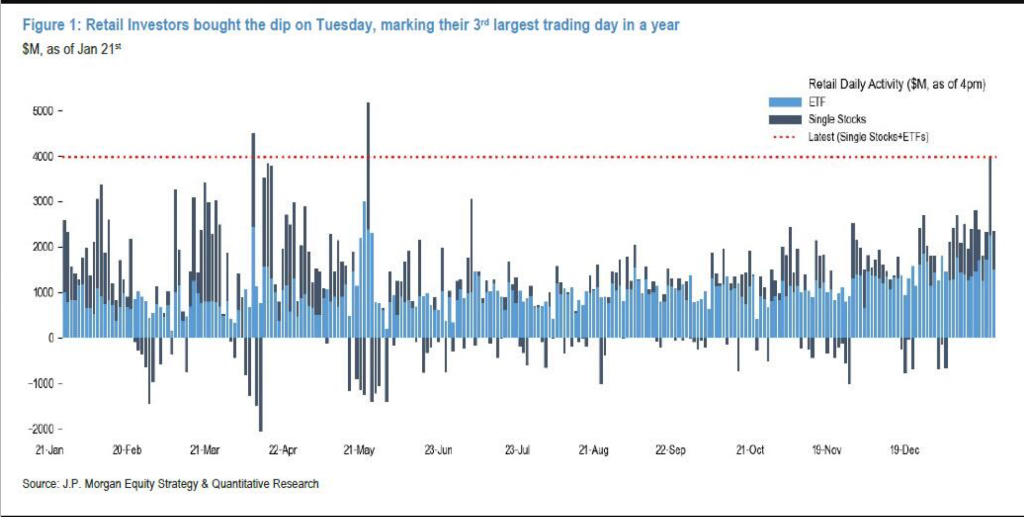
Group 1 - Retail investors made significant purchases during market panic, achieving a net buy of $12.9 billion this week, marking the third-largest single-day buy of the year [1] - Over the past 21 trading days, retail investors' cumulative net purchases exceeded $45 billion, indicating a shift from risk aversion to active allocation [1] - Retail sentiment has transitioned from a defensive stance to a more proactive investment strategy, as evidenced by their buying behavior [1][3] Group 2 - Following Trump's remarks in Davos, market sentiment improved, confirming retail investors' expectations of a market reversal [3] - Retail investors' buying in ETFs and individual stocks has become more balanced, reflecting a diversification in their investment strategies [3][22] - The technology sector remains the primary focus for retail investors, with significant net purchases in stocks like Tesla and Amazon, while Apple has seen net selling [12] Group 3 - Precious metals have regained popularity among retail investors, with ETFs in this category becoming a buying hotspot [4] - Broad-based stock ETFs contributed approximately 40% of total ETF purchases, driven by strong inflows into QQQ, SPY, and VOO [7] - Retail investors are actively participating in the options market, focusing on high-profile stocks and precious metal ETFs [24]


美股前瞻01.22:特朗普TACO速度再超预期,风偏回暖半导体新高
East Money Securities· 2026-01-22 09:48
Market Overview - The market sentiment improved significantly following Trump's speech at the Davos Forum, where he indicated that he would not use military force to acquire Greenland and announced a framework for future agreements regarding Greenland and the Arctic, alleviating worst-case scenarios of escalating tensions between the US and Europe [1] - The S&P 500 recorded one of its largest single-day gains since November, with small-cap indices reaching all-time highs and outperforming the S&P for 13 consecutive trading days [1] - The Philadelphia Semiconductor Index rose by 3.18%, indicating strong performance in the semiconductor sector, while the overall market saw a rebound but did not fully recover from previous declines [1] Core Insights - The rapid reversal of the tariff situation regarding Greenland, from imposition to cancellation within a single trading day, demonstrates the efficiency and effectiveness of the TACO strategy [3] - Despite the recent market rebound, the underlying weakness in US Treasury bonds remains, with any marginal foreign capital withdrawal likely to have a significant impact [3] - The report suggests that while short-term market sentiment is improving, the overall trend has not reversed, and potential tariffs and geopolitical noise will keep indices in a volatile phase [3] Investment Recommendations - It is advised to prioritize investments in high-growth sectors such as semiconductors, midstream resources, energy infrastructure, and defense industries, while also considering banks and defensive sectors for hedging purposes [3] - The report emphasizes that the earnings foundation of the US stock market remains intact, and the previous day's drop was primarily a revaluation of risk premiums and market sentiment [3]
美国市场梦回「四月风波」,惨遭「股债汇三杀」,华尔街抛售美国交易重燃,这次市场为何不相信TACO了?
Sou Hu Cai Jing· 2026-01-21 01:51
Group 1 - The market is experiencing significant turmoil, with gold prices rising by 3%, U.S. Treasury yields soaring, and both U.S. stocks and the dollar facing declines [1] - The European Union is reacting to U.S. policies under Trump, with concerns about political stability in Germany and France, and potential military confrontations in Europe [1] - The U.S. is facing internal economic challenges, including supply chain disruptions and commodity price volatility, while external pressures from geopolitical tensions are increasing [1] Group 2 - Trump's response to potential Supreme Court rulings on tariffs includes exploring alternative methods such as licensing, indicating a shift in strategy [3] - The U.S. financial markets experienced a sharp decline, with the Dow Jones dropping over 900 points and significant losses in major indices, reflecting market anxiety over trade policies [3] - The TACO strategy, which previously capitalized on Trump's policy reversals, is failing as market participants grow weary of his unpredictable actions [5] Group 3 - The Federal Reserve's tightening policy has undermined the TACO strategy, as expectations for monetary easing have diminished, leading to concerns about inflation and economic growth [7] - The U.S. CPI is showing signs of persistent inflation, with core service prices remaining high, impacting consumer purchasing power [7] - The market is no longer anticipating a policy reversal, as the fundamental economic issues of inflation and weak recovery persist [8] Group 4 - There is a notable shift in investment patterns, with funds moving from technology sectors to defensive sectors, indicating a decrease in risk appetite among investors [9] - The bond market is reflecting long-term concerns, with rising yields indicating skepticism about inflation and fiscal sustainability [9] - The effectiveness of the TACO strategy is diminishing as market participants have fully priced in Trump's policy patterns, leading to increased uncertainty [11]

川普又要加100%关税了?
3 6 Ke· 2025-10-11 09:40
Core Points - The article discusses the recent announcement by Trump regarding a potential 100% tariff on Chinese goods, which has led to significant market reactions, including a sharp decline in U.S. stock indices and cryptocurrency values [2][3][20] - The context of this announcement is tied to China's recent export controls on rare earth elements, which are critical for various high-tech industries [6][9][11] Group 1: Market Reactions - Following Trump's tweet about the tariffs, the S&P 500 dropped by 2.7% and the Nasdaq fell by 3.5%, marking the largest decline in six months [2] - The cryptocurrency market also experienced a downturn, with Bitcoin dropping by 13% during intraday trading, and WTI crude oil prices fell by 4% [2] - The FTSE A50 futures, which track A-shares, declined by 4.28%, and U.S.-listed Chinese stocks saw significant losses, with Alibaba down 8.45% and Tencent down 6.33% [3] Group 2: China's Export Controls - China's recent export control measures on rare earth elements were an escalation from previous restrictions implemented in April, targeting specific heavy rare earth elements and related technologies [6][9] - The new regulations require licenses for the export of certain rare earth materials and technologies, particularly for military and advanced semiconductor applications [7][14] - China holds a dominant position in the global rare earth market, accounting for nearly 70% of global production and 92% of refined supply, which complicates U.S. military supply chains [9][11] Group 3: Diplomatic Context - The timing of China's export control measures appears to be a response to recent U.S.-Pakistan mineral procurement agreements, indicating a strategic counteraction [11][13] - The implementation dates for some of the new regulations are set for December 1, coinciding with a planned meeting between U.S. and Chinese leaders at the APEC summit, suggesting potential for negotiation [14][15] - Trump's comments about tariffs and negotiations indicate a complex interplay of threats and potential concessions, with the possibility of a softer stance as negotiations progress [15][20]

下半年超预期机会可能来自“顺周期”!刘煜辉最新交流,详谈稳定币及反内卷
聪明投资者· 2025-07-28 01:55
Group 1 - The core conflict of the current era is the showdown between China's industrial power and the financial power represented by the US dollar, with trade wars and tariff battles being mere surface issues [1][8][20] - The expansion of stablecoins is driven not only by virtual and crypto assets but also by real-world economic and trade dynamics [1][20] - The political will behind the "anti-involution" movement is significant, and its successful implementation could lead to strong upward momentum in cyclical sectors, potentially pushing indices to new heights [1][42] Group 2 - The "Stablecoin Act" passed by the US Congress in May 2024 is seen as a significant attempt at financial restructuring and a self-redemption of the dollar's power [2][5][6] - The core design of stablecoins requires that for every unit issued, there must be an equivalent compliant asset backing it, such as US Treasury bonds, which will increase in demand as the blockchain asset market expands [3][19] - China must adopt a dual approach by not only promoting the digitalization of its currency but also building a market for crypto assets denominated in renminbi to enhance its global financial power [3][21][23] Group 3 - The past two decades have seen a significant rise in China's manufacturing dominance, while the financial power of the US has stagnated, leading to a growing disparity between the two powers [8][10] - The US has attempted to undermine China's industrial power through trade policies, but China's manufacturing output has actually increased by 5 percentage points during this period [9][10] - The future balance between these two powers will depend on how effectively China can elevate the renminbi's status in the global financial system [10][11] Group 4 - The stablecoin act aims to connect the crypto asset market with the fragile US dollar system, attempting to rejuvenate the dollar's credit system to counter China's industrial strength [12][13][20] - The rapid expansion of the blockchain asset market is facilitated by advancements in technology, particularly in AI and distributed ledger systems, which could potentially replace traditional fiat currency mechanisms [15][19] - The global capital market has begun to accept the logic of stablecoin expansion, which is tied to the demand for US Treasury bonds [19][20] Group 5 - The "anti-involution" strategy is positioned as a core economic policy for the second half of the year, aiming to reverse the current deflationary trends in China [30][31][32] - The current deflationary state is characterized by aggressive price competition among manufacturers, which could lead to systemic risks if not addressed [33][34] - The success of the "anti-involution" policy will depend on both supply-side interventions and demand-side stimulus measures to halt the downward price spiral [36][40] Group 6 - The potential for cyclical sectors to gain momentum in the market is significant if the "anti-involution" measures yield positive price effects [42][43] - The current market sentiment reflects skepticism about the effectiveness of these measures, with investors still favoring deflationary assets [41][42] - The complexity of implementing "anti-involution" measures today is greater than a decade ago, as the focus has shifted to final product sectors dominated by private enterprises [39][40] Group 7 - Gold is identified as the best investment asset in the current G2 era, with a strong likelihood of high returns over a longer time horizon [66][68] - The ongoing geopolitical tensions and economic competition between the US and China create a prolonged period of uncertainty, making gold a reliable asset [67][68]
“对等关税2.0”来袭:15%只是起步,最高达50%! 当市场豪赌TACO 特朗普关税算盘也在升级
智通财经网· 2025-07-24 01:23
Group 1 - The core viewpoint of the articles revolves around President Trump's announcement of increasing tariffs, with a minimum rate of 15% and a potential range of 15% to 50% depending on the country, indicating a significant shift in trade policy [1][2] - Trump has indicated that he will send letters to over 150 countries regarding the potential tariff rates, which marks an increase from the previously expected 10% baseline [1] - The announcement of higher tariffs is seen as a catalyst for further escalation in trade tensions, with the market showing indifference to these developments, potentially encouraging more aggressive tariff actions from the Trump administration [3][6] Group 2 - Analysts from major banks, including Bank of America and Morgan Stanley, predict that the impact of the new tariffs will not be fully reflected in economic data until later in the year, with inflationary pressures expected to rise significantly [4][5] - The TACO trading strategy has gained popularity among investors, betting that Trump will ultimately back down from his aggressive tariff threats, leading to market rebounds after initial declines [6][7] - There is a growing concern among analysts that the market's confidence in Trump's eventual retreat from tariffs may be misplaced, as the rapid market gains could lead to disappointment if expectations are not met [7]
长城基金汪立:低位蹲守比追高更具性价比
Xin Lang Ji Jin· 2025-07-15 01:24
Market Overview - The average daily trading volume was approximately 14,961 billion, with growth stocks outperforming value stocks, and small-cap stocks outperforming large-cap stocks [1] - The real estate, steel, and non-bank financial sectors performed well, while coal, banking, and automotive sectors lagged [1] Macro Outlook - In June, CPI increased while PPI decreased, indicating ongoing overcapacity issues; domestic demand remains weak [2] - The CPI year-on-year growth reached a new high since May 2024, driven by rising prices of oil and industrial commodities [2] - The PPI year-on-year decline expanded to the lowest level since August 2023, with overcapacity in coal, steel, and cement sectors [2] - The "anti-involution" policies are expected to boost prices in certain industries, but demand-side improvements are necessary for further price increases [2] International Market Sentiment - Optimism in the equity markets continues, with US stocks breaking previous highs; however, new tariffs announced by the US may increase market volatility [3] - Strong employment data in the US has led to uncertainty regarding interest rate cuts, with potential risks in the over-traded TACO strategy [3] - The global economic downturn risks are rising, and further market gains may depend on timely interest rate cuts or unexpected fiscal expansions [3] Market Trends - The market is currently in a volatile upward trend, with significant selling pressure observed recently, leading to increased divergence between bulls and bears [4] - Key observation point is whether the market can maintain support at 3500; if it does, the upward trend may continue [4] - Short-term adjustments are expected to be shallow, and the market remains in an upward trend, necessitating defensive positioning [4] Investment Focus - Attention should be given to relatively low-positioned industries that have not yet surpassed previous highs, such as cyclical industries, electric new energy, and non-bank financials [5] - The potential for greater elasticity exists in industries that have not yet broken through previous highs, especially if the market continues to strengthen [5] - A "barbell strategy" is recommended, focusing on offensive sectors like technology and defense, while defensive sectors include banking and precious metals [6]
TACO护体,美股无惧风雨,财报季将再掀狂澜?
智通财经网· 2025-07-12 03:41
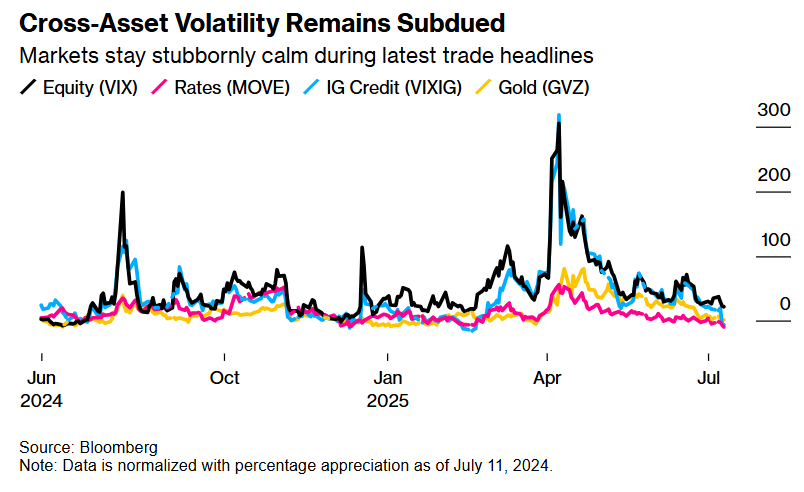
Group 1 - The article discusses the resilience of the market in the face of various crises, including inflation fears, tariffs, and geopolitical tensions, suggesting that these factors have not significantly impacted the long-term bullish trajectory driven by AI [1][2][6] - Investors are increasingly confident in the upcoming earnings season, particularly for major tech companies and AI-related firms, which are expected to show strong performance and continue to drive the market to new highs [2][12] - The "TACO" trading strategy has gained popularity among Wall Street traders, betting that the Trump administration will back down from aggressive tariff threats, leading to market rebounds after initial declines [7][8] Group 2 - Despite rising indicators of market pressure, traders are showing increased risk tolerance, with low volatility across asset classes indicating a potential for continued upward movement in risk assets [3][6] - Major tech companies, particularly those involved in AI, are projected to lead earnings growth, with Nvidia and Microsoft expected to drive significant increases in profitability, contributing to the overall bullish sentiment in the market [12][13] - The demand for AI infrastructure remains strong, with major clients committing to increased spending on AI capabilities, which is seen as a key driver for stock market performance [13]