结构性行情

Search documents
港股2026年或延续结构性行情三大景气主线值得关注
Zhong Guo Zheng Quan Bao· 2025-11-25 20:27
Core Viewpoint - The Hong Kong stock market has shown strong performance in 2023, with the Hang Seng Index and Hang Seng Tech Index rising by 29.09% and 25.60% respectively, driven by liquidity and sentiment, and this trend is expected to continue into 2026 [1][2] Group 1: Market Performance and Drivers - The strong performance of the Hong Kong stock market in 2023 is attributed to "excess liquidity" chasing "scarce return assets," with valuation and sentiment playing a significant role [1][2] - Despite external uncertainties, the market has benefited from trends in the AI industry and improvements in the domestic economic fundamentals [1][2] - The overall profitability of listed companies in Hong Kong is slightly below initial expectations for 2023, with sectors like biopharmaceuticals and technology hardware showing resilience, while e-commerce and real estate face more significant pressures [2] Group 2: Future Liquidity and Investment Strategies - The liquidity environment is expected to remain ample in the first half of 2026, with potential interest rate cuts by the Federal Reserve, although the long-term interest rate is projected to stay high at 3.8% to 4% [2][3] - Southbound capital is anticipated to continue flowing into the Hong Kong market, with an expected inflow of 600 billion HKD from public funds and insurance capital, and 500 billion HKD from individual investors [3] - Investment preferences are shifting from high-dividend sectors to growth areas, with a focus on AI technology and sectors benefiting from overseas demand [3] Group 3: Investment Opportunities - Key investment directions for 2026 include AI-driven industry trends, capacity cycle reversals, and sectors related to export and commodities amid global uncertainties [4][5] - Investors are advised to maintain flexibility in their strategies, balancing between chasing structural growth and taking profits when market conditions become overheated [5]
兴华基金黄生鹏:权益资产性价比提升 当前小微盘股具有较好的安全边际
Zhong Zheng Wang· 2025-11-25 13:00
Core Viewpoint - The equity market's confidence has gradually improved throughout the year, characterized by distinct structural trends in different phases, including AI-led trends, innovative drug sectors, and the recent strength in low-volatility dividend assets [1] Market Trends - The market has experienced significant sector rotation, with notable phases including AI dominance at the beginning of the year, innovative pharmaceuticals after April, and technology growth led by semiconductors and AI in August and September [1] - Following October, low-volatility dividend assets have shown a phase of strength, indicating a shift in investor focus [1] Investment Insights - With the decline in risk-free rates, the cost of capital has decreased, enhancing the attractiveness of equity assets and increasing investor risk appetite [1] - The effectiveness of market pricing is improving, yet small-cap stocks remain under-researched, presenting more opportunities for value discovery [1] - Current market liquidity favors small and micro-cap stocks, providing numerous trading opportunities [1] - The valuation structure indicates that small and micro-cap stocks, primarily assessed by price-to-book (PB) ratios, still offer a good margin of safety compared to large-cap stocks, making them appealing from a defensive standpoint [1]
帮主郑重午评:沪指高开低走!3200股上涨却指数翻绿,午后该抄底还是观望?
Sou Hu Cai Jing· 2025-11-24 04:45
老铁们中午好,我是帮主郑重,专注中长线的财经老炮!今天上午的A股有点意思,沪指高开低走跌了0.34%,深成指、创业板指也跟着调整,但全市场超 3200只个股上涨,这"指数跌、个股涨"的分化行情,你看懵了吗? 先划重点数据,看懂盘面真相: • 沪深京三市半日成交额10325亿元,比昨天缩量2849亿!资金开始变得谨慎,观望情绪很明显; • 军工装备、商业航天直接爆发,航天环宇20CM涨停,中天火箭、中船防务也封板,妥妥的日内主线; • 锂板块全线崩了!盛新锂能、融捷股份连续两跌停,天齐锂业、赣锋锂业逼近跌停,海南板块也冲高回落,海马汽车差点跌停。 第三,仓位控制很关键,缩量行情下别满仓押注,留着子弹,等确定性信号出现再出手更稳妥。 互动2:你觉得午后军工能继续领涨吗?扣"1=能""2=不能",看看谁的眼光准! 帮主20年经验总结:震荡市拼的不是胆量,是耐心。现在市场不缺机会,但缺不乱跟风的定力,中长线来看,那些有业绩支撑、有政策利好的赛道,短期波 动都是上车的"小插曲"。 互动3:你午后打算加仓、减仓还是不动?点赞关注,评论区说说你的操作计划,帮主帮你把把关! 我是帮主郑重,专注中长线不追涨杀跌。午后行情变化快 ...

A股:迹象非常明示,牛市没有结束,A股很可能重演2014年行情
Sou Hu Cai Jing· 2025-11-22 16:54
Group 1 - The current A-share market is in a phase of transition, characterized by a lack of significant index movement but a critical structural change [3][4] - The market is likely to experience a similar pattern to late 2014, with a potential emotional peak around the Chinese New Year [4][49] - The sentiment is currently cold, which is often a sign of a brewing main upward trend rather than the end of a bull market [6][13] Group 2 - The participation of retail investors is low, with new account openings not showing a significant surge like in 2015 [7][8] - There are no signs of a typical "end-stage frenzy," such as widespread IPOs or a rush for hot stocks [10][11] - The market has not yet reached a stage of universal excitement, indicating that the bull market is still in its mid-phase [13][14] Group 3 - The funding structure is undergoing a transformation, with traditional active funds becoming more selective and focused on familiar sectors [18][20] - Quantitative trading has increased short-term volatility but does not determine long-term trends [19][20] - There is a gradual return of northbound capital, signaling positive market sentiment [21][22] Group 4 - The macroeconomic environment remains supportive, with a moderately loose monetary and fiscal policy [29][34] - Policies are focused on high-end manufacturing, digital economy, and green energy, which are expected to drive future market performance [36][39] - The stock market is not merely a game of ups and downs but reflects a collective bet on future industrial landscapes [40] Group 5 - The current bull market is more evident in small-cap indices like the CSI 2000 and CSI 500, which have shown significant gains [42][44] - Many stocks have rebounded sharply from their lows, indicating a structural bull market despite the index's lack of movement [44][46] - The real sustained momentum is found in policy-supported sectors and growth-oriented small-cap stocks [46][47] Group 6 - The upcoming months are expected to follow a specific rhythm: confirming a mid-term bottom in November, consolidating in December, and potentially experiencing a significant rally in January [50][53] - The market may undergo a final emotional purge and technical correction before a substantial upward movement [50][51] - January could see a surge in trading volume and a rise in indices, particularly in small-cap stocks with strong performance and policy backing [54][55]

宏观金融数据日报-20251121
Guo Mao Qi Huo· 2025-11-21 06:14
Report Summary 1. Investment Rating - No investment rating for the industry is provided in the report. 2. Core Viewpoints - The central bank carried out 300 billion yuan of 7 - day reverse repurchase operations, with a net investment of 110 billion yuan on the day. The 11 - month LPR quote remained unchanged, and the central bank will implement a moderately loose monetary policy [3][4]. - The market sentiment was cautious, with the stock index oscillating and closing down. The macro - level is a mix of positives and negatives. The market lacks a core driving force, and there are differences in market expectations. The stock index is expected to continue the oscillating pattern with support at the bottom and pressure upwards [6]. 3. Key Points by Category Monetary Policy and Interest Rates - The central bank conducted 300 billion yuan of 7 - day reverse repurchase operations at an operating rate of 1.40%, with a net investment of 110 billion yuan after 190 billion yuan of reverse repurchases matured [3]. - The 11 - month LPR remained unchanged, with the 1 - year LPR at 3.0% and the 5 - year LPR at 3.5%. The central bank will implement a moderately loose monetary policy [4]. - Interest rates of various varieties changed, such as DRO01 at 1.37% (- 5.67bp), DR007 at 1.49% (- 2.74bp), etc. [3] Stock Index and Market Conditions - The stock indexes fell, with the Shanghai - Shenzhen 300 down 0.51% to 4564.9, the Shanghai 50 down 0.4% to 3008.3, the CSI 500 down 0.85% to 7061.9, and the CSI 1000 down 0.63% to 7340.4. The trading volume of the two markets was 1.7082 trillion yuan, a decrease of 17.7 billion yuan [6]. - The market sentiment was cautious, and the stock index oscillated and closed down. The market lacks a core driving force, and there are differences in market expectations. The stock index is expected to continue the oscillating pattern [6]. Futures Market - Futures prices of different varieties changed, such as IF down 0.6%, IH down 0.3%, IC down 0.7%, and IM down 0.6%. Trading volumes and open interests also had different changes [5]. - The premium and discount rates of different futures contracts varied, for example, IF's premium rate for the current - month contract was 55.56%, and IH's discount rate for the current - month contract was - 3.76% [7].
沪指跌破3900点,专家:多空分歧加大,不意味着行情结束
Nan Fang Du Shi Bao· 2025-11-21 06:13
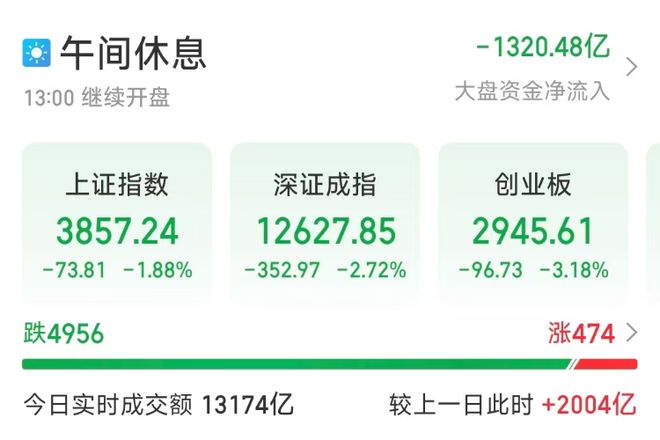
Market Overview - A-shares are experiencing a continued adjustment, with the Shanghai Composite Index down 1.88% at 3857.24, the Shenzhen Component down 2.72% at 12627.85, and the ChiNext down 3.18% at 2945.61, as of November 21 [3] - The total trading volume across the three markets reached 13,174 billion, an increase of 2,004 billion compared to the previous day, with over 4,900 stocks declining [3] Sector Performance - The China Shipbuilding Industry is active, with stocks like Jiuzhiyang hitting the daily limit and others like China Shipbuilding Defense and Kunshan Intelligent rising over 6% [3] - Conversely, the energy metal sector saw significant declines, with companies such as Ganfeng Lithium and Tibet Mining hitting their daily limit down [3] Regulatory and Market Sentiment - The Guangzhou Futures Exchange announced adjustments to trading fees and limits for lithium carbonate futures, which may temper the recent bullish sentiment in the market [3] - According to CITIC Futures, the current supply-demand dynamics favor a quicker destocking of lithium carbonate, but the recent regulatory changes may cool investor enthusiasm and increase volatility risks [3] Economic Insights - Yang Delong, Chief Economist at Qianhai Kaiyuan Fund, suggests that the recent market fluctuations are typical as investors take profits near year-end, but this does not indicate the end of the structural market rally [4] - The sales of equity funds have shown a notable recovery, indicating that more investors are entering the stock market seeking opportunities, especially given low returns on bank deposits and wealth management products [4] - Yang anticipates that the Shanghai Composite Index could trade above 4,000 points by 2026, reflecting a potential upward trend after the current adjustments [4] Risk Assessment - Bohai Securities reports that the current market adjustment is primarily due to external risk releases, but the overall risk remains moderate [5] - The regulatory emphasis on preventing extreme market fluctuations suggests that there is no strong basis for a sustained decline, and the recent adjustments may provide a window for capital reallocation [5]
越跌越买,抄底来了
Zhong Guo Ji Jin Bao· 2025-11-21 05:51
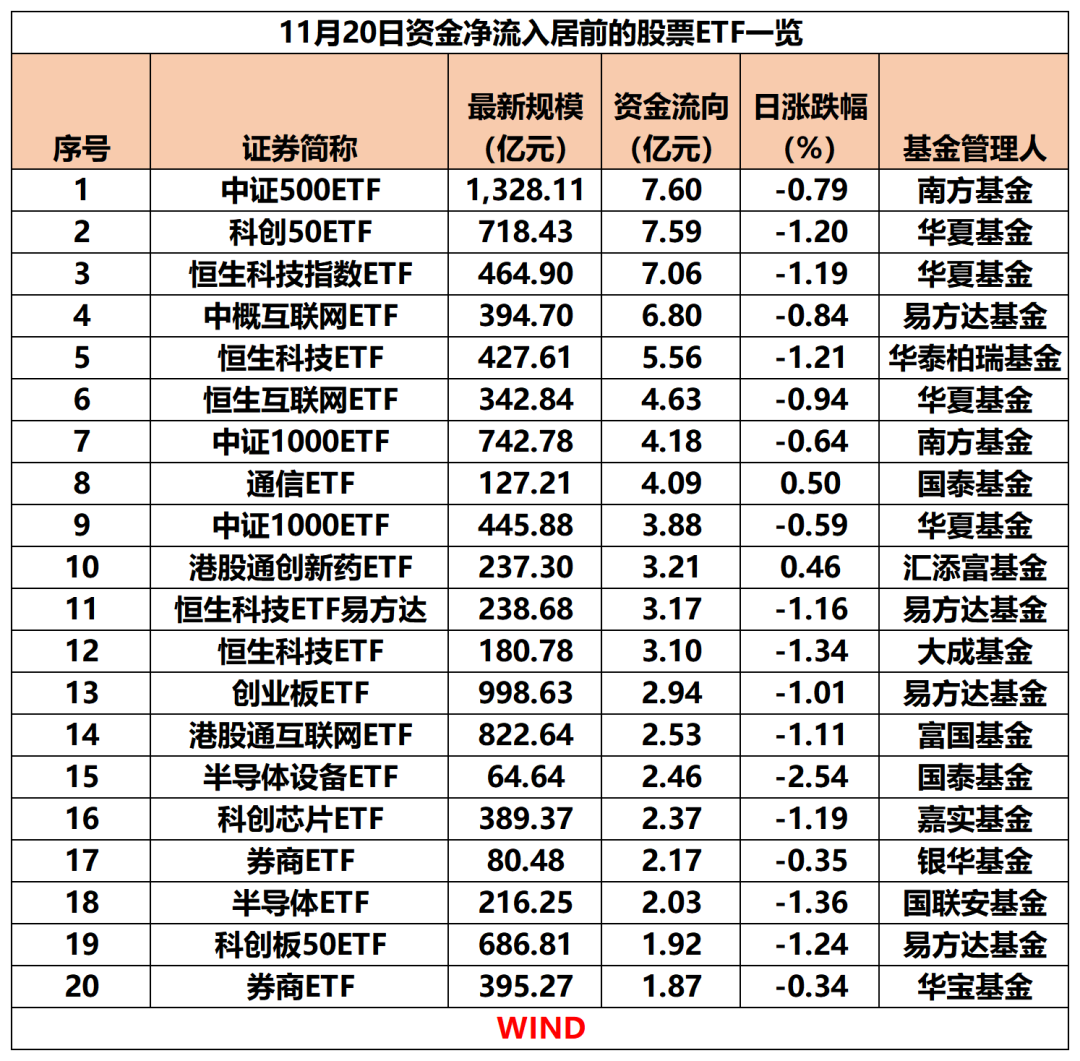
Core Insights - The overall net inflow of stock ETFs reached 9 billion yuan on November 20, with a total inflow of nearly 28.5 billion yuan for the week from November 17 to November 20 [1][3]. Fund Inflows - The top five sectors for net inflow included Hang Seng Technology (2.35 billion yuan), Semiconductors (1.15 billion yuan), Sci-Tech 50 Index (1.08 billion yuan), Hong Kong Internet (890 million yuan), and Gold (870 million yuan) [3]. - The leading fund company, E Fund, reported a total ETF size of 810.53 billion yuan, with a net inflow of 1.57 billion yuan on November 20, and an increase of 209.88 billion yuan since 2025 [3]. Fund Outflows - The top five sectors for net outflow included the CSI 300 Index (1.2 billion yuan), New Energy (910 million yuan), Banks (600 million yuan), Computers (250 million yuan), and Media (250 million yuan) [3][8]. - The Securities ETF, Bank ETF, and Battery ETF were among the largest outflow products, with the CSI 300 ETFs experiencing significant net outflows [8]. Market Trends - The current A-share market is experiencing a technology-led structural market, with a strong long-term outlook for sectors such as semiconductors, innovative technology products, and innovative pharmaceuticals [8][9]. - The market is expected to focus more on the 2026 economic outlook as year-end approaches, with technology sectors showing clearer investment opportunities [9].
越跌越买!抄底来了
Zhong Guo Ji Jin Bao· 2025-11-21 05:40
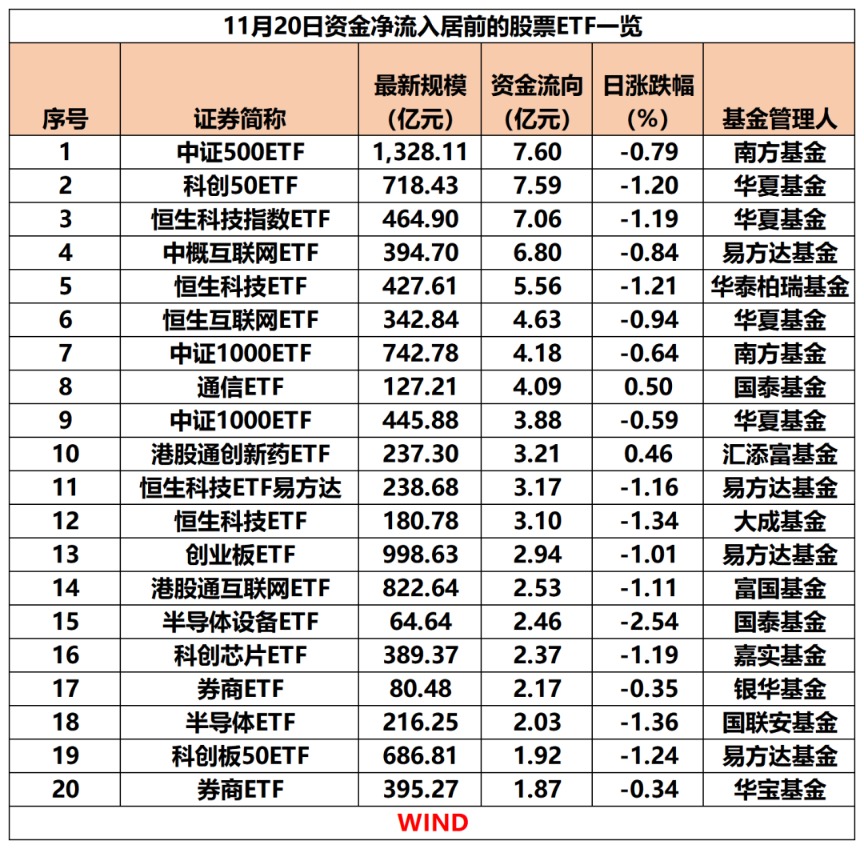
Group 1 - On November 20, the overall net inflow of stock ETFs reached 9 billion yuan, with a total inflow of nearly 28.5 billion yuan since November 17 [1][2] - The top five sectors for inflow included Hang Seng Technology (2.35 billion yuan), Semiconductors (1.15 billion yuan), and the Sci-Tech 50 Index (1.08 billion yuan) [2] - The top five sectors for outflow were the CSI 300 Index (1.2 billion yuan), New Energy (910 million yuan), and Banking (600 million yuan) [2] Group 2 - As of November 20, the latest scale of E Fund's ETF reached 810.53 billion yuan, with a net inflow of 1.57 billion yuan on the previous day [2] - The net inflow for E Fund's China Concept Internet ETF was 680 million yuan, while the Hang Seng Technology ETF saw a net inflow of 320 million yuan [2] - Huaxia Fund's Sci-Tech 50 ETF and Hang Seng Technology Index ETF had the highest net inflows of 759 million yuan and 706 million yuan, respectively [3] Group 3 - The leading ETFs for net inflow included the CSI 500 ETF, Sci-Tech 50 ETF, and CSI 1000 ETF, while popular thematic ETFs like Securities ETF and Banking ETF experienced significant outflows [4][6] - The net outflow from the Securities ETF was 505 million yuan, and the Banking ETF saw a net outflow of 433 million yuan [6] - Market analysts suggest that the current A-share market is experiencing a technology-led structural market, with a strong long-term outlook for sectors like semiconductors and innovative technologies [6][7]
越跌越买!抄底来了
中国基金报· 2025-11-21 05:34
Core Viewpoint - The stock ETF market in China has seen significant inflows, with a total of 90 billion yuan on November 20, and nearly 285 billion yuan since November 17, indicating a trend of "buying on dips" in the market [2][3][4]. Fund Inflows - On November 20, the overall net inflow for stock ETFs (including cross-border ETFs) reached 90 billion yuan, bringing the total scale to 4.57 trillion yuan [5]. - The top five sectors for inflows included Hang Seng Technology (23.5 billion yuan), Semiconductors (11.5 billion yuan), Sci-Tech 50 Index (10.8 billion yuan), Hong Kong Internet (8.9 billion yuan), and Gold (8.7 billion yuan) [5]. - The leading fund companies included E Fund, with a total ETF scale of 810.53 billion yuan and a net inflow of 15.7 billion yuan on November 20 [5]. Fund Outflows - The top five sectors for outflows were the CSI 300 Index (-12.0 billion yuan), New Energy (-9.1 billion yuan), Banks (-6.0 billion yuan), Computers (-2.5 billion yuan), and Media (-2.5 billion yuan) [5]. - Popular theme ETFs such as Securities ETFs, Bank ETFs, and Battery ETFs experienced significant outflows, with multiple CSI 300 ETFs leading the outflow rankings [10]. Investment Trends - The current A-share market is undergoing a technology-led structural market, with a strong long-term outlook for sectors like semiconductors, innovative technology products, and innovative pharmaceuticals [12]. - The "anti-involution" trend is creating structural opportunities in sectors like new energy and is expected to reshape the overall manufacturing ecosystem, with a focus on semiconductors, new energy smart vehicles, and biopharmaceuticals [12]. - As the year-end approaches, institutional funds are expected to focus more on the 2026 economic outlook, with a clearer investment direction in the technology sector and traditional manufacturing with improving profit expectations [12].

可转债基金收益又“霸榜”!年内收益领跑债基,公募产品稳健,私募业绩分化
Hua Xia Shi Bao· 2025-11-20 03:55
Core Insights - The performance of convertible bond funds has significantly outperformed other investment products in the capital market, with the "Southern Changyuan Convertible Bond A" fund leading with a return of 38.09% this year [2] - Convertible bond funds have become the dominant players in the bond fund market, occupying 6 out of the top 30 positions in terms of returns, and accounting for 19 out of the top 30 funds overall [2] - Private equity convertible bond funds have also shown impressive performance, with some achieving annualized returns exceeding 70% without any negative returns reported [2] Group 1: Performance Analysis - The average net value growth rate of convertible bond funds has surpassed 20% this year, significantly higher than the overall bond fund average of 2.13% [6] - Among the top 50 bond funds, 29 positions are held by convertible bond funds, showcasing their dual investment advantages in both equity and debt [6] - The convertible bond market has seen a 41% increase in fund size in the third quarter, reaching 133.4 billion yuan [4] Group 2: Market Dynamics - The "strong stock, stable bond" market environment has provided an ideal backdrop for convertible bonds, with the stock market's upward momentum driving the rebound of convertible bonds [5] - The characteristics of convertible bonds, which offer downside protection and unlimited upside potential, make them particularly attractive during market volatility [5] - The acceleration of forced redemptions in the convertible bond market has created opportunities for active strategies, allowing investors to capitalize on predictable outcomes [9] Group 3: Investment Strategies - Public funds tend to have more restrictions on individual bond selection due to risk control and liquidity requirements, while private funds have greater flexibility, potentially leading to higher returns [7] - The performance of private equity convertible bond products can vary significantly, with top performers achieving remarkable returns, but also carrying higher risks and lower transparency [6][7] - Investors are advised to focus on selecting high-quality management products rather than engaging in direct trading, especially in a volatile market environment [10]