贸易壁垒

Search documents
美国总统特朗普在信中表示,如果墨西哥在打击贩毒集团、阻止芬太尼流入方面取得实质性成效,或欧盟愿意向美国开放贸易市场、取消关税、非关税政策及其他贸易壁垒,美国或将考虑对关税政策作出相应调整。
news flash· 2025-07-12 12:52
Core Viewpoint - The U.S. may consider adjusting its tariff policies based on Mexico's effectiveness in combating drug cartels and preventing fentanyl influx, or if the EU is willing to open its trade market to the U.S. by removing tariffs and other trade barriers [1] Group 1 - President Trump indicated that substantial progress by Mexico in fighting drug trafficking could influence U.S. tariff policies [1] - The potential for tariff adjustments is also linked to the EU's willingness to eliminate trade barriers with the U.S. [1]
警惕全球贸易“逆风”,两大国际机构发声
凤凰网财经· 2025-07-09 13:28
Core Viewpoint - The World Trade Organization (WTO) has revised its global trade outlook from an expected expansion to a downward adjustment due to increasing trade tensions and geopolitical uncertainties [1][3]. Group 1: Global Trade Assessment - The WTO's latest report indicates that global trade policy activities have increased, with rising tensions among major trading partners contributing to a more volatile and unpredictable trade environment [1]. - The United Nations Conference on Trade and Development (UNCTAD) forecasts a $300 billion increase in global trade for the first half of the year, but warns of significant obstacles in the second half due to U.S. trade policy uncertainties and geopolitical tensions [1][4]. Group 2: Trade Barriers and Policy Recommendations - The WTO calls for countries to reduce tariffs and other trade barriers to promote trade liberalization and economic growth, emphasizing the need for transparency in trade policies [2]. - The report highlights that retaliatory measures, such as those taken by Canada and the EU against U.S. trade policies, are likely to exacerbate trade tensions and lead to a decline in global trade volume [2]. Group 3: Trade Growth Projections - Earlier projections for global trade growth in 2025 and 2026 have been significantly downgraded due to U.S. tariff policies, with expectations for merchandise trade growth now revised downward [3]. - The WTO's Goods Trade Barometer indicates a slight increase in the global goods trade index, but a decline in new export orders suggests a slowdown in trade growth later this year [4]. Group 4: Trade Imbalances and Risks - The report notes an increase in global trade imbalances, particularly with the U.S. experiencing a widening trade deficit over the past four quarters [5]. - The potential for further unilateral actions by the U.S. could escalate trade tensions and disrupt global supply chains, increasing the risk of trade fragmentation [5].


中国又反击了,欧洲认清现实:无牌可打
Sou Hu Cai Jing· 2025-07-07 16:21
Group 1 - The article discusses the geopolitical dilemma faced by the EU as it navigates between the US and China, highlighting its attempts to establish trade agreements with the US while simultaneously managing its relationship with China [1][3][11] - The EU has imposed trade barriers against Chinese products, citing unfair competition, which has led to retaliatory measures from China, including anti-dumping investigations on EU products [1][6][17] - The EU's exports to China are declining while imports from China are increasing, prompting EU decision-makers to tighten restrictions on Chinese goods [6][11][18] Group 2 - The EU is exploring new trade partnerships with a group of 11 countries, excluding the US and China, indicating a shift in its trade strategy [5] - Despite the EU's criticisms of China regarding trade practices and geopolitical issues, the economic interdependence between the two regions limits the EU's ability to exert pressure on China [11][13] - The article notes that the EU's reliance on Chinese industrial materials remains significant, complicating its stance against China [10][18] Group 3 - The EU's recent measures to restrict Chinese participation in public procurement for medical devices are framed as necessary for fair competition, but have led to reciprocal actions from China [6][9] - The article highlights the EU's ongoing challenges in balancing its trade policies with both the US and China, as it faces pressure from both sides [8][10] - The EU's leadership is expected to continue pressing China for more stable supply channels for critical materials like rare earths during upcoming summits [15][18]
不许中国产品冲击,脸真大,智库专家:中国要理解欧洲的贸易壁垒
Sou Hu Cai Jing· 2025-07-06 23:51
Core Viewpoint - Europe, once an industrial powerhouse, is now facing unprecedented challenges in its manufacturing sector, particularly in the automotive industry, due to the ongoing repercussions of the Russia-Ukraine conflict and an energy crisis [2][7] Group 1: Trade Barriers and Protectionism - The EU announced in 2024 the imposition of "anti-subsidy tariffs" on Chinese electric vehicles, claiming it is to maintain "fair competition," which reveals Europe's own struggles in the electric vehicle sector [5] - France initiated sanctions against the Chinese automotive industry, leading to the EU's "anti-subsidy investigation" and subsequent tariffs on Chinese products, similar to previous actions against Chinese solar panels [5][7] - The protectionist tendencies observed in Europe are not unique, as multiple European countries have followed the U.S. lead in imposing barriers against Chinese high-tech products under the guise of "national security" [9] Group 2: Energy Dependency and Strategic Failures - Europe's manufacturing sector has long relied on cheap Russian energy, and the disruption caused by the Russia-Ukraine conflict has led to soaring energy costs, negatively impacting the competitiveness of European products [7] - The slow response of Europe in addressing climate change and energy transition has resulted in missed opportunities in the new energy sector, prompting a reliance on trade barriers to compensate for strategic failures [7][9] - Experts argue that instead of building walls, Europe should confront its issues and focus on industrial upgrades and technological innovation to remain competitive globally [9]

王毅外长还在访欧,中方宣布重大决定,中欧贸易谈判谈崩了?
Sou Hu Cai Jing· 2025-07-06 04:32
Group 1 - Wang Yi's visit to Europe aimed to ease economic and trade relations, but the negotiations have not progressed as expected due to strong demands from the EU [3] - The EU's request for China to stop supporting Russia, lift rare earth export restrictions, and propose a plan to reshape trade relations indicates a tough stance [3] - The imposition of a maximum anti-dumping duty of 34.9% on brandy exports to the EU for five years reflects China's strong response to EU trade barriers [1][4] Group 2 - The division among EU member states regarding their approach to China complicates the EU's policy consensus, with some advocating for deeper economic ties while others push for a tougher stance [4] - Despite the anti-dumping measures, China has left room for exemptions for major brandy producers, indicating a willingness to negotiate [6] - The EU's economic strategy is inconsistent, as it seeks to reduce dependence on China while also recognizing China as a crucial economic partner, projected to become the EU's largest import source by 2024 [6] Group 3 - The EU faces challenges in tariff negotiations with the US, which could further impact its economy if no consensus is reached [8] - Improving relations with China could be a strategic choice for the EU to counter US tariff pressures, especially if unreasonable accusations against China are halted [8] - Wang Yi emphasized that cooperation, rather than confrontation, is essential for mutual benefit in the context of global economic and trade trends [9]
美元指数跌至多年低位,日央行政策转向推动日元走强!
Sou Hu Cai Jing· 2025-07-01 06:24
近期全球外汇市场呈现显著变化,美元指数持续走弱至多年低位。日本央行货币政策立场的微妙转变,叠加美日贸易关系的复杂演进,正在重塑两国货币的 相对价值。市场参与者密切关注这一趋势的发展轨迹,美元兑日元汇率面临多重压力因素的交织影响。 日本央行政策预期推动日元走强 美日贸易关系的复杂性为汇率走势增添了变数。贸易政策的不确定性对两国经济前景产生了不同程度的影响。日本作为出口导向型经济体,对贸易环境变化 较为敏感,这种敏感性在汇率市场得到了充分体现。 美国关税政策的潜在调整成为影响汇率预期的关键因素。市场担忧新的贸易壁垒可能对日本出口企业造成冲击,进而影响日本经济增长前景。这种担忧在一 定程度上限制了日元的上涨空间,但同时也为美元带来了下行压力。 贸易谈判的进展情况直接影响着市场情绪。谈判过程中的任何积极或消极信号都会在外汇市场引发即时反应。投资者对谈判结果的不同预期,导致美元兑日 元汇率出现较大幅度的波动。 来源:金融界 日本通胀数据持续超出央行目标水平,为货币政策调整提供了基础条件。东京地区消费者价格指数虽有所回落,但仍维持在3.1%的相对高位,明显高于日 本央行设定的2%通胀目标。核心通胀指标的韧性表现,增强了市 ...

出行观 | 中国车企出海,还得当作长期的事来对待
Guan Cha Zhe Wang· 2025-06-30 02:06
Core Insights - The internationalization of China's automotive industry is a long-term process that requires patience [1] Group 1: Export Challenges - China's automobile exports to Russia have sharply decreased, with a 49% year-on-year drop in the first four months, totaling 155,000 vehicles, and a 69% decline in April alone [2] - The Russian government has significantly increased the recycling fee for imported cars, effectively raising the actual price by over 10%, which diminishes the competitiveness of Chinese companies in Russia [2][6] - In Brazil, local industry officials express concerns that the influx of Chinese electric vehicles, particularly from BYD, is hindering the domestic automotive industry and employment [3][4] Group 2: Local Investment - Chinese automakers, such as BYD, are not only exporting but also investing locally, with BYD establishing a production complex in Bahia, Brazil, with a total investment of 5.5 billion reais (approximately 7.5 billion yuan) [4] Group 3: Trade Barriers and Market Dynamics - Emerging economies like Brazil and Russia are imposing trade barriers similar to those in developed countries, reflecting their focus on the automotive sector, especially electric vehicles [6] - The Chinese automotive industry has made significant progress in brand recognition, quality, and technology, but faces ongoing challenges due to changing global political and economic conditions [6][7] Group 4: Strategic Recommendations - Chinese automakers need to familiarize themselves with the policies, legal environments, and technical standards of export destinations [7] - There is a need to reassess pricing strategies to avoid anti-dumping issues, as overly low prices can trigger trade disputes [7] - Companies should build a multi-dimensional defense system to protect their interests against unreasonable market demands [7]


美国总统特朗普:希望与印度全面取消贸易壁垒,预计将与印度达成贸易协议。
news flash· 2025-06-27 16:06
美国总统特朗普:希望与印度全面取消贸易壁垒,预计将与印度达成贸易协议。 ...
深观察丨美式关税恶果:在损人和害己之间循环
Sou Hu Cai Jing· 2025-06-15 13:31
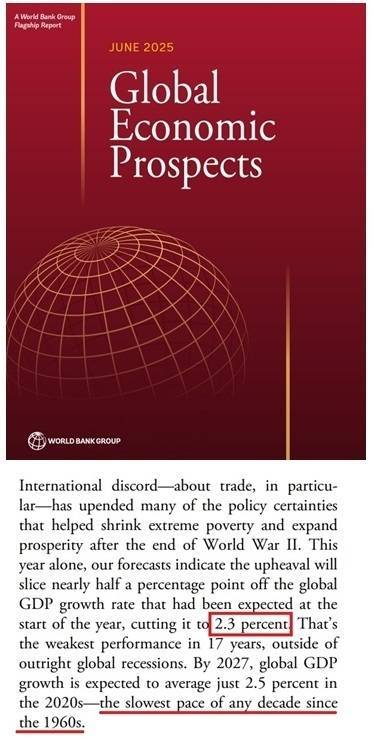
Global Economic Outlook - International financial institutions have recently downgraded global economic growth forecasts for this year, with the World Bank reducing its projection from 2.7% to 2.3% [1][3] - The World Bank's report indicates that nearly 70% of economies are experiencing a slowdown, with the potential for the average growth rate in the 2020s to be the lowest since the 1960s [1][3] Impact of Tariffs - The reports highlight that the U.S. tariff policies are not only hindering global economic growth but are also detrimental to the U.S. economy itself [1][6] - The OECD has also lowered its global growth forecast for the next two years to 2.9%, citing increased trade barriers and uncertainty in economic policies as significant factors affecting business and consumer confidence [4][6] U.S. Economic Projections - The U.S. economic growth forecast has been significantly reduced from 2.3% to 1.4% for this year, with projections for 2024 and 2025 at 1.6% and 1.5% respectively [3][4] - The U.S. economy has shown signs of contraction, with a reported GDP shrinkage of 0.2% in the first quarter, marking the first decline in nearly three years [12][14] Consumer and Business Impact - New tariffs on steel-derived products, effective from June 23, are expected to increase prices for consumers significantly, with some products potentially tripling in cost [6][9] - The aggressive tariff policies have led to job losses in the U.S. manufacturing sector, with estimates indicating a loss of 75,000 jobs since the implementation of steel and aluminum tariffs in 2018 [9][12] Trade Data Fluctuations - U.S. trade data has shown significant volatility, with a sharp decline in imports in April due to reduced demand from importers and increasing caution in the market [15] - The overall role of trade in the U.S. economy is expected to weaken, reminiscent of conditions seen during the early COVID-19 pandemic and the global financial crisis [15]
英国经济出现18个月来最严重萎缩,降息预期飙升
Hua Er Jie Jian Wen· 2025-06-12 08:03
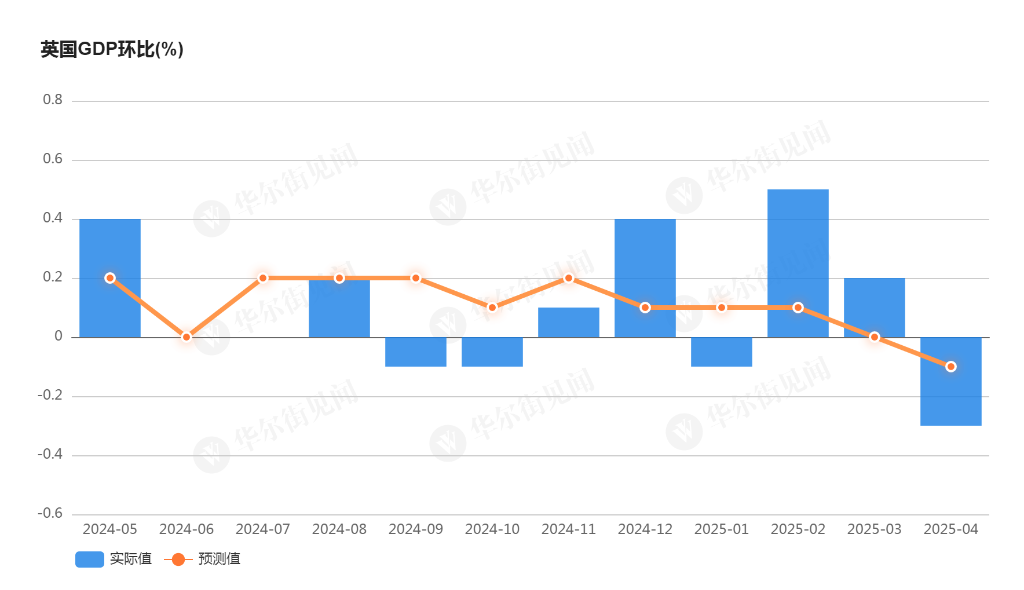
Group 1 - The UK economy faced its most severe monthly decline in 18 months, with April GDP shrinking by 0.3%, significantly worse than the expected contraction of 0.1% [2][3] - The decline marks the end of a brief recovery earlier in the year, where Q1 GDP had grown by 0.7%, outperforming both the Eurozone and the US [3] - The drop in exports to the US, attributed to tariff policies, has severely impacted overall economic performance, revealing the UK's reliance on foreign trade [4] Group 2 - The global trade environment has worsened, leading to increased caution among local businesses, particularly affecting investment decisions [5] - Structural issues, including long-term low investment and stagnant productivity, have weakened the UK's economic growth foundation, exacerbated by Brexit and the pandemic [7] - Recent tax reforms and increased operational costs due to higher employer taxes and minimum wage hikes are adding further burdens on businesses [7] Group 3 - The labor market, previously resilient, is now facing pressures that could lead to a surge in unemployment, with companies experiencing hiring freezes and layoffs [8]