
适度宽松的货币政策

Search documents
政策解读|聚焦内需,聚力开局——2025年四季度货币政策执行报告解读
申万宏源宏观· 2026-02-11 02:53
Core Viewpoint - The central bank's report emphasizes the need to support domestic demand and ensure a good start for the "14th Five-Year Plan" amidst increasing external uncertainties and inflation risks [2][15]. Economic Situation Analysis - The report highlights deepening impacts of external environmental changes, with a focus on the uncertainty of inflation trends and monetary policy adjustments [2][15]. - It stresses the importance of strengthening domestic circulation and expanding domestic demand to maintain economic stability and growth [2][15]. Policy Tone - The report continues to advocate for a moderately loose monetary policy, emphasizing the flexible and efficient use of various policy tools such as reserve requirement ratio (RRR) cuts and interest rate reductions [3][16]. - It introduces the goal of promoting low financing costs for society and ensuring the health of the banking system [3][16]. Key Issues - The report discusses three types of fiscal and financial coordination measures to support domestic demand: maintaining ample liquidity, using re-loans with fiscal subsidies, and enhancing credit guarantees [4][17]. - It notes that the total assets of asset management products reached 120 trillion yuan by the end of 2025, reflecting a 13.1% year-on-year growth, primarily directed towards interbank deposits and certificates of deposit [4][17]. Specialized Topics - The report emphasizes the need for optimizing carbon reduction support tools and advancing carbon finance product innovation to support green finance [5][17]. - It outlines the implementation of a one-time credit repair policy, which is expected to positively impact individuals, financial institutions, and the broader economy [5][17].

宏观金融类:文字早评2026/02/11-20260211
Wu Kuang Qi Huo· 2026-02-11 02:45
Report Summary 1. Investment Rating The report does not provide an overall investment rating for the industries. 2. Core Views - **Macro - financial**: In the short - term, the divergence in US monetary policy expectations and the approaching Chinese Spring Festival have affected the market. But in the long - term, policy support for the capital market remains unchanged. For stocks, it is recommended to buy on dips; for bonds, the market is expected to continue to fluctuate; for precious metals, maintain a wait - and - see attitude [4][6][9]. - **Non - ferrous metals**: Most non - ferrous metals are expected to fluctuate. Factors such as policy expectations, supply and demand, and inventory levels affect their prices. For example, copper is affected by reserve policies and supply - demand patterns; aluminum is supported by low LME inventory; zinc may be affected by macro sentiment; lead's price stability depends on post - holiday downstream restocking; nickel is under fundamental pressure; tin has supply - demand marginal relaxation; lithium carbonate has uncertain supply - demand after the holiday; alumina is affected by mine strikes and supply overcapacity; stainless steel is supported by fundamentals; and cast aluminum alloy is supported by cost and supply - side factors [12][14][17][18][20][21][22][24][26][28]. - **Black building materials**: The black building materials sector is in a bottom - game stage with multiple factors. Steel products are affected by domestic real - estate policies and overseas monetary policies, and are expected to fluctuate weakly. Iron ore is expected to fluctuate weakly due to supply and demand and inventory factors. Coking coal and coke may face short - term price pressure and potential long - term upward trends. Glass and soda ash are expected to continue to fluctuate, with glass lacking demand support and soda ash having weak demand. Manganese - silicon and silicon - iron are affected by market sentiment and cost factors. Industrial silicon and polysilicon are in a supply - demand double - weak situation [31][33][36][37][40][42][45][49][51]. - **Energy and chemicals**: For rubber, it is recommended to reduce risks before the Spring Festival. Crude oil should be taken profit at high prices and mid - term layout should be the main strategy. Methanol should be observed in the short - term. Urea should be short - sold. For pure benzene and styrene, profits can be gradually taken. PVC has a poor fundamental situation. Ethylene glycol has a high inventory pressure. PTA and p - xylene have good mid - term prospects. Polyethylene and polypropylene are affected by supply and demand and cost factors [56][58][61][63][65][68][70][73][75]. - **Agricultural products**: For live pigs, short - term selling on rebounds is recommended, while long - term support should be noted. For eggs, short - term short - selling is recommended, and the long - term situation depends on capacity reduction. For soybean and rapeseed meal, prices are expected to fluctuate. For oils and fats, mid - term bullishness is expected, and buying on dips is recommended. For sugar, wait for the international price to rebound after the northern hemisphere's harvest. For cotton, there is potential for long - term price increase, and low - buying opportunities before the Spring Festival should be considered [83][85][88][90][94][97]. 3. Summary by Industry Macro - financial - **Stock Index** - **Market Information**: The central bank will continue the moderately loose monetary policy. SMC's Q4 revenue increased by 4.5% quarter - on - quarter, with a gross margin of 19.2% and a capacity utilization rate of 95.7%. Byte released a new image - generation model. The National Development and Reform Commission promotes the integration of bidding and AI [2]. - **Strategy**: Due to the divergence in US monetary policy expectations and the approaching Spring Festival, the market risk appetite is suppressed. In the long - term, policy support remains, so the strategy is to buy on dips [4]. - **Treasury Bonds** - **Market Information**: On Tuesday, the main contracts of TL, T, TF, and TS had different changes. The central bank will continue the moderately loose monetary policy and conducted a net injection of 2059 billion yuan through reverse repurchase [5]. - **Strategy**: The central bank's policy indicates a loose capital situation. However, the economic recovery foundation is not solid, and the demand is weak. The bond market is expected to continue to fluctuate [6]. - **Precious Metals** - **Market Information**: Gold and silver prices in domestic and international markets declined. The inflation expectations in the US decreased, and the retail sales were stagnant. COMEX silver inventory decreased [7][8]. - **Strategy**: The market sentiment is cautious, and prices are expected to fluctuate. Fundamentals support the price of gold, and the tight inventory supports the near - month price of silver. It is recommended to wait and see [9]. Non - ferrous metals - **Copper** - **Market Information**: US retail sales data affected copper prices. LME and domestic copper inventories changed, and the import was at a loss [11]. - **Strategy**: Policies and economic data support the sentiment. The supply of copper ore is tight, but the short - term supply is sufficient. Copper prices are expected to fluctuate [12]. - **Aluminum** - **Market Information**: The market volatility decreased before the holiday. Aluminum prices adjusted due to production cuts in Mozambique. Domestic and LME aluminum inventories changed [13]. - **Strategy**: Domestic inventory accumulates, but LME inventory is low. Aluminum prices are expected to fluctuate [14]. - **Zinc** - **Market Information**: The prices of zinc futures and spot changed. The inventory increased, and the import was at a loss [15][16]. - **Strategy**: The inventory accumulation of zinc ore slows down, and the domestic zinc ingot inventory accumulates. The industry is weak, but macro sentiment may drive the price up [17]. - **Lead** - **Market Information**: The prices of lead futures and spot changed. The inventory increased, and the import had a profit [18]. - **Strategy**: The lead ore inventory is high, and the smelter's operating rate decreases seasonally. The price stability depends on post - holiday restocking [18]. - **Nickel** - **Market Information**: Nickel prices declined slightly. The spot premium and cost remained stable [19]. - **Strategy**: There is a short - term rebound demand, but the fundamentals are under pressure. Nickel prices are expected to fluctuate widely [20]. - **Tin** - **Market Information**: Tin prices fluctuated narrowly. The supply was restricted by raw materials, and the demand was weak [21]. - **Strategy**: Tin prices may rebound with precious metals, but the short - term supply - demand is loose. It is recommended to wait and see [21]. - **Lithium Carbonate** - **Market Information**: The spot and futures prices of lithium carbonate increased slightly [22]. - **Strategy**: The pre - holiday capital is cautious. The future supply - demand is uncertain. Lithium prices are expected to fluctuate within a range [22]. - **Alumina** - **Market Information**: The alumina index declined. The basis and inventory changed [23]. - **Strategy**: The mine strike in Guinea needs attention, and the supply overcapacity persists. It is recommended to wait and see [24]. - **Stainless Steel** - **Market Information**: The price of stainless - steel futures increased slightly. The spot price remained stable, and the inventory increased [26]. - **Strategy**: The supply pressure is controllable, and the fundamentals are supported. It is recommended to buy on dips [26]. - **Cast Aluminum Alloy** - **Market Information**: The price of cast aluminum alloy futures declined slightly. The inventory decreased [27]. - **Strategy**: The cost increases, and the supply - side factors support the price [28]. Black building materials - **Steel** - **Market Information**: The prices of rebar and hot - rolled coil futures declined. The inventory and position changed [30]. - **Strategy**: The market is in a bottom - game stage, affected by domestic and overseas factors. Steel prices are expected to fluctuate weakly [31]. - **Iron Ore** - **Market Information**: The price of iron - ore futures remained unchanged. The spot price and basis were reported [32]. - **Strategy**: The overseas shipment decreased, the demand was affected by equipment failure, and the inventory was high. Iron - ore prices are expected to fluctuate weakly [33]. - **Coking Coal and Coke** - **Market Information**: The prices of coking coal and coke futures declined. The spot prices and basis were reported [34]. - **Strategy**: Overseas coal disturbances affect sentiment, and the short - term price upward drive is weak. There may be a long - term upward trend, but beware of post - holiday price corrections [36][37][39]. - **Glass and Soda Ash** - **Market Information**: The prices of glass and soda ash futures declined. The inventory and position changed [40][41]. - **Strategy**: Glass lacks demand support, and soda ash has weak demand. Both are expected to continue to fluctuate [40][42]. - **Manganese - silicon and Silicon - iron** - **Market Information**: The price of manganese - silicon futures increased slightly, and that of silicon - iron futures decreased slightly [43]. - **Strategy**: The market sentiment and cost factors affect the prices. Pay attention to potential cost - driven events [44][45]. - **Industrial Silicon and Polysilicon** - **Market Information**: The prices of industrial silicon and polysilicon futures declined. The supply and demand changed [46][50]. - **Strategy**: Both are in a supply - demand double - weak situation. Industrial silicon prices are expected to fluctuate weakly, and polysilicon prices are expected to fluctuate [49][51]. Energy and chemicals - **Rubber** - **Market Information**: Rubber prices followed the market to rebound. The tire - enterprise operating rate decreased, and the inventory increased [53][54]. - **Strategy**: Reduce risks before the Spring Festival. Trade short - term on the disk and set stop - losses [56]. - **Crude Oil** - **Market Information**: The prices of crude - oil and refined - oil futures increased. The inventory of crude oil and refined oil changed [57]. - **Strategy**: Take profit at high prices and focus on mid - term layout [58]. - **Methanol** - **Market Information**: The regional spot and futures prices of methanol changed slightly [59]. - **Strategy**: The current price has factored in many negative factors. Observe in the short - term [61]. - **Urea** - **Market Information**: The regional spot and futures prices of urea changed [62]. - **Strategy**: The import window is open, and the fundamentals are bearish. Short - sell [63]. - **Pure Benzene and Styrene** - **Market Information**: The prices of pure benzene and styrene changed. The supply, demand, and inventory changed [64]. - **Strategy**: The non - integrated profit of styrene has been repaired. Gradually take profits [65]. - **PVC** - **Market Information**: The price of PVC futures declined. The cost, supply, demand, and inventory changed [66][67]. - **Strategy**: The fundamentals are poor, with strong supply and weak demand. Pay attention to the changes in capacity and operation [68]. - **Ethylene Glycol** - **Market Information**: The price of ethylene - glycol futures declined. The supply, demand, and inventory changed [69]. - **Strategy**: The inventory pressure is high, and there is a need for production reduction. There is a risk of rebound [70]. - **PTA** - **Market Information**: The price of PTA futures increased. The supply, demand, and inventory changed [71]. - **Strategy**: Enter the inventory - accumulation stage during the Spring Festival. Pay attention to mid - term buying opportunities [73]. - **p - Xylene** - **Market Information**: The price of p - xylene futures increased. The supply, demand, and inventory changed [74]. - **Strategy**: The inventory is expected to increase before the maintenance season. Pay attention to mid - term buying opportunities following crude oil [75]. - **Polyethylene (PE) and Polypropylene (PP)** - **Market Information**: The prices of PE and PP futures increased. The supply, demand, and inventory changed [76][78]. - **Strategy**: PE's valuation has room to decline, and PP's price may bottom out. For PP, buy on dips for the 5 - 9 spread [77][80]. Agricultural products - **Live Pigs** - **Market Information**: The domestic pig prices continued to decline [82]. - **Strategy**: Short - term selling on rebounds, and note the long - term support [83]. - **Eggs** - **Market Information**: The national egg prices were mostly stable with a few declines [84]. - **Strategy**: Short - term short - selling, and the long - term depends on capacity reduction [85]. - **Soybean and Rapeseed Meal** - **Market Information**: The prices of soybean and rapeseed meal futures increased slightly. The supply and demand situation changed [86][87]. - **Strategy**: The prices are expected to fluctuate [88]. - **Oils and Fats** - **Market Information**: The prices of oil futures declined. The supply, demand, and inventory changed [89][90]. - **Strategy**: Mid - term bullish, buy on dips [90]. - **Sugar** - **Market Information**: The price of sugar futures increased slightly. The supply and demand situation changed [91][93]. - **Strategy**: Wait for the international price to rebound after the northern hemisphere's harvest. Observe domestically [94]. - **Cotton** - **Market Information**: The price of cotton futures increased slightly. The supply, demand, and inventory changed [95][96]. - **Strategy**: Short - term high - level fluctuations, long - term potential for increase. Look for low - buying opportunities before the Spring Festival [97].
格林大华期货早盘提示:焦煤、焦炭-20260211
Ge Lin Qi Huo· 2026-02-11 02:18
Morning session notice 早盘提示 更多精彩内容请关注格林大华期货官方微信 格林大华期货研究院 证监许可【2011】1288 号 2026 年 2 月 11 日星期三 研究员:纪晓云 从业资格:F3066027 交易咨询资格:Z0011402 本报告中的信息均源于公开资料,格林大华期货研究院对信息的准确性及完备性不作任何保 证,也不保证所包含的信息和建议不会发生任何变更。我们力求报告内容的客观、公正,但 文中的观点、结论和建议仅供参考,报告中的信息和意见并不构成所述期货合约的买卖出价 和征价,投资者据此作出的任何投资决策与本公司和作者无关,格林大华期货有限公司不承 担因根据本报告操作而导致的损失,敬请投资者注意可能存在的交易风险。本报告版权仅为 任何机构和个人不得以任何形式翻版 如引用、转载、刊发,须注明出处为格林大华期货有限公司。 1172.0 联系方式:010-56711796 | 板块 | 品种 | 多(空) | 推荐理由 【行情复盘】 | | --- | --- | --- | --- | | | | | 昨日焦煤主力合约 Jm2605 收于 1119.0 元/吨,环比日盘开盘下跌 ...
2026年02月11日申万期货品种策略日报-国债-20260211
Shen Yin Wan Guo Qi Huo· 2026-02-11 01:39
| | | | | 申银万国期货研究所 唐广华(从业资格号:F3010997;交易咨询号:Z0011162) | | | | | | | --- | --- | --- | --- | --- | --- | --- | --- | --- | --- | | | | | | tanggh@sywgqh.com.cn 021-50586292 | | | | | | | | | TS2603 | TS2606 | TF2603 | TF2606 | T2603 | T2606 | TL2603 | TL2606 | | | 昨日收盘价 | 102.482 | 102.504 | 106.015 | 106.080 | 108.485 | 108.485 | 112.68 | 112.83 | | | 前日收盘价 | 102.484 | 102.514 | 106.025 | 106.085 | 108.490 | 108.500 | 112.73 | 112.84 | | | 涨跌 | -0.002 | -0.010 | -0.010 | -0.005 | -0.005 | -0.015 | -0.050 | ...
央行:继续实施好适度宽松的货币政策;葛卫东10亿元认购江淮汽车定增股票……盘前重要消息一览
证券时报· 2026-02-11 00:20
Group 1 - The People's Bank of China (PBOC) released the "2025 Q4 China Monetary Policy Implementation Report," emphasizing the continuation of a moderately loose monetary policy to support economic governance and the "14th Five-Year Plan" [5][6] - The report highlights the importance of counter-cyclical and cross-cyclical adjustments to enhance macroeconomic governance effectiveness [5] - The report aims to integrate incremental and stock policy effects to achieve a good start for the "14th Five-Year Plan" [5] Group 2 - Five departments issued the "Implementation Opinions on Strengthening the Capacity Building of the Information and Communication Industry to Support Low-altitude Infrastructure Development," focusing on the collaborative development of information infrastructure and low-altitude applications [6] - The plan includes achieving a ground mobile communication network coverage rate of no less than 90% for low-altitude public air routes by 2027, along with the development of at least 10 standards for information infrastructure [6] - The initiative aims to enhance low-altitude navigation service levels and create typical low-altitude application scenarios in urban governance, logistics, and cultural tourism [6] Group 3 - Data shows that from the stock registration date of December 1, 2025, to February 9, 2026, approximately 270 A-share listed companies implemented cash dividends totaling over 370 billion yuan, a year-on-year increase of about 9.6% [8] - The "15th Five-Year Plan" for Zhejiang Province aims to cultivate trillion-level industrial clusters, focusing on core industries like embodied intelligence and smart driving, with a target of achieving 1.2 trillion yuan in revenue from the core AI industry by 2030 [8]






【早知道】央行:继续实施好适度宽松的货币政策;上海已开放超5200公里自动驾驶测试道路
Sou Hu Cai Jing· 2026-02-11 00:11
Group 1 - The central bank continues to implement a moderately loose monetary policy [1] - The central bank focuses on ensuring the effective implementation of financial policies such as re-loans for affordable housing [1] - Multiple departments have released opinions on accelerating the application of artificial intelligence in the bidding and tendering sector [1] Group 2 - Five departments are enhancing the integration and innovation of low-altitude equipment and low-altitude information communication [1] - Shanghai has opened over 5,200 kilometers of autonomous driving test roads [1] - Zhejiang supports the establishment of a community of upstream and downstream enterprises in the photovoltaic industry chain [1] - Deep Blue Aerospace has made significant progress in the development of the core propulsion system for the "Yunxing No. 2" large reusable launch vehicle [1]
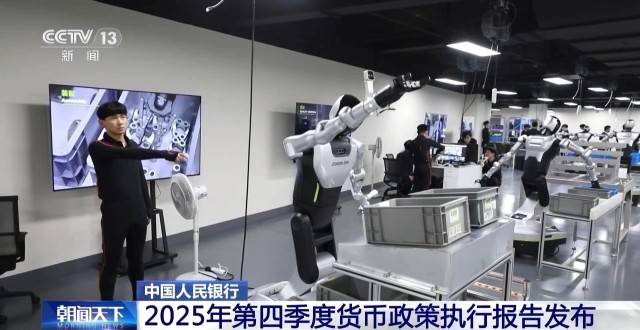
2025年第四季度货币政策执行报告发布
Sou Hu Cai Jing· 2026-02-10 23:08
Core Viewpoint - The People's Bank of China (PBOC) is set to continue its moderately accommodative monetary policy into 2025, aiming to maintain ample liquidity and relatively loose social financing conditions [1] Group 1: Monetary Policy - The report indicates that the effects of the moderately accommodative monetary policy are gradually becoming evident, with a commitment to continue this approach throughout the year [1] - The PBOC plans to leverage monetary credit policy to support key groups in entrepreneurship, employment, and education, while also promoting financial support for consumer services [1] Group 2: Credit Structure - By the end of 2025, the credit structure is expected to continue optimizing, with significant growth in technology loans, green loans, inclusive loans, elderly care industry loans, and digital economy industry loans, all maintaining double-digit growth [1] - The report highlights a focus on reducing the comprehensive financing costs for enterprises through pilot programs [1] Group 3: Currency Stability - The RMB exchange rate is projected to remain stable amid complex conditions, with the closing price against the USD at 6.9890 by the end of 2025, reflecting a 4.4% appreciation compared to the end of 2024 [1]
实体经济获得更多“源头活水”(锐财经)
Ren Min Ri Bao· 2026-02-10 22:52
Core Insights - The People's Bank of China reported that by the end of Q4 2025, the balance of RMB loans from financial institutions reached 271.91 trillion yuan, marking a year-on-year growth of 6.4%, with an annual increase of 1.627 trillion yuan [1] Group 1: Credit Support - Financial institutions are actively implementing a moderately loose monetary policy to support local economic development [1] - In Hebei, a new loan product for the lantern industry was introduced, with a total credit limit exceeding 470 million yuan [2] - In Gansu, green loans reached 469.5 billion yuan by the end of 2025, increasing by 51.4 billion yuan year-on-year, with a growth rate of 11.7% [2] - In Guangxi, banks issued loans totaling 817.48 billion yuan to 585,400 small and micro enterprises, achieving full coverage of loan targets [2][3] Group 2: Financing Costs - The average interest rate for newly issued corporate loans and personal housing loans was approximately 3.1% in December 2025, a decrease of 2.5 and 2.6 percentage points respectively since the second half of 2018 [4] - The Shandong branch of the People's Bank of China has implemented measures to disclose comprehensive financing costs, benefiting 690,000 loans totaling 2.6 trillion yuan [5] Group 3: Supply and Demand Balance - By the end of Q4 2025, the balance of industrial medium and long-term loans in both domestic and foreign currencies grew by 8.4%, while green loans increased by 20.2% [6] - The China Construction Bank launched a series of consumer promotion activities ahead of the Spring Festival to stimulate demand [7] - Financial institutions are customizing financial solutions for quality enterprises facing temporary funding pressures, as demonstrated by a 3 million yuan loan to a dental clinic in Beijing [7] Group 4: Future Financial Policies - The People's Bank of China plans to continue implementing a moderately loose monetary policy to align the growth of social financing and money supply with economic growth and price level expectations [7]
继续实施好适度宽松的货币政策 央行:引导银行稳固信贷支持力度
Zhong Guo Zheng Quan Bao· 2026-02-10 21:09
Core Viewpoint - The People's Bank of China (PBOC) emphasizes the continuation of a moderately accommodative monetary policy to support stable economic growth and reasonable price recovery, while monitoring liquidity and financial market changes [1] Group 1: Monetary Policy Implementation - The report highlights the importance of maintaining liquidity in the banking system and using various monetary policy tools to ensure reasonable growth in social financing and money supply, aligning with economic growth and price expectations [1] - Experts suggest that the cumulative effects of the moderately accommodative monetary policy will continue to manifest, with both incremental and stock policies working together to support stable economic growth and reasonable price recovery [1] Group 2: Support for Economic Structure Transformation - The report includes measures to optimize financial services to support economic structure transformation, focusing on expanding domestic demand, technological innovation, and support for small and micro enterprises [2] - In January 2026, the PBOC announced policies to lower interest rates on structural monetary policy tools and enhance support for key areas, indicating a comprehensive coverage of financial services for the "Five Major Financial Tasks" [2] Group 3: Financial Support for Consumption and Housing - The report stresses the need to build a robust pension financial system and support the development of the silver economy, while also promoting financial policies to boost service consumption and improve housing finance systems [3] Group 4: Monetary Policy Transmission - The report calls for deepening interest rate marketization reforms and improving the transmission channels of monetary policy, ensuring that short-term market interest rates align with central bank policy rates [4] - It emphasizes the importance of monitoring cross-border capital flows and maintaining the stability of the RMB exchange rate within a reasonable range [4] Group 5: Liquidity Management - Recent statistics indicate that the PBOC has injected a net of 6 trillion yuan into the market through open market operations in 2025, reflecting a relatively loose social financing condition [5] - The adjustment in asset allocation by residents does not imply significant changes in liquidity, as most funds are redirected back into the banking system, indicating a shift in the structure of bank deposits rather than a decrease in overall liquidity [5]
央行报告重申“适度宽松” 降准降息仍有空间
Xin Lang Cai Jing· 2026-02-10 21:07
Group 1 - The core viewpoint of the report emphasizes that the People's Bank of China (PBOC) will continue to implement a moderately accommodative monetary policy to support economic stability and growth amid complex internal and external environments [1][2] - The report indicates that by the end of 2025, the total social financing stock and the broad money supply (M2) grew by 8.3% and 8.5% year-on-year, respectively, which is consistently higher than the nominal economic growth rate, providing strong support for the real economy [1] - The report highlights that the interest rates for newly issued corporate loans and personal housing loans remained low at around 3.1%, contributing to a steady decline in overall financing costs [1] Group 2 - Credit resources are continuously directed towards key sectors, with loans for technology, green initiatives, inclusive finance, elderly care, and digital economy industries maintaining double-digit growth; notably, loans for the elderly care industry surged by 50.5% year-on-year [2] - The PBOC has enhanced its structural monetary policy tools, increasing various relending quotas and creating new tools such as relending for service consumption and elderly care, leading to a more comprehensive financial system [2] - The report reaffirms the commitment to a moderately accommodative monetary policy and emphasizes the need for flexible and efficient use of various policy tools, including reserve requirement ratio (RRR) cuts and interest rate reductions [2]