美联储货币政策

Search documents
非农数据不及预期,如何看待当前美国经济状况?
Jing Ji Guan Cha Wang· 2025-08-04 14:23
Core Viewpoint - The latest U.S. non-farm employment data for July significantly underperformed expectations and was subject to substantial revisions, raising concerns about the economy's resilience against tariff impacts [1][2] Economic Indicators - July's non-farm payrolls increased by 73,000, falling short of the expected 104,000, with prior months' data revised down by 258,000, marking the largest adjustment since June 2020 [1] - The unemployment rate rose to 4.248%, above the expected 4.2% and the previous value of 4.117%, the highest since November 2021 [1] - The ISM manufacturing PMI for July recorded at 48, down from 49.5, indicating a contraction in manufacturing activity [3] - The GDP growth for Q2 2025 is projected at an annualized rate of 3.0%, but the Private Domestic Final Purchases (PDFP) only grew by 1.2%, reflecting a decline in internal growth momentum [3] Market Reactions - Following the disappointing employment data, U.S. stock markets declined, with the S&P 500 and Nasdaq indices falling by 2.36% and 2.17%, respectively [1] - The 10-year U.S. Treasury yield decreased by 17.2 basis points to 4.216%, while the 2-year yield fell by 24.2 basis points to 3.682% [1] Monetary Policy Insights - The July FOMC meeting resulted in a 9-2 vote to maintain the policy rate at 4.25-4.5%, with dissenting votes advocating for a rate cut [4] - Fed Chair Powell indicated that while the labor market is balanced, inflation remains a concern, necessitating a restrictive policy stance [4] - The resignation of Fed Governor Kugler may provide an opportunity for President Trump to appoint a new member, potentially influencing future monetary policy [4]
非农“掺假”、经济支柱出现裂缝,美国经济开始撑不住了?
智通财经网· 2025-08-04 11:36
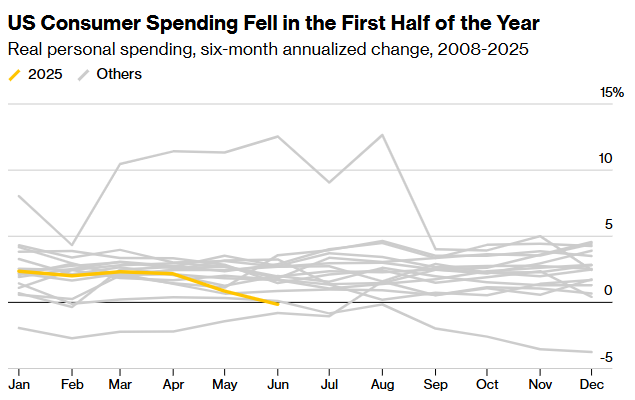
Economic Overview - Recent economic data has raised warning signals, confirming concerns among U.S. corporate executives and consumers regarding the economic situation [1] - The non-farm payroll data released last Friday indicated a much worse labor market condition than previously reported, with a downward revision of nearly 260,000 jobs for May and June [3] - The average job growth over the past three months was only 35,000, marking the worst level since the pandemic [3] Consumer and Business Impact - Many U.S. businesses have paused investments and hiring due to uncertainty surrounding Trump's economic policies, particularly tariffs [4] - Consumer spending has decreased due to rising debt levels, leading to reduced consumption of non-essential goods [4] - Economic growth is expected to be steady but lower than in previous years, with forecasts predicting a 1.5% growth for 2023 and 1.7% by 2026 [4] Inflation and Pricing Pressure - Companies like Procter & Gamble have noted that economic uncertainty is suppressing consumer demand, with CFO Andre Schulten indicating a noticeable slowdown in consumption trends [5] - Prices for frequently imported goods, such as furniture and appliances, have risen, suggesting that companies are passing on higher tariff costs to consumers [5] - Economists anticipate that import tariffs will further increase prices in the coming months [5] Federal Reserve's Position - Federal Reserve Chairman Jerome Powell acknowledged the downward risks in the labor market while describing it as "robust," also noting the slowdown in consumer spending [9] - The housing market continues to be a drag on economic growth, with total spending on residential and non-residential projects down 2.9% year-over-year in June, marking one of the most severe annual declines since early 2019 [9] Employment Data Revisions - The recent large-scale revision of employment data revealed that the number of new jobs added in May and June was 258,000 less than previously reported, shifting the labor market from robust growth to near stagnation [12] - Despite a slowdown in hiring, most companies have not resorted to layoffs, and the unemployment rate rose to 4.2% in July, remaining relatively low [12] - The decline in non-farm employment and rising unemployment will significantly suppress consumer spending, particularly affecting low-income groups reliant on wages [12]


特朗普不满就业数据就解雇统计局长遭广泛批评:政府数据公信力不要了?
Sou Hu Cai Jing· 2025-08-04 11:29
Group 1 - The dismissal of the Bureau of Labor Statistics (BLS) director, Erica McEntyre, by President Trump due to dissatisfaction with employment data has sparked widespread criticism and raised concerns about the reliability of government statistics [1][3][4] - The July employment report indicated a weak job growth of only 73,000 new jobs, with significant downward revisions to previous months' data, reflecting the impact of Trump's economic policies [3][5] - Economic experts warn that the lack of trust in government data could lead to poor economic decision-making, as accurate data is crucial for policymakers and the public [5][6][7] Group 2 - The high inflation rate, with consumer prices rising by 2.6% and core prices by 2.8% from the second half of last year to the first half of this year, is exacerbated by Trump's tariff policies, which have increased import prices [5][6] - The uncertainty surrounding Trump's trade and immigration policies has led to stagnation in business decisions, including hiring, with only the healthcare sector showing significant job growth [6][7] - The economic divide is widening, with large banks and tech companies reporting substantial profit growth while consumer-facing companies struggle with rising costs, indicating a potential slowdown in economic growth [6][7]

美国就业数据“说谎”,消费者缩手,一场“完美风暴”正在形成?
Jin Shi Shu Ju· 2025-08-04 10:08
Economic Conditions - Recent economic data indicates that warning signs are flashing, with a weaker labor market and declining consumer spending in the first half of the year [1] - The average job growth over the past three months is only 35,000, marking the worst performance since the pandemic [1][4] - Many companies are postponing investment and hiring plans due to uncertainty surrounding economic policies, particularly tariffs [2] Consumer Spending - Companies like Procter & Gamble have noted a slowdown in consumer spending trends, attributed to consumer expectations rather than current realities [3] - Rising prices for imported furniture and appliances suggest that companies are beginning to pass higher tariff costs onto consumers [3] Federal Reserve and Interest Rates - The recent employment data has raised questions about the Federal Reserve's decision to maintain interest rates, increasing pressure on officials to lower rates before the economy cools excessively [3][5] - Following the employment report, the two-year U.S. Treasury prices surged, while the S&P 500 index saw a significant decline [5] Economic Growth Projections - Despite current struggles, the U.S. economy is expected to continue growing, albeit at a slower pace, with forecasts of 1.5% growth for this year and 1.7% for 2026 [2]
美国就业崩盘!非农创9个月新低,市场瞬间炸锅!
Sou Hu Cai Jing· 2025-08-04 09:44
Group 1 - The core point of the article highlights a significant downturn in the U.S. labor market, with July's non-farm payrolls adding only 73,000 jobs, the lowest in nine months, and substantially below the market expectation of 104,000 [1][3] - The revisions for May and June show a combined loss of 258,000 jobs, indicating a more severe decline than initially reported [1][3] - The unemployment rate increased slightly from 4.1% to 4.2%, but this is misleading as it reflects a decrease in labor force participation rather than an increase in joblessness [3][6] Group 2 - Average hourly earnings rose from 3.7% to 3.9% year-over-year, suggesting that those still employed are earning more, which complicates inflation control for the Federal Reserve [5][8] - The government sector has been a significant contributor to job losses, with a reduction of 12,000 federal jobs in July and a total of 84,000 since January [5][6] - Most industries, except for healthcare, are stagnant, indicating a lack of expansion and a cautious approach from employers [6][8] Group 3 - There is a notable increase in the number of individuals who want to work but are not actively seeking employment, totaling 6.2 million in July, which reflects a growing sense of disengagement from the labor market [6][8] - The current labor market data is crucial as it may influence the Federal Reserve's monetary policy decisions, with potential implications for interest rate adjustments [8] - The article suggests that the non-farm payroll report could serve as a pivotal point for the Federal Reserve's policy direction, raising questions about whether to cut rates or maintain the current stance [8]

华宝期货晨报铝锭-20250804
Hua Bao Qi Huo· 2025-08-04 06:21
Report Industry Investment Rating - Not provided Core Viewpoints - The finished products are expected to run in a volatile and consolidating manner, and the aluminum price is expected to adjust within a short - term range [4][5] Summary by Related Catalogs Finished Products - Yungui region's short - process construction steel enterprises are expected to affect a total of 741,000 tons of construction steel output during the Spring Festival shutdown from mid - January. In Anhui, 1 out of 6 short - process steel mills started to shut down on January 5, and most of the rest will shut down around mid - January, with a daily output impact of about 16,200 tons [3][4] - From December 30, 2024, to January 5, 2025, the total transaction area of newly built commercial housing in 10 key cities was 2.234 million square meters, a 40.3% decrease from the previous period and a 43.2% increase year - on - year [4] - The finished products continued to decline in a volatile manner yesterday, reaching a new low. In the pattern of weak supply and demand, the market sentiment is pessimistic, and the price center of gravity continues to move down. This year's winter storage is sluggish, providing little support for prices. The view is that it will run in a volatile and consolidating manner [4] Aluminum Ingots - In July 2025, the average fully - taxed cost of China's electrolytic aluminum industry was 16,261 yuan/ton, a 1.7% decrease from the previous period and a 5.8% decrease year - on - year. In August, alumina's support for costs will be evident [4] - In August, the operating capacity of alumina is expected to increase month - on - month, and the demand for bauxite will grow. The supply of bauxite from Guinea is expected to decline starting in August, and the inventory accumulation rate of bauxite in China is expected to slow down, with the inventory likely to reach an inflection point from August to September [4] - In July, China's electrolytic aluminum output increased by 1.05% year - on - year and 3.11% month - on - month. On August 4, the inventory of electrolytic aluminum ingots in major consumption areas was 564,000 tons, an increase of 20,000 tons from last Thursday and 31,000 tons from last Monday [4] - Currently in the off - season, inventory is accumulating, and the off - season pressure on the demand side limits the upside space. The short - term aluminum price is expected to move within a range, and subsequent attention should be paid to the inventory - consumption trend [5]
穆迪:美国经济站在悬崖边缘,美联储也难施以援手
Jin Shi Shu Ju· 2025-08-04 05:28
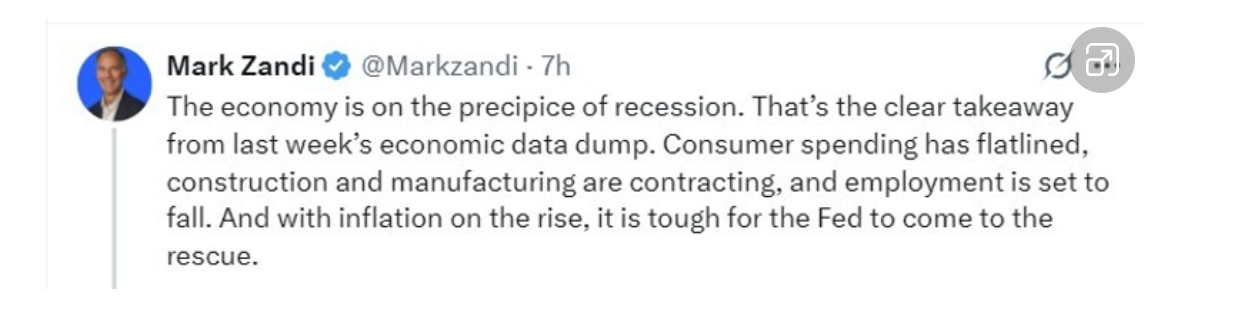
Economic Outlook - The recent employment report indicates that the U.S. economy is heading towards a recession, with various economic indicators signaling a downturn [1] - Consumer spending is stagnating, construction and manufacturing sectors are contracting, and employment is expected to decline [1][2] - The Federal Reserve faces challenges in responding to rising inflation, which complicates potential interventions [1] Employment Data - Non-farm payrolls increased by only 73,000 last month, significantly below the expected 110,000, with previous months' data also revised downwards [2] - The average monthly job growth over the past three months is only 35,000, indicating a slowdown in employment growth [2] - Despite a stable unemployment rate around 4% to 4.2%, the labor force participation rate is declining due to reduced foreign-born labor [3] Labor Market Dynamics - The reduction in foreign-born labor by 1.2 million over the past six months is attributed to restrictive immigration policies, leading to a stagnation in labor supply [3] - There is a hiring freeze across the economy, particularly affecting new graduates, which suggests a significant drop in the "neutral job growth" needed to maintain stable unemployment [3] - Morgan Stanley economists have raised alarms about potential recession, noting that private sector job growth has averaged only 52,000 per month over the past three months [3][4] Economic Indicators - The second quarter GDP showed unexpected growth, but domestic final demand indicators suggest a slowdown [2] - Core inflation accelerated to 2.8%, exceeding the Federal Reserve's target of 2%, while consumer spending growth in June fell short of expectations [2] - The Atlanta Fed's GDP tracking model predicts a slowdown in economic growth from 3% in the second quarter to 2.1% in the third quarter [2]
海外高频 | 8月1日后,美国平均关税税率升至18.3% (申万宏观·赵伟团队)
申万宏源宏观· 2025-08-04 03:28
Group 1 - The average tariff rate in the US increased to 18.3% after August 1, down approximately 4 percentage points from 22.5% on April 2 [62][63] - The new tariff rates for countries with trade agreements range from 10% to 20%, while those for countries with trade deficits range from 25% to 41% [62][63] - Ongoing negotiations between the US and other countries, including India, aim to finalize a phase one agreement by fall 2025, focusing on agricultural products, medical devices, and digital trade tariffs [62] Group 2 - Developed market indices experienced declines, with the S&P 500 down 2.4% and the French CAC40 down 3.7% [2][3] - Emerging market indices also saw declines, with the South Korean Composite Index down 2.4% and the Ho Chi Minh Index down 2.3% [3] - The majority of sectors within the S&P 500 fell, particularly materials, consumer discretionary, healthcare, and financials, which dropped 5.4%, 4.5%, 3.9%, and 3.8% respectively [6] Group 3 - The yield on the 10-year US Treasury bond decreased by 17.0 basis points to 4.2% [16] - Other developed countries also saw declines in their 10-year bond yields, with Germany at 2.8% and Japan at 1.6% [16] - Emerging market 10-year bond yields mostly fell, with Turkey down 21.0 basis points to 29.3% and South Africa down 24.0 basis points to 9.6% [22] Group 4 - The US dollar index rose by 1.0% to 98.69, while most other currencies depreciated against the dollar [27][39] - The offshore Chinese yuan depreciated to 7.1929 against the dollar [39] - Major emerging market currencies also saw depreciation, with the Mexican peso down 1.6% and the Philippine peso down 1.0% [27] Group 5 - Commodity prices showed mixed results, with WTI crude oil rising 3.3% to $67.3 per barrel, while coking coal prices fell 13.2% to 1093 yuan per ton [45][46] - Precious metals experienced varied performance, with COMEX gold up 0.9% to $3360.1 per ounce, while COMEX silver fell 3.4% to $36.8 per ounce [52][58] Group 6 - The US economy's Q2 GDP grew at an annualized rate of 3%, surpassing market expectations of 2.6%, but internal demand showed signs of weakness [73] - Consumer spending in Q2 grew at an annualized rate of 1.4%, below the expected 1.5% [73] - The overall GDP growth was primarily driven by net exports, indicating a potential end to the trend of "importing" [73] Group 7 - The US added 73,000 jobs in July, falling short of the expected 104,000, with previous months' job additions revised down significantly [76] - The unemployment rate rose to 4.2%, aligning with expectations, while job openings in June decreased to 7.437 million, below the anticipated 7.5 million [76]

美国经济:就业显著走弱,美联储面临两难
Zhao Yin Guo Ji· 2025-08-04 01:41
Employment Data - In July, the U.S. added 73,000 non-farm jobs, below the market expectation of 104,000[5] - The non-farm employment figures for May and June were revised down by 258,000 to 19,000 and 14,000 respectively, resulting in a 3-month moving average of 35,000, the lowest since the pandemic[5] - Private sector job growth increased from 3,000 to 83,000 in July, while goods-producing jobs decreased by 13,000, with manufacturing jobs experiencing three consecutive months of negative growth[5] Unemployment and Labor Participation - The unemployment rate rose from 4.1% to 4.2%, marking a new high since 2021 but still at historical lows[5] - The labor participation rate fell to 62.2%, the lowest since 2022, indicating a contraction in labor supply[5] - The household survey showed a decrease of 260,000 in employment and an increase of 220,000 in unemployment in July[5] Federal Reserve's Dilemma - Fed Chair Powell indicated that even if job growth drops to zero, a stable unemployment rate would suggest a robust labor market due to simultaneous declines in supply and demand[5] - The Fed faces a dilemma as tariffs may drive inflation up, complicating the balance between expanding employment and reducing inflation[5] - It is anticipated that the Fed will likely keep interest rates unchanged in September, followed by rate cuts in October and December[5]
亚马逊大跌引发连锁反应,美股黄金齐变脸,下一轮风暴何时来临?
Sou Hu Cai Jing· 2025-08-03 22:19
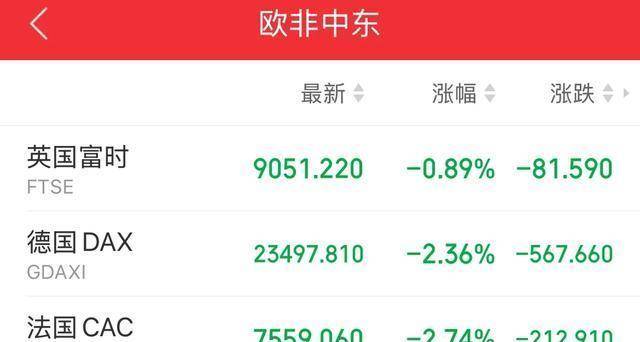
Core Viewpoint - The financial markets faced a sudden storm in August, primarily driven by disappointing economic data, particularly the U.S. non-farm payroll report for July and significant revisions to previous months' data, raising concerns about the U.S. economic recovery and the Federal Reserve's monetary policy direction [1][2]. Economic Indicators - The final value of the S&P Manufacturing PMI was reported at 49.8%, while the ISM Manufacturing PMI was even lower at 48, indicating a contraction in the manufacturing sector for the first time since December of the previous year [2]. - The University of Michigan Consumer Sentiment Index also fell short of expectations, ending at 61.7, further painting a bleak picture of the economy [2]. Market Reactions - Major U.S. stock indices, including the Dow Jones Industrial Average, Nasdaq Composite, and S&P 500, experienced significant declines, with the Dow down 1.38%, Nasdaq down 1.92%, and S&P 500 down 1.51% [6]. - The technology sector was particularly hard hit, with notable declines in stocks of major companies such as Amazon, which fell by 6.38% due to disappointing earnings expectations [1][6]. Inflation and Interest Rate Expectations - One-year inflation expectations surged to 4.5%, exceeding market forecasts, while five-year expectations decreased, indicating persistent short-term inflationary pressures [3]. - The anticipation of a potential interest rate cut by the Federal Reserve gained traction, leading to a significant drop in the U.S. dollar index, which fell by 1.12% to 98.8510 [5]. Global Market Impact - The risk-averse sentiment spread globally, affecting European markets, with major indices like the FTSE 100, DAX, and CAC 40 all experiencing declines, some exceeding 2.7% [5]. - The weakening dollar contributed to increased volatility in global markets, with non-U.S. currencies appreciating against the dollar [5]. Future Outlook - The upcoming non-farm payroll data for August is expected to be a critical focus for the market, as it will influence perceptions of the U.S. economic recovery and potential capital outflows [7]. - The current market turmoil highlights underlying structural issues within the U.S. economy, with a fragile market sentiment that may lead to further volatility in the future [7].