
美联储降息预期

Search documents
有色金属大宗商品周报(2025/12/15-2025/12/19):铜铝价格高位震荡,等待突破上行-20251221
Hua Yuan Zheng Quan· 2025-12-21 13:16
Investment Rating - The investment rating for the non-ferrous metals industry is "Positive" (maintained) [3] Core Views - Copper prices are experiencing high volatility, supported by macroeconomic factors such as the unexpected rise in the US unemployment rate and lower-than-expected CPI, which have increased expectations for interest rate cuts by the Federal Reserve [4] - The supply-demand dynamics for copper are tightening, with capital expenditures on copper mines insufficient and frequent supply disruptions expected to lead to a shift from a tight balance to a shortage [4] - The aluminum market is characterized by a slight accumulation of domestic inventory, with prices remaining high due to stable demand and limited supply growth [4] - The lithium sector is witnessing strong demand, with lithium prices entering an upward cycle as inventory continues to deplete [4] - Cobalt prices are expected to continue rising due to a tight supply of raw materials, despite some easing of export restrictions from the Democratic Republic of Congo [4] Summary by Sections 1. Industry Overview - The US unemployment rate for November was reported at 4.6%, exceeding expectations, while non-farm employment increased by 64,000, also above forecasts [8] - The US retail sales for October were flat, and the CPI for November was reported at 2.7%, below expectations [8] 2. Market Performance - The non-ferrous metals sector outperformed the Shanghai Composite Index, with a weekly increase of 1.46% compared to a 0.03% rise in the index [10] - The sector's PE_TTM valuation is at 26.64 times, while the PB_LF valuation is at 3.29 times, indicating a premium over the broader market [19] 3. Copper - London copper prices increased by 0.36%, while Shanghai copper prices decreased by 0.96% [24] - Copper inventories in London decreased by 3.32%, while Shanghai inventories increased by 7.18% [24] 4. Aluminum - London aluminum prices rose by 2.37%, while Shanghai aluminum prices fell by 0.54% [36] - The aluminum industry is facing a slight increase in inventory, with production capacity nearing its limits [4] 5. Lithium - Lithium carbonate prices rose by 3.33% to 97,650 CNY/ton, while lithium hydroxide prices increased by 3.91% to 86,280 CNY/ton [78] - The lithium sector is expected to see a profit turning point as demand continues to grow [4] 6. Cobalt - The price of MB cobalt rose by 0.51% to 24.45 USD/pound, with domestic cobalt prices increasing by 1.93% to 422,000 CNY/ton [90] - The supply of cobalt remains tight, with expectations for continued price increases [4]

华源晨会精粹20251221-20251221
Hua Yuan Zheng Quan· 2025-12-21 12:29
Group 1: New Consumption - The core strategy emphasizes expanding domestic demand as a key driver for economic growth, with multiple policies introduced to stimulate consumption, including a focus on service consumption and financial collaboration [6][7][8] - The official launch of the Hainan Free Trade Port on December 18, 2025, has led to a significant increase in consumer spending, with sales exceeding 250 million yuan on the first day, marking a 90% year-on-year growth [8][9] - The beauty and skincare market is dominated by the top five brands: Proya, L'Oreal, Han Shu, Lancôme, and Estée Lauder, with a notable expansion in the head brand segment [10][11] Group 2: Metal New Materials - Copper prices are experiencing high volatility, supported by a decrease in the U.S. unemployment rate and expectations of interest rate cuts by the Federal Reserve, which may lead to a price increase [13][14] - Aluminum prices remain high despite a slight increase in domestic inventory, with expectations of a supply shortage in the coming year due to stable demand and limited production capacity [15] - Lithium demand is robust, with prices entering an upward cycle as inventory continues to decrease, driven by strong growth in lithium battery applications [16] Group 3: Pharmaceuticals - The pharmaceutical index has shown a slight decline, but there is optimism for a rebound in innovative drug stocks due to upcoming catalysts and a favorable adjustment period [19][21] - The CTLA-4 antibody has demonstrated promising clinical data, potentially leading to a new paradigm in tumor drug development, with significant survival rate improvements reported [20][21] - Recommended stocks in the innovative drug sector include Xinyi Tai, Zai Lab, and Hotgen Biotech, among others, with a focus on companies showing clear performance trends and potential for recovery in 2026 [22][21] Group 4: North Exchange - The North Exchange has registered its first asset purchase project, with a focus on the upcoming IPO of Hengdongguang, which specializes in optical communication components [24][25] - The exchange is expected to receive continued support for reforms and expansion, with a focus on identifying undervalued assets and companies with merger intentions [26] - The overall market remains stable, with a focus on small and medium-sized stocks that show consistent growth and potential in emerging sectors such as AI and commercial aerospace [26][27]


降息预期升温+AI进展催化
Xin Lang Cai Jing· 2025-12-21 11:31
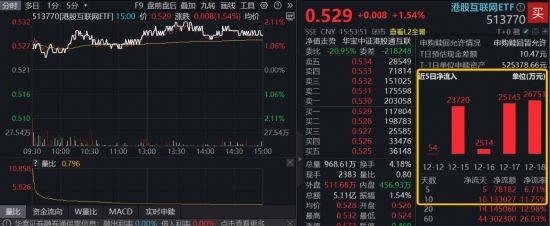
Core Viewpoint - The Hong Kong stock market is experiencing a rebound, driven by expectations of interest rate cuts from the Federal Reserve and advancements in AI technology, leading to significant gains in major internet stocks [3][4]. Group 1: Market Performance - On December 19, the Hang Seng Index and the Hang Seng Tech Index rose by 0.75% and 1.12% respectively, with major internet companies like Tencent, Kuaishou, and Meituan all gaining over 1% [1]. - The Hong Kong Internet ETF (513770) saw a high opening and increased by 1.54%, with a peak gain of over 2% during trading [1]. Group 2: Economic Indicators - The latest U.S. core CPI for November increased by 2.6% year-on-year, marking the lowest level since 2021, indicating signs of cooling inflation [3]. - Market expectations for aggressive interest rate cuts by the Federal Reserve in 2026 have risen, with traders anticipating two rate cuts totaling 50 basis points next year [3]. Group 3: AI Developments - Meituan has launched and open-sourced its virtual human video generation model, LongCat-Video-Avatar, which supports various core functions including Audio-Text-to-Video [3]. - Tencent has released its Mix Universe Model 1.5, allowing users to create interactive worlds from text or images, and has open-sourced a comprehensive real-time world model framework [3]. Group 4: Investment Insights - The Hong Kong Internet ETF (513770) has attracted a net inflow of 1.33 billion yuan over the past 10 days, indicating strong investor interest [4]. - Dongwu Securities suggests that the current market position is attractive for long-term investment in technology growth stocks, anticipating a rebound in the Hong Kong market [4]. - CITIC Securities remains optimistic about the internet sector's cyclical properties combined with the upward trend of AI, viewing major internet companies as potential beneficiaries [4].






美国经济数据倾向降息,美元继续走弱
Dong Zheng Qi Huo· 2025-12-21 09:45
Report Industry Investment Rating - The rating for the US dollar is "Oscillating" [5] Report's Core View - The US economic data leans towards interest rate cuts, and the US dollar is expected to continue weakening. The labor market is weakening, and inflation is falling, which is favorable for the future monetary policy of the Federal Reserve. With the upcoming nomination of the new Federal Reserve Chairman, the market's expectations for future monetary policy rhythm will change, and the US dollar index is expected to continue to decline [34] Summary by Relevant Catalogs 1. Global Market Overview This Week - Market risk appetite remained high, with stock markets showing mixed performance. Bond yields mostly increased, and the yield on US Treasuries dropped to 4.14%. The US dollar index rose 0.2% to 98.6, and most non - US currencies depreciated. The offshore RMB rose 0.27%, the euro rose 0.26%, the pound fell 0.07%, the yen fell 1.25%, the Swiss franc rose 0.03%, the real fell 2.3%, and the Australian dollar, New Zealand dollar, Korean won, Indian rupee, and Canadian dollar ended lower, while the ringgit, Thai baht, and rand ended higher. Gold prices rose 0.9% to $4339 per ounce, the VIX index slightly decreased to 14.9, the spot commodity index ended lower, and Brent crude oil fell 0.7% to $61.5 per barrel [1][9] 2. Market Trading Logic and Asset Performance 2.1 Stock Market - Global stock markets showed mixed performance, with US and A - shares slightly rising. Developed - market stock markets mostly closed higher, with the S&P 500 rising 0.1%. Emerging - market stock markets mostly closed lower, with the Shanghai Composite Index rising 0.03%. The Hang Seng Index fell 1.1%, and the Nikkei 225 Index fell 2.61%. The Chinese stock market showed an oscillating trend due to weak economic data in November and the support from the "national team" [10][11] 2.2 Bond Market - Global bond yields mostly increased, while the US Treasury yield dropped to 4.14%. The 10 - year US Treasury yield initially rose to 4.18% and then declined due to factors such as market expectations of interest rate cuts and good auction data. The Japanese central bank's interest rate hike pushed up the yields of European and American bonds, and the yield curves of developed countries became steeper. The 10 - year Chinese Treasury yield oscillated downward to 1.828%, and the Sino - US interest rate spread inverted slightly to 232bp [14][18][21] 2.3 Foreign Exchange Market - The US dollar index rose 0.2% to 98.6, and most non - US currencies depreciated. The offshore RMB rose 0.27%, the euro rose 0.26%, the pound fell 0.07%, the yen fell 1.25%, the Swiss franc rose 0.03%, the real fell 2.3%, and the Australian dollar, New Zealand dollar, Korean won, Indian rupee, and Canadian dollar ended lower, while the ringgit, Thai baht, and rand ended higher [24][27] 2.4 Commodity Market - Spot gold rose 0.9% to $4338 per ounce. The US employment market continued to weaken, and the CPI in November significantly declined. The market's expectation of an interest rate cut in January slightly increased, and gold oscillated near the previous high. Brent crude oil fell 0.7% to $61.5 per barrel. Supply - side disruptions remained, but demand was weak, and oil prices oscillated at low levels. The spot commodity index ended lower, silver continued to rise, and the volatility of non - ferrous metals increased [28][30] 3. Hotspot Tracking - The labor market is weakening, and inflation is falling. The November non - farm payroll data showed that the slowdown trend in the labor market remained unchanged, and the unemployment rate rose to a four - year high. The latest CPI was significantly lower than expected, and core CPI growth was only 2.6%. Although data quality may be an issue, the slowdown in inflation is beneficial to the market [31][34] 4. Next Week's Important Event Reminders - Monday: China's December LPR - Tuesday: US Q3 GDP - Wednesday: US initial jobless claims; Christmas Eve, European and American markets may close early - Thursday: Christmas, European and American markets are closed - Friday: Japan's November unemployment rate [35]
和讯投顾魏玉根:周末五条重要消息或影响市场
Sou Hu Cai Jing· 2025-12-21 08:14
Group 1 - The Japanese interest rate hike has led to a rebound in the US market, positively impacting A-shares, particularly in the technology sector, with Nvidia rising nearly 4% and Micron increasing nearly 7% after a previous 10% rise [1] - The non-ferrous metals sector has seen significant gains, with silver reaching a new high of $64.7 per ounce, driven by supply-demand issues and expectations of two rate cuts by the Federal Reserve next year [1] - Lithium carbonate futures experienced a notable increase of over 4%, with leading companies in the sector, such as SQM and Albemarle, also seeing their stock prices rise, attributed to improved supply-demand dynamics and market sentiment [2] Group 2 - The consumer sector is showing strong performance, with a trend established and identified as a key focus for the coming year, supported by ongoing policy incentives [2] - The commercial aerospace sector remains active, with leading companies experiencing price increases and a rotation among stocks, indicating strong speculative interest in this area [2]
铜周报:铜价延续上涨趋势-20251221
Dong Ya Qi Huo· 2025-12-21 01:18
铜周报 铜行业周报 2025/12/19 咨询业务资格:沪证监许可【2012】1515号 研报作者:许亮 Z0002220 审核:唐韵 Z0002422 【免责声明】 本报告基于本公司认为可靠的、已公开的信息编制,但本公司对该等信息的准确性及完整性不作任何保证。本报告所载的意见、结论及预测仅反映报告发布时的观点、结论 和建议。在不同时期,本公司可能会发出与本报告所载意见、评估及预测不一致的研究报告。本公司不保证本报告所含信息保持在最新状态。本公司对本报告所含信息可在不发出通知的情 形下做出修改, 交易者(您)应当自行关注相应的更新或修改。本公司力求报告内容客观、公正,但本报告所载的观点、结论和建议仅供参考,交易者(您)并不能依靠本报告以取代行 使独立判断。对交易者(您)依据或者使用本报告所造成的一切后果,本公司及作者均不承担任何法律责任。本报告版权仅为本公司所有。未经本公司书面许可,任何机构或个人不得以翻 版、复制、发表、引用或再次分发他人等任何形式侵犯本公司版权。如征得本公司同意进行引用、刊发的,需在允许的范围内使用,并注明出处为"东亚期货",且不得对本报告进行任何有 悖原意的引用、删节和修改。本公司保留追 ...
股指期货周报:美联储降息预期提升,股指本周触底反弹-20251220
Zhe Shang Qi Huo· 2025-12-20 07:09
Report Industry Investment Rating No relevant content provided. Core Viewpoints - Multiple index - type ETFs saw increased trading volume during intraday trading, driving the stock index to rebound. The Fed cut interest rates by 25 BP again. The Political Bureau meeting set the tone for 2026, maintaining a loose policy, and the Economic Work Conference made directional arrangements. In the medium - to - long term, the domestic market is characterized by a liquidity narrative, with a continuous influx of incremental funds, and the stock index still has upward momentum after consolidation [3]. - The international situation is complex, and positive results have been achieved in China - US economic and trade consultations. The US has entered a new interest - rate cut cycle, which is beneficial for the appreciation of the RMB and the return of foreign capital, bringing new incremental funds. Current policies to stabilize the capital market are positive, and the bottom line of the stock index is clear. The Political Bureau meeting and the Economic Work Conference have given directional guidance, including the continued implementation of more proactive and effective macro - policies, efforts to stabilize the real estate market, and greater emphasis on the role of the "strong domestic market" in expanding domestic demand. After the risk - free interest rate drops to a low level, the entry of medium - to - long - term funds and residents into the market will enter a new cycle. Future index trends need to focus on trading volume, and if the trading volume of the two markets can remain above 2 trillion yuan, the relatively strong trend can be maintained [4]. Summary by Directory Market Performance - This week, domestic stock indices continued to fluctuate. From the perspective of global indices, as of December 19, 2025, the Nasdaq index rose 0.48%, the S&P 500 index rose 0.1%, but the Hang Seng Technology Index fell 2.82%. The Shanghai Composite Index rose 0.03%, the CSI 1000 index fell 0.56%, the SSE 50 index rose 0.32%, the ChiNext index fell 2.26%, and the STAR 50 index fell 2.99%. In terms of industries, the 31 Shenwan primary industry indices showed divergent trends this week, with sectors such as commercial retail, non - bank finance, and social services leading the gains, while sectors such as electronics, power equipment, and machinery leading the losses [11][15]. Liquidity - In November, the growth rate of the total social financing scale was stable, while the growth rates of M2 and M1 declined. As of November, the balance of M2 was 336.99 trillion yuan, a year - on - year increase of 8.5% (previous value 8.2%). The balance of narrow - money (M1) was 112.88 trillion yuan, a year - on - year increase of 4.9% (previous value 6.2%), and the M2 - M1 gap widened to 3.1 percentage points. The funds rate (DR007) remained at a low level, and in November, the net MLF investment was 100 billion yuan. The yield of 10 - year treasury bonds was around 1.85%. Direct financing became the main support for social financing, with government bonds making a prominent contribution. At the end of November, the stock of social financing increased by 8.5% year - on - year (unchanged from the previous value), and the cumulative increment in the first 11 months was 33.39 trillion yuan, an increase of 8.99 trillion yuan year - on - year. The new social financing in November was 2.49 trillion yuan, mainly driven by direct financing such as government bonds and corporate bonds [13][16]. Trading Data and Emotions - This week, the trading volume of the two markets shrank slightly, and the stock index maintained a volatile pattern. From January to November 2025, retail investors in the A - share market opened a cumulative total of 24.9402 million new stock accounts, a year - on - year increase of 7.95%. The growth rate of institutional investor account openings was even more rapid, with a cumulative total of 93,400 new accounts, a year - on - year increase of 36%. The trading volume (MA5) of the two markets shrank to less than 2 trillion yuan again, and liquidity is an important factor supporting the current index and needs continuous tracking [23][24]. Index Valuation - The absolute valuation of the indices is at a low level, but the quantiles are relatively high. As of December 19, 2020, the latest PB of the Shanghai Composite Index was 16.26, with a quantile of 79.25, and the latest PB of the entire A - share market was 21.79, with a quantile of 82.18. Among the major stock indices, the quantiles of the CSI 1000 > CSI 500 > CSI 300 > SSE 50 [30][35]. Index Industry Weights (as of June 30, 2025) - In the SSE 50, the weights of the banking, non - bank finance, and food and beverage industries are relatively high, at 21.31%, 15.48%, and 13.88% respectively, and the electronics industry has become the fourth - largest weighted industry. The weights of the CSI 300 are relatively dispersed, and the top three weighted industries are banking, non - bank finance, and electronics. The top three weighted industries of the CSI 500 are electronics, pharmaceutical biology, and non - bank finance. The top three weighted industries of the CSI 1000 are electronics, pharmaceutical biology, and computers [40][41]. Other Overseas and Domestic Policy Tracking - Domestic policy tracking shows that from May to December 2025, a series of policy measures were introduced, including reducing the reserve requirement ratio, lowering policy and provident fund interest rates, establishing a 300 - billion - yuan service consumption and elderly care refinancing loan, supporting Central Huijin to play the role of a "stabilization fund", and deepening the reform of the STAR Market, ChiNext, and Beijing Stock Exchange. The current domestic fiscal and monetary policies are loose, and continuous policy stimuli are introduced to stabilize the economy. The "1 + 1" system based on the new "National Strength Articles" supports the development of the capital market, with a focus on the development of science and technology innovation and green development. High - tech sectors, especially low - penetration tracks, have received capital support and are迎来 long - term allocation opportunities [46][50].
年内涨幅翻倍 白银投资成“香饽饽”
Sou Hu Cai Jing· 2025-12-19 15:00
Core Viewpoint - Silver prices have surged over 120% in 2025, driven by supply-demand imbalances, industrial demand, and investment inflows, with expectations for continued upward movement in 2026 despite short-term volatility risks [1][2][3]. Group 1: Price Trends - As of mid-December 2025, silver prices reached approximately $64.74 per ounce, up from about $30.1 per ounce at the beginning of the year [1]. - On December 17, silver futures in Shanghai hit a record high of 15,477 yuan per kilogram, while COMEX silver peaked at $65.909 per ounce, marking a year-to-date increase of over 125%, significantly outperforming gold [2]. - Silver prices have shown a consistent upward trend, breaking through key psychological levels, including $40, $50, and $60 per ounce within a few months [2]. Group 2: Supply and Demand Dynamics - The global silver market is projected to face a supply gap of approximately 95 million ounces by 2025, with industrial demand expected to account for 58.5% of total demand in 2024 [3][5]. - Industrial silver demand is forecasted to grow at a compound annual growth rate (CAGR) of 5.4% from 2019 to 2024, contributing to 98% of the total increase in silver demand during this period [5]. - Major silver-producing countries have seen reduced output, while global inventories are at a ten-year low, indicating a tightening supply situation [6]. Group 3: Market Influences - The expectation of Federal Reserve interest rate cuts is a key driver of silver's price surge, as lower interest rates enhance the appeal of non-yielding assets like silver [4]. - A decline in the U.S. dollar index is also expected to support silver prices, with historical data indicating that a 1% drop in the dollar typically results in a 1.5% to 2% increase in silver prices [4]. - The increasing industrial applications of silver, particularly in the photovoltaic sector and electric vehicles, are reshaping traditional demand structures [6]. Group 4: Future Outlook - Analysts predict that silver prices may continue to rise, with major investment banks adjusting their price targets upward, with UBS forecasting a target price of $58 to $60 per ounce for 2026 [6]. - The ongoing demand from sectors such as renewable energy and electronics is expected to maintain upward pressure on prices, despite potential short-term corrections [6][7]. - Institutions have raised concerns about the volatility in the silver market, suggesting that large trades can significantly impact prices, necessitating cautious risk management from investors [7][8].
贺博生:12.19黄金原油晚间行情价格涨跌趋势分析及周五收官操作建议
Sou Hu Cai Jing· 2025-12-19 12:37
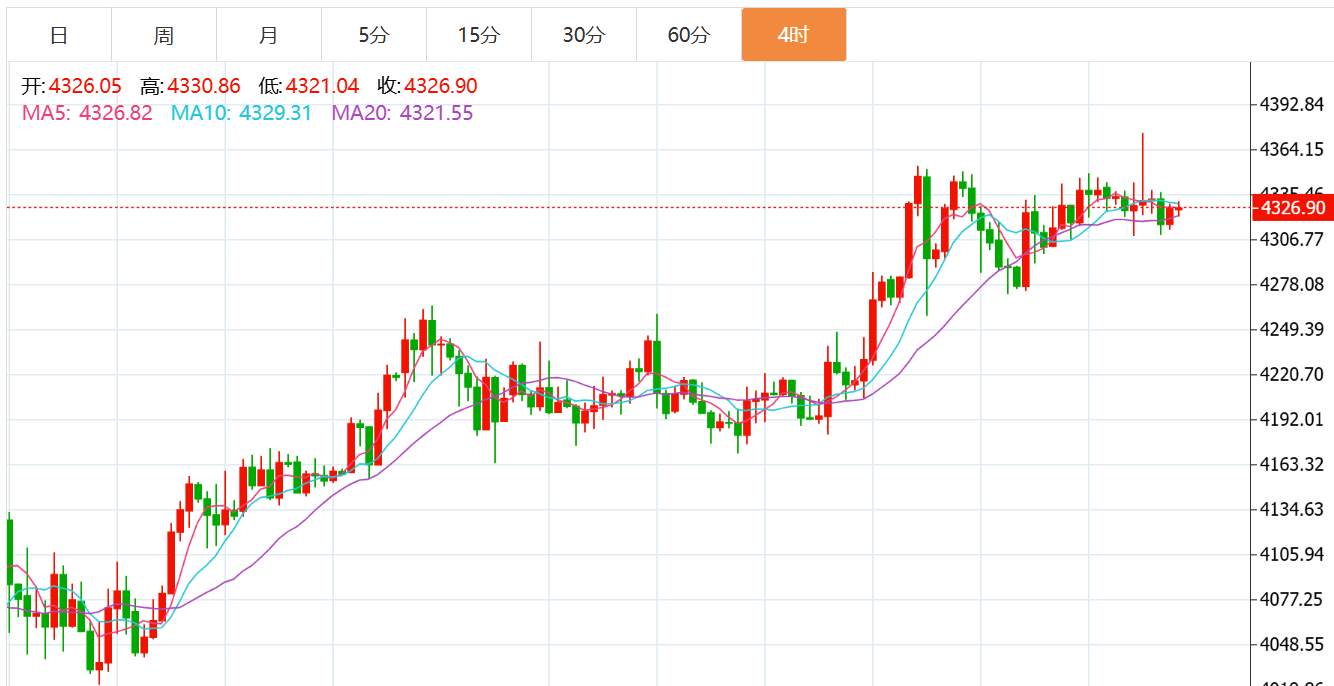
Market Overview - The market operates on the principle that informed individuals earn from those who are less informed, emphasizing that in capital markets, the only standard is winning or losing [1] - The investment philosophy suggests that one should act when the price reaches a certain point and remain observant otherwise [1] Gold Market Analysis Fundamental Analysis - Gold prices experienced fluctuations, dropping to around $4310 before recovering to approximately $4327, influenced by profit-taking and buying on dips [2] - The unexpected decrease in the US November CPI to 2.7% has strengthened expectations for further interest rate cuts by the Federal Reserve, limiting the downside for gold prices [2] - Geopolitical tensions and strong demand continue to support gold, with investors advised to monitor the upcoming US Michigan Consumer Sentiment Index for further insights [2] Technical Analysis - The daily chart indicates that gold's recent bullish momentum lacks strong conviction, as evidenced by a bearish candlestick formation [3] - Short-term resistance is identified at the $4365-$4370 range, while support is noted at the $4320 level [3] - The hourly chart suggests a sideways movement with potential for a significant downward adjustment, with key support levels at $4310-$4305 and $4280-$4270 [5] Oil Market Analysis Fundamental Analysis - US crude oil prices are currently around $55.80 per barrel, reflecting a weak overall trend and hovering near yearly lows [6] - Market sentiment is mixed due to geopolitical factors and slow global economic recovery, which limits the demand outlook for oil [6] - The support for oil prices is primarily based on expectations rather than actual changes in the market [6] Technical Analysis - The daily chart shows a bearish trend with four consecutive days of declining prices, having broken through the significant support level at $56 [7] - The short-term outlook indicates a potential for further downward movement, with resistance levels at $57.0-$58.0 and support at $54.5-$53.5 [7] Risk Management Strategies - Emphasis on the importance of stop-loss orders, regardless of their size, to mitigate risks [8] - Recommendations against averaging down on losing positions to avoid increasing exposure to risk [9] - Suggestion to maintain consistent position sizes and avoid drastic changes in trading strategy [10][11]
人民币年底为什么一直涨?
Sou Hu Cai Jing· 2025-12-19 11:39
Group 1 - The core viewpoint is that the Chinese yuan has entered a "surge" mode by the end of 2025, strengthening against major currencies, with the onshore yuan approaching the 7.04 mark, appreciating over 700 basis points since November, marking a 14-month high since October 2024 [1][2] Group 2 - The recent appreciation of the yuan is attributed to the weakening of the US dollar index and a shift towards a more accommodative global monetary policy environment, with market expectations for a 25 basis point rate cut by the Federal Reserve reaching 87% by mid-December [2] - China's assets are showing strong attractiveness in 2025, with the A-share Shanghai Composite Index breaking a nearly 10-year high and significant foreign capital inflows into Hong Kong stocks, with over 30 billion yuan net inflow in October [3] - The GDP growth in Q3 2025 was 5.3%, exceeding market expectations, and the manufacturing PMI returned to the expansion zone at 50.2 in October, indicating a positive economic recovery [4] - International investment banks are raising their ratings on Chinese assets, correcting previous pessimistic expectations about the domestic economy, which provides solid fundamental support for the yuan's exchange rate [5] - China's exports have shown unexpected resilience, with a trade surplus of 51 billion USD in September, the highest monthly figure since 2020, enhancing the stability of the foreign exchange market and providing endogenous appreciation momentum for the yuan [5] - Domestic policies aimed at reducing "involution" are driving corporate value reassessment, alongside narratives from AI and technology sectors, making yuan-denominated assets more competitive globally [6] - Increased preference for yuan assets by overseas investors is further driving the exchange rate up, creating a positive cycle of asset appreciation, capital inflow, and currency strengthening [7] - The fourth quarter is traditionally a peak period for foreign trade enterprises to settle foreign exchange, as they convert accumulated foreign exchange income into yuan to lock in profits [8] - Additionally, overseas workers tend to remit their wages back to China before the Spring Festival, increasing demand for yuan, with historical data showing that the surplus from bank foreign exchange settlements is typically highest before the Spring Festival [9]
