货币政策

Search documents
股指期货将震荡整理,黄金、白银期货将创下上市以来新高,白银、黄金期货将震荡偏强,铂、钯、焦煤、玻璃、纯碱、原油、燃料油期货将偏强震荡,镍、锡、碳酸锂期货将震荡偏弱
Guo Tai Jun An Qi Huo· 2026-01-19 11:33
1. Report's Investment Rating for the Industry The document does not mention the investment rating for the industry. 2. Core Viewpoints of the Report - Through macro - fundamental and technical analysis, the report predicts the trend, resistance, and support levels of various futures contracts on January 19, 2026, and the overall trend in January 2026. Some futures are expected to reach new highs [1][2][4]. - It also presents a series of macro - news and their potential impacts on the futures market, such as policy changes and trade agreements [6][7]. 3. Summary by Relevant Catalogs 3.1 Futures Market Trend Forecast - **January 19, 2026 Forecast**: - **Stock Index Futures**: IF2603, IH2603, IC2603, and IM2603 are expected to oscillate and consolidate. Resistance and support levels are provided for each contract [2][21]. - **Treasury Bond Futures**: T2603 is likely to oscillate strongly, and TL2603 is expected to oscillate and consolidate [2][41][46]. - **Precious Metals Futures**: AU2604 and AG2604 are expected to oscillate strongly and may reach new highs. PT2606 and PD2606 are likely to oscillate strongly [2][48][52]. - **Base Metals Futures**: Some, like CU2603 and AL2603, are expected to oscillate strongly, while others, such as ZN2603 and NI2602, may oscillate weakly [2][67][73]. - **Other Commodity Futures**: Some futures, including JM2605 and FG605, are expected to oscillate strongly, and others, like RB2605 and I2605, may oscillate weakly [2][101][108]. - **January 2026 Forecast**: - Stock index futures (IF, IH, IC, IM continuous contracts) are expected to oscillate strongly. Some may reach new highs [4]. - Gold, silver, copper, and other futures continuous contracts are expected to oscillate strongly, with some reaching new highs [4][5]. 3.2 Macro - news and Their Impacts - **Domestic News**: - The State Council promotes consumption - boosting measures, and the SFC strengthens market regulation and promotes reform [6][7]. - The central bank adjusts the minimum down - payment ratio for commercial real estate loans and cuts re - loan and re - discount rates [7][8]. - The total social electricity consumption in China in 2025 exceeded 10 trillion kWh [9]. - **International News**: - Canada and China reach an economic and trade cooperation agreement, and the EU may impose tariffs on US goods [6][11]. - The US Federal Reserve officials express their views on interest rates and economic growth [10]. 3.3 Commodity Futures - related Information - The Shanghai Futures Exchange adjusts trading limits for silver and nickel futures contracts [13]. - The Shanghai International Energy Exchange Center revises the container shipping index (European line) futures standard contract [13]. - On January 16, international precious metal futures generally declined, while crude oil futures rose, and London base metals fell [13][14].
BlueberryMarkets:加拿大通胀预期下降,就业增长放缓?
Sou Hu Cai Jing· 2026-01-19 10:23
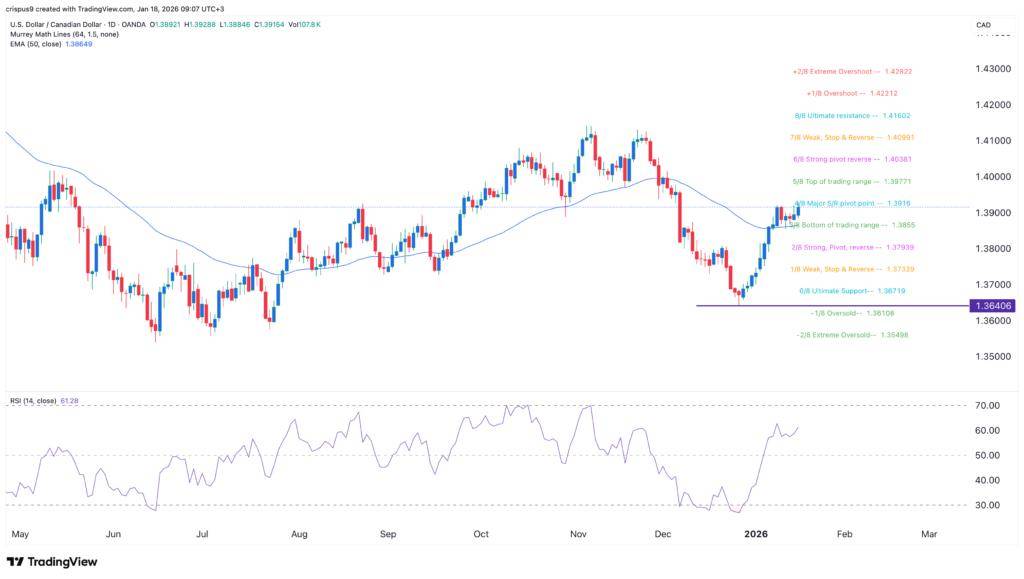
Group 1: Currency Exchange and Economic Data - The USD/CAD exchange rate has rebounded from a low of 1.3640 to the current level of 1.3915, marking the highest level since December 5 [1] - Canada’s consumer price index (CPI) is expected to remain stable at 2.2% year-on-year for December 2022, with a projected month-on-month decline of 0.4% [1] - The core inflation rate, excluding volatile food and energy prices, is anticipated to decrease to 2.8% from the previous 2.9% [1] - Employment data for December shows a minimal increase of 8,200 jobs, significantly lower than the previous three months' average of 181,000 jobs [1] Group 2: Central Bank Policies and Trade Agreements - The Bank of Canada has reduced interest rates from a post-pandemic high of 5% to the current 2.5%, with further cuts anticipated later this year due to economic pressures [2] - A recent agreement between Canada and China involves Canada lowering tariffs on Chinese electric vehicles, while China lifts import restrictions on Canadian canola, potentially enhancing trade relations [2] - The U.S. Federal Reserve is expected to maintain its interest rate range between 3.5% and 3.75% in the upcoming decision, which will significantly influence the USD's performance [2] Group 3: Technical Analysis - The USD/CAD rebound has surpassed key support and resistance pivot points at 1.3916 and is above the 50-day exponential moving average (EMA) [4] - The relative strength index (RSI) is nearing the overbought territory, indicating potential for continued price increases [4] - Key resistance for bullish market participants is targeted around 1.400 [4]

央行打出结构性货币政策工具的“组合拳”,资金面明显改善,债市偏强震荡
Dong Fang Jin Cheng· 2026-01-19 09:55
1. Report Industry Investment Rating - No information provided in the report 2. Core Viewpoints of the Report - On January 15, the liquidity situation improved significantly; the bond market showed a generally strong and volatile trend; the main indices of the convertible bond market rose collectively, and most convertible bond issues increased in price; the yields of U.S. Treasury bonds across various maturities generally increased, and the yields of 10 - year government bonds in major European economies showed divergent trends [1] 3. Summary by Directory 3.1 Bond Market News 3.1.1 Domestic News - The article "Speech at the Central Urban Work Conference" by General Secretary Xi Jinping was published in the second issue of Qiushi Journal on January 16, putting forward the overall requirements for urban work [3] - The central bank launched a "combination punch" of structural monetary policy tools at the beginning of 2026. On January 15, it announced a 0.25 - percentage - point cut in the interest rates of various structural monetary policy tools starting from January 19, and also signaled further easing of aggregate tools such as reserve requirement ratio cuts and interest rate cuts [4] - In 2025, RMB loans increased by 16.27 trillion yuan, and the balance of broad - money (M2) at the end of December 2025 increased by 8.5% year - on - year [4] - The China Financial Regulatory Administration arranged five key tasks for 2026 at its regulatory work meeting on January 15, with the resolution of risks in small and medium - sized financial institutions being the top priority [5] - The Ministry of Finance and the State Taxation Administration announced that from January 1, 2026, to December 31, 2027, the bond interest income of overseas institutions investing in the domestic bond market will be temporarily exempt from enterprise income tax and value - added tax [6] 3.1.2 International News - On January 15, the latest data from the U.S. Department of Labor showed that the number of initial jobless claims in the U.S. for the week ending January 10 fell to 198,000, indicating a resilient labor market [7] 3.1.3 Commodities - On January 15, WTI February crude oil futures fell 4.56% to $59.19 per barrel; Brent March crude oil futures fell 4.15% to $63.76 per barrel; COMEX February gold futures fell 0.26% to $4,623.7 per ounce; NYMEX natural gas prices rose 0.99% to $3.144 per ounce [9] 3.2 Liquidity Situation 3.2.1 Open - Market Operations - On January 15, the central bank conducted 179.3 billion yuan of 7 - day reverse repurchase operations at a fixed interest rate, with a net injection of 169.4 billion yuan after 9.9 billion yuan of reverse repurchase expired [11] 3.2.2 Funding Rates - On January 15, due to continuous net injections by the central bank and increased roll - over of repurchase agreements, the liquidity situation improved significantly. DR001 dropped 2.48bp to 1.367%, and DR007 dropped 6.44bp to 1.502% [12] 3.3 Bond Market Dynamics 3.3.1 Interest - Rate Bonds - **Spot Bond Yield Trends**: On January 15, the bond market continued to recover in the morning due to the weak stock market, and after the central bank announced a 25bp structural interest rate cut in the afternoon, the bond market first rose and then fell. Overall, the bond market showed a generally strong and volatile trend. By 20:00, the yield of the 10 - year Treasury bond active issue 250016 dropped 0.20bp to 1.8550%, and the yield of the 10 - year China Development Bank bond active issue 250215 rose 0.10bp to 1.9680% [15] - **Bond Tendering Situation**: Multiple bonds were tendered on January 15, with different issue scales, winning yields, and multiples [16] 3.3.2 Credit Bonds - **Secondary - Market Transaction Anomalies**: On January 15, the transaction prices of 7 industrial bonds deviated by more than 10%, including some "Vanke" bonds with significant price increases and decreases [17] - **Credit Bond Events**: Companies such as Vanke, Wuxi Transportation Industry Group, Jinan Zhangqiu Holdings, Zhangzidao, Muyuan Co., Ltd., and Chongqing Iron and Steel announced relevant events, including bond展期, cancellation of bond issuance, overdue loans, and profit and loss forecasts [21] 3.3.3 Convertible Bonds - **Equity and Convertible Bond Indices**: On January 15, the three major A - share indices showed mixed performance, and the main indices of the convertible bond market rose collectively. The trading volume of the convertible bond market was 95.371 billion yuan, a decrease of 16.058 billion yuan from the previous trading day. Most convertible bond issues rose [20] - **Convertible Bond Tracking**: On January 16, Aohong Convertible Bond and Shuangle Convertible Bond were listed; Naipu Convertible Bond 02 and Shangtai Convertible Bond started online subscriptions. On January 15, Hongchuan Convertible Bond announced that it was about to trigger the clause for downward revision of the conversion price; Jingce Convertible Bond 2 announced that it would not redeem early, and Zoubang Convertible Bond was expected to trigger the early - redemption clause [26] 3.3.4 Overseas Bond Markets - **U.S. Bond Market**: On January 15, the yields of U.S. Treasury bonds across various maturities generally increased. The 2 - year U.S. Treasury bond yield rose 5bp to 3.56%, and the 10 - year U.S. Treasury bond yield rose 2bp to 4.17%. The yield spread between 2 - year and 10 - year U.S. Treasury bonds narrowed by 3bp to 61bp; the yield spread between 5 - year and 30 - year U.S. Treasury bonds narrowed by 5bp to 102bp [24][25] - **European Bond Market**: On January 15, the yields of 10 - year government bonds in major European economies showed divergent trends. The yield of the 10 - year German government bond rose 3bp to 2.81%, while the yields of 10 - year French and Italian government bonds remained unchanged, the yield of the 10 - year Spanish government bond dropped 1bp, and the yield of the 10 - year British government bond rose 5bp [28] - **Price Changes of Chinese - Issued U.S. Dollar Bonds**: As of the close on January 15, the prices of Chinese - issued U.S. dollar bonds showed different daily changes, with some bonds rising and some falling [30]

ATFX汇市前瞻:日央行新年首份决议 迟来的美国PCE数据
Xin Lang Cai Jing· 2026-01-19 09:47
Group 1: Japan's Monetary Policy - The Bank of Japan will hold its first interest rate decision of 2026 on January 22-23, with results expected between 11:00 and 13:00 [4][14] - Institutions predict that the Bank of Japan will maintain its current interest rates and not implement a rate hike, supported by the lack of media speculation ahead of the decision [4][14] - The core CPI for December is expected to be 2.4%, significantly lower than the previous value of 3%, indicating a low probability of a rate hike if expectations are met [4][14] Group 2: U.S. Economic Data - The U.S. PCE data for November is considered more significant than Japan's interest rate decision, although it is seen as lagging and less impactful due to its timing [5][15] - The core PCE year-on-year rate is forecasted to be 2.8%, consistent with the previous month, suggesting stable price levels in the U.S. from September to November [5][18] - The upcoming unemployment claims data is expected to rise to 212,000 from the previous 198,000, indicating an increase in jobless claims [8][19] Group 3: UK Economic Indicators - The UK unemployment rate for November is expected to be 5%, slightly lower than the previous 5.1%, indicating minimal change [9][21] - The core CPI for December is anticipated to remain at 3.2%, unchanged from the previous value, reflecting stable inflation [9][21] - Overall, the stability in unemployment and inflation suggests a low necessity for adjustments in the UK's monetary policy, with GBP/USD fluctuations more influenced by the U.S. dollar index and Federal Reserve actions [11][22]

瑞达期货国债期货日报-20260119
Rui Da Qi Huo· 2026-01-19 08:51
1. Report Industry Investment Rating No relevant information provided. 2. Core Viewpoints - In 2025, China's economy maintained a steady and progressive growth trend, with export growth significantly contributing to the economy, stable growth on the production side, and the need to boost domestic demand growth momentum [4]. - The central bank's structural interest rate cuts will guide commercial banks to accurately allocate credit resources to key national areas and weak links, achieving "precise drip - irrigation" of monetary policy and serving the long - term goal of promoting economic structure optimization and high - quality development [4]. - With the stabilization of the RMB exchange rate and bank net interest margins, and the weakening of internal and external constraints, the central bank indicates that there is still room for reserve requirement ratio cuts and interest rate cuts within the year. However, due to weak market allocation demand, the supply pressure of long - term bonds continues to disrupt the bond market. It is expected that interest rates will continue to fluctuate in the short term, with continued differentiation between long - and short - term performance [4]. 3. Summary by Relevant Catalogs 3.1 Futures Market - **Futures Prices and Volumes**: T, TF, and TL main contract closing prices decreased by 0.02%, 0.02%, and 0.22% respectively, while the TS main contract closing price remained unchanged. The trading volumes of T, TF, TS, and TL main contracts decreased by 16,762, 19,513, 10,268, and 15,821 respectively [2]. - **Futures Spreads**: Most futures spreads showed an upward trend, such as the TL2603 - 2606 spread increased by 0.02, and the T03 - TL03 spread increased by 0.22 [2]. - **Futures Positions**: The T main contract position decreased by 2,327, the TF main contract position increased by 1,075, the TS main contract position decreased by 600, and the TL main contract position increased by 2,030. The net short positions of T and TS increased, while those of TF and TL decreased [2]. 3.2 Bond Market - **CTD Bond Prices**: The prices of some CTD bonds changed, with 250018.IB (6y) increasing by 0.0469 and 250025.IB (6y) decreasing by 0.0453 [2]. - **Active Bond Yields**: The yields of 1y, 3y, 5y, 7y, and 10y active bonds decreased by 1.75bp, 2.00bp, 1.75bp, 2.00bp, and 1.05bp respectively [2]. 3.3 Interest Rates - **Short - term Interest Rates**: The silver - pledged overnight rate increased by 4.64bp, the silver - pledged 7 - day rate increased by 6.00bp, and the silver - pledged 14 - day rate decreased by 3.00bp. Shibor overnight and 7 - day rates decreased by 0.70bp and 0.30bp respectively, while the Shibor 14 - day rate increased by 0.50bp [2]. - **LPR Rates**: The 1 - year and 5 - year LPR rates remained unchanged [2]. 3.4 Public Market Operations - The open - market reverse repurchase issuance scale was 158.3 billion yuan, the maturity scale was 86.1 billion yuan, and the interest rate was 1.4% with a term of 7 days [2]. 3.5 Industry News - **Domestic Economic Data**: In 2025, China's GDP was 1,401,879 billion yuan, a 5.0% increase year - on - year. In December 2025, the industrial added value of large - scale industries increased by 5.2% year - on - year and 0.49% month - on - month. The total retail sales of consumer goods were 501,202 billion yuan in 2025, a 3.7% increase year - on - year. The national fixed asset investment (excluding rural households) was 485,186 billion yuan in 2025, a 3.8% decrease year - on - year [2]. - **Real Estate Market**: In December 2025, the prices of commercial residential buildings in 70 large and medium - sized cities decreased month - on - month, and the year - on - year decline increased. In first - tier cities, the prices of new commercial residential buildings decreased by 0.3% month - on - month and 1.7% year - on - year, and the prices of second - hand residential buildings decreased by 0.9% month - on - month and 7.0% year - on - year [2]. - **International Trade Tension**: EU countries are considering imposing tariffs on US goods worth 93 billion euros and restricting US companies from entering the EU market in response to US President Trump's tariff hikes on eight European countries [3]. 3.6 Key Events to Watch - On January 22, 20:30, the European Central Bank will release the minutes of its December 2025 monetary policy meeting. - On January 22, 21:30, the US will release the PCE price index for November 2025 [4].

鲍威尔去留悬念背后 ——美联储独立性与政治控制权的博弈暗战
Sou Hu Cai Jing· 2026-01-19 08:24
基于对美联储治理架构、政策决策逻辑及美国政治博弈脉络的深度研判,Wmax认为,围绕美联储主席鲍威尔去留的争议,本质是一场关乎美联储政策独立 性与特朗普政府控制权的核心较量。鲍威尔的最终选择,将直接重塑美联储未来的政策走向,更会对全球金融市场的稳定运行产生深远影响。 特朗普施压与调查风波:干预货币政策的显性手段 Wmax通过对事件脉络的梳理发现,特朗普对鲍威尔的施压并非单纯的政见分歧,而是直指美联储货币政策主导权。鲍威尔于2018年由特朗普任命,但因其 未按总统意愿大幅降息,持续遭到公开攻击。当前通胀虽有降温,但食品杂货、公用事业和住房的高成本仍是敏感政治议题,特朗普将降息视为缓解民生压 力的关键手段。 司法部针对鲍威尔的刑事调查,成为施压的核心抓手。调查聚焦美联储办公楼25亿美元翻修工程的证词,而该项目此前已被特朗普公开批评为铺张浪费。 Wmax研判,这场调查绝非单纯的合规审查,而是总统试图干预货币政策的升级手段。面对压力,鲍威尔在1月11日的声明中强硬反击,直言刑事指控威胁 是美联储坚持基于公众利益制定利率、不屈从政治偏好的必然结果。这一表态,也让市场普遍认定鲍威尔大概率选择留任美联储理事会,以捍卫机构独立 ...

今日起,再贷款、再贴现利率正式下调!
Xin Lang Cai Jing· 2026-01-19 07:32
Core Viewpoint - The People's Bank of China (PBOC) is implementing a series of monetary policy measures, including a 0.25 percentage point reduction in re-lending and rediscount rates, effective January 19, 2026, indicating a moderate easing of monetary policy aimed at supporting emerging industries and sectors with weak recovery [1][6]. Group 1: Monetary Policy Adjustments - The PBOC's recent measures align with the policy direction set during the Central Economic Work Conference at the end of last year, focusing on structural adjustments and supporting new industries [1][6]. - The total amount of various re-lending and support tools introduced by the PBOC exceeds 8 trillion yuan, which is expected to improve liquidity in the real economy and reduce financing costs for banks and enterprises [1][6]. Group 2: Specific Rate Changes - After the rate cut, the new re-lending rates for supporting agriculture and small enterprises are set at 0.95% for 3 months, 1.15% for 6 months, and 1.25% for 1 year, while the rediscount rate is 1.5% and the mortgage supplementary loan rate is 1.75% [1][6]. - The rate for the special structural monetary policy tool will be reduced to 1.25%, which is lower than the current 7-day reverse repurchase rate, providing a more stable funding source for banks [2][7]. Group 3: Structural Policy Enhancements - The PBOC has announced a package of structural monetary policy upgrades, including increasing the quota for re-lending and rediscounting by 500 billion yuan, establishing a dedicated re-lending facility for private enterprises with a quota of 1 trillion yuan, and expanding the support range for various tools [3][8]. - These measures are expected to enhance the effectiveness of monetary policy, stimulate credit growth in key sectors such as small and micro enterprises, technological innovation, and green transformation, thereby aiding economic structural optimization [2][3][8]. Group 4: Future Outlook - Experts anticipate that in 2026, the PBOC will flexibly utilize various monetary policy tools, including reserve requirement ratio (RRR) cuts and interest rate reductions, to maintain ample liquidity and achieve multiple objectives such as stable growth and balanced economic conditions [4][9]. - The focus will be on optimizing new credit while revitalizing existing credit, combining counter-cyclical and cross-cyclical adjustments to maintain supply-demand balance and structural optimization [3][4][9].
2026年利率年度策略:市场锚点与多空潮汐
Southwest Securities· 2026-01-19 07:13
Core Insights - The report indicates that the bond market will enter a "game" era in 2025, driven by increased fiscal policy and a focus on "debt reduction + development," with the deficit rate expected to rise to 4% [5][12] - The "15th Five-Year Plan" aims for a nominal GDP growth rate of around 5.5% to achieve a per capita GDP of $20,000 to $30,000 by 2035, necessitating a compound annual growth rate (CAGR) of 3.6%-7.5% from 2026 to 2035 [31][32] - The report emphasizes the need for a shift in investment strategies towards a focus on "coupon and leverage" rather than solely capital gains, as the market lacks clear trends [5][21] Group 1: Supply and Monetary Policy - The fiscal policy will continue to expand, with a focus on "debt reduction + development," leading to a significant increase in special bond issuance [7][12] - The monetary policy will maintain a cautious approach, with expectations of 1-2 rate cuts in 2026 to support fiscal efforts and alleviate bank liabilities [5][13] - The bond market is expected to face challenges due to a high supply of government bonds in the second and third quarters of 2026, which may test market sentiment [5][12] Group 2: Economic Growth and Internal Demand - The report highlights a shift in global monetary policy towards differentiation, with domestic growth needing to focus more on internal demand expansion [32][40] - The "15th Five-Year Plan" emphasizes the importance of innovation-driven growth and the establishment of a unified national market to enhance economic efficiency [31][32] - The expected economic growth will require a stable inflation rate and a focus on enhancing internal growth dynamics to recover from the impacts of previous economic models [31][32] Group 3: Investment Strategy and Market Dynamics - The report suggests prioritizing duration control in investment strategies for 2026, focusing on capturing short-term opportunities and structural adjustments in bond types [5][21] - The changing landscape of asset pricing and institutional demand may lead to differentiated investment behaviors among banks, insurance companies, and funds [5][12] - The report warns against a mechanical extension of duration for capital gains, advocating for a more active management approach to enhance returns [5][21]
有色金属周报:美暂缓加征关键矿产关税,有色板块冲高回落-20260119
Guo Mao Qi Huo· 2026-01-19 05:57
Report Industry Investment Rating No relevant content provided. Core View of the Report The report analyzes the market conditions of various non - ferrous metals including copper, zinc, nickel, and stainless steel. It points out that for copper, short - term price may be affected by policy and market sentiment, but the medium - to - long - term trend remains unchanged; zinc price is mainly affected by the "catch - up" logic and is recommended for high - selling and low - buying; nickel and stainless steel prices are expected to fluctuate at high levels, with short - term bullish sentiment but limited by inventory accumulation [9][90][195]. Summary by Directory 01. Non - ferrous Metal Price Monitoring - The closing price monitoring shows that the US dollar index is 99.4 with a daily increase of 0.03%, a weekly increase of 0.23%, and an annual increase of 1.12%. The exchange rate CNH is 6.969 with a daily decrease of 0.01%, a weekly decrease of 0.19%, and an annual decrease of 0.29%. Different non - ferrous metals have different price changes, such as industrial silicon at 8,605 yuan/ton with a daily decrease of 1.43%, a weekly decrease of 1.26%, and an annual decrease of 2.88% [7]. 02. Copper (CU) - **Logic and Strategy**: Macro factors are bearish, raw material factors are bullish, smelting and demand factors are neutral, and inventory is bearish. The investment view is bullish, suggesting to go long on dips [9]. - **Main Data**: The closing price of SHFE copper is 100,770 yuan/ton, a decrease of 0.6% from last week. The electrolytic copper production is 110.3 million tons, an increase of 1.1% from last week [10]. - **Macro and Industry Events**: China's export and import data in December 2025 exceeded expectations. The central bank launched a series of policies, and the US CPI data was stable. Trump decided not to impose new tariffs on key minerals for the time being [11][12]. - **Market Review**: The copper price rose first and then fell, with the SHFE copper falling 0.6% and LME copper falling 0.2% [16]. - **Spot Premium**: The domestic spot premium of flat - copper widened slightly, the SHFE copper term structure remained in a C - structure, and the LME copper spot premium widened [24][25]. - **Smelting**: The copper ore port inventory increased to 69.0 million tons, the spot processing fee decreased slightly to - 46.6 dollars/ton, and the smelting profit of using spot copper ore expanded the loss while that of using long - term contract copper ore increased [37]. - **Copper Output**: SMM expects the domestic electrolytic copper output in January to decrease by 1.45 million tons month - on - month, with a decrease of 1.23%, and increase by 15.63 million tons year - on - year, with an increase of 14.78% [41]. - **Copper Import and Export**: The spot import loss of copper widened, and the Yangshan copper premium declined. In November, the refined copper import decreased while the export increased significantly [47][52]. - **Recycled Copper**: The copper scrap price difference remained high, the electrolytic copper rod production rate increased, and the recycled copper rod production rate remained low [58]. - **Copper Product Production Rate**: The copper product production rate declined [60]. - **Position Volume**: The SHFE copper position volume remained high, and the short - term squeeze risk was low [68]. - **Copper Inventory**: The global visible copper inventory continued to increase [77]. 03. Zinc (ZN) - **Logic and Strategy**: Macro factors are slightly positive, raw material and smelting factors are neutral, demand factors are negative, and inventory is neutral. The investment view is that the zinc price fluctuates, and it is recommended to sell high and buy low [90]. - **Main Data**: The closing price of the LME zinc main contract is 3,314.5 dollars/ton, an increase of 5.11% from last week. The SHFE zinc main contract is 24,750 yuan/ton, an increase of 3.25% from last week [91]. - **Market Review**: The zinc price rose due to good market sentiment, with the SHFE zinc rising 3.25% as of January 16 [92]. - **Premium**: The domestic premium of zinc declined [95]. - **Processing Fee**: The domestic zinc concentrate processing fee remained stable at the bottom [107]. - **Export Window**: The export window of refined zinc was closed [124]. - **Downstream Production Rate**: The downstream production rate in the off - season was weak [133]. - **Terminal Demand**: Infrastructure investment showed a mixed trend, real estate data continued to decline, the automobile and home appliance industries showed growth [162][163][173][182]. - **Inventory**: The domestic social inventory of zinc stabilized [183]. 04. Nickel - Stainless Steel (NI·SS) - **Logic and Strategy**: Macro factors are neutral, raw material factors are slightly positive, smelting and demand factors are neutral, and inventory is slightly negative. The investment view is that the price will fluctuate at a high level, suggesting short - term long on dips and not chasing highs [195]. - **Main Data**: The closing price of the LME nickel main contract is 17,578 dollars/ton, a decrease of 0.71% from last week. The SHFE nickel main contract is 141,350 yuan/ton, an increase of 1.62% from last week [199]. - **Recent News**: Indonesia's nickel ore production target in 2026 is about 260 million wet tons, and Vale Indonesia has obtained the 2026 mining quota [202]. - **Raw Material**: The nickel ore import decreased seasonally, the port inventory continued to decline, the domestic and Indonesian nickel iron production decreased, the Indonesian intermediate product production increased, and the refined nickel production increased [208][216][221][231]. - **Stainless Steel**: The stainless steel production in December decreased, and the production schedule in January increased significantly. The social inventory continued to decline, the import decreased, and the export increased slightly [241][246][257]. - **Terminal Demand**: The demand side of stainless steel remained weak, the ternary precursor production decreased, and the new energy vehicle sales continued to grow [263][285]. - **Nickel Inventory**: The global nickel inventory continued to increase [286].
2026年美国经济展望:乐观预期背后的三个风险
Sou Hu Cai Jing· 2026-01-19 05:57
Group 1: Core Viewpoint - The 2026 economic outlook for the U.S. is optimistic, with expectations of growth exceeding 2%, driven by AI investments, tax reforms, and continued interest rate cuts by the Federal Reserve [1][6][7] Group 2: Optimistic Factors - AI investment is expected to continue expanding, contributing to GDP growth, although the growth rate may significantly decline compared to previous years [1][6] - The "Big and Beautiful" tax reform has already been implemented in 2025, with limited incremental policies in 2026, leading to a potential decrease in fiscal stimulus effects [1][6] - The Federal Reserve plans to cut interest rates only twice in 2026, maintaining a neutral policy rate around 3%, which may provide some economic relief but not strong stimulus [1][6] Group 3: Risks - The negative impact of tariffs is expected to persist, with the effective tariff rate reaching its highest since 1943, potentially reducing long-term economic growth by 0.7 percentage points and contributing to inflationary pressures [2][7] - The labor market is projected to remain weak, with high unemployment rates and low job growth, which may constrain consumer spending and income growth [2][7] - Stock market returns may decline due to uncertainties related to AI narratives, monetary policy, and midterm elections, leading to a weakened wealth effect that could suppress consumption and investment [2][8]