
汇率波动

Search documents
杨华曌:周初国际黄金价格再次走高 最新行情走势分析操作建议
Xin Lang Cai Jing· 2025-12-15 10:29
Economic Data Focus - Upcoming important economic data, including delayed non-farm payroll reports for October and November, average hourly earnings growth, and unemployment rate, are set to influence market expectations for the Federal Reserve's January meeting [1][4] - The latest inflation data to be released on Thursday is also highly anticipated, as marginal changes in inflation trends will directly impact future monetary policy [1][4] - In the lead-up to these data releases, some traders are adopting cautious position management strategies, which has somewhat suppressed price volatility [1][4] Gold Market Analysis - Gold exchange-traded funds continue to see net inflows, indicating sustained demand for precious metal allocations from institutional investors [1][4] - Central bank gold purchases provide structural support for gold prices, driven by a global trend towards diversification of reserve assets [1][4] - There is a noticeable trend of investors shifting funds from sovereign bonds and money markets to precious metals, closely linked to hedging against inflation risks and seeking asset preservation [1][4] Technical Analysis of Gold - Gold is currently trading above $4300, maintaining a strong upward trend, with a resistance range identified between $4350 and $4257 [2][5] - Short-term resistance is noted at $4353, with further resistance at $4380 and $4400, while support levels are identified at $4300, $4275, and $4260 [2][5] - Recommendations for trading strategies include selling at $4350-$4300 and buying at $4275, with specific stop-loss levels set for risk management [3][6]
央行政策分化成核心推手 加元获鹰派立场支撑
Jin Tou Wang· 2025-12-12 02:40
Core Viewpoint - The divergence in monetary policy between the Federal Reserve and the Bank of Canada has led to increased volatility in the USD/CAD exchange rate, influenced by economic data and trade uncertainties [1][2]. Group 1: Monetary Policy Divergence - The Bank of Canada maintained its overnight rate at 2.25%, indicating a hawkish stance and suggesting the end of the rate-cutting cycle, supported by strong economic data such as a 53,000 increase in employment and a GDP growth of 2.6% in Q3 [1]. - The Federal Reserve cut its rate by 25 basis points to 3.6%, the lowest in nearly three years, with indications of potential further cuts in 2026, raising concerns about economic slowdown and diminishing the dollar's attractiveness [1]. Group 2: Economic Indicators - Canada's unemployment rate fell to 6.5%, and residential construction grew by 6.7%, showcasing economic resilience despite concerns over household consumption [1]. - Oil prices have dropped by 15.2% in 2025, impacting Canada's crude oil export revenues and weakening support for the Canadian dollar [2]. Group 3: Trade and Investment Uncertainties - The U.S. tariffs on Canadian steel and aluminum products have negatively affected related industries, contributing to investment uncertainties in Canada [2]. - The review of the USMCA (United States-Mexico-Canada Agreement) adds further uncertainty to trade dynamics, particularly affecting Canadian exports to the U.S. [2]. Group 4: Technical Analysis and Predictions - The USD/CAD exchange rate is currently experiencing a weak oscillation around the 1.3800 mark, with technical indicators suggesting potential downward movement [2]. - Short-term predictions for the USD/CAD exchange rate are set between 1.3740 and 1.3830, with key resistance at 1.3890 and support levels at 1.3740 and 1.3680 [2].
加拿大央行政策 支撑加元偏强
Jin Tou Wang· 2025-12-10 02:40
Group 1 - The USD/CAD exchange rate is currently at 1.3853, showing a slight increase of 0.0001 from the previous trading day, with a fluctuation range indicating stability in the market [1] - Recent Canadian employment data exceeded expectations, reinforcing the Bank of Canada's strong policy stance, which supports the Canadian dollar [1] - Global trade concerns are affecting the Canadian export environment, limiting the appreciation potential of the Canadian dollar [1] Group 2 - The USD/CAD pair is experiencing a balance of forces, with key resistance at 1.3875 and support at 1.3800, indicating a potential range-bound movement [2] - Technical indicators suggest a market in a wait-and-see mode, with MACD convergence and RSI in a neutral zone [2] - Upcoming U.S. employment data and central bank policy decisions are expected to influence short-term volatility in the USD/CAD exchange rate [2]
日本财务大臣称将应对汇率过度波动
Xin Hua Cai Jing· 2025-12-08 07:10
在回应议员质询时,片山皋月重申,汇率和收益率由市场决定,反映多重因素影响,"很难将财政政策 对它们的影响单独分析出来"。她同时透露,尽管本财年已通过追加预算,但国债发行总量将少于上一 财年,表明政府在制定财政政策时已充分考虑财政可持续性问题。 (文章来源:新华财经) 新华财经北京12月8日电日本财务大臣片山皋月在国会就外汇市场走势发表明确表态,强调若汇率出 现"过分波动",日本政府将采取适当措施予以应对。 片山皋月指出,当前日元汇率呈现"单边、快速波动"的特征,对此她表示"深感担忧"。她强调,汇率保 持平稳波动至关重要,过度或无序的行情——尤其是由投机行为引发的波动——将可能触发政府干预。 ...
韩媒:美关税令韩国汽车出口量五年来首次下滑
Huan Qiu Shi Bao· 2025-12-04 22:51
Group 1: Automotive Industry - South Korea's automotive exports are projected to decline for the first time in five years in 2025, with an estimated export volume of 2.71 to 2.72 million vehicles in 2023, representing a decrease of 2.3% to 2.6% compared to the previous year [2] - Exports of South Korean cars to the U.S. from January to October 2023 reached 1.10746 million units, accounting for 49.1% of total exports, which is a year-on-year decrease of 7.9% [2] - The U.S. tariff policy and protectionism are increasing uncertainty for South Korean exports in 2024, despite a reduction in tariffs from 25% to 15% under the Korea-U.S. tariff agreement [2] Group 2: Industrial Products - Several South Korean industrial products have faced significant challenges due to U.S. tariffs, with some companies reporting a complete halt in exports to the U.S. since June 2023 [3] - A South Korean company exporting industrial bolts and nuts has seen its products valued at 2 billion KRW stuck in warehouses due to terminated orders from U.S. clients following steel tariffs [3] - The number of inquiries to the Korea Trade-Investment Promotion Agency regarding tariffs has surged, with 7,722 cases reported from February 18 to late November 2023, highlighting confusion among companies due to frequent changes in U.S. customs standards [3] Group 3: Currency Fluctuations - The high volatility of the Korean won is creating unprecedented challenges for South Korean export industries, undermining the traditional benefits of a strong currency [4] - Companies in high-cost dollar-settled industries, such as refining and steel, are experiencing severe impacts from unpredictable exchange rate fluctuations [4] - For instance, SK Innovation reported that a 10% increase in the exchange rate would reduce its pre-tax profits by 154.4 billion KRW, while major steel companies like POSCO indicated that a similar increase could lead to a net profit decrease of 548.5 billion KRW [4]
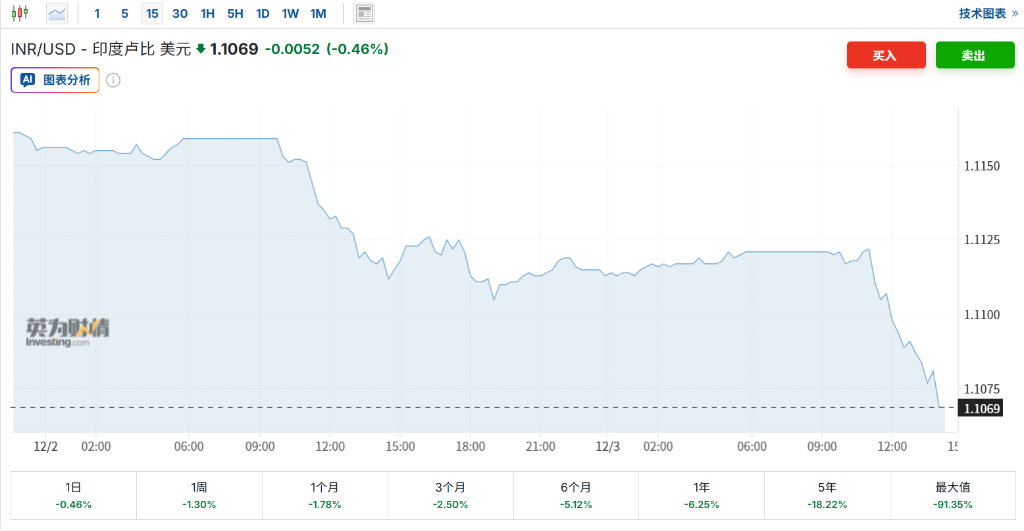
外媒称印度央行允许卢比贬值
Xin Hua Wang· 2025-12-04 14:11
Group 1 - The Reserve Bank of India (RBI) is allowing the Indian rupee to depreciate due to multiple economic risks, including an expanding trade deficit and capital outflows [1][3] - The rupee has recently fallen by 1.3% against the US dollar over the past seven trading days, breaking the psychological barrier of 90 rupees per dollar for the first time [1][3] - The RBI's intervention will focus on curbing excessive volatility or signs of speculative trading rather than defending a specific exchange rate level [3] Group 2 - Foreign investors have sold off $17 billion worth of Indian stocks this year, indicating severe capital outflows [3] - Economic analysts predict that the RBI may lower interest rates by 25 basis points to 5.25% due to current inflation rates being significantly below the target of 4% [4] - Major banks, including Citigroup, Standard Chartered, and the State Bank of India, suggest that the RBI has sufficient reasons to pause interest rate cuts given the rapid economic growth and the rupee's depreciation [4]


人民币到底该不该升值?对大家有什么影响?
Sou Hu Cai Jing· 2025-12-04 06:46
Core Viewpoint - The recent appreciation of the Renminbi (RMB) against the US dollar reflects China's economic resilience, but it raises concerns for export-oriented businesses [1][3]. Economic Factors - The RMB has appreciated nearly 4% since the beginning of 2025, marking its best annual performance in five years, influenced by a weakening US dollar due to sluggish economic recovery and interest rate cuts by the Federal Reserve [3]. - China's economic fundamentals are strong, with a GDP growth of 5.2% year-on-year in the first three quarters of 2025, and a manufacturing PMI of 50.8% in October, indicating expansion [3]. - Increased foreign investment and active capital markets, with over 300 billion RMB net inflow from foreign capital into A-shares by the end of November 2025, have bolstered demand for the RMB [3]. Expert Opinions - Goldman Sachs predicts the RMB could rise to 6.85 against the dollar in 2026, citing continued strong economic growth in China and potential further interest rate cuts by the Federal Reserve [4]. - The IMF suggests the RMB is undervalued by 18%-50%, indicating further appreciation is possible, which has caused concern among export businesses [5]. Impact on Different Sectors - Import-oriented businesses, such as airlines, benefit from RMB appreciation as it reduces costs for purchasing aircraft and fuel, with a 1% appreciation lowering domestic airline fuel costs by approximately 800 million RMB [6]. - Export-oriented companies face challenges as RMB appreciation makes their products more expensive in international markets, reducing competitiveness, particularly in low-margin industries like textiles and furniture [7][8]. - Regions heavily reliant on exports, such as Guangdong and Zhejiang, may experience slowed GDP growth due to reduced export growth rates, potentially declining by 2-3 percentage points with a 5% RMB appreciation [10]. Recommendations for Stakeholders - Businesses should consider financial tools to hedge against exchange rate risks, such as forward contracts, to mitigate the impact of currency fluctuations [11]. - Investors are advised to adjust asset allocations, favoring sectors that benefit from RMB appreciation while being cautious of those that may suffer [11]. - Individuals planning to travel or study abroad may find it advantageous to exchange currency now, but should do so cautiously to manage risks associated with fluctuating exchange rates [11].

瑞郎政策避险博弈汇价震荡
Jin Tou Wang· 2025-12-04 03:08
Core Viewpoint - The USD/CHF exchange rate is influenced by the divergence in monetary policies between the Federal Reserve and the Swiss National Bank, alongside the strengthening of the Swiss franc as a safe-haven currency [1][2] Group 1: Monetary Policy Divergence - The Federal Reserve completed two rounds of interest rate cuts in 2025, maintaining the federal funds rate at 3.50%-3.75%, with a shift towards a "data-dependent" approach [1] - The Swiss National Bank faces a dilemma with a strong currency and low inflation, as the Swiss franc appreciated over 10% this year, while October CPI showed a 0.3% month-on-month decline [1][2] - Market expectations indicate a 100% probability of a rate cut by the Swiss National Bank in December, with a 69% chance of a 25 basis point cut to 0% [1] Group 2: Economic Indicators - The U.S. economy showed resilience with a third-quarter GDP growth rate of 2.1% year-on-year and a 3.0% increase in consumer spending, stabilizing the dollar index between 98-102 since July [2] - In contrast, Switzerland's third-quarter GDP growth was only 0.1% quarter-on-quarter, indicating pressure on the manufacturing sector [2] Group 3: Technical Analysis and Market Signals - The USD/CHF exchange rate has been consolidating between 0.80-0.81 since hitting a low of 0.7915 in September, with the MACD remaining in negative territory [2] - Key signals to watch include the Swiss National Bank's December decision, U.S. CPI data's impact on Federal Reserve policy, and changes in geopolitical risks [2] - Resistance levels are identified at 0.8050-0.8100, while support levels are at 0.7915-0.8000, with potential for a new trend if these levels are breached [2]
美印谈判受阻,印度央行紧急“护盘”失败,卢比失守90关口
Hua Er Jie Jian Wen· 2025-12-03 07:02
Core Viewpoint - The Indian Rupee is facing significant depreciation against the US Dollar, breaking the psychological barrier of 90, amid uncertainties surrounding US-India trade negotiations, leading to increased capital outflow pressures [1][3]. Group 1: Currency Performance - On December 3, the Indian Rupee depreciated by 0.3%, reaching a historical low of 90.1575 against the US Dollar, driven by market concerns over stalled trade talks [1]. - The Rupee's decline is closely linked to the fluctuating sentiment surrounding US-India trade negotiations, which have been inconsistent throughout the year [4]. - The Indian central bank's interventions have been largely ineffective in stabilizing the Rupee, as market participants continue to expect further depreciation [6]. Group 2: Trade Negotiations - The ongoing trade negotiations between India and the US have faced multiple setbacks, with the US imposing higher-than-expected tariffs on Indian goods and threatening punitive measures due to India's energy purchases from Russia [4][5]. - Despite India engaging in trade talks with multiple economies, the uncertainty surrounding the US agreement remains a focal point for the market, exerting pressure on exports and the currency [5]. Group 3: Market Sentiment and Central Bank Response - Market participants are exhibiting a strong bearish sentiment towards the Rupee, with importers accelerating their demand for US Dollars, complicating the central bank's efforts to stabilize the currency [6]. - Analysts suggest that if the Rupee closes above 90, speculative pressures may increase, potentially pushing the currency towards 91 [6]. - The persistent weakness of the Rupee is likely to influence the Reserve Bank of India's monetary policy decisions, with expectations that the central bank may opt to maintain interest rates in light of currency volatility [7].
美韩贸易协议刺激美元需求 韩国大幅提高2026年外汇稳定债券发行上限
智通财经网· 2025-12-03 06:25
Core Points - South Korea is increasing its annual foreign exchange stabilization bond issuance limit from $1.4 billion to $5 billion for 2026, more than doubling the original plan, in response to rising dollar demand due to a trade agreement with the U.S. [1] - The issuance of foreign exchange stabilization bonds aims to address currency fluctuations and capital outflow pressures, with a commitment to invest $350 billion in the U.S. and limit annual dollar outflows to $20 billion [1] - The South Korean government is taking measures to boost foreign exchange reserves, including issuing $1.7 billion in Samurai and U.S. dollar bonds and €1.4 billion (approximately $1.6 billion) in euro bonds [1] Financial Ratings and Currency Trends - Moody's, S&P Global, and Fitch have rated South Korea's sovereign debt at Aa2, AA, and AA- respectively, indicating strong creditworthiness [2] - The South Korean won has depreciated over 7% against the U.S. dollar in the second half of the year, reaching its lowest level in 16 years, making it the worst-performing Asian currency during this period [2] - The South Korean government is concerned about the increasing uncertainty in the foreign exchange market and is actively considering all available tools to address the depreciation of the won [2] Government Response and Measures - An emergency meeting was convened on November 24 by multiple government departments, led by the Ministry of Finance, to discuss specific measures to stabilize the foreign exchange market [2] - The meeting focused on effectively alleviating the depreciation pressure on the won and evaluating potential intervention strategies [2]