
财政赤字

Search documents
预算案谈判破裂,法债遭遇抛售潮、30年期收益率触及十六年高位
Sou Hu Cai Jing· 2025-12-19 13:37
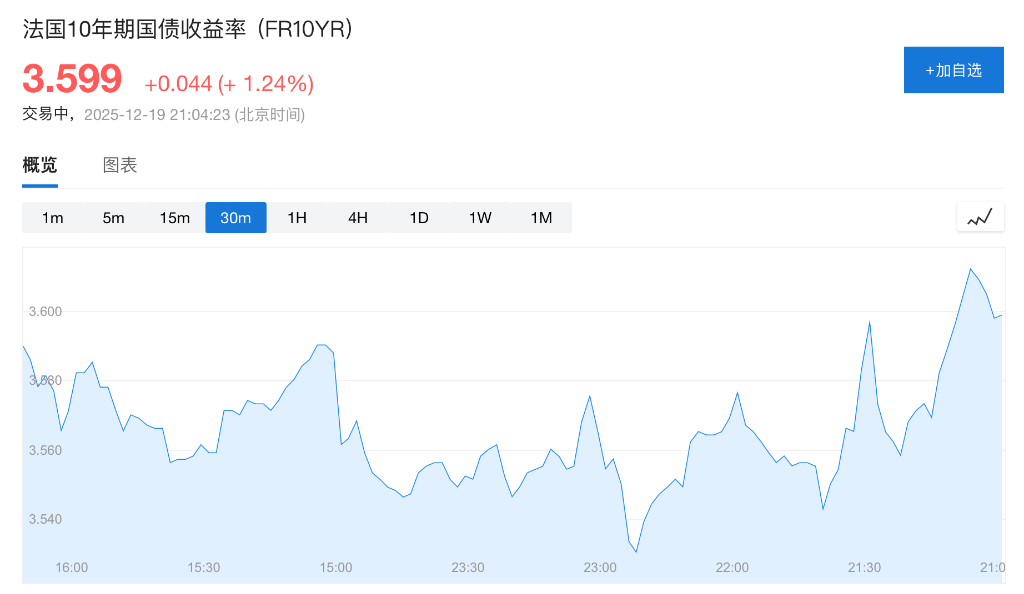
Core Viewpoint - The French bond market is facing significant turmoil, with the 30-year bond yield reaching its highest level since 2009, driven by concerns over the country's fiscal outlook following the breakdown of budget negotiations [1][4]. Group 1: Market Impact - The yield on France's 30-year bonds rose by 7 basis points to 4.525%, while the 10-year bond yield increased by 6 basis points to 3.614%, nearing a nine-month high [1]. - The failure of budget negotiations has led to a loss of market confidence, posing a major setback for Prime Minister Sébastien Lecornu, who had aimed to pass the national budget by year-end [5]. Group 2: Fiscal Policy Implications - The breakdown of budget talks means the government will have to extend the budget until 2026, severely limiting its ability to reform public finances [4]. - The inability to pass new spending projects, including a proposed €6.5 billion increase in defense spending, highlights the constraints imposed by the budget extension mechanism [5]. Group 3: Economic Outlook - The stalled budget will hinder France's efforts to reduce its fiscal deficit, with plans to bring the deficit below 5% of GDP by 2026 and to 3% by 2029, as required by the European Commission [6]. - The French central bank governor indicated that the budget extension would result in a deficit significantly above ideal levels, lacking any cost-saving or tax measures [6]. Group 4: Political Dynamics - Prime Minister Lecornu's failure to push the budget through is attributed to his decision to forgo a constitutional power that would allow the government to pass the budget without parliamentary vote, risking a vote of no confidence [7]. - Efforts to negotiate compromises with the center-left Socialist Party have not resolved the deadlock, as numerous amendments proposed by opposition parties have stalled the legislative process [7].

数据点评 | 财政的四大发力点(申万宏观·赵伟团队)
赵伟宏观探索· 2025-12-18 16:03
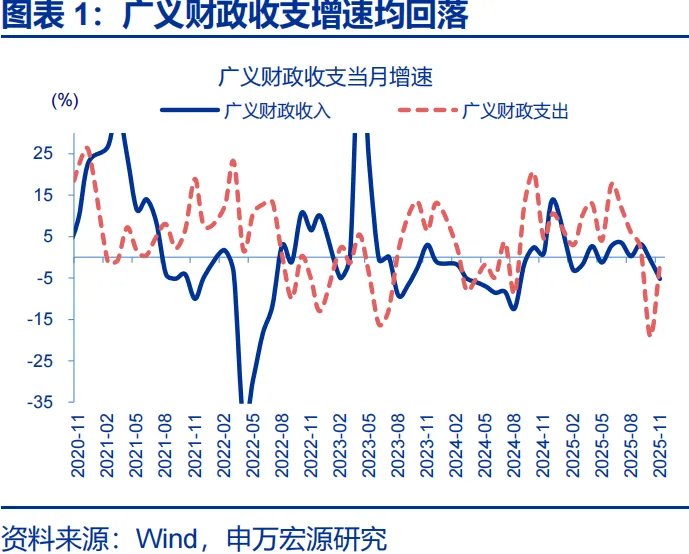
Core Viewpoint - The focus of future fiscal revenue and expenditure may be on maintaining deficits, standardizing tax incentives, supplementing local financial resources, and resolving hidden debts [2][48]. Group 1: Fiscal Revenue and Expenditure Overview - In the first eleven months of 2025, the national general public budget revenue reached 200,516 billion yuan, a year-on-year increase of 0.8%, while expenditure was 248,538 billion yuan, up 1.4% year-on-year [6][47]. - The divergence in fiscal revenue and expenditure in November showed improved expenditure but pressured income, with broad fiscal expenditure down 1.7% year-on-year, a significant narrowing of the decline by 17.5 percentage points compared to October [2][7]. - Broad fiscal revenue fell by 5.2% year-on-year in November, further declining by 4.6 percentage points from October [2][50]. Group 2: Factors Influencing Fiscal Performance - The divergence in fiscal revenue is partly due to base disturbances and the ongoing drag of land finance, with November 2024 broad fiscal revenue showing a recovery of 11% year-on-year, creating high base pressure [8][48]. - The income growth rate weakened, further constraining overall financial expansion space, while the low performance of land finance persisted [2][8]. Group 3: Support for Fiscal Expenditure - The 5,000 billion yuan limit on local special bonds and the implementation of financial tools became significant supports for broad fiscal expenditure in November, with government fund expenditure turning positive [10][49]. - Despite the ongoing drag from land finance and short-term pressure on income, the fiscal expenditure growth rate is expected to continue recovering due to the support from the local debt limit [10][49]. Group 4: Future Fiscal Strategy - Looking ahead to 2026, the focus of fiscal revenue may emphasize maintaining necessary fiscal deficits and standardizing tax incentives and fiscal subsidy policies [13][48]. - The expenditure side will prioritize addressing local fiscal difficulties and urging local governments to actively manage debts, targeting both the stock of hidden debts and the flow issues of local financial resources [13][48].

申万宏源:财政的四大发力点
Xuan Gu Bao· 2025-12-18 11:22
Core Viewpoint - The focus of future fiscal revenue and expenditure may be on maintaining deficits, standardizing tax collection, supplementing local financial resources, and resolving hidden debts [2][3][18] Fiscal Revenue and Expenditure Overview - In the first eleven months of 2025, the national general public budget revenue was 200,516 billion yuan, a year-on-year increase of 0.8%, while the expenditure was 248,538 billion yuan, up 1.4% year-on-year [5] - In November, the broad fiscal expenditure showed a year-on-year decline of 1.7%, a significant narrowing of the decline by 17.5 percentage points compared to October, while the broad fiscal revenue fell by 5.2%, further declining by 4.6 percentage points from October [2][6] Revenue and Expenditure Dynamics - The divergence in fiscal revenue and expenditure is partly due to base disturbances and the ongoing drag from land finance [11][19] - The government fund revenue in November saw a year-on-year decline of 15.8%, although the decline was narrowed by 2.6 percentage points compared to October [24][29] - The general fiscal expenditure budget completion rate in November was 8%, lower than the five-year average of 8.4% [38] Support for Fiscal Expenditure - The 5,000 billion yuan local special bond limit and the implementation of financial tools have become important supports for broad fiscal expenditure in November [15][49] - The government fund expenditure turned positive in November, reaching a growth of 2.8%, significantly improving from a negative growth in October [38][49] Future Fiscal Strategy - The fiscal revenue strategy for 2026 may focus on maintaining necessary fiscal deficits and addressing local fiscal difficulties while encouraging local governments to actively manage debts [18][19]

11月财政数据点评:财政的四大发力点
Shenwan Hongyuan Securities· 2025-12-18 07:10
Revenue and Expenditure Overview - In the first 11 months of 2025, the national general public budget revenue was 200,516 billion yuan, a year-on-year increase of 0.8%[6] - National general public budget expenditure reached 248,538 billion yuan, with a year-on-year growth of 1.4%[6] Fiscal Trends - In November, broad fiscal expenditure showed improvement with a year-on-year decline of 1.7%, a significant narrowing of 17.5 percentage points compared to October[7] - Broad fiscal revenue in November fell by 5.2% year-on-year, a further decline of 4.6 percentage points from October's -0.6%[7] Budget Completion and Support - The budget completion rate for broad fiscal expenditure in November rose to 8%, up from 5.6% in October, indicating a year-end acceleration in spending[7] - The completion rate for broad fiscal revenue was 7%, consistent with the previous year and the five-year average[16] Factors Affecting Revenue - The decline in revenue is partly due to high base effects and ongoing weakness in land finance, with November's general public budget revenue showing a minimal change of -0.02% year-on-year[9] - Land finance continues to be a drag, with land transfer income remaining in negative growth territory[9] Future Fiscal Focus - Future fiscal priorities may include maintaining necessary fiscal deficits, standardizing tax incentives, addressing local fiscal difficulties, and encouraging local debt management[3] - The emphasis will be on resolving issues related to local hidden debts and supplementing local financial resources[15] Expenditure Insights - General fiscal expenditure in November showed a year-on-year decline of 3.7%, but this was a significant improvement from October's decline of over 6 percentage points[29] - Health and technology-related expenditures saw notable increases, with year-on-year growth rates of 32.5% and 27.4%, respectively[29] Government Fund Performance - Government fund expenditure turned positive in November, reaching a growth of 2.8%, a significant recovery from previous declines[32] - The budget completion rate for government fund expenditure was 9.3%, below the five-year average of 10%[20]
数据点评 | 财政的四大发力点(申万宏观·赵伟团队)
申万宏源宏观· 2025-12-18 06:51
Core Viewpoint - The focus of future fiscal revenue and expenditure may be on maintaining deficits, standardizing tax collection, supplementing local financial resources, and resolving hidden debts [2][48] Group 1: Fiscal Revenue and Expenditure Overview - In the first eleven months of 2025, the national general public budget revenue reached 200,516 billion yuan, a year-on-year increase of 0.8%, while expenditure was 248,538 billion yuan, up 1.4% year-on-year [1][6] - In November, the broad fiscal expenditure showed a significant improvement with a year-on-year decline of -1.7%, narrowing the drop by 17.5 percentage points compared to October, while fiscal revenue fell by -5.2%, a further decline of 4.6 percentage points [2][7][50] Group 2: Factors Influencing Fiscal Performance - The divergence in fiscal revenue and expenditure is partly due to base disturbances in the revenue side and the ongoing drag from land finance [2][8] - The broad fiscal revenue in November 2025 saw a year-on-year decline of -5.2%, with government fund revenue down by -15.8% and general fiscal revenue at -0.02% [4][14] Group 3: Support for Fiscal Expenditure - The 5,000 billion yuan limit on local special bonds and the implementation of financial tools have become important supports for broad fiscal expenditure in November [3][10] - The government fund expenditure turned positive in November, reaching a growth of 2.8%, significantly improving from a negative position in October, attributed to the 5,000 billion yuan local special bond limit [39][50] Group 4: Future Fiscal Strategy - Looking ahead to 2026, the fiscal revenue focus may include maintaining necessary fiscal deficits, standardizing tax incentives, addressing local fiscal difficulties, and urging local governments to actively manage debts [13][49] - The central economic work conference indicates that the revenue side will emphasize maintaining necessary fiscal deficits and standardizing tax incentives and fiscal subsidy policies [2][48]

1-11月财政数据点评:明年财政政策增量仍然值得期待
Bank of China Securities· 2025-12-17 14:11
Fiscal Revenue and Expenditure - In November, public fiscal revenue was CNY 14,026.0 billion, remaining flat year-on-year, with tax revenue at CNY 11,450.0 billion, a 2.8% increase, but the growth rate slowed by 5.8 percentage points compared to October[2] - Non-tax revenue fell to CNY 2,576.0 billion, down 10.8% year-on-year, with the decline narrowing by 22.1 percentage points from the previous month[2] - Public fiscal expenditure in November was CNY 22,713.0 billion, a decrease of 3.7% year-on-year, although the decline rate improved by 6.1 percentage points from October[3] Government Fund Performance - From January to November, government fund budget revenue totaled CNY 40,274.0 billion, down 4.9% year-on-year, with a worsening decline rate of 2.1 percentage points compared to the previous month[17] - In November, central government fund revenue was CNY 320.0 billion, down 9.1%, while local government fund revenue was CNY 5,481.0 billion, down 16.1%, with the decline rate improving by 4.3 percentage points from October[5] - The revenue from state-owned land use rights fell to CNY 4,137.0 billion, a 26.8% decrease year-on-year, with the decline rate slightly narrowing by 0.4 percentage points from October[5] Fiscal Policy Outlook - The central economic work conference emphasized the continuation of a more proactive fiscal policy, aiming to maintain necessary fiscal deficits and total expenditure levels[4] - The actual deficit rate for this year has exceeded 5.0%, and fiscal spending and financing are expected to maintain necessary strength in the coming year[4] - Broad fiscal expenditure from January to November reached CNY 340,662 billion, a 4.5% increase year-on-year, with central fiscal expenditure at CNY 47,310.0 billion, growing by 21.0%[22]
抛售15吨黄金救急,军费烧钱压力大,越打越富也撑不住?
Sou Hu Cai Jing· 2025-12-17 05:05
Core Viewpoint - The Russian Central Bank's decision to sell 15 tons of gold in late November 2025 marks a significant shift in its financial strategy, indicating severe fiscal challenges and a potential loss of trust in the currency [1][3]. Group 1: Financial Situation - The Russian government faced a budget deficit of 4.2 trillion rubles in the first ten months of 2025, significantly higher than the previous year, prompting the Central Bank to sell gold to fill budget gaps [3]. - The Central Bank's gold reserves have decreased from 405.7 tons to 173.1 tons, with 232.6 tons sold in recent years, highlighting a critical depletion of financial buffers [1][3]. - The external environment is challenging, with $300 billion in assets frozen abroad, leading to reliance on money printing and tax increases to cover deficits, which in turn drives inflation above 8% [3][10]. Group 2: Military and Economic Impact - Military expenditures have surged, with daily costs reaching 453 billion rubles, the highest since the Soviet Union's dissolution, consuming a significant portion of the budget [6][8]. - The Russian economy is experiencing a decline in oil export revenues, with a drop of $3.6 billion year-on-year, exacerbating fiscal pressures [6][10]. - The military's personnel costs have escalated dramatically, with salaries for contract soldiers increasing from 20,000 rubles to 260,000 rubles, further straining the budget [8]. Group 3: Long-term Consequences - The strategy of selling gold is viewed as a temporary fix that undermines national creditworthiness and increases future financing costs, with the National Wealth Fund shrinking from $113.5 billion in 2022 to $51.6 billion [10][13]. - The ongoing conflict and sanctions have limited Russia's export and financial channels, with predictions of a significant drop in oil revenues, indicating a bleak fiscal outlook [11][13]. - The systemic issues are reflected in the growing number of regions facing budget deficits, totaling 169.2 billion rubles, suggesting widespread economic distress [13].

明年财政赤字将如何安排?丨落实会议部署 问答中国经济
Zheng Quan Shi Bao Wang· 2025-12-17 02:05
Group 1 - The central economic work conference has outlined the overall requirements and policy orientation for economic work in the coming year, emphasizing the importance of maintaining necessary fiscal deficits and total debt levels [1] - The expected fiscal deficit rate for next year is projected to be no less than 4%, which aligns with the current fiscal expansion trend while avoiding rapid accumulation of debt risks [1][2] - The fiscal deficit serves as a key indicator of the government's spending scale and fiscal policy strength, with a focus on ensuring social welfare, stabilizing employment, and expanding domestic demand [2] Group 2 - The increase in fiscal deficit will primarily be compensated by issuing government bonds, which will help optimize the government debt structure and alleviate local government debt risks in the short term [3] - Maintaining a high fiscal deficit rate may increase fiscal risks; however, the current government debt ratio is significantly lower than that of major economies and emerging markets, indicating ample borrowing space [3] - The expansion of the fiscal deficit will lead to an increase in central budgetary spending, with a focus on enhancing public service supply and supporting consumption and technological innovation [3][4] Group 3 - The emphasis on larger fiscal spending will highlight the "investment in people" approach, necessitating increased expenditures in social security, education, and healthcare to ensure basic living standards and enhance consumer capacity [4] - In the context of stabilizing investment, there will be a need for improved efficiency in traditional infrastructure spending, with local governments relying on special bonds and long-term treasury bonds for funding [4]
明年财政赤字将如何安排?丨落实会议部署 问答中国经济
证券时报· 2025-12-17 01:50
编者按: 日前召开的中央经济工作会议,明确了明年经济工作的总体要求和政策取向,部署了明年经济工 作"八个坚持"的重点任务,抓住关键、纲举目张。为深入学习贯彻会议精神,本报即日起推出"落实 会议部署 问答中国经济"系列述评,围绕发展目标设定、赤字规模安排、推动投资企稳等10个方面 热点问题展开讨论,敬请关注。 财政政策作为宏观调控的主要手段,通过预算、政府债券、税收等工具组合,发挥扩大总需求和定向调结构 的双重优势,实现经济质的有效提升和量的合理增长。在中央经济工作会议提出"保持必要的财政赤字、债务 总规模和支出总量"的总体要求后,市场对明年财政赤字率的设定高度关注。 财政赤字是衡量全年财政政策力度和财政风险水平的重要指标,直接关系到年内政府支出规模。目前,市场 机构与业内人士对财政赤字率的预期较为一致,预计明年赤字率不低于今年水平,即不低于4%。该赤字率水 平既能延续财政扩张态势,又避免了债务风险过快累积。 财政赤字率是社会各界观察宏观政策力度的风向标,从稳定市场预期角度看,"十五五"开局之年的财政赤字 率水平不宜低于上年。2025年,财政政策取向转为"更加积极",赤字率大幅提升1个百分点至4%,为近年最 高 ...

四大证券报头版头条内容精华摘要_2025年12月17日_财经新闻
Xin Lang Cai Jing· 2025-12-16 23:03
Group 1 - The Social Security Fund emphasizes the importance of long-term capital and patient investment strategies to support the development of the fund industry [1] - The fund aims to implement the decisions made by the central government and ensure prudent investment operations [1] Group 2 - 360 Company clarifies allegations of financial fraud, stating it will pursue legal action against false claims that suggest significant financial misconduct [2] - Following the allegations, 360's stock price fell by 5.07% by the end of trading on December 16 [2] Group 3 - The trend of using AI as a financial assistant is gaining popularity among young investors, with discussions on social media about AI-managed investments [3] - Investors are comparing AI tools and their performance in a competitive manner [3] Group 4 - Dongjie Intelligent announces plans for a major asset restructuring involving the acquisition of a controlling stake in a robotics company [4] - The transaction is expected to be classified as a significant asset restructuring and related party transaction [4] Group 5 - The Ministry of Industry and Information Technology has granted approval for the first batch of L3-level conditional autonomous driving vehicles, marking a significant step towards commercialization [5][16] - Two electric vehicle models will be tested in designated areas of Beijing and Chongqing [5][17] Group 6 - Hubei state-owned assets have made six acquisitions of listed companies this year, with a recent purchase of an 18.66% stake in ST Yishite for 2.437 billion yuan [6][25] - This acquisition focuses on the new energy power equipment sector [6] Group 7 - Several banks are tightening personal precious metal trading services, actively clearing inactive clients to manage market risks and comply with regulations [7][8][26] - This shift may lead to a more concentrated market with a focus on institutional clients [8] Group 8 - China Aviation Industry Corporation is investing approximately 422 million yuan in a new aerospace equipment assembly facility [9][27] - The project aims to enhance the company's capabilities in aerospace equipment assembly [9] Group 9 - The Chinese government has introduced a plan to promote high-quality development in the service outsourcing industry, encouraging companies to utilize multi-tiered capital markets for financing [14][33] - The service outsourcing sector is experiencing significant growth and structural optimization [14] Group 10 - A new standard for gold exchange services has been established, aiming to create a more transparent and fair trading environment for consumers [15][34] - This standard is expected to enhance compliance and operational efficiency within the gold market [15]