
降准

Search documents
加量操作呵护流动性央行开展6000亿元买断式逆回购
Shang Hai Zheng Quan Bao· 2025-10-14 18:30
Core Viewpoint - The People's Bank of China (PBOC) is conducting a 600 billion yuan reverse repurchase operation to stabilize liquidity, indicating a continued supportive monetary policy stance [1][2]. Group 1: Monetary Policy Actions - The PBOC will conduct a 600 billion yuan 6-month reverse repurchase operation on October 15, 2023, as part of its strategy to maintain market stability [1]. - This operation follows the maturity of 800 billion yuan in 3-month reverse repos on the same day, helping to smooth short-term funding fluctuations [1]. - In October, the total net injection of liquidity through reverse repos is approximately 400 billion yuan, which is an increase of 100 billion yuan compared to September [1]. Group 2: Market Conditions and Expectations - The increase in reverse repo operations is attributed to heightened funding demand due to concentrated government bond issuances and the introduction of new policy financial instruments [2]. - Analysts expect that the PBOC will continue to use both reverse repos and Medium-term Lending Facility (MLF) tools to inject liquidity into the market [2][3]. - There is a possibility of a reserve requirement ratio (RRR) cut in the fourth quarter, which would provide longer-term, lower-cost liquidity to the market [3]. Group 3: Future Outlook - The PBOC is likely to maintain a stable short-term liquidity environment, with interest rates expected to stabilize around 1.5% [3]. - The market is anticipated to experience limited liquidity gaps, with structural tensions being manageable [3].
央行:“十四五”以来共降准9次,累计下调法定存款准备金率3.5个百分点
Sou Hu Cai Jing· 2025-10-14 09:12
Core Viewpoint - The People's Bank of China has implemented a total of 9 reserve requirement ratio cuts since the beginning of the 14th Five-Year Plan, reducing the statutory deposit reserve ratio by 3.5 percentage points, which has provided approximately 7 trillion yuan in long-term liquidity [1] Monetary Policy Tools - The central bank has employed various monetary policy tools to flexibly adjust short- and medium-term liquidity [1] - The toolbox for monetary policy has been enriched, including operations such as open market transactions of government bonds and reverse repos [1] Credit Growth Management - There is an emphasis on strengthening the understanding and grasp of the supply and demand patterns and new characteristics of monetary credit to promote reasonable growth in monetary credit [1]
9月央行各项工具净投放9268亿元 专家:预计四季度降准、降息等工具仍有操作空间
Sou Hu Cai Jing· 2025-10-13 04:50
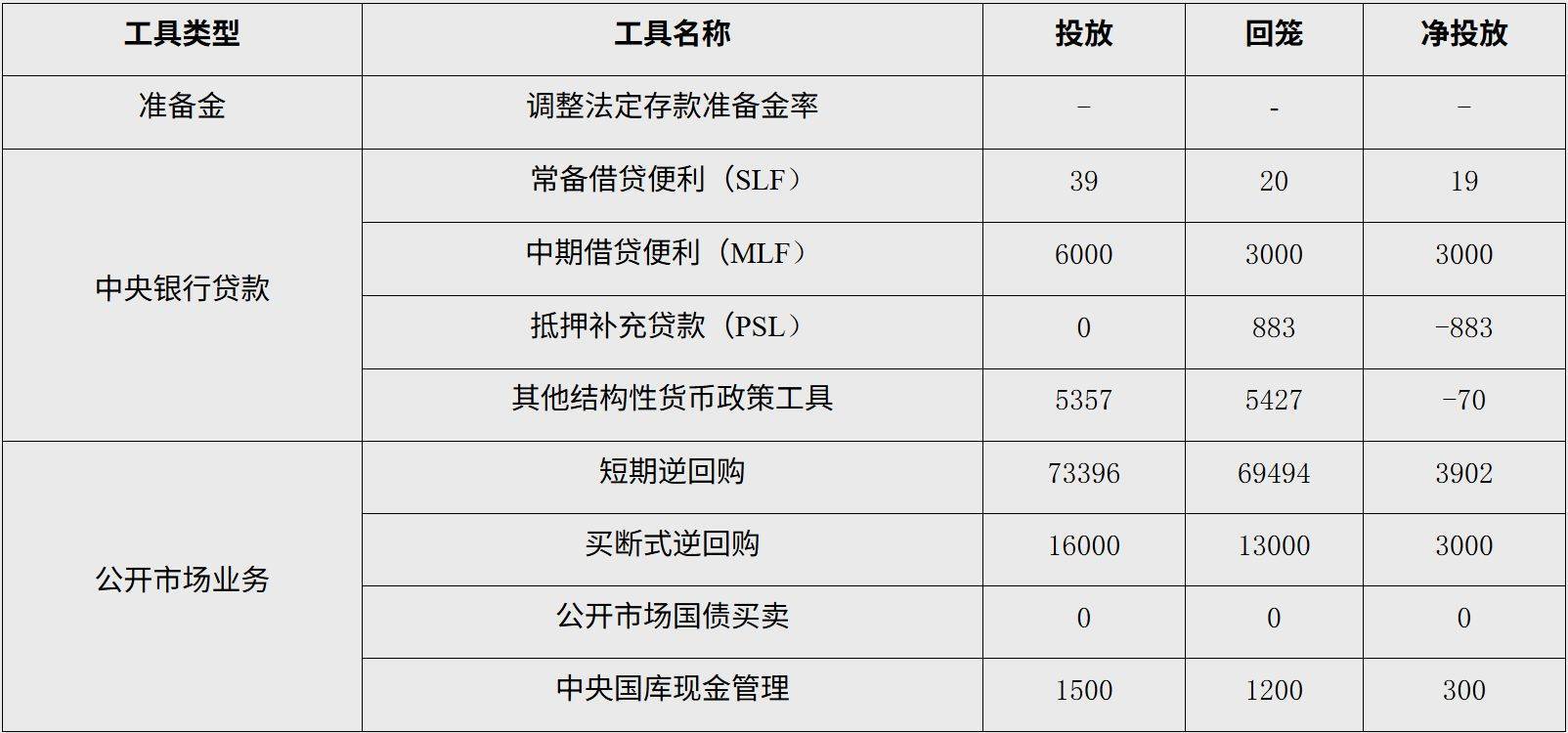
Core Viewpoint - The People's Bank of China (PBOC) has significantly increased liquidity net injection in September, amounting to 926.8 billion yuan, indicating a potential for further monetary easing in the fourth quarter, including possible reserve requirement ratio (RRR) cuts and interest rate reductions [1][4]. Group 1: Monetary Policy Tools - In September, the PBOC's liquidity injection included 19 million yuan from the Standing Lending Facility (SLF), 300 billion yuan from the Medium-term Lending Facility (MLF), and 3.9 trillion yuan from short-term reverse repos, while there was no activity in government bond transactions [3][4]. - The MLF and reverse repos can serve as substitutes for government bond transactions, reducing the necessity for the PBOC to inject liquidity through bond purchases [3][4]. - The PBOC's toolbox remains rich, with significant room for both quantity-based tools like RRR cuts and price-based tools like interest rate cuts [3][4]. Group 2: Economic Context and Future Outlook - The current macroeconomic environment is characterized by weak recovery, necessitating a continuation of a moderately loose monetary policy to address external shocks and domestic demand deficiencies [4][9]. - The introduction of 500 billion yuan in new policy financial tools is expected to be a crucial pathway for stimulating investment, with a projected leverage effect that could lead to an additional investment scale of approximately 1 trillion to 1.7 trillion yuan [4][7]. - The PBOC's approach to government bond transactions differs fundamentally from quantitative easing (QE) practices in developed economies, focusing on liquidity management rather than a large-scale, one-sided purchase of bonds [6][7]. Group 3: Market Reactions and Indicators - The market liquidity remains ample, with funding rates stabilizing around policy rates, and the PBOC is expected to maintain a balance between financial stability and economic development [3][8]. - Observations of market interest rates should focus on the weighted average of key rates rather than individual transaction rates, as fiscal factors can influence liquidity conditions [8][9]. - The anticipated gradual recovery of prices will require coordinated efforts across various sectors, with expectations for the 10-year government bond yield to trend down to around 1.6% amid ongoing economic adjustments [9].

四季度还有戏!机构预测央行或单独下调5年期LPR 房贷利率有望再降?
Sou Hu Cai Jing· 2025-09-28 08:40
Core Viewpoint - The anticipated interest rate cuts in China have not materialized, with the Loan Prime Rate (LPR) remaining stable for four consecutive months, while the Federal Reserve has initiated a new easing cycle with a 25 basis point cut [1][2][5] Group 1: Monetary Policy Context - The People's Bank of China (PBOC) has maintained the 1-year and 5-year LPR at 3.0% and 3.5% respectively, reflecting a cautious approach amid various economic pressures [1][5] - The Fed's recent rate cut to a range of 4.00%-4.25% marks the beginning of a new easing cycle, with expectations of further cuts in the fourth quarter [1][2] Group 2: Economic Conditions - Domestic economic conditions, including weak inflation and pressures in the real estate market, have led to expectations for a follow-up rate cut in China to stabilize the RMB and stimulate economic recovery [2][5] - The banking sector is facing significant pressure on net interest margins, which have dropped to approximately 1.45%, limiting the scope for further rate reductions [5] Group 3: Real Estate Market Challenges - The stability of the real estate market is under threat, with 69 out of 70 major cities reporting a decline in second-hand housing prices, particularly in first-tier cities [6][9] - The core issues in the real estate market extend beyond financing costs, highlighting structural problems in supply and demand [7][9] Group 4: Policy Recommendations - To address the real estate market's challenges, a combination of fiscal policy and structural adjustments is recommended, including optimizing market supply and enhancing demand through employment and income stability [9][11] - The government is encouraged to pause new land auctions and repurchase undeveloped land to alleviate supply pressures, aligning with recent policy directions [9][11] Group 5: Future Outlook - The potential for new monetary policy actions, including further rate cuts, is anticipated as the Fed's easing opens up more operational space for the PBOC [9][11] - The overall expectation is that with the gradual release of policy effects and ongoing economic recovery, the real estate market may stabilize over time [11]

9月最新LPR公布!
Sou Hu Cai Jing· 2025-09-25 09:36
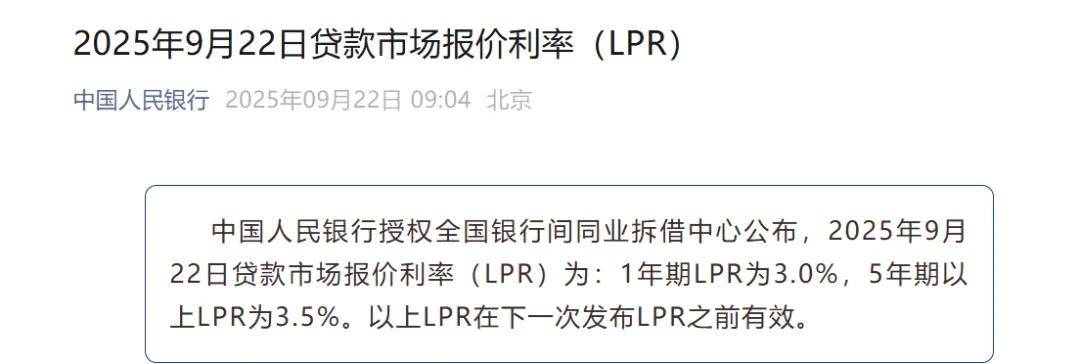
Summary of Key Points Core Viewpoint - The People's Bank of China (PBOC) has maintained the Loan Prime Rate (LPR) for both the 1-year and 5-year terms at 3.0% and 3.5% respectively as of September 22, 2025, indicating a stable monetary policy environment [2]. Historical LPR Changes - The 1-year LPR has seen a gradual decline from 3.70% in January 2022 to 3.00% in September 2025, reflecting a total decrease of 70 basis points over this period [2][3]. - The 5-year LPR has also decreased from 4.60% in January 2022 to 3.50% in September 2025, marking a reduction of 110 basis points [2][3]. Recent Adjustments - The only adjustment to the LPR in 2025 occurred on May 20, when the 1-year LPR was lowered by 10 basis points from 3.10% to 3.00% [3]. Market Expectations - Following the recent interest rate cuts by the Federal Reserve, industry experts anticipate that China may follow suit with potential reductions in reserve requirements or interest rates, suggesting a forthcoming wave of economic benefits [4].
央行9月净投放6000亿中期流动性,什么信号
Guan Cha Zhe Wang· 2025-09-24 12:51
Core Viewpoint - The People's Bank of China (PBOC) announced a 600 billion MLF operation to maintain liquidity in the banking system, indicating a continued net injection of liquidity for the seventh consecutive month, aligning with market expectations [1][2]. Group 1: MLF Operations and Liquidity - The PBOC will conduct a 600 billion MLF operation on September 25, 2025, with a one-year term, using a fixed quantity and multi-price bidding method [1]. - In September, 300 billion MLF is maturing, resulting in a net injection of 300 billion MLF, maintaining a high level of net liquidity injection totaling 600 billion, consistent with the previous month [1][2]. - The continuous net injection of medium-term liquidity reflects the coordination between monetary and fiscal policies, supporting government bond issuance and meeting credit demand from enterprises and households [1][2]. Group 2: Market Conditions and Future Expectations - Recent market conditions, including rising mid-to-long-term interest rates and tightening liquidity, prompted the PBOC to increase fund injections through MLF to stabilize market expectations [2]. - The PBOC's ongoing net liquidity injection signals a supportive monetary policy stance, especially in light of declining macroeconomic indicators due to various factors [2]. - Looking ahead, there is an expectation for further monetary policy easing in the fourth quarter, including potential reserve requirement ratio cuts and the resumption of government bond trading, to ensure stable liquidity in the market [2].
债市周观察:国外如期降息,国内仍需等待
Great Wall Securities· 2025-09-23 06:20
Report Industry Investment Rating No information provided in the given content. Core Viewpoints of the Report - The bond market showed a volatile trend last week. The long - term yield fluctuated under the influence of multiple factors and finally returned to around 1.80%. The Fed restarted rate cuts in September, and there is a probability of further cuts in Q4. The domestic 9 - month LPR did not cut rates in September, and the total policy tools may not be introduced in the short term. However, the probability of bond trading and reserve requirement cuts is relatively high [1][3] - The 8 - month economic data released at the beginning of the week was weak, but the bond market's reaction was limited. News of Sino - US economic and trade talks and important articles affected market expectations. The restart of bond trading operations and the Fed's rate cut expectation drove the 10 - year Treasury yield down, while the Fed's statement and the adjustment of the central bank's reverse - repurchase operation mode also influenced the bond market [2] Summary by Directory 1. Interest - rate Bond Data Review for Last Week - **Funding Rates**: DR001 fluctuated between September 15 - 19, closing at 1.46% on September 19. R001 rose and then fell, closing at 1.50%. DR007 and FR007 also showed upward - then - downward trends [8] - **Open - market Operations**: The central bank's reverse - repurchase投放量 was 1.83 trillion yuan, with a total maturity of 1.26 trillion yuan, resulting in a net capital injection of 5623 billion yuan [8] - **Sino - US Market Interest Rate Comparison**: The interest - rate spread between Sino - US bonds inverted, and the inversion amplitude of long - and short - term spreads widened. The term spread of Chinese bonds slightly decreased, while that of US bonds slightly increased. The yield curve of Chinese bonds changed little, and that of US bonds shifted to the right [15][16] 2. High - frequency Real - estate Data Tracking - **First - tier Cities**: The average daily transaction area was 7.31 million square meters, and the average daily transaction volume was 680 units, showing a low - level volatile trend [24] - **Top Ten Cities**: The transaction data rebounded compared to last week, with an average daily transaction area of about 11.07 million square meters, an increase of 1.43 million square meters per day [25] - **30 Large and Medium - sized Cities**: The transaction volume remained at a historical low. The average daily transaction area was about 21.38 million square meters, and the average daily transaction volume was about 1914 units [26]
货币政策应坚持“以我为主”,降准优于降息丨董希淼专栏
Sou Hu Cai Jing· 2025-09-22 23:12
Core Viewpoint - The People's Bank of China (PBOC) is expected to maintain a moderately loose monetary policy, potentially implementing reserve requirement ratio (RRR) cuts and interest rate reductions, but large-scale rate cuts are deemed unrealistic [1][5][6]. Monetary Policy Outlook - PBOC will utilize various monetary policy tools to ensure ample liquidity and lower overall financing costs, supporting economic recovery [1]. - The current Loan Prime Rate (LPR) has remained unchanged at 3.0% for one-year and 3.5% for five-year loans for four consecutive months, indicating a cautious approach to rate adjustments [1][4]. - The recent U.S. Federal Reserve rate cuts provide a more favorable external environment for China's monetary policy, potentially easing pressure on interest rates and the RMB exchange rate [3][5]. Interest Rate Dynamics - The average interest rate for new corporate loans in August was approximately 3.1%, down about 40 basis points year-on-year, while the average for new personal housing loans was also around 3.1%, down 25 basis points [4]. - The necessity for LPR reductions is questioned, as current rates are already at historical lows and the recent market operations have not indicated a need for immediate changes [4][5]. Constraints on LPR Changes - Factors limiting LPR adjustments include bank interest margins, which have decreased to 1.42%, and the already low deposit rates, which may restrict further reductions [3][5]. - The PBOC's focus will be on balancing internal and external factors while maintaining a stable economic environment, with RRR cuts prioritized over interest rate cuts [5][6]. Future Expectations - A potential RRR cut of 0.25 to 0.5 percentage points is anticipated in the fourth quarter, aimed at enhancing market liquidity [6]. - If policy and deposit rates continue to decline, there remains a possibility for LPR to decrease by 5 to 10 basis points later this year, although expectations should be tempered [6]. Structural Support Measures - Beyond lowering LPR, reducing non-interest costs and providing more policy support for key sectors will be essential for lowering overall financing costs [7]. - The collaboration between monetary policy and fiscal measures, such as interest subsidies and risk compensation, will be crucial in enhancing financial support for consumption and domestic demand [7].

工商银行股价盘中一度跌逾2% 跌破半年线
Xin Lang Cai Jing· 2025-09-19 05:03
Group 1 - The banking sector has shown a downward trend since July 11, with notable examples such as Agricultural Bank's stock price dropping from a historical high of 7.55 yuan to around 6.7 yuan [1] - July marks a concentrated dividend distribution period for bank stocks, leading to short-term pressure on stock prices due to arbitrage funds exiting after dividends [1] - Credit demand has been weak, with social financing and credit data for July and August falling below expectations, indicating insufficient expansion momentum for banks' asset sides [1] Group 2 - On September 18, the Federal Reserve announced a 25 basis point interest rate cut, marking the resumption of rate cuts after nine months, which may lead to further rate cuts and reserve requirement ratio reductions domestically, putting pressure on future bank interest margins [1] - Several bank shareholders and executives have announced plans to increase their holdings in their respective banks, citing recognition of long-term investment value and support for the banks' long-term development [1] - The announcement of share buybacks has positively impacted stock prices, with Qilu Bank (601665.AH) leading the gains with an increase of over 2.5% following the completion of executive buybacks [1]

国债期货日报-20250917
Nan Hua Qi Huo· 2025-09-17 10:23
Report Summary 1. Report Industry Investment Rating No relevant content provided. 2. Core View of the Report - Focus on the central bank's attitude. The bond market was less affected by the strong performance of the A-share index. The better-than-expected issuance of 20-year new bonds in the primary market drove the bond futures up in the afternoon. The market has low expectations for interest rate cuts. If the Fed cuts interest rates by more than 25bp tonight, it may drive the domestic bond market. The trading strategy is to buy on dips and not chase the rise. If the market continues to rise tomorrow, take profit on previous long positions [2][4] 3. Summary by Relevant Catalogs 3.1. Market Review - On Wednesday, bond futures opened lower and closed higher across the board, and spot bond yields declined. The open market conducted 418.5 billion yuan of reverse repurchases, with a net injection of 114.5 billion yuan. There was also a 150 billion yuan treasury cash fixed deposit. The funding situation remained tight, and DR001 rose to 1.49% [2] 3.2. Intraday News - The weighted winning bid rate of the 20-year treasury bond issued by the Ministry of Finance was 2.1616%, with an overall multiple of 5.71 and a marginal multiple of 2.16. Former central bank official Sheng Songcheng said that in the current economic situation, reserve requirement ratio cuts are better than interest rate cuts in China, but there is still room for interest rate cuts [3] 3.3. Market Analysis - The A-share index hit a new high today, but the bond market was less affected. The issuance of 20-year new bonds in the primary market was better than expected, and the winning bid rate was lower than the secondary market, driving the bond futures up in the afternoon. The market has low expectations for interest rate cuts. If the Fed cuts interest rates by more than 25bp tonight, it may drive the domestic bond market. The market sentiment is okay. The trading strategy is to buy on dips and not chase the rise. If the market continues to rise tomorrow, take profit on previous long positions [4] 3.4. Daily Data of Treasury Bond Futures | Contract | 2025-09-17 | 2025-09-16 | Today's Change | | --- | --- | --- | --- | | TS2512 | 102.45 | 102.41 | 0.04 | | TF2512 | 105.87 | 105.78 | 0.09 | | T2512 | 108.135 | 108.01 | 0.125 | | TL2512 | 115.82 | 115.52 | 0.3 | | TS Basis (CTD) | -0.0395 | -0.0241 | -0.0154 | | TF Basis (CTD) | -0.0011 | 0.0072 | -0.0083 | | T Basis (CTD) | 0.2948 | 0.3299 | -0.0351 | | TL Basis (CTD) | 0.5555 | 0.3712 | 0.1843 | | TS Contract Position (Lots) | 79034 | 77964 | 1070 | | TF Contract Position (Lots) | 147322 | 144812 | 2510 | | T Contract Position (Lots) | 246189 | 240621 | 5568 | | TL Contract Position (Lots) | 166472 | 168706 | -2234 | | TS Main Contract Trading Volume (Lots) | 38558 | 43740 | -5182 | | TF Main Contract Trading Volume (Lots) | 70704 | 89826 | -19122 | | T Main Contract Trading Volume (Lots) | 101611 | 138741 | -37130 | | TL Main Contract Trading Volume (Lots) | 132135 | 177470 | -45335 | [5]