
反内卷政策

Search documents
时报观察 | 债市延续震荡格局 投资者应保持定力
Zheng Quan Shi Bao· 2025-09-11 18:01
Group 1 - The recent decline in the bond market has seen the main contract for government bond futures hit a six-month low, with the 30-year bond futures index nearing its yearly low [1] - The yield on the 10-year government bond has risen above 1.8%, increasing by 20 basis points from 1.63% to a peak of 1.83% over two months, raising concerns among bond investors [1] - The cumulative yield of the China Securities Comprehensive Bond Index for all bonds this year is only 0.33%, with passive index bond funds and medium-to-long-term pure bond funds showing negative average net values in August [1] Group 2 - The current adjustment in the bond market is driven by two main factors: the sustained bull market in equities, which has increased investor risk appetite, and the implementation of anti-involution policies that have raised inflation expectations [1] - The equity market's rising risk appetite is expected to continue, with the Shanghai and Shenzhen stock exchanges seeing over 10 trillion yuan in trading volume for 76 consecutive trading days [2] - Despite the bullish expectations in the equity market, the real economy still requires further improvement, with weak demand in real estate and exports limiting the upward pressure on prices [2]
时报观察 债市延续震荡格局 投资者应保持定力
Zheng Quan Shi Bao· 2025-09-11 17:52
Group 1 - Recent decline in the bond market, with the main contract for government bond futures hitting a six-month low and the 30-year bond futures index nearing its yearly low [1] - The yield on the 10-year government bond has risen above 1.8%, increasing from 1.63% to a peak of 1.83% over two months, representing a 20 basis points increase [1] - The cumulative yield of the China Securities Comprehensive Bond Index for the year is only 0.33%, with passive index bond funds and medium-to-long-term pure bond funds showing negative average net values in August [1] Group 2 - The current adjustment in the bond market is driven by two main factors: the sustained bull market in equities increasing investor risk appetite, and the implementation of anti-involution policies raising inflation expectations [1] - The equity market's risk appetite is expected to continue, with significant trading volumes in the Shanghai and Shenzhen markets and a notable increase in the non-ferrous metals industry index [2] - Despite the bullish expectations, the real economy still requires further improvement, with weak demand in real estate and exports limiting the upward pressure on prices [2]
基数扰动之外,通胀还有哪些信号?
2025-09-11 14:33
Summary of Key Points from the Conference Call Industry Overview - The conference call discusses the inflation trends in China, specifically focusing on the Consumer Price Index (CPI) and Producer Price Index (PPI) for August 2023, highlighting the impact of various sectors on these indices [1][2][3]. Core Insights and Arguments - **CPI Performance**: In August, China's CPI decreased by 0.1% year-on-year, a smaller decline than the previous month, primarily driven by falling food prices, particularly pork, which saw a significant year-on-year drop of 16.1% [1][4]. - **Non-Food Prices**: Non-food consumer goods prices, such as home appliances and clothing, continued to rise due to domestic demand and consumption expansion policies. The automotive sector experienced a stabilization in prices due to the curtailment of price wars [1][4]. - **PPI Trends**: The PPI fell by 2.9% year-on-year in August, but this marked a narrowing of the decline by 0.7 percentage points, the first such improvement in six months. This change was attributed to last year's low base and policies aimed at reducing disorderly competition [1][5]. - **Sectoral Disparities**: There is a notable divergence among industries; upstream raw material processing prices improved significantly, while midstream manufacturing and downstream consumer goods production prices remained stable or weakened [1][5]. Additional Important Insights - **Future Outlook on Food Prices**: The high base effect is expected to continue exerting downward pressure on food prices, especially pork. However, the automotive sector may see continued price improvements due to ongoing anti-involution policies [1][6]. - **PPI Recovery Potential**: There is an expectation that PPI year-on-year downward pressure will ease, but midstream and downstream production sectors will still face challenges. Monitoring the expansion and effectiveness of anti-involution policies will be crucial [2][6]. - **Service Sector Performance**: Services such as healthcare, education, and tourism maintained high activity levels, with year-on-year increases noted in these areas [1][4]. This summary encapsulates the key points discussed in the conference call, providing a comprehensive overview of the current state and future outlook of inflation in China, along with sector-specific insights.
通胀数据快评:PPI环比止跌
Guoxin Securities· 2025-09-11 14:30
Inflation Data Summary - In August, China's CPI decreased by 0.4% year-on-year, worse than the expected decline of 0.2% and down from the previous month's 0.0%[3] - The PPI fell by 2.9% year-on-year, matching expectations but improving from a previous decline of 3.6%[3] - Core CPI rose by 0.9% year-on-year, marking the highest level in 18 months and continuing to improve for four consecutive months[5] Price Dynamics - Food prices significantly dragged down the overall CPI, with food items declining by 4.3% year-on-year, compared to a 1.6% decline in the previous month[5] - Pork prices saw a substantial drop of 16.1% year-on-year, contributing to the weaker-than-expected CPI data[5] - Service items and industrial consumer goods prices remained stable, with service CPI increasing by 0.6% year-on-year and industrial consumer goods rising by 1.5%[5] PPI Insights - The PPI's month-on-month change stabilized at 0.0%, marking the first halt in decline since November 2024[8] - Upstream prices showed notable stabilization, particularly in black metal mining and smelting, with increases of 2.1% and 1.9% respectively[8] - Downstream industrial product prices showed minimal improvement, with automotive and general machinery PPI declining slightly[8] Future Outlook - The weak August CPI reflects a significant divergence in consumption structure, primarily influenced by high base effects and supply-side factors[6] - There is potential for CPI to gradually recover post high base effects, especially if international commodity prices rebound and domestic policies align[10]
焦煤:库存持续去化
Bao Cheng Qi Huo· 2025-09-11 12:06
Report Summary 1. Report Industry Investment Rating No investment rating is provided in the report. 2. Core Viewpoint In the context of supply - demand both being weak, the fundamentals of coking coal remain good. In the short term, the bulls and bears will engage in a game between the "anti - involution" policy and weakening demand. The tight supply strongly supports the coking coal price, but the upside is limited, and it is expected to continue a high - level oscillating trend [6]. 3. Summary by Related Content Price - Since August, the coking coal futures price has fallen from 1328 yuan/ton to 1075 yuan/ton, a cumulative decline of over 19%. The futures price decline has led to a synchronous weakening of the spot price, with mainstream varieties falling by 30 - 150 yuan/ton [2]. Inventory - As of the week of September 5, the coking coal inventory continued to decline. The total coking coal inventory was 3034.82 million tons, a week - on - week decrease of 36.78 million tons, and significantly lower than the same period last year, a year - on - year decline of 20.70%. The decline is due to low domestic coal mine supply [3]. Supply - Domestic coal mine production has been running at a low level recently. As of September 5, the capacity utilization rate of 523 coking coal mines was 75.78%, a week - on - week decrease of 8.26 percentage points. The daily output of raw coal and clean coal decreased by 18.55 million tons and 6.01 million tons respectively week - on - week. Although mines are gradually resuming production, the capacity utilization rate is difficult to return to the high level of the first half of the year, and domestic supply is tight [4]. - The supply of imported coking coal has increased. In July, China imported 3873.2 million tons of coking coal, a month - on - month increase of 13%. As of the week of September 5, the average daily customs clearance of the three major ports increased by 5.81% week - on - week [5]. Demand - As of the week of September 5, the combined daily coke output of all - sample independent coking plants and 247 steel mills decreased for two consecutive weeks. In the short term, there is room for improvement in coking coal demand due to the improved profitability of coking enterprises and the replenishment demand before the "National Day" holiday. However, the contradictions in the downstream steel market are accumulating, the increase in coking coal demand may be limited, and the procurement of raw materials is becoming more cautious [5].
黑色金属日报-20250911
Guo Tou Qi Huo· 2025-09-11 11:35
Report Investment Ratings - Thread: ★★★, indicating a clearer long trend and a relatively appropriate investment opportunity currently [1] - Hot-rolled steel: ☆☆☆, suggesting that the short-term long/short trend is in a relatively balanced state, with poor operability on the current market, and it's advisable to wait and see [1] - Iron ore: ☆☆☆, similar to hot-rolled steel, short-term trend is balanced and operability is poor [1] - Coke: ★☆☆, representing a bullish bias, with a driving force for price increase but limited operability on the market [1] - Coking coal: ★☆☆, also bullish with limited market operability [1] - Silicon iron: ☆☆☆, short-term trend balanced and hard to operate [1] Core Views - The steel market is facing potential negative feedback pressure due to weak downstream demand, with the steel plate expected to oscillate weakly in the short term [2] - Iron ore is expected to oscillate at a high level, supported by high iron water demand and potential policy benefits [3] - Coke and coking coal prices are affected by market sentiment and policy expectations, with prices having large volatility [4][6] - Silicon manganese and silicon iron prices are also influenced by policies, and their supply and demand are in a dynamic balance [7][8] Summary by Category Steel - Thread table demand and production continue to decline, inventory accumulates, while hot-rolled demand recovers, production increases, and inventory slightly drops [2] - The overall domestic demand for steel is weak, with real estate investment falling sharply and infrastructure and manufacturing growth slowing down, but steel exports remain high [2] - The steel plate has insufficient rebound momentum and is expected to oscillate weakly in the short term, with cost support at the bottom [2] Iron Ore - Global iron ore shipments decline significantly, domestic arrivals decrease slightly, and port inventories stabilize and rebound [3] - Terminal demand rises slightly, and there is a strong expectation of iron water production recovery this week, along with pre-holiday restocking demand from steel mills [3] - Iron ore is expected to oscillate at a high level due to policy benefits and market speculation [3] Coke - The second round of coke price cuts is in progress, and the coking production decreases slightly [4] - Coke inventory rises, and traders' purchasing willingness declines [4] - Coke prices are expected to oscillate strongly due to market sentiment and policy expectations [4] Coking Coal - Coking coal production increases due to the end of the military parade, and spot auction transactions weaken [6] - Coking coal inventory decreases overall, with production-side inventory slightly increasing [6] - Coking coal prices are affected by market sentiment and policy expectations, with large volatility [6] Silicon Manganese - The price of silicon manganese weakens, and attention is paid to the tender price of a large northern steel mill [7] - The short-term decline in iron water production has little impact, and silicon manganese production continues to increase [7] - Manganese ore prices are expected to rise, and long-term manganese ore inventory is likely to accumulate [7] Silicon Iron - The price of silicon iron weakens, and attention is also paid to the tender price of a large northern steel mill [8] - The short-term decline in iron water production has little impact, and silicon iron supply recovers significantly [8] - Silicon iron inventory decreases slightly, and the market pays attention to policy continuity [8]
黑色金属数据日报-20250911
Guo Mao Qi Huo· 2025-09-11 09:53
Report Industry Investment Rating No relevant content provided. Core Views of the Report - The steel market's supply and demand may shift from weak to strong as the "Golden September and Silver October" season approaches. The focus in the next two weeks is to observe the steel's apparent demand, and the futures price valuation is neutral [2]. - The short - term trading style of the double - silicon market changes rapidly, following the black sector. Fundamentally, the industry's profit has recovered, supply is increasing, and demand may be under pressure, with high inventory and de - stocking pressure [3]. - The coking coal and coke market is oscillating. Although the first round of coke price cuts has been implemented, the downside of the futures market may be limited. There are opportunities for mid - line low - position long - position layout [5]. - Guinea's policy affects the market's expectation of iron ore supply increment. The short - term upward breakthrough of iron ore prices allows early low - position long - positions to take profit. The 01 - contract iron ore still has support below [6]. Summary by Relevant Catalogs Steel - On September 10, the closing prices of far - month contracts RB2605, HC2605, etc. and their changes were presented. The current futures price valuation is neutral, and the basis is briefly favorable for end - users' buying hedging. The market is waiting for the performance of this week's apparent demand [1][2]. - The trading strategy is to stay on the sidelines for single - side trading and close the cash - and - carry arbitrage [7]. Silicon Iron and Manganese Silicon - The short - term market sentiment fluctuates greatly, and the double - silicon market follows the black sector. The industry's profit has recovered, supply is increasing, and terminal demand may be difficult to improve significantly, with high inventory and de - stocking pressure [3]. - Industrial customers are advised to focus on cash - and - carry arbitrage [7]. Coking Coal and Coke - On September 10, the closing prices of far - month and near - month contracts of coking coal and coke and their changes were shown. The first round of coke price cuts has been implemented, but the futures market's previous low may have priced in 2 - 3 rounds of cuts. The downside may be limited. Mid - line investors can consider low - position long - position layout based on last week's low [1][5][7]. Iron Ore - Guinea's policy affects the market's expectation of iron ore supply increment. The iron ore price has broken through upward, and early low - position long - positions can take profit. In September, there is support from the demand side due to pre - holiday restocking. The 01 - contract iron ore still has support below [6]. - The trading strategy is to continue the low - position long - position idea [7].
煤焦日报:多空因素交织,煤焦区间震荡-20250911
Bao Cheng Qi Huo· 2025-09-11 09:32
1. Report Industry Investment Rating - Not provided in the content 2. Core Viewpoints of the Report - On September 11, the coke main contract closed at 1,630 yuan/ton, with an intraday increase of 1.81%. The position of the main contract was 46,900 lots, a net increase of 472 lots from the previous trading day. The spot price of Rizhao Port's quasi - first - grade wet - quenched coke decreased by 3.18% week - on - week, while that of Qingdao Port increased by 0.70% week - on - week. Coke supply and demand have not improved significantly. After the 9/3 parade, coke enterprises and steel mills gradually resumed production, but concerns on the demand side emerged due to shrinking profits of downstream steel mills. The "anti - involution" policy expectation still disturbs the market, supporting coke to maintain a volatile operation [5][33]. - On September 11, the coking coal main contract closed at 1,141.5 points, with an intraday increase of 2.33%. The position of the main contract was 718,100 lots, a net increase of 13,673 lots from the previous trading day. The latest quotation of Mongolian coal at Ganqimaodu Port decreased by 3.4% week - on - week. Domestic coking coal production has been suppressed, but the optimistic atmosphere in the futures market has cooled due to the lack of further production - cut expectations, and the demand - drag logic has become more prominent. However, the "anti - involution" news still disturbs the market, and there is some resistance to the downward movement of coking coal futures. The market is in a stalemate between bulls and bears, and the main contract is oscillating within a range [6][33]. 3. Summary by Relevant Catalogs 3.1 Industry News - From January to August this year, China's automobile production and sales exceeded 20 million for the first time. Production and sales reached 21.051 million and 21.128 million vehicles respectively, with year - on - year increases of 12.7% and 12.6%. New energy vehicle production and sales were 9.625 million and 9.62 million vehicles respectively, with year - on - year increases of 37.3% and 36.7%. New energy vehicle sales accounted for 45.5% of total vehicle sales. From January to August, automobile exports were 4.292 million vehicles, a year - on - year increase of 13.7%, among which new energy vehicle exports were 1.532 million vehicles, a year - on - year increase of 87.3% [7]. - On September 11, Mongolia's small TT company conducted an online auction of coking coal. The starting price of Mongolian No. 4 raw coal was $90/ton, and the listed quantity of 51,200 tons was fully sold at a transaction price of $101.5/ton. The supply location is the supervision area of Ganqimaodu Port in China, and the supply time is within 90 days after payment, with the final supply date being December 11, 2025 [8]. 3.2 Spot Market - Rizhao Port's quasi - first - grade wet - quenched coke flat - price index was 1,520 yuan/ton, a week - on - week decrease of 3.18%. Qingdao Port's quasi - first - grade wet - quenched coke ex - warehouse price was 1,430 yuan/ton, a week - on - week increase of 0.70%. The latest quotation of Mongolian coal at Ganqimaodu Port was 1,140 yuan/ton, a week - on - week decrease of 3.4% [5][6][12]. 3.3 Futures Market - The coke main contract closed at 1,630 yuan/ton, with an intraday increase of 1.81%, a trading volume of 22,593 lots (a decrease of 1,062 lots from the previous day), and a position of 46,939 lots (an increase of 472 lots from the previous day). The coking coal main contract closed at 1,141.5 points, with an intraday increase of 2.33%, a trading volume of 1,064,365 lots (an increase of 57,148 lots from the previous day), and a position of 718,075 lots (an increase of 13,673 lots from the previous day) [13]. 3.4 Relevant Charts - The report provides multiple charts including coke and coking coal inventory charts (such as 230 independent coking plants' coke inventory, 247 steel mills' coking plant coke inventory, etc.), domestic steel mill production situation, Shanghai terminal wire rod and screw steel procurement volume, coal washing plant production situation, and coking plant operation situation [14][27][31]. 3.5 Market Outlook - Coke's main contract situation and market analysis are the same as the core viewpoints. Coking coal's main contract situation and market analysis are also consistent with the core viewpoints, with both maintaining a volatile operation due to the influence of multiple factors [5][6][33].
小摩全球新能源车行业追踪:中美欧渗透率齐升 电池产业链景气度回升
智通财经网· 2025-09-11 08:52
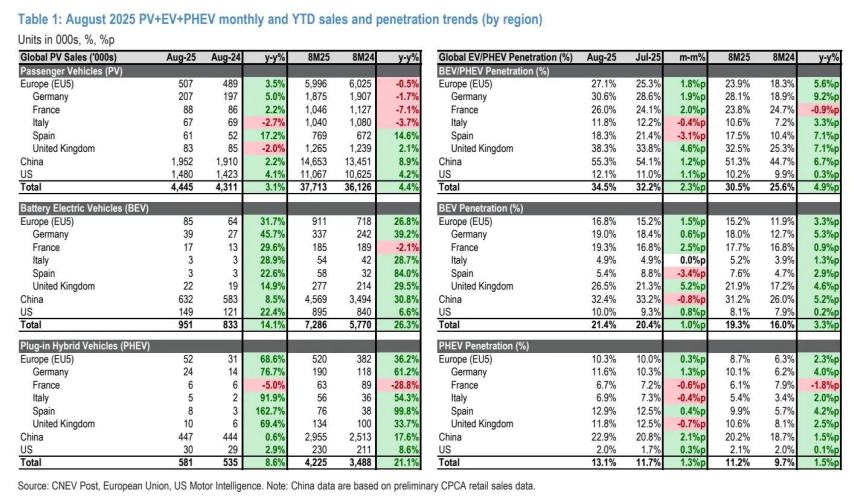
Core Insights - The global electric vehicle (EV) market continues to grow, with significant regional differences influenced by policy and subsidy adjustments [1][2] - The penetration rates in key markets such as Europe, the US, and China have shown positive growth, but the competitive landscape among leading automakers and battery companies is evolving [1][4] Regional Market Performance - In August 2025, the combined sales of electric vehicles in Europe (Germany, France, UK, Italy, Spain), the US, and China reached 1.39 million units, marking a year-on-year increase of 10% and a month-on-month increase of 5% [2] - The overall penetration rate for electric vehicles rose to 35%, up 2 percentage points year-on-year and month-on-month [2] - In Europe, the five countries achieved a penetration rate of 27.1%, nearing the historical peak of 27.7% in August 2023, with the UK showing the most significant growth [3][4] Key Market Drivers - The UK's growth in EV penetration is attributed to the "Electric Vehicle Subsidy Program," which provides incentives for small economic models priced below €37,000 [3] - In the US, the penetration rate increased to 12.1%, with pure electric vehicles surpassing 10% for the first time, driven by increased subsidies before the expiration of the $7,500 tax credit [4] - In China, retail sales of new energy vehicles reached 1.08 million units in August, with a penetration rate of 55%, supported by new model launches and price competition [5] Battery and Materials Sector - China's electric vehicle supply chain index rose by 20%, outperforming Japan and South Korea, primarily due to the country's anti-involution policies [6] - The battery materials sector is expected to stabilize or recover prices by 2026, influenced by capacity restrictions and market dynamics [7] Investment Outlook - The company remains optimistic about the prospects of Chinese and Korean automakers and battery leaders, despite anticipated demand weakness in the US market in Q4 due to subsidy reductions [9] - In China, companies like BYD are favored for their overseas business potential, while CATL is recognized for its technological leadership and stable profitability [9]





长城基金尤国梁:持续看好军工板块
Xin Lang Ji Jin· 2025-09-11 08:21
Group 1 - The A-share market has experienced adjustments in September, reflecting a positive overall market sentiment despite previous accumulated pressure [1] - Domestic "anti-involution" policies are gaining traction, leading to a recovery in residents' risk appetite and a gradual shift of funds from the deposit market to the capital market [1] - The expectation of interest rate cuts by the Federal Reserve is increasing, suggesting a continuation of global liquidity easing [1] Group 2 - Investment opportunities are being highlighted, particularly in the military industry, with expectations of continued interest due to upcoming events and contracts [1] - The next key focus for the military sector is the 100th anniversary of the army in 2027, which may attract long-term capital [1] - In the AI sector, attention is shifting towards application opportunities in consumer electronics and robotics following a general increase in computing power [1]