
资产配置

Search documents
全球银行悄悄布局,黄金即将迎来暴涨?金价或将重演历史
Sou Hu Cai Jing· 2025-10-29 17:59
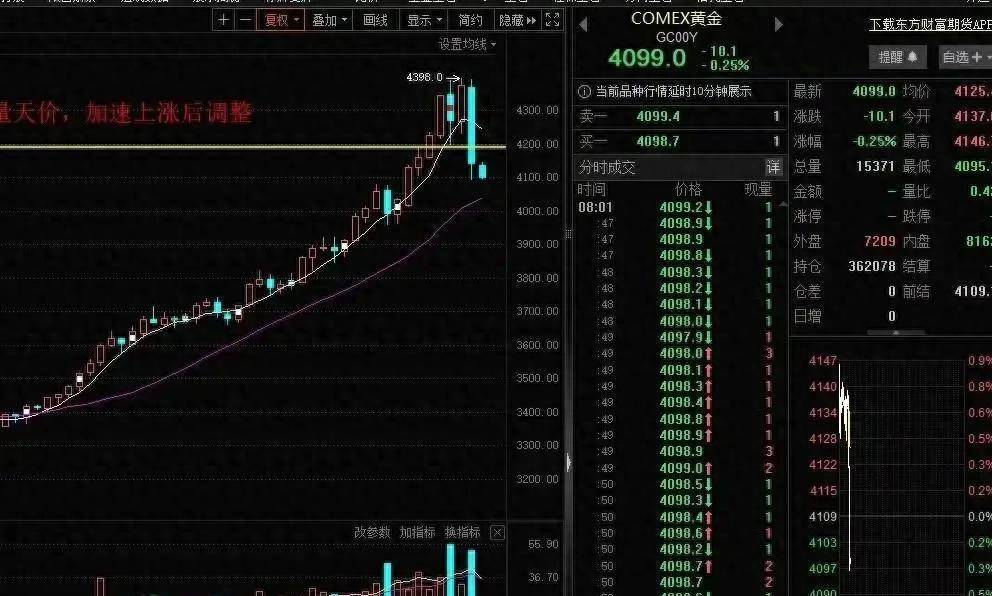
上周金价跌破4000美元整数关口,投资群里瞬间炸开了锅。 "要跌到3800! ""牛市完了! "各种悲观论调不绝于耳。 这种场景让我不禁回想起2011年冬天, 当时金价从1920美元高点坠落,市场上一片"泡沫破裂"的哀嚎。 | 足数 = | 叠加 ▼ | 图线 | 显示 ▼ | 简约 | 隐藏 ▶▶ 123 | | COMEX黄金 | | | 下载东方财富期货APP | | | --- | --- | --- | --- | --- | --- | --- | --- | --- | --- | --- | --- | | | | | | 设置均线 | | | GC00Y 4099.0 | | | 提醒 ◆ | 自选十 | | | | | 4398.0 - | | | | - 0.25% | | | | | | | | | | | | | 1 当前品种行情延时10分钟展示 | | 最新 | 4099.0 194 | 4125 | | | | | | | 4300.00 | | | | | | | | 大价,加速上涨后调整 | | | | | | 1 | 4099.4 | 1 | 涨跌 | -10.1 今天 | ...

4 Money Mistakes Wealthy People Don’t Make
Yahoo Finance· 2025-10-29 17:00
Group 1 - Wealthy individuals closely monitor the economy, legislation, and markets to assess their financial impact [1] - Building and maintaining wealth involves making consistent smart financial decisions rather than just earning a high income [2] - High-net-worth individuals employ disciplined strategies to protect and grow their assets while avoiding common pitfalls [2] Group 2 - Consulting with financial advisors is crucial for wealthy individuals, especially during political or economic changes [4] - Wealthy individuals prioritize careful financial planning and money management to enhance their net worth [4] - Diversification is essential for a balanced portfolio, particularly in turbulent economic times [5] Group 3 - Wealthy individuals avoid putting all their money into a single asset class to mitigate risk and ensure long-term stability [6] - They actively seek to minimize tax liabilities through strategic financial planning and the use of tax-advantaged accounts [6] - Common strategies include investing in a mix of asset types and regularly rebalancing portfolios to maintain target allocations [7]
I Asked ChatGPT To Provide the Perfect Balanced Portfolio — Here’s What It Said
Yahoo Finance· 2025-10-29 16:18
Group 1 - The core idea of maintaining a balanced portfolio is to protect wealth during economic and stock market turbulence by offsetting losses in one asset class with gains in another [1] - A perfect balanced portfolio is not one-size-fits-all; it depends on individual factors such as age, income, family situation, and goals [3][4] - General guidelines for asset allocation include a mix of stocks, bonds, cash, and alternative assets to achieve growth, stability, and innovation [4][6] Group 2 - Recommended asset allocation for a moderate-to-aggressive investor with a long-term horizon includes 40%-50% in stocks/funds, 15%-25% in bonds, and 10%-15% in real estate [5][7] - Specific allocations within stocks include 20%-25% in U.S. large cap, 5%-10% in U.S. midcap and small cap, and 5%-7% in emerging markets [5][7] - Cash and savings should comprise 5%-10% of the portfolio for liquidity, with high-yield savings and money market options providing low-risk interest [7]
AI赋能资产配置(十八):LLM助力资产配置与投资融合
Guoxin Securities· 2025-10-29 14:43
Group 1: Core Conclusions - LLM reshapes the information foundation of asset allocation, enhancing the absorption of unstructured information such as sentiment, policies, and financial reports, which traditional quantitative strategies have struggled with [1][11] - The effective implementation of LLM relies on a collaborative mechanism involving "LLM + real-time data + optimizer," where LLM handles cognition and reasoning, external APIs and RAG provide real-time information support, and numerical optimizers perform weighting calculations [1][12] - LLM has established operational pathways in sentiment signal extraction, financial report analysis, investment reasoning, and agent construction, providing a realistic basis for enhancing traditional asset allocation systems [1][3] Group 2: Information Advantage Reconstruction - LLM enables efficient extraction, quantification, and embedding of soft information such as sentiment, financial reports, and policy texts into allocation models, significantly enhancing market expectation perception and strategy sensitivity [2][11] - The modular design of LLM, APIs, RAG, and numerical optimizers enhances strategy stability and interpretability while being highly scalable for multi-asset allocation [2][12] - A complete chain of capabilities from signal extraction to agent execution has been formed, demonstrating LLM's application in quantitative factor extraction and allocation [2][20] Group 3: Case Studies - The first two case studies focus on how sentiment and financial report signals can be transformed into quantitative factors for asset allocation, improving strategy sensitivity and foresight [20][21] - The third case study constructs a complete investment agent process, emphasizing the collaboration between LLM, real-time data sources, and numerical optimizers, showcasing a full-chain investment application from information to signal to optimization to execution [20][31] Group 4: Future Outlook - The integration of LLM with reinforcement learning, Auto-Agent, multi-agent systems, and personalized research platforms will drive asset allocation from a tool-based approach to a systematic and intelligent evolution, becoming a core technological path for building information advantages and strategic moats for buy-side institutions [3][39]
4000点的A股让人跃跃欲试?揭秘理财固收+掘金权益市场
Di Yi Cai Jing Zi Xun· 2025-10-29 13:31
Core Viewpoint - The A-share market is experiencing renewed interest as the Shanghai Composite Index returns to the 4000-point mark after 10 years, prompting investors to seek better yield alternatives amid declining deposit rates and improving equity market performance [1] Group 1: Market Trends - The issuance scale of mixed financial products has shown a significant expansion trend this year, with some products offering annualized returns of over 5% to 7% [1] - The "fixed income +" products are increasingly focusing on equity assets, with a notable rise in the performance of mixed products compared to the previous year [2][3] - The average annualized return of "fixed income +" products from Everbright Wealth is above 3%, with some products achieving returns over 5% [3] Group 2: Asset Allocation - The typical allocation model for "fixed income +" products consists of 70%-90% fixed income assets (such as government bonds and high-grade credit bonds) and 10%-30% equity/alternative assets (like stocks and REITs) [4] - The "plus" portion of "fixed income +" products has been expanded to include REITs, quantitative strategies, and derivatives, which have shown positive results [3][4] Group 3: Investment Strategies - Financial institutions are increasingly collaborating with external managers to gain alpha returns from equity assets and diversify their portfolios [6] - The regulatory environment is encouraging financial companies to participate in equity markets, with recent policies allowing them to engage in IPOs and private placements [6][7] - The focus on equity investments is seen as a market trend, with firms needing to enhance their research capabilities to manage risks effectively [8] Group 4: Future Outlook - There is potential for further expansion in the "plus" segment of "fixed income +" products, particularly in cross-border assets and derivatives [10] - The industry is cautiously optimistic about the upward potential of "fixed income +" yields, with current yields being 30-50 basis points higher than pure fixed income products [11] - The overall yield environment for various financial products has been declining, with recent reports indicating a drop in annualized yields for open and closed fixed income products [11]
金融工程专题报告:基于宏观数据的资产配置与风格行业轮动体系
CAITONG SECURITIES· 2025-10-29 11:47
Quantitative Models and Construction Methods 1. Model Name: Stock Timing Model - **Construction Idea**: The model is based on the comprehensive judgment of economic growth and liquidity easing[18] - **Construction Process**: - Construct timing factors from two core dimensions: economic growth and liquidity easing[18] - Factors include PMI YoY smoothed value, manufacturing fixed asset investment completion amount cumulative YoY, CPI YoY smoothed value, and new medium and long-term loans cumulative value YoY[19] - Use the formula: $$ \text{Factor} = \begin{cases} 1 & \text{if indicator improves} \\ 0 & \text{otherwise} \end{cases} $$ - Backtest using CSI 800 total return as the benchmark[19] - **Evaluation**: The model effectively captures stock market cycles, avoiding downturns[21] 2. Model Name: Bond Timing Model - **Construction Idea**: The model analyzes from the perspective of monetary liquidity supply and demand[23] - **Construction Process**: - Factors include DR007, SHIBOR, and social financing scale stock YoY smoothed value[24] - Use the formula: $$ \text{Factor} = \begin{cases} 1 & \text{if short-term average < long-term average} \\ 0 & \text{otherwise} \end{cases} $$ - Backtest using ChinaBond Treasury Total Net Price Index as the benchmark[24] - **Evaluation**: The model captures bond market trends, minimizing drawdowns[25] 3. Model Name: All-Weather Strategy - **Construction Idea**: The model adjusts risk budgets for different assets based on timing signals[17] - **Construction Process**: - Use a risk parity model to allocate risk contributions of assets[30] - Adjust risk budgets based on stock and bond timing signals[32] - Optimize the model: $$ \begin{array}{c} \min \sum_{i=1}^{N} \left( RC_i - b_i \sigma_p \right)^2 \\ \text{s.t.} \sum_{i=1}^{N} \omega_i = 1 \\ 0 \leq \omega_i \leq 1 \end{array} $$ - Backtest using a combination of CSI 800, ChinaBond Treasury Total Wealth Index, CSI Convertible Bond Index, S&P 500 ETF, and AAA Credit Bonds[31] - **Evaluation**: The strategy provides higher absolute returns while controlling risk[38] Model Backtest Results Stock Timing Model - Annualized Return: 14.1%[21] - Benchmark Annualized Return: 5.4%[21] - Excess Annualized Return: 8.7%[21] - Monthly Win Rate: 56.7%[21] Bond Timing Model - Annualized Return: 2.3%[25] - Benchmark Annualized Return: 1.1%[25] - Excess Annualized Return: 1.1%[25] - Monthly Win Rate: 68.3%[25] All-Weather Strategy - Annualized Return: 6.1%[38] - Benchmark Annualized Return: 5.1%[38] - Excess Annualized Return: 1.0%[38] - Maximum Drawdown: 2.6%[38] - Sharpe Ratio: 2.04[38] Quantitative Factors and Construction Methods 1. Factor Name: Value-Growth Rotation Factor - **Construction Idea**: The factor is based on economic recovery, liquidity, and market sentiment[47] - **Construction Process**: - Factors include manufacturing fixed asset investment completion amount, PPI YoY smoothed value, M2 YoY smoothed value, social financing YoY smoothed value, medium and long-term loan growth YoY smoothed value, market turnover rate, and margin balance percentile[48] - Use the formula: $$ \text{Factor} = \begin{cases} 1 & \text{if indicator improves} \\ 0 & \text{otherwise} \end{cases} $$ - Backtest using the National Growth Index and National Value Index[48] - **Evaluation**: The factor captures the cyclical characteristics of value and growth styles[47] 2. Factor Name: Size Rotation Factor - **Construction Idea**: The factor is based on economic prosperity, liquidity, and market sentiment[55] - **Construction Process**: - Factors include manufacturing fixed asset investment completion amount, PPI YoY smoothed value, gold daily return rate, government bond yield, credit spread, M1 YoY smoothed value, market turnover rate, and margin balance percentile[56] - Use the formula: $$ \text{Factor} = \begin{cases} 1 & \text{if indicator improves} \\ 0 & \text{otherwise} \end{cases} $$ - Backtest using the CSI 300 Index and CSI 1000 Index[57] - **Evaluation**: The factor captures the cyclical characteristics of large-cap and small-cap styles[55] Factor Backtest Results Value-Growth Rotation Factor - Annualized Return: 9.2%[51] - Benchmark Annualized Return: 1.7%[51] - Excess Annualized Return: 7.5%[51] - Monthly Win Rate: 60.2%[51] Size Rotation Factor - Annualized Return: 9.2%[59] - Benchmark Annualized Return: 0.1%[59] - Excess Annualized Return: 9.0%[59] - Monthly Win Rate: 58.3%[59] Industry Rotation Solution 1. Factor Name: Macro Factor - **Construction Idea**: The factor is based on the second-order changes in economic growth and liquidity[67] - **Construction Process**: - Factors include PMI, social financing scale, manufacturing fixed asset investment completion amount, CPI, M2 growth rate, 10-year government bond yield, and credit spread[70] - Use the formula: $$ \text{Factor} = \begin{cases} 1 & \text{if indicator improves} \\ 0 & \text{otherwise} \end{cases} $$ - Backtest using industry indices[73] - **Evaluation**: The factor captures the marginal inflection points of macro trends[67] 2. Factor Name: Fundamental Factor - **Construction Idea**: The factor is based on historical prosperity, prosperity changes, and prosperity expectations[79] - **Construction Process**: - Factors include industry component stock median, industry profitability, and industry consensus profit expectations[79] - Use the formula: $$ \text{Factor} = \begin{cases} 1 & \text{if indicator improves} \\ 0 & \text{otherwise} \end{cases} $$ - Backtest using industry indices[82] - **Evaluation**: The factor captures the core of industry prosperity[79] 3. Factor Name: Technical Factor - **Construction Idea**: The factor is based on index momentum, leading stock momentum, and K-line patterns[87] - **Construction Process**: - Factors include industry index relative excess return IR, leading stock sharp ratio, and K-line pattern score[89] - Use the formula: $$ \text{Factor} = \begin{cases} 1 & \text{if indicator improves} \\ 0 & \text{otherwise} \end{cases} $$ - Backtest using industry indices[96] - **Evaluation**: The factor captures the technical evaluation of industry trends[87] 4. Factor Name: Crowding Factor - **Construction Idea**: The factor is based on financing inflows, turnover rate, and transaction proportion[100] - **Construction Process**: - Factors include industry financing buy amount, industry turnover rate, and industry transaction amount proportion[101] - Use the formula: $$ \text{Factor} = \begin{cases} 1 & \text{if indicator improves} \\ 0 & \text{otherwise} \end{cases} $$ - Backtest using industry indices[104] - **Evaluation**: The factor captures the crowding level of industries[100] Industry Rotation Backtest Results Macro Factor - Annualized Return: 42.9%[73] - Benchmark Annualized Return: -22.8%[73] - Excess Annualized Return: 65.7%[73] Fundamental Factor - Annualized Return: 11.3%[85] - Benchmark Annualized Return: 2.8%[85] - Excess Annualized Return: 8.5%[85] - IC Mean: 8.2%[85] Technical Factor - Annualized Return: 9.7%[97] - Benchmark Annualized Return: 2.8%[97] - Excess Annualized Return: 6.9%[97] - IC Mean: 8.2%[97] Crowding Factor - Annualized Return: -2.9
李迅雷专栏 | 黄金暴涨、股市波动,普通人机会在哪?
中泰证券资管· 2025-10-29 11:33
Core Viewpoints - The current market dynamics and potential for a "slow bull" market are under discussion, with emphasis on the importance of understanding the underlying drivers of stock and gold prices [4][11][12]. Group 1: Market Dynamics - The stock market's volatility is influenced by investor psychology, particularly greed and fear, which are common pitfalls for many investors [6][5]. - The A-share market is characterized by high turnover rates, leading to elevated valuations and a tendency for prolonged bear markets compared to bull markets [9][10]. - The recent market rally is attributed to a combination of improved corporate fundamentals, declining interest rates, and supportive policies, although the sustainability of this rally remains uncertain [14][19][20]. Group 2: Investment Strategies - Investors are advised to focus on the fundamentals of listed companies and avoid chasing trends, emphasizing the importance of buying low and selling high [6][7]. - The concept of "slow bull" is still under evaluation, with a consensus that a sustained upward trend would require several years of consistent growth [13][14]. - The current valuation levels of A-shares are considered moderate, suggesting that while there is potential for growth, caution is warranted [16][24]. Group 3: Gold Market Insights - The recent surge in gold prices, which has increased by over 50% this year, raises concerns about potential corrections, indicating that current levels may not be the best entry point for new investments [41][43]. - Central banks globally are increasing their gold reserves to enhance monetary authority, reflecting a strategic shift away from reliance on the US dollar [47]. - Recommendations for gold investment allocation suggest a cautious approach, with a current optimal allocation of around 10% of an investment portfolio [48].

金价短期回调不改长期韧性,市场关注结构性支撑
Sou Hu Cai Jing· 2025-10-29 09:18
Core Viewpoint - Recent international gold prices have retreated from historical highs, with COMEX gold futures declining for three consecutive trading days, closing at $3968.10 per ounce, approximately 9% lower than the record high set in October. Despite this pullback, gold prices have maintained a 3% increase for the month and over 50% year-to-date, indicating both volatility and resilience in the gold market [1] Group 1: Market Analysis - Analysts note that the current price adjustment coincides with a monetary policy window from the Federal Reserve, suggesting that short-term fluctuations in gold prices should not overshadow its long-term support logic [1] - Sprott's senior partner Ryan McIntyre highlights that the restructuring of the global trust system and rising sovereign risks are creating structural support for gold, particularly due to the ongoing U.S. high deficit and federal debt issues, which may continue to drive demand for asset diversification [3] - Aakash Doshi, head of metal strategy at State Street Bank, identifies a potential technical support range for gold prices between $3600 and $3650, emphasizing that structural factors such as global fiscal debt burdens and central bank gold purchases remain intact [3] Group 2: Price Projections - Doshi's probability analysis suggests that the likelihood of gold prices surpassing $5000 is significantly higher than the chance of falling to $3000, providing a new perspective for market observation [3] - Historical data indicates that after the Federal Reserve's first rate cut since 2020 in September, gold experienced a brief fluctuation but subsequently rose by approximately 13% within a month, reaching a new historical high, demonstrating a multi-stage response of gold prices to monetary policy [3] Group 3: Asset Allocation - Professional institutions generally regard gold as a crucial component of investment portfolios, with risk management models indicating that the allocation of physical gold and gold ETFs typically ranges from 5% to 20% [4] - Market practices show that maintaining a stable allocation ratio through regular adjustments is a common method for institutional investors to manage risk exposure [4]

小雪三分法实盘运作一年报告
雪球· 2025-10-29 08:41
Core Viewpoint - The article emphasizes the effectiveness of the "Xiaoxue Three-Point Method" in achieving stable investment returns through diversified asset allocation and systematic investment strategies, demonstrating a significant annual return and low drawdown compared to major indices [2][5][23]. Performance Overview - The Xiaoxue Three-Point Method account achieved a cumulative return of 16.43% and an annualized return of 22.57%, with a weighted return of 22.24% [5]. - The performance benchmark, a composite index, yielded a return of 17.45%, while other major indices like the CSI 300 and Hang Seng Index returned 19.20% and 28.38%, respectively [5]. - The account's maximum drawdown was only -8.09%, significantly lower than the drawdowns of major indices, indicating effective risk management through low-correlation asset allocation [7][8]. Risk Management - The article highlights the importance of controlling risk, noting that a diversified asset allocation can mitigate losses during market downturns, leading to better long-term performance [8][10]. - A comparison of different strategies shows that a conservative approach can yield better returns over time, even in volatile markets [9]. Monthly Performance - The account maintained an 80% probability of positive monthly returns throughout the year, demonstrating resilience against market fluctuations [10][11]. Investment Strategy - The strategy focuses on asset allocation rather than market timing, allowing for smoother cost averaging and reduced volatility [13][14]. - The article outlines specific actions taken in response to market events, emphasizing a gradual and cautious approach rather than aggressive trading [14][15]. User Experience - The method has shown high adaptability, with a 96% probability of positive returns for users, indicating that long-term holding and systematic investment strategies are effective [19][20]. - Nearly 50% of users engaged in regular investment contributions, which helped to average costs and reduce timing risks [20]. Current Market Outlook - The article suggests that the current market trends driven by technology and global liquidity are favorable for investment, and it encourages continued investment in diversified assets [22][23]. - It asserts that now is still a good time to enter the market, emphasizing the importance of consistent investment strategies over trying to time the market [22][23].

资产配置快评:2025年第47期:Riders on the Charts:每周大类资产配置图表精粹-20251029
Huachuang Securities· 2025-10-29 07:02
Economic Overview - Eurozone's fiscal deficit as a percentage of GDP for Germany, France, and Italy was 2.2% in H1 2025, down from 2.5% in Q4 2024, indicating a "tight fiscal & loose monetary" environment[4] - U.S. core CPI in September 2025 was 3%, below the expected 3.1%, showing a decrease in inflationary pressure[7] - U.S. durable goods consumption expenditure increased by $20 billion, from $5.56 trillion to $5.68 trillion, despite new tariffs[10] Market Valuation - The effective exchange rate index for the euro was at a historical high of 130 as of October 24, 2025, indicating overvaluation of euro assets[13] - The 10-year government bond yield spread between Italy and Germany fell to 79 basis points, and between Greece and Germany to 66 basis points, both at 15-year lows, reflecting low risk premiums in Southern European bonds[13] Commodity Insights - Gold prices reached a historical high of $4,336.4, exceeding the 200-day moving average by 32.5%, suggesting potential for a price correction[16] - The copper-to-gold price ratio fell to 2.7, indicating a divergence with the offshore RMB exchange rate, which rose to 7.1[27] Investment Metrics - The equity risk premium (ERP) for the CSI 300 index was 4.2%, significantly below the 16-year average, suggesting room for valuation increases[18] - The total return ratio of domestic stocks to bonds was 28.8, above the past 16-year average, indicating enhanced attractiveness of equities over fixed income[29]
