
硬科技

Search documents
分化!资金继续抱团硬科技
Sou Hu Cai Jing· 2025-09-22 11:01
港股市场整体承压,科技股显现韧性。恒生指数跌0.76%报26344.14点;恒生科技指数跌0.58%报 6257.91点;恒生中国企业指数跌1.07%报9370.73点。大市成交2905.37亿港元,南向资金净买入127.36 亿港元,半导体与消费电子板块获内资青睐。 9月22日,A股市场呈现结构性分化格局,三大指数小幅收涨,科技板块全线爆发推动科创50指数大涨 3.38%,消费电子与半导体产业链领涨市场,而旅游影视等消费板块集体回调;港股市场整体承压,三 大指数集体收跌,科技股相对抗跌,苹果概念与半导体板块逆势走强。 受国庆节前效应影响,两市成交额均较前一交易日显著萎缩,显示资金观望情绪浓厚,市场热点集中於 科技主线,结构性特征突出。 展望后市,A股科技主线有望延续强势,需关注量能变化与板块轮动节奏;港股或延续震荡整固,重点 跟踪外资流向与政策预期。操作上建议聚焦半导体、消费电子等景气方向,规避高位消费股回调风险, 把握科技成长与政策催化的结构性机会。 主要指数表现 A股市场缩量上涨,科技成长风格主导市场。上证指数全天震荡收涨0.22%报3828.58点;深证成指涨 0.67%报13157.97点;创业板指 ...
科创板ETF数量超百只 规模近3000亿元
Zheng Quan Ri Bao Wang· 2025-09-22 10:07
Core Insights - The launch of the E Fund Shanghai Stock Exchange Sci-Tech Innovation Board New Energy ETF on September 22 marks the total number of Sci-Tech Innovation Board ETFs reaching 101 [1] - The previous listing of the Huatai-PineBridge Shanghai Stock Exchange Sci-Tech Innovation Board Innovative Drug ETF on September 19 pushed the total number of Sci-Tech Innovation Board ETFs to over 100 [1] - The overall management scale of Sci-Tech Innovation Board ETFs is nearly 300 billion, making it the segment with the highest proportion of index investment in A-shares [1] Industry Development - The Sci-Tech Innovation Board has developed a multi-layered index product system covering broad-based, thematic, and strategic indices, with continuous structural optimization and maturation of the ecosystem [1] - Over the past five years, the growth of Sci-Tech Innovation Board ETFs has provided investors with diversified investment tools and has become a significant channel for directing social funds towards "hard technology" enterprises [1] - A complete system has been formed in broad-based indices, represented by the Sci-Tech 50, Sci-Tech 100, Sci-Tech 200, and Sci-Tech Comprehensive Index [1] - Thematic indices cover key areas of new productive forces, including artificial intelligence, chips, new energy, and innovative drugs [1] Future Outlook - Market analysts indicate that the series of indices from the Sci-Tech Innovation Board demonstrate excellent long-term performance and possess notable long-term allocation value [1] - The investment ecosystem of the Sci-Tech Innovation Board is expected to further develop and improve with the implementation of the "Eight Measures" and "1+6" reform policies [1]
2025年中国科技投资痛点、趋势与展望报告
Sou Hu Cai Jing· 2025-09-22 05:05
今天分享的是:2025年中国科技投资痛点、趋势与展望报告 报告共计:24页 2025中国科技投资:在"渡口时刻"探寻硬科技突围与资本新秩序 2025年,中国科技投资领域正站在关键的"渡口时刻"。一方面,行业呈现出止跌回暖的积极态势,募资、投资、退出三大核心环节均出现多年未见的正向变 化;另一方面,慢时代周期、非市场化诉求、行业内卷等堵点依然存在,推动着科技投资格局与资本逻辑加速重构,硬科技突围与资本新秩序的构建成为行 业发展的核心命题。 从行业整体表现来看,2025年上半年中国科技投资市场的回暖信号尤为明显,这一趋势在募资、投资、退出三大环节均有清晰体现。在募资端,2025年上半 年迎来了近四年首次正增长,对比2024年上半年数据,无论是基金数量还是募资规模,都实现了实质性提升,结束了此前连续多年的下滑态势,为科技投资 市场注入了关键流动性。投资端的拐点则更为突出,回顾2021年至2025年上半年的一级市场股权投资走势,2025年上半年投资金额与案例数均摆脱了此前的 震荡下行趋势,呈现出企稳回升的良好势头,市场活跃度显著提高。退出环节同样有所改善,2025年上半年机构退出总数较2024年同期大幅增长,其中IP ...

帮主郑重:杠杆资金本周猛砸20亿买中芯国际,这波操作藏着啥信号?
Sou Hu Cai Jing· 2025-09-21 21:48
Group 1 - The core point of the article highlights the significant inflow of over 2 billion yuan into SMIC, making it the top stock in net financing purchases, which subsequently led to a nearly 12% increase in its stock price [1][3] - The overall market situation shows that leveraged funds are active, with nearly 2,000 stocks receiving net purchases, and over 1,100 stocks having net purchases exceeding 10 million yuan, while around 200 stocks surpassed 100 million yuan [3] - SMIC's strong performance is attributed to the favorable policies in the semiconductor industry, increasing demand for AI chips, and a recovery in consumer electronics orders, positioning it as a leader in domestic chip manufacturing [3][4] Group 2 - The article contrasts the stocks that experienced net selling, such as Zhongji Xuchuang and Zijin Mining, indicating that funds are reallocating towards more stable investments in hard technology leaders, major financial institutions, and top companies in the new energy sector [4] - The article warns ordinary investors against blindly following the significant purchase of SMIC shares without understanding the underlying long-term logic of the semiconductor industry [4] - The future stability of leveraged funds in hard technology leaders like SMIC will depend on the industry's fundamentals, including order increases and technological breakthroughs [4]

联博基金李长风:中国硬科技正成为全球资产配置“必需品”
Shang Hai Zheng Quan Bao· 2025-09-21 15:28
Core Viewpoint - Chinese hard technology assets are becoming essential in global asset allocation, surpassing traditional investment categories [1] Group 1: Industry Insights - The development path of China's technology industry is characterized by a large domestic market that provides unique scale advantages, facilitating rapid growth across various sectors such as home appliances, mobile devices, and new energy vehicles [1] - Continuous support from national policies is a significant driving force behind the growth of China's technology sector [1] - The innovative capabilities and dedicated efforts of Chinese engineers are crucial for driving technological breakthroughs, exemplified by companies like DeepSeek, which achieved competitive model capabilities through algorithm innovation [1] Group 2: Investment Opportunities - In the hard technology sector, semiconductor equipment, specialty processes, and advanced packaging are particularly promising areas, with quality enterprises successfully converting policy benefits into technological advantages [2] - These companies have established significant positions in the global supply chain, gaining certification from top international clients through differentiated technological advantages and cost-effectiveness [2] - The dual development model of these enterprises, leveraging both domestic market stability and international client services, enhances their resilience against market fluctuations and fosters sustainable business models [2] Group 3: Future Outlook - The expectation is for China's technology industry to gradually shift towards a "innovation-driven profitability" model, where companies achieve excess returns through technological innovation [3] - Establishing a healthy and sustainable business model is key for the long-term stability of Chinese tech stocks, with a focus on converting innovation advantages into profitability [3] - Over the next 5 to 10 years, the hard technology sector in China is anticipated to produce a number of world-class companies, offering sustainable long-term returns for investors [3]
策略周末谈:加仓中国:外资会买什么?
Western Securities· 2025-09-21 11:35
Group 1 - Foreign capital is expected to increase investment in "export advantage" assets such as new energy, chemicals, and pharmaceuticals, driven by the Federal Reserve's interest rate cuts, which typically accelerate global capital flow back to China [1][10][11] - The expansion of capital expenditure (CAPEX) in the manufacturing sector, supported by fiscal subsidies since 2019, has solidified China's global competitive advantage in high-end manufacturing, despite negatively impacting financial metrics like return on invested capital (ROIC) and free cash flow [2][16][19] - The "anti-involution" policy is anticipated to enhance the financial returns of China's manufacturing sector, with signs of improving free cash flow in some "export advantage" industries as CAPEX contracts [3][24][30] Group 2 - The Hang Seng Technology Index is expected to experience a "main rising wave" as foreign capital returns to Hong Kong stocks, driven by both southbound capital and foreign investment [4][33] - The investment strategy suggests focusing on three main lines: "hard currency" assets under globalization, "hard technology" sectors, and Chinese manufacturing benefiting from the "anti-involution" policy [5][34][37] Group 3 - The report highlights that the current market environment may lead to a phase of consolidation in A-shares, with a shift in market style towards high-quality manufacturing and technology sectors [5][34][40] - Recent economic data indicates a decline in retail sales and industrial output, suggesting potential challenges for consumer-driven sectors [51][52]
超300家机构,盯上1家公司
Zhong Guo Zheng Quan Bao· 2025-09-21 09:33
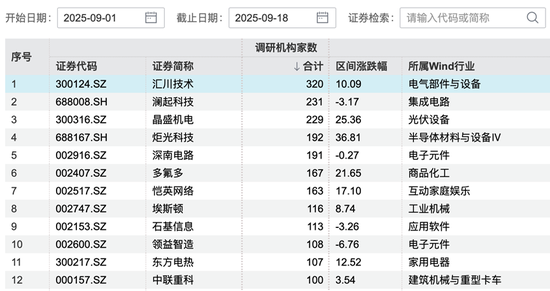
Group 1 - The core focus of the article is on the significant increase in institutional research on A-share companies, particularly in the "hard technology" sectors such as integrated circuits, electronic components, and application software [2][6] - In September, over 1,000 A-share companies were researched by institutions, with more than ten companies receiving attention from over 100 institutions [1][4] - Huichuan Technology was the most researched company, receiving inquiries from 320 institutions, including 157 foreign institutions [3][5] Group 2 - Huichuan Technology reported a revenue of 20.509 billion yuan for the first half of 2025, representing a year-on-year growth of 26.73%, and a net profit of 2.968 billion yuan, up 40.15% year-on-year [3] - The company provides core products and solutions for industrial automation, including frequency converters, servo systems, and industrial robots, and is actively developing components for humanoid robots [3][7] - Other companies like Lanke Technology and Jingsheng Mechanical & Electrical also received significant institutional research, with Lanke Technology being researched by 231 institutions and Jingsheng Mechanical & Electrical by 229 institutions [5][4] Group 3 - The article highlights the importance of market value management, with companies like Lanke Technology emphasizing a shareholder-centric approach and continuous improvement in investor relations [7] - Liyi Intelligent Manufacturing plans to focus on innovation and international development, targeting growth in sectors such as robotics and AI [8] - The technology sector is expected to remain a focal point in the A-share market, driven by advancements in production capabilities and economic transformation [6][7]

超3500亿!科技部:将设一批母基金、S基金等
母基金研究中心· 2025-09-20 07:56
Core Viewpoint - The establishment of the National Venture Capital Guidance Fund is expected to significantly boost the venture capital industry by attracting nearly 1 trillion yuan in local and social capital, focusing on early-stage, small, long-term investments in hard technology sectors [2][3][4]. Group 1: National Venture Capital Guidance Fund - The National Venture Capital Guidance Fund aims to enhance the growth of innovative enterprises by directing financial capital towards early, small, long-term investments in hard technology, particularly in fields like artificial intelligence and quantum technology [3][4]. - The fund's lifespan is set to be 20 years, which is longer than typical venture capital funds, indicating a commitment to long-term capital support [3][4]. - The fund is expected to leverage local and social capital, potentially leading to a total investment of around 1 trillion yuan [2][3]. Group 2: Impact on the Venture Capital Industry - The creation of a national-level mother fund is seen as a significant opportunity for the venture capital sector, especially given the lack of new national-level mother funds in recent years [4][5]. - The initiative is anticipated to restore confidence in the venture capital industry and provide essential support to private equity funds [4][6]. - The government has been actively promoting policies to support venture capital, including the recent "17 Measures for Promoting High-Quality Development of Venture Capital" [6][7]. Group 3: Long-term Capital and Market Dynamics - The venture capital industry has faced challenges in securing long-term capital, which is crucial for supporting investments in early-stage companies [6][7]. - The current policy environment is favorable, with increased government support aimed at enhancing the availability of long-term capital sources [6][7]. - The establishment of various funds, including technology industry integration funds and secondary market funds, is expected to exceed 350 billion yuan, further supporting the venture capital ecosystem [5][6].

视频 上交所王泊:坚持为未盈利硬科技企业打开“资本入口”
Zhong Guo Jing Ying Bao· 2025-09-19 06:01
Core Viewpoint - The Shanghai Stock Exchange emphasizes the importance of providing a "capital entry" for unprofitable hard technology companies, aiming to support their growth and innovation in the market [2] Group 1 - The Shanghai Stock Exchange is committed to creating a favorable environment for hard technology enterprises that have not yet achieved profitability [2] - The exchange plans to enhance its support for these companies by facilitating access to capital markets [2] - There is a recognition of the potential of hard technology sectors to drive future economic growth, despite current unprofitability [2]
帮主郑重盘前策略:美股新高A股跳水,9月19日这几个信号决定下一步方向
Sou Hu Cai Jing· 2025-09-18 22:55
外围市场也带来分化影响。美股科技股大涨,尤其是英伟达带领芯片股发力,带动A股半导体板块逆势走强。中芯国际创历史新高,工业富联吸金超150 亿,说明科技主线韧性十足。不过罗素2000小盘股指数大涨,咱们的中小盘股却没跟上,这个分化值得关注。 技术面上,昨天沪指早盘冲到3899点,离3900点仅一步之遥,但午后跌破3870点支撑位,尾盘放量下跌。现在3800点成为关键多空分水岭,这个位置既是20 日均线所在,也是市场心理关口。守住与否将决定后续走势。 资金流向分化明显。昨天两市成交爆出3.13万亿,创年内第三高,但主力资金净流出328亿,北向资金也跑了45亿。有意思的是,半导体和机器人板块却合 计吸金超168亿,中微公司、闻泰科技等硬科技标的获得资金加仓,说明资金正在从高位股向有政策支撑的科技股转移。 老铁们,昨天这行情真是让人看不懂——美股道指纳指全都创了历史新高,咱们A股却集体跳水,沪指跌1.15%,创业板跌1.64%,超4200只个股下跌。作为 20年财经老记者,帮主我觉得有必要和大家捋一捋背后的逻辑。 先说消息面。美联储虽然降息25个基点,但明松暗紧,对明年降息预期比市场保守,这让资金产生犹豫。好在咱们央 ...