
适度宽松货币政策

Search documents
银行ETF南方(512700.SH)涨0.95%,宁波银行涨4.06%
Jin Rong Jie· 2026-01-13 05:41
Core Viewpoint - The banking sector shows strong investment potential due to multiple factors, including attractive dividend strategies and robust regional economic growth [1] Group 1: Market Performance - On January 13, the Shanghai and Shenzhen markets experienced fluctuations, with the banking sector leading in gains, particularly the Southern Bank ETF (512700.SH) which rose by 0.95% and Ningbo Bank which increased by 4.06% [1] Group 2: Investment Logic - The banking sector is favored for its dividend yield strategy, with several banks implementing mid-term dividends, providing a safety margin through stable cash flow and high dividend rates [1] - Strong regional economic performance is driving the growth of high-quality banks, while institutional investments in bank stocks reflect recognition of the sector's value [1] Group 3: Regulatory Environment - The regulatory authority has extended the loan extension period for real estate whitelist projects to five years, which helps alleviate liquidity pressure on real estate companies and stabilizes bank asset quality [1] - The 2026 Central Bank work meeting proposed a moderately loose monetary policy to maintain ample liquidity, guide balanced credit allocation, and enhance financial support for key sectors, creating a favorable policy environment for the banking industry [1] Group 4: Investment Opportunities - The Southern Bank ETF (512700.SH) offers comprehensive coverage of sector opportunities, allowing investors to benefit from industry policy dividends and improvements in asset quality [1]

1月资产配置月度报告:跨年行情多点开花,外需韧性超预期
Sou Hu Cai Jing· 2026-01-13 02:57
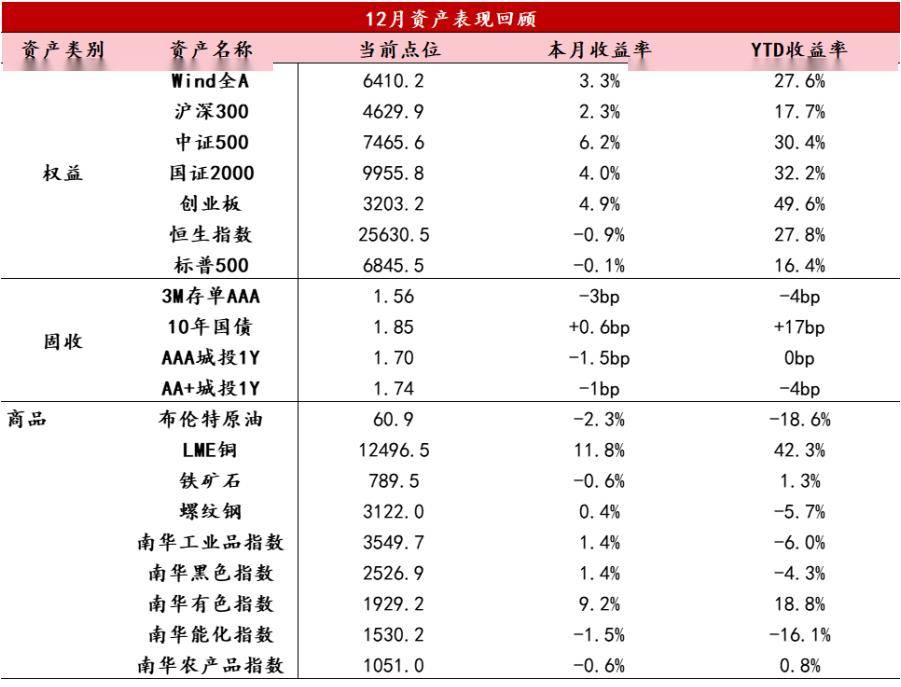
Stock Market Overview - In December, the Federal Reserve's interest rate cut was implemented as expected, leading to fluctuations in future rate cut expectations, while the Nasdaq index experienced volatility [1] - The A-share market showed overall fluctuations, with the Shanghai Composite Index achieving 11 consecutive gains by the end of the month, driven by a positive tone from the Central Economic Work Conference and a declining US dollar index [1] - The Wind All A index recorded a +3.3% increase for the month, with 60% of the Shenwan first-level industries rising, particularly strong performances in defense and military (+17.22%) and non-ferrous metals (+13.68%) [1] Bond Market Overview - The bond market continued to experience wide fluctuations in December, with increased yield volatility and a steeper curve [2] - Despite relatively ample liquidity and the central bank's resumption of bond purchases providing some support, concerns over long-term bond supply and other factors kept the market in a weak oscillation pattern [2] - The 10-year government bond yield ended the month at 1.85%, reflecting an N-shaped trend throughout December [2] Commodity Market Overview - The commodity market showed a bullish atmosphere in December, with precious metals and non-ferrous sectors being the strongest performers [3] - Gold prices fluctuated, with London gold closing at $4318.25 per ounce, up 2.36% from the previous month, while copper prices also saw significant increases [3] - The oil market experienced a downward trend, with Brent crude oil closing at $60.91 per barrel, down 2.26% for the month [3] Macroeconomic Performance - In November, China's exports demonstrated strong resilience, growing by 5.9% year-on-year, driven by a significant increase in machinery and high-tech product exports [5] - However, domestic consumption remained weak, with retail sales growth slowing to 0.3% year-on-year, indicating structural constraints on internal demand [5] - Fixed asset investment continued to decline, with real estate investment adjustments dragging down overall figures, highlighting the challenges in achieving self-sustaining growth [5] Policy Outlook - The Central Economic Work Conference set the tone for macroeconomic policy in 2026, focusing on addressing the structural imbalance of "strong supply and weak demand" [9] - The strategic shift will prioritize investment in human capital and social welfare, aiming to enhance income levels and consumer demand [9] - Fiscal policy is expected to maintain a more active stance, with a nominal deficit rate targeted around 4.0%, while monetary policy will shift focus from total volume to price stability [10][11] Asset Allocation Analysis - In December, net buying in the stock market rebounded to over 2.5 trillion yuan, with significant inflows into equity ETFs [14] - The manufacturing PMI showed a seasonal rebound, indicating improved trade conditions and proactive inventory preparations by companies [15] - Looking ahead to 2026, the market is expected to experience structural trends, with a focus on sectors that demonstrate sustainable performance and profitability [16]

利率周报(2026.1.5-2026.1.11):CPI同比阶段性回升-20260112
Hua Yuan Zheng Quan· 2026-01-12 14:03
1. Report Industry Investment Rating No relevant content provided. 2. Report Core Viewpoints - In December 2025, China's prices recovered. CPI rose 0.8% year-on-year, reaching a new high since March 2023, with food prices playing a significant role, and core CPI remaining stable. PPI's year-on-year decline narrowed to -1.9%, with three consecutive months of positive month-on-month growth, and prices in upstream and new-quality productivity-related industries were well-supported. In 2026, the central bank may continue its moderately loose monetary policy, with a new focus on "optimizing supply." It may focus on price recovery, keeping financing costs low, strengthening the prevention and control of financing platform debt risks, and promoting financial opening-up. In the US, the December non-farm payrolls were lower than expected, but the unemployment rate decreased. Traders postponed the first interest rate cut in 2026 to June, with an expected total cut of 50BP for the year [2][4][118]. 3. Summary by Relevant Catalogs 3.1 Macro News - **CPI and PPI Trends**: In December 2025, CPI rose 0.8% year-on-year, with food prices rising 1.1% and contributing significantly. Core CPI was stable at 1.2%. PPI's year-on-year decline narrowed to -1.9%, and it had three consecutive months of positive month-on-month growth [4][13][29]. - **Factors Affecting CPI**: Food prices, especially fresh vegetables and fruits, drove CPI growth, while energy prices, affected by international oil prices, restricted CPI growth [19]. - **Factors Affecting PPI**: Domestic policies, seasonal demand, input factors, and new-quality productivity all influenced PPI trends. Upstream prices were supported by policies and seasonal demand, and new-quality productivity-related industries contributed to price increases [33][38]. - **Central Bank Policy**: The 2026 central bank work conference added "optimizing supply" as a policy focus, emphasizing balanced credit supply, reasonable price recovery, and support for financing platform debt risk resolution [43]. - **US Non-farm Payrolls**: In December 2025, US non-farm payrolls increased by 50,000, lower than expected, and the unemployment rate decreased to 4.4%. Traders postponed the first interest rate cut to June, with an expected 50BP cut for the year [4][48]. 3.2 Meso-level High-frequency Data - **Consumption**: Passenger car retail and wholesale volumes increased year-on-year, but movie box office revenue decreased. Three major household appliances' retail volume and revenue showed mixed trends [4][9][54]. - **Transportation**: Passenger transportation activities were relatively high, with increases in migration, flight numbers, and subway ridership. However, freight transportation, including postal, railway, and highway, decreased [4][9][59]. - **Industry**: Most industrial indicators showed a year-on-year decline, including steel production, coal consumption, and factory operating rates [4][9][64]. - **Real Estate**: The real estate market continued to decline, with decreases in housing sales area and land transactions [9][76][80]. - **Prices**: Food prices showed mixed trends, with pork prices down and vegetable prices up. Industrial product prices also varied, with some rising and some falling [4][9][90]. 3.3 Bond and Foreign Exchange Markets - **Bond Yields**: Most government bond yields increased, with significant adjustments at the long end. The yields of national debt, policy bank bonds, local government bonds, and interbank certificates of deposit all changed to varying degrees [4][104][109]. - **Foreign Exchange Rates**: The US dollar to RMB exchange rate decreased, and the yields of ten-year government bonds in the US, Japan, the UK, and Germany also changed [113][117]. 3.4 Investment Recommendations - The bond market in 2026 may perform better than expected. Attention should be paid to the potential rebound of long-term bonds. It is recommended to focus on long-term bond trading opportunities, allocate 3 - 5Y capital bonds for coupon income, and explore multi-asset investment opportunities [4].
2026年3月全国两会展望
CAITONG SECURITIES· 2026-01-12 12:41
Fiscal Policy - The central economic work conference in 2025 emphasized a more proactive fiscal policy, with a focus on optimizing the "two new and two heavy" projects, including an allocation of CNY 625 billion in special long-term bonds[2] - Approximately CNY 2200 billion is planned for "two heavy" project construction, indicating a significant boost in fiscal spending for 2026[2] Monetary Policy - The central bank aims to maintain a moderately loose monetary policy, balancing growth and price recovery, with potential for rate cuts and reserve requirement ratio reductions in 2026[2] - There is expected room for further monetary easing throughout the year, supporting economic stability and risk prevention[2] Industrial Policy - The 20th Central Committee and the "14th Five-Year Plan" propose building a modern industrial system centered on advanced manufacturing and accelerating high-level technological self-reliance[2] - Key focus areas for 2026 include quantum technology, brain-computer interfaces, 6G, embodied intelligence, and commercial aerospace[2] Macroeconomic Outlook - GDP growth for the first half of 2025 was reported at 5.3%, with a decline to 4.8% in Q3, but 2026 is expected to show resilience despite high base effects[2] - CPI in December 2025 increased by 0.2% month-on-month and 0.8% year-on-year, while PPI showed a similar month-on-month increase, indicating potential for inflation recovery in 2026[2] Investment Recommendations - Technology innovation and advanced manufacturing are projected to be the main development lines, with confidence in GDP growth for 2026, especially as CPI and PPI are expected to exit deflation[2] - The A-share market is anticipated to transition from a technology-driven bull market in 2025 to a broader bull market in 2026, reflecting the overall positive outlook for Chinese assets[2] Risk Factors - Potential risks include slower-than-expected policy progress, economic growth falling short of expectations, and geopolitical uncertainties[2]
格林期货早盘提示:国债-20260112
Ge Lin Qi Huo· 2026-01-12 01:57
Group 1: Report Industry Investment Rating - The investment rating for the macro and financial sector (specifically for treasury bonds) is "oscillation" [1] Group 2: Core View of the Report - The treasury bond futures were horizontally volatile on Friday, and the short - term trend may be oscillatory. Attention should be paid to the impact of the stock market. Traders are advised to conduct band operations for trading - type investments [1][2] Group 3: Summary by Related Catalogs Market Review - On Friday, the opening of the main contracts of treasury bond futures was mixed, with the 30 - year treasury bond futures main contract TL2603 down 0.07%, the 10 - year T2603 down 0.02%, the 5 - year TF2603 down 0.03%, and the 2 - year TS2603 down 0.03% [1] Important Information - The central bank conducted 34 billion yuan of 7 - day reverse repurchase operations on Friday, with no reverse repurchase maturing, resulting in a net injection of 34 billion yuan [1] - The overnight interest rate in the inter - bank capital market remained low on Friday. DR001's weighted average was 1.27% throughout the day, the same as the previous trading day; DR007's weighted average was 1.47%, also the same as the previous trading day [1] - The closing yields of inter - bank treasury bond cash bonds mostly declined compared to the previous trading day. The 2 - year treasury bond yield fell 0.26 BP to 1.44%, the 5 - year fell 0.59 BP to 1.66%, the 10 - year fell 1.23 BP to 1.88%, and the 30 - year fell 1.66 BP to 2.30% [1] - In December, the national consumer price (CPI) rose 0.8% year - on - year, higher than the market expectation of 0.75% and the previous value of 0.7%. The CPI was flat for the whole year of 2025. The CPI rose 0.2% month - on - month in December, compared with a 0.1% decline in the previous value. The national industrial producer price (PPI) fell 1.9% year - on - year in December, better than the market expectation of a 2.0% decline and the previous value of a 2.2% decline. The PPI fell 2.6% for the whole year of 2025. The PPI rose 0.2% month - on - month in December, rising for the third consecutive month, with the previous value rising 0.1%. China's overall inflation level showed a mild recovery in December [1] - On January 9, the State Council executive meeting deployed a package of policies for fiscal and financial coordination to boost domestic demand and studied the work of providing basic public services at the place of residence. The meeting emphasized strengthening the coordination between fiscal and financial policies, guiding social capital to participate in promoting consumption and expanding investment, and implementing a series of policies to promote consumption and support private investment [1][2] - The US added 50,000 non - farm payrolls in December, lower than the expected 65,000 and the previous value of 64,000. The data for October and November were revised down by 76,000 in total, resulting in only 584,000 new jobs for the whole year, the weakest since the pandemic. The US unemployment rate was 4.4% in December, lower than the expected 4.5% and the previous value of 4.6%. The decline in the unemployment rate was partly due to the fact that the unemployed left the labor market. The labor participation rate in December dropped from 62.5% in November to 62.4%. After the data was released, traders still expected the Fed to cut interest rates by about 50 basis points in 2026, and thought the possibility of a rate cut in January was almost zero [2] - The US Supreme Court completed the work of disclosing opinions on Friday but did not announce the judgment result on Trump's tariffs. It said that January 14 would be the next day for announcing rulings, but the specific time for the final ruling was still unclear [2] - The National Commerce Work Conference was held in Beijing from January 10 to 11. It pointed out that in 2026, the national commerce system should focus on eight aspects of work, including implementing a special action to boost consumption, creating the "Shop in China" brand, and promoting the expansion and upgrading of commodity consumption [2] Market Logic - The Chinese manufacturing PMI in December was 50.1%, returning to the expansion range after eight consecutive months below the boom - bust line. The production index was 51.7% and the new order index was 50.8%, indicating that both production and demand in the manufacturing industry entered the expansion range. The service business activity index was 49.7% in December, still below the boom - bust line [2] - The CPI and core CPI both rose 0.2% month - on - month in December, and the PPI also rose 0.2% month - on - month. The rise in gold, silver, and non - ferrous metal prices in December played a significant role. The manufacturing PMI ex - factory price index was 48.9% and the service sales price index was 48.1%, indicating that China's overall inflation level remained mild [2] - The 2026 People's Bank of China work conference emphasized continuing to implement a moderately loose monetary policy, taking promoting high - quality economic development and reasonable price recovery as important considerations for monetary policy, and flexibly using various monetary policy tools such as reserve requirement ratio cuts and interest rate cuts to maintain sufficient liquidity [2] - On Friday, the Wind All - A index opened slightly lower, rose in the morning and then fell back, and rose steadily in the afternoon, closing 1.18% higher than the previous trading day. The trading volume was 3.15 trillion yuan, an increase from the previous trading day's 2.83 trillion yuan [2] Trading Strategy - Traders are advised to conduct band operations for trading - type investments [2]
多家银行开年首期大额存单主打短期 个别利率跌破1%
Zheng Quan Ri Bao· 2026-01-09 16:40
Core Viewpoint - The current trend in the large-denomination certificate of deposit (CD) market is characterized by a significant shift towards short-term products and a decline in interest rates, with many banks focusing on one-year or shorter maturities while three-year CDs see a sharp reduction in issuance and five-year products nearly disappearing [1][2][3][4] Group 1: Market Trends - Over 40 banks have announced the issuance of the first batch of large-denomination CDs for 2026, with a notable emphasis on short-term products [1] - The issuance of three-year large-denomination CDs has drastically decreased, and five-year products are almost non-existent [2][3] - Interest rates for large-denomination CDs are on a downward trend, with most three-year products yielding less than 2% and one-year rates generally below 1.5%, with some short-term CDs dropping to around 1% [2][3] Group 2: Specific Product Examples - Jinxiang Rural Commercial Bank issued its first large-denomination CD for 2026 with rates of 1.2% for three months, 1.5% for one year, 1.55% for two years, and 1.75% for three years [2] - Yunnan Tengchong Rural Commercial Bank launched a three-month large-denomination CD with a rate of only 0.95% [2] - Guangdong Longchuan Rural Commercial Bank's first large-denomination CD for 2026 includes rates of 1.15% for six months, 1.3% for one year, and 1.35% for two years [2] Group 3: Factors Influencing Trends - The dual trend of short-term focus and declining interest rates in the large-denomination CD market is primarily driven by banks' need to reduce long-term high-cost liabilities due to ongoing pressure on net interest margins [3][4] - The overall net interest margin for commercial banks was reported at a historical low of 1.42% as of the end of Q3 2025, prompting banks to minimize or cease issuing high-cost long-term deposits [4] - Experts predict that the low interest rate environment for large-denomination CDs will likely become the norm in 2026, influenced by continued accommodative monetary policy and persistent downward pressure on asset yields [4]
中信证券:预计2026年新增地方债发行规模仍有所扩容
Xin Lang Cai Jing· 2026-01-09 00:32
中信证券研报称,预计2026年新增地方债发行规模仍有所扩容,供给整体靠前发力。化债资金方面,预 计置换隐债专项债仍前置发行,特殊新增专项债于二三季度接续发力,呈现错峰接续的特征。此外,地 方债的发行节奏应与地方政府融资成本变化和市场承接能力相匹配,因此在地方债扩张时期,适度宽松 的货币政策基调延续,也可以期待流动性市场维持宽松格局。 ...

央行等量续作3个月期买断式逆回购 机构:预计2026年利率环境延续相对稳定
Xin Hua Cai Jing· 2026-01-08 15:12
Group 1 - The central bank conducted a 3-month reverse repurchase operation of 1.1 trillion yuan on January 8, marking the third consecutive month of maintaining the same amount for this operation [2] - Analysts suggest that the stable interest rate environment is expected to continue into 2026, with a low volatility state likely becoming the norm [3] - The central bank's approach is characterized by "small steps and quick runs" in open market operations, indicating a shift from large-scale liquidity injections to more measured actions [2][3] Group 2 - The current monetary policy remains "moderately loose," with a combination of "broad money and broad credit" expected to support financial conditions [3] - Data shows that the standard deviation of the DR001 interest rate has decreased from over 4% in the first quarter to around 0.5% in the fourth quarter, indicating enhanced market stability [3] - The central bank is expected to continue ensuring ample liquidity, with a focus on short-term reverse repos as a flexible tool for managing market liquidity needs [2][3]
央行2026年适度宽松货币政策对不同类型银行的影响与应对
Jin Rong Jie· 2026-01-08 13:01
Core Viewpoint - The People's Bank of China (PBOC) will implement a moderately accommodative monetary policy in 2026, focusing on promoting high-quality economic development and reasonable price recovery, while maintaining ample liquidity and relatively loose financing conditions [1][2]. Monetary Policy Predictions - The PBOC is expected to lower the reserve requirement ratio (RRR) 1-2 times in 2026, releasing long-term liquidity of 1-2 trillion yuan, and reduce interest rates by 10-25 basis points, with a higher probability of lowering the 5-year Loan Prime Rate (LPR) [2]. - The target for social financing costs is to maintain them at historically low levels, with the average interest rate for new corporate loans around 3% [2]. - Social financing and M2 growth rates are expected to align with economic growth (around 5%) and price level targets (around 2%), with an average asset growth rate of about 8% across industries [2]. Impacts on Different Types of Banks Large State-owned Commercial Banks - Expected to increase new loans by approximately 15 trillion yuan, with a focus on key sectors [3]. - Net interest margin is projected to be around 1.4%, as the decline in funding costs is expected to exceed the decline in asset yields [3]. - Anticipated growth in bond underwriting income and wealth management scale by over 10% due to strong comprehensive financial service capabilities [3]. - Non-performing loan (NPL) ratio is expected to drop below 1.2% [3]. Joint-stock Banks - Anticipated growth in technology and green finance loans by around 20% due to high marketization and product innovation capabilities [4]. - Net interest margin is expected to decline to below 1.5% [4]. - Digital transformation is expected to accelerate, with online credit approval rates reaching 80% [4]. - New customer acquisition is expected to increase significantly, with innovative products like "computing power loans" being introduced [4]. Urban Commercial Banks - Expected loan growth in local key industries and small businesses by around 20% [5]. - Net interest margin is projected to be between 1.4% and 1.5% [5]. - Anticipated growth in inclusive finance loans by around 15% [6]. - Digital service capabilities are expected to improve, with online channel coverage reaching 90% [6]. Rural Small Banks - Expected growth in agricultural and small business loans by around 15% [7]. - Anticipated reduction in funding costs, with the reserve requirement ratio dropping to around 4.5% [7]. - Policy support for inclusive finance is expected to increase by 30% [7]. - NPL ratio is projected to decrease to around 2.5% [7]. Challenges Faced by Different Types of Banks Large State-owned Banks - Facing pressure from narrowing net interest margins due to competitive pricing from large clients [8]. - Digital transformation efforts may be hindered by organizational complexity [8]. - High risk concentration in real estate and local government debts [8]. Joint-stock Banks - Expected further narrowing of net interest margins due to high funding costs [9]. - Capital replenishment pressure is significant, with an estimated need for 800 billion yuan [9]. - Risk control capabilities will be tested due to the high-risk nature of technology finance [9]. Urban Commercial Banks - Anticipated decline in net interest margins, with some nearing 1% [10]. - Increased liquidity risk due to high reliance on central bank funding [10]. - Digital transformation may lag behind due to insufficient investment [10]. Rural Small Banks - Weak risk control capabilities may lead to higher NPL ratios [11]. - Expected decline in net interest margins, with some nearing 1% [11]. - Digital transformation challenges due to small scale and lack of professional talent [11]. Differentiated Response Strategies - Large state-owned banks should focus on comprehensive financial services and enhance their role as policy transmission hubs [13]. - Joint-stock banks should strengthen their competitive advantages in technology and green finance [14]. - Urban commercial banks should deepen their local market presence and enhance digital services [15]. - Rural banks should focus on serving rural revitalization and enhance their financial service capabilities [16]. Summary and Outlook - The PBOC's accommodative monetary policy presents opportunities for total expansion, structural optimization, and profit enhancement for the banking sector, while also posing challenges such as narrowing net interest margins and risk management [17]. - Different types of banks should adopt differentiated strategies based on their strengths and characteristics to navigate the evolving landscape [18].
11000亿元!人民银行最新操作为2026“适度宽松”货币政策打开空间
Bei Jing Shang Bao· 2026-01-08 10:11
Core Viewpoint - The People's Bank of China (PBOC) has initiated a significant liquidity injection into the banking system through a 110 billion yuan reverse repurchase operation, aimed at maintaining ample liquidity in the financial market [1][6]. Group 1: Reverse Repo Operations - On January 8, the PBOC conducted a 110 billion yuan buyout reverse repo operation with a term of three months (90 days) to ensure sufficient liquidity in the banking system [1]. - This operation marks the third consecutive month of equal-scale buyout reverse repo operations, indicating a consistent approach to liquidity management [6]. - Additionally, the PBOC executed a 99 billion yuan seven-day reverse repo operation on the same day, highlighting its dual approach to liquidity provision [7]. Group 2: Market Implications - The continuation of the buyout reverse repo operations is expected to support the funding needs of key projects and bolster economic recovery, especially with the early issuance of local government bonds in 2026 [8]. - Analysts suggest that the PBOC's actions are designed to counter potential liquidity tightening, thereby stabilizing the financial market and encouraging increased credit supply from financial institutions [8]. - The PBOC is likely to utilize both buyout reverse repos and Medium-term Lending Facility (MLF) tools to inject liquidity into the market throughout January, reflecting a sustained supportive monetary policy stance [8][9]. Group 3: Broader Monetary Policy Context - The PBOC's recent actions align with its broader monetary policy goals of maintaining a moderately loose monetary environment, promoting high-quality economic growth, and ensuring that liquidity conditions remain favorable [9]. - The PBOC's work conference emphasized the importance of flexible and effective use of various monetary policy tools, including reserve requirement ratio cuts and interest rate adjustments, to match the growth of social financing and money supply with economic growth expectations [9].
