算力

Search documents
超4200股飘红
Di Yi Cai Jing Zi Xun· 2025-10-20 03:56
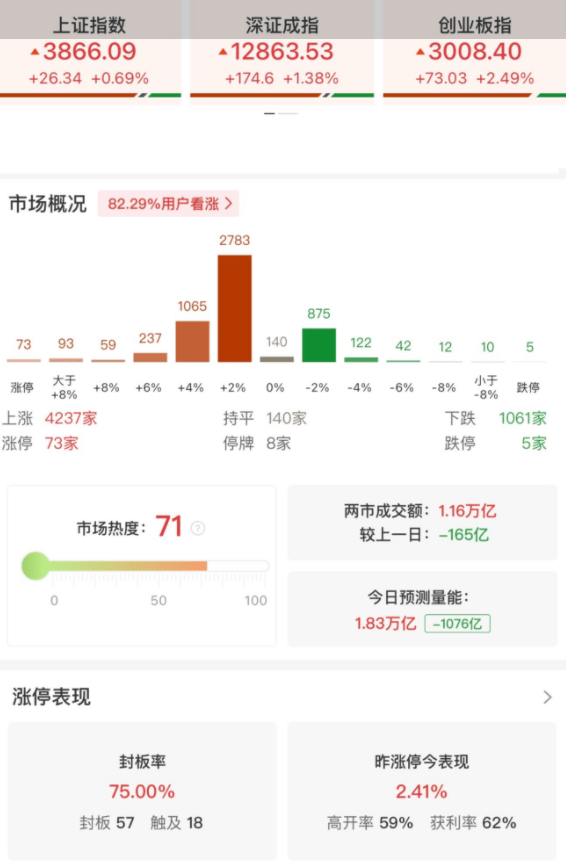
Core Viewpoint - The A-share market experienced a significant rebound, particularly in technology stocks, with the Shanghai Composite Index rising by 0.69%, the Shenzhen Component Index by 1.38%, and the ChiNext Index by 2.49% [2]. Market Performance - The total trading volume in the Shanghai and Shenzhen markets reached 1.16 trillion yuan, a decrease of 16.5 billion yuan compared to the previous trading day, with over 4,200 stocks showing gains [4]. - The A-share market's total market capitalization surpassed 24.5 trillion yuan [4]. Sector Highlights - Technology stocks, particularly in CPO, computing power, and 6G concepts, saw significant gains, with companies like Cambrian Technology reporting a revenue increase of 2386.38% year-on-year [4][6]. - Solid-state battery concepts gained traction, with companies like Hekang New Energy and Zhuhai Guanyu rising over 10% following announcements of technological breakthroughs in solid-state battery production [6][8]. - Precious metals experienced a notable decline, with the precious metals sector down by 6.09% [3]. Notable Stocks - Agricultural Bank of China saw its stock price rise over 1%, continuing a streak of 12 consecutive days of gains [4]. - Companies in the CPO sector, such as Huijie Ecology and Cambridge Technology, reached their daily limit up [8]. - The stock of Cambrian Technology expanded its gains to over 5%, trading at 1318.97 yuan [4].






ETF午评 | A股三大指数齐涨,日股创新高,日经ETF涨超5%,AI算力爆发,创业板人工智能ETF涨超4%,中概互联网ETF涨3.43%
Sou Hu Cai Jing· 2025-10-20 03:53
Market Performance - The Shanghai Composite Index rose by 0.69% at midday, with the index up by 2.49% overall, indicating a positive market sentiment [1] - Over 4,200 stocks showed gains in the market, highlighting broad-based participation in the rally [1] Sector Performance - Technology stocks experienced a significant rebound, with CPO, computing power, and 6G concepts leading the gains [1] - Solid-state batteries, robotics, and winter sports concepts also showed active performance [1] - Precious metals saw a substantial pullback, while rare earth permanent magnets and agriculture sectors faced declines [1] ETF Performance - Japanese stocks reached a historical high, with the Huaxia Fund's Nikkei ETF increasing by 5.22%, and the latest premium/discount rate at 4.13% [3] - The AI hardware sector surged, with multiple entrepreneurial AI ETFs rising over 4% [3] - The E Fund's China concept ETF rose by 3.43%, indicating strong interest in this segment [3] Gold and Mining Sector - Gold prices retreated, leading to declines in gold stock ETFs and gold ETFs, which fell by 4.35% and 3.81% respectively [4] - The gold ETF AU decreased by 3.52%, reflecting a broader downturn in the sector [4] - Mining and non-ferrous metal ETFs also dropped by over 1%, indicating weakness in these areas [4]

暴涨近7%!光模块再现骤升式行情,高“光”159363盘中量价齐升涨逾6%
Mei Ri Jing Ji Xin Wen· 2025-10-20 02:29
Group 1 - The core viewpoint of the news highlights a significant rebound in the optical module and computing hardware sector, with the AI-themed ChiNext ETF experiencing a jump of nearly 7% [1] - Major companies such as Zhongji Xuchuang and Tianfu Communication saw their stock prices increase by over 10%, while Xinyi Sheng rose by more than 7% [1] - The largest and most liquid AI-themed ChiNext ETF (159363) opened significantly higher, with a price increase of over 6% and a real-time transaction volume exceeding 500 million yuan, indicating a notable increase in trading activity [1] Group 2 - According to a report from Industrial Securities, overseas major clients have revised their procurement plans for 1.6T optical modules for 2026, increasing the forecast from 10 million to 20 million units, driven by the rapid growth in bandwidth demand for AI training and inference networks [1] - Guosheng Securities noted that the optical module market is experiencing rapid growth and technological iteration due to the continuous explosion of AI computing demand, with leading companies in the sector expected to maintain strong profitability and competitive advantages [1] - The first ChiNext AI ETF (159363) and its corresponding off-market connection (023407) have over 70% of their portfolio allocated to computing power and more than 20% to AI applications, with a focus on leading optical module company "Yizhongtian," which constitutes over 51% of the ETF [2]


滚动更新丨A股三大股指集体高开,科技股大幅反弹,黄金股回调
Di Yi Cai Jing· 2025-10-20 01:31
Market Overview - Technology stocks experienced a significant rebound, while insurance stocks surged. Conversely, gold stocks showed a notable pullback, and pharmaceutical, rare earth, and banking stocks declined [1]. - The A-share market opened with the Shanghai Composite Index rising by 0.67%, the Shenzhen Component Index increasing by 1.49%, and the ChiNext Index up by 2.45% [2]. Stock Performance - The Shanghai Composite Index reached 3865.55, up by 25.80 points (0.67%), while the Shenzhen Component Index was at 12877.70, up by 188.76 points (1.49%). The ChiNext Index stood at 3007.21, increasing by 71.84 points (2.45%) [3]. - Notable performers included technology stocks, particularly in the CPO, computing power, and consumer electronics sectors, with Zhongji Xuchuang opening over 9% higher. Insurance stocks also performed well, with China Life opening nearly 6% higher [3]. Sector Performance - The insurance sector rose by 2.81%, while the National Big Fund holdings increased by 2.30%. Other sectors such as semiconductors and storage chips also saw gains of 2.07% and 2.05%, respectively [4]. - The Hong Kong market opened strongly, with the Hang Seng Index up by 2.52% and the Hang Seng Tech Index rising by 3.9%. Notable gains were seen in tech stocks, with NetEase up by 6% and Alibaba nearly 5% higher [6][7]. New Listings - Haixi New Drug, a pharmaceutical company established in March 2012, opened its first trading day at a high of 18%, priced at 102 HKD. The company focuses on both generic and innovative drug pipelines, with a commercialized product portfolio addressing various diseases [5].


AI带动算力产业需求旺盛 景气度有望持续
Zheng Quan Shi Bao Wang· 2025-10-20 01:20
Core Viewpoint - OpenAI and Broadcom have announced a strategic partnership to develop and deploy custom AI chips and computing systems with a total power consumption of 10GW over the next four years, addressing the growing demand for large-scale computing [1] Group 1: AI Chip Development - OpenAI aims to advance its first self-developed AI chip to meet increasing large-scale computing needs [1] - The collaboration is expected to encourage other internet giants to follow suit in investing in computing power [1] Group 2: National Initiatives - On October 14, the Ministry of Industry and Information Technology launched a special initiative for "millisecond computing" focusing on the development of computing networks [1] - The initiative aims to create a high-speed, high-capacity, low-latency metropolitan network, providing millisecond-level computing resource access across various applications [1] Group 3: Market Outlook - CITIC Construction Investment Securities believes that the demand for computing power driven by AI remains strong and the industry outlook is positive [1] - Despite potential short-term market fluctuations and adjustments, the long-term perspective remains optimistic, recommending a focus on leading companies in the sector [1]

华尔街见闻早餐FM-Radio | 2025年10月20日
Hua Er Jie Jian Wen· 2025-10-19 23:03
Market Overview - Trade tensions eased, leading to a rebound in US stocks, with major indices rising over 1% for the week [4] - Regional bank stocks rebounded, with the regional bank index up nearly 2%, following financial reports that alleviated concerns over bad debts [4] - Gold prices reached a nine-week consecutive rise, with futures up over 5% for the week, marking the largest weekly gain in nearly five months [4] - The offshore RMB briefly rose above 7.12, reaching a three-week high before experiencing a decline [4] Key Events - The 20th Central Committee's Fourth Plenary Session was held from October 20 to 23, focusing on the formulation of the 15th Five-Year Plan [5][15] - A video call took place between Chinese Vice Premier He Lifeng and US Treasury Secretary Janet Yellen, discussing important bilateral economic issues and agreeing to hold new trade consultations soon [5][16] - The Chinese government announced a policy adjustment for duty-free shopping for travelers in Hainan, effective November 1 [6][17] Company News - Truist Financial reported a nearly 4% increase in stock price after financial results showed loan provisions below analyst expectations, easing market fears [17][21] - Ally Financial and Fifth Third also saw stock price increases, with Fifth Third's credit officer expressing confidence in the credit quality of their loan portfolio [21] - China's Zijin Mining reported a 57.14% year-on-year increase in net profit for Q3, driven by production increases and favorable gold prices [23] Economic Indicators - China's fiscal revenue for the first three quarters increased by 0.5% year-on-year, with a significant rise in transaction stamp duty revenue by 103.4% [20] - The US Treasury yield for ten-year bonds was approximately 4.01%, with a slight increase of about 4 basis points on the day [10]

注意,三大重磅消息,下周稳了……
Sou Hu Cai Jing· 2025-10-19 11:31
Group 1 - The core viewpoint indicates that upcoming negotiations between China and the U.S. are likely to ease tensions, while the Federal Reserve is expected to consider interest rate cuts, with uncertainty around the magnitude of the cut [1] - Key sectors to focus on include technology, artificial intelligence, computing power, domestic substitution, new energy, and semiconductors, suggesting potential investment opportunities amidst market adjustments [1] - The importance of patience in investment strategies is emphasized, particularly in light of upcoming quarterly reports, where performance does not always correlate with stock price movements [1] Group 2 - The market's critical levels are identified at 3850 and 3900 points, with a target of 4000 points, highlighting the need to adapt to market dynamics and find suitable investment directions [2] - The philosophy of investing is discussed, advocating for a strategy of buying low and selling high, while maintaining a long-term perspective [4]

如何看待当下的光模块行情?
GOLDEN SUN SECURITIES· 2025-10-19 08:44
Investment Rating - The report maintains a "Buy" rating for key companies in the optical module industry, including Zhongji Xuchuang and Xinyi Sheng [5][11]. Core Insights - The optical module market is experiencing rapid growth driven by the increasing demand for AI computing power, with price changes reflecting a healthy industry development rather than simple supply-demand dynamics [1][23]. - Optical modules are classified as technology-driven products rather than standard commodities, with their pricing following a unique industry pattern of "new product high gross margin → smooth decline after scaling → technological iteration" [2][24]. - Price reductions in optical modules do not necessarily lead to decreased profitability for companies; instead, leading firms can maintain or even enhance their profit levels through scale effects, process improvements, and supply chain optimization [3][25]. - The competition in the optical module industry has shifted focus from individual product pricing to continuous innovation and comprehensive solution offerings, which form the core competitive advantage of companies [4][27]. Summary by Sections Investment Strategy - The report recommends focusing on the optical communication sector, highlighting key players such as Zhongji Xuchuang, Xinyi Sheng, and Tianfu Communication, among others [9][14]. - It emphasizes the importance of technological iteration and product upgrades as the main growth drivers in the optical module industry [30]. Market Review - The communication sector has seen a decline, with operators performing relatively better compared to other segments [18][19]. - The report notes that the optical communication index has decreased by 6.7%, indicating challenges within the sector [22]. Optical Module Market Dynamics - The report outlines that the iteration cycle for 800G and 1.6T optical communication has shortened from 3-4 years to 1-2 years, with significant shipments expected for 800G and gradual ramp-up for 1.6T [2][24]. - The unique pricing model of optical modules is characterized by a predictable decline in prices as technology matures and production scales up [2][24]. Profitability and Competitive Barriers - Leading optical module companies have shown an ability to increase gross and net profit margins despite price reductions, supported by cost control and technological advancements [3][25]. - The report highlights that the core competitive barriers in the optical module industry are built around product upgrades and comprehensive capabilities rather than just pricing [4][27]. Recommendations - The report continues to favor the computing power sector and recommends investing in leading optical module companies while also suggesting attention to emerging players in the domestic computing power supply chain [8][29].
利好来了,周末消息(汇总)!
Xin Lang Cai Jing· 2025-10-19 06:02
Group 1 - The U.S. Senate is considering imposing a 500% tariff on Russian oil, which initially caused a market downturn, but later reversed after comments from a U.S. official suggested that high tariffs are unsustainable [1] - A video call between Chinese and U.S. trade leaders is set to take place, aiming to implement agreements made by the two countries' leaders and initiate new trade discussions, which may ease trade tensions [1] Group 2 - The Shanghai Stock Exchange will review the IPO application of Muxi Integrated Circuits on October 24, which is significant for the semiconductor industry, particularly in GPU and AI chip production [3] - NVIDIA's new AI chip, Blackwell, has begun production in the U.S., indicating a strong expansion strategy and potentially impacting the global semiconductor supply chain [3] - Tianbing Technology is preparing for an IPO after successfully launching a batch of satellites, reflecting the growing momentum in the commercial space sector [3] Group 3 - The Chinese Ministry of Finance announced a 50% VAT refund on self-generated electricity products from offshore wind power starting November 1, which will lower costs and improve profitability for companies in coastal regions [4] - Chery showcased a solid-state battery module with an energy density of 600Wh/kg and a range of 1200-1300 km, signaling a significant technological breakthrough in battery technology [4] - The humanoid robot sector is expected to see increased activity, with various upcoming events and product launches that may drive interest and investment [5]
AI全面开战!OpenAI刚放的三个大招
老徐抓AI趋势· 2025-10-18 15:28
Core Insights - OpenAI is entering a new phase of AI development characterized by a competition for computing power, a revolution in video technology, and the implementation of intelligent agents [2][3] Group 1: Computing Power and Infrastructure - OpenAI has announced a partnership with AMD to build a 6GW computing center, which is equivalent to the annual electricity consumption of a large city, indicating a significant investment in AI infrastructure [3] - The collaboration with AMD, Nvidia, and Broadcom highlights the strategic importance of a diversified supply chain in AI development, as reliance on a single chip manufacturer could hinder progress [3] - OpenAI's agreements with Samsung and SK Hynix for storage solutions are substantial, amounting to double the current global demand, reflecting the explosive need for data storage in AI model training and operation [5] Group 2: AI Video Revolution - The launch of Sora 2 marks a pivotal moment in AI, transitioning from a demo to a usable but costly product, indicating that AI capabilities are improving and becoming more accessible [6] - Sora 2 signifies a shift in content creation, allowing anyone to generate high-quality videos without the need for traditional production resources, thus democratizing content creation [6] Group 3: Intelligent Agents and Organizational Change - OpenAI's introduction of an enterprise-level AI platform at the developer conference represents a shift from AI as a tool to AI as a part of organizational structure, enabling businesses to deploy various intelligent agents for different roles [7] - This transition suggests that future companies will be restructured around human-AI collaboration, emphasizing the need for adaptation in business models [7] Group 4: Investment and Future Trends - OpenAI's significant investments in computing power are viewed as a rational strategy to secure future capabilities, as the demand for AI continues to grow [8] - The ongoing competition for computing resources is not just an industry issue but a national-level resource contest, as evidenced by investments from major corporations and governments [8] - Individuals are encouraged to understand, utilize, and invest in AI, as the future wealth divide will be influenced by one's relationship with AI technology [9]