去美元化

Search documents
西南期货早间评论-20260122
Xi Nan Qi Huo· 2026-01-22 02:00
1. Report Industry Investment Ratings No industry investment ratings were provided in the report. 2. Core Views of the Report - The macro - economic recovery momentum needs to be strengthened, and it is expected that the monetary policy will remain loose. The Treasury bond futures are under pressure, and caution is advised. The stock index is expected to have its fluctuation center gradually move up, and previous long positions can be held. The precious metals market is expected to have significant fluctuations, and long positions can be liquidated and wait and see. The prices of rebar and hot - rolled coils may continue to be weakly volatile. The iron ore market's supply - demand pattern has weakened, and it may continue to correct in the short term. The coking coal and coke futures may continue to be weak in the short term. The ferroalloy has an overall over - supply pressure, and long positions in the low - level range can be considered after the price decline. The crude oil is expected to continue to rebound after the correction. The fuel oil, polyolefin, and synthetic rubber may have long - position opportunities. The natural rubber is expected to have a wide - range shock. The PVC may be strongly volatile. The urea is expected to be in a strong - oscillating state. The PX may be in an oscillating adjustment. The PTA may be in an oscillating operation. The ethylene glycol may face pressure in the short term, and it is advisable to wait and see. The short - fiber may follow the raw material price to oscillate. The bottle - chip may follow the cost side to oscillate. The soda ash is suitable for range operation in the short term. The glass is expected to oscillate before the Spring Festival. The caustic soda price is expected to continue to be weak in the short term. The pulp market is under pressure due to inventory and weak demand. The lithium carbonate price may have greater short - term fluctuations. The copper price is at a high level and may be adjusted. The aluminum price may be adjusted at a high level. The zinc price may face pressure and correct. The lead price may maintain a range - bound oscillation. The tin price may be strongly volatile. The nickel is in an over - supply pattern. The soybean meal may have long - position opportunities in the low - cost support range, and the soybean oil may consider liquidating long positions when the price rises. The palm oil may consider long - position opportunities after the correction. The rapeseed meal and oil may consider reducing and holding the spread between soybean meal and rapeseed meal and between soybean oil and rapeseed oil. The cotton price is expected to be strongly volatile in the medium - to - long term. The sugar price is expected to be bearish in the medium - to - long term. The apple price is expected to be strongly volatile in the medium - to - long term. The live pig market may face supply pressure in the first quarter, and it is advisable to wait and see. The egg market can consider a positive spread strategy. The corn and starch may follow the corn market, and the supply pressure of corn needs to be further released. The log price is expected to be stable, and the futures may oscillate at the bottom [5][6][7][10][12][14][15][19][21][24][26][29][30][35][37][39][40][42][43][45][46][48][49][51][52][54][56][58][60][63][64][66][68][71][73][74][77][78][81][84][85][87][89]. 3. Summary According to the Directory Treasury Bonds - On the previous trading day, most Treasury bond futures closed higher. The central bank conducted 363.5 billion yuan of 7 - day reverse repurchase operations, with a net investment of 122.7 billion yuan. The People's Bank of China held a payment and settlement work meeting. The Treasury bond futures are under pressure due to factors such as the relatively low yield, the stable economic recovery, and the rising risk appetite [5][6]. Housing and Real Estate - The Ministry of Housing and Urban - Rural Development stated that the real estate market is city - based, and cities should use regulatory autonomy. The government will continue to implement policies according to cities, support reasonable financing of real estate enterprises and housing demand, and promote the stable operation of the real estate market [6]. Stock Index - On the previous trading day, stock index futures showed mixed performance. The central bank in Guangdong adjusted the minimum down - payment ratio for commercial housing loans. The domestic economic recovery momentum is weak, but the asset valuation is low, and the market sentiment has warmed up. It is expected that the fluctuation center of the stock index will gradually move up [7]. Precious Metals - On the previous trading day, gold and silver futures rose. The global trade and financial environment is complex, which is beneficial to the allocation and hedging value of gold. However, the speculative sentiment has heated up significantly, and it is advisable to liquidate long positions and wait and see [9][10]. Rebar and Hot - Rolled Coils - On the previous trading day, rebar and hot - rolled coil futures declined slightly. In the medium term, the prices are dominated by industry supply - demand logic. The demand for rebar is decreasing year - on - year, and the market is entering the off - season. The supply pressure has been relieved, and the inventory is slightly higher than last year. The prices may continue to be weakly volatile, and the hot - rolled coils may have a similar trend [12]. Iron Ore - On the previous trading day, iron ore futures continued to correct. The demand for iron ore has decreased, the supply is under pressure, and the port inventory is at a high level in the past five years. The supply - demand pattern has weakened, and it may continue to correct in the short term [14]. Coking Coal and Coke - On the previous trading day, coking coal and coke futures continued to fall. The production of coking coal is stable, and the demand from downstream coke enterprises has improved. The price increase of coke has been resisted by steel mills. The futures may continue to be weak in the short term [15]. Ferroalloy - On the previous trading day, the manganese - silicon and silicon - iron futures had different performances. The supply of manganese ore has changed, the cost of ferroalloy has a narrow - range fluctuation, and the production and demand are both weak. The overall over - supply pressure continues, and long positions in the low - level range can be considered after the price decline [17][18][19]. Crude Oil - On the previous trading day, INE crude oil oscillated higher. Speculators have turned to hold net long positions in US crude oil futures, the number of oil and gas rigs has declined, and the US has adjusted its policy on Venezuelan energy. The crude oil is expected to continue to rebound after the correction [20][21]. Fuel Oil - On the previous trading day, fuel oil oscillated upward. The export volume of fuel oil from Singapore has increased, but the high inventory restricts the increase. The price difference in the spot market has improved, and long - position opportunities can be considered [23][24]. Polyolefin - On the previous trading day, the PP market in Hangzhou had mixed quotes, and the LLDPE price in Yuyao declined. The northern cold weather and the southern labor shortage have affected the production, but the demand from high - end manufacturing for modified PP is stable. The profit of some enterprises has recovered, and long - position opportunities can be considered [25][26]. Synthetic Rubber - On the previous trading day, synthetic rubber futures rose. The market rise was supported by the increase in butadiene price and high device operation rate, but the downstream demand was weak. It is expected to be strongly volatile, and long - position opportunities can be considered [27][28][29]. Natural Rubber - On the previous trading day, natural rubber futures rose. The domestic rubber - tapping season is coming to an end, the demand for raw materials has increased, the demand from the tire industry has improved, but the inventory has continued to accumulate. It is expected to have a wide - range shock [30][31]. PVC - On the previous trading day, PVC futures declined. It is in the traditional off - season, but the policy expectation may make the market strongly volatile. The production capacity utilization rate has decreased, the demand from downstream enterprises has declined slightly, the cost has changed, and the inventory has increased. It may be strongly volatile [32][33][35]. Urea - On the previous trading day, urea futures rose. The export demand and cost support make the price strongly oscillating. The daily production is high, the demand from the compound fertilizer industry is stable, and the inventory is lower than expected [36][37]. PX - On the previous trading day, PX futures rose. The PXN spread and short - process profit are stable, the operating rate has increased, and the cost side has support. It may be in an oscillating adjustment [38][39]. PTA - On the previous trading day, PTA futures rose. The supply has decreased slightly, the demand from the polyester industry has decreased, and the processing fee is at an average level. It may be in an oscillating operation [40]. Ethylene Glycol - On the previous trading day, ethylene glycol futures declined. The supply may increase, the port inventory is under pressure, and the expected arrival at the port has increased significantly. It may face pressure in the short term, and it is advisable to wait and see [41][42]. Short - Fiber - On the previous trading day, short - fiber futures rose. The supply is at a relatively high level, the sales have improved, and the terminal factory is digesting raw material inventory. It may follow the raw material price to oscillate [43]. Bottle - Chip - On the previous trading day, bottle - chip futures rose. The load has decreased slightly, there will be concentrated production cuts around the Spring Festival, the export growth rate has increased, and it may follow the cost side to oscillate [44][45]. Soda Ash - On the previous trading day, soda ash futures declined. The supply is abundant, the inventory has continued to accumulate, and the downstream demand is average. It is suitable for range operation in the short term [46]. Glass - On the previous trading day, glass futures declined. The supply is abundant, the inventory has decreased slightly, but the trader's inventory has increased. The market sentiment is stable, and it is expected to oscillate before the Spring Festival [47][48]. Caustic Soda - On the previous trading day, caustic soda futures declined. The supply is sufficient, the inventory has continued to accumulate, and the demand is stable. The price is expected to continue to be weak in the short term [49]. Pulp - On the previous trading day, pulp futures declined slightly. The import pulp market sentiment is weak, the price trend is divided, the inventory is at a high level and continues to accumulate, and the demand from paper mills is weak [50][51]. Lithium Carbonate - On the previous trading day, lithium carbonate futures rose. The market trading sentiment has cooled down. The supply is abundant, the demand from the energy storage and power battery sectors has improved, and the inventory has decreased. The price may have greater short - term fluctuations [52]. Copper - On the previous trading day, Shanghai copper futures were flat. The macro - environment is complex, the supply is tight, but the high price has suppressed the demand, and the inventory has increased. The price is at a high level and may be adjusted [53][54][55]. Aluminum - On the previous trading day, Shanghai aluminum and alumina futures rose. The bauxite supply is abundant, the alumina market is oversupplied, the electrolytic aluminum production increase is limited, and the demand is affected by the off - season and high price. The price may be adjusted at a high level [56][57]. Zinc - On the previous trading day, Shanghai zinc futures rose. The raw material supply is tight, the processing fee is under pressure, the consumption is seasonally weak, and the price may face pressure and correct [58][59]. Lead - On the previous trading day, Shanghai lead futures rose. The supply of lead concentrate is tight, the production of primary lead is restricted, the demand is differentiated, and the inventory is low. The price may maintain a range - bound oscillation [60][61]. Tin - On the previous trading day, Shanghai tin futures rose. The supply is tight due to geopolitical conflicts and slow production resumption, the demand has some resilience, and the inventory has decreased. The price may be strongly volatile [62][63]. Nickel - On the previous trading day, Shanghai nickel futures rose. The macro - environment is complex, the Indonesian nickel policy has changed, the supply cost may increase, but the downstream demand is weak, and it is in an over - supply pattern [64]. Soybean Meal and Soybean Oil - On the previous trading day, soybean meal futures declined slightly, and soybean oil futures rose. The South American soybean harvest is slow, the dollar has weakened, the domestic soybean import has slowed down, the oil - mill crushing is in a loss, and the demand for soybean meal and oil has different performances. The soybean meal may have long - position opportunities in the low - cost support range, and the soybean oil may consider liquidating long positions when the price rises [65][66]. Palm Oil - The Malaysian palm oil price has risen to a seven - week high. The export has increased, the production has decreased, the domestic import has decreased, and the inventory is at a medium level in the past seven years. Long - position opportunities can be considered after the correction [67][68]. Rapeseed Meal and Rapeseed Oil - Canadian rapeseed futures rose. China will reduce the comprehensive tariff on Canadian rapeseed. The domestic rapeseed, rapeseed oil, and rapeseed meal imports have changed, and the inventory has increased. The spread between soybean meal and rapeseed meal and between soybean oil and rapeseed oil can be considered to be reduced and held [69][70][71]. Cotton - On the previous trading day, domestic cotton futures declined. The USDA supply - demand report is favorable, the domestic cotton production is high but the inventory accumulation is lower than expected, and the future planting area may be reduced. The demand is resilient. It is expected to be strongly volatile in the medium - to - long term, and long positions can be considered after the correction [72][73][74]. Sugar - On the previous trading day, Zhengzhou sugar futures declined. The Indian sugar production is expected to increase, the domestic sugar supply is sufficient, and there is pressure from domestic and imported sugar. The price may be bearish in the medium - to - long term [76][77][78]. Apple - On the previous trading day, domestic apple futures rebounded. The inventory is at a low level in recent years, the new - season apple production and quality have declined. It is expected to be strongly volatile in the medium - to - long term, and long positions can be considered after the correction [80][81][82]. Live Pig - On the previous trading day, live - pig futures declined. The northern and southern pig prices have declined, the supply is abundant, and the consumption change during the Spring Festival needs to be followed. The first - quarter supply may face pressure, and it is advisable to wait and see [83][84]. Egg - On the previous trading day, egg futures rose. The egg production cost has increased, the inventory of laying hens is at a high level, and the supply may be high in January. A positive spread strategy can be considered [85]. Corn and Starch - On the previous trading day, corn and corn - starch futures rose. The northern port inventory is low, the supply pressure needs to be released, the demand for corn starch has improved slightly, and it may follow the corn market [86][87]. Log - On the previous trading day, log futures rose. The supply is abundant, the inventory has different changes, the demand from downstream processing plants has increased. The price is expected to be stable, and the futures may oscillate at the bottom [88][89].
现货黄金历史性站上4800美元/盎司,黄金股票ETF大涨6.33%点评
Sou Hu Cai Jing· 2026-01-22 01:20
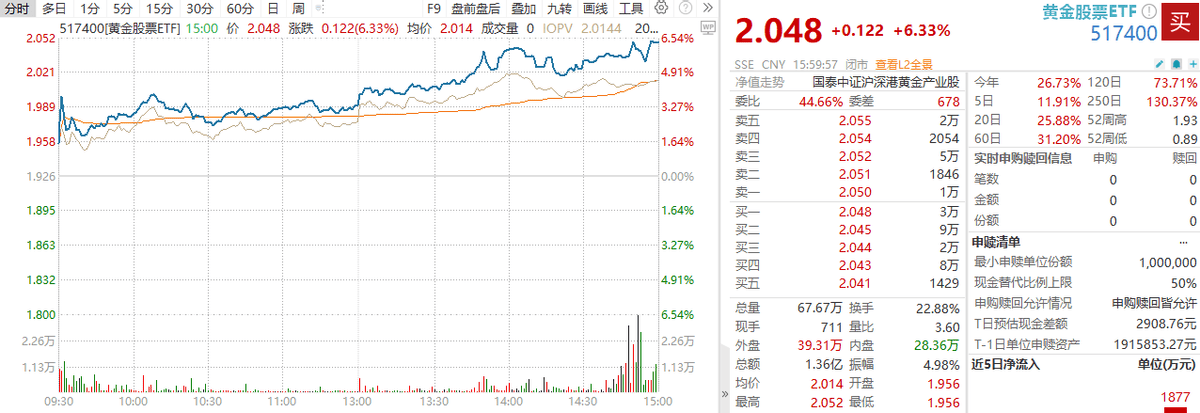
Core Viewpoint - The market experienced a pullback after a rise, with significant trading volume in the Shanghai and Shenzhen stock markets. Gold prices reached a historic high, leading to substantial gains in gold-related ETFs and funds [1][8]. Market Performance - On January 21, the Shanghai Composite Index rose by 0.08%, the Shenzhen Component Index increased by 0.7%, and the ChiNext Index gained 0.54% [1]. - The total trading volume in the Shanghai and Shenzhen markets was 2.6 trillion yuan, a decrease of 177.1 billion yuan from the previous trading day [1]. Gold Price Movement - Gold prices reached a peak of $4,888 per ounce, driven by geopolitical tensions and market uncertainties [8]. - Gold Stock ETF (517400) closed up by 6.33%, with a year-to-date increase of 26.73% [2][13]. - Gold Fund ETF (518800) closed up by 2.93%, with a year-to-date increase of 11.60% [5][13]. Geopolitical Influences - Increased geopolitical tensions, particularly related to U.S. President Trump's statements regarding Greenland, have contributed to rising gold prices [8]. - Canadian Prime Minister Carney's remarks at the World Economic Forum highlighted a shift in the global order, which may impact investor sentiment towards U.S. assets [9]. Central Bank Actions - The Polish central bank approved a plan to purchase 150 tons of gold, emphasizing gold's role as a stable asset independent of other countries' monetary policies [10]. - Global central banks continue to increase their gold reserves, supporting the bullish outlook for gold prices [10]. Future Outlook - Analysts predict that gold prices could continue to rise, with some forecasting an average price of $4,741.97 per ounce by 2026, a 38% increase from the previous year [12]. - The long-term logic for gold remains strong, supported by factors such as geopolitical risks, a potential U.S. interest rate cut cycle, and ongoing central bank purchases [13].

2026年1月22日,国内黄金9995价格多少钱一克?
Sou Hu Cai Jing· 2026-01-22 01:19
Core Insights - Domestic gold price (99.95%) reached 1091.8 CNY per gram, up by 1.09% [1] - International gold price reported at 4787.3 USD per ounce, down by 1.04% [2] Group 1: Influential News on Gold Prices - Trump's softened stance on Greenland reduces risk aversion, leading to a temporary retreat in international gold prices, which fell to 4808 USD per ounce [3] - Central banks globally continue to increase gold reserves, with a projected net purchase of 297 tons by 2025, supporting high gold prices amid a trend of de-dollarization [4] - Concerns over the independence of the Federal Reserve and expectations of at least two interest rate cuts by 2026 may lower the opportunity cost of holding gold, further driving investment into gold assets [5]
摩根士丹利:黄金对美元霸权的挑战“看不到尽头”
Xin Hua Cai Jing· 2026-01-22 01:18
Core Insights - Morgan Stanley indicates that the role of the US dollar in the global system is gradually being weakened, but credible alternative currencies remain limited, making gold the biggest challenger to the dollar [1] Group 1: Dollar's Declining Influence - The international influence of the US dollar has declined across multiple indicators, including its share in central bank foreign exchange reserves and its usage in corporate and emerging market sovereign issuances [1] - Despite the decline, the dollar still holds the largest share in global reserves [1] Group 2: Gold's Rising Position - When considering gold, the situation changes significantly; gold's share in central bank holdings has increased from approximately 14% to between 25% and 28%, with this upward trend showing "no signs of slowing down" [1] - Risk premiums and hedging behaviors will continue to exert pressure on the dollar while supporting gold demand [1] Group 3: Policy Factors - The policy factors driving "de-dollarization" are currently in a state of "neutral to slightly accelerating," and the evolution of these policies in the short term will determine how far the de-dollarization trend will go [1]

铜冠金源期货商品日报-20260122
Tong Guan Jin Yuan Qi Huo· 2026-01-22 01:17
Report Industry Investment Rating No relevant content provided. Core Viewpoints of the Report - Overseas, Trump's speech in Davos and agreements on Greenland and NATO, along with the US Supreme Court's decision, led to the resurgence of the "TACO trade," affecting the dollar, gold, silver, US bonds, stocks, and commodities [2]. - Domestically, the 2025 economic data was better than expected, with A - shares showing a positive mid - term trend despite short - term adjustments [3]. - Different commodities have different trends. For example, precious metals' gold - silver ratio is expected to rise, copper prices will adjust in the short term, aluminum prices will fluctuate at high levels, etc. [4][6][8] Summary by Related Catalogs Macroeconomic Situation - Overseas: Trump defined Greenland as a US core security interest, reached a "future agreement framework" with NATO on Greenland and Arctic security, postponed the February 1 tariff measures, and the US Supreme Court maintained the ban on immediately dismissing Fed Governor Cook. The "TACO trade" reappeared, with the dollar index rebounding to 98.8, gold and silver retreating, the 10 - year US Treasury yield falling to 4.24%, and US stocks rising over 1% after sharp fluctuations [2]. - Domestic: The 2025 economic data was better than expected, with export resilience exceeding expectations, consumption falling as expected, and investment being a short - term drag. Fiscal and monetary policies will moderately support the economy in Q1. A - shares rose on Wednesday, with the Sci - tech Innovation 50 leading the gain by over 3%, and the market entering a stage of volume - shrinking and differentiation [3]. Precious Metals - On Wednesday, COMEX gold futures rose 1.48% to $4836.20 per ounce, and COMEX silver futures fell 1.78% to $92.95 per ounce. LBMA predicted that the average silver price in 2026 would reach $79.57 per ounce. However, after the explosive growth in 2025, the market is over - inflated. The gold - silver ratio is at a 50 - year low and is expected to rise, with gold outperforming silver in the short term [4][5]. Copper - On Wednesday, Shanghai copper's main contract weakened, and LME copper sought support at $12,700. Trump's agreement with NATO on Greenland reduced market risk - aversion, causing copper prices to adjust downward. High copper prices dragged down domestic demand, and the global visible inventory increased. In the short term, copper prices will adjust, but the adjustment range may be limited [6][7]. Aluminum - On Wednesday, Shanghai aluminum's main contract closed at 24,155 yuan/ton, up 0.56%. The easing of geopolitical tensions and the increase in downstream purchases during price adjustments limited the decline of aluminum prices. The position in the Shanghai aluminum market rebounded, and aluminum prices are expected to fluctuate at high levels [8][9]. Alumina - On Wednesday, the main alumina futures contract closed at 2,672 yuan/ton, down 0.71%. A Henan alumina plant's maintenance had limited impact on production. The import window remained open, inventory continued to accumulate, and alumina supply remained in surplus, continuing its weak trend [10]. Cast Aluminum - On Wednesday, the main cast aluminum alloy futures contract closed at 22,895 yuan/ton, up 0.42%. The cost of scrap aluminum did not decline further, and there was a game between supply and demand in the market. Cast aluminum prices will remain volatile [11]. Zinc - Trump's agreement on Greenland reduced risk - aversion, and the dollar rebounded, putting pressure on zinc prices. Teck's downward adjustment of the production guidance for the Antamina mine in 2026 and supply disruptions from the Iran situation tightened the supply of zinc ore. However, it is currently the consumption off - season, and high - priced raw materials suppress demand. Zinc prices will remain volatile [12][13][14]. Lead - Downstream battery enterprises' weak purchasing sentiment and high inventory suppressed lead prices. However, some smelters plan to increase production cuts, which will ease the decline in lead prices. Lead prices are expected to maintain a weak and volatile trend [15]. Tin - Trump's agreement on Greenland reduced market risk - aversion, and the dollar rebounded, causing tin prices to give back some gains. High - level inventories decreased, but downstream demand for high - priced raw materials was weak. Tin prices are expected to fluctuate widely at high levels, with macro - sentiment leading the price movement [16]. Steel (Screw and Coil) - On Wednesday, steel futures fluctuated. Affected by seasonal demand, market transactions weakened. The steel market is in a situation of weak supply and demand, and steel prices are expected to fluctuate [17]. Iron Ore - On Wednesday, iron ore futures fluctuated. Supply remained high, and port inventory increased. Demand was weak in the off - season. Although there was an expectation of pre - holiday inventory replenishment, the overall supply was stronger than demand, and iron ore prices are expected to fluctuate [18]. Coking Coal and Coke (Double Coking) - On Wednesday, double coking futures fluctuated and adjusted. The supply of coking coal and coke was loose due to coal mine resumption, while downstream demand was weak. The supply - demand contradiction was prominent, and prices are expected to fluctuate weakly [19]. Soybean and Rapeseed Meal - On Wednesday, the soybean meal 05 contract fell 0.04%, and the rapeseed meal 05 contract rose 0.36%. Argentina's soybean - producing areas may turn dry, which may affect yields. Domestic pre - holiday inventory replenishment and oil mills' price - holding intentions support the market. Soybean meal prices are expected to fluctuate at low levels [20]. Palm Oil - On Wednesday, the palm oil 05 contract rose 1.28%. From January 1 - 20, 2026, Malaysia's palm oil production decreased by 16.06% month - on - month. Supply contraction and inventory reduction are expected to support palm oil prices, which are expected to fluctuate strongly in the short term [21][22].
从卡尼演到丹麦抛售美债 瑞银首席:美国或成为自身成功的“受害者”
Di Yi Cai Jing· 2026-01-22 01:16
2026年1月21日,瑞士达沃斯。 "从某种意义上说,美国未来可能会成为自身成功的受害者。"海菲尔说。 一场演讲与一个投资决定 海菲尔提到的第一个背景,并非来自金融市场,而是政治叙事。 在达沃斯论坛期间,加拿大总理、前英国央行行长马克·卡尼的一场演讲,被不少与会者反复提及。卡 尼在演讲中直言,以规则为基础的旧国际秩序已经结束,世界正在进入大国竞争时代。在这种环境下, 中等国家如果继续停留在对过去的怀旧之中,将难以应对现实挑战。 "我觉得他说出了很多人正在感受到、但还没有完全说清楚的东西。"海菲尔如此评价。在他看来,这种 判断并不只是政治层面的感慨,而正在逐步反映到投资决策中。 丹麦投资机构的举动,正是这种情绪在资产配置层面的体现之一。尽管体量有限,但在当前高度敏感的 市场环境下,任何"减持美债"的表态,都会被迅速放大解读。 美国总统特朗普时隔数年后再次出席达沃斯论坛,并发表了特别讲话。随后,在与北约秘书长吕特会晤 后,特朗普称,暂时不会按原定计划向反对美国得到格陵兰岛的欧洲八国加征关税。 同一天,第一财经记者来到瑞银集团位于达沃斯小镇的办事处,采访瑞银财富管理全球首席投资总监马 克·海菲尔(Mark Haef ...
从卡尼演到丹麦抛售美债,瑞银首席:美国或成为自身成功的“受害者”
Di Yi Cai Jing· 2026-01-22 01:00
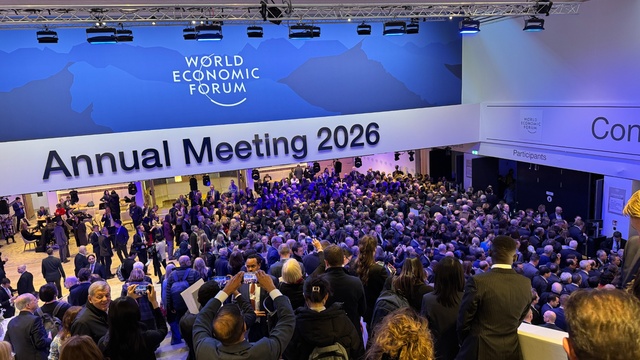
"过去几年里,黄金和大宗商品的强势表现,某种程度上反映了资金逐步远离美元资产的过程。" 2026年1月21日,瑞士达沃斯。 美国总统特朗普时隔数年后再次出席达沃斯论坛,并发表了特别讲话。随后,在与北约秘书长吕特会晤 后,特朗普称,暂时不会按原定计划向反对美国得到格陵兰岛的欧洲八国加征关税。 同一天,第一财经记者来到瑞银集团位于达沃斯小镇的办事处,采访瑞银财富管理全球首席投资总监马 克·海菲尔(Mark Haefele)。达沃斯论坛期间,瑞银集团高层代表常常在这栋低调的小楼里,同来自全 球各地的投资人与合作伙伴进行交流。 围绕美国、格陵兰岛和其他地缘政治局势的讨论在本届达沃斯论坛期间不曾断绝。此前一天,丹麦公共 投资机构"学界养老基金"宣布,将在本月底前抛售价值1亿美元的美国国债,在会场内外引发了不小的 讨论。 在海菲尔看来,这一事件本身并不足以动摇美国国债市场,但它所折射出的,却是全球投资者正在"边 际层面"重新审视美国资产敞口的现实。 "从某种意义上说,美国未来可能会成为自身成功的受害者。"海菲尔说。 一场演讲与一个投资决定 海菲尔提到的第一个背景,并非来自金融市场,而是政治叙事。 在达沃斯论坛期间,加拿大 ...

申万宏源研究晨会报告-20260122
Shenwan Hongyuan Securities· 2026-01-22 00:57
Group 1: Textile and Apparel Industry Insights - The textile and apparel industry is expected to see a gradual recovery in domestic demand in 2026, with a focus on high-growth consumption areas such as high-performance outdoor brands, discount retail, personal care, and sleep economy [9][13] - The retail sales of clothing, shoes, and textiles in China reached 1.52 trillion yuan in 2025, showing a year-on-year increase of 3.2%, with December experiencing a slowdown in growth due to warmer winter temperatures [9] - The export value of China's textile and apparel in 2025 was $293.8 billion, a decrease of 2.6% year-on-year, indicating a shift in supply chain orders towards countries like Vietnam, which saw a 7% increase in textile exports [9] Group 2: Performance of Key Brands - Major outdoor brands such as Anta, Li Ning, and 361 Degrees are expected to perform well, while discount retailers like Hailan Home are also projected to grow [10][13] - The performance of women's apparel brands is showing signs of recovery, with companies like Xinha and Ge Li Si expected to see significant growth in revenue and net profit [10] - The children's clothing segment is anticipated to stabilize, with brands like Semir and Jiama showing slight growth in revenue [10] Group 3: Non-woven Fabric Industry - The non-woven fabric industry is benefiting from quality upgrades and expanding demand, with companies like Sturdy, Yanjiang, and Nobon expected to see revenue growth of 10% to 20% in 2025 [11][12] - The global market for wet and dry wipes is projected to be worth hundreds of billions, with China experiencing faster growth than the global average [11] Group 4: Global Interest Rate Trends and Impacts - Recent increases in long-term interest rates in developed countries have led to global market volatility, with the 30-year Japanese government bond yield rising by 41 basis points and the 30-year U.S. Treasury yield increasing by 7 basis points [14][15] - The geopolitical tensions, particularly involving the U.S. and Europe, have prompted a reallocation of global funds, with potential risks for U.S. Treasury securities [15] Group 5: Banking Sector Performance - Ningbo Bank reported a revenue of 71.97 billion yuan in 2025, with a year-on-year growth of 8%, driven by an increase in net interest income and non-interest income [18][19] - The bank's non-performing loan ratio remained stable at 0.76%, indicating effective risk management [19] - Industrial Bank also showed a slight revenue increase of 0.2% in 2025, with expectations for steady recovery in 2026 [21][23]
“5000美元/盎司指日可待” 分析人士:黄金市场波动或加剧
Qi Huo Ri Bao· 2026-01-22 00:41
21日,现货黄金价格一举突破4800美元/盎司关口,逼近4900美元/盎司,再创历史新高。 多家机构发布了最新预测。 Kitco黄金调查:华尔街机构对黄金短期走势分歧明显(50%看涨、25%看跌、25%持平),而散户仍坚 定看涨(78%)。 "本轮金价上涨的主要原因是地缘局势动荡引发的极端避险情绪。"正信期货贵金属分析师蒲祖林表示, 本月以来委内瑞拉事件、伊朗局势、美联储主席被起诉风波和格陵兰岛事件等使市场避险情绪持续升 温,资金大量涌入更具安全性的黄金和相关大宗商品。 山金期货贵金属分析师林振龙告诉记者,这一轮地缘风险的特殊性在于欧美出现裂痕——特朗普宣称对 多个欧洲国家加征关税,以胁迫获取格陵兰岛控制权,既引发美欧贸易战担忧,更动摇了北约同盟关 系,这种非常规的地缘博弈极大地动摇了市场信心。 齐盛期货贵金属分析师刘晓琳补充称,以往与黄金同步走强的美元、长端美债此次同步遭遇抛售,资金 呈现"独宠黄金"的格局,黄金作为"中性资产"的战略价值被重新定义。 展望后市,蒲祖林表示,短期来看,地缘冲突背景下的避险需求仍是黄金价格上涨的主要驱动力。特朗 普政府在中期选举年及访华前的窗口期可能再度上演"TACO"交易模式 ...
美股大跌背后,格陵兰岛争端引爆“卖出美国”交易
阿尔法工场研究院· 2026-01-22 00:08
Core Viewpoint - The article discusses the recent geopolitical tensions surrounding Greenland and its impact on global markets, particularly the U.S. stock market, which experienced significant declines. It highlights the potential for gold to become a safe haven asset amid these uncertainties [4][5][14]. Market Reactions - On January 20, 2026, the S&P 500 index fell by 2.1%, erasing all gains for the year, as geopolitical tensions escalated due to U.S. President Trump's ambitions regarding Greenland [5]. - The VIX, a measure of market volatility, reached its highest level since November of the previous year, while U.S. long-term Treasury yields rose to a four-month high [5]. - The dollar weakened against most major currencies, and Bitcoin saw a significant drop, while gold prices hit a historical high, surpassing $4,700 [5][10]. U.S. Trade Policy and Its Implications - President Trump announced a 10% tariff on imports from eight European countries, which could lead to a 0.1% to 0.2% decline in the actual GDP of the affected nations [7]. - This move has prompted global investors to consider reducing their exposure to U.S. assets, reflecting a "Sell America" sentiment [7][8]. - Goldman Sachs does not anticipate a broad beta adjustment in the U.S. market but expects a continued rotation trend, favoring AI-enabled and productivity-enhancing stocks over software stocks [8]. Gold as a Safe Haven - Global macro fund managers suggest that gold is the only asset that will benefit in the short term, potentially accelerating the process of de-dollarization [9]. - Analysts predict that gold could surpass $5,000 in 2026, driven by geopolitical tensions and the potential for a rebalancing of dollar assets [10]. - The geopolitical significance of Greenland, with its rich mineral resources, is seen as a strategic asset for the U.S. in breaking China's rare earth monopoly [10][11]. European Response to U.S. Tariffs - The European Union is preparing to respond to Trump's tariffs, with potential measures including suspending the EU-U.S. trade agreement and imposing counter-tariffs on U.S. goods [15]. - The EU's response is expected to be gradual, allowing for negotiation time, with initial steps likely to include suspending the trade agreement before implementing countermeasures [15].